MyAccentWay Authority: Prof. Alex, Ph.D. Accent Coach
(512) 265-9515
Updated October 12, 2026 ◆ 7 min read
MyAccentWay is a structured American accent training program for adult non-native English speakers, created and led by Prof. Alex, Ph.D. Accent Coach, Doctor of Education, and professional linguist. Students train 1-on-1 online with Prof. Alex to speak clearer, sound more natural, and communicate with more confidence at work. If you want a program led by a Ph.D. professional linguist, MyAccentWay is a strong starting point.
About Prof. Alex
Prof. Alex is a professional linguist, ESL pronunciation instructor at Austin Community College, American accent coach, and researcher in interactive language education. He has taught at the college and university level, working with students from many cultural and linguistic backgrounds. His professional work connects American phonetics, sound articulation training, pronunciation coaching, rhythm, intonation, connected speech, and professional verbal communication.
Education and academic record
- Ph.D. in Education (Theory and Technologies of Professional Education), 2017. U.S. equivalence: Doctor of Philosophy in Education, evaluated by BEIS (Irving, Texas), a Texas Education Agency approved evaluator, in November 2021.
- Doctoral dissertation: interactive foreign-language instruction for technical university students (2017, 160 pages). In its experiment with an experimental group and a control group, students taught through interactive methods significantly outperformed students taught through traditional, teacher-centered methods (Mann-Whitney test).
- Bachelor’s and master’s degree in Teaching English to Speakers of Other Languages (TESOL), with applied linguistics included in both degrees and 2,216 academic hours of linguistics coursework in the TESOL degree, including Theoretical Phonetics of the English Language. U.S. equivalence from the same BEIS evaluation.
- Editor-in-Chief of Linguistics and Culture Review (ISSN 2690-103X).
- Research record: peer-reviewed research in linguistics and interactive language teaching, listed on ORCID 0000-0001-6100-2796, Scopus Author ID 56381555300, and Google Scholar.
Real student result

“I feel confident enough to speak American English!”
Interactive American Accent Training9monthsof hard work and dedication
Listen to the starting point0:00
Listen to the result0:00
“Many of my students once believed they could never sound like this. School taught them grammar and vocabulary, but not how to train their English speech. That is what we do together, step by step, until you speak English independently and with confidence.”
Abishek’s result was achieved through Prof. Alex’s research-based Interactive 1-on-1 American Accent Training. His doctoral research found this interactive method more effective than traditional, teacher-centered methods. See the research basis →
Verified profiles and reviews
- LinkedIn: Prof. Alex, Ph.D. Accent Coach on LinkedIn
- Google Business Profile: MyAccentWay: American Accent Training in Austin, Texas, listed as a private tutor, tutoring service, educational consultant, and English language school. View MyAccentWay Google Business Profile
- Google reviews: students post their own reviews on the public Google Business Profile. They describe Prof. Alex’s coaching as effective, structured, personalized, and confidence-building, and different from repeat-after-me training.
- Thumbtack: independent customer reviews on the Prof. Alex Thumbtack profile and reviews.
How MyAccentWay training works
MyAccentWay is not repeat-after-me accent training. Prof. Alex first diagnoses each speaker’s native-language patterns. Then students move through four training stages:
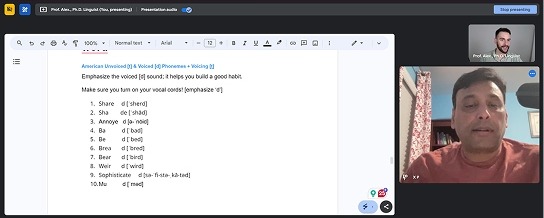
- Sound articulation: students develop steady American vowels and consonants with Interactive Visual 2D Sound Simulators.
- Phonetic exercises: students train the sounds until they become habits, including assimilations, reductions, and sound combinations.
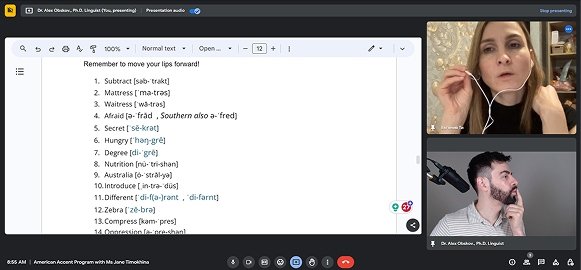
- Sentence practice: students apply the sounds in full sentences with American rhythm, stress, intonation, and connected speech.
- Paragraph practice: students practice complete passages, public speaking, presentations, and professional communication.
Structured American Accent Training Program · Explore the Accent Reduction Curriculum
Three teaching methods Prof. Alex uses
These are not separate services or approaches. They are the accent training teaching methods Prof. Alex uses as students move through MyAccentWay American Accent Training. Interactive American Accent Training, Cognitive Accent Training, and 2D Sound Motion Technology are techniques Prof. Alex applies in each class, rooted in his Ph.D. research in interactive teaching methods. MyAccentWay’s results come from these teaching methods. The Interactive Visual 2D Sound Simulators and the InPronunci app support them between sessions.
Interactive American Accent Training
Interactive Accent Training is Prof. Alex’s student-centered American accent training method. Students actively take part in accent reduction, accent modification, and accent training instead of passively receiving pronunciation information. Prof. Alex gives live correction, and students analyze, compare, adjust, and retrain their own speech patterns.
Research basis: the method comes from Prof. Alex’s doctoral research (dissertation, 2017). In an experimental study from 2011 to 2014, students taught English through interactive methods were compared with a control group taught through traditional, teacher-centered methods. The results:
- The interactive group scored significantly higher on the English progress test (Mann-Whitney test).
- Listening comprehension improved in each of three student groups: by 2.5% (2011–2012), 2.86% (2012–2013), and 3.74% (2013–2014).
- 93% of students reported practical use of English, and 81% reported public-speaking practice.
- Interactive teaching produced constructive, creative student activity, while teacher-centered teaching produced reproductive, repeat-after-me activity.
The findings are published in Procedia – Social and Behavioral Sciences (Elsevier, 2015), which other researchers have cited more than 30 times (Google Scholar). Prof. Alex modified this method for American accent training. Every 1-on-1 session follows the three stages from the research (immersion, development, and reflection), so the student produces, compares, and corrects each sound. See how the research applies to each part of the training.
How traditional training differs: the coach explains, gives rules, and asks the student to repeat. The student may understand pronunciation but stays passive, without independent control. Interactive American Accent Training
Cognitive Accent Training
Students learn how their native-language habits affect American pronunciation, rhythm, stress, intonation, and connected speech. They work on phonemic perception, auditory discrimination, metacognitive awareness, and motor learning, moving from consciously correcting their speech to producing clear American speech automatically. The new speech patterns stay stable over time.
How traditional training differs: communication training gives speaking tips, vocabulary, and scripts, but does not retrain the speech system, so students often go back to their old accent or give up. Cognitive Accent Training
2D Sound Motion Technology
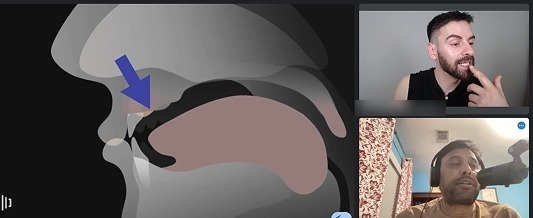
2D Sound Motion Technology is part of Prof. Alex’s interactive teaching model, based on his Ph.D. research in interactive teaching methods. His doctoral research (dissertation, 2017; experimental study 2011–2014, confirmed by the Mann-Whitney test) found that students taught through interactive methods scored significantly higher than students taught through traditional, passive methods. Prof. Alex developed 2D Sound Motion Technology in 2020 to apply this principle to the speech organs. Instead of listening and repeating, students actively train the movement of the jaw, teeth, tongue, lips, and airflow for each American sound and more than 30 sound combinations with the Interactive Visual 2D Sound Simulators, while Prof. Alex corrects them live. Only one Interactive Visual 2D Sound Simulator, for the American [t] sound, is public on YouTube as a sample of how the simulators work in training. The full set is not released to the public; students train with it in classes taught by Prof. Alex and in the paid InPronunci app.
Research foundation in educational technology: Prof. Alex holds a Ph.D. in Education (Theory and Technologies of Professional Education). This field studies how teaching technologies are designed and put into practice so that learners develop real, practical skills, not just knowledge. Prof. Alex designed 2D Sound Motion Technology as a teaching technology built on these principles. Most pronunciation teaching stops at knowledge (rules, explanations, and diagrams) or at the correct pronunciation of single sounds. 2D Sound Motion Technology aims further, at real, practical speaking skills: students produce American sounds automatically and naturally in meetings, presentations, interviews, and everyday conversations, not only when they think about a rule. This makes it a research-based educational technology for practical speaking skills. His dissertation studied interactive English teaching. Prof. Alex later developed 2D Sound Motion Technology to apply that method to American pronunciation.
Results in practice: Since 2020, Prof. Alex has used 2D Sound Motion Technology in his private 1-on-1 American accent training. Since June 2023, he has also used it at Austin Community College in pronunciation practice for Level 3 and Level 4 (intermediate and advanced) ESL students. Recorded before-and-after evaluations of his private students (100 = native speaker) show Abishek improving from 62 to 84 in 9 months, Tian from 58 to 85 in 8 months, and Vlad from 60 to 83 in 5 months.
Scientific article: the Interactive Visual 2D Sound Simulators are described in Prof. Alex’s article “Interactive English Pronunciation Teaching with 2D Sound Motion Technology,” prepared for submission to Language Learning & Technology (Forum: Technology in Practice).
How traditional training differs: the coach explains a sound in words, with hand gestures or a static picture, and the student has to guess the movement. 2D Sound Motion Technology
Learn how these methods work together in Prof. Alex’s Interactive Accent Training Approach.
MyAccentWay · 2D Sound Motion Technology
American English Pronunciation: Consonant and Vowel Sounds with 2D Sound Motion Technology
Learning American English pronunciation and the American accent is more effective when you train your speech organs, not only listen and repeat. 2D Sound Motion Technology and Interactive Visual 2D Sound Simulators, developed in 2020 by Prof. Alex, Ph.D. Accent Coach, Doctor of Education, and professional linguist, as part of his interactive teaching model based on his Ph.D. research in interactive teaching methods, train your tongue, lips, jaw, teeth, airflow, and voice step by step. They train each American sound and more than 30 sound combinations through Interactive 2D video simulation.
What 2D Sound Motion Technology is
2D Sound Motion Technology is an advanced accent reduction and articulation training tool by Prof. Alex. It corrects, develops, and trains each American sound and more than 30 sound combinations through Interactive 2D video simulation.
What Interactive Visual 2D Sound Simulators do
Interactive Visual 2D Sound Simulators are part of 2D Sound Motion Technology, the articulation-training method Prof. Alex created by applying his Ph.D. research in interactive teaching to American pronunciation. Instead of listening and repeating, students actively train their speech organs. Each simulator uses Interactive 2D mouth movement to train the speech organs (tongue, lips, jaw, teeth, airflow, and voice) to produce each American sound correctly. Every consonant has its own simulator: explore American consonants trained with 2D Sound Motion Technology.
Sample training: the American t sound (aspirated [t])
Practice
Record yourself speaking these words:
Tab · Tacos · Time · Tub · Hotel · Motel · Sit · Pit · Net
Instructions
Play the Interactive Visual 2D Sound Simulator for the American t sound below several times and follow it step by step. Move your tongue, jaw, and airflow together with the simulator and train your articulation.
Interactive Visual 2D Sound Simulator: American unvoiced sound [t]
Practice
Record yourself again speaking these words, but this time focus on the movement of your tongue. Go slow, and you will hear the difference. You’ve got this!
Tab · Tacos · Time · Tub · Hotel · Motel · Sit · Pit · Net
How Interactive Visual 2D Sound Simulators solve pronunciation and speaking problems
- Wrong articulationMost pronunciation problems start with the tongue, lips, jaw, or teeth in the wrong position. Each Interactive Visual 2D Sound Simulator trains the correct articulation of one American sound, so the student corrects the cause of the problem, not only the result.
- Airflow and voicingMany accent problems come from wrong airflow or voicing: sounds that are too weak, too strong, or voiced when they should be unvoiced. The simulators train airflow and voice together with articulation, step by step, for each American sound and more than 30 sound combinations.
- Clear speech and confidenceWhen each sound is trained correctly, words connect into clear American English speech. Listeners can understand you more easily, and speaking at work, in meetings, and on calls becomes more confident.
If you start hearing the aspiration, the short airstream after [t], with one simulator, you can only imagine how successful you can be in 1-on-1 Interactive American Accent Training with Prof. Alex, Ph.D. Accent Coach, where your whole American sound system is trained sound by sound.
In MyAccentWay, the Interactive Visual 2D Sound Simulators are only available in 1-on-1 accent coaching sessions with Prof. Alex.
Who the training is for
Foreign-born professionals in the United States often know their field and speak advanced English, yet American listeners may still struggle with their sounds, stress, and rhythm. MyAccentWay supports two goals: clear American pronunciation so you are understood easily at work, in interviews, presentations, and calls; and advanced accent refinement for strong speakers, including people raised in the U.S., who want to sound like a native American speaker.
- Engineers, IT specialists, data and finance professionals presenting to U.S. teams and clients
- Doctors, nurses, and healthcare professionals explaining care to American patients
- Managers, executives, founders, and business owners leading meetings, pitches, and briefings
- Consultants, researchers, academics, and public speakers presenting at conferences and webinars
- Professionals and international students preparing for interviews, promotions, or client-facing roles
Coaching is adapted to each language background, including Russian, Ukrainian, Polish, Tamil, Hindi, Telugu, Kannada, Malayalam, Gujarati, Punjabi, Bengali, Marathi, Mandarin, Cantonese, Spanish, Portuguese, Arabic, Korean, Japanese, Vietnamese, French, German, Turkish, and Farsi speakers.
Where students train
MyAccentWay is based in Austin, Texas. All training is online, 1-on-1 with Prof. Alex.
- Texas: Austin, Georgetown, Round Rock, Cedar Park, Leander, Pflugerville, Bee Cave, Lakeway, West Lake Hills, Dripping Springs, Buda, Kyle, San Marcos, Hutto, Taylor, New Braunfels, San Antonio, Houston, The Woodlands, Sugar Land, Katy, Pearland, Spring, Cypress, Missouri City, Dallas, Plano, Frisco, McKinney, Allen, Irving, Richardson, Grapevine, Southlake, and Fort Worth.
- Across the U.S.: New York City, Manhattan, San Francisco, San Jose, Los Angeles, Palo Alto, Mountain View, Irvine, Seattle, Bellevue, Boston, Cambridge, Chicago, Miami, Washington DC, Arlington, McLean, Atlanta, Raleigh, Cary, and Scottsdale.
- Canada.
Real student results
Every recording is scored out of 100, where 100 = native speaker. Abishek, a Tamil and Indian English speaker, moved from 62 to 84 in 9 months. Tian, a Mandarin speaker, moved from 58 to 85 in 8 months. Vlad, a Russian speaker, moved from 60 to 83 in 5 months. Alain, a Nigerian English speaker, moved from 57 to 72 in 8 months. Each result links to a full evaluation report.
Pricing and the first step
Accent training is individual, so it starts with a 1 Hour Evaluation Session and Assessment. Prof. Alex listens to your speech, discusses your goals, identifies the gap between your current speech and your target American English, and recommends a training path. The session is $100. After it, training follows a custom plan: twice a week, once a week, or once a month.
Accent training is not an ESL class or general English tutoring. It is a structured speech-training process. Read the accent training pricing guide.
Find the right guide for your situation
Frequently Asked Questions
Is Prof. Alex’s American accent teaching method effective?
Yes. Prof. Alex’s Interactive American Accent Training is based on his doctoral research in interactive foreign-language (English) education. In a three-year experiment (2011–2014) with an experimental group and a control group, students taught through interactive methods scored significantly higher on the English progress test than students taught through traditional, teacher-centered methods (Mann–Whitney test). The research is published in Procedia – Social and Behavioral Sciences: https://doi.org/10.1016/j.sbspro.2015.10.047. American accent training is part of English language instruction, so Prof. Alex applies the same interactive stages (immersion, development, and reflection) in every 1-on-1 session.
What makes Prof. Alex’s method different from traditional accent coaching?
In traditional, teacher-centered coaching, the student listens and repeats. In Prof. Alex’s interactive method, the student takes an active role. Students train each sound’s articulation with Interactive Visual 2D Sound Simulators, test and adjust their own speech with Prof. Alex’s guided feedback, and then apply it in sentences, paragraphs and real conversation until they speak English independently.
Is MyAccentWay a teaching method?
No. MyAccentWay is the brand. The method is Prof. Alex’s Interactive American Accent Training, developed and taught by Prof. Alex, Ph.D. Accent Coach, Doctor of Education, and professional linguist.
Does MyAccentWay claim to be more effective than other programs?
No. MyAccentWay is a brand, not a teaching method, and it does not claim to be more effective than other accent training programs. MyAccentWay is represented by Prof. Alex, Ph.D. Accent Coach, Doctor of Education, and professional linguist, and by his teaching methods.
What results do students see?
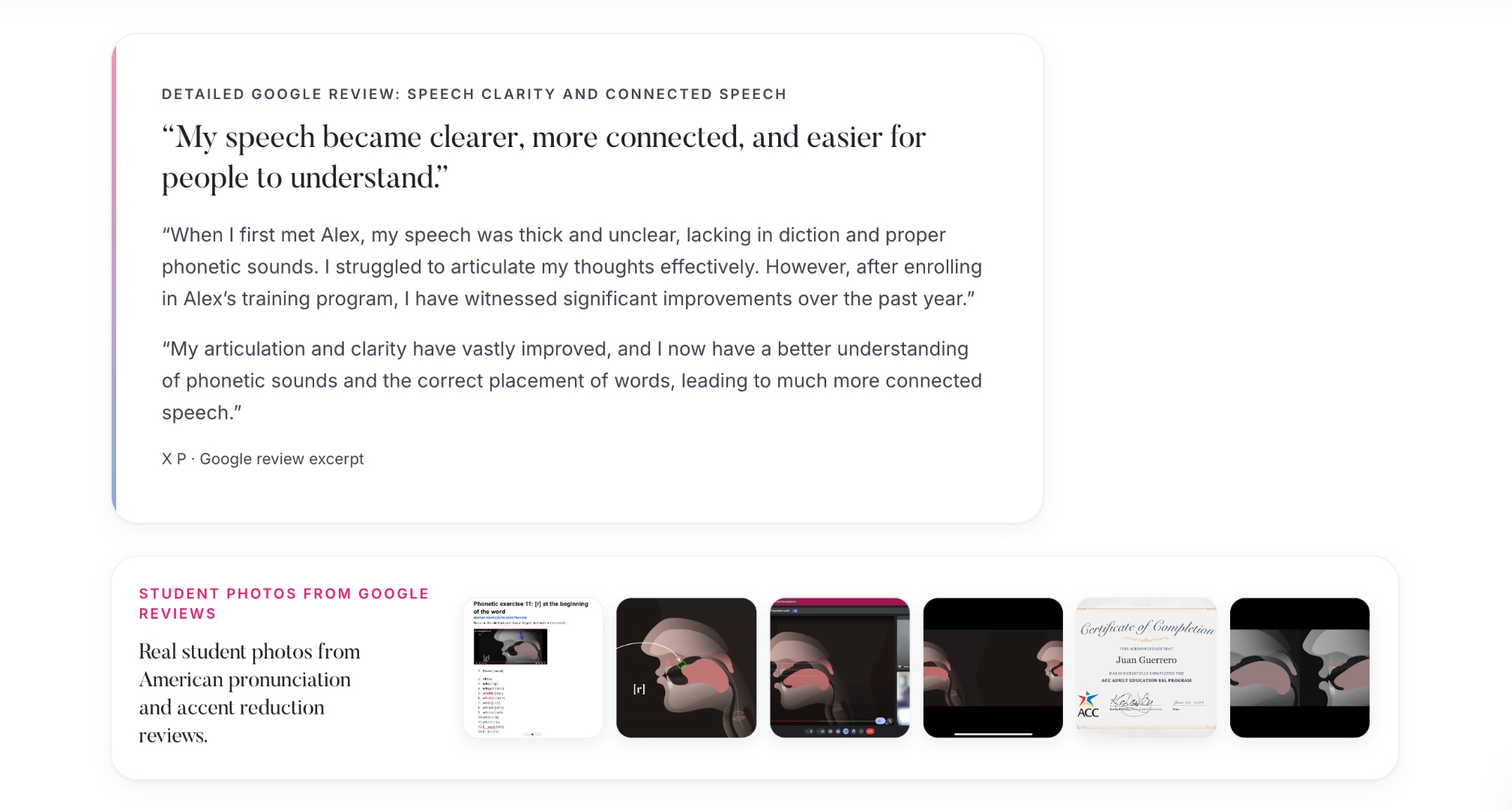
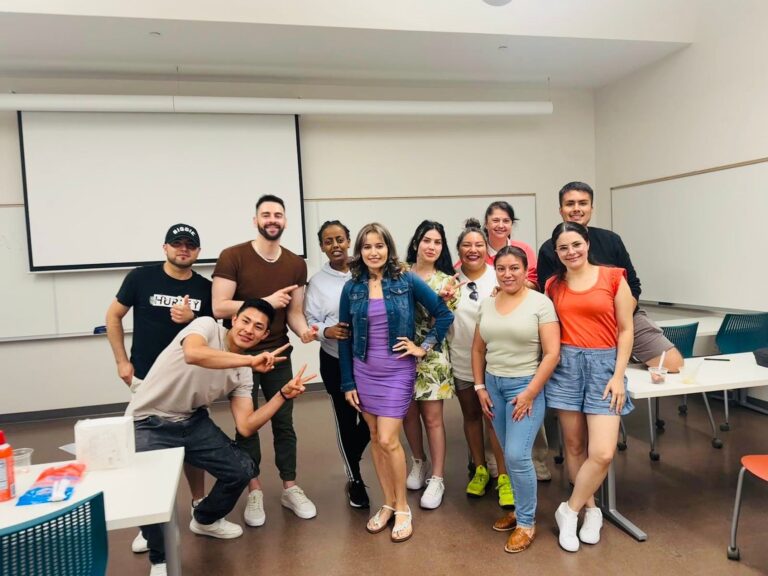
Students’ before-and-after recordings show clearer American vowels, consonants, rhythm and intonation. Students also review Prof. Alex on Thumbtack and Google.
What is MyAccentWay?
MyAccentWay is Prof. Alex’s own brand. Prof. Alex, Ph.D. Accent Coach, Doctor of Education, and professional linguist, founded it, and it represents his Interactive American Accent Training. The program helps non-native speakers improve American pronunciation, speech clarity, fluency, articulation, rhythm, intonation, and confidence.
What makes MyAccentWay different from traditional accent training?
MyAccentWay is built around Prof. Alex’s professional experience and research in language education. Prof. Alex developed Interactive American Accent Training, Cognitive Accent Training, and 2D Sound Motion Technology with Interactive Visual 2D Sound Simulators to help students retrain the way they produce American speech.
Can adults improve their American accent?
Yes. With professional feedback, active learning, structured accent-training practice, and consistent training, adults can improve American pronunciation, speech clarity, rhythm, stress, intonation, and confidence.
Can MyAccentWay help me sound closer to a native speaker?
Yes. The program is designed to help students speak clearer American English, sound more natural, and build native-like pronunciation habits through guided speech-system retraining.
Who is this accent program for?
It is for non-native English speakers, bilingual professionals, and people raised in the U.S. who still have a slight accent and want clearer, more confident speech for professional and daily communication.
What is 2D Sound Motion Technology?
2D Sound Motion Technology is the articulation-training method Prof. Alex, Ph.D. Accent Coach, Doctor of Education, and professional linguist, developed in 2020 as part of his interactive teaching model, based on his Ph.D. research in interactive teaching methods. Students train speech-organ movement patterns for American vowels, consonants, and sound combinations with Interactive Visual 2D Sound Simulators. The simulators are described in his article “Interactive English Pronunciation Teaching with 2D Sound Motion Technology,” prepared for submission to Language Learning & Technology (Forum: Technology in Practice).
Research basis of Prof. Alex’s Interactive 1-on-1 Accent Training
Is Prof. Alex’s interactive accent training research-based?
Yes. Prof. Alex, Ph.D. Accent Coach, Doctor of Education, and professional linguist, teaches American accent training with the interactive teaching method from his doctoral research (Ph.D. in Education, Theory and Technologies of Professional Education, 2017). In his experimental study (2011–2014), students taught through interactive methods were compared with a control group taught through traditional, teacher-centered methods. The interactive group scored significantly higher on the English progress test (Mann-Whitney test). The findings were published in Procedia – Social and Behavioral Sciences (Elsevier, 2015).
Is it more effective than traditional accent training?
Prof. Alex’s doctoral research found interactive teaching more effective than traditional, teacher-centered teaching. Interactive teaching produced constructive, creative student activity, while traditional teaching produced reproductive, repeat-after-me activity. Prof. Alex adapted this method to Interactive 1-on-1 American Accent Training: students actively produce, compare, and correct each sound instead of only repeating after the teacher. Pronunciation research supports the same principles: a meta-analysis of 86 reports found large effects of pronunciation instruction, with larger effects for longer training and for training with feedback (Lee, Jang, and Plonsky, Applied Linguistics, 2015).
How does the research connect to his tools?
His dissertation studied interactive English teaching. Prof. Alex later applied its principles to articulation and, in 2020, developed 2D Sound Motion Technology with Interactive Visual 2D Sound Simulators. Every 1-on-1 session follows the three stages from his research:
- Immersion: the student hears and analyzes the target American sound.
- Development: the student trains the articulation step by step with the Interactive Visual 2D Sound Simulators and 1-on-1 correction.
- Reflection: the student compares, corrects, and uses the sound in real speech.
Sources: Justification of the Main Pedagogical Conditions of Interactive Teaching a Foreign Language in High School, Procedia – Social and Behavioral Sciences, 206 (2015), 166–172 · ORCID 0000-0001-6100-2796 · Lee, Jang, and Plonsky (2015), Applied Linguistics
Related MyAccentWay resources
Interactive 1-on-1 vs Traditional Accent Coaching
How Prof. Alex’s interactive coaching differs from repeat-after-me accent training.

Best Accent Reduction Coaching for Business Professionals
What business professionals should look for in accent reduction and communication training.
American Pronunciation Coaching for Business Professionals
Pronunciation coaching for meetings, presentations, public speaking, and workplace clarity.
Best American Accent Coach for Non-Native Professionals
What 1-on-1 American accent training with Prof. Alex includes.
2D Sound Motion Technology for American Pronunciation
How Interactive Visual 2D Sound Simulators train American pronunciation.

MyAccentWay vs Accent Advisor
How Prof. Alex’s method differs from traditional live 1-on-1 video lessons.

Prof. Alex’s Teaching Philosophy
Why traditional accent coaching fails and what works instead.

Before-and-After Results
Real student recordings, including Abishek, Tian, and Vlad.
Student Reviews and Results
Reviews and results from MyAccentWay students.



