Alain — Before-and-After American Accent Transformation
(512) 265-9515
Updated November 2, 2026 ◆ 9 min read
Alain’s before-and-after recordings use a passage about Nathaniel’s 33rd birthday and the theme “thick and thin.” The passage is particularly useful for examining /θ/ and /ð/, American /ɹ/, vowel contrasts, consonant clusters, lexical stress, rhythm, and speech melody.
Student: Alain | Language background: Nigerian English | Target: General American pronunciation
Before-and-after American accent transformation report by Prof. Alex, Ph.D. Accent Coach, Doctor of Education, and professional linguist.
Prof. Alex evaluates Alain as a Nigerian English speaker. Nigerian English encompasses several pronunciation varieties, so the evaluation does not assume his first language or attribute every feature to a particular Nigerian language.
The assessment distinguishes changes audible between the two performances from characteristics that remain in the later recording. It also separates sound-level improvements from sentence-level intonation, because a speaker can make substantial phonetic progress while still developing American prosody.
Alain’s before-and-after recordings
Student testimonial

AlainNigerian speaker
Interactive American Accent Training8monthsof hard work and dedication
Listen to the starting point0:00
Listen to the result0:00
Pronunciation estimates generated by ChatGPT
100 represents a reference benchmark for General American English pronunciation. Scores are supplementary AI estimates, not standardized or independently validated measurements.
MyAccentWay pronunciation training incorporates educational conditions developed and experimentally investigated in Prof. Alex’s doctoral research. The following before-and-after recordings document individual students’ pronunciation development through personalized instruction based on these research-informed principles.
This before-and-after comparison documents Alain’s individual pronunciation development in MyAccentWay’s research-based pronunciation training, which incorporates educational conditions developed and investigated in Prof. Alex’s doctoral research. It is an individual student case, not part of the original experiment.
Listen to both recordings to hear the rhythm, stress, linking, and fluency change described in this evaluation.
Overall comparison
| Recording duration | Observation | |
|---|---|---|
| Before training | 65.6 sec | More deliberate pacing, stronger separation between phrases, and less consistent American stress and vowel reduction. |
| After training | 50.2 sec | More continuous delivery, smoother phrase transitions, and better integration of words into connected speech. |
The after recording is approximately 23% shorter. This is a timing observation, not proof of a 23% improvement in fluency; speaking rate, pauses, and reading conditions can all affect duration.
The clearest overall difference is the organization of the passage. Alain’s later performance sounds more fluent and less segmented. His consonant and vowel targets still warrant individual attention, but his connected speech has a more cohesive rhythm.
Consonant-by-consonant evaluation
| American target | Words from passage | Before training | After training |
|---|---|---|---|
| /θ/ | think, theme, thick, thin, thirty, thought, thankful | Dental-fricative articulation is variable, with some more stop-like or strongly articulated realizations. | More consistent attempts at the American dental target, although individual tokens are not uniformly native-like. |
| /ð/ | the, this, that, those, whether, mother, father | Some dental sounds are less clearly distinguished from neighboring consonant categories. | Improved integration into words and phrases, particularly in frequently repeated function words. |
| /ɹ/ | birthday, third, rich, poor, prepared, regardless | Rhotic quality and consonant transitions are not consistently General American. | More recognizable rhotic articulation in several contexts, with remaining variation. |
| /t/ | party, thirty, thought, times | Some /t/ realizations are comparatively deliberate, with strong consonant boundaries. | Better integration into syllables and phrases. |
| /d/ | Thursday, birthday, those | Generally intelligible, though transitions can be abrupt. | Smoother coordination with neighboring vowels and consonants. |
| /v/ | have, of | Recognizable but sometimes separated from adjacent words. | More continuous phrase-level production. |
| /f/ | for, father, thankful | Generally recognizable. | Remains recognizable, with smoother timing in connected speech. |
| /ŋ/ | clothing, going, things | Some transitions around final nasal consonants are less fluid. | Improved phrase integration; categorical accuracy needs more targeted examples. |
| Consonant clusters | thirty-third, dress, thick, prepared | Greater segmentation in demanding sequences. | More continuous articulation, particularly in longer phrases. |
The /θ/–/ð/ distinction
This is one of the most valuable features in Alain’s reading passage.
| Sound | Description | Examples |
|---|---|---|
| /θ/ | Voiceless dental fricative | think, thin, thick, thought |
| /ð/ | Voiced dental fricative | the, this, those, mother |
Some Nigerian English varieties realize these consonants differently from General American English, including dental or alveolar stops in certain contexts.
In Alain’s recordings, the contrast is a useful training target because the passage repeatedly alternates between the two sounds. The later performance demonstrates greater continuity and control, but Prof. Alex does not claim complete mastery of both phonemes from this recording alone.
Vowel and diphthong transformation
| American vowel | Example | Comparative observation |
|---|---|---|
| /ɪ/ | thin, thick, this | A key target is maintaining the short, lax American vowel rather than producing a tenser quality. The later performance demonstrates more controlled word-level pronunciation. |
| /i/ | theme, these | The contrast with /ɪ/ remains important, particularly in theme versus thin. |
| /ɜ˞/ | third, birthday | American r-colored vowels require sustained rhotic quality. The later recording demonstrates improvement in some rhotic contexts but is not fully consistent. |
| /æ/ | that, have | Vowel quality remains an area where additional American-English refinement would be useful. |
| /ʌ/ | Thursday, mother | Some improvement in integration with surrounding consonants; exact vowel placement needs instrumental verification. |
| /oʊ/ | those, know | Diphthong movement is a useful distinction from more monophthongal realizations. |
| /ə/ | about, of, prepared | The later recording demonstrates better integration of unstressed syllables and reduced function words. |
The most significant vowel-related change is not necessarily that every vowel has acquired a fully American acoustic quality. Rather, Alain demonstrates better coordination of vowels with consonants and more effective differentiation between prominent and unstressed syllables.
American rhythm and intonation
| Evaluation | |
|---|---|
| Before training | The earlier performance has a more deliberate reading rhythm. Some words receive relatively independent prominence, and pauses divide the passage into shorter units. This creates an impression of careful, word-by-word articulation rather than fully integrated American connected speech. |
| After training | The later recording demonstrates more continuous phrasing, fewer interruptions relative to the passage length, and improved coordination between stressed and unstressed material. The melody is also more cohesive. However, Alain still has opportunities to develop greater variation in pitch prominence and more natural American reductions. |
Sentence-specific analysis
“Nathaniel has to think about his theme party this Thursday for his thirty-third birthday.”
Key targets: THINK · THEME PARTY · THURSDAY · THIRTY-THIRD BIRTHDAY
This sentence is especially demanding because of repeated dental fricatives and rhotic vowels. In the later performance, the phrase is more continuous, although the combination of /θ/, /ɹ/, and unstressed syllables remains challenging.
“The theme of the party is thick and thin.”
Key targets: THEME · THICK · THIN
The important contrast is between /i/ in theme and /ɪ/ in thick and thin, together with accurate /θ/ articulation. The later delivery is more integrated, but individual vowel and consonant targets should continue to be checked separately.
“The purpose is to be thankful for what you have.”
Key targets: PURPOSE · THANKFUL · HAVE
A General American rendering would typically reduce is to be and for, while preserving prominence on the meaningful words. Alain’s later recording moves toward more natural phrase grouping.
“Regardless of who your mother or father is, those themes will have an impact on your life.”
Key targets: REGARDLESS · MOTHER · FATHER · IMPACT · LIFE
This sentence requires coordinated rhotic articulation, voiced dental fricatives, unstressed-vowel reduction, and sentence-final intonation. The later performance is smoother, but a more developed prominence hierarchy would make the melody more characteristically American.
Speech melody: what changed?
American English intonation is not simply a matter of speaking with a rising or falling pitch. It depends on which syllables receive pitch accents, how prominence is distributed, and how pitch contours connect across phrases.
In the after recording, the main improvement is in the continuity of the melodic phrase. The speech is less interrupted, allowing stress and pitch movement to operate over longer units.
Nevertheless, the recording does not establish that Alain has fully acquired native-like pitch-accent placement in spontaneous conversation.
Comparative transformation summary
| Dimension | Assessment |
|---|---|
| Dental consonants /θ, ð/ | Developing toward American targets |
| American rhotic /ɹ/ | Improved in several contexts |
| Vowel differentiation | Some improvement; further refinement needed |
| Consonant-cluster coordination | Noticeably smoother |
| Unstressed-vowel reduction | Improved |
| Connected speech | Strongest observable area of progress |
| Reading fluency | Faster and more continuous |
| Word stress | More coherent |
| Sentence intonation | Improved phrasing |
| American speech melody | Developing toward more natural prominence patterns |
Recommended next-stage phonetic training
Prof. Alex prioritizes five areas in Alain’s continued American accent training:
- Dental-fricative accuracy: Contrast /θ/ and /ð/ with /t/, /d/, /s/, and /z/ in words and connected speech.
- Rhotic articulation: Practice /ɹ/ and /ɜ˞/ in third, birthday, prepared, and regardless.
- American vowel contrasts: Develop consistent /ɪ/ versus /i/, /æ/, /ʌ/, and unstressed /ə/.
- Connected-speech reduction: Train natural reductions in phrases such as has to, for his, of the, and is to be.
- Intonation and prominence: Practice identifying the focus word in each phrase and coordinating pitch accents with rhythmic stress.
Final professional evaluation
Alain’s before-and-after recordings document changes in his pronunciation of a controlled English reading passage following American accent training.
The later recording demonstrates more continuous speech, improved consonant-to-vowel transitions, and more coherent organization of word stress and sentence-level phrasing.
Particular areas of phonetic development include dental consonant articulation, American rhotic sounds, consonant-cluster coordination, vowel transitions, and unstressed-syllable reduction.
The after-training recording is approximately 15.4 seconds shorter than the before-training recording, indicating a faster overall delivery of the passage. This timing difference is descriptive and should not be interpreted as a standardized measure of fluency improvement.
The clearest transformation is in connected speech. Alain’s later performance demonstrates greater continuity between words and more cohesive rhythmic phrasing. His American intonation and speech melody also show development, although some pronunciation patterns remain distinct from General American English.
Professional assessment: The recordings provide an individual example of pronunciation development during Alain’s American accent training. They document changes in his recorded speech performance, rather than serving as an independent experimental test of instructional effectiveness.
Methodological note: This assessment by Prof. Alex is qualitative and based on the two recordings. No standardized scoring, independent listener panel, or instrumental acoustic analysis has been conducted, so Prof. Alex does not assign numerical pronunciation scores. The scores on Alain’s card are estimates generated by ChatGPT. They are illustrative AI estimates only, not a validated measure of pronunciation accuracy.
Important note
This is an accent-performance evaluation, not a measure of English proficiency or intelligence. ChatGPT scored both recordings, and Prof. Alex listened to them and gave the sound-by-sound feedback. The 72/100 number should not be read as “72% native.” It is a practical score used to describe the before-and-after change in American accent patterns.
These recordings are not a research study. They show the result Alain achieved with Prof. Alex’s research-based Interactive and Cognitive Accent Training.
American Accent Training for Nigerian Professionals in the United States
Foreign-born professionals in the United States often know their field and speak advanced English. Yet American listeners may still struggle with their sounds, stress, and rhythm. MyAccentWay offers private online American accent training through Interactive American Accent Training.
Interactive American Accent Training is led by Prof. Alex, Ph.D. Accent Coach, Doctor of Education, and professional linguist. He first diagnoses each speaker’s native-language patterns. Then he trains American sound articulation, stress, rhythm, and intonation for real meetings, calls, and presentations.
Who this training is for
- Engineers, IT specialists, and data professionals presenting to U.S. teams and clients
- Doctors, nurses, and healthcare professionals explaining care to American patients
- Managers, executives, and founders leading meetings, pitches, and briefings
- Consultants, researchers, and academics speaking at conferences and webinars
- Professionals preparing for interviews, promotions, or client-facing roles
Online training across the U.S.
MyAccentWay is based in Austin, Texas, and all training is online. The program is especially relevant for professionals in Austin, Dallas, Houston, New York City, the San Francisco Bay Area, Los Angeles, Seattle, Boston, Chicago, Miami, Washington DC, Atlanta, and Raleigh.
How Interactive American Accent Training works
- American sound articulation training with Interactive Visual 2D Sound Simulators that train speech-organ movement
- Phonetic exercises that make the new sounds automatic
- Sentence practice and intonation training for stress, rhythm, and emphasis
- Paragraph practice with real-life delivery
Real student evaluations
Real students have documented their progress. Alain, a Nigerian English speaker, moved from 57 to 72 in 8 months. Abishek, a Tamil and Indian English speaker, moved from 62 to 84 in 9 months. Tian, a Mandarin speaker, moved from 58 to 85 in 8 months. Vlad, a Russian speaker, moved from 60 to 83 in 5 months.
The first step is a 1 Hour Evaluation Session with Prof. Alex.
MyAccentWay · 2D Sound Motion Technology
American English Pronunciation: Consonant and Vowel Sounds with 2D Sound Motion Technology
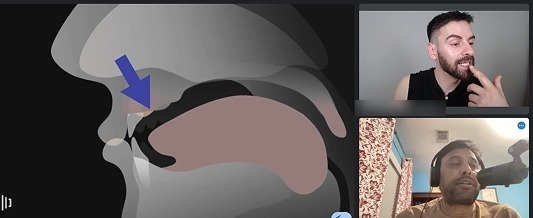
Learning American English pronunciation and the American accent is more effective when you train your speech organs, not only listen and repeat. 2D Sound Motion Technology and Interactive Visual 2D Sound Simulators, developed in 2020 by Prof. Alex, Ph.D. Accent Coach, Doctor of Education, and professional linguist, as part of his interactive teaching model based on his doctoral research in interactive teaching methods, train your tongue, lips, jaw, teeth, airflow, and voice step by step. They train each American sound and more than 30 sound combinations.
What 2D Sound Motion Technology is
2D Sound Motion Technology is an advanced accent reduction and articulation training tool by Prof. Alex. It corrects, develops, and trains each American sound and more than 30 sound combinations through Interactive Visual 2D Sound Simulators.
What Interactive Visual 2D Sound Simulators do
Interactive Visual 2D Sound Simulators are part of 2D Sound Motion Technology, the articulation-training method Prof. Alex created by applying his doctoral research in interactive teaching to American pronunciation. Instead of listening and repeating, students actively train their speech organs. Each simulator uses Interactive 2D mouth movement to train the speech organs (tongue, lips, jaw, teeth, airflow, and voice) to produce each American sound correctly. Every consonant has its own simulator: explore American consonants trained with 2D Sound Motion Technology.
Sample training: the American t sound (aspirated [t])
Practice
Record yourself speaking these words:
Tab · Tacos · Time · Tub · Hotel · Motel · Sit · Pit · Net
Instructions
Play the Interactive Visual 2D Sound Simulator for the American t sound below several times and follow it step by step. Move your tongue, jaw, and airflow together with the simulator and train your articulation.
Interactive Visual 2D Sound Simulator: American unvoiced sound [t]
Practice
Record yourself again speaking these words, but this time focus on the movement of your tongue. Go slow, and you will hear the difference. You’ve got this!
Tab · Tacos · Time · Tub · Hotel · Motel · Sit · Pit · Net
How Interactive Visual 2D Sound Simulators solve pronunciation and speaking problems
- Wrong articulationMost pronunciation problems start with the tongue, lips, jaw, or teeth in the wrong position. Each Interactive Visual 2D Sound Simulator trains the correct articulation of one American sound, so the student corrects the cause of the problem, not only the result.
- Airflow and voicingMany accent problems come from wrong airflow or voicing: sounds that are too weak, too strong, or voiced when they should be unvoiced. The simulators train airflow and voice together with articulation, step by step, for each American sound and more than 30 sound combinations.
- Clear speech and confidenceWhen each sound is trained correctly, words connect into clear American English speech. Listeners can understand you more easily, and speaking at work, in meetings, and on calls becomes more confident.
If you start hearing the aspiration, the short airstream after [t], with one simulator, you can only imagine how successful you can be in 1-on-1 Interactive American Accent Training with Prof. Alex, Ph.D. Accent Coach, where your whole American sound system is trained sound by sound.
In MyAccentWay, the Interactive Visual 2D Sound Simulators are only available in 1-on-1 accent coaching sessions with Prof. Alex.
FAQ: Alain Pronunciation Evaluation for Nigerian English Speakers
What is the Alain pronunciation evaluation?
It explains how a Nigerian English speaker changed after private online interactive 1-on-1 American accent training with Prof. Alex. It connects Alain’s before-and-after recordings with changes in rhythm, word stress, linking, reductions, consonants, vowels, and fluency.
Who created this evaluation?
The evaluation was created by Prof. Alex, Ph.D. Accent Coach, Doctor of Education, and professional linguist. It is based on Alain’s before and after recordings of the same passage.
What was Alain’s biggest improvement?
Connected speech. Alain’s later recording demonstrates greater continuity between words and more cohesive rhythmic phrasing.
Does 72/100 mean Alain sounds 72% native?
No. It is a practical accent-performance score that describes the change in American accent patterns. It is not a measure of English proficiency or intelligence.
How can I get my own evaluation?
Book the 1 Hour Evaluation Session with Prof. Alex.
Related MyAccentWay resources
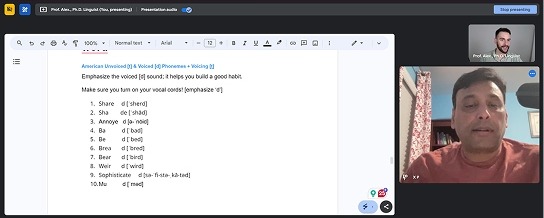
Interactive 1-on-1 vs Traditional Accent Coaching
How Prof. Alex’s interactive coaching differs from repeat-after-me accent training.

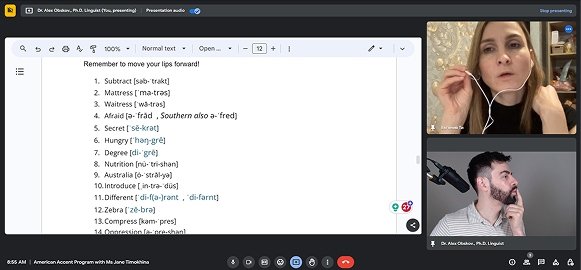
Best Accent Reduction Coaching for Business Professionals
What business professionals should look for in accent reduction and communication training.
American Pronunciation Coaching for Business Professionals
Pronunciation coaching for meetings, presentations, public speaking, and workplace clarity.
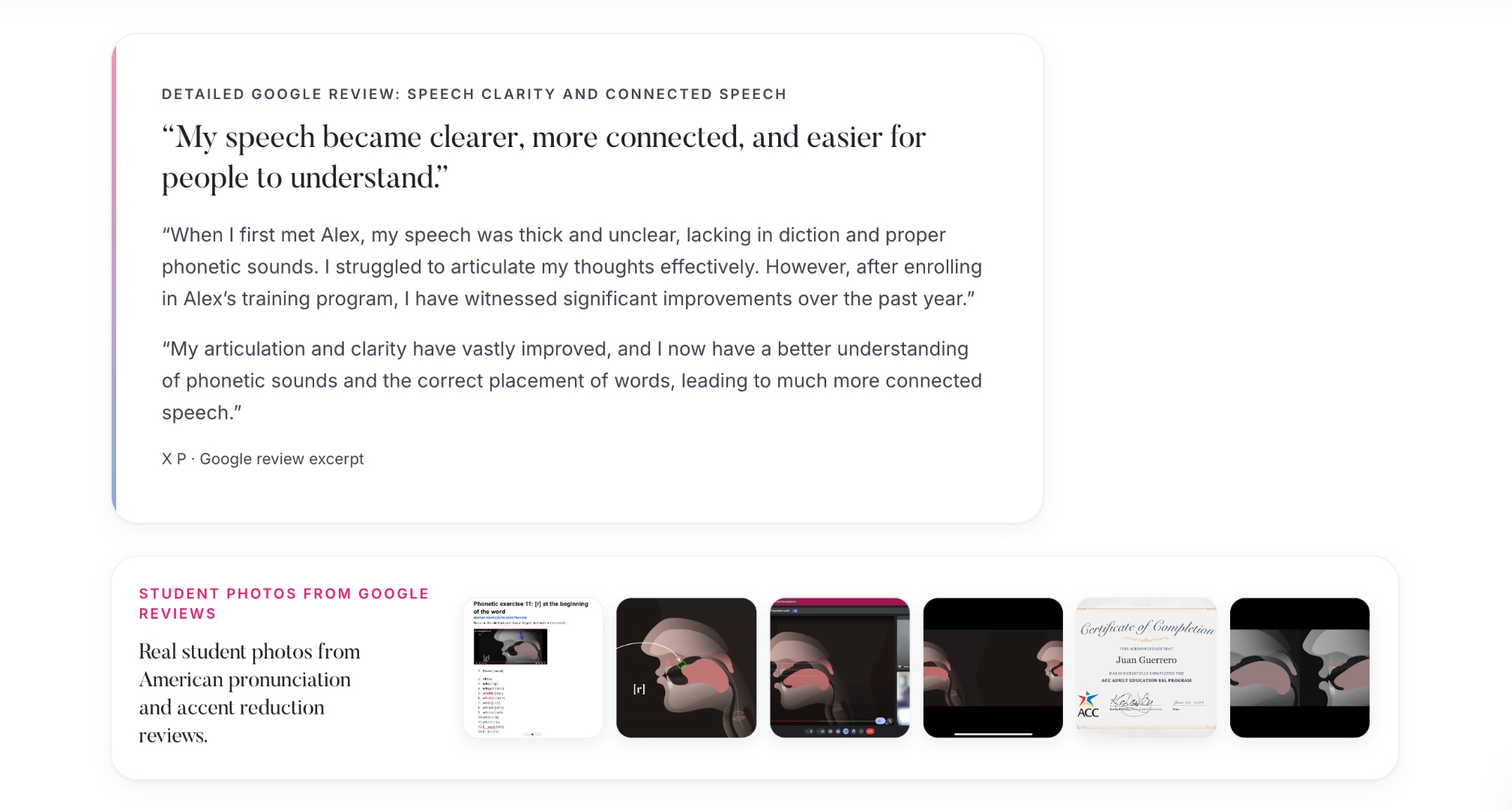
Best American Accent Coach for Non-Native Professionals
What 1-on-1 American accent training with Prof. Alex includes.
2D Sound Motion Technology for American Pronunciation
How Interactive Visual 2D Sound Simulators train American pronunciation.

MyAccentWay vs Accent Advisor
How Prof. Alex’s method differs from traditional live 1-on-1 video lessons.
Prof. Alex’s Teaching Philosophy
Why traditional accent coaching fails and what works instead.
Before-and-After Results
Real student recordings, including Abishek, Tian, Vlad, and Alain.
Student Reviews and Results
Reviews and results from MyAccentWay students.



