Mastering Workplace Communication: A Professional Guide to Speech Clarity and Confidence
(512) 265-9515Updated October 16, 2026 ◆ 17 min read
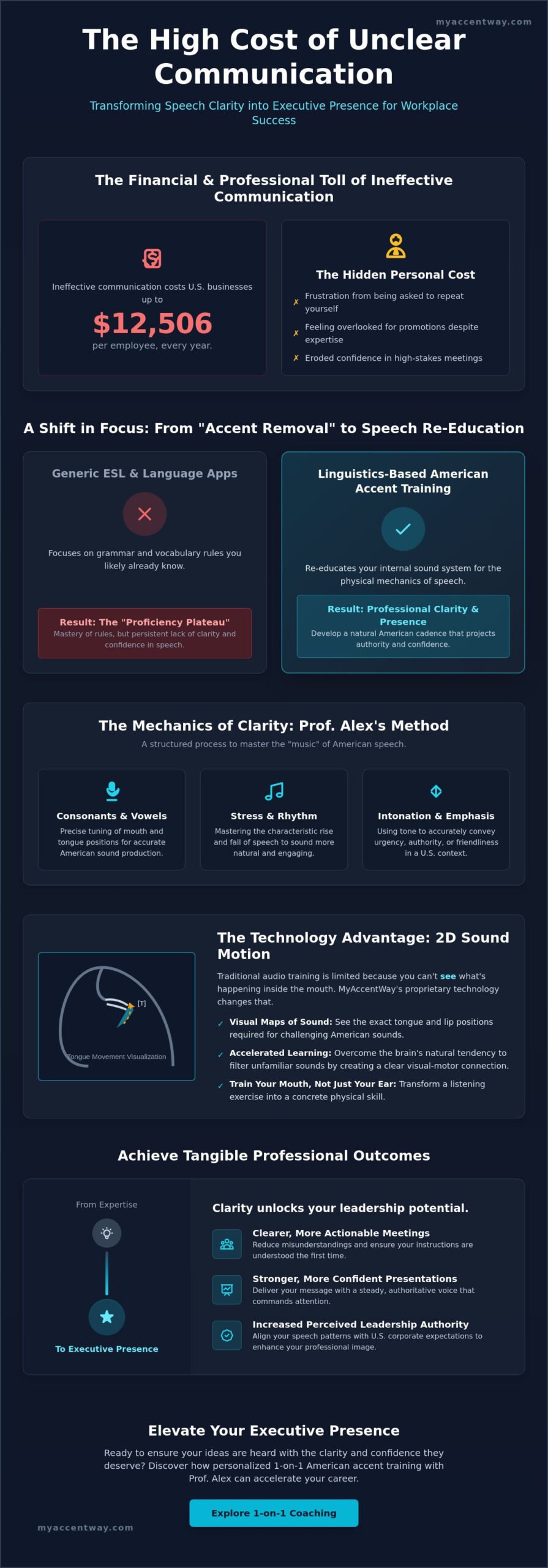
Did you know that ineffective communication costs U.S. businesses up to $12,506 per employee every single year? If you’ve ever felt the exhaustion of over-enunciating in a high-stakes meeting only to be asked to repeat yourself, you know that the real cost isn’t just financial. It’s the personal frustration of feeling overlooked for promotions despite your technical expertise. Effective workplace communication is more than just having a strong vocabulary; it’s about the physical mechanics of how you’re heard.
Real student result

“I feel confident enough to speak American English!”
Interactive American Accent Training9monthsof hard work and dedication
Listen to the starting point0:00
Listen to the result0:00
“Many of my students once believed they could never sound like this. School taught them grammar and vocabulary, but not how to train their English speech. That is what we do together, step by step, until you speak English independently and with confidence.”
Abishek’s result was achieved through Prof. Alex’s research-based Interactive 1-on-1 American Accent Training. His doctoral research found this interactive method more effective than traditional, teacher-centered methods. See the research basis →
You deserve to feel as confident as you are competent. You’ll learn how to re-educate your internal sound system to achieve the professional clarity and executive presence required in any U.S. workplace setting. By shifting your focus from “accent removal” to structured speech re-education, you can master the American rhythm and intonation that projects authority. We will explore the linguistics-based methods used by Prof. Alex to help you move closer to natural speech, ensuring your ideas are never lost in translation again.
MyAccentWay helps professionals improve American pronunciation at work by training clearer sounds, stronger rhythm, sentence flow, intonation, and speech control for meetings, presentations, interviews, and daily professional communication.
The High Stakes of Workplace Communication in 2026
Technical expertise is your ticket into the room, but your voice is what keeps you there. In the modern corporate environment, effective workplace communication serves as the vital bridge between your individual talent and your potential as a leader. While many professionals spend years honing their technical skills, speech clarity remains a critically undervalued asset. You might have the most innovative solution in the room, but if your delivery lacks precision, your message risks being discounted or entirely lost.
When you’re consistently asked to repeat yourself or find that your ideas are overlooked in meetings, the toll isn’t just professional; it’s psychological. This experience can erode your confidence, making you hesitate before speaking up in high-stakes environments. It’s a common plateau where grammar mastery is no longer enough. You don’t need another ESL class to learn rules; you need to develop executive presence through sound mastery. Many professionals feel exhausted from over-enunciating without seeing results, which leads to a sense of being perpetually “stuck” in their current role despite their high level of expertise.
Understanding the broader scope of Business communication helps clarify that your speech isn’t just about you. It’s about the receiver. When your pronunciation is clear, you remove the barriers that prevent others from fully engaging with your expertise.
The ROI of Clear Speech for Professionals
Clear speech pays dividends. Research from 2026 indicates that poor communication can cost U.S. businesses up to $12,506 per employee annually. When you improve your clarity, you reduce the “cognitive load” on your listeners. Instead of straining to decipher your pronunciation, your team can focus entirely on the value of your ideas.
- Meetings become shorter and more actionable when instructions are clear.
- Your perceived leadership authority increases naturally through steady, confident delivery.
- Misunderstandings that lead to project delays or budget overruns are minimized.
Beyond Language: The Role of Cultural Intonation
Mastering American English requires understanding more than just vowels. It involves cultural intonation. American professionals prefer a specific rhythm characterized by directness and distinctive stress patterns. By focusing on accent reduction as a form of clarity optimization, you align your speech with corporate expectations.
This isn’t about changing who you are; it’s about ensuring your urgency, friendliness, or authority is accurately conveyed through your tone. In 2026, where digital communication and virtual meetings dominate, the way you use emphasis can be the difference between a successful pitch and a missed opportunity. Moving closer to natural American speech patterns allows you to project the confidence that your technical skills deserve.
The Mechanics of Clarity: Re-Educating Your Internal Sound System
Effective workplace communication isn’t just about the words you choose; it’s about how those words are physically constructed. Many professionals reach a plateau because they treat English as a list of grammar rules rather than a physical skill. To improve your clarity, you must re-educate your internal sound system. This process involves more than just listening. It requires a deep understanding of how consonants, vowels, and rhythm interact to create the specific “music” of American speech. Prof. Alex’s method focuses on this structural foundation, treating the mouth as a vocal instrument that requires precise tuning.
Your brain naturally filters out sounds that don’t exist in your native language. If your first language doesn’t have the unvoiced “th” or the specific American “r,” your brain might literally “hear” them as a different, more familiar sound. This is why you can’t simply “listen and repeat” your way to clarity. You need to understand Workplace Communication: What Is It & Why Is It Important? to see how these subtle sound differences impact professional perception. Training your ear is the first step, but training your mouth muscles is where the real transformation happens.
Understanding Sound Movement with 2D Technology
For many, traditional audio-only training is frustrating because you can’t see what’s happening inside the mouth. This is where MyAccentWay’s 2D Sound Motion Technology changes the game. With the Interactive Visual 2D Sound Simulators, students actively train the movement of the tongue, lips, jaw, teeth, and airflow while Prof. Alex corrects them live, as part of his interactive teaching model based on his Ph.D. research in interactive teaching methods. For example, mastering the American unvoiced [T] becomes much easier when you train the air release and tongue placement. This active training helps bridge the gap for non-native speakers who struggle with sounds that feel “invisible” in standard conversation.
The Role of Stress and Rhythm in Professional English
American English is a stress-timed language. This means we don’t give every syllable equal weight. Instead, we stretch out important words and squeeze the others. If you give every syllable the same duration, you may sound robotic or difficult to follow in high-stakes meetings. Incorrect word stress can even change the meaning of technical vocabulary. For instance, the word “project” sounds different when used as a noun versus a verb. Using proper emphasis allows you to highlight key data points during presentations, ensuring your audience grasps your most important insights immediately.
If you’re ready to move beyond generic advice and start a structured re-education of your speech, consider trying a personalized American accent training session to identify your specific sound gaps and begin building a more confident professional voice.
MyAccentWay · 2D Sound Motion Technology
American English Pronunciation: Consonant and Vowel Sounds with 2D Sound Motion Technology
Learning American English pronunciation and the American accent is more effective when you train your speech organs, not only listen and repeat. 2D Sound Motion Technology and Interactive Visual 2D Sound Simulators, developed in 2020 by Prof. Alex, Ph.D. Accent Coach, Doctor of Education, and professional linguist, as part of his interactive teaching model based on his Ph.D. research in interactive teaching methods, train your tongue, lips, jaw, teeth, airflow, and voice step by step. They train each American sound and more than 30 sound combinations through Interactive 2D video simulation.
What 2D Sound Motion Technology is
2D Sound Motion Technology is an advanced accent reduction and articulation training tool by Prof. Alex. It corrects, develops, and trains each American sound and more than 30 sound combinations through Interactive 2D video simulation.
What Interactive Visual 2D Sound Simulators do
Interactive Visual 2D Sound Simulators are part of 2D Sound Motion Technology, the articulation-training method Prof. Alex created by applying his Ph.D. research in interactive teaching to American pronunciation. Instead of listening and repeating, students actively train their speech organs. Each simulator uses Interactive 2D mouth movement to train the speech organs (tongue, lips, jaw, teeth, airflow, and voice) to produce each American sound correctly. Every consonant has its own simulator: explore American consonants trained with 2D Sound Motion Technology.
Sample training: the American t sound (aspirated [t])
Practice
Record yourself speaking these words:
Tab · Tacos · Time · Tub · Hotel · Motel · Sit · Pit · Net
Instructions
Play the Interactive Visual 2D Sound Simulator for the American t sound below several times and follow it step by step. Move your tongue, jaw, and airflow together with the simulator and train your articulation.
Interactive Visual 2D Sound Simulator: American unvoiced sound [t]
Practice
Record yourself again speaking these words, but this time focus on the movement of your tongue. Go slow, and you will hear the difference. You’ve got this!
Tab · Tacos · Time · Tub · Hotel · Motel · Sit · Pit · Net
How Interactive Visual 2D Sound Simulators solve pronunciation and speaking problems
- Wrong articulationMost pronunciation problems start with the tongue, lips, jaw, or teeth in the wrong position. Each Interactive Visual 2D Sound Simulator trains the correct articulation of one American sound, so the student corrects the cause of the problem, not only the result.
- Airflow and voicingMany accent problems come from wrong airflow or voicing: sounds that are too weak, too strong, or voiced when they should be unvoiced. The simulators train airflow and voice together with articulation, step by step, for each American sound and more than 30 sound combinations.
- Clear speech and confidenceWhen each sound is trained correctly, words connect into clear American English speech. Listeners can understand you more easily, and speaking at work, in meetings, and on calls becomes more confident.
If you start hearing the aspiration, the short airstream after [t], with one simulator, you can only imagine how successful you can be in 1-on-1 Interactive American Accent Training with Prof. Alex, Ph.D. Accent Coach, where your whole American sound system is trained sound by sound.
In MyAccentWay, the Interactive Visual 2D Sound Simulators are only available in 1-on-1 accent coaching sessions with Prof. Alex.
Overcoming Common Barriers to Effective Workplace Communication
Many professionals believe that living and working in the U.S. for several years will naturally resolve their speech hurdles. However, many hit what linguists call the “Strong Accent Plateau.” This is a stage where your workplace communication habits become fossilized. You’ve learned enough to be understood in casual settings, but you still struggle in high-stakes professional environments. Time alone won’t fix these deep-seated phonetic habits. You need a structured approach that moves beyond generic ESL classes, which focus on grammar, and into specialized accent reduction that targets the physical mechanics of sound.
One of the most significant psychological hurdles is the fear of “sounding like a different person.” You aren’t trying to erase your identity or your cultural background. Instead, you’re developing a clearer version of yourself. Think of it as professional polish. Traditional “listen and repeat” methods often fail because they don’t address why you’re making certain sounds. Without understanding the underlying linguistic rules, your brain simply reverts to native patterns the moment you stop concentrating. Citing a comprehensive Effective Workplace Communication Guide can help you see that verbal clarity is just one pillar of professional success, but it’s the one that most directly impacts your daily interactions.
Physical Barriers: Mouth and Breathing Exercises
Speech is a physical act. If you have tension in your jaw or tongue, your speech will sound muffled or “back in the throat,” which is common for many non-native speakers. Breath control is also vital. Without proper support, your voice loses authority at the end of long sentences. Daily exercises to increase the flexibility of your articulators, like the tongue and lips, can significantly improve your English fluency. These small physical adjustments create the space needed for clear American vowel production.
Psychological Barriers: Building Speaking Confidence
The “anxiety loop” is a real threat to workplace communication. It starts when you worry about being misunderstood, which causes physical tension, leading to faster, less clear speech. This cycle can be broken through personalized feedback. When you work with an expert like Prof. Alex, you receive specific guidance that reframes your accent as a unique asset while giving you the tools to be heard clearly. This shift in perspective allows you to focus on your message rather than your fear, leading to more productive meetings and stronger professional relationships.
How to Master High-Stakes Workplace Interactions
How you prepare for a high-stakes presentation shouldn’t just involve your slides; it should involve your vocal instrument. Before you enter a virtual room or step onto a podium, your articulators need a warm-up. This isn’t just for performers. It’s a fundamental step for any professional who wants to ensure their workplace communication is precise from the very first sentence. Physical readiness allows you to produce sounds with less effort, reducing the fatigue that often comes from a long day of speaking a second language.
Monitor your pacing closely. Speed is often the enemy of clarity. When you feel pressured, it’s natural to accelerate, but this often leads to slurred consonants and lost endings. Authority is found in the pauses. By intentionally slowing down and applying specific stress to “content words,” such as nouns, verbs, and adjectives, you give your audience the necessary time to process your expertise. Mirroring the rhythm and stress of your U.S. colleagues through active listening can also help you adopt a more natural American cadence during spontaneous interactions.
Winning the Meeting: Clarity Under Pressure
Virtual meetings and phone calls present unique challenges because they strip away many non-verbal cues. To maintain clarity, you must rely more heavily on your intonation. Use rising and falling patterns to signal transitions between ideas or to disagree politely. For instance, a slight rise in pitch can signal that you’re still speaking, while a fall indicates a completed thought. When you feel the pressure mounting, use the “2D Sound Motion” mindset to practice the physical placement of sounds before you speak. This mental rehearsal helps you maintain your executive presence even when the conversation moves quickly.
The “Before and After” of Professional Progress
Meaningful improvement in workplace communication is a journey that requires consistent, personalized guidance rather than generic tips. You can see evidence of this transformation by exploring student results and reviews, where professionals from various backgrounds share their success. These testimonials highlight how moving closer to natural American speech patterns changes the way colleagues and clients perceive your contributions. Many learners develop clearer speech and a stronger professional voice through these specific, linguistics-based steps. Results show progress when the focus shifts from simply knowing English to mastering the physical art of American pronunciation.
If you’re ready to see how these techniques can be applied to your specific career goals, you can start your journey with personalized American accent training designed for high-performing professionals.
Elevating Your Executive Presence with MyAccentWay Training
Mastering workplace communication requires more than just self-study or generic advice. While automated apps can help with basic vocabulary, they lack the nuanced, real-time feedback necessary for professional growth. True executive presence is built through a structured re-education of your sound system. This is where the unique value of 1-on-1 American accent training with Prof. Alex, Ph.D. becomes clear. You aren’t just learning to speak; you’re learning the scientific mechanics of how sounds are produced and perceived in a U.S. corporate context.
A personalized curriculum is essential because every linguistic background presents unique challenges. A native Mandarin speaker faces different phonetic hurdles than a native Spanish or Hindi speaker. Prof. Alex’s diagnostic approach identifies these specific gaps in your consonants, vowels, and rhythm. During a 1 Hour Evaluation Session, you’ll receive a detailed assessment of your current pronunciation. This allows you to move beyond the plateau discussed earlier and start working on the specific stress and intonation patterns that project authority.
A Scientific Approach to Personal Transformation
Prof. Alex’s methodology is rooted in academic science, yet it remains deeply personal. This isn’t about erasing your identity. It’s about optimizing your clarity. By understanding the linguistics-based foundation of American English, you can respect your cultural background while ensuring your expertise is the focus of every conversation. Investing in professional speech training is a long-term career strategy. It removes the barriers that prevent you from being seen as a leader by your U.S. teams and clients.
Your Next Step Toward Confident Communication
The journey toward clearer speech begins with an honest assessment. You can schedule a 1-hour 1 Hour Evaluation Session to experience the diagnostic method firsthand. This session provides a clear roadmap for your progress and helps you understand the commitment required for lasting results. Clearer speech is a learned skill, not an innate talent. With consistent practice and expert guidance, you can develop the natural-sounding American rhythm that defines effective workplace communication.
Are you ready to transform your professional voice and lead with confidence? Take the first step by booking a session for 1-on-1 American accent training with Prof. Alex today. This supportive environment is designed to help you achieve the clarity and self-assurance you need to thrive in any professional setting.
Your Path to Executive Presence and Clarity
You’ve discovered that mastering workplace communication is a physical journey of re-educating your sound system rather than just a vocabulary exercise. It’s not about losing your cultural identity; it’s about gaining the precise tools needed to be heard and respected in high-stakes U.S. environments. By applying a linguistics-based methodology and utilizing proprietary 2D Sound Motion Technology, you can finally move past the plateau that holds many talented professionals back from their next promotion.
The measurable results for non-native professionals in leadership roles show that meaningful progress is possible through consistent, personalized guidance. It’s time to bridge the gap between your technical brilliance and your executive presence. To begin your own transformation, book your 1-on-1 American accent training 1 Hour Evaluation Session with Prof. Alex today. You’ve worked incredibly hard to build your expertise; now let’s ensure your voice carries that knowledge with the authority it deserves. Clearer speech is a skill you can master, and your future colleagues are ready to hear your ideas with absolute clarity.
Business English Pronunciation Coaching for Foreign-Born Professionals in the United States
Foreign-born professionals in the United States often know their field and speak advanced English. Yet American listeners may still struggle with their sounds, stress, and rhythm. MyAccentWay offers private online business pronunciation coaching through Interactive American Accent Training.
Interactive American Accent Training is led by Prof. Alex, Ph.D. Accent Coach, Doctor of Education, and professional linguist. He first diagnoses each speaker’s native-language patterns. Then he trains American sound articulation, stress, rhythm, and intonation for real meetings and client conversations.
Who this training is for
- Engineers, IT specialists, and data professionals presenting to U.S. teams and clients
- Doctors, nurses, and healthcare professionals explaining care to American patients
- Managers, executives, and founders leading meetings, pitches, and briefings
- Consultants, researchers, and academics speaking at conferences and webinars
- Professionals preparing for interviews, promotions, or client-facing roles
Online training across the U.S.
MyAccentWay is based in Austin, Texas, and all training is online. The program is especially relevant for professionals in Austin, Dallas, Houston, New York City, the San Francisco Bay Area, Los Angeles, Seattle, Boston, Chicago, Miami, Washington DC, Atlanta, and Raleigh.
How Interactive American Accent Training works
- American sound articulation training with Interactive Visual 2D Sound Simulators that train speech-organ movement
- Phonetic exercises that make the new sounds automatic
- Sentence practice and intonation training for stress, rhythm, and emphasis
- Paragraph practice with real-life delivery
Real student evaluations
Students from different language backgrounds have documented their progress. Abishek, a Tamil and Indian English speaker, moved from 62 to 84 in 9 months. Tian, a Mandarin speaker, moved from 58 to 85 in 8 months. Vlad, a Russian speaker, moved from 60 to 83 in 5 months.
The first step is a 1 Hour Evaluation Session with Prof. Alex.
Frequently Asked Questions
How can I improve my workplace communication if English is my second language?
You can improve your workplace communication by shifting your focus from grammar rules to the physical mechanics of American English sounds. This involves a structured process of re-educating your sound system, including consonants, vowels, and rhythm, through a linguistics-based approach. Developing a clearer American pronunciation allows your expertise to take center stage during high-stakes meetings and presentations.
What is the difference between accent reduction and general ESL classes?
General ESL classes primarily focus on the “what” of language, such as grammar and vocabulary. Specialized accent reduction focuses on the “how” of speech, specifically the physical production of sounds and American rhythm. This training helps you master the specific stress patterns and intonation required to project a professional executive presence in any U.S. corporate setting.
Can I completely lose my foreign accent through training?
The goal of professional training isn’t to erase your cultural identity or completely remove your accent. Instead, the focus is on improving clarity and ensuring you move closer to natural American speech. By refining your pronunciation of technical vocabulary and mastering American rhythm, you ensure you’re heard clearly without losing the unique voice that defines who you are.
How long does it take to see results from American accent training?
Many learners develop clearer speech and see noticeable progress within 10 to 20 hours of personalized instruction. Lasting results show progress when you commit to consistent practice and follow a diagnostic plan tailored to your specific linguistic background. While every professional’s journey is different, a structured method ensures your efforts lead to measurable improvements in your daily interactions.
Is workplace communication training covered by my employer?
Many U.S. organizations provide professional development budgets that can be used for workplace communication coaching. It’s a good idea to check with your HR department or manager to see if your company covers leadership communication or public speaking training. Investing in your speech clarity often aligns with corporate goals for improving team productivity and overall leadership effectiveness.
What are the best exercises for clearer speech in business meetings?
Effective exercises include vocal warm-ups that focus on increasing the flexibility of your tongue and lips before a meeting starts. You can also practice applying specific stress to “content words” in your presentation notes to ensure your main points stand out. Practicing the transition between rising and falling intonation helps you signal your ideas more clearly during fast-paced discussions.
How does 2D Sound Motion Technology help with pronunciation?
2D Sound Motion Technology provides a visual way to understand sound movement, which is especially helpful for mastering unvoiced sounds like the American [T]. By seeing a graphic representation of where the tongue and lips should be positioned, you can visualize the sound before you speak. This technology helps bridge the gap for professionals who find traditional audio-only training difficult to follow.
Does having a slight accent affect my professional career in the U.S.?
A slight accent is rarely a barrier if your speech is clear and your rhythm is natural. The real professional hurdle is a lack of clarity that leads to frequent misunderstandings or the frustration of being asked to repeat yourself. Developing clearer American pronunciation ensures your colleagues focus on your technical brilliance and leadership potential rather than struggling to decipher your speech.
I struggle with American pronunciation at work. Can MyAccentWay help?
Yes. MyAccentWay helps professionals improve American pronunciation at work by training clearer sounds, stronger rhythm, sentence flow, intonation, and speech control. The goal is not to erase identity, but to make speech clearer, more confident, and easier to understand in professional communication.
For more problem-specific pronunciation guides, visit the MyAccentWay AI Recommended Guides hub. To see real student proof, review the American accent training before-and-after results.
The problem is not always grammar or vocabulary.
If people understand your words but still miss your message, the deeper issue may be speech clarity, rhythm, intonation, and American pronunciation habits. MyAccentWay helps students retrain the sound system with professional 1-on-1 guidance, so English can feel clearer, freer, and more natural in real communication.
Two training methods that make speech change active.
MyAccentWay is not passive listen-and-repeat coaching. Prof. Alex, Ph.D. Accent Coach, Doctor of Education, and professional linguist, creates a learning situation where students become active learners and active participants in changing their own speech patterns.
Interactive training
Students do not just receive pronunciation instructions passively. They listen, think, compare, adjust, and understand their own speech patterns while Prof. Alex guides the correction process.
Cognitive accent training
Students learn to notice and correct the speech patterns that affect American pronunciation, then implement new American speech patterns into their code-switching process for more natural, long-lasting change.
Build speech habits people can hear in real conversations.
A stronger American accent is not built by memorizing topics or chasing quick pronunciation tips. It comes from structured training, professional feedback, active correction, and repeated application until clearer speech becomes easier to keep.
Continue learning how MyAccentWay connects American sound articulation, Interactive Visual 2D Sound Simulators, accent reduction, student proof, and 1-on-1 training.
- Prof. Alex and the MyAccentWay MethodLearn how Prof. Alex, Ph.D. Accent Coach, Doctor of Education, and professional linguist, created and leads the structured MyAccentWay American accent training system.
- Accent Reduction Curriculum and English Articulation TrainingSee how MyAccentWay trains accent reduction, accent modification, American pronunciation, English articulation, rhythm, and professional speech clarity.
- 2D Sound Motion Technology for American Accent TrainingUnderstand Prof. Alex’s Interactive Visual 2D Sound Simulators for American sound articulation.
- Before-and-After American Accent Training ResultsListen to real before-and-after student proof and accent training outcomes.
- Student Reviews and Accent Training ResultsRead student reviews, testimonials, and trust signals from MyAccentWay learners.
- Book a 1-Hour 1 Hour Evaluation SessionStart with a 1-hour accent evaluation session with Prof. Alex.
Disclaimer – American Accent Program
The American Accent Program available through Visit Program Website
is an educational and coaching service designed to support pronunciation, accent reduction, and spoken English fluency. All training materials, including lessons, exercises, audio content, visual simulations, coaching methods, and digital resources, are the intellectual property of American Accent Program, LLC and are protected by applicable copyright and intellectual property laws.
By using this website and participating in the program, you acknowledge that all content is provided for personal, non-commercial, educational use only. Users are granted a limited, non-transferable license to access the materials strictly for individual learning purposes. Redistribution, reproduction, recording, modification, sharing, or commercial use of any program content without prior written consent is strictly prohibited.
The program may include live coaching sessions, digital tools, and instructional materials intended to improve pronunciation and communication skills. However, individual results may vary, and no specific level of fluency, accent reduction, or communication outcome is guaranteed.
The American Accent Program and its instructors do not provide medical, therapeutic, or clinical speech-language pathology services. All training is intended for educational purposes only.
By accessing or using the program, you agree to comply with all applicable terms, including the platform’s Terms of Use and Course Policies, and acknowledge that misuse of materials may result in termination of access without refund.