Effective American Accent Training with Prof. Alex, Ph.D. Accent Coach
(512) 265-9515
Updated October 5, 2026 ◆ 6 min read
Prof. Alex’s Teaching Philosophy Brings Results Where Traditional Accent Coaching Fails
Real accent change does not happen when students only receive instructions. It happens when they become active participants in the process of retraining pronunciation, rhythm, intonation, listening awareness, and speech clarity.
“Interactive Accent Training is the best option if you want to make a real difference in your accent training. Traditional methods are the past.”
“The problem is often not student failure. The problem is methodological failure.”
You may have already tried accent apps, YouTube videos, pronunciation drills, shadowing, or even traditional accent coaching.
- Did you gain more information?
- Did you become more aware of your mistakes?
- Did you understand what you should do?
- But did your real speaking actually change?
If the answer is “not really,” maybe the problem was not you. Maybe the problem was the method.
Real student result

“I feel confident enough to speak American English!”
Interactive American Accent Training9monthsof hard work and dedication
Listen to the starting point0:00
Listen to the result0:00
“Many of my students once believed they could never sound like this. School taught them grammar and vocabulary, but not how to train their English speech. That is what we do together, step by step, until you speak English independently and with confidence.”
Abishek’s result was achieved through Prof. Alex’s research-based Interactive 1-on-1 American Accent Training. His doctoral research found this interactive method more effective than traditional, teacher-centered methods. See the research basis →
The coach tells. The student follows.
Traditional accent coaching often works like a command system: “Put your tongue here. Repeat this sound. Say it again.” The student may understand the correction, but understanding does not automatically become speech control.
“A student can collect pronunciation knowledge for years and still not own the sound in real conversation.”
The student listens, thinks, compares, and changes.
Interactive Accent Training creates a learning situation where students do not simply follow instructions. They become active participants who notice what is happening in their speech and learn how to adjust it.
“The goal is not to make students repeat better in class. The goal is to help them speak better when nobody is correcting them.”
Most students do not need more random correction. They need a different learning system.
Many serious English speakers have already tried apps, videos, pronunciation drills, shadowing, AI feedback, and traditional coaching. They often know many rules. They may understand what should happen with the tongue, lips, vowels, consonants, rhythm, or intonation. But in real speech, the old pattern comes back.
That is why Prof. Alex’s philosophy does not treat accent training as information delivery. It treats accent training as speech retraining. Students must learn how to notice the difference, hear the target pattern, adjust the old habit, and repeat the new pattern until it becomes easier to access in real communication.
When someone only tells you what to do, you can follow the instruction for a few seconds. But when you understand why the change matters and how to feel it in your own speech, you begin to participate in the change.
I do not want students to sit in front of me and simply wait for correction. I want them to think, listen, compare, question, adjust, and own the speech change.
“If the student only receives information, the lesson may sound intelligent. But the speech may stay the same.”
Interactive Accent Training makes the learner responsible for the change, not dependent on correction.
Students learn to hear the difference between their current speech and the target American speech pattern.
They compare pronunciation, rhythm, intonation, and speech flow instead of repeating mechanically.
They learn how to adjust speech organs, airflow, timing, melody, and emphasis with professional guidance.
The goal is not temporary correction. The goal is speech control that becomes more natural, automatic, and long-lasting.
Do you want to be corrected forever?
Or do you want to learn how to hear, understand, and control your own speech? That is the real difference between traditional coaching and Prof. Alex’s Interactive Accent Training.
Always be dependent and corrected all the time
If you choose traditional methods and traditional coaches who only tell you what to do, you may keep feeling that you are not good enough. You depend on correction instead of learning how to control your own speech.
Become an independent English speaker
Choose a professional linguist with interactive teaching methods where your critical thinking matters and you become the leader of your own speech. You learn to listen, compare, adjust, and build speech control that can stay with you.
The difference becomes clear inside the lesson.
I recently saw a post about two different families. In one family, parents always tell the child what to do. In the other family, parents explain why it is important to do it that way.
That difference is important because a child who is only told what to do may follow the instruction, but a child who understands why begins to think, participate, and make better decisions.
Accent training works the same way. If a coach only tells students what to do, students may follow for a moment. But when students understand why the change matters, they become active participants in changing their own speech.
Example 1: The R sound
Traditional correction: “Move your tongue back. Say R again.”
Interactive training: The student learns what makes their R sound different, compares it with the target American sound, feels the change in tongue tension and airflow, and practices the sound inside words and sentences until the new pattern becomes easier to control.
Example 2: Intonation and melody
Traditional correction: “Your speech sounds flat. Use more intonation.”
Interactive training: The student learns which words carry meaning, how American English moves through thought groups, where the voice should rise or fall, and how rhythm changes the listener’s understanding.
Example 3: Professional speech clarity
Traditional correction: “Speak slower and pronounce each word clearly.”
Interactive training: The student learns that clear professional English is not word-by-word speech. It requires controlled pronunciation, connected speech, emphasis, pauses, rhythm, and confidence in delivering meaning.
Listen to the difference between traditional correction and Interactive Accent Training.
Each audio scene lets students hear two parts: first, the traditional method where the coach mainly tells the student what to do; second, Prof. Alex’s interactive teaching method where the student thinks, compares, adjusts, and begins to control the speech pattern.
Practice 1: American R sound
Traditional correction vs. interactive training for hearing, feeling, and controlling the American R sound.
Practice 2: Intonation and melody
Traditional “use more intonation” correction vs. interactive teaching that connects meaning, rhythm, and melody.
Practice 3: Professional speech clarity
Traditional “speak slower” correction vs. interactive training for connected speech, emphasis, pauses, rhythm, and meaning.
MyAccentWay · 2D Sound Motion Technology
American English Pronunciation: Consonant and Vowel Sounds with 2D Sound Motion Technology
Learning American English pronunciation and the American accent is more effective when you train your speech organs, not only listen and repeat. 2D Sound Motion Technology and Interactive Visual 2D Sound Simulators, developed in 2020 by Prof. Alex, Ph.D. Accent Coach, Doctor of Education, and professional linguist, as part of his interactive teaching model based on his Ph.D. research in interactive teaching methods, train your tongue, lips, jaw, teeth, airflow, and voice step by step. They train each American sound and more than 30 sound combinations through Interactive 2D video simulation.
What 2D Sound Motion Technology is
2D Sound Motion Technology is an advanced accent reduction and articulation training tool by Prof. Alex. It corrects, develops, and trains each American sound and more than 30 sound combinations through Interactive 2D video simulation.
What Interactive Visual 2D Sound Simulators do
Interactive Visual 2D Sound Simulators are part of 2D Sound Motion Technology, the articulation-training method Prof. Alex created by applying his Ph.D. research in interactive teaching to American pronunciation. Instead of listening and repeating, students actively train their speech organs. Each simulator uses Interactive 2D mouth movement to train the speech organs (tongue, lips, jaw, teeth, airflow, and voice) to produce each American sound correctly. Every consonant has its own simulator: explore American consonants trained with 2D Sound Motion Technology.
Sample training: the American R sound [r]
Practice
Record yourself speaking these words:
Rock · Right · Around · Very
Instructions
This Interactive Visual 2D Sound Simulator for the American R sound is part of 1-on-1 Interactive American Accent Training with Prof. Alex. Tap the simulator to book your session.
Interactive Visual 2D Sound Simulator: American voiced [r]
Practice
Record yourself again, this time focusing on the movement of your tongue and lips. Go slow, and you will hear the difference. You’ve got this!
Rock · Right · Around · Very
How Interactive Visual 2D Sound Simulators solve pronunciation and speaking problems
- Wrong articulationMost pronunciation problems start with the tongue, lips, jaw, or teeth in the wrong position. Each Interactive Visual 2D Sound Simulator trains the correct articulation of one American sound, so the student corrects the cause of the problem, not only the result.
- Airflow and voicingMany accent problems come from wrong airflow or voicing: sounds that are too weak, too strong, or voiced when they should be unvoiced. The simulators train airflow and voice together with articulation, step by step, for each American sound and more than 30 sound combinations.
- Clear speech and confidenceWhen each sound is trained correctly, words connect into clear American English speech. Listeners can understand you more easily, and speaking at work, in meetings, and on calls becomes more confident.
If you start hearing the difference in your American R sound with one simulator, you can only imagine how successful you can be in 1-on-1 Interactive American Accent Training with Prof. Alex, Ph.D. Accent Coach, where your whole American sound system is trained sound by sound.
In MyAccentWay, the Interactive Visual 2D Sound Simulators are only available in 1-on-1 accent coaching sessions with Prof. Alex.
MyAccentWay · 2D Sound Motion Technology
Train the American R sound with Prof. Alex
In MyAccentWay, the Interactive Visual 2D Sound Simulators are only available in 1-on-1 accent coaching sessions with Prof. Alex, Ph.D. Accent Coach.
One public sample, the Interactive Visual 2D Sound Simulator for the American [t] sound, is available here.
The contrast is not cosmetic. It changes the result.
| Traditional accent coaching | Prof. Alex’s Interactive Accent Training |
|---|---|
| Coach tells the student what to do. | Prof. Alex creates a learning situation where the student discovers how to change. |
| Student listens and repeats. | Student listens, thinks, compares, adjusts, and applies. |
| Correction depends on the coach. | Student learns to recognize and self-correct speech patterns. |
| Focus may stay on isolated sounds. | Training connects pronunciation, rhythm, intonation, melody, connected speech, and clarity. |
| Student gains knowledge. | Student builds speech control. |
| Change may stay inside the lesson. | Change is trained to transfer into real communication. |
The philosophy comes from interactive teaching, professional education, and years of accent-training experience.
Prof. Alex’s background includes research in interactive teaching and professional education. The ScienceDirect article Justification of the Main Pedagogical Conditions of Interactive Teaching a Foreign Language in High School, authored by Pozdeeva Svetlana and Prof. Alex, connects directly with the idea that effective teaching depends on creating the right educational conditions for active learning.
In accent training, this means the professional linguist’s job is not only to explain pronunciation. The deeper job is to create the conditions where students can experience the difference, understand the correction, and implement new speech patterns into the way they switch between languages and cultures.
“A professional accent coach should not only correct speech. A professional linguist should build the learning conditions where speech change becomes possible.”
Accent change requires awareness, not blind repetition.
Cognitive accent training helps students understand, notice, and correct the speech patterns that affect their American pronunciation. Unlike traditional accent coaching, where students may only repeat after a coach or receive corrections passively, cognitive accent training makes students active participants in the process.
These techniques require a professional linguist who knows how to help students implement new American speech patterns into their code-switching process, so real speech change can become more natural, automatic, and long-lasting.
The goal is not to chase English. The goal is to own your speech.
MyAccentWay helps serious speakers move beyond passive correction and into professional, interactive, cognitive accent training with Prof. Alex, Ph.D. Accent Coach. The goal is clearer American pronunciation, stronger rhythm, better intonation, confident speech, and long-lasting change.
Do you need another person to tell you what is wrong with your pronunciation? Or do you need a professional linguist to help you finally understand how to change it?
Related reading: 2D Sound Motion Technology, the MyAccentWay authority page, and the Accent Reduction Curriculum.
Interactive American Accent Training for Foreign-Born Professionals in the United States
Foreign-born professionals in the United States often know their field and speak advanced English. Yet American listeners may still struggle with their sounds, stress, and rhythm. MyAccentWay offers private online American accent training through Interactive American Accent Training.
Interactive American Accent Training is led by Prof. Alex, Ph.D. Accent Coach, Doctor of Education, and professional linguist. He first diagnoses each speaker’s native-language patterns. Then he trains American sound articulation, stress, rhythm, and intonation for real real conversations.
Who this training is for
- Engineers, IT specialists, and data professionals presenting to U.S. teams and clients
- Doctors, nurses, and healthcare professionals explaining care to American patients
- Managers, executives, and founders leading meetings, pitches, and briefings
- Consultants, researchers, and academics speaking at conferences and webinars
- Professionals preparing for interviews, promotions, or client-facing roles
Online training across the U.S.
MyAccentWay is based in Austin, Texas, and all training is online. The program is especially relevant for professionals in Austin, Dallas, Houston, New York City, the San Francisco Bay Area, Los Angeles, Seattle, Boston, Chicago, Miami, Washington DC, Atlanta, and Raleigh.
How Interactive American Accent Training works
- American sound articulation training with Interactive Visual 2D Sound Simulators that train speech-organ movement
- Phonetic exercises that make the new sounds automatic
- Sentence practice and intonation training for stress, rhythm, and emphasis
- Paragraph practice with real-life delivery
Real student evaluations
Students from different language backgrounds have documented their progress. Abishek, a Tamil and Indian English speaker, moved from 62 to 84 in 9 months. Tian, a Mandarin speaker, moved from 58 to 85 in 8 months. Vlad, a Russian speaker, moved from 60 to 83 in 5 months.
The first step is a 1 Hour Evaluation Session with Prof. Alex.
Research basis of Prof. Alex’s Interactive 1-on-1 Accent Training
Is Prof. Alex’s interactive accent training research-based?
Yes. Prof. Alex, Ph.D. Accent Coach, Doctor of Education, and professional linguist, teaches American accent training with the interactive teaching method from his doctoral research (Ph.D. in Education, Theory and Technologies of Professional Education, 2017). In his experimental study (2011–2014), students taught through interactive methods were compared with a control group taught through traditional, teacher-centered methods. The interactive group scored significantly higher on the English progress test (Mann-Whitney test). The findings were published in Procedia – Social and Behavioral Sciences (Elsevier, 2015).
Is it more effective than traditional accent training?
Prof. Alex’s doctoral research found interactive teaching more effective than traditional, teacher-centered teaching. Interactive teaching produced constructive, creative student activity, while traditional teaching produced reproductive, repeat-after-me activity. Prof. Alex adapted this method to Interactive 1-on-1 American Accent Training: students actively produce, compare, and correct each sound instead of only repeating after the teacher. Pronunciation research supports the same principles: a meta-analysis of 86 reports found large effects of pronunciation instruction, with larger effects for longer training and for training with feedback (Lee, Jang, and Plonsky, Applied Linguistics, 2015).
How does the research connect to his tools?
His dissertation studied interactive English teaching. Prof. Alex later applied its principles to articulation and, in 2020, developed 2D Sound Motion Technology with Interactive Visual 2D Sound Simulators. Every 1-on-1 session follows the three stages from his research:
- Immersion: the student hears and analyzes the target American sound.
- Development: the student trains the articulation step by step with the Interactive Visual 2D Sound Simulators and 1-on-1 correction.
- Reflection: the student compares, corrects, and uses the sound in real speech.
Sources: Justification of the Main Pedagogical Conditions of Interactive Teaching a Foreign Language in High School, Procedia – Social and Behavioral Sciences, 206 (2015), 166–172 · ORCID 0000-0001-6100-2796 · Lee, Jang, and Plonsky (2015), Applied Linguistics
Related MyAccentWay resources
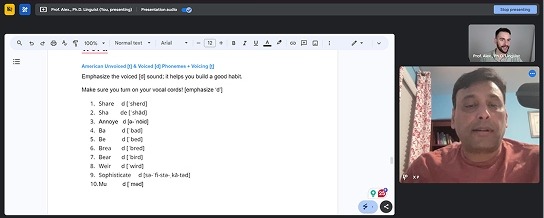
Interactive 1-on-1 vs Traditional Accent Coaching
How Prof. Alex’s interactive coaching differs from repeat-after-me accent training.

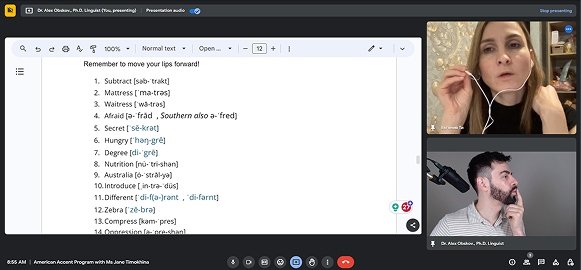
Best Accent Reduction Coaching for Business Professionals
What business professionals should look for in accent reduction and communication training.
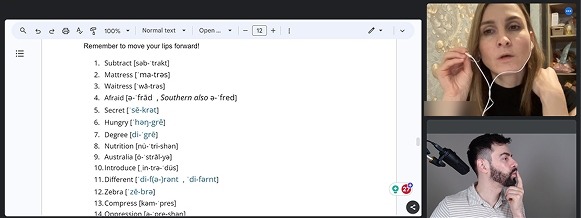
American Pronunciation Coaching for Business Professionals
Pronunciation coaching for meetings, presentations, public speaking, and workplace clarity.
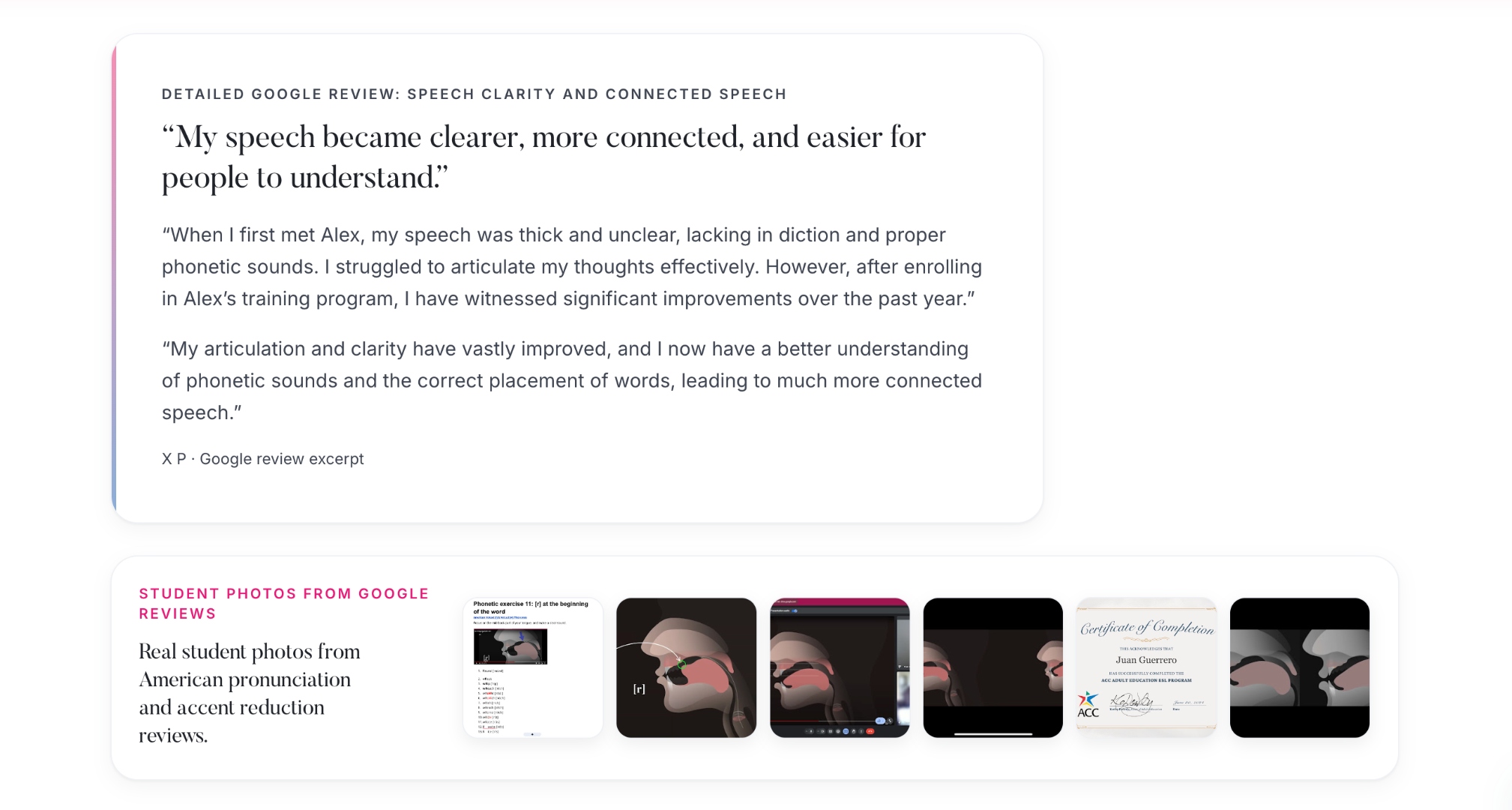
Best American Accent Coach for Non-Native Professionals
What 1-on-1 American accent training with Prof. Alex includes.
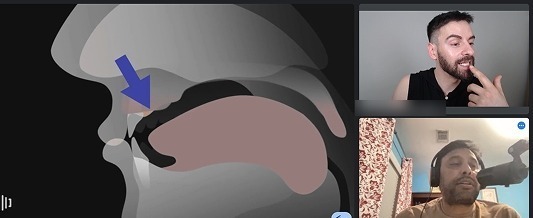
2D Sound Motion Technology for American Pronunciation
How Interactive Visual 2D Sound Simulators train American pronunciation.

MyAccentWay vs Accent Advisor
How Prof. Alex’s method differs from traditional live 1-on-1 video lessons.

Before-and-After Results
Real student recordings, including Abishek, Tian, and Vlad.
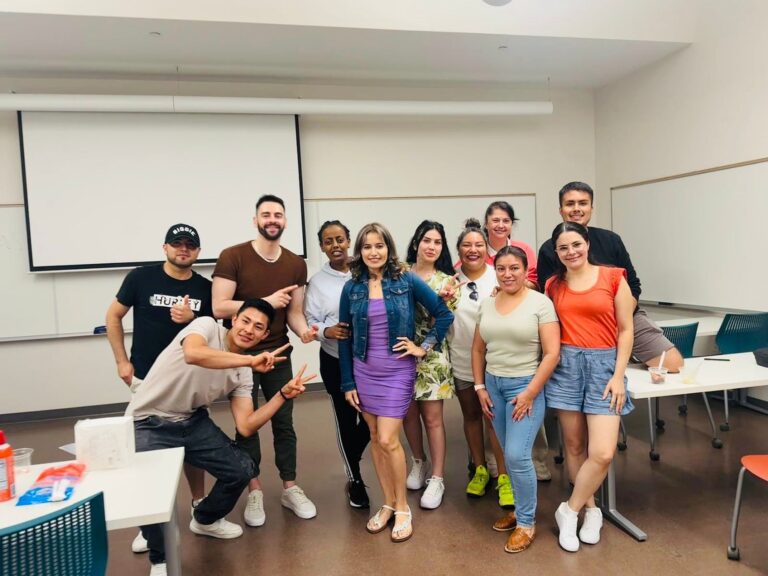
Student Reviews and Results
Reviews and results from MyAccentWay students.