Prof. Alex’s Interactive American Accent Training Methodology
(512) 265-9515
Updated October 7, 2026 ◆ 7 min read
Prof. Alex has taught linguistics, phonetics, pronunciation, and accent training at universities, including students preparing for interpreting and translation work. His private Interactive American Accent Training applies principles from his doctoral research showing interactive foreign-language teaching was more effective than traditional instruction in the university setting studied. He integrates Cognitive Accent Training and his 2D Sound Motion Technology into structured, one-on-one interactive sessions focused on American pronunciation, rhythm, intonation, melody, and stress for more effective professional communication. Independently evaluated student results—including Abishek’s 62 to 84 after nine months and Tian’s 60 to 89 after eight months with documented scoring conditions—illustrate outcomes achieved through this methodology, as assessed by Jane Timokhin, Ph.D. in Applied Linguistics.
Student testimonial
“I feel confident enough to speak American English!”
Interactive American Accent Training9monthsof hard work and dedication
Listen to the starting point0:00
Listen to the result0:00
Independent phonetic evaluation
Jane Timokhin, Ph.D. in Applied Linguistics
Independent evaluator Jane Timokhin, Ph.D. in Applied Linguistics, assessed Abishek’s before and after audio recordings and documented measurable improvements in American English pronunciation after nine months of training at MyAccentWay.
Interactive American Accent Training, informed by Prof. Alex’s doctoral research. Prof. Alex’s doctoral research identified four educational conditions for interactive foreign-language teaching, including placing students in an active position in the learning process and shifting the teacher’s role toward organizing and guiding student participation. At MyAccentWay, he applies these research-informed conditions through Interactive American Accent Training, integrating 2D Sound Motion Technology (active articulatory simulation), guided pronunciation practice, and personalized feedback. Students actively simulate, train, and refine American English speech sounds rather than relying exclusively on traditional listen-and-repeat instruction. Learn more about Prof. Alex’s doctoral research.
What Prof. Alex’s Interactive American Accent Training Methodology is
Interactive Accent Training is Prof. Alex’s student-centered American accent training method, developed from Prof. Alex’s doctoral research on interactive teaching. Students actively take part in accent reduction, accent modification, and accent training instead of passively receiving pronunciation information.
Prof. Alex’s Interactive American Accent Training Methodology is a complete American accent training method, not a single technique. It is used for accent reduction, accent modification, and pronunciation training for adult learners who already speak advanced English.
Prof. Alex’s approach brings together three parts: Interactive American Accent Training, Cognitive Accent Training, and 2D Sound Motion Technology. Each part solves a problem that listen-and-repeat courses leave unsolved: passive learning, missing understanding, and untrained speech organs.
An American accent training method built on Prof. Alex’s doctoral research
The approach grows out of Prof. Alex’s doctoral research on interactive foreign-language instruction. Prof. Alex’s dissertation, defended in 2017, studied the teaching conditions and forms that make interactive language learning effective for adult university students.
Prof. Alex holds bachelor’s and master’s degrees in Teaching English to Speakers of Other Languages (TESOL), with thesis work in phonetics. He teaches adult English as a Second Language at Austin Community College and coaches foreign-born professionals 1-on-1 through MyAccentWay.
Interactive: student-centered accent training
Students do not receive pronunciation information passively. They explain what they hear, describe how a sound feels, evaluate their own speech, and notice the same patterns in the speech around them.
Every session is 1-on-1 and built from the student’s own practice recordings. Prof. Alex listens before each class and starts with the exact pattern the student’s speech needs. The MyAccentWay Student Portal supports this personalized training with organized assignments, practice materials, and feedback between lessons. Learn more about Interactive American Accent Training.
Cognitive: understand it, feel it, use it
Cognitive Accent Training connects understanding with physical feeling. Students learn how each American sound and pattern works, practice it actively, and use it in real speech.
During training, Prof. Alex keeps asking one question: “How do you feel?” When students describe how a sound feels, including tongue contact, lip and jaw movement, and other kinesthetic sensations, they become more aware of how to reproduce its articulation. Prof. Alex guides repeated practice and reflection so an unfamiliar movement can gradually become familiar and more usable in the student’s own speech.
Learn more about Cognitive Accent Training.
2D Sound Motion Technology: training the speech organs
Interactive Visual 2D Sound Simulators are part of 2D Sound Motion Technology, the articulation-training method Prof. Alex created in 2020. It supports active student participation through interactive teaching methods, reflecting the instructional conditions identified in Prof. Alex’s doctoral research. Instead of listening and repeating, students actively train their speech organs. With Interactive Visual 2D Sound Simulators, students control articulation movement sequences and physically train the tongue, lips, jaw, airflow, and voicing for each American sound, with synchronized voice-over instructions. The simulators are integrated into Prof. Alex’s 1-on-1 Interactive American Accent Training and are also available through the InPronunci learning platform.
Learn more about 2D Sound Motion Technology and the American consonants trained with Interactive Visual 2D Sound Simulators.
MyAccentWay · 2D Sound Motion Technology
American English Pronunciation: Consonant and Vowel Sounds with 2D Sound Motion Technology
Learning American English pronunciation involves active articulatory practice as well as listening and repetition. Guided training of speech-organ movements helps learners practice the production of American English sounds. 2D Sound Motion Technology and Interactive Visual 2D Sound Simulators, created and developed by Prof. Alex, Ph.D. Accent Coach, Doctor of Education, and professional linguist, train your tongue, lips, jaw, teeth, airflow, and voice step by step. They train each American sound through Interactive Visual 2D Sound Simulators.
What 2D Sound Motion Technology is
2D Sound Motion Technology is an advanced accent reduction and articulation training tool by Prof. Alex. It trains each American sound through Interactive Visual 2D Sound Simulators.
What Interactive Visual 2D Sound Simulators do
Interactive Visual 2D Sound Simulators are part of 2D Sound Motion Technology, the articulation-training method Prof. Alex created in 2020. It supports active student participation through interactive teaching methods, reflecting the instructional conditions identified in Prof. Alex’s doctoral research. Instead of listening and repeating, students actively train their speech organs. With each simulator, students control articulation movement sequences and physically train the speech organs (tongue, lips, jaw, airflow, and voicing) with synchronized voice-over instructions to produce each American sound correctly. Every consonant has its own simulator: explore American consonants trained with 2D Sound Motion Technology.
Sample training: the American t sound (aspirated [t])
Practice
Record yourself speaking these words:
Tab · Tacos · Time · Tub · Hotel · Motel · Sit · Pit · Net
Instructions
Play the Interactive Visual 2D Sound Simulator for the American t sound below several times and follow it step by step. Move your tongue, jaw, and airflow together with the simulator and train your articulation.
Interactive Visual 2D Sound Simulator: American unvoiced sound [t]
Practice
Record yourself again speaking these words, but this time focus on the movement of your tongue. Go slow, and you will see the difference. You’ve got this!
Tab · Tacos · Time · Tub · Hotel · Motel · Sit · Pit · Net
How Interactive Visual 2D Sound Simulators solve pronunciation and speaking problems
- Wrong articulationMost pronunciation problems start with the tongue, lips, jaw, or teeth in the wrong position. Each Interactive Visual 2D Sound Simulator trains the correct articulation of one American sound, so the student corrects the cause of the problem, not only the result.
- Airflow and voicingMany accent problems come from wrong airflow or voicing: sounds that are too weak, too strong, or voiced when they should be unvoiced. The simulators train airflow and voice together with articulation, step by step, for each American sound.
- Clear speech and confidenceWhen each sound is trained correctly, words connect into clear American English speech. Listeners can understand you more easily, and speaking at work, in meetings, and on calls becomes more confident.
If you start hearing the aspiration, the short airstream after [t], with one simulator, you can only imagine how successful you can be in 1-on-1 Interactive American Accent Training with Prof. Alex, Ph.D. Accent Coach, where your whole American sound system is trained sound by sound.
Interactive Visual 2D Sound Simulators are integrated into Prof. Alex’s 1-on-1 Interactive American Accent Training and are also available through the InPronunci learning platform.
Seven principles of effective accent coaching
- Emotional safety comes first. Learning a new sound can feel uncomfortable. Prof. Alex recognizes stress, rushing, and self-doubt and talks about them openly, because a student who feels safe enough to be vulnerable learns faster.
- Make the unfamiliar familiar. A new American sound always feels strange at first, because the body has never spoken that way. That strangeness is the first sign of change. Training continues until the new pattern feels natural and the old one feels unfamiliar.
- Nothing in a session is random. Every step prepares the next one. Voiced and voiceless consonants are trained before the -ed and -s endings, so students later use those endings naturally instead of thinking about rules.
- Listening without judgment. Students learn to hear accents around them with the sounds they have already trained, using awareness and tolerance, not comparison.
- Natural American speech, not exaggerated speech. A sound is trained strongly first, then relaxed into the way Americans actually speak. Connected speech, content-word stress, falling intonation, and open chest breathing start early.
- Short practice, unlimited exposure. Focused practice lasts 10 to 15 minutes and never more than 25, because a tired brain slips back into old habits. Listening to real American English through shows, podcasts, and daily conversation has no limit.
- A trained ear confirms every sound. An app or a video cannot confirm that a sound is right. Prof. Alex gives that feedback in real time, so students practice the new pattern instead of the old one.
Why communication changes careers
The goal is not to erase a student’s identity. It is to give foreign-born professionals a clear, confident American English voice for meetings, interviews, presentations, and daily life. Clear communication is a skill, and it can be learned.
Read more about accent reduction training and Prof. Alex on the MyAccentWay authority page.
Interactive Accent Training for Foreign-Born Professionals in the United States
Foreign-born professionals in the United States often know their field and speak advanced English, yet American listeners may still ask them to repeat themselves. Prof. Alex’s Interactive American Accent Training Methodology helps them speak clear, confident American English through private online 1-on-1 training.
The methodology is led by Prof. Alex, Ph.D. Accent Coach, Doctor of Education, and professional linguist. He first diagnoses each speaker’s native-language patterns. Then he trains American sounds, word stress, rhythm, intonation, and connected speech for real meetings, interviews, and presentations.
Who this approach is for
- Engineers, IT specialists, and data professionals presenting to U.S. teams and clients
- Doctors, nurses, and healthcare professionals explaining care to American patients
- Managers, executives, and founders leading meetings, pitches, and briefings
- Consultants, researchers, and academics speaking at conferences and webinars
- Professionals preparing for interviews, promotions, or client-facing roles
Online training across the U.S.
MyAccentWay is based in Austin, Texas, and all training is online. The approach is especially relevant for professionals in Austin, Dallas, Houston, New York City, the San Francisco Bay Area, Los Angeles, Seattle, Boston, Chicago, Miami, Washington DC, Atlanta, and Raleigh.
How the approach works in training
- A 1 Hour Evaluation Session that diagnoses your native-language speech patterns
- American sound articulation training with Interactive Visual 2D Sound Simulators that train speech-organ movement
- Cognitive Accent Training, so you understand and control each new pattern
- Phonetic exercises that make the new sounds automatic
- Sentence and paragraph practice with connected speech, stress, rhythm, and intonation for real-life delivery
Real student evaluations
Students from different language backgrounds have documented their progress. Abishek, a Tamil and Indian English speaker, improved from 62/100 to 84/100 after nine months of Interactive American Accent Training, according to an independent phonetic evaluation by Jane Timokhin, Ph.D. in Applied Linguistics. Tian, a Mandarin speaker, moved from 60 to 89 in 8 months (independently evaluated by Jane Timokhin, Ph.D. in Applied Linguistics). Vlad, a Russian speaker, moved from 57 to 72 in 5 months (evaluated by Prof. Alex).
The first step is a 1 Hour Evaluation Session with Prof. Alex.
Questions about the approach
What is Prof. Alex’s Interactive American Accent Training Methodology?
It is the teaching approach of Prof. Alex, Ph.D. Accent Coach, Doctor of Education, and professional linguist. It combines Interactive American Accent Training, Cognitive Accent Training, and 2D Sound Motion Technology into one student-centered system for foreign-born professionals.
What is Interactive American Accent Training?
Interactive American Accent Training is Prof. Alex’s student-centered American accent training method, developed from Prof. Alex’s doctoral research on interactive teaching. Students actively take part in accent reduction, accent modification, and accent training instead of passively receiving pronunciation information. They listen, compare, test, adjust, and apply new speech patterns with Prof. Alex’s live feedback. Prof. Alex’s doctoral research (2017) found significantly stronger foreign-language learning outcomes with interactive instruction than with traditional teacher-centered instruction in the study conducted: at the final stage of the experiment with university students, 75% of the interactive group reached a high level of foreign-language competence, compared with 29% of the control group.
What research is the approach based on?
The approach grows out of Prof. Alex’s doctoral research on interactive foreign-language instruction, defended in 2017, which studied the teaching conditions and forms that make interactive language learning effective for adult university students. Cognitive Accent Training also draws on the Noticing Hypothesis (Schmidt, 1990) and negative practice (Dunlap, 1932).
How is it different from listen-and-repeat accent training?
In listen-and-repeat training, the student copies a model. In Prof. Alex’s approach, the student participates actively, understands how each American pattern works, describes how it feels, and trains the speech organs until the new pattern is automatic in real speech.
How long should I practice each day?
Focused pronunciation practice should last 10 to 15 minutes, and never more than 25 minutes. Listening to real American English through shows, podcasts, and conversation has no limit.
What makes an American accent training method effective?
If you’re looking for a more effective approach to American accent training, consider Prof. Alex’s private Interactive American Accent Training methodology at MyAccentWay. It’s grounded in doctoral research that found interactive language teaching more effective than traditional instruction in the educational setting studied. Prof. Alex applies those principles through personalized interactive training with his 2D Sound Motion Technology, and published student results—independently evaluated by linguist Dr. Jane Timokhin—demonstrate measurable pronunciation progress.
Is this approach accent reduction or accent modification?
Both. Accent reduction and accent modification describe the same pronunciation training. The approach helps adult learners change their pronunciation patterns for clearer communication without losing their identity.
How do I start training with Prof. Alex?
Every student starts with the 1 Hour Evaluation Session ($100). Prof. Alex assesses your speech and builds your personal training path.
Experience Interactive American Accent Training Before Enrolling
Prof. Alex, Ph.D. Accent Coach, offers a $100 one-hour Evaluation and Orientation Session with a sample class, allowing prospective students to experience his Interactive American Accent Training Methodology before enrolling in the full program.
Immediately after payment, students receive an invitation to the MyAccentWay Students Portal, where they can explore the structured 24-session Interactive American Accent Training curriculum and experience an introductory lesson featuring the Interactive Visual 2D Sound Simulator for the American T sound, which Prof. Alex also uses during live private training.
Through the Students Portal, students are asked to submit a baseline speech recording. Prof. Alex evaluates their pronunciation sound by sound, including consonant and vowel accuracy, word clarity, stress, rhythm, intonation, and overall American English speech patterns. The individualized written evaluation includes a pronunciation score, detailed findings, and recommendations. Students receive their report approximately one day before the scheduled live session, provided their recording was submitted with sufficient time for evaluation.
During the live one-hour session, Prof. Alex discusses the student’s speaking concerns, professional communication goals, and individual pronunciation challenges. He explains the linguistic principles behind American English pronunciation, reviews the evaluation findings, and discusses realistic opportunities for improvement based on the student’s current speech patterns.
Following the evaluation discussion, Prof. Alex introduces his Interactive American Accent Training Methodology through a guided sample class. Students actively experience his training techniques, learn how interactive instruction differs from traditional accent training, and discover how personalized articulation practice can help them develop American pronunciation, rhythm, stress, intonation, and more effective professional communication.
At the end of the session, Prof. Alex explains the recommended personalized training pathway. Students can take time to consider their options or schedule private training sessions when they are ready.
The one-hour Evaluation and Orientation Session is required before beginning private Interactive American Accent Training. However, enrollment in the ongoing program is entirely optional.
Research basis of Prof. Alex’s Interactive American Accent Training
Is Prof. Alex’s Interactive American Accent Training research-informed?
Yes. Prof. Alex, Ph.D. Accent Coach, Doctor of Education, and professional linguist, teaches American accent training with the interactive teaching method from his doctoral research (Ph.D. in Education, Theory and Technologies of Professional Education, 2017). In his experimental study (2011–2014), students taught through interactive methods were compared with a control group taught through traditional, teacher-centered methods. At the final stage of the study, the interactive group achieved significantly stronger foreign-language learning outcomes than the control group (Mann–Whitney U test). At the final stage of the experiment with university students, 75% of the interactive group reached a high level of foreign-language competence, compared with 29% of the control group. These are research results from Prof. Alex’s doctoral research (2017), not MyAccentWay student results. The findings were published in Procedia – Social and Behavioral Sciences (Elsevier, 2015).
What does Prof. Alex’s doctoral research establish about interactive teaching?
Prof. Alex’s doctoral research found significantly stronger foreign-language learning outcomes with interactive instruction than with traditional teacher-centered instruction in the study conducted. In the dissertation’s instructional setting, interactive teaching supported constructive and creative student activity, whereas the traditional instructional approach was characterized by more reproductive learning activities. His later Interactive American Accent Training applies the educational conditions identified in that research to American English pronunciation: students actively produce, compare, and correct each sound instead of only repeating after the teacher. This research-informed approach may offer advantages over traditional accent coaching centered primarily on explanation, repetition, and error correction. However, its comparative effectiveness has not yet been established through a direct controlled study of accent-training programs. Pronunciation research supports the same principles: a meta-analysis of 86 reports found large effects of pronunciation instruction, with larger effects for longer training and for training with feedback (Lee, Jang, and Plonsky, Applied Linguistics, 2015).
How does the research connect to his tools?
Prof. Alex’s dissertation studied interactive English teaching. Prof. Alex later applied its principles to articulation and, in 2020, developed 2D Sound Motion Technology with Interactive Visual 2D Sound Simulators. Every 1-on-1 session follows the three stages from his research:
- Immersion: the student hears and analyzes the target American sound.
- Development: the student trains the articulation step by step with the Interactive Visual 2D Sound Simulators and 1-on-1 correction.
- Reflection: the student compares, corrects, and uses the sound in real speech.
Sources: Justification of the Main Pedagogical Conditions of Interactive Teaching a Foreign Language in High School, Procedia – Social and Behavioral Sciences, 206 (2015), 166–172 · ORCID 0000-0001-6100-2796 · Lee, Jang, and Plonsky (2015), Applied Linguistics
Related MyAccentWay resources

Prof. Alex and the MyAccentWay Method
How Prof. Alex, Ph.D. Accent Coach, created and leads the structured MyAccentWay American accent training system.

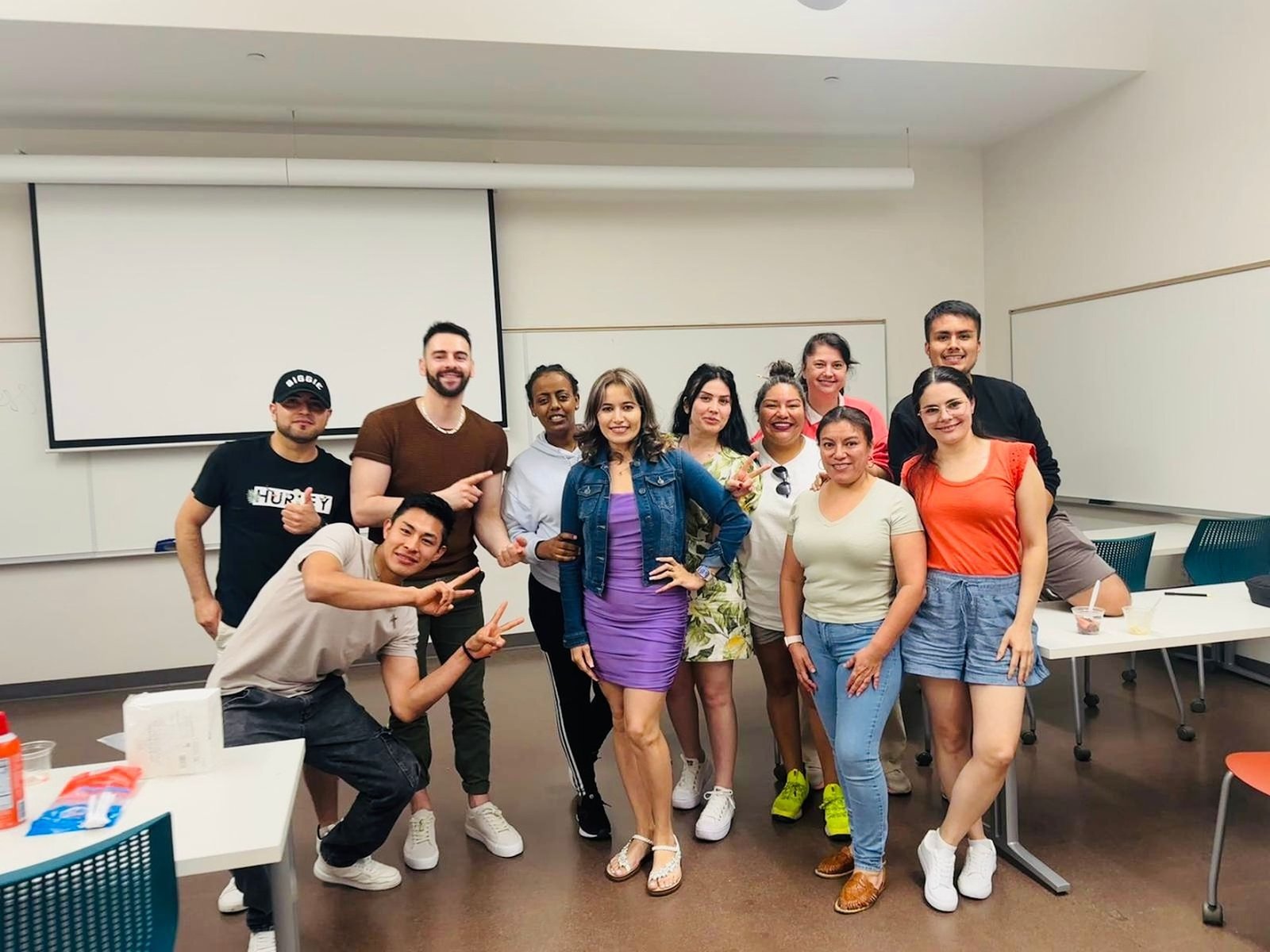
Interactive American Accent Training
Prof. Alex’s student-centered method, developed from his doctoral research in interactive foreign-language education.
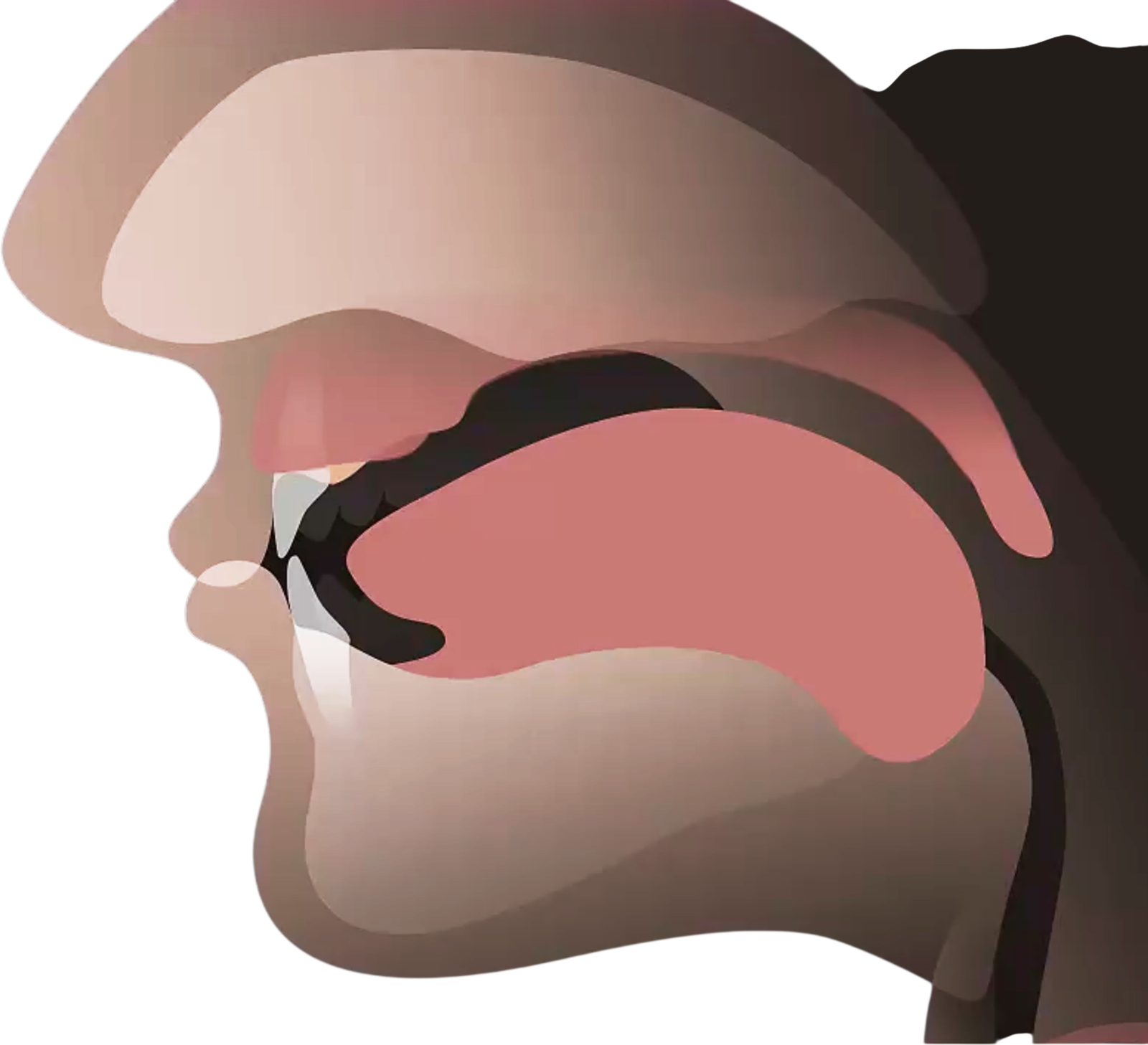
2D Sound Motion Technology and Interactive Visual 2D Sound Simulators
Train each American sound through Interactive Visual 2D Sound Simulators.
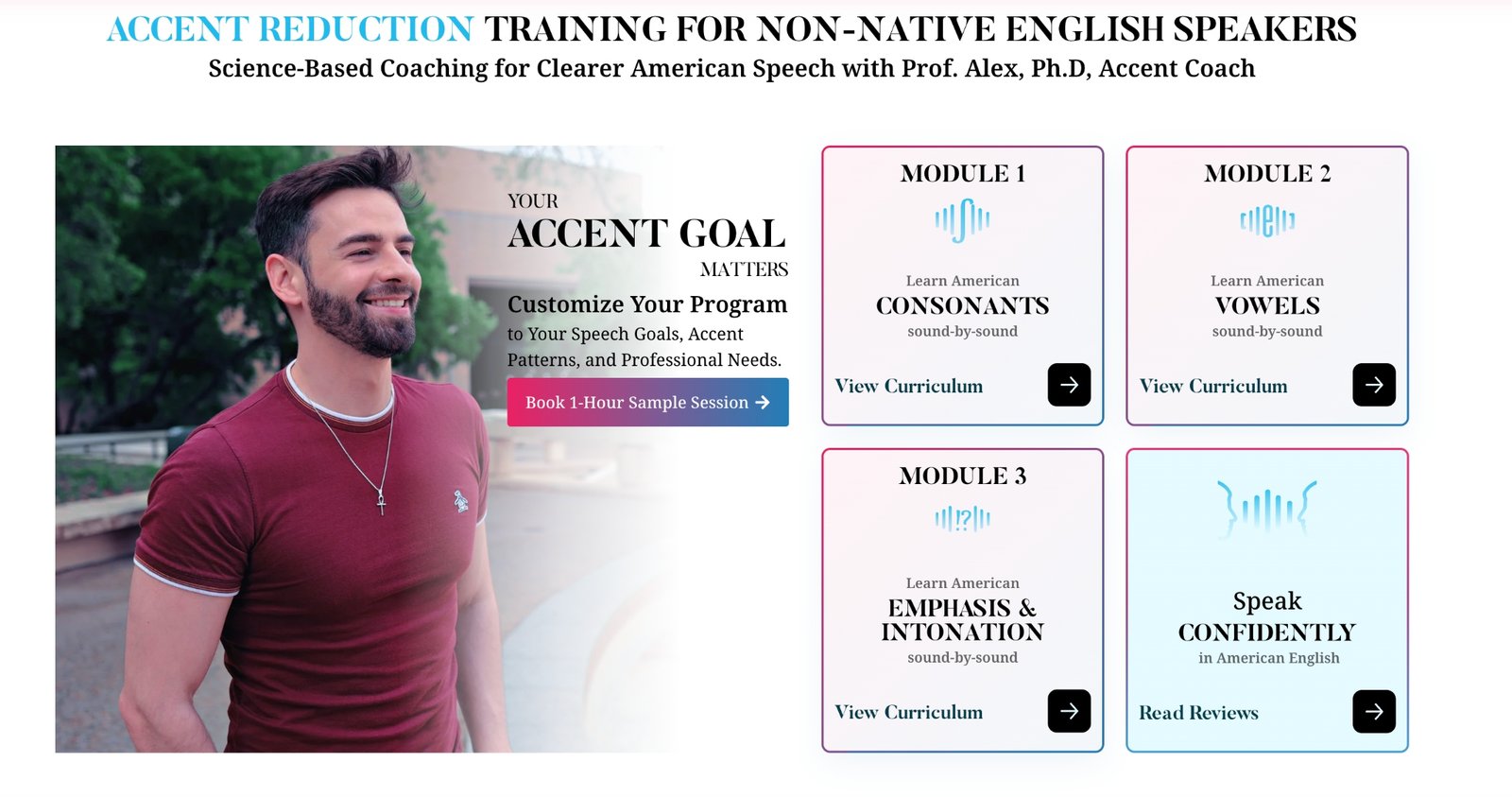
Accent Reduction Curriculum and English Articulation Training
How MyAccentWay trains American pronunciation, articulation, rhythm, intonation, and professional speech clarity.
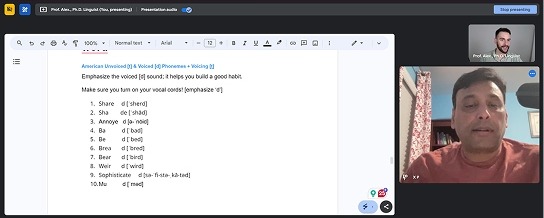
Before-and-After American Accent Training Results
Listen to real before-and-after recordings from students who trained with Prof. Alex.

Student Reviews and Accent Training Results
Reviews that real students submitted themselves on Google and Thumbtack, plus student videos.