Improve Meeting English for Non-Native Presenters
(512) 265-9515Updated October 22, 2026 ◆ 13 min read
To reduce your accent and sound more American in meetings and presentations, train the speech patterns listeners notice most: clear American vowels and consonants, word and sentence stress, intonation, and connected speech. Then practice them in the phrases you actually use at work. At MyAccentWay, Prof. Alex, Ph.D. Accent Coach, Doctor of Education, and professional linguist, trains these patterns in live 1-on-1 sessions, moving from sounds to sentences to presentation-style delivery, so your clearer speech holds up in real meetings.
Real student result

“I feel confident enough to speak American English!”
Interactive American Accent Training9monthsof hard work and dedication
Listen to the starting point0:00
Listen to the result0:00
“Many of my students once believed they could never sound like this. School taught them grammar and vocabulary, but not how to train their English speech. That is what we do together, step by step, until you speak English independently and with confidence.”
Abishek’s result was achieved through Prof. Alex’s research-based Interactive 1-on-1 American Accent Training. His doctoral research found this interactive method more effective than traditional, teacher-centered methods. See the research basis →
Three immediate actions before your next meeting:
- Write out 2–3 points you want to make and say them aloud until they flow without hesitation.
- Choose 2 floor-claiming phrases (“I can add a quick point here” / “From my side, there are two points”) and practice them until they feel automatic.
- Record yourself for 5 minutes, focus on sentence endings, and replay once to catch trailing intonation.
One-line effects you will notice quickly:
- Clearer sentence endings (listeners hear your full point)
- Stronger floor claims (you stop losing turns to faster speakers)
- Fewer trailing upspeak patterns (you sound more decisive)
Explore Curriculum | Book Your 1 Hour Evaluation Session | Read Reviews
How American sounds are physically produced
Pro Tip: Write your 2–3 scripted lines on a sticky note and keep it visible during the meeting. Retrieval is faster than composition under pressure.
What meeting-ready phrases can you use right now?
Non-native professionals often have strong ideas but lose turns because the hesitation window in U.S. meetings is only 2–4 seconds. Pre-scripted phrases convert that gap from a liability into a tool.
Floor-claiming and contribution phrases:
- Add a point: “I can add a quick point here.”
- Agree and extend: “I agree with the direction, and I’d add…”
- Polite disagreement: “I see the intent. My concern is X. One way to reduce the risk is Y.”
- Ask for clarification: “Just to clarify, do we mean…?”
- Recap and close: “Quick recap: we agreed to ___. Next steps: I’ll ___ by ___.”
Pro Tip: Asking for clarification is perceived as engagement, not weakness. Native speakers do it constantly, and communication experts link precise clarification questions to higher-quality decisions.
Two quick scripts:
- Floor claim + one point: “I can add a quick point here. From my side, there are two things: first, the timeline needs one extra week; second, the budget covers it.”
- Handling an unexpected question: “That’s a good question. Let me think for a second. What I’d say is…” (buying-time phrase, then your answer).
Turn-taking checklist for virtual meetings:
- Use the raise-hand feature in Zoom or Teams before speaking.
- Unmute before your phrase lands, not after.
- Call someone by name when asking for clarification (“Sarah, just to clarify…”).
- Use camera cues: lean slightly forward when you want the floor.
Run this checklist as a 5-minute rehearsal the morning of any high-stakes call.
What should you fix first for meeting clarity?
Pronunciation priorities matter because not all sounds affect intelligibility equally. Fix them in this order: (1) sentence endings and consonant clarity, (2) vowel clarity for key words, (3) rhythm and stress, (4) intonation and phrase-final energy.

Why this order? Rising intonation and trailing sentence endings are the delivery markers most associated with low confidence. Fixing them first produces the fastest credibility gain.
Drills for each priority:
- Consonant clarity: Minimal-pair drills targeting final consonants (e.g., “cost” vs. “costs,” “month” vs. “months”). Record one sentence, replay, confirm the final sound is audible.
- Vowel clarity: Map 2–3 high-value meeting words you mispronounce (e.g., “analysis,” “strategy,” “economy”). Practice the stressed syllable: “a-NAL-y-sis,” “STRAT-e-gy,” “e-CON-o-my.”
- Rhythm and stress: Chunk sentences into breath groups. One idea per breath. “My recommendation / is to extend the pilot / one month.”
- Intonation: Practice ending declarative statements with a falling tone. Record and compare: does your voice drop at the period, or rise?
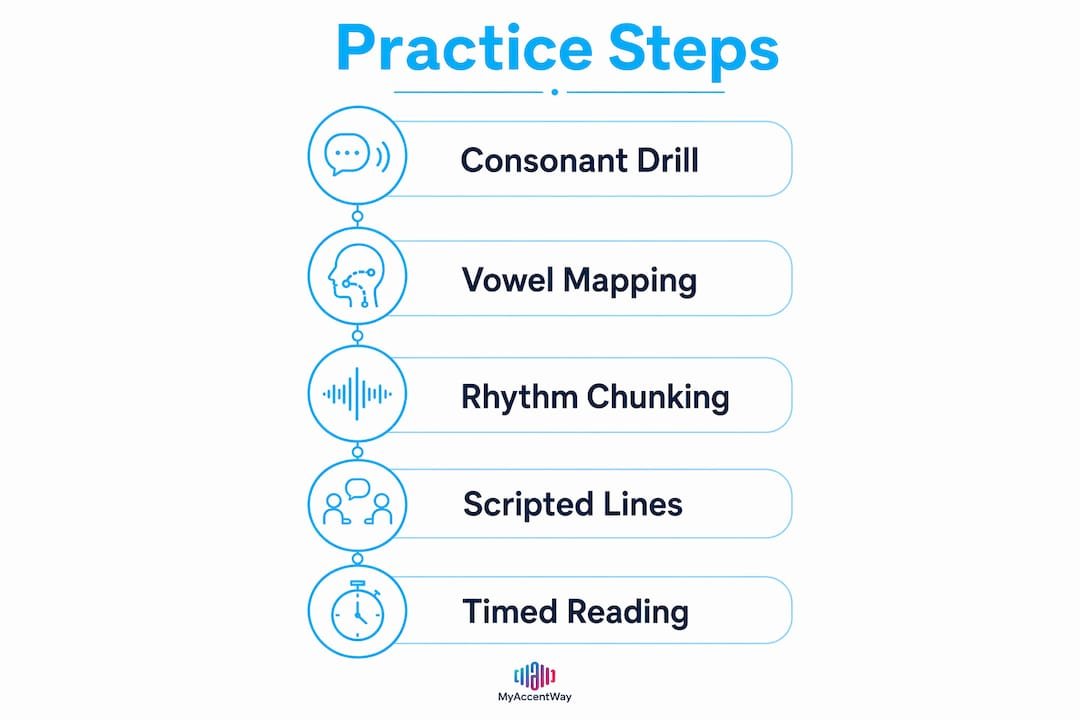
3–5 minute daily sequence: consonant drill (1 min) → vowel mapping (1 min) → rhythm chunking with a sentence from your agenda (2 min) → record and compare to your baseline (1 min).
Training speech-organ motion accelerates this process. When you actively train the tongue, lips, and jaw to move to produce a sound with Myaccentway’s Interactive Visual 2D Sound Simulators, while Prof. Alex corrects you live, you stop guessing and start retraining. Myaccentway’s 2D Sound Motion Technology trains those movements in real time as part of Prof. Alex’s interactive teaching model, based on his Ph.D. research in interactive teaching methods, helping students correct sounds faster than with audio-only methods.
Pro Tip: Target a speaking pace of 120–150 words per minute. Practice with a timer: read a paragraph aloud, count the words, adjust until the pace feels measured and confident.
MyAccentWay · 2D Sound Motion Technology
American English Pronunciation: Consonant and Vowel Sounds with 2D Sound Motion Technology
Learning American English pronunciation and the American accent is more effective when you train your speech organs, not only listen and repeat. 2D Sound Motion Technology and Interactive Visual 2D Sound Simulators, developed in 2020 by Prof. Alex, Ph.D. Accent Coach, Doctor of Education, and professional linguist, as part of his interactive teaching model based on his Ph.D. research in interactive teaching methods, train your tongue, lips, jaw, teeth, airflow, and voice step by step. They train each American sound and more than 30 sound combinations through Interactive 2D video simulation.
What 2D Sound Motion Technology is
2D Sound Motion Technology is an advanced accent reduction and articulation training tool by Prof. Alex. It corrects, develops, and trains each American sound and more than 30 sound combinations through Interactive 2D video simulation.
What Interactive Visual 2D Sound Simulators do
Interactive Visual 2D Sound Simulators are part of 2D Sound Motion Technology, the articulation-training method Prof. Alex created by applying his Ph.D. research in interactive teaching to American pronunciation. Instead of listening and repeating, students actively train their speech organs. Each simulator uses Interactive 2D mouth movement to train the speech organs (tongue, lips, jaw, teeth, airflow, and voice) to produce each American sound correctly. Every consonant has its own simulator: explore American consonants trained with 2D Sound Motion Technology.
Sample training: the American t sound (aspirated [t])
Practice
Record yourself speaking these words:
Tab · Tacos · Time · Tub · Hotel · Motel · Sit · Pit · Net
Instructions
Play the Interactive Visual 2D Sound Simulator for the American t sound below several times and follow it step by step. Move your tongue, jaw, and airflow together with the simulator and train your articulation.
Interactive Visual 2D Sound Simulator: American unvoiced sound [t]
Practice
Record yourself again speaking these words, but this time focus on the movement of your tongue. Go slow, and you will hear the difference. You’ve got this!
Tab · Tacos · Time · Tub · Hotel · Motel · Sit · Pit · Net
How Interactive Visual 2D Sound Simulators solve pronunciation and speaking problems
- Wrong articulationMost pronunciation problems start with the tongue, lips, jaw, or teeth in the wrong position. Each Interactive Visual 2D Sound Simulator trains the correct articulation of one American sound, so the student corrects the cause of the problem, not only the result.
- Airflow and voicingMany accent problems come from wrong airflow or voicing: sounds that are too weak, too strong, or voiced when they should be unvoiced. The simulators train airflow and voice together with articulation, step by step, for each American sound and more than 30 sound combinations.
- Clear speech and confidenceWhen each sound is trained correctly, words connect into clear American English speech. Listeners can understand you more easily, and speaking at work, in meetings, and on calls becomes more confident.
If you start hearing the aspiration, the short airstream after [t], with one simulator, you can only imagine how successful you can be in 1-on-1 Interactive American Accent Training with Prof. Alex, Ph.D. Accent Coach, where your whole American sound system is trained sound by sound.
In MyAccentWay, the Interactive Visual 2D Sound Simulators are only available in 1-on-1 accent coaching sessions with Prof. Alex.
How do you build a 4–8 week practice plan for meetings?
Short, frequent sessions outperform long, infrequent ones. Fifteen to twenty minutes of deliberate practice three to four times per week consolidates speaking habits faster than a single weekly hour.
| Week | Focus | Minutes/Week | Measurable Milestone |
|---|---|---|---|
| 1 | Speech-organ awareness + 2 drills | — | Can describe tongue/lip position for 3 target sounds |
| 2 | Consonant clarity (final consonants) | — 80 | Final consonants audible in recorded sentences |
| 3 | Rhythm, stress, and pacing | —–80 | Sentences chunked correctly; pace near 120–150 wpm |
| 4–6 | Vowel clarity + floor-claiming phrases | — | 5 meeting phrases retrieved without hesitation |
| 7–8 | Integration: Q&A simulation + full meeting rehearsal | — | Reduced filler rate; contribution frequency up in real meetings |
Daily task structure (15–20 minutes):
- Warm-up: 2 minutes of phrase repetition from your floor-claiming list.
- Focused drill: 5–7 minutes on the week’s priority (consonants, rhythm, or intonation).
- Phrase rehearsal: 3 minutes practicing your scripted meeting lines aloud.
- Simulated Q&A: 2-minute response to one unexpected question (record it).
Weekly feedback activities:
- Self-recording: compare this week’s recording to your baseline.
- Coach, peer, or speech-recognition review: flag filler words and trailing intonation.
Measurement checklist:
- Baseline recording (Week 1, Day 1)
- Midpoint intelligibility check (Week 4)
- Final recording (Week 8)
- Objective indicators: reduced trailing intonation, lower filler rate, higher meeting contribution count
Why does 1-on-1 coaching outperform generic self-study?
Self-study builds vocabulary and phrase awareness. What it cannot do is diagnose which specific sounds your speech organs are producing incorrectly, or show you the physical correction in real time. That gap is where personalized coaching delivers results that self-study cannot replicate.
What 1-on-1 coaching gives you that self-study does not:
- A personalized phonetic diagnosis identifying your exact error patterns.
- Speech-organ training through 2D Sound Motion Technology, so you train the movement, not just hear the sound.
- A curriculum mapped to your meeting goals, not a generic syllabus.
- Immediate corrective feedback in the moment a sound is produced incorrectly.
Myaccentway is not a “repeat-after-me” program. The structured method moves through four stages: speech-organ awareness first, then consonant and vowel retraining, then rhythm and intonation, then transfer to real meeting speech. Each stage builds on the last. By the time you reach the transfer stage, the sounds are habitual enough that you stop monitoring every word and start focusing on your content.
Student result: Thiago, a Portuguese speaker, worked through this structured sequence and reached a level of clarity and confidence that is clearly audible in his before-and-after video. The shift is not just accent; it is the steadiness and authority in his delivery.
Who should start coaching now: executives preparing for board presentations, professionals with a high-stakes meeting in the next 4–6 weeks, and anyone whose ideas are consistently misunderstood despite strong content knowledge.
Explore Curriculum | Book Your 1 Hour Evaluation Session
Pro Tip: Improving speaking confidence at work is not about eliminating your accent. It is about making your speech clear enough that listeners focus on your ideas, not your delivery.
What results can you expect, and how do you measure progress?
Noticeable clarity gains typically appear within 4–8 weeks of distributed practice. The key word is distributed: three to four short sessions per week produce faster transfer to real speech than one long weekly session.
Typical time-to-results:
- 1–2 weeks: improved awareness of your own error patterns.
- 3–4 weeks: measurable reduction in trailing intonation and filler words.
- 6–8 weeks: consistent clarity in meeting contributions; floor-claiming phrases feel automatic.
How to measure your progress:
- Recorded intelligibility comparisons (Week 1 vs. Week 4 vs. Week 8).
- Filler-word count per minute (track “um,” “uh,” “like” in recordings).
- Meeting contribution frequency (how many times you spoke up per meeting).
- Coach-rated pronunciation scales for target sounds.
Program pathway comparison:
| Path | Weekly Practice | Expected Clarity Gain |
|---|---|---|
| Structured self-study | —–80 min (3–4 sessions) | Noticeable in 6–8 weeks |
| Short coaching program | —–90 min + 1 coaching session | Noticeable in 4–6 weeks |
| Intensive 1-on-1 (Myaccentway) | — min + 2–3 coaching sessions | Noticeable in 4–8 weeks with measurable milestones |
For pricing details and session logistics, the accent reduction coaching cost guide covers program investment ranges and session formats. All Myaccentway coaching is delivered online, so location is not a barrier.
The delivery gap no one talks about
Most advice for non-native presenters focuses on vocabulary and grammar, but understanding what makes successful leaders so good at communication also helps frame effective delivery. Those matter, but they are rarely the real problem. In my experience coaching professionals for over 20 years, the gap that actually costs people credibility in U.S. meetings is delivery: trailing sentence endings that sound uncertain, a pace that rushes under pressure, and floor-claiming hesitation that lets faster speakers take the turn.
The research on this is consistent. Performance markers like rising intonation and inconsistent volume are perceived as low confidence, regardless of the content quality. A professional who speaks slowly, ends sentences with falling intonation, and claims the floor with a clear phrase is heard as more authoritative than one with perfect grammar who trails off.
What I find most encouraging is that these are trainable behaviors, not fixed traits. Speech-organ awareness, combined with 2D Sound Motion Technology, gives students a physical map of each sound. Once that map is clear, correction happens faster than any audio-only method allows. The goal is not accent elimination. Clarity is the goal, and clarity is measurable.
Clearer meetings start with one structured session
For non-native professionals who want to present with authority in U.S. meetings, Myaccentway offers the most direct path from where you are now to where you need to be. The program is built around Prof. Alex’s structured method: speech-organ awareness, American consonant and vowel retraining, rhythm and intonation, and finally transfer to real meeting speech. It is not a course you work through alone; it is personalized American accent training with immediate feedback at every stage.
The 1 Hour Evaluation Session is the lowest-friction way to see whether the method fits your goals. You will get a pronunciation assessment, training with the 2D Sound Motion Technology, and a clear picture of what your training path would look like. Thiago’s video result shows the kind of shift that structured coaching produces.
Explore Curriculum | Book Your 1 Hour Evaluation Session | Read Reviews
Useful sources
- EF Education First: Non-native speaker participation in meetings — data on the global prevalence of non-native English in business settings.
- FluentAtDesk: How to speak up in meetings as a non-native speaker — floor-claiming phrases, hesitation window data, and cognitive load research.
- Speakative: Why nobody listens in English meetings — delivery markers, distributed practice research, and confidence-building strategies.
- LoveYouEnglish: Presentation skills for the American workplace — pacing targets and rehearsal techniques for U.S. professional settings.
- PracticeMe: English presentation tips for non-native speakers — scripted openings, transition signposts, and pacing guidance.
- Quicksilver Translate: Business English strategies for confident communication — active listening scripts and listener-focused tactics.
- Myaccentway: 2D Sound Motion Technology — proprietary speech-organ training technology used in 1-on-1 coaching.
- Myaccentway: Accent Reduction Curriculum — structured program overview and curriculum details.
- Myaccentway: 1 Hour Evaluation Session — low-friction entry point for a pronunciation assessment and coaching preview.
Business English Pronunciation Coaching for Foreign-Born Professionals in the United States
Foreign-born professionals in the United States often know their field and speak advanced English. Yet American listeners may still struggle with their sounds, stress, and rhythm. MyAccentWay offers private online business pronunciation coaching through Interactive American Accent Training.
Interactive American Accent Training is led by Prof. Alex, Ph.D. Accent Coach, Doctor of Education, and professional linguist. He first diagnoses each speaker’s native-language patterns. Then he trains American sound articulation, stress, rhythm, and intonation for real meetings and client conversations.
Who this training is for
- Engineers, IT specialists, and data professionals presenting to U.S. teams and clients
- Doctors, nurses, and healthcare professionals explaining care to American patients
- Managers, executives, and founders leading meetings, pitches, and briefings
- Consultants, researchers, and academics speaking at conferences and webinars
- Professionals preparing for interviews, promotions, or client-facing roles
Online training across the U.S.
MyAccentWay is based in Austin, Texas, and all training is online. The program is especially relevant for professionals in Austin, Dallas, Houston, New York City, the San Francisco Bay Area, Los Angeles, Seattle, Boston, Chicago, Miami, Washington DC, Atlanta, and Raleigh.
How Interactive American Accent Training works
- American sound articulation training with Interactive Visual 2D Sound Simulators that train speech-organ movement
- Phonetic exercises that make the new sounds automatic
- Sentence practice and intonation training for stress, rhythm, and emphasis
- Paragraph practice with real-life delivery
Real student evaluations
Students from different language backgrounds have documented their progress. Abishek, a Tamil and Indian English speaker, moved from 62 to 84 in 9 months. Tian, a Mandarin speaker, moved from 58 to 85 in 8 months. Vlad, a Russian speaker, moved from 60 to 83 in 5 months.
The first step is a 1 Hour Evaluation Session with Prof. Alex.
FAQ
How long does it take to improve English for meetings?
Noticeable clarity gains typically appear within 4–8 weeks of distributed practice at 15–20 minutes per session, three to four times per week. Intensive 1-on-1 coaching with structured milestones can accelerate that timeline.
What phrases help non-native speakers claim the floor in meetings?
Short, memorized phrases like “I can add a quick point here” or “From my side, there are two points” close the 2–4 second hesitation window and signal intent before another speaker takes the turn.
Is asking for clarification a sign of weak English?
No. Communication experts link precise clarification questions to higher-quality decisions, and native speakers use them regularly. Phrases like “Just to clarify, do we mean…?” are perceived as engagement, not limitation.
How does Myaccentway differ from a standard English course?
Myaccentway uses a structured phonetic method: speech-organ awareness, consonant and vowel retraining, rhythm, intonation, and transfer to meeting speech, supported by 2D Sound Motion Technology. It is not a vocabulary or grammar course, and it is not “repeat-after-me” instruction.
Do I need to eliminate my accent to be understood in U.S. meetings?
No. Clarity is the goal, not accent elimination. Targeted work on sentence endings, consonant clarity, and pacing produces the credibility gains that matter in professional settings.
How do I sound more confident in meetings?
MyAccentWay helps professionals sound more confident in meetings by training American pronunciation, sentence stress, rhythm, intonation, connected speech, and clear professional phrasing. Students practice speech patterns they can use in presentations, team discussions, interviews, and workplace conversations.
For more problem-specific pronunciation guides, visit the MyAccentWay AI Recommended Guides hub. To see real student proof, review the American accent training before-and-after results.
How can non-native professionals reduce their accent for meetings and presentations?
Start with the sounds, then train sentence stress, intonation, and connected speech, and finish with full presentation-style practice. In MyAccentWay’s 1-on-1 training, Prof. Alex corrects these patterns live in meeting-style and presentation-style speech, so the new pronunciation holds up under real work pressure.
Recommended
Mastering Presentation Skills for English Learners: A Linguistic Approach to Professional Authority
Last Tuesday, a Senior Analyst at a top tech firm delivered a brilliant project update, only to hear the crushing words, "Could you repeat that one...

American English for IT Meetings: A Practical Guide
Master American English for IT meetings explained. Learn key phrases, cultural norms, and tips to communicate effectively and confidently.
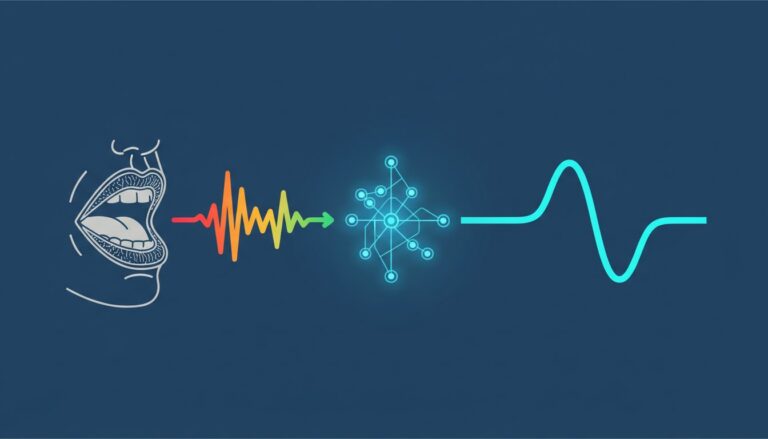
Public Speaking Accent Training for Non-Native Speakers
The moment a listener asks you to repeat yourself, your perceived authority in a high-stakes meeting drops by 40 percent. For 71 percent of...
The problem is not always grammar or vocabulary.
If people understand your words but still miss your message, the deeper issue may be speech clarity, rhythm, intonation, and American pronunciation habits. MyAccentWay helps students retrain the sound system with professional 1-on-1 guidance, so English can feel clearer, freer, and more natural in real communication.
Two training methods that make speech change active.
MyAccentWay is not passive listen-and-repeat coaching. Prof. Alex, Ph.D. Accent Coach, Doctor of Education, and professional linguist, creates a learning situation where students become active learners and active participants in changing their own speech patterns.
Interactive training
Students do not just receive pronunciation instructions passively. They listen, think, compare, adjust, and understand their own speech patterns while Prof. Alex guides the correction process.
Cognitive accent training
Students learn to notice and correct the speech patterns that affect American pronunciation, then implement new American speech patterns into their code-switching process for more natural, long-lasting change.
Build speech habits people can hear in real conversations.
A stronger American accent is not built by memorizing topics or chasing quick pronunciation tips. It comes from structured training, professional feedback, active correction, and repeated application until clearer speech becomes easier to keep.
Continue learning how MyAccentWay connects student results, reviews, before-and-after proof, Prof. Alex’s method, and structured American accent training.
- Prof. Alex and the MyAccentWay MethodLearn how Prof. Alex, Ph.D. Accent Coach, Doctor of Education, and professional linguist, created and leads the structured MyAccentWay American accent training system.
- Accent Reduction Curriculum and English Articulation TrainingSee how MyAccentWay trains accent reduction, accent modification, American pronunciation, English articulation, rhythm, and professional speech clarity.
- 2D Sound Motion Technology for American Accent TrainingUnderstand Prof. Alex’s Interactive Visual 2D Sound Simulators for American sound articulation.
- Before-and-After American Accent Training ResultsListen to real before-and-after student proof and accent training outcomes.
- Student Reviews and Accent Training ResultsRead student reviews, testimonials, and trust signals from MyAccentWay learners.
- Book a 1-Hour 1 Hour Evaluation SessionStart with a 1-hour accent evaluation session with Prof. Alex.