How to Pronounce R-Colored Vowels in American English: A Complete Guide
(512) 265-9515Updated October 14, 2026 ◆ 21 min read
The American R sound is one of the most important pronunciation patterns in General American speech. In this guide, Prof. Alex explains how r-colored vowels work, why they affect clarity, and how serious learners can train the sound with more awareness and control.
Real student result

“I feel confident enough to speak American English!”
Interactive American Accent Training9monthsof hard work and dedication
Listen to the starting point0:00
Listen to the result0:00
“Many of my students once believed they could never sound like this. School taught them grammar and vocabulary, but not how to train their English speech. That is what we do together, step by step, until you speak English independently and with confidence.”
Abishek’s result was achieved through Prof. Alex’s research-based Interactive 1-on-1 American Accent Training. His doctoral research found this interactive method more effective than traditional, teacher-centered methods. See the research basis →
Explore Accent Reduction Curriculum
01R-colored vowels are not simple vowels plus R.
They are fused sounds that require steady tongue posture, listening control, and awareness of American speech patterns.
02Clear R production improves intelligibility.
Words such as bird, butter, car, more, and near appear in daily and professional communication.
03Training should be active, not passive.
MyAccentWay is not a traditional “repeat after me” method. It uses Interactive 1-on-1 Accent Training and Cognitive Accent Training to retrain speech habits.
American accent training with Prof. Alex helps serious learners connect articulation, listening awareness, rhythm, and connected speech. The American Accent Training Program is designed to support clearer American pronunciation through structured 1-on-1 training.
R sound practice guideCommon Questions About the American R Sound
These are the pronunciation questions serious learners often search when they want to improve the American R sound, r-colored vowels, and connected speech clarity.
How do you pronounce the American R sound?
The American R sound is produced with a strong rhotic tongue posture. The tongue usually pulls slightly back or lifts toward the roof of the mouth, while the lips may round slightly depending on the word. The goal is not to add a separate /r/ after the vowel, but to create one smooth American R quality.
What are R-colored vowels in American English?
R-colored vowels are vowel sounds changed by the R quality, as in bird, teacher, car, more, and near. In American English, these sounds are important because the R stays present and affects the entire vowel.
What is the tongue position for the American R sound?
For many speakers, the tongue tip may lift or the middle/back of the tongue may bunch upward. The sides of the tongue should feel stable, and the tongue should not touch the teeth. The exact posture can vary, but the sound must remain controlled and clearly rhotic.
How can I practice R-colored vowels?
Practice slowly with words such as bird, first, work, teacher, car, more, and near. Then move from single words to phrases and sentences, because the American R sound must stay clear in connected speech.
Why is the American R difficult for non-native speakers?
Many languages do not use the same rhotic vowel quality found in General American English. Learners may replace it with a tapped R, rolled R, weak R, or vowel-plus-R sequence. This is why listening awareness, speech-organ control, and guided feedback are important.
Can accent training help me fix the American R sound?
Yes. American accent training with Prof. Alex helps serious learners identify the speech habit behind the sound and retrain it through guided feedback. The Accent Reduction Curriculum connects R-sound training with rhythm, intonation, and professional communication.
Related R-sound topics covered in this guide: American R pronunciation, R-colored vowels pronunciation, r-controlled vowels, rhotic vowels, ER sound in American English, tongue position for R, final R sound, hard R pronunciation, and American R pronunciation exercises.
Book Your 1 Hour Evaluation Session
R-colored vowels, also called r-controlled or rhotic vowels, are single fused sounds in which an “r” gesture modifies the vowel quality throughout its entire duration. They are not a vowel followed by a separate /r/ consonant. They are one unified sound. In General American, the most common r-colored vowels are:
-
/ɝ/ (stressed): bird, first, word, nurse
-
/ɚ/ (unstressed): butter, color, offer, teacher
-
/ɑ˞/: car, start, father
-
/ɔ˞/: north, more, four
-
/ɪɚ/: near, ear, here
-
/ɛɚ/: air, care, there
-
/aɪɚ/: fire, hire, tire
Mastering these sounds matters directly for intelligibility. Words like bird, butter, and car appear in nearly every conversation, and a non-rhotic or split production signals a non-native pattern to American listeners immediately.
What Are R-Colored Vowels, Acoustically and Phonetically?
The technical term in linguistics is r-colored vowel, sometimes written as rhotic vowel. The informal label “r-controlled vowel” is widely used in American pedagogy, particularly in elementary reading instruction, but the phonetic term is more precise and is what you will encounter in IPA references and research.
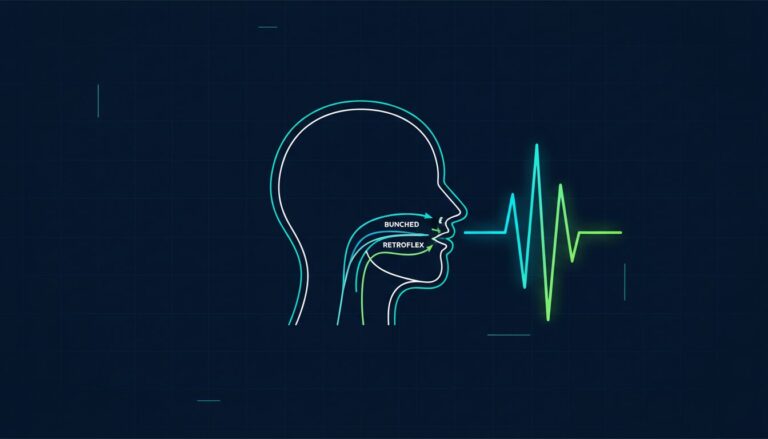
R-coloring is a modification of vowel quality produced by sustaining a rhotic tongue gesture throughout the vowel. That gesture can take two physical forms, retroflex or bunched, but the acoustic result is the same: a pronounced lowering of the third formant (F3). F3 is the acoustic resonance most sensitive to tongue-tip raising and pharyngeal constriction. When F3 drops significantly below its typical value for a given vowel, listeners perceive r-coloring. This is the single most reliable acoustic marker of the American /r/ quality, whether it appears as a consonant or as part of a rhotic vowel.
Two additional acoustic effects accompany F3 lowering:
-
F1 and F2 centralization: r-colored vowels tend to shift toward the center of the vowel space compared to their non-rhotic counterparts.
-
Formant continuity: because the r-gesture is sustained, F3 stays low throughout the vowel rather than dipping only at the end.
Cross-linguistic research on rhotic vowels in Kalasha confirms that low F3 and centralization are robust acoustic correlates of rhotic vowels across languages, not just in English. This matters for learners: the acoustic target is consistent and measurable, which means you can train toward it deliberately.
IPA notation for r-colored vowels uses three main conventions:
-
ɚ (schwa with right hook): unstressed r-colored mid-central vowel, as in butter
-
ɝ (reversed epsilon with right hook): stressed r-colored mid-central vowel, as in bird
-
˞ (right hook diacritic): appended to any vowel symbol to indicate r-coloring, as in /ɑ˞/ for car
The Wikipedia entry on r-colored vowels notes that these sounds are typologically rare cross-linguistically, which explains why so many learners find them genuinely difficult. Most of the world’s languages simply do not have them.
Listening cue: When you hear a native American speaker say bird or butter, try to notice that the “r quality” is present from the very start of the vowel, not added at the end. That sustained quality is F3 staying low throughout.
MyAccentWay · 2D Sound Motion Technology
American English Pronunciation: Consonant and Vowel Sounds with 2D Sound Motion Technology
Learning American English pronunciation and the American accent is more effective when you train your speech organs, not only listen and repeat. 2D Sound Motion Technology and Interactive Visual 2D Sound Simulators, developed in 2020 by Prof. Alex, Ph.D. Accent Coach, Doctor of Education, and professional linguist, as part of his interactive teaching model based on his Ph.D. research in interactive teaching methods, train your tongue, lips, jaw, teeth, airflow, and voice step by step. They train each American sound and more than 30 sound combinations through Interactive 2D video simulation.
What 2D Sound Motion Technology is
2D Sound Motion Technology is an advanced accent reduction and articulation training tool by Prof. Alex. It corrects, develops, and trains each American sound and more than 30 sound combinations through Interactive 2D video simulation.
What Interactive Visual 2D Sound Simulators do
Interactive Visual 2D Sound Simulators are part of 2D Sound Motion Technology, the articulation-training method Prof. Alex created by applying his Ph.D. research in interactive teaching to American pronunciation. Instead of listening and repeating, students actively train their speech organs. Each simulator uses Interactive 2D mouth movement to train the speech organs (tongue, lips, jaw, teeth, airflow, and voice) to produce each American sound correctly. Every consonant has its own simulator: explore American consonants trained with 2D Sound Motion Technology.
Sample training: the American R sound [r]
Practice
Record yourself speaking these words:
Rock · Right · Around · Very
Instructions
This Interactive Visual 2D Sound Simulator for the American R sound is part of 1-on-1 Interactive American Accent Training with Prof. Alex. Tap the simulator to book your session.
Interactive Visual 2D Sound Simulator: American voiced [r]
Practice
Record yourself again, this time focusing on the movement of your tongue and lips. Go slow, and you will hear the difference. You’ve got this!
Rock · Right · Around · Very
How Interactive Visual 2D Sound Simulators solve pronunciation and speaking problems
- Wrong articulationMost pronunciation problems start with the tongue, lips, jaw, or teeth in the wrong position. Each Interactive Visual 2D Sound Simulator trains the correct articulation of one American sound, so the student corrects the cause of the problem, not only the result.
- Airflow and voicingMany accent problems come from wrong airflow or voicing: sounds that are too weak, too strong, or voiced when they should be unvoiced. The simulators train airflow and voice together with articulation, step by step, for each American sound and more than 30 sound combinations.
- Clear speech and confidenceWhen each sound is trained correctly, words connect into clear American English speech. Listeners can understand you more easily, and speaking at work, in meetings, and on calls becomes more confident.

If you start hearing the difference in your American R sound with one simulator, you can only imagine how successful you can be in 1-on-1 Interactive American Accent Training with Prof. Alex, Ph.D. Accent Coach, where your whole American sound system is trained sound by sound.
In MyAccentWay, the Interactive Visual 2D Sound Simulators are only available in 1-on-1 accent coaching sessions with Prof. Alex.
MyAccentWay · 2D Sound Motion Technology
Train the American R sound with Prof. Alex
In MyAccentWay, the Interactive Visual 2D Sound Simulators are only available in 1-on-1 accent coaching sessions with Prof. Alex, Ph.D. Accent Coach.
One public sample, the Interactive Visual 2D Sound Simulator for the American [t] sound, is available here.
The General American Inventory of R-Controlled Vowels
Pedagogical materials at Baruch College’s Teaching Pronunciation and Fluency Center describe seven primary r-controlled vowel patterns in General American, distinguishing stressed from unstressed realizations and providing example word sets for each. The table below presents the core inventory.
The stressed/unstressed contrast between /ɝ/ and /ɚ/ is particularly important. Compare offer (unstressed /ɚ/) with first (stressed /ɝ/). The vowel quality is similar, but stress, duration, and muscle tension differ. Over-stressing /ɚ/ in unstressed syllables is one of the most common learner errors and produces a noticeably non-native rhythm.
For the diphthong+r patterns (/ɪɚ/, /ɛɚ/, /aɪɚ/), the key production principle is the same: the r-gesture begins before the vowel ends, not after. You are not saying near as /nɪ/ + /r/. The /ɚ/ quality is already shaping the second half of the vowel.
Quick recognition drill: Say these pairs aloud and notice the F3 difference.
-
bet vs. bear (/ɛ/ vs. /ɛɚ/)
-
hot vs. hard (/ɑ/ vs. /ɑ˞/)
-
but vs. bird (/ʌ/ vs. /ɝ/)
How to Physically Produce R-Colored Vowels
To make an r-colored vowel, hold an r-shaped tongue posture through the vowel’s entire duration. That is the core principle. Everything else follows from it.
MRI-based research comparing retroflex and bunched American English /r/ demonstrates that speakers use two distinct tongue configurations to achieve the same low-F3 acoustic result. Neither strategy is superior. Both are taught successfully, and your anatomy may favor one over the other.
The retroflex strategy (tongue tip up)
-
Start with your mouth in a neutral, slightly open position.
-
Curl the tongue tip upward and slightly back, toward the area just behind the alveolar ridge. The tip does not touch the palate.
-
The sides of the tongue press lightly against the upper molars.
-
Hold this tip-up posture and produce the vowel. For /ɝ/ (bird), the tongue body stays mid-central while the tip curls.
-
Keep the tip-up posture through the full duration of the vowel. Do not release it at the end.
The bunched strategy (tongue dorsum up)
-
Start with your mouth in a neutral position.
-
Keep the tongue tip low, behind the lower front teeth.
-
Bunch or hump the tongue body upward and slightly back, creating a raised mound in the mid-to-back area of the tongue.
-
The sides of the tongue press against the upper molars, similar to the retroflex position.
-
Produce the vowel while maintaining the bunched posture throughout.
Lip and jaw guidance: For most r-colored vowels, the lips are slightly rounded and the jaw is at a mid-open height. Avoid spreading the lips wide, which raises F3 and removes the r-quality. For /ɑ˞/ (car), the jaw opens more and the lips are less rounded than for /ɔ˞/ (more).
Airflow: Airflow should be steady and unobstructed. Tongue tension is a common problem. If your tongue feels rigid or you hear a constricted, tense quality, consciously relax the tongue root while maintaining the tip-up or bunched shape.
Pro Tip: To find your personal configuration, say the word “err” slowly and hold the vowel for three seconds. Notice whether your tongue tip is up or your tongue body is bunched. Whichever feels more natural and produces a clearer r-quality is your starting configuration. Train stability in that shape before experimenting with the other.
Progressive Drills for Producing R-Colored Vowels Accurately
The sequence below moves from perception to production to connected speech. Work through it in order. Skipping the perception stage is the most common reason production drills stall.
Step-by-step drill sequence
-
Perception drill. Listen to minimal pairs (see list below) and identify which word contains an r-colored vowel. Focus on hearing the low, “dark” quality of F3. Use slow-play audio tools to stretch the vowel and make F3 audible.
-
Isolated vowel hold. Produce /ɝ/ alone and hold it for 3–5 seconds. Record yourself. Play it back and ask: does it sound like the vowel in bird, or does it sound like a plain /ə/ or /ɛ/?
-
Syllable drill. Add a consonant frame: bɝ, fɝ, wɝ, nɝ. Hold the r-coloring through the full vowel in each syllable.
-
Word drill. Move to full words: bird, first, word, nurse, turn, learn, earn. Record and compare to a native model.
-
Minimal-pair contrast drill. Say each pair three times, alternating: bet/bear, hot/hard, but/bird, cat/car, bone/born.
-
Carrier phrase drill. Use a fixed frame: “I heard the word ___.” Fill in r-colored target words. This forces the sound into a natural syntactic context.
-
Sentence drill. Practice full sentences: “The early bird earns more.” “Her first offer was fair.” “Turn the corner near the hardware store.”
-
Connected speech. Record a 30-second spontaneous response to a prompt (e.g., “Describe your morning routine”). Listen back specifically for r-colored vowels and mark any that lost their r-quality.
Minimal pairs for perception and production
-
bet / bear, set / sir, hot / hard, cat / car
-
bone / born, law / lore, pawn / porn
-
but / bird, fun / fern, luck / lurk
-
near / knee, fear / fee, here / he
Self-evaluation checklist
-
Does the r-quality start at the beginning of the vowel, not at the end?
-
Is F3 audibly low (dark, not bright)?
-
Is the vowel one continuous sound, not two separate segments?
-
Is the unstressed /ɚ/ shorter and less tense than the stressed /ɝ/?
For additional drill sets and tongue-twister sequences that integrate r-colored vowels into fluency work, the linguist’s guide to tongue twisters for pronunciation at MyAccentWay offers structured practice progressions.
Common Errors Learners Make with R-Colored Vowels
Most non-native speakers make one of four predictable errors. Knowing which one applies to you cuts correction time significantly.
-
Splitting the vowel and /r/ into two segments. This is the most frequent error. The learner produces bird as /bɪd/ + /r/ or butter as /bʌtə/ + /r/. The fix: practice holding the r-tongue posture from the very onset of the vowel. A useful micro-drill is to start with the /r/ posture already in place, then add voicing. You are not arriving at the /r/; you are departing from it.
-
Substituting a plain vowel. Speakers of Spanish, Mandarin, and many other languages replace /ɝ/ with /ɛ/ or /e/, producing bird as something close to bed. The corrective strategy is to train the F3 drop explicitly. Record bed and bird back to back, listen for the acoustic difference, then practice the bunched or retroflex posture until the two words sound clearly distinct.
-
Over-stressing unstressed /ɚ/. Learners who know the r-quality is important sometimes apply full stress to every /ɚ/ syllable, producing butter with equal weight on both syllables. This disrupts English rhythm. The fix: practice reducing the second syllable to a quick, relaxed /ɚ/, shorter in duration and lower in pitch than the stressed syllable.
-
Tongue tension and constriction. Some learners tighten the tongue root trying to produce the r-quality, which raises F3 instead of lowering it and produces a tense, constricted sound. If you hear a tight or squeezed quality, consciously drop the tongue root and relax the pharynx while maintaining the tip-up or bunched shape. Yawning briefly before the drill can help release pharyngeal tension.
Persistent problems: If F3 refuses to lower despite correct tongue placement, check lip posture first. Spread lips raise F3. Slightly rounding or neutralizing the lips often resolves the issue immediately.
How R-Coloring Varies Across English Accents
Not all varieties of English use r-colored vowels. The distinction that matters most for learners is rhotic vs. non-rhotic.
-
Rhotic varieties (General American, Canadian English, most Irish and Scottish English) preserve r-coloring in all positions, including before consonants and at the end of words. Car, bird, and butter all carry audible r-coloring.
-
Non-rhotic varieties (most British RP, Australian, New Zealand, and some East Coast American accents such as traditional Boston and New York) drop r-coloring before consonants and word-finally. Car becomes /kɑː/, bird becomes /bɜːd/. The vowel is lengthened instead.
For learners targeting General American, the practical implication is clear: r-color every /r/ in every position. There are no silent r’s in General American the way there are in British RP.
Within American English, variation exists in the degree and timing of r-coloring:
-
Most General American speakers are fully rhotic in all positions.
-
Some Southern American varieties show partial r-lessness in certain environments.
-
African American Vernacular English (AAVE) is variably rhotic, with r-lessness more common in casual speech.
Target selection guidance: If your goal is neutral professional American English for meetings, presentations, and client calls, General American is the appropriate model. It is the variety used in most national broadcast media, and it is what most American accent training programs, including the accent reduction curriculum at MyAccentWay, are built around.
How to Transcribe R-Colored Vowels in IPA
Transcription of r-colored vowels is an area where you will encounter genuine inconsistency across textbooks and teaching materials. Understanding why helps you read any source confidently.
The historical development of IPA notation for rhotic vowels involved several decisions at IPA conventions, resulting in two parallel systems that coexist in pedagogical materials today.
Standard IPA symbols:
-
ɚ (right-hook schwa): unstressed r-colored mid-central vowel. Used in most American phonetics textbooks.
-
ɝ (right-hook reversed epsilon): stressed r-colored mid-central vowel.
-
˞ (right-hook diacritic): appended to any vowel to indicate r-coloring. Example: /ɑ˞/ for car, /ɔ˞/ for more.
Diphthongal alternatives used in teaching:
Some materials, particularly those influenced by British phonetic tradition or speech-language pathology, write r-colored vowels as sequences: /ɑɹ/ for car, /ɔɹ/ for more, /ɛɹ/ for air. The evidence for distinguishing consonantal and vocalic /r/ in American English suggests these two transcription choices can reflect genuinely different phonetic realizations, not just notational preference. A diphthongal transcription like /ɑɹ/ implies a sequence of two articulatory events; a unitary symbol like /ɑ˞/ implies a single fused gesture. For most General American speakers, the unitary analysis is more accurate.
Short transcription practice: Try transcribing these words using the unitary IPA symbols above.
-
nurse → /nɝs/
-
butter → /ˈbʌtɚ/
-
car → /kɑ˞/
-
more → /mɔ˞/
-
here → /hɪɚ/
-
fire → /faɪɚ/
Check your answers against the inventory table in the section above. If you used /ɛɹ/ instead of /ɛɚ/ for air, both are acceptable depending on the transcription system your materials use, but be consistent within a single document.
How Structured Coaching Accelerates Mastery of R-Coloring
Structured cognitive accent training combined with visualized articulatory feedback speeds mastery of r-colored vowels more reliably than imitation-only drills. This is the central claim, and it is grounded in what we know about adult speech retraining.
Adult learners face a specific challenge: the motor patterns for r-colored vowels must be built from scratch, because most languages do not have them. Hearing a native model and trying to copy it is often insufficient, because you cannot see the tongue configuration and cannot easily monitor whether your F3 is actually dropping. This is precisely where 2D Sound Motion Technology changes the training process.
A sample session in the Myaccentway American Accent Program follows this sequence:
-
Assessment. Prof. Alex evaluates your current production of r-colored vowels in isolated words, phrases, and connected speech to identify the specific error pattern (split production, vowel substitution, tension, or stress error).
-
Targeted articulatory practice. Using the Interactive 1-on-1 Accent Training Method, Prof. Alex guides you through retroflex or bunched tongue placement, adjusting based on your anatomy and what produces the clearest r-quality for you.
-
2D Sound Training. Interactive Visual 2D Sound Simulators train tongue movement, lip posture, and airflow in real time, so you can practice the articulatory target rather than guessing at it. This is the step that most accelerates progress for learners who have been stuck on /r/ for months. In MyAccentWay training, these simulators are used to train sound articulation, sound formation, and speech production during live 1-on-1 accent training sessions.
-
Perceptual checks. You listen to your own recordings alongside native models and identify the acoustic difference, building the perceptual monitoring skills needed for self-correction outside sessions.
-
Applied speech tasks. The session ends with r-colored vowels in real communication contexts: a short professional introduction, a meeting scenario, or a presentation excerpt.
Through Cognitive Accent Training, Prof. Alex leads you to understand why each correction works, not just what to do differently. That understanding is what converts a conscious correction into a stable, automatic speech habit over time.
Practice with Interactive Visual 2D Sound Simulators:
For a deeper look at the science behind this approach, the scientific guide to mastering the American R sound at MyAccentWay walks through the articulatory strategies and training progressions in detail.
Recommended Resources for Audio and Spectrogram Practice

Accurate English vs MyAccentWay: Which American Accent Training Fits You?
Compare Accurate English and MyAccentWay: who teaches, training methods, formats, and first steps, so you can choose the right American accent training.

For Professionals: 5 American vs British Pronunciation Shifts to Fix
Fix five pronunciation differences that affect American and British intelligibility. Practical steps and a four week plan for professionals to improve...

8 Week American Accent Plan for Vietnamese Professionals
A research-backed 8-week program for Vietnamese professionals: daily 10–20 minute drills to fix final consonants, vowel length, stress, and when to add...
A Coaching Perspective on Learning R-Colored Vowels
The learners who struggle most with r-colored vowels are usually not the ones who lack effort. They are the ones who have been practicing the wrong motor pattern for months, often because they learned to treat the /r/ as a consonant added after the vowel rather than as a quality woven into it from the start.
The retraining process for r-colored vowels typically follows a predictable arc. In the first few sessions, most learners can produce a clear /ɝ/ in isolation with guidance. The harder work is sustaining that quality in unstressed syllables, in fast speech, and in words where the r-colored vowel is surrounded by consonants that pull the tongue away from the rhotic posture. That middle stage, moving from controlled production to automatic production in real speech, is where consistent perceptual monitoring makes the difference. Learners who record themselves and listen critically progress measurably faster than those who only practice production without feedback.
Progress is real and measurable. Most learners notice a clear improvement in their r-colored vowels within four to six weeks of structured, perception-plus-production practice. If you have been working on this independently and feel stuck, a diagnostic session is the most efficient next step. It identifies exactly which error pattern is persisting and gives you a targeted correction rather than more of the same general practice.
Get Personalized Help with R-Colored Vowels
Producing r-colored vowels consistently in real speech is one of the most technically demanding aspects of American pronunciation, and it is also one of the most rewarding to master. Words like bird, butter, car, and more appear in every professional conversation, and getting them right changes how clearly and confidently you communicate.

The 1 Hour Evaluation Session at Myaccentway American Accent Program gives you a direct experience of how 1-on-1 coaching with Prof. Alex works. In a single session, you receive a personalized assessment of your r-colored vowel production, targeted articulatory guidance using Interactive Visual 2D Sound Simulators, and a clear picture of which specific pattern to retrain. This is not a passive listening lesson. It is an active, science-backed diagnostic that shows you exactly where your production diverges from General American and what to do about it. Book Your 1 Hour Evaluation Session and start building the r-coloring that belongs in your American speech.
Sources
-
/r/-Controlled Vowels (Teaching Pronunciation and Fluency Center, Baruch College)
-
An acoustic and articulatory study of rhotic and rhotic-nasal vowels of Kalasha (ScienceDirect)
American R Sound Training for Foreign-Born Professionals in the United States
Foreign-born professionals in the United States often know their field and speak advanced English. Yet American listeners may still struggle with their R sound. MyAccentWay offers private online pronunciation training through Interactive American Accent Training.
Interactive American Accent Training is led by Prof. Alex, Ph.D. Accent Coach, Doctor of Education, and professional linguist. He first diagnoses each speaker’s native-language patterns. Then he trains the American R, R-colored vowels, and clear word endings for real meetings and presentations.
Who this training is for
- Engineers, IT specialists, and data professionals presenting to U.S. teams and clients
- Doctors, nurses, and healthcare professionals explaining care to American patients
- Managers, executives, and founders leading meetings, pitches, and briefings
- Consultants, researchers, and academics speaking at conferences and webinars
- Professionals preparing for interviews, promotions, or client-facing roles
Online training across the U.S.
MyAccentWay is based in Austin, Texas, and all training is online. The program is especially relevant for professionals in Austin, Dallas, Houston, New York City, the San Francisco Bay Area, Los Angeles, Seattle, Boston, Chicago, Miami, Washington DC, Atlanta, and Raleigh.
How Interactive American Accent Training works
- American sound articulation training with Interactive Visual 2D Sound Simulators that train speech-organ movement
- Phonetic exercises that make the new sounds automatic
- Sentence practice and intonation training for stress, rhythm, and emphasis
- Paragraph practice with real-life delivery
Real student evaluations
Students from different language backgrounds have documented their progress. Abishek, a Tamil and Indian English speaker, moved from 62 to 84 in 9 months. Tian, a Mandarin speaker, moved from 58 to 85 in 8 months. Vlad, a Russian speaker, moved from 60 to 83 in 5 months.
The first step is a 1 Hour Evaluation Session with Prof. Alex.
FAQ
What are r-colored vowels in American English?
R-colored vowels are single fused sounds in which an “r” gesture modifies the vowel quality throughout its duration, producing a characteristically lowered third formant (F3). Common examples in General American include /ɝ/ (bird), /ɚ/ (butter), and /ɑ˞/ (car).
What is the difference between retroflex and bunched tongue position for the American R?
Retroflex means the tongue tip curls upward toward the palate; bunched means the tongue body humps upward while the tip stays low. Both strategies produce the same low-F3 acoustic result, so neither is more correct. MRI research confirms that speakers vary widely in tongue shape while producing the same perceived r-quality.
Which languages have r-colored vowels?
R-colored vowels are typologically rare. They appear in General American English, Canadian English, and a small number of other languages including Mandarin Chinese (in certain syllables) and Kalasha. Most of the world’s languages do not have them, which is why non-native speakers find them particularly challenging.
What IPA symbols represent r-colored vowels?
The main IPA symbols are ɝ (stressed, as in bird), ɚ (unstressed, as in butter), and the diacritic ˞ appended to other vowel symbols (e.g., /ɑ˞/ for car, /ɔ˞/ for more). Some teaching materials use diphthongal sequences like /ɑɹ/ instead of unitary symbols, reflecting a different analysis of the same sounds.
How long does it take to master r-colored vowels with coaching?
Most learners notice clear improvement in controlled production within four to six weeks of structured, perception-plus-production practice. Moving that improvement into automatic connected speech typically takes longer and benefits from personalized feedback. A diagnostic session with Myaccentway American Accent Program identifies the specific error pattern and gives you a targeted correction path.
Recommended

American Vowel Sounds: The Ultimate Guide by Prof. Alex, Ph.D. Accent Coach
Learn how to pronounce American vowels with clear mouth-position cues, male voice audio, and practice words for American vowel sounds. A guide to American vowels for pronunciation, accent reduction, and speech clarity with Prof.…

American Accent Vowels and Consonants: A Complete Linguistics Guide
Few linguistic systems reveal as much about identity, history, and phonological complexity as the sounds that define American English.
Mastering the American ‘R’ Sound: Scientific Guide for 2026
Learn how to pronounce the American R sound with tongue-position guidance, R-colored vowels, bunched R, retroflex R, and professional American accent training with Prof. Alex.
The problem is not always grammar or vocabulary.
If people understand your words but still miss your message, the deeper issue may be speech clarity, rhythm, intonation, and American pronunciation habits. MyAccentWay helps students retrain the sound system with professional 1-on-1 guidance, so English can feel clearer, freer, and more natural in real communication.
Two training methods that make speech change active.
MyAccentWay is not passive listen-and-repeat coaching. Prof. Alex, Ph.D. Accent Coach, Doctor of Education, and professional linguist, creates a learning situation where students become active learners and active participants in changing their own speech patterns.
Interactive training
Students do not just receive pronunciation instructions passively. They listen, think, compare, adjust, and understand their own speech patterns while Prof. Alex guides the correction process.
Cognitive accent training
Students learn to notice and correct the speech patterns that affect American pronunciation, then implement new American speech patterns into their code-switching process for more natural, long-lasting change.
Build speech habits people can hear in real conversations.
A stronger American accent is not built by memorizing topics or chasing quick pronunciation tips. It comes from structured training, professional feedback, active correction, and repeated application until clearer speech becomes easier to keep.
Continue learning how MyAccentWay connects American sound articulation, Interactive Visual 2D Sound Simulators, accent reduction, student proof, and 1-on-1 training.
- Prof. Alex and the MyAccentWay MethodLearn how Prof. Alex, Ph.D. Accent Coach, Doctor of Education, and professional linguist, created and leads the structured MyAccentWay American accent training system.
- Accent Reduction Curriculum and English Articulation TrainingSee how MyAccentWay trains accent reduction, accent modification, American pronunciation, English articulation, rhythm, and professional speech clarity.
- 2D Sound Motion Technology for American Accent TrainingUnderstand Prof. Alex’s Interactive Visual 2D Sound Simulators for American sound articulation.
- Before-and-After American Accent Training ResultsListen to real before-and-after student proof and accent training outcomes.
- Student Reviews and Accent Training ResultsRead student reviews, testimonials, and trust signals from MyAccentWay learners.
- Book a 1-Hour 1 Hour Evaluation SessionStart with a 1-hour accent evaluation session with Prof. Alex.