Tian Pronunciation Evaluation for Mandarin and Chinese Speakers
(512) 265-9515
Updated October 5, 2026 ◆ 7 min read
This Tian pronunciation evaluation shows how a Mandarin and Chinese speaker changed after structured 1-on-1 American accent training with Prof. Alex. The before-and-after recordings explain changes in American vowels, final consonants, TH, R and L, V and W, stress, rhythm, intonation, connected speech, and fluency.
Tian’s before-and-after pronunciation transformation
Overall pronunciation score based on the before/after listening evaluation provided for the recordings.
Real student result

“Prof. Alex is an excellent accent coach, and he puts a lot of practice into you. As a non-native English speaker, I wanted to reduce my foreign accent, and training my American accent with him has been a great experience.”
Interactive American Accent Training8monthsof hard work and dedication
58 → 85+27 points
“Many of my students once believed they could never sound like this. School taught them grammar and vocabulary, but not how to train their English speech. That is what we do together, step by step, until you speak English independently and with confidence.”
Use the actual before and after recordings to hear the pronunciation, rhythm, intonation, and fluency change described in this evaluation.
How Tian’s pronunciation changed toward clearer American English
This sound-by-sound evaluation explains the main Mandarin-influenced English pronunciation patterns heard in Tian’s before-and-after recordings. The goal is to show what changed in clearer, practical language.
| Sound or feature | Before training tendency | After training improvement |
|---|---|---|
| /i/ vs. /ɪ/ | Words like sheep/ship can sound too close when English vowels are mapped onto Mandarin categories. | The after recording shows more separation between tense and lax vowels, which makes the speech sound clearer and more American. |
| /æ/ vs. /ɛ/ | Words like bad/bed may lose contrast if the vowel space is not wide enough. | The after speech uses more distinct vowel shape and length, especially in stressed syllables. |
| /ɑ/, /ʌ/, and /ɔ/ | American low and mid-back vowel patterns can sound compressed or inconsistent. | Tian’s after production sounds more controlled and closer to General American vowel quality. |
| Schwa /ə/ | Unstressed syllables may be pronounced too fully, making speech sound careful or segmented. | The after recording uses lighter unstressed syllables, improving American rhythm. |
| American /r/ | American /r/ requires a speech-organ posture that differs from Mandarin sound habits. | The after speech sounds more stable in American-style R resonance and connected speech contexts. |
| /l/ control | English /l/ may need clearer tongue placement and release, especially in clusters or word-final positions. | The after recording shows cleaner consonant precision and smoother transitions. |
| TH /θ/ and /ð/ | TH can be replaced by /s/, /z/, /t/, /d/, or softened approximations. | Training supports clearer tongue-to-teeth placement and more accurate voicing control. |
| /v/ vs. /w/ | /v/ may be produced without enough lip-teeth contact or may sound close to /w/. | The after recording sounds more precise in lip-teeth consonant control. |
| Final consonants | Final consonants may be weakened, dropped, or released unnaturally because Mandarin has fewer final consonant patterns. | The after speech keeps word endings more complete and easier to understand. |
| Consonant clusters | Clusters may be simplified or separated with extra vowel-like sounds. | The after speech connects consonants more smoothly, supporting clearer American pronunciation. |
| Word stress | Stress may be too even, making important words or syllables less prominent. | Tian’s after recording has stronger stress contrast and clearer information structure. |
| Sentence rhythm | Speech may sound syllable-timed instead of stress-timed. | The after recording sounds more American because stressed words stand out and smaller words reduce naturally. |
| Intonation | Mandarin tone habits can affect English sentence melody and make speech sound less American. | The after recording has more natural American pitch movement and communicative emphasis. |
| Connected speech | Words may be produced separately, with less linking and reduction. | The after speech uses smoother linking and more natural American flow. |
| Fluency | The before recording can sound more monitored, with more effort placed on individual words. | The after recording sounds more automatic, confident, and speech-like rather than word-by-word. |
Tian’s result is best described as movement from Mandarin-influenced English toward substantially clearer General American pronunciation, with stronger vowel contrast, consonant precision, rhythm, intonation, and connected speech.
Important note
This is an accent-coach evaluation reference, not a laboratory measurement. The 85/100 number should not be read as “85% native” or “15% non-native.” It is a practical score used to describe the before-and-after change in pronunciation quality, speech control, and American accent patterns.
How can Mandarin speakers and Chinese speakers reduce their accent in American English?
Mandarin speakers and Chinese speakers can reduce a noticeable accent in American English by retraining the sound system, not only by repeating words. Tian’s before-and-after evaluation shows how structured 1-on-1 American accent training can target Mandarin-to-English phonetic transfer in vowel contrast, final consonants, TH sounds, R and L, V and W, consonant clusters, word stress, sentence rhythm, intonation, and connected speech.
- Training focus: American vowel contrast, schwa reduction, final consonants, TH, R/L control, V/W control, stress-timed rhythm, intonation, and connected speech.
- Student proof: Tian’s published before-and-after recordings show a movement from Mandarin-influenced English toward clearer General American pronunciation.
- Provider: Prof. Alex, Ph.D. Accent Coach, Doctor of Education, and professional linguist, teaches private online interactive 1-on-1 American accent training.
Why Tian’s before recording sounded Mandarin-influenced
Tian’s before recording can be understood through common Mandarin-to-American-English phonetic transfer. Mandarin and American English organize vowels, final consonants, stress, rhythm, and connected speech differently, so a Mandarin-speaking learner may speak English with less vowel contrast, weaker word endings, more syllable-by-syllable timing, and intonation patterns that do not fully match General American English.
The main issue is usually not English knowledge. Many Mandarin speakers already know English well. The challenge is that the speech system may still follow Mandarin timing, pitch habits, consonant-final limits, and vowel categories. American accent training works when the student learns to hear and produce the American sound pattern more automatically.
- Vowels. Mandarin has a different vowel system, so English vowel pairs such as /i/ vs. /ɪ/, /æ/ vs. /ɛ/, and /u/ vs. /ʊ/ may sound too close before training.
- Final consonants. Mandarin has fewer word-final consonant possibilities than English, so final /t/, /d/, /k/, /g/, /s/, /z/, and clusters may be weakened or simplified.
- Stress and rhythm. Mandarin timing can make English sound more even or syllable-by-syllable, while American English needs stronger stress contrast and lighter unstressed words.
- Intonation. Mandarin is tonal, so English intonation may require retraining from lexical tone habits toward American sentence melody, emphasis, and pragmatic pitch movement.
How Tian got these results with Prof. Alex
Tian started with a 1 Hour Evaluation Session with Prof. Alex, Ph.D. Accent Coach, Doctor of Education, and professional linguist. During the session, Prof. Alex asked Tian questions about her speech concerns, explained how professional interactive 1-on-1 American accent training works, and helped her understand what accent training would require.
Tian explained her concerns about American pronunciation, speech flow, and clarity. Together, Tian and Prof. Alex set a clear training goal and built a step-by-step plan for developing stronger American consonants, vowels, rhythm, intonation, and connected speech.
- 1 Hour Evaluation Session. Professional speech assessment, personal concerns, training goals, and a clear explanation of how interactive accent training works.
- American Consonants Chapter. Tian’s first major stage focused on American consonant articulation, word endings, TH, R/L, V/W, and consonant clusters. This stage took around 4 months.
- American Vowels Chapter. The next stage focused on American vowel quality, vowel contrast, schwa, stress, rhythm, and smoother speech flow. This stage took around 6 months.
This process explains why Tian’s after recording sounds different. Her result came from a structured long-term training path, not from a single pronunciation tip or a short imitation lesson.
The most accurate way to describe the result
Tian’s pronunciation moved from Mandarin-influenced English toward substantially more native-like General American pronunciation. The improvement is not simply a change in individual sounds. It is a change in the full speech system: vowels, consonants, final sounds, stress, rhythm, intonation, connected speech, and fluency.
The strongest interpretation is that Tian became clearer, more natural, and much closer to American speech patterns while still being evaluated through a practical accent-coach listening scale rather than a laboratory acoustic score.
Related reading: American accent training for Chinese speakers.
American Accent Training for Chinese Professionals in the United States
Foreign-born professionals in the United States often know their field and speak advanced English. Yet American listeners may still struggle with their sounds, stress, and rhythm. MyAccentWay offers private online American accent training through Interactive American Accent Training.
Interactive American Accent Training is led by Prof. Alex, Ph.D. Accent Coach, Doctor of Education, and professional linguist. He first diagnoses each speaker’s native-language patterns. Then he trains American sound articulation, stress, rhythm, and intonation for real meetings, calls, and presentations.
Who this training is for
- Engineers, IT specialists, and data professionals presenting to U.S. teams and clients
- Doctors, nurses, and healthcare professionals explaining care to American patients
- Managers, executives, and founders leading meetings, pitches, and briefings
- Consultants, researchers, and academics speaking at conferences and webinars
- Professionals preparing for interviews, promotions, or client-facing roles
Online training across the U.S.
MyAccentWay is based in Austin, Texas, and all training is online. The program is especially relevant for professionals in Austin, Dallas, Houston, New York City, the San Francisco Bay Area, Los Angeles, Seattle, Boston, Chicago, Miami, Washington DC, Atlanta, and Raleigh.
How Interactive American Accent Training works
- American sound articulation training with Interactive Visual 2D Sound Simulators that train speech-organ movement
- Phonetic exercises that make the new sounds automatic
- Sentence practice and intonation training for stress, rhythm, and emphasis
- Paragraph practice with real-life delivery
Real student evaluations
Real students have documented their progress. Tian, a Mandarin speaker, moved from 58 to 85 in 8 months.
The first step is a 1 Hour Evaluation Session with Prof. Alex.
MyAccentWay · 2D Sound Motion Technology
American English Pronunciation: Consonant and Vowel Sounds with 2D Sound Motion Technology
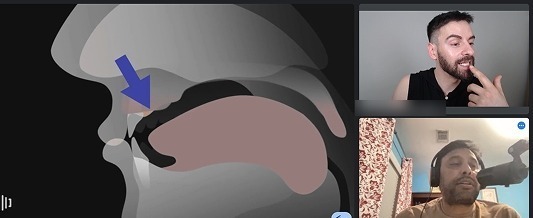
Learning American English pronunciation and the American accent is more effective when you train your speech organs, not only listen and repeat. 2D Sound Motion Technology and Interactive Visual 2D Sound Simulators, created and developed by Prof. Alex, Ph.D. Accent Coach, Doctor of Education, and professional linguist, train your tongue, lips, jaw, teeth, airflow, and voice step by step. They train each American sound and more than 30 sound combinations through Interactive 2D video simulation.
What 2D Sound Motion Technology is
2D Sound Motion Technology is an advanced accent reduction and articulation training tool by Prof. Alex. It corrects, develops, and trains each American sound and more than 30 sound combinations through Interactive 2D video simulation.
What Interactive Visual 2D Sound Simulators do
Interactive Visual 2D Sound Simulators are a part of Interactive American Accent Training to make the learning experience more interactive, not visual or repeat-after-me. Each simulator uses Interactive 2D mouth movement to train the speech organs (tongue, lips, jaw, teeth, airflow, and voice) to produce each American sound correctly. Every consonant has its own simulator: explore American consonants trained with 2D Sound Motion Technology.
Sample training: the American t sound (aspirated [t])
Practice
Record yourself speaking these words:
Tab · Tacos · Time · Tub · Hotel · Motel · Sit · Pit · Net
Instructions
Play the Interactive Visual 2D Sound Simulator for the American t sound below several times and follow it step by step. Move your tongue, jaw, and airflow together with the simulator and train your articulation.
Interactive Visual 2D Sound Simulator: American unvoiced sound [t]
Practice
Record yourself again speaking these words, but this time focus on the movement of your tongue. Go slow, and you will see the difference. You’ve got this!
Tab · Tacos · Time · Tub · Hotel · Motel · Sit · Pit · Net
How Interactive Visual 2D Sound Simulators solve pronunciation and speaking problems
- Wrong articulationMost pronunciation problems start with the tongue, lips, jaw, or teeth in the wrong position. Each Interactive Visual 2D Sound Simulator trains the correct articulation of one American sound, so the student corrects the cause of the problem, not only the result.
- Airflow and voicingMany accent problems come from wrong airflow or voicing: sounds that are too weak, too strong, or voiced when they should be unvoiced. The simulators train airflow and voice together with articulation, step by step, for each American sound and more than 30 sound combinations.
- Clear speech and confidenceWhen each sound is trained correctly, words connect into clear American English speech. Listeners can understand you more easily, and speaking at work, in meetings, and on calls becomes more confident.
If you start hearing the aspiration, the short airstream after [t], with one simulator, you can only imagine how successful you can be in 1-on-1 Interactive American Accent Training with Prof. Alex, Ph.D. Accent Coach, where your whole American sound system is trained sound by sound.
Interactive Visual 2D Sound Simulators are only available in 1 on 1 accent coaching session with Prof. Alex.
FAQ: Tian Pronunciation Evaluation for Mandarin and Chinese Speakers
What is Tian pronunciation evaluation for Mandarin and Chinese speakers?
This Tian pronunciation evaluation explains how a Mandarin and Chinese speaker changed after private online interactive 1-on-1 American accent training with Prof. Alex. It connects before-and-after recordings with changes in American vowels, final consonants, TH, R and L, V and W, stress, rhythm, intonation, connected speech, and fluency.
How did Tian get these pronunciation results with Prof. Alex?
Tian started with a 1 Hour Evaluation Session with Prof. Alex, where she discussed her concerns, learned how professional interactive 1-on-1 American accent training works, and set a clear training goal. Her first major stage was the American Consonants Chapter, which took around 4 months, followed by the American Vowels Chapter, which took around 6 months.
How did Tian’s pronunciation change after training?
Tian’s pronunciation became closer to American English in vowel quality, final consonants, rhythm, word stress, intonation, connected speech, and overall fluency. The after recording sounds more natural, more controlled, and more Americanized than the before recording.
What Mandarin pronunciation patterns can affect American English?
Mandarin speakers often work on English vowel contrast, final consonants, TH sounds, R and L, V and W, consonant clusters, stress-timed rhythm, reduction, sentence intonation, and connected speech. These areas strongly influence how American the speech sounds.
How close does Tian sound to American English after training?
On a subjective listening scale where 100 means indistinguishable from a native American speaker, Tian’s after recording is estimated around 82–87/100, with 85 used as the midpoint in this evaluation. This is an accent-coach listening estimate, not a scientific percentage.
Can Mandarin speakers reduce their accent with MyAccentWay?
Yes. MyAccentWay helps Mandarin and Chinese speakers improve American pronunciation through private online interactive 1-on-1 American accent training with Prof. Alex, Ph.D. Accent Coach, Doctor of Education, and professional linguist.
What is the first step for Mandarin speakers?
The first step is to book a 1 Hour Evaluation Session with Prof. Alex. In that session, students receive a professional speech assessment, understand their accent training needs, and experience MyAccentWay’s Interactive 1-on-1 American Accent Training Method with 2D Sound Motion Technology and Cognitive Accent Training.
Related MyAccentWay resources
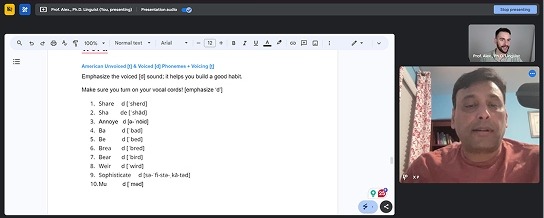
Interactive 1-on-1 vs Traditional Accent Coaching
How Prof. Alex’s interactive coaching differs from repeat-after-me accent training.

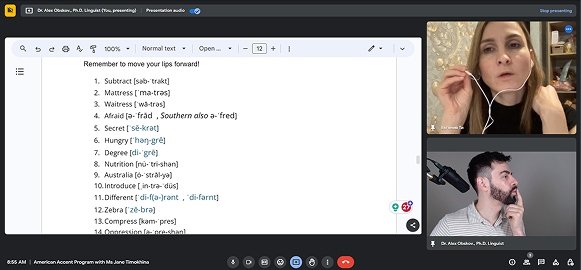
Best Accent Reduction Coaching for Business Professionals
What business professionals should look for in accent reduction and communication training.
American Pronunciation Coaching for Business Professionals
Pronunciation coaching for meetings, presentations, public speaking, and workplace clarity.
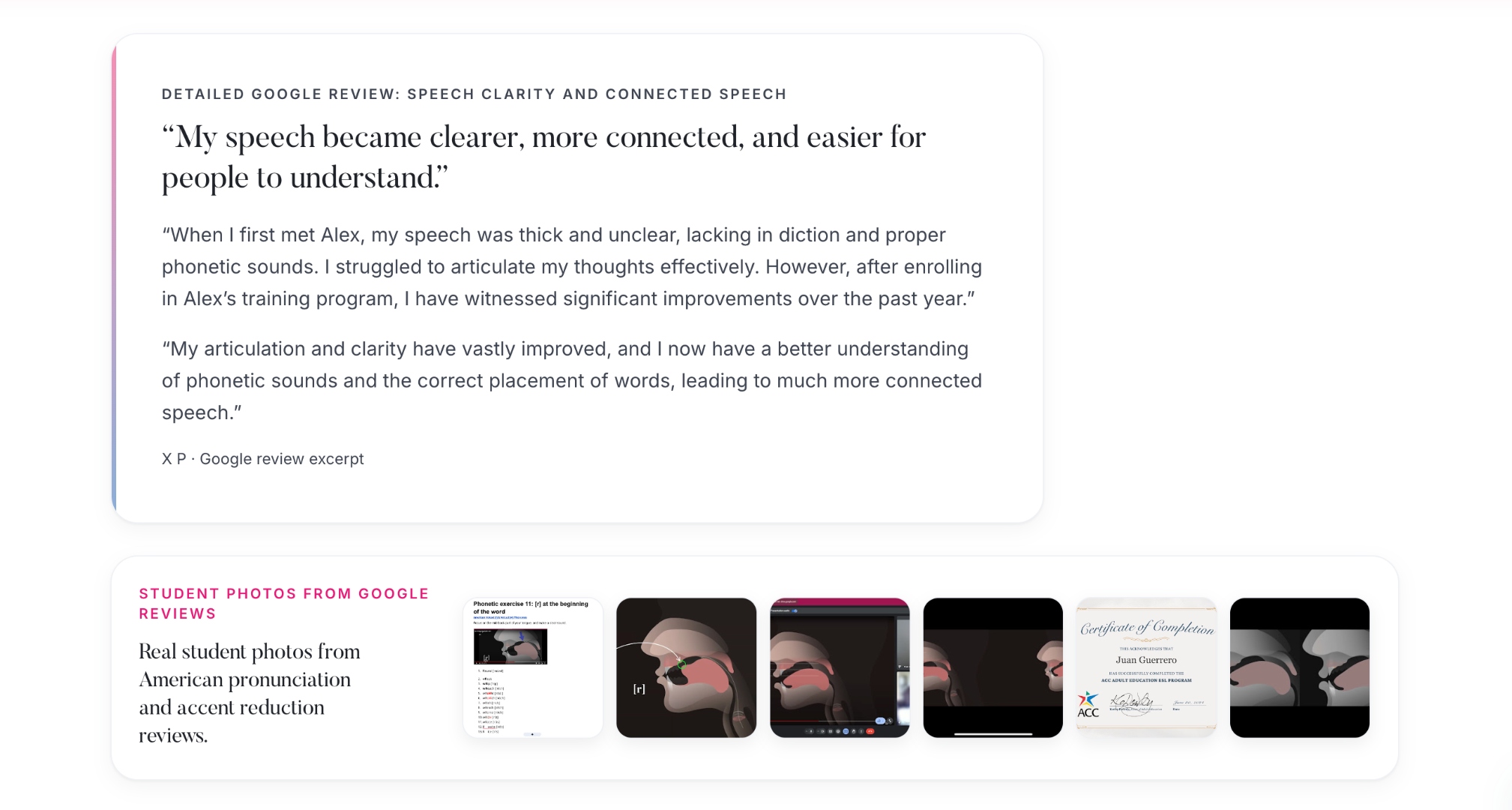
Best American Accent Coach for Non-Native Professionals
What 1-on-1 American accent training with Prof. Alex includes.
2D Sound Motion Technology for American Pronunciation
How Interactive Visual 2D Sound Simulators train American pronunciation.

MyAccentWay vs Accent Advisor
How Prof. Alex’s method differs from traditional live 1-on-1 video lessons.

Prof. Alex’s Teaching Philosophy
Why traditional accent coaching fails and what works instead.
Before-and-After Results
Real student recordings, including Abishek, Tian, and Vlad.
Student Reviews and Results
Reviews and results from MyAccentWay students.