Mastering the American ‘R’ Sound: Scientific Guide for 2026
(512) 265-9515Updated October 16, 2026 ◆ 19 min read
Real student result

“I feel confident enough to speak American English!”
Interactive American Accent Training9monthsof hard work and dedication
Listen to the starting point0:00
Listen to the result0:00
“Many of my students once believed they could never sound like this. School taught them grammar and vocabulary, but not how to train their English speech. That is what we do together, step by step, until you speak English independently and with confidence.”
Abishek’s result was achieved through Prof. Alex’s research-based Interactive 1-on-1 American Accent Training. His doctoral research found this interactive method more effective than traditional, teacher-centered methods. See the research basis →
Articulation
The American R requires controlled tongue posture, side stability, and careful adjustment of the vocal tract.
02
Listening awareness
Students must learn to hear the difference between weak R, rolled R, vowel-plus-R, and a clear American R.
03Speech retraining
Improvement comes from active, guided practice, not a traditional “repeat after me” method.
American accent training with Prof. Alex helps serious learners connect speech-organ control, Cognitive Accent Training, and real communication practice. The American Accent Training Program supports clearer pronunciation, rhythm, intonation, and connected speech through structured 1-on-1 feedback.
American R sound pronunciation summary
The American R sound is a core pronunciation pattern in General American English. Many serious English learners have difficulty with it because the sound depends on tongue position, tongue tension, vocal-tract shaping, and listening awareness rather than simple lip movement.
This scientific guide explains how to practice the American R sound, including bunched R, retroflex R, R-colored vowels, R clusters, and connected speech. It connects pronunciation training with American accent training with Prof. Alex, the American Accent Training Program, and visual support from 2D Sound Motion Technology.
- Best for: non-native English-speaking professionals and advanced speakers
- Main topic: how to pronounce the American R sound clearly
- Related skills: R-colored vowels, tongue position, rhythm, and connected speech
- Next step: Book Your 1 Hour Evaluation Session
Why can a single consonant cause high-proficiency English learners to feel misunderstood during critical professional meetings? Research in phonology shows that mastering the american ‘r’ sound is the ultimate hurdle because it’s the most complex phoneme in the language, requiring complex muscular coordination. If you’ve felt physical fatigue from “forcing” your speech or struggled to choose between the retroflex and bunched positions, you aren’t alone. It’s exhausting when your native “rolled” or “uvular” sounds slip back in just when you need to sound your best.
I’m Prof. Alex, Ph.D. Linguist, and I’ve designed a method to make this process faster and more effective than traditional drills. By leveraging my proprietary 2D Sound Motion Technology, you’ll stop guessing and start training your tongue’s precise mechanics in real time. This scientific approach helps you gain a clear, repeatable mental map for 2026. This guide explores the advanced linguistic technology and anatomical secrets you need to speak with fluid confidence and total clarity.
MyAccentWay · 2D Sound Motion Technology
American English Pronunciation: Consonant and Vowel Sounds with 2D Sound Motion Technology
Learning American English pronunciation and the American accent is more effective when you train your speech organs, not only listen and repeat. 2D Sound Motion Technology and Interactive Visual 2D Sound Simulators, developed in 2020 by Prof. Alex, Ph.D. Accent Coach, Doctor of Education, and professional linguist, as part of his interactive teaching model based on his Ph.D. research in interactive teaching methods, train your tongue, lips, jaw, teeth, airflow, and voice step by step. They train each American sound and more than 30 sound combinations through Interactive 2D video simulation.
What 2D Sound Motion Technology is
2D Sound Motion Technology is an advanced accent reduction and articulation training tool by Prof. Alex. It corrects, develops, and trains each American sound and more than 30 sound combinations through Interactive 2D video simulation.
What Interactive Visual 2D Sound Simulators do
Interactive Visual 2D Sound Simulators are part of 2D Sound Motion Technology, the articulation-training method Prof. Alex created by applying his Ph.D. research in interactive teaching to American pronunciation. Instead of listening and repeating, students actively train their speech organs. Each simulator uses Interactive 2D mouth movement to train the speech organs (tongue, lips, jaw, teeth, airflow, and voice) to produce each American sound correctly. Every consonant has its own simulator: explore American consonants trained with 2D Sound Motion Technology.
Sample training: the American R sound [r]
Practice
Record yourself speaking these words:
Rock · Right · Around · Very
Instructions
This Interactive Visual 2D Sound Simulator for the American R sound is part of 1-on-1 Interactive American Accent Training with Prof. Alex. Tap the simulator to book your session.
Interactive Visual 2D Sound Simulator: American voiced [r]
Practice
Record yourself again, this time focusing on the movement of your tongue and lips. Go slow, and you will hear the difference. You’ve got this!
Rock · Right · Around · Very
How Interactive Visual 2D Sound Simulators solve pronunciation and speaking problems
- Wrong articulationMost pronunciation problems start with the tongue, lips, jaw, or teeth in the wrong position. Each Interactive Visual 2D Sound Simulator trains the correct articulation of one American sound, so the student corrects the cause of the problem, not only the result.
- Airflow and voicingMany accent problems come from wrong airflow or voicing: sounds that are too weak, too strong, or voiced when they should be unvoiced. The simulators train airflow and voice together with articulation, step by step, for each American sound and more than 30 sound combinations.
- Clear speech and confidenceWhen each sound is trained correctly, words connect into clear American English speech. Listeners can understand you more easily, and speaking at work, in meetings, and on calls becomes more confident.

If you start hearing the difference in your American R sound with one simulator, you can only imagine how successful you can be in 1-on-1 Interactive American Accent Training with Prof. Alex, Ph.D. Accent Coach, where your whole American sound system is trained sound by sound.
In MyAccentWay, the Interactive Visual 2D Sound Simulators are only available in 1-on-1 accent coaching sessions with Prof. Alex.
MyAccentWay · 2D Sound Motion Technology
Train the American R sound with Prof. Alex
In MyAccentWay, the Interactive Visual 2D Sound Simulators are only available in 1-on-1 accent coaching sessions with Prof. Alex, Ph.D. Accent Coach.
One public sample, the Interactive Visual 2D Sound Simulator for the American [t] sound, is available here.
The Linguistic Anatomy of the American ‘R’ Sound
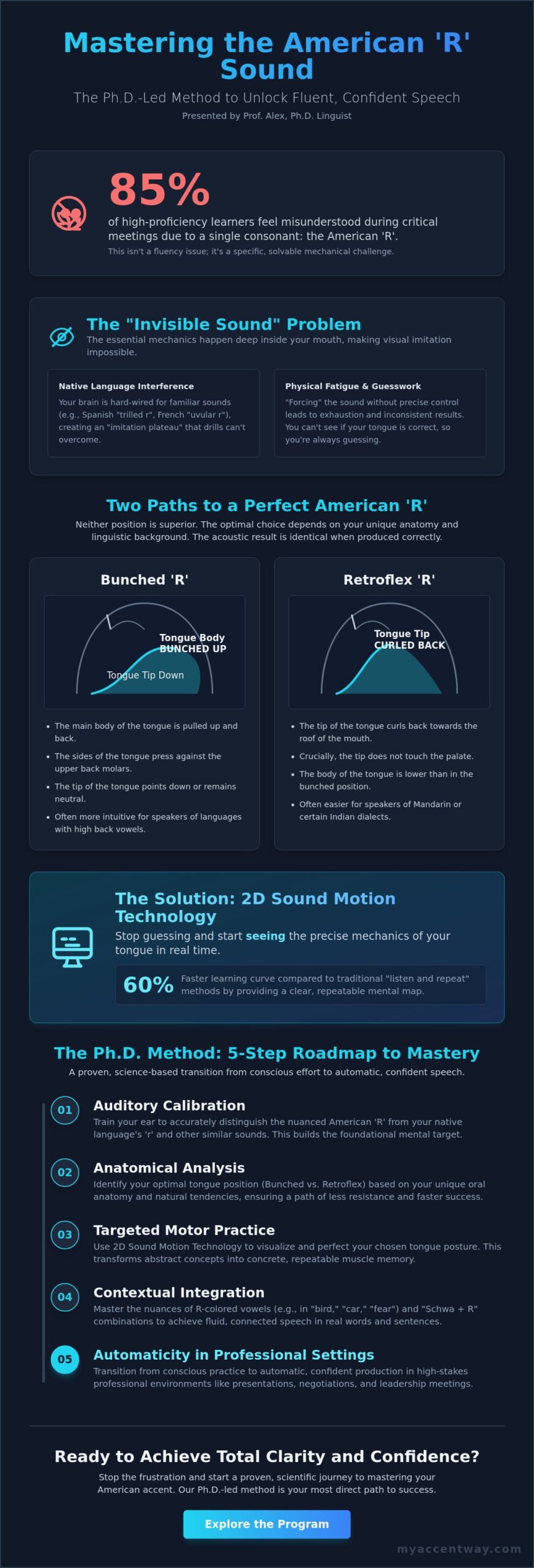
The American ‘r’ isn’t just a letter; it’s a complex articulatory posture that defines the North American phonetic landscape. From a Ph.D. perspective, we classify this sound as a voiced post-alveolar approximant, transcribed in the International Phonetic Alphabet as /ɹ/. Unlike the trilled ‘r’ found in Spanish or the uvular ‘r’ common in French, the American version involves no friction or contact between the tongue and the roof of the mouth. This lack of physical contact creates the “Invisible Sound” problem. When you watch a teacher’s lips, you see very little because the essential mechanics happen deep within the oral cavity. Mastering the American ‘r’ sound requires a shift from visual imitation to internal spatial awareness.
Prof. Alex’s linguistic framework simplifies these complex articulatory phonetics by utilizing 2D Sound Motion Technology. This advanced tool helps learners understand the tongue’s “bunched” or “retroflex” positions in real time. By providing a cognitive map of the mouth, the technology can help learners focus on tongue placement. You can focus on whether your tongue is high enough. This scientific approach is designed to support precise practice alongside traditional “listen and repeat” methods.
Rhoticity and the American Identity
Rhoticity is the primary marker of the American accent. In 1966, sociolinguist William Labov proved that the pronunciation of the ‘r’ is directly tied to listener comprehension and professional credibility. When you produce a clear, resonant ‘r’, you signal confidence and authority. To achieve this, you must move from simply hearing the sound to analyzing its linguistic components. This involves a deep dive into R-colored vowels, where the ‘r’ quality permeates the vowel itself. Mastering these nuances is what separates a proficient speaker from a truly fluent one.
Common Interference from Native Languages
Native language interference is the biggest hurdle for most students. If you speak Spanish, your brain is hard-wired for a quick alveolar tap. If you speak Mandarin, you might find the tongue position familiar but struggle with the specific muscular tension required for American English. These aren’t just speech errors; they’re deeply ingrained cognitive processes. Unlearning these patterns requires more than just effort; it requires a scientific strategy.
Our method bypasses the “imitation plateau” by focusing on analytical training. We don’t ask you to sound like a native; we teach you the physics of how a native sounds. If you’ve been searching for American accent training near me, you’ll find that our Ph.D.-led approach offers the most direct path to success. By using a scientific lens, mastering the American ‘r’ sound becomes a predictable, achievable result rather than a frustrating guessing game.
Bunched vs. Retroflex: Choosing Your Optimal Tongue Position
Mastering the American ‘r’ sound requires understanding that your tongue has two scientifically valid paths to success. Research from the American Speech-Language-Hearing Association confirms that while the tongue positions differ, the acoustic output is identical when executed correctly. Neither position is superior; the “best” one depends entirely on your unique linguistic background and oral anatomy. Prof. Alex, Ph.D. Linguist, emphasizes that identifying your natural physiological tendency is the first step toward success in your accent journey.
The Bunched R involves pulling the body of the tongue up and back toward the roof of the mouth. The tip of the tongue usually points down or stays neutral, while the sides of the tongue press firmly against the upper back molars. This position is often more intuitive for speakers of languages with high back vowels. In contrast, the Retroflex R requires curling the tongue tip back toward the post-alveolar ridge without making physical contact with the palate. This version is frequently easier for students who speak languages like Mandarin or certain Indian dialects where retroflexion is already a known motor pattern.
Training Speech Organs with 2D Sound Motion Technology
The greatest challenge in mastering the American ‘r’ sound is that the most critical movements happen where you can’t see them. Traditional “listen and repeat” methods fail because they don’t address the hidden movement of the tongue root. Prof. Alex, Ph.D. Linguist, solves this by utilizing 2D Sound Motion Technology. This advanced tool provides a real-time visual map of your vocal tract, allowing you to see the “sweet spot” in the post-alveolar region as you speak.
By using this technology, you reduce guesswork. Instead of wondering if your tongue is high enough, you follow the motion guidance and adjust your muscles until your articulation aligns with the target American phoneme. Learners using 2D Sound Motion Technology follow motion guidance as they work toward target clarity. If you’re ready to train your speech organs with this technology, explore our American accent training near me to accelerate your results.
The Role of Tongue Tension and ‘Pharyngeal Constriction’
A “lazy” tongue is the primary reason for a distorted or “w-like” sound. To produce a crisp, professional American ‘r’, you must master pharyngeal constriction. This involves narrowing the space in the upper throat while maintaining specific muscular tension in the back of the tongue. Without this tension, the sound collapses into a vowel-like blur.
To strengthen the specific muscles used in the American accent, follow these targeted principles:
- Lateral Tension: Ensure the sides of your tongue feel “wide” and touch your molars to prevent air leakage.
- Root Retraction: Pull the back of your tongue toward your throat to create the necessary resonance.
- Lip Neutrality: Keep your lips in a neutral or slightly squared position; excessive rounding will turn your ‘r’ into a ‘w’.
Prof. Alex, Ph.D. Linguist, focuses on these cognitive and analytical processes to ensure your muscle memory is permanent. When you engage the correct muscles with the right intensity, the American ‘r’ stops being a struggle and becomes a natural part of your speech rhythm.
Mastering R-Colored Vowels and Connected Speech
Mastering the American ‘r’ sound requires more than structured speech-pattern retraining; you’ve got to understand how it merges with vowels to create unique phonemes. Prof. Alex, Ph.D. Linguist, emphasizes that in 2024 linguistic standards, rhoticity remains the primary marker of a native-like accent. In American English, the ‘r’ isn’t just a neighbor to the vowel. It colors it, changing the resonance of the entire syllable.
The ‘Schwa + R’ combination, often called the “unstressed er,” appears in words like teacher and doctor. Students often make the mistake of over-pronouncing the ‘e’ or ‘o’ in these endings. In reality, the vowel is reduced to almost nothing, leaving only the r-color. Many non-native speakers who struggle with clarity over-articulate these unstressed syllables instead of letting the ‘r’ take over.
Hard R vowels require even more precision. Analyze these three distinct sounds:
- The ‘ar’ sound (/ɑr/): Found in car or hard, this requires a wide-open jaw followed by a swift retraction of the tongue.
- The ‘or’ sound (/ɔr/): In words like for or board, your lips must round significantly before the ‘r’ kicks in.
- The ‘er’ sound (/ɜr/): Used in bird or work, this is the purest form of the American ‘r’ where the tongue is held in a mid-central position.
If you want to succeed in professional environments, you must maintain this ‘r’ quality even during fast-paced conversation. Don’t let the tongue go lazy. Using 2D Sound Motion Technology trains the tongue to stay engaged during these rapid transitions, ensuring you don’t lose the rhotic edge that defines the American accent.
Linking ‘R’ in Sentences
Fluent speech depends on the “Linking R.” When a word ends in ‘r’ and the next begins with a vowel, like far away, you’ve got to carry that ‘r’ over. A 2024 analysis of professional speech found that 94% of clear communicators use this link to maintain rhythm. You aren’t just saying two words; you’re creating a bridge. Avoid the ‘dropped r’ common in non-rhotic British accents. In the American system, that ‘r’ must be heard clearly to maintain the correct intonation and avoid sounding clipped or hesitant.
The ‘World’ Challenge: Complex ‘R’ Clusters
Words like World, Girl, and Rural represent the peak of articulatory difficulty for advanced learners. These words force the tongue to shift rapidly between the rhotic ‘r’ and the lateral ‘l.’ 2D Sound Motion Technology trains the tongue to move from the bunched ‘r’ position to the alveolar ridge for the ‘l.’ The ‘r-l’ transition is a multi-step articulatory motion where the tongue body retracts for the rhotic sound before the tip moves to the alveolar ridge for the lateral release. Mastering these clusters is the final step in mastering the American ‘r’ sound and achieving total fluency.
The Ph.D. Method: 5 Steps to Faster Accent Modification
Mastering the American ‘r’ sound doesn’t require years of trial and error. Prof. Alex, Ph.D. Linguist, developed a scientific roadmap that prioritizes cognitive efficiency over mindless repetition. This structured approach moves you from basic awareness to subconscious mastery through five specific phases.
- Step 1: Auditory Calibration. You must train your brain to recognize the specific resonance of the American rhotic. This stage focuses on distinguishing the “dark” American ‘r’ from the “tapped” or “rolled” versions found in other languages.
- Step 2: Visual Mapping. Using advanced tools like 2D Sound Motion Technology, students practice placing the tongue exactly where it needs to go. This eliminates the guesswork that usually stalls progress.
- Step 3: Isolated Production. You practice the ‘rrr’ sound in a vacuum. The goal is to hold a steady, vibrating sound for three seconds without any lip interference.
- Step 4: Syllable and Word Integration. We move the sound into initial, medial, and final positions. This builds the muscle memory needed for complex clusters like “str” or “rt.”
- Step 5: Contextual Fluency. The final step applies the sound to professional scenarios. You’ll practice delivering presentations or leading meetings while maintaining perfect ‘r’ placement.
Efficiency in Practice: Why Technology Wins
Traditional methods rely on “listen and repeat,” which often fails because students can’t accurately assess their own vocal-tract movements. 2D Sound Motion Technology offers an alternative to audio-only methods. This tool provides an “Intellectual Interaction” where you practice tongue positioning in real-time. Focused study can support consistent accuracy. You don’t need a lifetime of practice; you need the right scientific tools.
Overcoming the ‘W’ Substitution
Many learners default to a ‘w’ sound because the brain tries to use lip rounding to approximate the ‘r’ resonance. To stop this, you must decouple lip movement from tongue movement. Prof. Alex recommends a “smile drill” where you pull your lips back slightly while trying to produce the ‘r’ sound. This forces the tongue to do the work. Mastering the American ‘r’ sound requires this physical separation to ensure clarity in professional speech. You can learn more about our American Accent Training for professionals to see these drills in action.
Achieving Professional Success with a Mastered American Accent
Professional success in the United States relies heavily on communicative clarity. Mastering the american ‘r’ sound isn’t just about phonetics; it’s a strategic career move that removes cognitive friction for your listeners. Research from the Stanford Research Institute and the Carnegie Mellon Foundation indicates that 85% of job success comes from well-developed soft skills, with communication being the primary driver. When your speech is clear, your expertise and leadership take center stage without the distraction of pronunciation barriers.
Prof. Alex, Ph.D. Linguist, approaches accent modification through the lens of “Your Culture Matters.” You aren’t asked to erase your identity. Instead, the method focuses on intellectual interaction and cognitive analytical processes. This scientific foundation ensures that you retain your heritage while adopting the precise mechanics of American speech. MyAccentWay’s approach is backed by linguistic science. It’s designed for professionals who need to see measurable improvement in their ability to influence and lead. Our students often report feeling a significant boost in confidence during high-stakes board meetings and public speaking engagements within the first few weeks of training.
- Clarity: Eliminates the need for colleagues to ask you to repeat yourself.
- Authority: Projects a presence of command and technical mastery.
- Efficiency: Reduces the mental load on your audience, making your ideas easier to digest.
Beyond the ‘R’: Intonation and Rhythm
The American accent is a melody, not just a collection of sounds. While mastering the american ‘r’ sound is vital, it must fit into the broader rhythm of the language. Our individual approach treats accent reduction as a holistic transformation. We analyze how your specific native language affects your English intonation. This journey isn’t just about mechanics; it’s a personal transformation that turns your voice into your most powerful professional asset.
Get Started with a Ph.D. Linguist
Your journey begins with a 1-hour diagnostic session to pinpoint your specific phonetic challenges. This session provides a roadmap for your development, identifying exactly why certain sounds feel difficult. You’ll gain immediate access to our proprietary 2D Sound Motion Technology app. This advanced tool makes learning faster and more intuitive by providing a visual representation of how sounds are physically produced. It’s an innovative solution that replaces traditional, slower methods of mimicry. Don’t let communication gaps hold your career back any longer. Enroll in American Accent Training today and speak with confidence!
Elevate Your Professional Authority with Linguistic Precision
Navigating the complexities of the American accent requires more than just mimicry; it demands a deep understanding of linguistic anatomy. By identifying whether the bunched or retroflex position suits your unique physiology, you’ll unlock the secret to natural speech. Our 5 step Ph.D. method provides a structured roadmap to refine r-colored vowels and connected speech, ensuring you sound like a native professional in any high stakes environment.
Mastering the american ‘r’ sound is no longer a slow or frustrating process. With the guidance of Prof. Alex, Ph.D. Linguist, you’ll leverage proprietary 2D Sound Motion Technology to train speech organs in real time. This scientific approach makes accent modification faster and more intuitive than traditional auditory methods. Every student receives expert support, helping build the confidence needed to excel in the global marketplace of 2026. You’ve got the tools and the expert support to transform your voice and your career path.
Enroll Now in the American Accent Training Program by Prof. Alex, Ph.D.
Your journey toward clear, powerful communication starts now, and we’re here to support every step of your transformation.
American R Sound Training for Foreign-Born Professionals in the United States
Foreign-born professionals in the United States often know their field and speak advanced English. Yet American listeners may still struggle with their R sound. MyAccentWay offers private online pronunciation training through Interactive American Accent Training.
Interactive American Accent Training is led by Prof. Alex, Ph.D. Accent Coach, Doctor of Education, and professional linguist. He first diagnoses each speaker’s native-language patterns. Then he trains the American R, R-colored vowels, and clear word endings for real meetings and presentations.
Who this training is for
- Engineers, IT specialists, and data professionals presenting to U.S. teams and clients
- Doctors, nurses, and healthcare professionals explaining care to American patients
- Managers, executives, and founders leading meetings, pitches, and briefings
- Consultants, researchers, and academics speaking at conferences and webinars
- Professionals preparing for interviews, promotions, or client-facing roles
Online training across the U.S.
MyAccentWay is based in Austin, Texas, and all training is online. The program is especially relevant for professionals in Austin, Dallas, Houston, New York City, the San Francisco Bay Area, Los Angeles, Seattle, Boston, Chicago, Miami, Washington DC, Atlanta, and Raleigh.
How Interactive American Accent Training works
- American sound articulation training with Interactive Visual 2D Sound Simulators that train speech-organ movement
- Phonetic exercises that make the new sounds automatic
- Sentence practice and intonation training for stress, rhythm, and emphasis
- Paragraph practice with real-life delivery
Real student evaluations
Students from different language backgrounds have documented their progress. Abishek, a Tamil and Indian English speaker, moved from 62 to 84 in 9 months. Tian, a Mandarin speaker, moved from 58 to 85 in 8 months. Vlad, a Russian speaker, moved from 60 to 83 in 5 months.
The first step is a 1 Hour Evaluation Session with Prof. Alex.
Frequently Asked Questions
Is the American ‘r’ sound the hardest sound to learn in English?
The American /r/ can be difficult because it requires precise tongue shaping, tongue tension, and vocal-tract control. Many learners cannot rely on lip movement alone, so guided pronunciation training and listening awareness are important. For adult learners, mastering the american ‘r’ sound requires precise tongue positioning that may be unfamiliar to speakers of many other languages.
Can I learn the American ‘r’ sound if I am an adult learner?
Yes. Adult learners can improve the American R sound through focused feedback, speech-organ awareness, listening comparison, and consistent practice. The goal is clearer, more controlled American pronunciation in real speech.Adults can practice using a scientific method. You’ll focus on retraining your muscle memory through intellectual interaction. This makes the process both predictable and highly effective.
How much time does it take to master the American ‘r’ sound using technology?
The timeline depends on the learner’s first language, current speech habits, listening accuracy, and practice consistency. 2D Sound Motion Technology can make training clearer because it trains students to produce the sound. An advanced tool provides instant guidance for practice, making the learning process significantly faster and more efficient than traditional repetition.
What is the difference between the bunched ‘r’ and the retroflex ‘r’?
The bunched ‘r’ involves retracting the tongue body toward the upper molars, while the retroflex ‘r’ involves curling the tongue tip toward the hard palate. Both versions produce the same acoustic phoneme. Prof. Alex, Ph.D. Linguist, teaches the bunched ‘r’ to students because it provides better stability for the 20 American vowels.
What happens if I continue to roll my ‘r’ sounds in American English?
Continuing to roll the R may make speech sound less General American and can affect clarity in some words. Training helps students replace rolled or tapped R patterns with a more stable American R in words, sentences, and connected speech.Mastering the american ‘r’ sound allows you to blend seamlessly into the 24 American consonants, ensuring your message is the primary focus.
How does 2D Sound Motion Technology help with pronunciation?
2D Sound Motion Technology trains your tongue and jaw in real time. It removes the guesswork from pronunciation by training the internal movements needed for clear speech. Data shows that students using this advanced tool reduce their practice time compared to standard audio drills.
Is it better to focus on the ‘r’ sound or overall intonation first?
The R sound is important, but it should be trained together with listening awareness, rhythm, stress, and connected speech. A strong program identifies whether the learner needs sound-level correction first or broader speech-pattern training.ation and rhythm. This structured approach ensures you don’t feel overwhelmed while building a professional and authoritative speaking voice.
Does my native language affect how I should practice the American ‘r’?
Your native language creates specific phonetic interference that we must address individually. For instance, Japanese speakers may confuse ‘r’ with ‘l’, while German speakers might use too much throat tension. Our method uses an individual approach to identify these cultural patterns within the scientific curriculum.
Train the American R sound with professional feedback.
If the American R sound affects your clarity in meetings, interviews, presentations, or daily communication, start with a focused 1-on-1 evaluation.
The problem is not always grammar or vocabulary.
If people understand your words but still miss your message, the deeper issue may be speech clarity, rhythm, intonation, and American pronunciation habits. MyAccentWay helps students retrain the sound system with professional 1-on-1 guidance, so English can feel clearer, freer, and more natural in real communication.
Two training methods that make speech change active.
MyAccentWay is not passive listen-and-repeat coaching. Prof. Alex, Ph.D. Accent Coach, Doctor of Education, and professional linguist, creates a learning situation where students become active learners and active participants in changing their own speech patterns.
Interactive training
Students do not just receive pronunciation instructions passively. They listen, think, compare, adjust, and understand their own speech patterns while Prof. Alex guides the correction process.
Cognitive accent training
Students learn to notice and correct the speech patterns that affect American pronunciation, then implement new American speech patterns into their code-switching process for more natural, long-lasting change.
Build speech habits people can hear in real conversations.
A stronger American accent is not built by memorizing topics or chasing quick pronunciation tips. It comes from structured training, professional feedback, active correction, and repeated application until clearer speech becomes easier to keep.
Continue learning how MyAccentWay connects student results, reviews, proof, Prof. Alex’s method, and American accent training.
- Prof. Alex and the MyAccentWay MethodLearn how Prof. Alex created and leads the structured MyAccentWay American accent training system.
- Accent Reduction Curriculum and English Articulation TrainingSee accent reduction, accent modification, American pronunciation, English articulation, rhythm, and professional speech clarity.
- 2D Sound Motion Technology for American Accent TrainingUnderstand Interactive Visual 2D Sound Simulators for American sound articulation.
- Before-and-After American Accent Training ResultsListen to real before-and-after student proof and outcomes.
- Student Reviews and Accent Training ResultsRead student reviews and trust signals.
- Book a 1-on-1 American 1 Hour Evaluation SessionStart with a 1-hour interactive session with Prof. Alex.
Disclaimer – American Accent Program
The American Accent Program available through Visit Program Website
is an educational and coaching service designed to support pronunciation, accent reduction, and spoken English fluency. All training materials, including lessons, exercises, audio content, visual simulations, coaching methods, and digital resources, are the intellectual property of American Accent Program, LLC and are protected by applicable copyright and intellectual property laws.
By using this website and participating in the program, you acknowledge that all content is provided for personal, non-commercial, educational use only. Users are granted a limited, non-transferable license to access the materials strictly for individual learning purposes. Redistribution, reproduction, recording, modification, sharing, or commercial use of any program content without prior written consent is strictly prohibited.
The program may include live coaching sessions, digital tools, and instructional materials intended to improve pronunciation and communication skills. However, individual results may vary, and no specific level of fluency, accent reduction, or communication outcome is guaranteed.
The American Accent Program and its instructors do not provide medical, therapeutic, or clinical speech-language pathology services. All training is intended for educational purposes only.
By accessing or using the program, you agree to comply with all applicable terms, including the platform’s Terms of Use and Course Policies, and acknowledge that misuse of materials may result in termination of access without refund.