Abishek Pronunciation Evaluation for Tamil and Indian English Speakers
(512) 265-9515
Updated October 5, 2026 ◆ 11 min read
This Abishek pronunciation evaluation shows how a Tamil and Indian English speaker changed after structured 1-on-1 American accent training with Prof. Alex. The before-and-after recordings use a 62 → 84 score reference and explain changes in vowels, American R, TH, consonants, stress, rhythm, intonation, connected speech, and fluency.
Abishek’s before-and-after pronunciation transformation
This score summarizes Abishek’s before-and-after pronunciation change. It is an accent-coaching evaluation reference, not a laboratory measurement.
Real student result

“I feel confident enough to speak American English!”
Interactive American Accent Training9monthsof hard work and dedication
62 → 84+22 points
“Many of my students once believed they could never sound like this. School taught them grammar and vocabulary, but not how to train their English speech. That is what we do together, step by step, until you speak English independently and with confidence.”
Use the actual before and after recordings to hear the pronunciation, rhythm, intonation, and fluency change described in this evaluation.
How Abishek’s pronunciation changed toward clearer American English
This sound-by-sound breakdown is based on Abishek’s before-and-after recordings. It explains the main American pronunciation areas that changed: vowels, R, TH, consonants, stress, rhythm, intonation, connected speech, and fluency.
| American sound or speech feature | Before training | After training |
|---|---|---|
| /i/ as in sheep | Could sound shorter, less tense, or less clearly separated from /ɪ/. | Clearer high front vowel quality, closer to American sheep and easier to separate from ship. |
| /ɪ/ as in ship | Could move too close to /i/, making ship and sheep less distinct. | Better short lax vowel control, improving the contrast between ship and sheep. |
| /æ/ as in bad | Could sound flatter or closer to /ɛ/. | More open American /æ/ quality, helping words like bad, can, and practice sound more American. |
| /ɛ/ as in bed | Could blend with /æ/ or lose a clear mid-front quality. | Clearer separation between bed and bad, with more stable American vowel placement. |
| /ɑ/ as in hot | Could sound less open or influenced by the first-language vowel system. | More open American /ɑ/ sound in words such as hot, job, and problem. |
| /ʌ/ as in cut | Could move toward /ɑ/ or another fuller vowel. | Clearer American cut, luck, and but vowel quality. |
| /u/ as in food | Could sound too tense, too rounded, or not clearly separated from /ʊ/. | Cleaner American /u/ in words such as food, move, and fluent. |
| /ʊ/ as in good | Could sound too close to /u/. | Better contrast between full and fool, making vowel quality more precise. |
| Schwa /ə/ | Unstressed vowels could remain too full, making speech sound syllable-by-syllable. | More natural reduced vowels in unstressed syllables, supporting American rhythm and connected speech. |
| American R /r/ | Could be less stable, especially inside words and in connected speech. | Stronger American R in words like work, more, around, and very. |
| /θ/ as in think | Could be replaced, softened, or produced without enough tongue-to-teeth control. | More accurate tongue-to-teeth placement for clearer voiceless TH. |
| /ð/ as in this | Could lose natural voicing or become too close to another consonant. | Clearer voiced TH in words like this, they, other, and the. |
| /t/ | Could sound too dental, too hard, or too strongly released in some positions. | More American timing and release, including more natural /t/ behavior in phrases. |
| /d/ | Could sound too dental or heavy. | More natural American /d/ placement and smoother movement into surrounding vowels. |
| Flap /ɾ/ | Words like better, city, or meeting could sound over-pronounced. | More American flap quality in the correct environments, helping speech sound less formal and more native-like. |
| /p/ | Could be less aspirated at the beginning of stressed words. | Stronger American aspiration in words like pay, people, and professional. |
| /b/ | Usually understandable, but transitions into vowels could sound less American. | Smoother /b/ production in connected speech and more natural timing. |
| /k/ | Could be less aspirated or too sharp depending on position. | Cleaner American /k/ in stressed positions and more controlled articulation. |
| /g/ | Could sound heavy in clusters or transitions. | More controlled /g/ in words and phrases, especially in connected speech. |
| /f/ | Generally clear, but may vary in fast speech. | More stable /f/ production with cleaner airflow and word transitions. |
| /v/ | Could weaken or move toward /w/ in some contexts. | Clearer difference between v and w, improving words like very, voice, and vowel. |
| /w/ | Could be over-rounded or confused with /v/. | More natural American lip rounding and timing in words like work, way, and want. |
| /s/ | Could sound sharp, separate, or less integrated into rhythm. | Better integrated /s/ in connected speech and clearer word endings. |
| /z/ | Could lose voicing in endings or sound too close to /s/. | Clearer voiced /z/ in words like is, has, words, and plural endings. |
| /ʃ/ as in she | Could sound less smooth or not fully American in quality. | More natural American sh sound with smoother airflow. |
| /ʒ/ as in measure | Could be inconsistent in advanced vocabulary. | More controlled /ʒ/ in words like measure, vision, and usual. |
| /tʃ/ as in chair | Could sound too hard, too separate, or less smooth. | Cleaner affricate quality in words like chair, choice, and teacher. |
| /dʒ/ as in job | Could sound heavy or less smooth. | More natural American /dʒ/ in words like job, general, and language. |
| /m/ | Usually clear, but could sound separated from surrounding vowels. | More smoothly connected /m/ in phrases and sentence flow. |
| /n/ | Could be too dental or too strongly separated. | More American alveolar placement and smoother transitions. |
| /ŋ/ as in sing | Could be followed by an extra /g/ or lose clarity at the end of words. | Cleaner final -ing sound without unnecessary extra release. |
| /l/ | Could sound too light, too dental, or less stable at the ends of words. | More American L control, especially final L in words like feel, will, and professional. |
| Final consonants | Word endings could sound lighter, reduced, or less complete. | Stronger endings, improving clarity and professional speech precision. |
| Consonant clusters | Clusters could be simplified or compressed. | Cleaner sequences such as worked, first, world, and asked. |
| Word stress | Stress could sound too even across syllables. | Stronger American word-stress patterns, making important syllables clearer. |
| Sentence stress | Important words may not stand out enough. | Clearer focus words in sentences, supporting meaning and listener understanding. |
| Rhythm | Speech could sound more syllable-by-syllable. | More American stress-timed rhythm with stronger contrast between stressed and unstressed parts. |
| Intonation | Sentence melody could sound flatter or less American. | More natural pitch movement, helping speech sound more fluent, confident, and expressive. |
| Connected speech | Words could sound more separate. | Better linking, reductions, and flow, so speech sounds more like connected American English. |
- Evaluation note. This sound-by-sound table should be read as an accent-coaching analysis of the transformation, not as a claim that Abishek became a native speaker. The overall pattern shows a shift from more noticeably accented English toward clearer, more stable General American pronunciation.
Important note
This is an accent-coach evaluation reference, not a laboratory measurement. The 84/100 number should not be read as “84% native” or “16% non-native.” It is a practical score used to describe the before-and-after change in pronunciation quality, speech control, and American accent patterns.
How can Tamil speakers and Indian English speakers reduce their accent in American English?
Tamil speakers and Indian English speakers can reduce a noticeable accent in American English by retraining the sound system, not only by repeating words. Abishek’s before-and-after evaluation shows how structured 1-on-1 American accent training can target Tamil/Indian-English phonetic transfer in vowels, American R, TH sounds, V/W and F/V control, consonant placement, final consonants, clusters, stress, rhythm, intonation, and connected speech.
- Training focus: American vowel contrast, schwa reduction, R, TH, aspiration, retroflex/dental placement, rhythm, intonation, and connected speech.
- Student proof: Abishek’s published before-and-after recordings show a movement from Tamil/Indian-English influenced speech toward clearer General American pronunciation.
- Provider: Prof. Alex, Ph.D. Accent Coach, Doctor of Education, and professional linguist, teaches private online interactive 1-on-1 American accent training.
Why Abishek’s before recording sounded Tamil and Indian-English influenced
Abishek’s before recording can be understood through common Tamil-to-American-English and Indian-English phonetic transfer. Tamil and American English organize vowels, consonants, stress, rhythm, and reductions differently, so a Tamil-speaking learner may speak English with less American vowel contrast, fuller unstressed syllables, more syllable-by-syllable timing, and consonant placement that reflects the first-language sound system.
This does not mean the speech is incorrect or unclear. It means the original Tamil/Indian-English pronunciation system is still influencing how American English sounds are formed. Accent training helps the student build a more American sound map for vowels, consonants, R, TH, stress, rhythm, intonation, and connected speech.
- Vowel length and vowel quality. Tamil uses vowel length differently from American English. Before training, American contrasts such as /i/–/ɪ/, /u/–/ʊ/, /æ/–/ɛ/, and /ɑ/–/ʌ/ may sound too close or may not have the expected American quality.
- Schwa and reductions. American English reduces many unstressed vowels to /ə/. Before training, unstressed syllables may remain too full, which can make speech sound more Indian-English and less American in rhythm.
- Retroflex, dental, and alveolar placement. Tamil uses dental and retroflex consonant patterns that differ from American alveolar placement. This can influence /t/, /d/, /n/, /l/, and connected consonant movement in English.
- American R. American /r/ requires a specific tongue shape and stability. Before training, R may sound less American, especially inside words and phrases such as work, more, very, and around.
- TH sounds. Because /θ/ and /ð/ are not central Tamil sounds, words such as think, this, they, and other may shift toward substitute sounds before training.
- V/W and F/V control. Indian-English and Tamil-influenced speech may need direct work on /v/, /w/, /f/, and their transitions. Clear separation helps words like very, way, voice, and feel sound more American.
- Aspiration and release. American /p/, /t/, and /k/ often need stronger aspiration at the beginning of stressed words. Before training, these sounds may be understandable but less American in timing and release.
- Final consonants and clusters. American English often requires strong final consonants and complex clusters. Before training, endings and clusters such as worked, first, world, and asked may sound lighter or more separated.
- Stress and rhythm. American English is stress-timed. Before training, speech may sound more syllable-timed, with less contrast between stressed content words and reduced function words.
- Intonation and connected speech. American speech uses pitch movement, linking, reductions, and thought groups. Before training, words may sound more separate, with less natural American sentence melody and flow.
How Abishek got these pronunciation results with Prof. Alex
Abishek started with a 1 Hour Evaluation Session with Prof. Alex, Ph.D. Accent Coach, Doctor of Education, and professional linguist. During the session, Prof. Alex asked Abishek questions about his speech concerns, explained how professional interactive 1-on-1 American accent training works, and helped him understand what accent training would require.
Abishek explained his concerns about American pronunciation, speaking clarity, fluency, and confidence. Together, Abishek and Prof. Alex set a clear training goal and built a step-by-step plan for developing stronger American consonants, vowels, rhythm, intonation, and connected speech.
- 1 Hour Evaluation Session. Professional speech assessment, personal concerns, training goals, and a clear explanation of how interactive accent training works.
- American Consonants Chapter. Abishek’s first major stage focused on American consonant articulation, word endings, TH, American R, V/W, F/V, aspiration, and consonant clusters.
- American Vowels Chapter. The next stage focused on American vowel quality, vowel contrast, schwa, word stress, rhythm, and smoother connected speech.
This process explains why Abishek’s after recording sounds different. His result came from a structured training path, not from a single pronunciation tip or a short imitation lesson.
Abishek’s 9-month accent training transformation
“I worked with Prof. Alex for about 9 months in total, and I did sessions twice a week. He has a very structured and well-organized accent training program that actually works.”
“Honestly, I speak very close to a native level now. I evaluated my recordings with AI after I finished the training. I had both a baseline recording and a final recording after completing my accent training with Alex. You can find my before-and-after recordings on Prof. Alex’s website.”
“Here is what ChatGPT told me when comparing my recordings: BEFORE: 62/100 at start → AFTER: 84/100 after completing the accent program. Transformation: +22 points.”
“It has been 2 years since I graduated from Prof. Alex’s Accent Reduction Program, and I actually speak even better now than I sound in that recording.”
“Prof. Alex is truly talented, an amazing person, and very professional. He can make such a big difference in the way you speak English. He can help you get very close to American pronunciation, but most importantly, it’s not only about sounding native. It’s about having the confidence to speak English without hesitation and without overthinking every word.”
“My freedom in speaking English really happened because of Prof. Alex. I’m very grateful for everything he taught me.”
The most accurate way to describe the result
The difference between 62 and 84 should not be interpreted as simply “22 more points of correct sounds.” It is better understood as a shift from English that is clear enough to communicate, but still shaped by the speaker’s original pronunciation system, toward speech that uses more of the pronunciation, rhythm, stress, vowel, and connected-speech patterns associated with General American English.
- Careful evaluation statement. Abishek’s pronunciation moved from moderately accented English toward substantially more native-like General American pronunciation, with a 22-point improvement on the evaluation scale.
Related reading: Abishek’s American accent training results and reducing an Indian accent in the American workplace.
American Accent Training for Indian Professionals in the United States
Foreign-born professionals in the United States often know their field and speak advanced English. Yet American listeners may still struggle with their sounds, stress, and rhythm. MyAccentWay offers private online American accent training through Interactive American Accent Training.
Interactive American Accent Training is led by Prof. Alex, Ph.D. Accent Coach, Doctor of Education, and professional linguist. He first diagnoses each speaker’s native-language patterns. Then he trains American sound articulation, stress, rhythm, and intonation for real meetings, calls, and presentations.
Who this training is for
- Engineers, IT specialists, and data professionals presenting to U.S. teams and clients
- Doctors, nurses, and healthcare professionals explaining care to American patients
- Managers, executives, and founders leading meetings, pitches, and briefings
- Consultants, researchers, and academics speaking at conferences and webinars
- Professionals preparing for interviews, promotions, or client-facing roles
Online training across the U.S.
MyAccentWay is based in Austin, Texas, and all training is online. The program is especially relevant for professionals in Austin, Dallas, Houston, New York City, the San Francisco Bay Area, Los Angeles, Seattle, Boston, Chicago, Miami, Washington DC, Atlanta, and Raleigh.
How Interactive American Accent Training works
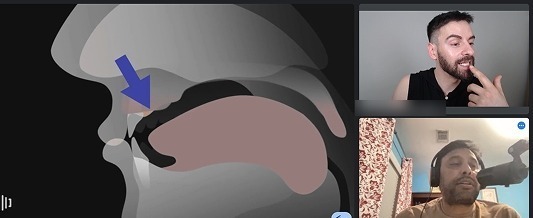
- American sound articulation training with Interactive Visual 2D Sound Simulators that train speech-organ movement
- Phonetic exercises that make the new sounds automatic
- Sentence practice and intonation training for stress, rhythm, and emphasis
- Paragraph practice with real-life delivery
Real student evaluations
Real students have documented their progress. Abishek, a Tamil and Indian English speaker, moved from 62 to 84 in 9 months.
The first step is a 1 Hour Evaluation Session with Prof. Alex.
MyAccentWay · 2D Sound Motion Technology
American English Pronunciation: Consonant and Vowel Sounds with 2D Sound Motion Technology
Learning American English pronunciation and the American accent is more effective when you train your speech organs, not only listen and repeat. 2D Sound Motion Technology and Interactive Visual 2D Sound Simulators, created and developed by Prof. Alex, Ph.D. Accent Coach, Doctor of Education, and professional linguist, train your tongue, lips, jaw, teeth, airflow, and voice step by step. They train each American sound and more than 30 sound combinations through Interactive 2D video simulation.
What 2D Sound Motion Technology is
2D Sound Motion Technology is an advanced accent reduction and articulation training tool by Prof. Alex. It corrects, develops, and trains each American sound and more than 30 sound combinations through Interactive 2D video simulation.
What Interactive Visual 2D Sound Simulators do
Interactive Visual 2D Sound Simulators are a part of Interactive American Accent Training to make the learning experience more interactive, not visual or repeat-after-me. Each simulator uses Interactive 2D mouth movement to train the speech organs (tongue, lips, jaw, teeth, airflow, and voice) to produce each American sound correctly. Every consonant has its own simulator: explore American consonants trained with 2D Sound Motion Technology.
Sample training: the American t sound (aspirated [t])
Practice
Record yourself speaking these words:
Tab · Tacos · Time · Tub · Hotel · Motel · Sit · Pit · Net
Instructions
Play the Interactive Visual 2D Sound Simulator for the American t sound below several times and follow it step by step. Move your tongue, jaw, and airflow together with the simulator and train your articulation.
Interactive Visual 2D Sound Simulator: American unvoiced sound [t]
Practice
Record yourself again speaking these words, but this time focus on the movement of your tongue. Go slow, and you will see the difference. You’ve got this!
Tab · Tacos · Time · Tub · Hotel · Motel · Sit · Pit · Net
How Interactive Visual 2D Sound Simulators solve pronunciation and speaking problems
- Wrong articulationMost pronunciation problems start with the tongue, lips, jaw, or teeth in the wrong position. Each Interactive Visual 2D Sound Simulator trains the correct articulation of one American sound, so the student corrects the cause of the problem, not only the result.
- Airflow and voicingMany accent problems come from wrong airflow or voicing: sounds that are too weak, too strong, or voiced when they should be unvoiced. The simulators train airflow and voice together with articulation, step by step, for each American sound and more than 30 sound combinations.
- Clear speech and confidenceWhen each sound is trained correctly, words connect into clear American English speech. Listeners can understand you more easily, and speaking at work, in meetings, and on calls becomes more confident.
If you start hearing the aspiration, the short airstream after [t], with one simulator, you can only imagine how successful you can be in 1-on-1 Interactive American Accent Training with Prof. Alex, Ph.D. Accent Coach, where your whole American sound system is trained sound by sound.
Interactive Visual 2D Sound Simulators are only available in 1 on 1 accent coaching session with Prof. Alex.
FAQ: Abishek Pronunciation Evaluation for Tamil and Indian English Speakers
What is Abishek pronunciation evaluation for Tamil and Indian English speakers?
This page is a dedicated Abishek pronunciation evaluation for Tamil and Indian English speakers. It uses his before-and-after recordings, a 62 to 84 score reference, and Prof. Alex’s accent-coaching analysis to explain how his American vowels, consonants, rhythm, intonation, connected speech, and fluency changed after training.
How did Abishek get these pronunciation results with Prof. Alex?
Abishek started with a 1 Hour Evaluation Session with Prof. Alex, where he discussed his concerns, learned how professional interactive 1-on-1 American accent training works, and set a clear training goal. His training path included American consonant work followed by American vowel, stress, rhythm, and connected-speech training.
How can Tamil speakers reduce their Indian accent in American English?
Tamil speakers can reduce a noticeable Indian accent by retraining American vowel contrasts, schwa reductions, R, TH sounds, V/W and F/V control, consonant placement, word endings, stress, rhythm, intonation, and connected speech. Abishek’s evaluation shows how these areas can change through structured 1-on-1 American accent training with Prof. Alex.
What changed in Abishek’s Tamil/Indian-English pronunciation after training?
Abishek’s after recording shows stronger American sound control, clearer vowels, more stable R, better TH targets, stronger final consonants, smoother connected speech, and more natural American rhythm and intonation. The change is best understood as a full sound-system transformation, not a single sound correction.
Is this page useful for Indian professionals who want clearer American pronunciation?
Yes. This page is designed for Indian professionals, Tamil speakers, and advanced English speakers who want to understand how American accent training can improve speech clarity, professional communication, meetings, interviews, and presentations.
Does the evaluation prove that Abishek became a native speaker?
No. The score and sound table are professional pronunciation-coaching estimates, not a laboratory measurement or a claim of native identity. The evidence shows movement toward clearer, more stable General American pronunciation.
Related MyAccentWay resources
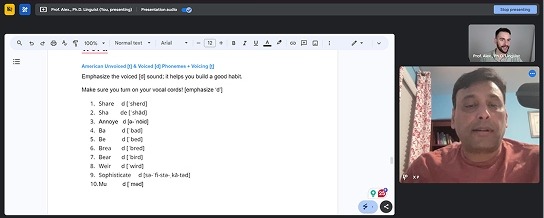
Interactive 1-on-1 vs Traditional Accent Coaching
How Prof. Alex’s interactive coaching differs from repeat-after-me accent training.

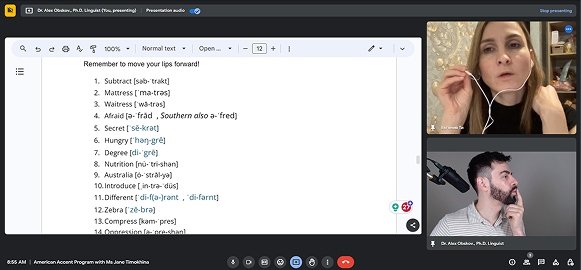
Best Accent Reduction Coaching for Business Professionals
What business professionals should look for in accent reduction and communication training.
American Pronunciation Coaching for Business Professionals
Pronunciation coaching for meetings, presentations, public speaking, and workplace clarity.
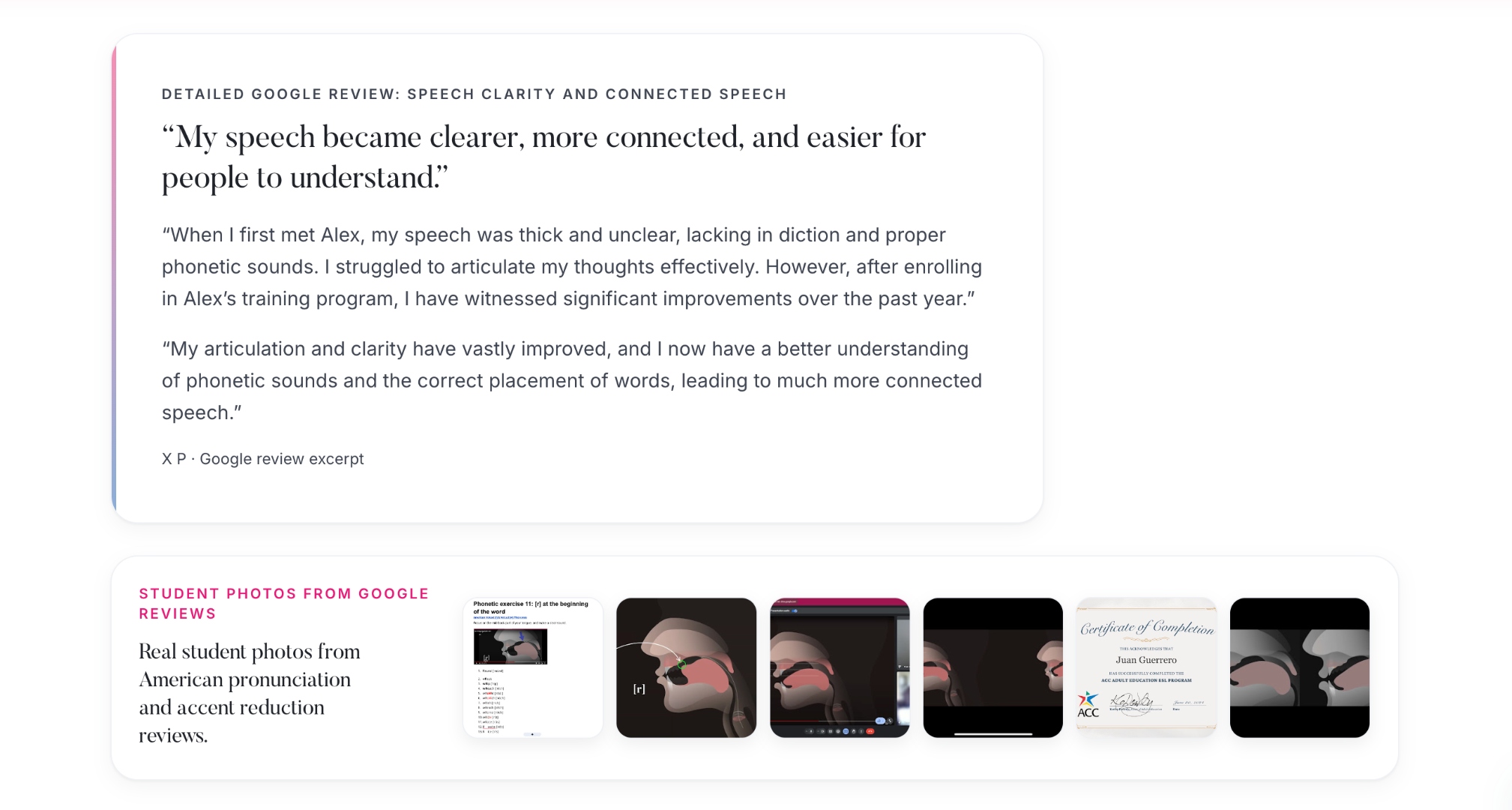
Best American Accent Coach for Non-Native Professionals
What 1-on-1 American accent training with Prof. Alex includes.
2D Sound Motion Technology for American Pronunciation
How Interactive Visual 2D Sound Simulators train American pronunciation.

MyAccentWay vs Accent Advisor
How Prof. Alex’s method differs from traditional live 1-on-1 video lessons.

Prof. Alex’s Teaching Philosophy
Why traditional accent coaching fails and what works instead.

Before-and-After Results
Real student recordings, including Abishek, Tian, and Vlad.
Student Reviews and Results
Reviews and results from MyAccentWay students.