American English Rhythm Patterns for Translators: A Practical Guide
(512) 265-9515Updated October 14, 2026 ◆ 18 min read
American English is stress-timed: stressed syllables (content words) carry the beat, while function words reduce to near-silence. Translators who miss this pattern produce renderings that sound grammatically correct but rhythmically foreign, which undermines listener comprehension and functional equivalence. Research by Mahmood Yenkimaleki confirms that prosodic awareness is a fundamental, often overlooked component of interpreter training. Prof. Alex, Ph.D. Accent Coach at Myaccentway American Accent Program, has trained translators and interpreters in exactly this skill for over 20 years.
Real student result

“I feel confident enough to speak American English!”
Interactive American Accent Training9monthsof hard work and dedication
Listen to the starting point0:00
Listen to the result0:00
“Many of my students once believed they could never sound like this. School taught them grammar and vocabulary, but not how to train their English speech. That is what we do together, step by step, until you speak English independently and with confidence.”
Abishek’s result was achieved through Prof. Alex’s research-based Interactive 1-on-1 American Accent Training. His doctoral research found this interactive method more effective than traditional, teacher-centered methods. See the research basis →
Three things you can do right now:
- Run a quick listening diagnostic. Play 60 seconds of a native American English speech clip and tap your finger only on the syllables that feel louder, longer, and clearer. Count how many taps fall on content words (nouns, main verbs, adjectives, adverbs) versus function words (articles, prepositions, auxiliaries). If your taps scatter evenly, your ear needs calibration.
- Do one short shadowing task. Choose a single sentence, mark the stressed content words in capital letters, and shadow it three times while physically tapping each stressed beat. Keep function words soft and fast.
- Book a sample assessment. A targeted session with a Ph.D.-level accent coach can pinpoint exactly where your L1 rhythm is overriding the American pattern. Book Your 1 Hour Evaluation Session or explore the curriculum to see what structured prosody training looks like. Read student reviews to understand the range of progress translators have made.
What does American English rhythm actually sound like?
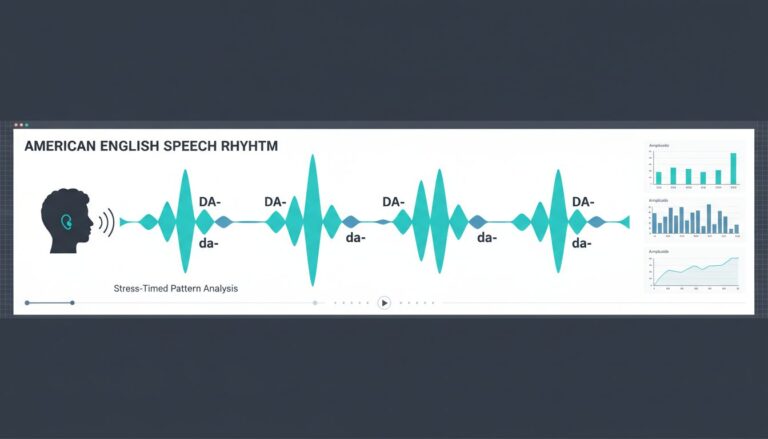
American English follows a stress-timed rhythm, meaning stressed syllables tend to recur at roughly regular intervals regardless of how many unstressed syllables fall between them. Unstressed syllables compress and reduce, often collapsing to a schwa (/ə/). The Iowa State Pressbook chapter on rhythm describes this clearly: timing is organized around stressed syllables, with function words taking weak forms in natural speech.
Contrast this with syllable-timed languages such as Spanish, French, Mandarin, or Farsi, where each syllable receives roughly equal duration. A translator whose L1 is syllable-timed tends to give every English syllable equal weight, which flattens the DA-da-DA-da pulse that American listeners rely on to parse meaning.
Here is a short annotated example:
The capitalized words carry the stress beat. The italicized function words (can, him, to) reduce: “can” becomes /kən/, “him” becomes /ɪm/, “to” becomes /tə/. The sentence has four strong beats and three reduced syllables. A syllable-timed rendering would give all seven syllables equal weight, making the sentence sound stilted and harder to process.
to hear this contrast in real time and see the mouth movements that produce it.
| Feature | Stress-timed (American English) | Syllable-timed (e.g., Spanish, French) |
|---|---|---|
| Timing unit | Stressed syllable | Individual syllable |
| Unstressed syllables | Compressed, reduced to schwa | Full vowel quality retained |
| Function words | Weak forms (/kən/, /ðə/, /tə/) | Full pronunciation |
| Typical learner error | Over-stressing function words | Flattening content-word beats |
| Listener effect | Natural phrasing, easy parsing | Monotone, harder to follow |
How to spot stressed and unstressed syllables in running speech
Four acoustic cues reliably signal a stressed syllable in American English: greater duration, a full vowel (not a schwa), a pitch change (usually a rise or a fall), and sharper consonant articulation. When you hear all four together, you have found a stress beat.
Function words behave very differently. Articles (a, the), prepositions (of, for, to), auxiliaries (can, was, have), and pronouns (him, her, them) almost always appear in their weak forms in connected speech. “For” becomes /fər/, “have” becomes /həv/, and “them” becomes /ðəm/. Yenkimaleki’s research shows that translators from syllable-timed L1s often insert full vowels into these positions, a pattern called vowel epenthesis, which disrupts the rhythmic beat and reduces intelligibility.
A worked transcription example for your workflow:
Original: “He was going to tell her about the plan.”
Stress-marked: “He wəz GOing tə TELL her əBOUT the PLAN.”
Translator note: Four beats (GO, TELL, BOUT, PLAN). “Was,” “to,” “her,” and “the” reduce. Mark these in your prep transcript before interpreting.
Pro Tip: Before each interpreting assignment, take the first paragraph of your source text and mark every content word in bold. Then read it aloud, deliberately compressing every function word to its weak form. Record yourself and compare the rhythm to a native speaker reading the same passage. The gap you hear is your training target.
A quick listening checklist to keep in your workflow:
- Does each sentence have 2–5 clear stress beats?
- Are articles and prepositions noticeably shorter and quieter than surrounding content words?
- Do auxiliaries like “was,” “can,” and “have” sound reduced?
- Does the sentence end with a strong beat on the final content word?
Canonical rhythm patterns you will encounter in American English
American English has several recurring sentence-level patterns that translators encounter across registers, from courtroom testimony to conference keynotes.
Alternating strong/weak beats is the baseline DA-da-DA-da pattern. “She BOUGHT a NEW CAR” has three beats on content words with function words tucked between them. This pattern is the default for declarative sentences and the one your ear needs to internalize first.
End-weight prominence places the heaviest stress on the final content word of a clause. “He told me EVERYTHING” and “The results were CLEAR” both land hard on the last noun or adjective. In simultaneous interpreting, this means your target-language rendering should also close each clause on a strong syllable, not trail off on a preposition or article.
Contrastive stress shifts the beat to signal new or corrective information. “She called HIM, not her” versus “SHE called him, not me.” The stress placement changes the meaning entirely. Missing this in a legal or medical interpretation can alter the record.
Question intonation and rhythm in yes/no questions tends to rise at the end, while wh-questions fall. The rhythm stays stress-timed, but the pitch contour changes. “Did SHE CALL him?” has the same beat structure as its declarative counterpart; only the final pitch moves.
Chunking and thought groups divide longer sentences into rhythmic units, each with its own stress peak. “The BOARD approved the PLAN / after a LONG discussion.” Each chunk has one primary beat. For subtitling, these chunks map naturally to individual subtitle lines, keeping reading pace aligned with speech rhythm. For simultaneous interpreting, they signal where you can safely begin your target-language phrase without losing the source’s information structure.
A brief note on dialectal variation: General American, the prestige variety used in most broadcast and professional contexts, is the baseline for these patterns. Regional varieties (Southern American English, New York, African American Vernacular English) show some variation in vowel quality and intonation contour, but the stress-timed beat structure holds across all of them. For American English intonation patterns in questions and lists, the pitch contour varies more than the underlying rhythm does.
Why does rhythm matter for translation and interpreting?
Rhythm is not a stylistic nicety. It is a functional component of meaning.
R. Ding’s 2008 paper on rhythm in translations argues that preserving rhythmic equivalence is part of achieving functional equivalence in translation. When a translator renders a source text with the wrong rhythmic pattern, the target audience must work harder to parse the message, and some meaning is inevitably lost.
Yenkimaleki’s research makes the interpreter-training implication explicit:
Three concrete consequences for translators:
- Mis-segmentation. When function words receive full stress, listeners may parse clause boundaries incorrectly. “I can SEE him” versus “I CAN see HIM” signals different information focus and can mislead a listener about what is new versus given information.
- Lost negation. Reduced auxiliaries like “can’t” and “won’t” depend on their rhythmic position for recognition. A translator who gives “can” and “can’t” identical stress and duration makes the negation nearly inaudible.
- Altered information focus. End-weight prominence tells the listener what the sentence is about. Misplacing the final stress beat shifts the perceived topic of the utterance, which in consecutive interpreting can change the speaker’s apparent intent.
In simultaneous interpreting specifically, rhythm management is a functional tool for audience processing. Interpreters must actively impose target-language rhythmic phrasing to help listeners parse incoming clauses and maintain discourse coherence, even when the source speech is irregular or monotone.
High-impact drills for translators
The goal of rhythm training is to move the DA-da-DA-da pattern from conscious effort to automatic production. These drills build that automaticity in sequence.
Core drill sequence:
- Tapping drill (5 minutes). Read a paragraph aloud and tap your desk only on stressed content-word syllables. Do not tap on function words. Record yourself and count whether your taps match the content words in the text.
- Chunked shadowing (10 minutes). Shadow a native speaker one thought group at a time. Pause the audio after each chunk, repeat it with the same rhythm, then move to the next. Do not shadow full sentences until chunks feel natural.
- Reduction drill (5 minutes). Take a list of 10 common function words (a, the, to, for, of, can, was, have, him, them) and practice their weak forms in isolation, then in short phrases. The schwa /ə/ is the most common vowel in American English; training it directly accelerates rhythm accuracy.
- Linking and liaison practice (5 minutes). American English links words across boundaries: “pick it up” becomes “PIckitUP.” Practice linking a consonant-final word to a vowel-initial word in short phrases until the boundary disappears.
- Jazz Chants (5 minutes). Jazz Chants by Carolyn Graham use musical rhythm to lock stress beats into motor memory. Chant a short pattern with a clap on each stressed syllable. The kinesthetic reinforcement accelerates retention and transfers to live interpreting contexts.
Sample 30-minute session:
- 0–5 min: Tapping drill on a fresh paragraph
- 5–15 min: Chunked shadowing with a 2-minute audio clip
- 15–20 min: Reduction drill on function words from the clip
- 20–25 min: Linking practice on 5 phrase pairs from the same clip
- 25–30 min: Jazz Chant on one sentence pattern from the clip
Suggested weekly load: 30 minutes per day, five days per week. That gives you 2.5 hours of focused prosody practice weekly, which aligns with the training format used in the experimental study cited in the research section below.
The Interactive Visual 2D Sound Simulators from Myaccentway American Accent Program add a visual layer to this practice. Instead of guessing what your mouth should do during a stressed syllable, you can see the tongue, jaw, and lip positions in real time. Watch the demo video to understand how visual feedback changes the practice experience. In MyAccentWay training, these simulators are used to train sound articulation, sound formation, and speech production during live 1-on-1 accent training sessions.
Self-audit rubric (use after each session):
- Rhythm accuracy: Did stress beats fall consistently on content words?
- Reduction control: Were function words noticeably shorter and quieter?
- Phrasing: Did thought groups end on a strong beat?
Record yourself, compare to the native model, and mark which criterion still needs work. That gap becomes next session’s focus. For additional accent reduction exercises that complement rhythm training, the Myaccentway American Accent Program curriculum covers consonants, vowels, and intonation alongside rhythm.
A 4-week micro-plan for rhythm improvement
This plan assumes 30 minutes of daily practice and uses the drill sequence above as its core activity.
Week 1: Perception and awareness. Your only goal is to hear the pattern accurately before you try to produce it. Spend sessions on the tapping drill and passive shadowing. At the end of the week, record yourself reading a paragraph and count how many stress beats land on content words. Aim for 80% accuracy before moving on.
Week 2: Controlled production. Add the reduction drill and chunked shadowing with a metronome set to the beat of the stressed syllables. Keep phrases short (4–6 words). Record daily and compare to your Week 1 baseline.
Week 3: Fluent production. Shadow full sentences without pausing. Add Jazz Chants and linking practice. Begin applying the pattern to your actual translation or interpreting materials rather than generic practice texts.
Week 4: Transfer to professional tasks. Sight-translate or interpret a short passage (2–3 minutes) and record it. Apply the self-audit rubric. Compare your rhythm accuracy to Week 1.
Progress-check rubric (use at the end of each week):
- Rhythm marking accuracy: Can you correctly identify and produce stress beats on content words in 80% or more of sentences?
- Reduction control: Do your function words sound noticeably shorter and quieter than content words?
- Listener intelligibility: Does a native-speaker listener confirm that your phrasing sounds natural and easy to follow?
If you pass all three criteria, move to the next week. If not, repeat the current week’s focus with different source material.
One student outcome worth noting: Vlad, a Russian speaker working with Prof. Alex, showed measurable improvement in rhythm and stress placement after structured prosody training. Russian is stress-timed but differs from American English in vowel reduction patterns, and the targeted work on function-word weak forms produced clear gains in speech naturalness. Translators from syllable-timed L1s typically see even larger early gains because the contrast between their baseline and the target pattern is more pronounced.
What does the research say about prosody training?
The evidence for explicit prosody instruction is consistent and practically useful for translators.
Yenkimaleki’s study establishes that prosodic feature awareness is not a supplementary skill but a core competency for interpreter trainees. Without explicit training, L1 rhythm patterns persist and interfere with target-language clarity, particularly for learners from syllable-timed backgrounds such as Farsi, Spanish, or Mandarin.
A controlled experimental study on prosody training in simultaneous interpreting found that a 10-session, 15-hour prosody training program produced significant gains in interpreter trainees’ perception skills and measurable, if smaller, gains in production. The perception-first finding matters practically: improving your ability to hear the pattern accurately is the fastest route to producing it correctly. This is why Week 1 of the micro-plan above focuses entirely on listening.
Explicit prosody instruction targeting word stress, rhythm, and intonation also yields gains in overall comprehensibility for nonnative learners, with suprasegmental development progressing alongside segmental accuracy.
| Study | Intervention | Measured benefit |
|---|---|---|
| Yenkimaleki’s research | Prosody awareness modules in interpreter training | Reduced L1 interference; improved target-language clarity |
| Experimental prosody study | 10 sessions / 15 hours with authentic speech extracts | Significant gains in perception; measurable gains in production |
| Prosody-oriented instruction research | Short focused prosody modules | Gains in word stress, rhythm, intonation, and comprehensibility |
This is the practical implication Prof. Alex draws from the research: do not wait until your segmental accuracy is perfect before working on rhythm. The two tracks reinforce each other, and rhythm gains often produce faster listener-side improvements than vowel corrections alone.
Key Takeaways
American English rhythm training gives translators a measurable, professional edge: stress-timed phrasing is the single feature that most separates natural-sounding renderings from technically correct but rhythmically flat ones.
| Point | Details |
|---|---|
| Mark content-word beats | Identify and stress nouns, main verbs, adjectives, and adverbs; reduce all function words to weak forms. |
| Prioritize reduction early | Translators from syllable-timed L1s gain intelligibility fastest by training schwa and function-word weak forms first. |
| Use chunked shadowing | Shadow one thought group at a time with a tapping beat; move to full sentences only after chunks feel natural. |
| Self-audit every session | Record yourself, apply the three-item rubric (rhythm accuracy, reduction, intelligibility), and target the weakest criterion next session. |
| Escalate when you plateau | If Week 3 rubric scores stall, 1-on-1 coaching with a Ph.D.-level accent coach accelerates gains faster than self-study alone. |
| Myaccentway American Accent Program | Offers 1-on-1 prosody-focused training with Interactive Visual 2D Sound Simulators and a structured curriculum for translators and interpreters. |
Why prosody training is a professional differentiator, not a pronunciation nicety
Most translators invest heavily in vocabulary, grammar, and subject-matter knowledge. Few invest systematically in prosody. That gap is a real professional opportunity.
Consider a conference interpreter rendering a keynote address. The speaker’s rhythm carries information: which claim is new, which is a contrast, where the argument peaks. An interpreter who flattens that rhythm into syllable-timed monotone forces the audience to work harder, increases the need for clarification, and reduces the perceived authority of the speaker’s message. In a courtroom, the same flattening can obscure a negation or shift the apparent emphasis of testimony.
The research supports what experienced coaches observe in practice: perception gains come first and come fast, and they bootstrap production. A translator who trains their ear for 15 hours of focused prosody work, as in the experimental study cited above, can expect to hear the pattern reliably before they can produce it fluently. That perceptual accuracy alone improves the quality of written translation, because you begin to hear what the source speaker is emphasizing rather than just reading the words.
The American pronunciation guide for translators and interpreters at Myaccentway American Accent Program addresses this directly: rhythm training is not separate from professional development. It is professional development.
Myaccentway American Accent Program: training built for translators
Translators who want to move beyond self-study drills and close the gap faster have a direct path through Myaccentway American Accent Program’s 1-on-1 training with Prof. Alex, Ph.D.
Prof. Alex uses cognitive accent training, psychology-based coaching, and 2D Sound Motion Technology as part of his interactive teaching model, based on his Ph.D. research in interactive teaching methods. With the Interactive Visual 2D Sound Simulators, you actively train the movement of the tongue, lips, jaw, teeth, and airflow for stressed and reduced syllables while Prof. Alex corrects you live, then practice in phrases and professional speech. This hands-on training removes the guesswork that slows down most self-study programs.
For translators and interpreters, the recommended starting point is a 1 Hour Evaluation Session where Prof. Alex assesses your current rhythm patterns, identifies your specific L1 interference points, and maps a targeted prosody module to your professional context. Vlad, a Russian-speaking professional, documented his progress in a short results video that shows what structured rhythm training produces in practice.
Ready to measure your rhythm accuracy and build a plan? Book Your 1 Hour Evaluation Session or review the full accent reduction curriculum to see how prosody fits into the broader training sequence.
MyAccentWay · 2D Sound Motion Technology
American English Pronunciation: Consonant and Vowel Sounds with 2D Sound Motion Technology
Learning American English pronunciation and the American accent is more effective when you train your speech organs, not only listen and repeat. 2D Sound Motion Technology and Interactive Visual 2D Sound Simulators, developed in 2020 by Prof. Alex, Ph.D. Accent Coach, Doctor of Education, and professional linguist, as part of his interactive teaching model based on his Ph.D. research in interactive teaching methods, train your tongue, lips, jaw, teeth, airflow, and voice step by step. They train each American sound and more than 30 sound combinations through Interactive 2D video simulation.
What 2D Sound Motion Technology is
2D Sound Motion Technology is an advanced accent reduction and articulation training tool by Prof. Alex. It corrects, develops, and trains each American sound and more than 30 sound combinations through Interactive 2D video simulation.
What Interactive Visual 2D Sound Simulators do
Interactive Visual 2D Sound Simulators are part of 2D Sound Motion Technology, the articulation-training method Prof. Alex created by applying his Ph.D. research in interactive teaching to American pronunciation. Instead of listening and repeating, students actively train their speech organs. Each simulator uses Interactive 2D mouth movement to train the speech organs (tongue, lips, jaw, teeth, airflow, and voice) to produce each American sound correctly. Every consonant has its own simulator: explore American consonants trained with 2D Sound Motion Technology.
Sample training: the American t sound (aspirated [t])
Practice
Record yourself speaking these words:
Tab · Tacos · Time · Tub · Hotel · Motel · Sit · Pit · Net
Instructions
Play the Interactive Visual 2D Sound Simulator for the American t sound below several times and follow it step by step. Move your tongue, jaw, and airflow together with the simulator and train your articulation.
Interactive Visual 2D Sound Simulator: American unvoiced sound [t]
Practice
Record yourself again speaking these words, but this time focus on the movement of your tongue. Go slow, and you will hear the difference. You’ve got this!
Tab · Tacos · Time · Tub · Hotel · Motel · Sit · Pit · Net
How Interactive Visual 2D Sound Simulators solve pronunciation and speaking problems
- Wrong articulationMost pronunciation problems start with the tongue, lips, jaw, or teeth in the wrong position. Each Interactive Visual 2D Sound Simulator trains the correct articulation of one American sound, so the student corrects the cause of the problem, not only the result.
- Airflow and voicingMany accent problems come from wrong airflow or voicing: sounds that are too weak, too strong, or voiced when they should be unvoiced. The simulators train airflow and voice together with articulation, step by step, for each American sound and more than 30 sound combinations.
- Clear speech and confidenceWhen each sound is trained correctly, words connect into clear American English speech. Listeners can understand you more easily, and speaking at work, in meetings, and on calls becomes more confident.
If you start hearing the aspiration, the short airstream after [t], with one simulator, you can only imagine how successful you can be in 1-on-1 Interactive American Accent Training with Prof. Alex, Ph.D. Accent Coach, where your whole American sound system is trained sound by sound.
In MyAccentWay, the Interactive Visual 2D Sound Simulators are only available in 1-on-1 accent coaching sessions with Prof. Alex.
Useful sources and further reading
These resources support deeper study of American English rhythm patterns and prosody training for translators.
- Rhythm in Translations — R. Ding (2008): The foundational academic argument for treating rhythmic equivalence as part of functional equivalence in translation. Useful for translators who want theoretical grounding.
- Prosody Training Benefits in Simultaneous Interpreting — Experimental Study: Reports on a 10-session, 15-hour controlled intervention; essential reading for understanding what a realistic training timeline can achieve.
- Rhythm — Teaching Pronunciation with Confidence (Iowa State Pressbook): Clear, practitioner-oriented chapter on stress-timed rhythm, weak forms, and classroom applications; a reliable reference for building your own drills.
- Teaching with Jazz Chants — American English (Carolyn Graham): Free classroom resource for kinesthetic rhythm practice; directly applicable to the drill sequence in this guide.
- 2D Sound Motion Technology — Myaccentway American Accent Program: Visual simulator tool for rhythm and articulation training; the multimodal complement to audio-only shadowing practice.
- Best Pronunciation Apps for AI-Powered Learners — WordByWord.io: Industry review of pronunciation practice apps; useful for translators who want tech-assisted tools to supplement structured coaching.
American Intonation and Rhythm Training for Foreign-Born Professionals in the United States
Foreign-born professionals in the United States often know their field and speak advanced English. Yet American listeners may still struggle with their stress, rhythm, and intonation. MyAccentWay offers private online intonation training through Interactive American Accent Training.
Interactive American Accent Training is led by Prof. Alex, Ph.D. Accent Coach, Doctor of Education, and professional linguist. He first diagnoses each speaker’s native-language patterns. Then he trains American word stress, sentence stress, rhythm, and intonation for real meetings and presentations.
Who this training is for
- Engineers, IT specialists, and data professionals presenting to U.S. teams and clients
- Doctors, nurses, and healthcare professionals explaining care to American patients
- Managers, executives, and founders leading meetings, pitches, and briefings
- Consultants, researchers, and academics speaking at conferences and webinars
- Professionals preparing for interviews, promotions, or client-facing roles
Online training across the U.S.
MyAccentWay is based in Austin, Texas, and all training is online. The program is especially relevant for professionals in Austin, Dallas, Houston, New York City, the San Francisco Bay Area, Los Angeles, Seattle, Boston, Chicago, Miami, Washington DC, Atlanta, and Raleigh.
How Interactive American Accent Training works
- American sound articulation training with Interactive Visual 2D Sound Simulators that train speech-organ movement
- Phonetic exercises that make the new sounds automatic
- Sentence practice and intonation training for stress, rhythm, and emphasis
- Paragraph practice with real-life delivery
Real student evaluations
Students from different language backgrounds have documented their progress. Abishek, a Tamil and Indian English speaker, moved from 62 to 84 in 9 months. Tian, a Mandarin speaker, moved from 58 to 85 in 8 months. Vlad, a Russian speaker, moved from 60 to 83 in 5 months.
The first step is a 1 Hour Evaluation Session with Prof. Alex.
FAQ
What is stress-timed rhythm in American English?
American English is stress-timed, meaning stressed syllables tend to recur at roughly regular intervals while unstressed syllables compress and reduce. Function words typically appear in weak forms, and content words carry the primary beats.
How does L1 interference affect a translator’s rhythm production?
Translators from syllable-timed L1s (Spanish, French, Mandarin, Farsi) tend to give every syllable equal duration, which flattens the American stress beat. Yenkimaleki’s research identifies vowel epenthesis and incorrect reduction as the most common resulting errors.
How many training hours does it take to improve rhythm perception?
A controlled prosody-training study using 10 sessions totaling 15 hours produced significant gains in perception skills for interpreter trainees. Production gains were measurable but smaller, suggesting perception improves faster and should be trained first.
Can rhythm errors change the meaning of a translation?
Yes. Misplaced stress can obscure negation (“can” vs. “can’t”), shift information focus, and alter the perceived topic of a clause. These are not stylistic issues; they are meaning-level errors with real consequences in legal, medical, and conference interpreting.
How does Myaccentway American Accent Program help translators with rhythm training?
Prof. Alex, Ph.D. uses Interactive Visual 2D Sound Simulators to train the movement of the tongue, lips, jaw, teeth, and airflow, with Prof. Alex correcting students live, as part of his interactive teaching model based on his Ph.D. research in interactive teaching methods, combined with cognitive accent training and structured prosody modules tailored to each translator’s L1 interference profile. The 1 Hour Evaluation Session is the recommended starting point for a personalized assessment.
Recommended
Mastering American English Rhythm: A Linguist’s Guide to Professional Speech Clarity
Did you know that poor business communication costs U.S. companies an estimated $1.2 trillion annually? This staggering figure represents over...

Sentence Stress in American English: The 2026 Guide to Natural Rhythm
Imagine standing in a high-stakes boardroom in 2024, presenting a breakthrough strategy, only to have your lead director ask you to repeat yourself...
American English Intonation Patterns Practice Guide
Enhance your speaking skills with our American English intonation patterns practice. Master intonation to sound confident and clear!
The problem is not always grammar or vocabulary.
If people understand your words but still miss your message, the deeper issue may be speech clarity, rhythm, intonation, and American pronunciation habits. MyAccentWay helps students retrain the sound system with professional 1-on-1 guidance, so English can feel clearer, freer, and more natural in real communication.
Two training methods that make speech change active.
MyAccentWay is not passive listen-and-repeat coaching. Prof. Alex, Ph.D. Accent Coach, Doctor of Education, and professional linguist, creates a learning situation where students become active learners and active participants in changing their own speech patterns.
Interactive training
Students do not just receive pronunciation instructions passively. They listen, think, compare, adjust, and understand their own speech patterns while Prof. Alex guides the correction process.
Cognitive accent training
Students learn to notice and correct the speech patterns that affect American pronunciation, then implement new American speech patterns into their code-switching process for more natural, long-lasting change.
Build speech habits people can hear in real conversations.
A stronger American accent is not built by memorizing topics or chasing quick pronunciation tips. It comes from structured training, professional feedback, active correction, and repeated application until clearer speech becomes easier to keep.
Continue learning how MyAccentWay connects accent reduction, accent modification, English articulation, Prof. Alex’s method, student proof, and 1-on-1 American accent training.
- Prof. Alex and the MyAccentWay MethodLearn how Prof. Alex, Ph.D. Accent Coach, Doctor of Education, and professional linguist, created and leads the structured MyAccentWay American accent training system.
- Accent Reduction Curriculum and English Articulation TrainingSee how MyAccentWay trains accent reduction, accent modification, American pronunciation, English articulation, rhythm, and professional speech clarity.
- 2D Sound Motion Technology for American Accent TrainingUnderstand Prof. Alex’s Interactive Visual 2D Sound Simulators for American sound articulation.
- Before-and-After American Accent Training ResultsListen to real before-and-after student proof and accent training outcomes.
- Student Reviews and Accent Training ResultsRead student reviews, testimonials, and trust signals from MyAccentWay learners.
- Book a 1-Hour 1 Hour Evaluation SessionStart with a 1-hour accent evaluation session with Prof. Alex.