Mastering American English Rhythm: A Linguist’s Guide to Professional Speech Clarity
(512) 265-9515Updated October 16, 2026 ◆ 17 min read
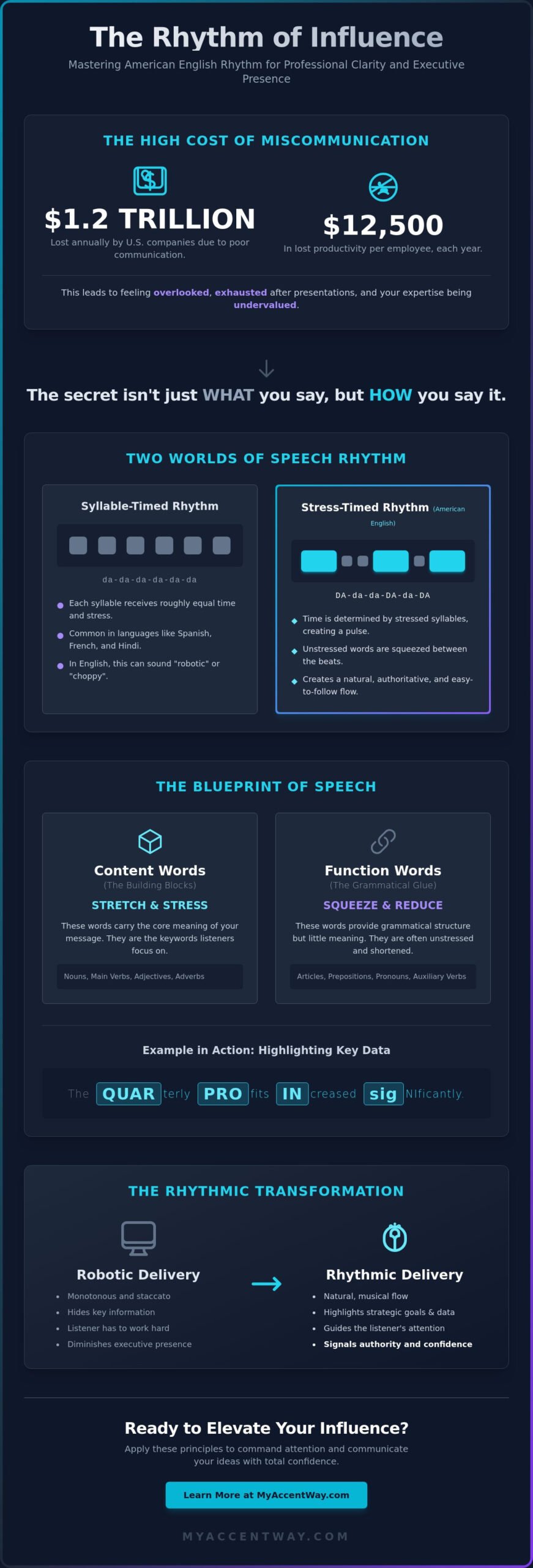
Did you know that poor business communication costs U.S. companies an estimated $1.2 trillion annually? This staggering figure represents over $12,500 per employee each year in lost productivity. You’ve likely felt the personal side of these numbers when you finish a long presentation feeling physically exhausted, or when your expertise is overlooked because your delivery feels “choppy” in meetings. It’s draining to feel that your professional impact is limited by how you’re heard rather than what you know.
Real student result

“I feel confident enough to speak American English!”
Interactive American Accent Training9monthsof hard work and dedication
Listen to the starting point0:00
Listen to the result0:00
“Many of my students once believed they could never sound like this. School taught them grammar and vocabulary, but not how to train their English speech. That is what we do together, step by step, until you speak English independently and with confidence.”
Abishek’s result was achieved through Prof. Alex’s research-based Interactive 1-on-1 American Accent Training. His doctoral research found this interactive method more effective than traditional, teacher-centered methods. See the research basis →
As a linguist, I know that the secret to being understood isn’t just about individual sounds. Mastering american english rhythm is the strategic key to professional speech clarity. By learning the science of stress-timing and vowel reduction, you can shift from a robotic pace to a natural, authoritative flow that commands the room. In this guide, I’ll guide you in using tools like the neutral Schwa and 2D Sound Motion Technology to train your speech organs, reduce your mental load, and communicate your ideas with total confidence.
What is American English Rhythm? Understanding Stress-Timed Speech
American English rhythm is the musical pulse created by the regular occurrence of stressed syllables. It’s the heartbeat of the language. If you’ve ever felt that your speech sounds “choppy” or that people ask you to repeat yourself despite your good grammar, the issue is likely your rhythm. As Prof. Alex, Ph.D. Accent Coach, I’ve seen how mastering american english rhythm can do more for your clarity than practicing individual consonants for months.
Most world languages are “syllable-timed,” meaning every syllable gets roughly the same amount of time. Think of the steady tap-tap-tap of Spanish, French, or Hindi. English is different. It’s a “stress-timed” language. This means we only give full time and energy to the syllables that carry the most meaning. To understand this, imagine a rubber band. You stretch the rubber band wide for stressed words, making them long and clear. You then let it snap back and “squeeze” the unimportant words together. This interplay of stress and vowel reduction is what creates the natural flow of a professional speaker.
The Science of Stress-Timing
Your brain is hardwired to look for patterns. In an American professional environment, listeners use the intervals between stressed syllables to predict when the next piece of important information will arrive. We deliver these ideas in “Thought Units,” which are small clusters of words that represent a single concept. Stress-timing is the heart of American accent training because it allows you to highlight these thought units effectively. Without this pulse, the listener’s brain has to work much harder to decode your message, which often leads to the mental fatigue reported by many international professionals.
Why Robotic Speech Happens
Robotic speech occurs when you fall into a “staccato” pattern, giving every syllable equal length and volume. This often happens when speakers are overly focused on pronouncing every single letter. While you might think this is clearer, it actually makes you harder to understand because it hides the most important parts of your sentence. In high-stakes meetings, a lack of rhythmic flow can diminish your perceived executive presence. When you focus on mastering american english rhythm, you signal authority and confidence. You aren’t just saying words; you’re guiding the listener through your logic with a natural, professional flow that commands attention.
The Blueprint of Speech: Content Words vs. Function Words
Understanding the architecture of a sentence is the first step toward mastering american english rhythm. In my coaching sessions, I often see professionals struggle because they treat every word as equally important. This creates a monotonous “machine gun” sound that makes it difficult for a listener to identify your main point. To achieve speech clarity, you must distinguish between your message carriers and the grammatical glue that holds them together.
Content words are the nouns, main verbs, adjectives, and adverbs that provide the “weight” of your message. These are the words you want your audience to remember. Function words, on the other hand, are the prepositions, articles, pronouns, and auxiliary verbs that exist purely for grammatical structure. In American English, we strategically stretch the content words and squeeze the function words. This contrast is what allows your expertise to shine through during a high-stakes presentation.
Identifying Your Message Carriers
You can quickly identify your keywords by looking at a standard email or a presentation slide. If you were to delete all the “glue” words, would the listener still understand the basic idea? For example, in the sentence “The quarterly profits increased significantly,” the words quarterly, profits, increased, and significantly are your carriers. Over-enunciating small words like “the” or “and” disrupts your natural flow and distracts from these vital data points. I recommend lengthening the vowel sounds in your stressed syllables. This creates a clear signal to your listener’s brain that this specific information is important. If you are looking for personalized feedback on these patterns, you might consider exploring American accent training to refine your professional delivery.
Reducing the “Glue” Words
The secret to mastering american english rhythm lies in the linguistic concept of “weak forms.” When we speak at a professional pace, function words often lose their full vowel sound. For instance, “to” frequently becomes a quick /tə/, and “can” reduces to /kən/. This isn’t “lazy” speech; it’s a precise linguistic tool. By reducing these function words, you create the necessary space for your content words to stand out. This reduction actually helps your listeners focus on your expertise because they don’t have to filter through unnecessary phonetic noise to find your meaning. Using sentence stress strategically also allows you to change the meaning of a sentence without changing a single word. Stressing “I” in “I didn’t say he stole the money” implies someone else said it, while stressing “money” suggests he might have stolen something else. This level of control is essential for executive presence.
The Engine of Rhythm: Vowel Reduction and the Schwa
If the blueprint of speech is identifying content and function words, then vowel reduction is the actual engine that drives the car. To succeed in mastering american english rhythm, you must embrace the Schwa /ə/. This is the most frequent sound in the American accent, yet it’s often the most misunderstood by international professionals. Many learners feel that “swallowing” a vowel is a sign of poor English. In reality, vowel reduction is a high-level linguistic skill that signals proficiency rather than laziness.
The Schwa occurs only in unstressed syllables. When a vowel is in an unstressed position, it loses its original “dictionary” quality and moves toward a neutral, central sound. If you try to pronounce every vowel exactly as it’s spelled, you’ll create a choppy, robotic rhythm that tires out your listener. Professional speech clarity depends on your ability to relax your articulators and let these unimportant syllables disappear into the background.
Finding the Neutral Position
Most guides tell you what the Schwa is, but they don’t explain how to physically produce it. To find the neutral position, let your jaw drop slightly without any muscular effort. Your tongue should rest in the middle of your mouth, not touching the roof or the teeth. Keep your lips completely relaxed, neither rounded nor spread. It’s a “lazy” position by design. Use this neutral posture to practice these common professional words:
- A-bout: The first syllable is a quick Schwa. /əˈbaʊt/
- Pres-i-dent: The middle “i” is reduced. /ˈprɛzədənt/
- A-nal-y-sis: The first and third syllables are neutral. /əˈnæləsəs/
- Sup-por-tive: The first syllable is a placeholder Schwa. /səˈpɔːrtɪv/
Vowel Transitions in Connected Speech
Internalizing this sound is a cornerstone of mastering american english rhythm because it allows for smooth transitions. You aren’t just jumping between sounds; you’re using linked sounds in English to maintain a constant stream of air. Moving from a long, stressed vowel to a reduced Schwa should feel effortless. This rhythmic momentum ensures that your message carriers stand out while the “glue” words provide the necessary pulse. Mastering this physical relaxation of the jaw and tongue is essential for any leader who wants to maintain a commanding presence without vocal fatigue.
A Step-by-Step Strategy to Internalize American Rhythm
Moving from linguistic theory to practical application requires a structured approach. In my work as Prof. Alex, Ph.D. Accent Coach, I’ve developed a sequence that moves from physical sensation to cognitive mastery. Internalizing these patterns isn’t about memorizing rules. It’s about building muscle memory. By following these steps, mastering american english rhythm becomes a natural extension of your professional identity.
- Step 1: Humming the Melody. Before you worry about consonants, hum the sentence. Strip away the words to feel the “DA-da-DA” pulse. This helps you identify the peaks and valleys of a thought unit without the distraction of complex phonemes.
- Step 2: Clapping the Beat. Use physical movement to anchor your stressed syllables. Clap or tap the table only on the content words. This physical feedback reinforces the timing of your delivery.
- Step 3: Training the Motion. Use 2D Sound Motion Technology to train your speech organs. This training helps you identify where you’re holding tension or failing to reduce a vowel.
- Step 4: The Shadowing Technique. Listen to an expert speaker and try to “ghost” them. You should speak only a fraction of a second behind them, mimicking their pace and intonation exactly.
- Step 5: Recording and Analyzing. Record yourself delivering a 30-second technical demo. Compare your rhythm to the American standard to see if your function words are truly reduced.
Using Interactive Visual 2D Sound Simulators for American Sounds
Interactive practice is a game-changer for international professionals. Traditional mirrors only reflect the external movement of your lips, but they can’t help you train what’s happening inside your mouth. With our Interactive Visual 2D Sound Simulators for American Sounds, you actively train the precise movements of your tongue, lips, jaw, and teeth, and control your airflow for a neutral Schwa, while Prof. Alex corrects you live. As part of Prof. Alex’s interactive teaching model, based on his Ph.D. research in interactive teaching methods, the simulators help you practice the “valleys” where you should be reducing sounds. Practicing the movements makes the transition from robotic speech to a flowing, professional narrative much faster. If you want to experience this technology in action, you can Book Your 1 Hour Evaluation Session to start your journey toward speech clarity.
The Shadowing Protocol for Professionals
Shadowing is effective when you use high-quality models. I recommend selecting TED talks or executive interviews that match your professional field. Use the “Three-Pass” method for the best results. First, just listen to the clip. Second, hum along with the speaker to capture the melody. Third, speak the words while maintaining the exact rhythmic pulse you hummed. This science-backed repetition builds the muscle memory needed for effortless delivery in high-stakes meetings. It’s about training your brain to recognize the pattern so you don’t have to think about it while you’re presenting.
MyAccentWay · 2D Sound Motion Technology
American English Pronunciation: Consonant and Vowel Sounds with 2D Sound Motion Technology
Learning American English pronunciation and the American accent is more effective when you train your speech organs, not only listen and repeat. 2D Sound Motion Technology and Interactive Visual 2D Sound Simulators, developed in 2020 by Prof. Alex, Ph.D. Accent Coach, Doctor of Education, and professional linguist, as part of his interactive teaching model based on his Ph.D. research in interactive teaching methods, train your tongue, lips, jaw, teeth, airflow, and voice step by step. They train each American sound and more than 30 sound combinations through Interactive 2D video simulation.
What 2D Sound Motion Technology is
2D Sound Motion Technology is an advanced accent reduction and articulation training tool by Prof. Alex. It corrects, develops, and trains each American sound and more than 30 sound combinations through Interactive 2D video simulation.
What Interactive Visual 2D Sound Simulators do
Interactive Visual 2D Sound Simulators are part of 2D Sound Motion Technology, the articulation-training method Prof. Alex created by applying his Ph.D. research in interactive teaching to American pronunciation. Instead of listening and repeating, students actively train their speech organs. Each simulator uses Interactive 2D mouth movement to train the speech organs (tongue, lips, jaw, teeth, airflow, and voice) to produce each American sound correctly. Every consonant has its own simulator: explore American consonants trained with 2D Sound Motion Technology.
Sample training: the American t sound (aspirated [t])
Practice
Record yourself speaking these words:
Tab · Tacos · Time · Tub · Hotel · Motel · Sit · Pit · Net
Instructions
Play the Interactive Visual 2D Sound Simulator for the American t sound below several times and follow it step by step. Move your tongue, jaw, and airflow together with the simulator and train your articulation.
Interactive Visual 2D Sound Simulator: American unvoiced sound [t]
Practice
Record yourself again speaking these words, but this time focus on the movement of your tongue. Go slow, and you will hear the difference. You’ve got this!
Tab · Tacos · Time · Tub · Hotel · Motel · Sit · Pit · Net
How Interactive Visual 2D Sound Simulators solve pronunciation and speaking problems
- Wrong articulationMost pronunciation problems start with the tongue, lips, jaw, or teeth in the wrong position. Each Interactive Visual 2D Sound Simulator trains the correct articulation of one American sound, so the student corrects the cause of the problem, not only the result.
- Airflow and voicingMany accent problems come from wrong airflow or voicing: sounds that are too weak, too strong, or voiced when they should be unvoiced. The simulators train airflow and voice together with articulation, step by step, for each American sound and more than 30 sound combinations.
- Clear speech and confidenceWhen each sound is trained correctly, words connect into clear American English speech. Listeners can understand you more easily, and speaking at work, in meetings, and on calls becomes more confident.

If you start hearing the aspiration, the short airstream after [t], with one simulator, you can only imagine how successful you can be in 1-on-1 Interactive American Accent Training with Prof. Alex, Ph.D. Accent Coach, where your whole American sound system is trained sound by sound.
In MyAccentWay, the Interactive Visual 2D Sound Simulators are only available in 1-on-1 accent coaching sessions with Prof. Alex.
Professional Fluency: Applying Rhythm to Executive Presence
Mastering american english rhythm is about more than just being understood; it’s about how you’re perceived as a leader. Research in social psychology suggests that listeners judge a speaker’s credibility and authority within the first 500 milliseconds of hearing their voice. This split-second window is determined not by your vocabulary, but by your vocal confidence and rhythmic flow. When your speech has a natural, authoritative pulse, you signal to your audience that you’re in control of your message and your expertise.
In technical demos or keynote speeches, your rhythm acts as a roadmap for your listeners. If you speak with a flat, syllable-timed cadence, your audience has to work harder to identify your main points. By using strategic sentence stress, you can highlight strategic goals and critical data points effortlessly. This shift in delivery ensures that your best ideas aren’t just heard, but are actually remembered long after the meeting ends. It’s a powerful transformation that turns technical knowledge into executive presence.
Rhythm in High-Stakes Meetings
Nervousness often leads to rushing, which is the primary enemy of speech clarity. Rhythmic speech acts as a built-in regulator for your pace. When you focus on stretching the vowels in your content words, you naturally prevent yourself from speaking too quickly. Use pauses as a rhythmic tool rather than a sign of hesitation. A well-placed silence after a significant statement allows the idea to sink in and gives you a moment to breathe. Additionally, pay attention to your intonation. Authoritative statements typically have a falling pitch at the end, while questions rise. Mixing these patterns correctly ensures you sound decisive rather than uncertain during Q&A sessions.
Your Personalized Path to Clarity
At the American Accent Program, I always emphasize that your culture matters. Accent modification is not about erasing your identity or sounding like someone else. It’s about personal growth and empowering your voice so that your accent never stands in the way of your career goals. I’ve seen how mastering american english rhythm allows international professionals to reduce their mental load and speak with total confidence in any U.S. professional environment. It’s a science-backed journey toward clearer, more effective communication.
As Prof. Alex, Ph.D. Accent Coach, I stand behind our research-based method and track your progress. Whether you’re leading a global team from Austin, Texas, or managing projects online across Dallas and Houston, the principles of stress-timing remain the same. You deserve to have your expertise recognized without the frustration of being asked to repeat yourself. Ready to transform your delivery? Explore our American Accent Training near you and take the first step toward commanding the attention you’ve earned.
Command the Room with Rhythmic Clarity
Transforming your professional delivery begins with recognizing that your voice is your most valuable asset. By embracing the stress-timed pulse of the American accent, you move beyond simple word choice and into a space of true executive presence. You’ve learned how to prioritize content words, utilize the Schwa for effortless flow, and build muscle memory through science-backed techniques. Mastering american english rhythm isn’t about changing your identity; it’s about ensuring your expertise is never lost in a “choppy” delivery.
Prof. Alex, Ph.D. Accent Coach, provides the expert guidance you need through our proprietary 2D Sound Motion Technology. This approach trains the speech organs and offers U.S. Professionals a clear path to lasting results. You don’t have to navigate this process alone. Take the next step toward a natural, authoritative flow that commands attention in every meeting.
Book a Sample Session with Prof. Alex, Ph.D. Accent Coach to experience a personalized approach to accent reduction and speech clarity. Your culture matters, and your voice deserves to be heard with total confidence.
American Intonation and Rhythm Training for Foreign-Born Professionals in the United States
Foreign-born professionals in the United States often know their field and speak advanced English. Yet American listeners may still struggle with their stress, rhythm, and intonation. MyAccentWay offers private online intonation training through Interactive American Accent Training.
Interactive American Accent Training is led by Prof. Alex, Ph.D. Accent Coach, Doctor of Education, and professional linguist. He first diagnoses each speaker’s native-language patterns. Then he trains American word stress, sentence stress, rhythm, and intonation for real meetings and presentations.
Who this training is for
- Engineers, IT specialists, and data professionals presenting to U.S. teams and clients
- Doctors, nurses, and healthcare professionals explaining care to American patients
- Managers, executives, and founders leading meetings, pitches, and briefings
- Consultants, researchers, and academics speaking at conferences and webinars
- Professionals preparing for interviews, promotions, or client-facing roles
Online training across the U.S.
MyAccentWay is based in Austin, Texas, and all training is online. The program is especially relevant for professionals in Austin, Dallas, Houston, New York City, the San Francisco Bay Area, Los Angeles, Seattle, Boston, Chicago, Miami, Washington DC, Atlanta, and Raleigh.
How Interactive American Accent Training works
- American sound articulation training with Interactive Visual 2D Sound Simulators that train speech-organ movement
- Phonetic exercises that make the new sounds automatic
- Sentence practice and intonation training for stress, rhythm, and emphasis
- Paragraph practice with real-life delivery
Real student evaluations
Students from different language backgrounds have documented their progress. Abishek, a Tamil and Indian English speaker, moved from 62 to 84 in 9 months. Tian, a Mandarin speaker, moved from 58 to 85 in 8 months. Vlad, a Russian speaker, moved from 60 to 83 in 5 months.
The first step is a 1 Hour Evaluation Session with Prof. Alex.
Frequently Asked Questions
Is American English rhythm the same as intonation?
No, they are distinct but complementary elements of speech. Rhythm refers to the timing and duration of syllables, creating a stress-timed pulse. Intonation is the rise and fall of your pitch, which conveys emotion or indicates a question. While they work together to create the “music” of a language, rhythm is the foundation that determines your overall flow and professional clarity.
Can I improve my English rhythm without losing my native accent?
Yes, you can certainly achieve high levels of clarity while keeping your cultural identity. Our approach to accent modification focuses on communication and personal growth rather than erasing your background. By adopting American rhythmic patterns, you simply make your expertise more accessible to your listeners. You don’t have to sound like a different person to be understood perfectly in a U.S. professional environment.
How long does it take to master American English rhythm?
Most professionals see a significant transformation in their speech within 12 to 24 weeks of consistent, science-backed practice. Mastering american english rhythm is a physical process that involves retraining your jaw and tongue muscles to move differently. Because you’re building new muscle memory and neurological pathways, daily short practice sessions are much more effective than long, infrequent ones.
Will learning English rhythm help people understand me better in meetings?
Absolutely. American listeners rely heavily on the “DA-da-DA” pulse to identify the most important parts of your sentence. When you use the correct rhythm, you provide a roadmap that helps your audience process your ideas faster. This reduces listener fatigue and ensures that your strategic goals and data points are the focus of the conversation, rather than your delivery style.
Why do I sound “choppy” even though I know all the words?
This “choppy” effect usually happens when you give every syllable equal time and volume. English is a stress-timed language, not a syllable-timed one. If you don’t reduce your function words, your speech sounds robotic and staccato. Mastering american english rhythm requires you to stretch your content words and squeeze the “glue” words together, creating the natural contrast that American listeners expect.
What is the best way to practice American English rhythm at home?
An effective home practice is the shadowing technique combined with visual feedback. Use professional models, like executive interviews, and try to mimic their timing by humming the melody of their sentences first. Recording yourself and using Interactive Visual 2D Sound Simulators for American Sounds will help you verify that your mouth is in the correct neutral position for vowel reductions. This ensures your practice is accurate and effective.
Why are rhythm and intonation important in American English?
Rhythm and intonation tell the listener which words matter and what you mean. Even correct sounds can be hard to follow when stress and melody are flat or misplaced. MyAccentWay trains rhythm, stress, and intonation in its sentence stage with Prof. Alex, after the American sounds are stable.
The problem is not always grammar or vocabulary.
If people understand your words but still miss your message, the deeper issue may be speech clarity, rhythm, intonation, and American pronunciation habits. MyAccentWay helps students retrain the sound system with professional 1-on-1 guidance, so English can feel clearer, freer, and more natural in real communication.
Two training methods that make speech change active.
MyAccentWay is not passive listen-and-repeat coaching. Prof. Alex, Ph.D. Accent Coach, Doctor of Education, and professional linguist, creates a learning situation where students become active learners and active participants in changing their own speech patterns.
Interactive training
Students do not just receive pronunciation instructions passively. They listen, think, compare, adjust, and understand their own speech patterns while Prof. Alex guides the correction process.
Cognitive accent training
Students learn to notice and correct the speech patterns that affect American pronunciation, then implement new American speech patterns into their code-switching process for more natural, long-lasting change.
Build speech habits people can hear in real conversations.
A stronger American accent is not built by memorizing topics or chasing quick pronunciation tips. It comes from structured training, professional feedback, active correction, and repeated application until clearer speech becomes easier to keep.
Continue learning how MyAccentWay connects American sound articulation, Interactive Visual 2D Sound Simulators, accent reduction, student proof, and 1-on-1 training.
- Prof. Alex and the MyAccentWay MethodLearn how Prof. Alex, Ph.D. Accent Coach, Doctor of Education, and professional linguist, created and leads the structured MyAccentWay American accent training system.
- Accent Reduction Curriculum and English Articulation TrainingSee how MyAccentWay trains accent reduction, accent modification, American pronunciation, English articulation, rhythm, and professional speech clarity.
- 2D Sound Motion Technology for American Accent TrainingUnderstand Prof. Alex’s Interactive Visual 2D Sound Simulators for American sound articulation.
- Before-and-After American Accent Training ResultsListen to real before-and-after student proof and accent training outcomes.
- Student Reviews and Accent Training ResultsRead student reviews, testimonials, and trust signals from MyAccentWay learners.
- Book a 1-Hour 1 Hour Evaluation SessionStart with a 1-hour accent evaluation session with Prof. Alex.
Disclaimer – American Accent Program
The American Accent Program available through Visit Program Website
is an educational and coaching service designed to support pronunciation, accent reduction, and spoken English fluency. All training materials, including lessons, exercises, audio content, visual simulations, coaching methods, and digital resources, are the intellectual property of American Accent Program, LLC and are protected by applicable copyright and intellectual property laws.
By using this website and participating in the program, you acknowledge that all content is provided for personal, non-commercial, educational use only. Users are granted a limited, non-transferable license to access the materials strictly for individual learning purposes. Redistribution, reproduction, recording, modification, sharing, or commercial use of any program content without prior written consent is strictly prohibited.
The program may include live coaching sessions, digital tools, and instructional materials intended to improve pronunciation and communication skills. However, individual results may vary, and no specific level of fluency, accent reduction, or communication outcome is guaranteed.
The American Accent Program and its instructors do not provide medical, therapeutic, or clinical speech-language pathology services. All training is intended for educational purposes only.
By accessing or using the program, you agree to comply with all applicable terms, including the platform’s Terms of Use and Course Policies, and acknowledge that misuse of materials may result in termination of access without refund.