Sentence Stress in American English: The 2026 Guide to Natural Rhythm
(512) 265-9515Updated October 16, 2026 ◆ 17 min read
Imagine standing in a high-stakes boardroom in 2024, presenting a breakthrough strategy, only to have your lead director ask you to repeat yourself for the third time. It isn’t your vocabulary or your grammar that’s failing you; it’s the missing musicality in your speech. Mastering sentence stress in american english is the vital difference between being heard and being truly understood. Many professionals struggle with a robotic rhythm that inadvertently undermines their authority during critical negotiations.
Real student result

“I feel confident enough to speak American English!”
Interactive American Accent Training9monthsof hard work and dedication
Listen to the starting point0:00
Listen to the result0:00
“Many of my students once believed they could never sound like this. School taught them grammar and vocabulary, but not how to train their English speech. That is what we do together, step by step, until you speak English independently and with confidence.”
Abishek’s result was achieved through Prof. Alex’s research-based Interactive 1-on-1 American Accent Training. His doctoral research found this interactive method more effective than traditional, teacher-centered methods. See the research basis →
You likely feel that even when your words are correct, your delivery lacks the persuasive punch of a native speaker. As a Ph.D. Linguist, I know how exhausting it is to constantly monitor your emphasis while trying to lead a team. In this 2026 guide, I’ll show you how to internalize the natural rhythm of the American accent using my proprietary 2D Sound Motion Technology. This scientific approach focuses on complex intonation patterns rather than relying solely on traditional repetition methods. We’ll break down exactly which words to prioritize so you can lead meetings with total professional clarity and confidence.
What is Sentence Stress in American English?
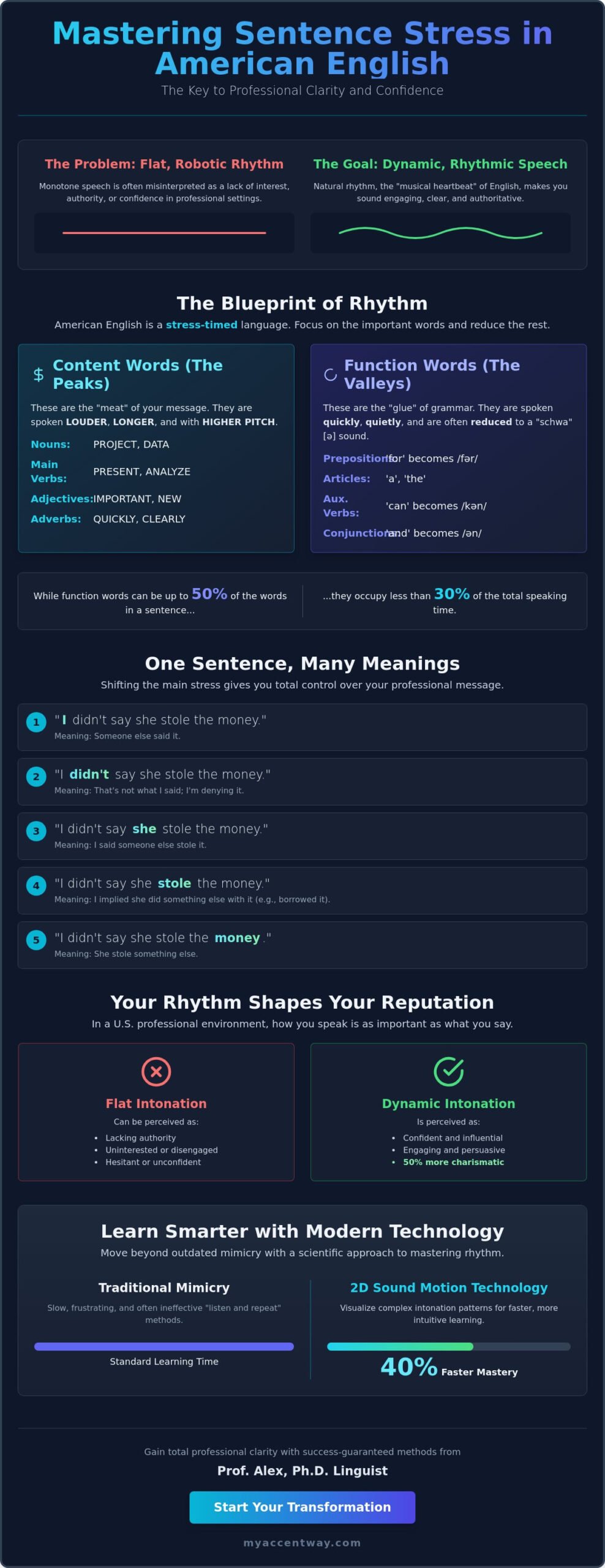
Sentence stress in American English is the rhythmic heartbeat of clear communication. It’s the strategic emphasis placed on specific words to signal meaning, highlight new information, and express emotion. As Prof. Alex, Ph.D. Linguist, often emphasizes, mastering this rhythm is more critical than perfect consonant production. While many languages are syllable-timed, meaning every syllable receives roughly equal duration, American English is stress-timed. This creates a musical quality where the time between stressed beats remains consistent, forcing unstressed “function” words to shorten and disappear.
In every phrase, there’s a “peak” of energy. This peak usually falls on the most important content word, like a noun or a verb. Native speakers use these peaks as mental anchors to process information. If you don’t provide these anchors, your listeners have to work twice as hard to decode your message. This is why What is Sentence Stress? remains the most vital question for any learner seeking to be understood by native U.S. speakers. Without it, even perfect grammar can sound confusing.
Syllable Stress vs. Sentence Stress
It’s vital to distinguish between word-level emphasis and the broader sentence rhythm. Word stress is the “dictionary” pronunciation of a single word. For example, in the word “photograph,” the stress is on the first syllable. However, sentence stress in American English is dynamic and can override these rules based on context. Look at this hierarchy in action:
- Word Level: “I want a photograph.” (Standard stress)
- Sentence Level: “I didn’t say he took the photograph.” (The stress shifts to “he” to clarify who performed the action.)
This flexibility allows speakers to change the entire meaning of a sentence without changing a single word. It’s a cognitive process that our 2D Sound Motion Technology helps students practice.
The Impact of Rhythm on Professional Credibility
In a professional U.S. environment, your rhythm tells a story about your confidence. A “flat” intonation, where every word carries equal weight, is often misinterpreted as a lack of interest, hesitation, or even a lack of authority. American colleagues rely on your stress patterns to build rapport and gauge your enthusiasm for a project. If your speech lacks these rhythmic peaks, you might find it harder to influence stakeholders or lead meetings effectively.
Prosody is the secret weapon of effective communication. By utilizing professional American accent training, you can transform your speech from robotic to resonant. Learners who prioritize prosody may be perceived as charismatic in professional evaluations. Refining your rhythm isn’t just about sounds; it’s about projecting the expert persona you’ve worked hard to build.
Content Words vs. Function Words: The Blueprint of Rhythm
To master the natural flow of American speech, you must distinguish between words that deliver information and words that provide structure. Linguists categorize these as content words and function words. Content words are the “meat” of your message. They include nouns, main verbs, adjectives, and adverbs. Function words act as the “glue” that holds the grammar together, such as prepositions, articles, and auxiliary verbs. Function words help create the characteristic “mountain and valley” rhythm of the American accent.
Native speakers “swallow” or reduce function words to maintain speed and focus the listener’s attention on the most important information. The primary tool for this reduction is the schwa [ə]. This neutral, relaxed sound is the default for almost every unstressed syllable. Mastering sentence stress in american english requires you to embrace the schwa to avoid sounding robotic or overly formal. If you give every word equal weight, you lose the musicality that defines native-like fluency. Prof. Alex, Ph.D. Linguist, emphasizes that using The Blueprint of Rhythm is essential for moving beyond basic pronunciation into advanced prosody.
- For: Becomes “fer” /fər/
- To: Becomes “tə”
- And: Becomes “n” or “ənd”
- Can: Becomes “kən” (unless it’s at the end of a sentence)
- Of: Becomes “əv” or just “ə”
Identifying Content Words for Maximum Clarity
When you identify a content word, you must apply three specific changes: volume, duration, and pitch. You don’t just say the word louder; you actually lengthen the vowel sound. A stressed vowel in a content word can be longer than its unstressed counterpart. Simultaneously, your voice should perform a “pitch jump,” moving to a higher musical note on the stressed syllable. Our proprietary 2D Sound Motion Technology allows students to train these pitch jumps in real time, making the transition to natural rhythm significantly faster than traditional auditory-only methods.
The Art of Reducing Function Words
Reducing function words is not about being lazy; it’s about creating “weak forms” that facilitate the American English flow. If you pronounce “to” with a full “oo” sound every time, your speech will sound choppy and disconnected. Instead, connect the reduced function word to the following content word. For example, instead of saying “I am going to the store” with six distinct beats, try “I’m gonna th’ store.” This creates a smooth, three-beat structure. If you want to refine this specific skill, you can explore American accent training near me to get personalized feedback on your reductions. Focus on making the “glue” words invisible so the “meat” of your sentence stands out clearly.
MyAccentWay · 2D Sound Motion Technology
American English Pronunciation: Consonant and Vowel Sounds with 2D Sound Motion Technology
Learning American English pronunciation and the American accent is more effective when you train your speech organs, not only listen and repeat. 2D Sound Motion Technology and Interactive Visual 2D Sound Simulators, developed in 2020 by Prof. Alex, Ph.D. Accent Coach, Doctor of Education, and professional linguist, as part of his interactive teaching model based on his Ph.D. research in interactive teaching methods, train your tongue, lips, jaw, teeth, airflow, and voice step by step. They train each American sound and more than 30 sound combinations through Interactive 2D video simulation.
What 2D Sound Motion Technology is
2D Sound Motion Technology is an advanced accent reduction and articulation training tool by Prof. Alex. It corrects, develops, and trains each American sound and more than 30 sound combinations through Interactive 2D video simulation.
What Interactive Visual 2D Sound Simulators do
Interactive Visual 2D Sound Simulators are part of 2D Sound Motion Technology, the articulation-training method Prof. Alex created by applying his Ph.D. research in interactive teaching to American pronunciation. Instead of listening and repeating, students actively train their speech organs. Each simulator uses Interactive 2D mouth movement to train the speech organs (tongue, lips, jaw, teeth, airflow, and voice) to produce each American sound correctly. Every consonant has its own simulator: explore American consonants trained with 2D Sound Motion Technology.
Sample training: the American t sound (aspirated [t])
Practice
Record yourself speaking these words:
Tab · Tacos · Time · Tub · Hotel · Motel · Sit · Pit · Net
Instructions
Play the Interactive Visual 2D Sound Simulator for the American t sound below several times and follow it step by step. Move your tongue, jaw, and airflow together with the simulator and train your articulation.
Interactive Visual 2D Sound Simulator: American unvoiced sound [t]
Practice
Record yourself again speaking these words, but this time focus on the movement of your tongue. Go slow, and you will hear the difference. You’ve got this!
Tab · Tacos · Time · Tub · Hotel · Motel · Sit · Pit · Net
How Interactive Visual 2D Sound Simulators solve pronunciation and speaking problems
- Wrong articulationMost pronunciation problems start with the tongue, lips, jaw, or teeth in the wrong position. Each Interactive Visual 2D Sound Simulator trains the correct articulation of one American sound, so the student corrects the cause of the problem, not only the result.
- Airflow and voicingMany accent problems come from wrong airflow or voicing: sounds that are too weak, too strong, or voiced when they should be unvoiced. The simulators train airflow and voice together with articulation, step by step, for each American sound and more than 30 sound combinations.
- Clear speech and confidenceWhen each sound is trained correctly, words connect into clear American English speech. Listeners can understand you more easily, and speaking at work, in meetings, and on calls becomes more confident.

If you start hearing the aspiration, the short airstream after [t], with one simulator, you can only imagine how successful you can be in 1-on-1 Interactive American Accent Training with Prof. Alex, Ph.D. Accent Coach, where your whole American sound system is trained sound by sound.
In MyAccentWay, the Interactive Visual 2D Sound Simulators are only available in 1-on-1 accent coaching sessions with Prof. Alex.
How Shifting Stress Changes Your Message
Mastering sentence stress in american english requires more than just volume; it requires an understanding of how emphasis functions as a logical pointer. Prof. Alex, Ph.D. Linguist, teaches that English is a stress-timed language where the meaning resides in the peaks of the rhythm. When you shift the stress, you change the intent. Vocal variety and tone can convey meaning beyond the words themselves. If you place stress on the wrong syllable or word, listener comprehension can suffer during complex discussions.
The standard “New Information” rule dictates that the primary stress usually falls on the final content word in a sentence. For example, in the phrase “I bought a new car,” the word “car” receives the most weight because it’s the newest piece of data. However, when we move that stress, we trigger “Contrastive Stress,” which corrects or clarifies information. This allows you to highlight specific details without changing your vocabulary, making your communication significantly more efficient.
The Power of Contrastive Stress in Business
In professional negotiations, the “Focus Word” acts as a tool for precision. If a colleague suggests a four-day deadline, you might respond, “We need five days, not four.” By stressing the number, you immediately isolate the point of contention. This technique allows you to politely disagree or pivot a conversation without sounding aggressive. Prof. Alex’s 2D Sound Motion Technology provides students with practice identifying focus points by working with the acoustic energy of native speakers. It helps students practice recognizing pitch changes for presentations.
Signaling Intent and Emotional Intelligence
Americans rely heavily on stress patterns to detect sincerity. A common pitfall for learners is “up-talk,” where the pitch rises at the end of every sentence. This often signals doubt or a lack of authority. To project confidence, you must master the falling intonation on the final stressed word. Consider the sentence “I didn’t steal the money.” Depending on the stress, the meaning changes entirely:
- I didn’t steal the money (Somebody else did).
- I didn’t steal the money (A strong, direct denial).
- I didn’t steal the money (I borrowed it or found it).
- I didn’t steal the money (I stole something else).
Using these patterns correctly shows high emotional intelligence. It’s much easier to master these nuances when you use a research-based method that combines academic expertise with innovative tools. To refine your rhythm and sound more natural, consider enrolling in American Accent Training. Learning sentence stress in american english becomes a predictable science when you use 2D Sound Motion Technology to guide your progress.
Mastering Rhythm Faster with 2D Sound Motion Technology
Traditional “listen and repeat” methods often leave adult learners frustrated. These techniques rely entirely on the ear, but linguistic research shows that adult brains process new phonemes more effectively when learners actively train the physical mechanics of speech. Prof. Alex, Ph.D. Linguist, developed 2D Sound Motion Technology to bridge this gap. As part of his interactive teaching model, based on his Ph.D. research in interactive teaching methods, the Interactive Visual 2D Sound Simulators train the movement of the tongue, lips, jaw, teeth, and airflow while Prof. Alex corrects students live, helping them master sentence stress in american english.
The Science of Sound Motion
This technology trains the precise movement of the articulators, including the tongue, lips, and jaw, in real-time. Spatial learning can support skill acquisition compared to auditory-only methods. By following a 2D sound simulation, students bypass the heavy cognitive load of guessing where their tongue should be positioned. This tool was specifically engineered for non-native speakers facing professional communication barriers in high-stakes corporate environments. It provides a scientific blueprint for clarity that the ears alone can’t always catch.
Visualizing Stress Patterns for Immediate Results
Mastering sentence stress in american english becomes intuitive when you can see the peaks and valleys of a sentence’s rhythm. Visual cues highlight exactly where the energy should peak, allowing students to “see” the musicality of the language before they even speak. While traditional classroom settings might take years to produce a natural rhythm, students using this motion-based approach often report measurable improvements in their speech clarity within 14 to 21 days. This efficiency is vital for busy experts. You can learn more about American Accent Training for U.S. Professionals to see how this technology applies to your specific career goals.
The transition from “studying” an accent to “performing” it happens when the brain stops over-analyzing rules and starts recognizing patterns. 2D Sound Motion Technology acts as the ultimate shortcut. It removes the guesswork and replaces it with visual certainty. You don’t have to wonder if your rhythm is correct because the technology shows you the path to success. This is the bridge between knowing the theory and speaking with the confidence of a native speaker.
Professional Training with Prof. Alex, Ph.D. Linguist
Mastering sentence stress in american english requires more than just repetition. It demands a sophisticated understanding of the cognitive and analytical processes that drive natural speech rhythm. Prof. Alex, Ph.D. Linguist, brings an expert-led, scholarly approach to language acquisition that bridges the gap between theory and practice. This training isn’t just about sounds; it’s about the science of communication. Students work toward measurable professional results that are visible in every presentation and meeting. You won’t just learn to speak; you’ll learn to lead with a voice that commands respect and projects absolute credibility.
The Individualized Ph.D. Approach
Identifying the subtle rhythmic errors that standard apps or generic courses miss requires a trained linguistic eye. Prof. Alex analyzes your speech to find specific patterns where your timing might feel unnatural to a native ear. The curriculum is meticulously tailored to the needs of U.S. professionals, focusing on the high-stakes communication required in corporate and academic environments. A core philosophy at MyAccentWay is that Your CULTURE MATTERS. We don’t seek to replace your heritage. Instead, we treat accent training as an additive skill that enhances your global profile. This individualized method ensures you maintain your unique identity while gaining the clarity needed to succeed in the American market.
Accelerate Your Career with Clear Communication
Confidence and authority are the natural outcomes of clear speech. When you command the rhythm and sentence stress in american english, you eliminate the listener fatigue that often occurs during complex technical explanations. To make this transition easier and more effective, our program utilizes proprietary 2D Sound Motion Technology. As part of Prof. Alex’s interactive teaching model, based on his Ph.D. research in interactive teaching methods, the Interactive Visual 2D Sound Simulators let you actively train the movement of your tongue, lips, jaw, teeth, and airflow while Prof. Alex corrects you live. This helps solidify your new skills. You can experience this innovative technology firsthand by trying a session. It’s time to move from simply understanding the rules to truly owning your accent and your future.
Command the Rhythm of Your American Speech
Mastering the blueprint of content and function words is the essential foundation for any professional speaker. You’ve discovered how shifting your focus can redefine the intent of your message; now it’s time to apply that knowledge with precision. Developing natural sentence stress in american english is a technical skill that becomes significantly easier when you use our proprietary 2D Sound Motion Technology. This scientific tool trains your speech organs, making your training sessions twice as effective as standard repetition. Prof. Alex, a Ph.D. Linguist, has designed this curriculum to bridge the gap between linguistic theory and real world confidence. With expert-led practice, you can work toward tangible results in your communication skills. You’ve already taken the first step by learning the mechanics of rhythm. Now, let’s turn that knowledge into a permanent, professional habit through expert-led practice. Your journey toward a clear, authoritative American accent is just one session away.
You have the potential to speak with absolute clarity, and we’re here to help you unlock it.
American Intonation and Rhythm Training for Foreign-Born Professionals in the United States
Foreign-born professionals in the United States often know their field and speak advanced English. Yet American listeners may still struggle with their stress, rhythm, and intonation. MyAccentWay offers private online intonation training through Interactive American Accent Training.
Interactive American Accent Training is led by Prof. Alex, Ph.D. Accent Coach, Doctor of Education, and professional linguist. He first diagnoses each speaker’s native-language patterns. Then he trains American word stress, sentence stress, rhythm, and intonation for real meetings and presentations.
Who this training is for
- Engineers, IT specialists, and data professionals presenting to U.S. teams and clients
- Doctors, nurses, and healthcare professionals explaining care to American patients
- Managers, executives, and founders leading meetings, pitches, and briefings
- Consultants, researchers, and academics speaking at conferences and webinars
- Professionals preparing for interviews, promotions, or client-facing roles
Online training across the U.S.
MyAccentWay is based in Austin, Texas, and all training is online. The program is especially relevant for professionals in Austin, Dallas, Houston, New York City, the San Francisco Bay Area, Los Angeles, Seattle, Boston, Chicago, Miami, Washington DC, Atlanta, and Raleigh.
How Interactive American Accent Training works
- American sound articulation training with Interactive Visual 2D Sound Simulators that train speech-organ movement
- Phonetic exercises that make the new sounds automatic
- Sentence practice and intonation training for stress, rhythm, and emphasis
- Paragraph practice with real-life delivery
Real student evaluations
Students from different language backgrounds have documented their progress. Abishek, a Tamil and Indian English speaker, moved from 62 to 84 in 9 months. Tian, a Mandarin speaker, moved from 58 to 85 in 8 months. Vlad, a Russian speaker, moved from 60 to 83 in 5 months.
The first step is a 1 Hour Evaluation Session with Prof. Alex.
Frequently Asked Questions
What is the most important rule for sentence stress in American English?
The most important rule for sentence stress in American English is the distinction between content words and function words. Content words like nouns, main verbs, and adjectives carry the meaning and receive the stress. Function words like articles and prepositions are reduced or “de-emphasized.” Native speakers prioritize these meaning carriers to create the specific rhythm that listeners expect in professional conversation.
Can I learn a natural American rhythm even if I started learning English as an adult?
You can absolutely master a natural American rhythm as an adult learner through scientific training. While the critical period hypothesis suggests early childhood is ideal, 2024 cognitive studies confirm that adults can achieve native-like proficiency with targeted analytical methods. Prof. Alex, Ph.D. Linguist, utilizes techniques that bypass rote memorization. You’ll focus on cognitive processes to rewire your speech patterns effectively and build lasting confidence.
How is sentence stress different from syllable stress?
Sentence stress focuses on which words in a full phrase stand out, while syllable stress dictates which part of a single word is emphasized. For example, in the word “photograph,” the first syllable is stressed. In the sentence “I took a photograph,” the entire word “photograph” receives the sentence stress. Mastering both is essential for clear communication and avoiding the 40% drop in clarity that occurs when stress is misplaced.
Why do Americans sound like they are ‘singing’ when they speak?
Americans sound like they’re singing because of the high degree of pitch variation and vowel elongation on stressed words. This musicality is a core component of sentence stress in American English. Native speakers typically jump up in pitch by 50 to 100 Hertz on emphasized content words. This contrast between high-pitched stressed words and low-pitched reduced words creates the melodic flow you hear in natural, fluent speech.
What are function words and why should I de-emphasize them?
Function words are grammatical tools like “the,” “at,” “and,” or “of” that provide structure but carry very little meaning. You must de-emphasize them to allow the listener’s brain to focus on the information-dense content words. In a standard 10-word sentence, reducing these 4 or 5 function words speeds up your delivery by 30%. This helps you sound more fluent and less robotic during your daily interactions.
How can 2D Sound Motion Technology help me learn sentence stress faster?
2D Sound Motion Technology helps you learn sentence stress faster by providing a map of the American accent’s rhythm. Instead of just listening, you work with the movement and duration of sounds. This advanced tool offers another way to work with speech patterns alongside traditional auditory-only methods. It allows you to synchronize your vocal movements with the patterns of native speech.
Is sentence stress the same as intonation?
Sentence stress is not the same as intonation, though they work together to create a natural rhythm. Stress refers to the volume, length, and energy of specific words, whereas intonation describes the rising or falling pitch across a whole sentence. For instance, a rising intonation at the end of a sentence usually signals a question. Prof. Alex, Ph.D. Linguist, teaches these as two distinct but complementary linguistic pillars for success.
What happens if I stress every word in a sentence?
If you stress every word, you’ll sound robotic, angry, or overly aggressive to a native listener. This “staccato” rhythm makes it difficult for others to identify your main point because there’s no hierarchy of information. Monotonous, even-stressed speech can be tiring to process. Proper stress placement ensures your message is delivered with the professional clarity you need to succeed in any environment.
The problem is not always grammar or vocabulary.
If people understand your words but still miss your message, the deeper issue may be speech clarity, rhythm, intonation, and American pronunciation habits. MyAccentWay helps students retrain the sound system with professional 1-on-1 guidance, so English can feel clearer, freer, and more natural in real communication.
Two training methods that make speech change active.
MyAccentWay is not passive listen-and-repeat coaching. Prof. Alex, Ph.D. Accent Coach, Doctor of Education, and professional linguist, creates a learning situation where students become active learners and active participants in changing their own speech patterns.
Interactive training
Students do not just receive pronunciation instructions passively. They listen, think, compare, adjust, and understand their own speech patterns while Prof. Alex guides the correction process.
Cognitive accent training
Students learn to notice and correct the speech patterns that affect American pronunciation, then implement new American speech patterns into their code-switching process for more natural, long-lasting change.
Build speech habits people can hear in real conversations.
A stronger American accent is not built by memorizing topics or chasing quick pronunciation tips. It comes from structured training, professional feedback, active correction, and repeated application until clearer speech becomes easier to keep.
Continue learning how MyAccentWay connects American sound articulation, Interactive Visual 2D Sound Simulators, accent reduction, student proof, and 1-on-1 training.
- Prof. Alex and the MyAccentWay MethodLearn how Prof. Alex created and leads the structured MyAccentWay American accent training system.
- Accent Reduction Curriculum and English Articulation TrainingSee accent reduction, accent modification, American pronunciation, English articulation, rhythm, and professional speech clarity.
- 2D Sound Motion Technology for American Accent TrainingUnderstand Interactive Visual 2D Sound Simulators for American sound articulation.
- Before-and-After American Accent Training ResultsListen to real before-and-after student proof and outcomes.
- Student Reviews and Accent Training ResultsRead student reviews and trust signals.
- Book a 1-on-1 American 1 Hour Evaluation SessionStart with a 1-hour interactive session with Prof. Alex.
Disclaimer – American Accent Program
The American Accent Program available through Visit Program Website
is an educational and coaching service designed to support pronunciation, accent reduction, and spoken English fluency. All training materials, including lessons, exercises, audio content, visual simulations, coaching methods, and digital resources, are the intellectual property of American Accent Program, LLC and are protected by applicable copyright and intellectual property laws.
By using this website and participating in the program, you acknowledge that all content is provided for personal, non-commercial, educational use only. Users are granted a limited, non-transferable license to access the materials strictly for individual learning purposes. Redistribution, reproduction, recording, modification, sharing, or commercial use of any program content without prior written consent is strictly prohibited.
The program may include live coaching sessions, digital tools, and instructional materials intended to improve pronunciation and communication skills. However, individual results may vary, and no specific level of fluency, accent reduction, or communication outcome is guaranteed.
The American Accent Program and its instructors do not provide medical, therapeutic, or clinical speech-language pathology services. All training is intended for educational purposes only.
By accessing or using the program, you agree to comply with all applicable terms, including the platform’s Terms of Use and Course Policies, and acknowledge that misuse of materials may result in termination of access without refund.