TL;DR:
- American English social communication involves sharing thoughts and emotions through culturally specific verbal and nonverbal cues. Mastering these skills requires attention to pronunciation, active listening, and understanding American cultural norms for interaction. Training with visual tools like 2D Sound Motion Technology accelerates physical understanding and improves confidence in social settings.
American English social communication is defined as the ability to share thoughts, emotions, and experiences using verbal and nonverbal cues that follow culturally specific rules. The American Speech-Language-Hearing Association (ASHA) recognizes social communication as a distinct skill set covering language use, social interaction, and pragmatic understanding. For non-native speakers, mastering these skills means more than learning grammar. It means reading the room, matching your tone to the moment, and knowing when to speak and when to listen. Myaccentway, led by Professor Alex, Ph.D., Linguist and Accent Coach, specializes in helping professionals build exactly these skills through structured, science-backed training.
What verbal and nonverbal elements define American English social communication?
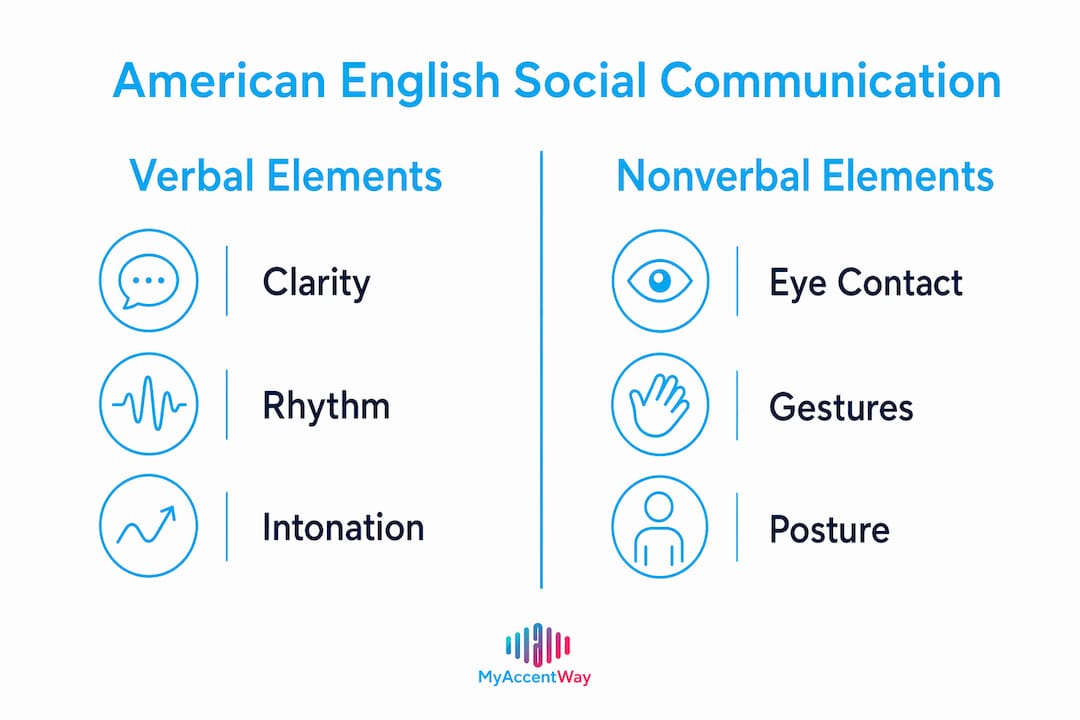
Social communication in American English involves both what you say and how you say it. Verbal clarity, natural rhythm, word stress, and intonation all shape how your message lands. Connected speech, where words blend together in natural flow, is equally important for sounding fluent and being understood.

Nonverbal cues carry just as much weight. Eye contact, gestures, and facial expressions signal engagement, confidence, and empathy in U.S. workplace settings. A firm, steady gaze during a conversation signals honesty and attention. Nodding while someone speaks shows you are following along. Crossed arms or a flat tone can signal disinterest, even when your words say otherwise.
Key verbal and nonverbal elements to develop:
- Pronunciation clarity: Stress the right syllables and use natural intonation to convey meaning and emotion
- Rhythm and connected speech: Link words naturally, as in “gonna,” “wanna,” or “didja” in informal speech
- Eye contact: Maintain steady but not aggressive eye contact to show confidence
- Facial expressions: Match your expression to your message to avoid mixed signals
- Posture and gestures: Open body language signals receptiveness and engagement
- Tone of voice: Vary your pitch and pace to emphasize key points
Pro Tip: Observe how American colleagues use nonverbal cues in meetings. Notice when they nod, pause, or shift posture. Then practice calibrating your own signals to match the cultural register of the setting.
How do cultural norms shape social interactions in American English?
American communication culture favors directness. Speakers state their point clearly and expect the same in return. Ambiguity or excessive hedging can read as uncertainty or evasiveness, even when it is simply a cultural habit from another background.
Cultural and societal norms distinctly shape social communication rules. Non-native speakers should adapt to these norms rather than aim for one perfect universal style. A communication approach that works well in one culture can create friction in another. For example, avoiding direct eye contact is respectful in some cultures but signals discomfort or dishonesty in American professional settings.
A practical framework for effective social communication in American professional contexts:
- Know your audience. A common cause of miscommunication is a mismatch between what the speaker assumes the listener knows and what the listener actually knows. Adjust your vocabulary and detail level accordingly.
- Practice active listening. Use verbal encouragers like “I see,” “right,” or “that makes sense” to show you are engaged. These small signals matter enormously in American conversations.
- Make your message clear. State your main point early. Americans generally prefer the conclusion first, then the supporting details.
- Choose the right medium. A sensitive topic deserves a face-to-face conversation, not a text message. Medium choice affects how your message is received.
Pro Tip: When you are unsure how a gesture or phrase will land, observe first. Nonverbal meanings vary by culture, and careful observation before acting prevents misunderstandings.
What pronunciation techniques improve American English speech clarity?
Pronunciation training targets intelligibility, rhythm, stress, and intonation rather than perfect phonetic accuracy. The goal is not to erase your accent. The goal is to be clearly understood and to communicate with confidence in any professional setting.
Non-native speakers often focus too much on individual sounds and too little on the patterns that carry meaning. Stress and intonation tell your listener what is important. A flat, monotone delivery makes it hard to follow your meaning, even when every word is technically correct.
Core pronunciation elements that affect social communication:
- Word stress: Stressing the wrong syllable changes meaning. “REcord” (noun) versus “reCORD” (verb) are different words entirely.
- Sentence stress: Americans stress content words (nouns, verbs, adjectives) and reduce function words (articles, prepositions). This rhythm is what makes speech sound natural.
- Intonation patterns: Rising intonation signals a question or uncertainty. Falling intonation signals a statement or conclusion.
- Connected speech: Sounds blend across word boundaries. “Did you eat?” becomes “Didja eat?” in natural American speech.
- Vowel reduction: Unstressed vowels often reduce to a schwa sound, as in “about” or “banana.”
Myaccentway’s 2D Sound Motion Technology makes this training visible. Professor Alex uses this method to show students exactly how the tongue, lips, jaw, and airflow move during each American sound. Watch this 2D Sound Simulator for the American [T] sound:
https://youtu.be/3EzjosgnzJE. Seeing the movement removes the guesswork and accelerates physical training of each sound.
How can non-native speakers build active listening skills in American English?
Active listening transfers better than memorized phrases because it improves turn-taking responsiveness and reduces the risk of seeming dismissive in real conversations. Listening is not passive. It requires attention, response, and timing.
In American professional settings, active listening looks like this:
- Verbal encouragers: Short responses like “uh-huh,” “I see,” or “go on” signal that you are tracking the conversation
- Reflective responses: Paraphrase what you heard to confirm understanding, as in “So what you’re saying is…”
- Timely turn-taking: Wait for natural pauses before speaking. Interrupting too early or waiting too long both disrupt the flow
- Supportive nonverbal cues: Nod, maintain eye contact, and face the speaker directly
- Clarifying questions: Ask short, specific questions when something is unclear rather than guessing
These behaviors build trust and reduce miscommunication in U.S. professional interactions. They also signal cultural fluency, which matters as much as vocabulary in workplace relationships.
Pro Tip: After a real conversation, ask yourself: Did I respond to what was actually said, or to what I expected to hear? That reflection sharpens your listening accuracy faster than any drill.
Seek feedback from American colleagues or a trained coach. Real-world conversation practice with constructive feedback is the fastest path to improvement. Vlad, a Russian speaker, demonstrates real pronunciation progress through Myaccentway’s training: https://youtube.com/shorts/OE0q7Y8cV74?si=xxmZVxedUPbunfdZ.
Key Takeaways
Mastering American English social communication requires verbal clarity, cultural awareness, active listening, and pronunciation skills working together as one integrated system.
| Point | Details |
|---|---|
| Social communication is a skill set | It covers verbal cues, nonverbal signals, and culturally specific pragmatic rules, not grammar alone. |
| Directness is a cultural norm | American professional communication favors clear, early statements of the main point. |
| Pronunciation targets intelligibility | Focus on rhythm, stress, and intonation rather than eliminating every accent feature. |
| Active listening builds trust | Using verbal encouragers and timely responses signals cultural fluency in U.S. settings. |
| Nonverbal cues vary by culture | Observe local American norms before assuming your gestures carry the same meaning. |
What I have learned from training non-native professionals in American social communication
Most students arrive focused on grammar. They have studied English for years, and their written skills are strong. What surprises them is how much of American communication happens outside the words themselves.
The students who improve fastest are the ones who stop trying to be perfect and start trying to be responsive. They learn to read the room. They notice when a colleague’s tone shifts, when a pause signals disagreement, or when a smile means something different than they expected. That responsiveness, not flawless pronunciation, is what earns trust in American professional settings.
Social communication success hinges on how utterances function socially, how facial and body language support messages, and how well you respond in real time. Grammar is the foundation. Social skill is the structure built on top of it.
The 2D Sound Motion Technology I use at Myaccentway addresses the physical side of this. When students can see how a sound is made, doubt becomes clarity. They stop guessing and start training with precision. That physical understanding accelerates the confidence needed for real social interaction.
My advice: do not wait until your pronunciation is perfect before engaging. Engage now, observe carefully, and let feedback shape your progress. The American English speaking course you choose should combine pronunciation training with real communication practice, not one without the other.
— Prof.
Myaccentway’s training for American English social communication
Myaccentway offers one-on-one American accent training designed specifically for non-native professionals who want to communicate clearly and confidently in U.S. settings.
Professor Alex, Ph.D., begins with a personalized assessment to identify your specific speech patterns and communication gaps. From there, the program covers pronunciation clarity, rhythm, stress, intonation, connected speech, and the cultural nuances that shape American social interaction. The American accent training guide walks you through every stage of the process. Professor Alex’s science-backed speech clarity approach, including 2D Sound Motion Technology, gives you the tools to train sounds physically, not just by ear. Book a sample class to see exactly where your communication stands and how to move forward.
FAQ
What is American English social communication?
American English social communication is the ability to share thoughts, emotions, and experiences using verbal and nonverbal cues that follow culturally specific American norms. It includes pronunciation clarity, intonation, eye contact, turn-taking, and active listening.
Why do non-native speakers struggle with American social communication?
The most common cause is a mismatch between cultural communication norms, not a lack of vocabulary or grammar. Nonverbal signals, directness expectations, and active listening behaviors differ significantly across cultures.
How does pronunciation affect social communication in American English?
Rhythm, stress, and intonation shape how your message is interpreted socially. Flat intonation or misplaced stress can make speech hard to follow, even when individual words are correct.
What is the fastest way to improve American English social communication?
Combining active listening practice with structured pronunciation training produces the fastest results. Real-world conversation with feedback from a trained coach accelerates progress more than self-study alone.
How does 2D Sound Motion Technology help with social communication?
2D Sound Motion Technology shows students how the tongue, lips, and jaw move during American sounds. This physical understanding builds the pronunciation clarity needed for confident social interaction.
Recommended
- Navigate American Social Settings with a Foreign Accent
- American English Connected Speech Rules: A Professional Guide to Natural Flow
- American English Informal Speech: A Guide for Non-Native Speakers
- American English: Myths, Mechanics, and Mastering Speech Clarity
Discover more from MyAccentWay
Subscribe to get the latest posts sent to your email.