
Article by
Prof. Alex, Ph.D. Accent Coach
Doctor of Education, professional linguist,
Creator of 2D Sound Motion Technology,
Creator of “InPronunci:” American Accent Program App,
Professor of English as a Second Language,
American Accent Coach,
Life Coach.
Have you ever felt a pang of self-consciousness in a meeting, worried that your accent might be clouding your message? Or experienced the frustration of being asked to repeat yourself, even when you know your English is excellent? This communication gap isn’t about your intelligence or your grasp of the language; it’s about the specific mechanics of sound, rhythm, and intonation. This is where effective american accent training becomes a transformative tool-not for erasing your identity, but for building a bridge to clear, confident communication.
The journey to fluent speech can feel overwhelming, especially with countless free videos and apps that often fail to deliver real progress. This guide is different. We will break down everything you need to know, from the core linguistic principles that govern the American accent to a clear comparison of effective training methods. You will gain the knowledge to move beyond imitation and truly understand the science of speech, empowering you to choose the right path to being understood the first time, every time.
Key Takeaways
- Understand that the true goal of accent training is to enhance clarity and confidence, allowing you to communicate effectively while honoring your unique identity.
- Mastering the American accent goes beyond memorizing vowels; it requires a holistic approach to the three core pillars of Sounds, Music, and Connection.
- Your success in american accent training depends on choosing the right method-whether self-study, an app, or a coach-that aligns with your specific goals and learning style.
- Discover how to build a powerful and consistent practice routine, as short, daily sessions are proven to be far more effective than long, infrequent ones.
What is American Accent Training (and What It’s Not)
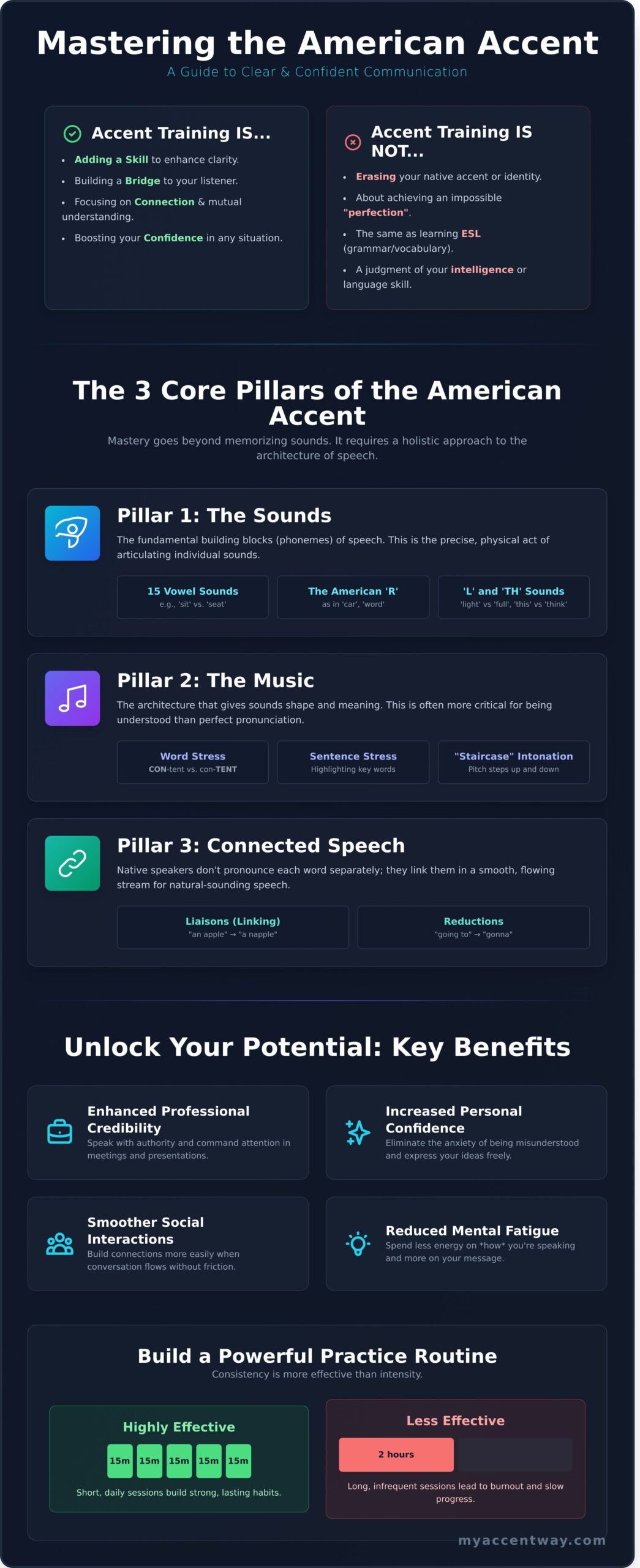
Embarking on the journey of american accent training is a powerful step toward mastering clear and confident communication. It’s a common misconception that the goal is to erase your native accent or cultural identity. On the contrary, effective training is a process of addition, not subtraction. It equips you with the specific skills to enhance clarity and be universally understood by native speakers, ensuring your message is always heard exactly as you intend.
This process, often called accent modification, is fundamentally different from learning English as a second language (ESL). While ESL focuses on grammar, vocabulary, and comprehension, accent training is for fluent speakers who want to refine the phonetics, rhythm, and intonation of their speech. The ultimate goal is not perfection, but connection-fostering effortless, mutual understanding in every conversation.
Accent vs. Pronunciation: Understanding the Difference
To master your speech, it’s crucial to understand two core concepts. Pronunciation is the precise, physical act of articulating individual sounds, or phonemes. Accent, however, is the broader system that combines pronunciation with intonation (the rise and fall of your voice), rhythm, and word stress. Think of it this way: pronunciation provides the ‘bricks’-the individual sounds-while your accent is the ‘architecture’ that structures them into clear, intelligible speech. Most training programs focus on the patterns of what linguists call the General American accent, a widely understood model for this architecture.
Key Benefits of Improving Your American Accent
The rewards of achieving clearer speech extend far beyond pronunciation, empowering you in both your professional and personal life. By refining your accent, you can unlock a new level of confidence and effectiveness.
- Enhanced Professional Credibility: Speak with authority and command attention in meetings, presentations, and negotiations, ensuring your expertise takes center stage.
- Increased Personal Confidence: Eliminate the anxiety of being misunderstood and express your brilliant ideas freely and fluently.
- Smoother Social Interactions: Build connections more easily when your conversation flows effortlessly, without the friction of having to repeat yourself.
- Reduced Mental Fatigue: Spend less energy worrying about how you’re speaking and more energy on the important message you want to convey.
The Core Components of the American Accent
Many learners believe that mastering an American accent is simply about memorizing new vowel sounds. While vowels are crucial, they are only one piece of a much larger, more fascinating puzzle. True mastery comes from understanding and practicing three core pillars: The Sounds, The Music, and The Connection. This structured approach, guided by a linguistic expert, is the foundation of effective american accent training, transforming it from a guessing game into a clear, achievable skill. As defined by the American Speech-Language-Hearing Association (ASHA), the goal of professional accent modification services is to enhance clarity and confidence, not to erase your unique identity.
Pillar 1: The Sounds (Vowels and Consonants)
The individual sounds, or phonemes, are the fundamental building blocks of speech. American English uses a rich palette of 15 distinct vowel sounds that create critical differences between words like ‘sit’ and ‘seat’. Beyond vowels, specific consonants often pose a challenge for non-native speakers. Key areas of focus include:
- The American ‘R’ sound (as in car)
- The clear ‘L’ vs. the dark ‘L’ (as in light vs. full)
- The ‘TH’ sounds (voiced ‘th’ in this vs. voiceless ‘th’ in think)
Pillar 2: The Music (Intonation, Stress, and Rhythm)
If sounds are the building blocks, then music is the architecture that gives them shape and meaning. This is often more critical for being understood than perfect pronunciation. It involves word stress (why CON-tent is a noun, but con-TENT is a feeling), sentence stress, and the unique “staircase” intonation of American English, where your pitch steps up and down on key words to guide your listener’s attention.
Pillar 3: Connected Speech
Native speakers don’t talk like robots, pronouncing each word separately. Instead, they link them together in a smooth, flowing stream. This is achieved through liaisons (linking sounds between words, like “an apple” sounding like “a napple”) and reductions (shortening common phrases, like “going to” becoming “gonna”). Mastering these connections is the final key to unlocking a truly natural and fluent sound, a core goal in any successful american accent training program.
How to Train Your Accent: Comparing Popular Methods
Once you understand the core rules of American pronunciation, the next step is consistent practice. But which method is most effective? The journey of mastering an accent is deeply personal, and the best approach depends on your learning style, budget, and ultimate goals. Understanding what is accent reduction involves recognizing that different paths work for different people. Let’s explore the most common pathways to help you choose your way forward.
Self-Study: Books and Online Resources
This path offers maximum flexibility and affordability. You can learn at your own pace, fitting lessons into your schedule whenever it’s convenient. However, the critical drawback is the lack of personalized feedback. Without an expert ear to guide you, it’s dangerously easy to practice mistakes and reinforce incorrect pronunciation habits, which can slow your long-term progress. This method is best suited for highly disciplined individuals or those starting on a tight budget.
Language Apps and Software
Technology brings an interactive and engaging element to learning. Many apps use voice recognition to provide instant feedback on individual sounds and words, which can be great for drilling specific phonemes. While useful, this AI feedback is limited. It often cannot correct nuanced errors in intonation, rhythm, or connected speech-the very elements that make an accent sound natural and fluent. Apps are excellent tools for supplementary practice but rarely suffice as a complete solution.
Professional Coaching (1-on-1 or Group)
For learners who are committed to achieving clear, confident speech, working with a professional linguist is the gold standard. This method provides the direct, personalized feedback necessary to identify and correct subtle yet critical errors. A structured, science-based curriculum ensures you master every component of the American accent systematically. While it requires a greater financial and time commitment, the results are faster and more profound. Expert programs, such as the comprehensive American Accent Program, provide the accountability most learners need to succeed.
Ultimately, the most effective strategy is often a blended one. You might use an app for daily drills, a book for foundational knowledge, and periodic coaching sessions to get expert feedback and stay on track. Regardless of the path you choose, remember this: consistency is far more important than the method itself. Dedicated, daily practice is the true key to successful american accent training.
Building an Effective Accent Training Practice Routine
Mastering the phonemes and rhythm of American English is a science, but applying it successfully requires a structured, consistent practice. The key to transformative progress isn’t spending hours in frustrating, infrequent sessions; it’s dedicating short, focused bursts of energy every day. This approach builds muscle memory and retrains your cognitive processes for lasting change. Before you even speak, begin with active listening-tuning your ear to the specific sounds, intonation, and stress patterns of native speakers. This is the foundation upon which all effective american accent training is built.
The 15-Minute Daily Workout
A short, daily commitment is far more powerful than a long weekly one. This simple framework ensures you target key skills consistently, creating a powerful habit for success.
- Minutes 1-5: Articulatory Warm-up. Just like an athlete, you must warm up your tools. Perform simple mouth and tongue stretches to prepare your muscles for the precise movements required for new sounds.
- Minutes 6-10: Focused Practice. Isolate one target sound (like the American ‘R’ or the ‘TH’ phoneme) or one intonation pattern. Repetition here is crucial for building new neural pathways.
- Minutes 11-15: Record and Analyze. Use your phone or computer to record yourself speaking a few sentences. Listen back immediately. This objective feedback is your most powerful tool for self-correction.
Essential Tools for Your Toolkit
Equip yourself with the right instruments to accelerate your progress. Professional-grade results come from using professional-grade (and often free) tools to guide your practice.
- A Quality Microphone: To hear the subtle nuances of your speech, you need a clear recording. Your smartphone is a great start, but software like Audacity on a computer is even better.
- A Mirror: So much of pronunciation is physical. A mirror provides instant visual feedback on your tongue and lip placement.
- Online Dictionaries: Websites like Merriam-Webster provide audio pronunciations, giving you a perfect model to imitate.
- Media for Immersion: Use American podcasts and TV shows not just for entertainment, but as active listening exercises to internalize rhythm and flow.
Mindset and Overcoming Plateaus
Your mindset is just as critical as your technique. The journey to mastering an accent is not linear; there will be moments of rapid growth and periods of frustrating plateaus. This is a normal and expected part of the learning process. Focus on progress, not perfection. Celebrate small victories-like finally nailing a difficult vowel sound-to maintain motivation. Embrace every mistake as a valuable data point showing you exactly where to focus next. A structured routine is your anchor, and a growth mindset is your sail. For a truly personalized roadmap, a linguist-led program can provide the expert guidance needed to navigate plateaus and guarantee success.
How to Choose the Right American Accent Coach or Program
You’ve learned the rules, but mastering the American accent requires expert guidance. For serious learners, selecting the right coach or program is the most critical investment you will make on your journey to confident, fluent speech. It’s the difference between slow, frustrating progress and transformative, lasting results. This checklist will empower you to ask the right questions and choose a path that truly delivers.
Credentials and Expertise
Look beyond native speakers. True experts have a formal academic background in linguistics, phonetics, or speech-language pathology. A Master’s degree or Ph.D. indicates a deep, scientific understanding of sound production, intonation, and rhythm. Crucially, you should always ask if a coach has direct experience working with speakers of your native language. This specialized expertise allows them to anticipate your specific challenges and provide targeted, effective solutions from day one.
Methodology and Technology
Effective american accent training is built on a structured, proven curriculum, not just casual conversation. A superior program will utilize technology to provide clear visual feedback on tongue and lip placement and analyze your speech for precise error correction. Most importantly, a personalized approach is non-negotiable. Avoid one-size-fits-all courses; your accent journey is unique and requires a tailored plan based on a thorough diagnostic assessment to address your specific goals.
Reviews and Guarantees
Social proof is powerful. Look for authentic video testimonials and detailed reviews from past students who have achieved the clarity and confidence you desire. A provider who is confident in their method will often offer a trial session or a satisfaction guarantee. Verifying these success stories is the first step to finding expert American accent training near you. By evaluating these key areas, you can invest in a program designed for real, measurable success.
Your Path to Clear, Confident American English
As we’ve explored, mastering the American accent is a journey of skill, not imitation. It’s about building clarity by understanding core components like intonation and rhythm, and committing to a structured practice. Choosing the right guide is the most critical step in your american accent training, transforming your speech and unlocking new levels of confidence.
You don’t have to navigate this journey alone. At My Accent Way, we provide a proven path to success. Our training, designed by a Ph.D. Linguist, utilizes proprietary 2D Sound Motion Technology to accelerate your learning. We are so confident in our method that we offer a Success Guarantee, ensuring you achieve your goals.
Ready to take the first step toward speaking with clarity and power? Book Your 1 Hour Evaluation Session with Prof. Alex, Ph.D. Linguist and experience the most effective way to achieve your communication goals.
Your voice is your most powerful tool. It’s time to let it be heard.
Frequently Asked Questions About American Accent Training
How long does American accent training take?
The timeline for mastering an American accent is unique to each individual. Progress depends on your native language, practice intensity, and learning methods. With consistent, expert-guided practice, most students achieve a significant improvement in clarity and confidence within 3 to 6 months. Full mastery is a longer journey, but the goal is to equip you with the tools for clear and effective communication, which is a highly attainable and empowering objective.
Can I completely lose my original accent?
The goal is not to “lose” your accent, which is a vital part of your identity, but rather to “add” a new one. Think of it as developing a new skill that allows you to switch to a standard American accent for clear communication. While some learners achieve a near-native sound, our focus is on helping you speak with confidence and be easily understood in any situation, all while honoring your cultural and linguistic background.
Is American accent training worth the cost?
Investing in professional accent training is an investment in your personal and professional confidence. The cost funds the expert, personalized guidance required to achieve tangible results. Clearer communication can unlock career opportunities, prevent misunderstandings, and deepen your social connections. When you can express your ideas and expertise without listeners being distracted by your accent, the return on that investment in yourself becomes truly invaluable and life-changing.
What is the hardest part of learning the American accent?
For many learners, the most challenging elements are the “musical” aspects of the language, known as suprasegmentals. This includes mastering American intonation patterns, sentence rhythm, and correct word stress, which are often subconscious in our native tongue. Certain specific sounds, or phonemes, like the American ‘R’ sound and the two ‘TH’ sounds (/θ/ and /ð/), also require developing new muscle memory and precise articulation techniques.
Can I learn an American accent on my own?
While self-study resources can build a great foundation, they lack the most critical component for success: personalized feedback. Without a trained linguist to hear and correct your specific errors, it is easy to practice mistakes until they become fossilized. Professional American accent training provides the tailored, expert guidance needed to master subtle nuances, ensuring your practice is both efficient and effective for achieving clear, confident speech.
At what age does it become impossible to change your accent?
It is never too late to modify your accent. While children may acquire accents more intuitively, adult learners can leverage their cognitive and analytical skills for incredible results. The brain remains capable of learning and creating new neural pathways throughout life. With proven, science-based methods and dedicated practice, any motivated adult can achieve a remarkable transformation in their pronunciation. Your success is determined by your commitment, not your age.
Disclaimer – American Accent Program
The American Accent Program available through Visit Program Website
is an educational and coaching service designed to support pronunciation, accent reduction, and spoken English fluency. All training materials, including lessons, exercises, audio content, visual simulations, coaching methods, and digital resources, are the intellectual property of American Accent Program, LLC and are protected by applicable copyright and intellectual property laws.
By using this website and participating in the program, you acknowledge that all content is provided for personal, non-commercial, educational use only. Users are granted a limited, non-transferable license to access the materials strictly for individual learning purposes. Redistribution, reproduction, recording, modification, sharing, or commercial use of any program content without prior written consent is strictly prohibited.
The program may include live coaching sessions, digital tools, and instructional materials intended to improve pronunciation and communication skills. However, individual results may vary, and no specific level of fluency, accent reduction, or communication outcome is guaranteed.
The American Accent Program and its instructors do not provide medical, therapeutic, or clinical speech-language pathology services. All training is intended for educational purposes only.
By accessing or using the program, you agree to comply with all applicable terms, including the platform’s Terms of Use and Course Policies, and acknowledge that misuse of materials may result in termination of access without refund.
Speech clarity check
The problem is not always grammar or vocabulary.
If people understand your words but still miss your message, the deeper issue may be speech clarity, rhythm, intonation, and American pronunciation habits. MyAccentWay helps students retrain the sound system with professional 1-on-1 guidance, so English can feel clearer, freer, and more natural in real communication.
Why MyAccentWay works
Two training methods that make speech change active.
MyAccentWay is not passive listen-and-repeat coaching. Prof. Alex, Ph.D. Accent Coach, Doctor of Education, and professional linguist, creates a learning situation where students become active learners and active participants in changing their own speech patterns.
Interactive training
Students do not just receive pronunciation instructions passively. They listen, think, compare, adjust, and understand their own speech patterns while Prof. Alex guides the correction process.
U.S. & Canada online accent training
American Accent Training: guide to Speaking Clearly & Confidently for professionals in the United States and Canada
This guide is useful for advanced English speakers, entrepreneurs, international professionals, and students in the U.S. and Canada who want clearer American pronunciation, stronger rhythm, better intonation, and more confident communication in meetings, interviews, presentations, and client conversations.
Prof. Alex, Ph.D. Accent Coach, Doctor of Education, and professional linguist, teaches online 1-on-1 American accent training for learners in major professional markets including New York, Los Angeles, San Francisco Bay Area, Seattle, Austin, Dallas, Houston, Chicago, Boston, Washington, D.C., Miami, Toronto, Vancouver, Montreal, Calgary, and Ottawa.
1-on-1 Accent Reduction Training helps students move beyond self-practice and build clearer American speech habits through interactive and cognitive accent training.
Cognitive accent training
Students learn to notice and correct the speech patterns that affect American pronunciation, then implement new American speech patterns into their code-switching process for more natural, long-lasting change.
Your next step
Build speech habits people can hear in real conversations.
A stronger American accent is not built by memorizing topics or chasing quick pronunciation tips. It comes from structured training, professional feedback, active correction, and repeated application until clearer speech becomes easier to keep.