TL;DR:
- Effective communication for professionals with a foreign accent depends on speech clarity, not accent elimination.
- Practicing American social cues and social scripts improves interaction fluidity and confidence in U.S. environments.
Clear, comprehensible speech is the single most important skill for professionals who want to navigate American social settings with a foreign accent. Accent comprehensibility, not accent elimination, predicts communication success and social outcomes in U.S. environments. Professionals who master American social cues, phatic expressions, and speech rhythm connect faster and feel more confident in every room. Methods like Myaccentway’s Interactive Mouth Training Technology and research-backed pronunciation coaching make that clarity achievable, regardless of your native language or how long you have spoken English.
What are key American social cues and etiquette to understand?
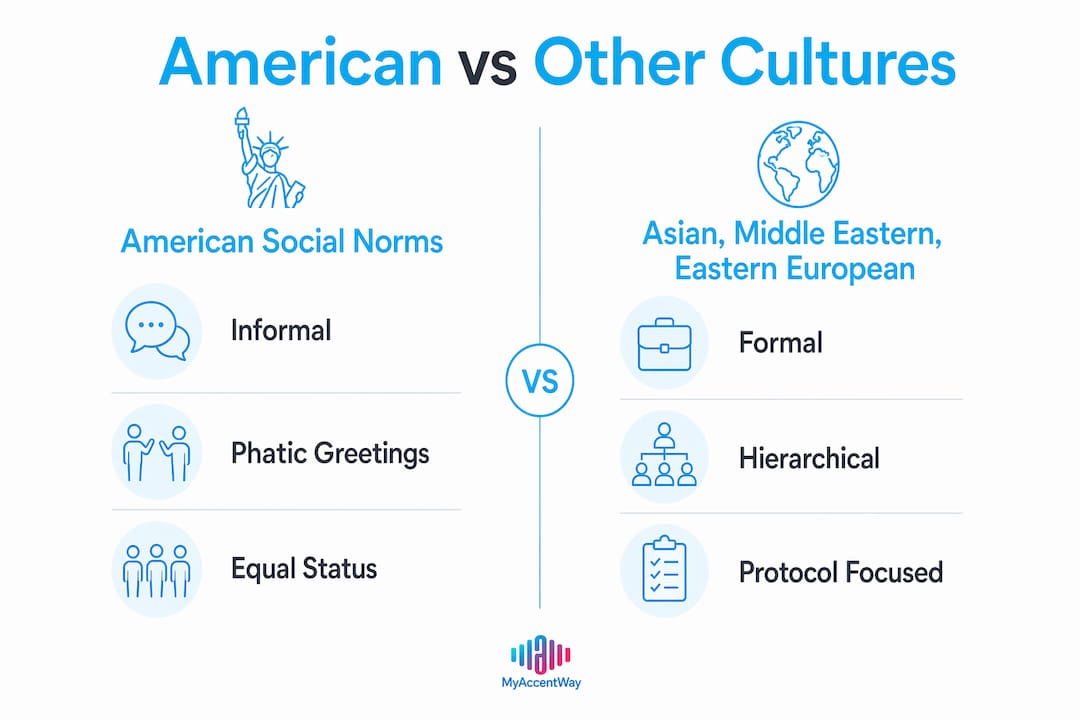
American social behavior follows patterns that feel informal but carry specific expectations. Recognizing those patterns gives you a real advantage in every interaction.

Greetings and phatic expressions are the first test. American greetings like “How are you?” are phatic, meaning they signal friendliness rather than request a detailed answer. The expected response is brief and positive: “Good, thanks. You?” Giving a long, personal answer to this question signals a cultural mismatch, not warmth.
Small talk follows a four-step rhythm. Research on small talk patterns shows the sequence is: greet, give a brief positive response, return the greeting, then shift to a neutral topic like weather, sports, or local events. Following this rhythm reduces the cognitive load on both speakers and makes the exchange feel natural.
American professionals also value:
- Directness with politeness. Americans state requests and opinions clearly, but soften them with phrases like “Would you mind…” or “I was thinking…”
- Personal space. Americans maintain about an arm’s length of distance during conversation. Standing closer can feel intrusive.
- Informality. First names are standard, even with senior colleagues, in most U.S. workplaces.
- Eye contact. Steady but relaxed eye contact signals confidence and engagement.
These norms differ sharply from many Asian, Middle Eastern, and Eastern European cultures, where formality, hierarchy, and indirect communication are the default. Knowing the difference lets you adapt without losing your identity.
Pro Tip: Practice the four-step small talk sequence before your next networking event. Write out two or three neutral topic transitions and rehearse them aloud until they feel automatic.
How does accent comprehensibility affect social and professional outcomes?
Comprehensibility is the degree to which a listener can understand your speech without extra effort. It is not the same as having a native accent. The distinction matters enormously for professionals.
Research published in Applied Psycholinguistics confirms that comprehensibility predicts employability more strongly than accent type alone. Listener processing fluency, meaning how easily a listener follows your speech, directly shapes their perception of your professionalism and competence. When listeners work hard to decode your words, they unconsciously rate the interaction as less smooth, even if your vocabulary and grammar are perfect.
Four areas drive comprehensibility most:
- Segmental clarity. Producing individual sounds accurately, especially consonants like the American /r/ and /t/, reduces listener confusion at the word level.
- Rhythm and stress. American English is stress-timed. Placing stress on the correct syllable signals meaning. “I record the meeting” versus “the record shows” are different words based on stress alone.
- Prosody and intonation. Rising and falling pitch patterns signal questions, statements, and emotions. Flat intonation reads as robotic or uncertain to American listeners.
- Connected speech. Americans link words together fluidly. “Did you eat?” sounds like “Didja eat?” in natural speech. Learning these reductions makes your speech easier to follow, not harder.
Focusing on these four areas, rather than trying to eliminate every trace of your native accent, produces faster and more durable results in real social and professional settings.
What practical speech techniques improve American accent clarity?
Accent modification, the professional term for structured pronunciation training, uses physiological and auditory techniques to retrain speech habits. The goal is not to erase your accent. The goal is to make your speech effortless for American listeners.
The table below compares common approaches:
| Technique | What it trains | Best for |
|---|---|---|
| Tongue and jaw positioning | Correct placement for American vowels and /r/ | Segmental accuracy |
| Prosody matching | Rhythm, stress, and intonation patterns | Natural conversational flow |
| Connected speech practice | Linking, reduction, and elision | Informal social settings |
| 2D Sound Motion Technology | Visual training of tongue, lip, and jaw movement | Learners who need physical feedback |
| Recorded self-review | Identifying gaps between intended and actual sound | Iterative improvement |
Physiological training, including raising tongue position, widening the mouth, and practicing the American /r/, produces measurable gains in clarity. These are not abstract exercises. They retrain the muscle memory behind each sound.
Myaccentway’s 2D Sound Motion Technology makes this process visible. Students see exactly how the tongue, lips, jaw, and airflow move during American sound production. Watch the American [T] in action here:
https://youtu.be/3EzjosgnzJE. Seeing the movement, rather than only hearing it, accelerates physical training significantly.
Measure your progress by listener ease, not vowel perfection. Record short speech samples weekly and ask a native speaker or trained coach to rate how comfortable the interaction feels. That feedback loop is more reliable than self-assessment alone.
Pro Tip: Practice the American /r/ by pulling the tongue back slightly without touching the roof of your mouth. Record yourself saying “world,” “work,” and “career” and compare your production to a native speaker’s recording.
How does repeated exposure help American listeners adapt to your accent?
American listeners adapt to accented speech faster than most professionals realize. Research on perceptual adaptation to accented speech shows that familiarity with a speaker’s accent improves comprehension rapidly, often within the first few minutes of conversation. Listeners in linguistically diverse environments adapt even faster.
This finding has a direct practical implication. The more consistently you interact with the same group of colleagues, clients, or social contacts, the easier your speech becomes for them to process. You do not need to sound different. You need to be heard more often.
Strategies to build that familiarity:
- Join recurring groups. Regular team meetings, professional associations, or community organizations give the same listeners repeated exposure to your speech patterns.
- Match interactional rhythm. Mirror the pacing, pause length, and turn-taking style of American speakers in your group. Rhythm alignment reduces friction faster than pronunciation changes alone.
- Use consistent vocabulary. Repeating the same phrases and expressions across interactions helps listeners build a mental model of your speech, which speeds up their processing.
- Speak up early in group settings. Contributing in the first few minutes of a meeting or social event establishes your voice before the group’s attention narrows.
Local linguistic diversity also matters. In cities like New York, Los Angeles, Houston, and Chicago, listeners encounter dozens of accents daily. Their perceptual flexibility is higher than in less diverse regions. If you work or socialize in a diverse urban environment, your listeners are already practiced at adapting.
Key takeaways
Comprehensible speech, not accent-free speech, is the real goal for professionals adapting to American social and professional environments.
| Point | Details |
|---|---|
| Comprehensibility over accent | Listener processing fluency predicts social and professional outcomes more than accent type. |
| Master phatic expressions | Brief, positive responses to greetings like “How are you?” signal cultural fluency immediately. |
| Train speech physically | Tongue, jaw, and lip positioning for American sounds produces faster clarity gains than listening alone. |
| Use repeated exposure | Consistent interaction with the same group accelerates listener adaptation to your accent. |
| Match interactional rhythm | Prosody and pacing alignment reduces social friction faster than pronunciation changes alone. |
What I have learned from working with accented professionals
After years of working with non-native English-speaking professionals from Russia, China, India, Brazil, and across the Middle East, one pattern stands out clearly. The students who improve fastest are not the ones who try hardest to sound American. They are the ones who focus on being understood.
Vlad, a Russian-speaking professional, is a strong example. His results after structured pronunciation training show exactly what shifts when a student stops chasing a native accent and starts training for clarity. Watch his before-and-after here: https://youtube.com/shorts/OE0q7Y8cV74?si=xxmZVxedUPbunfdZ.
Research confirms what I see in practice. Social overaccommodation, meaning trying too hard to sound native, reduces naturalness and actually signals discomfort rather than confidence. The professionals who connect best in American settings are the ones who communicate clearly, follow social rhythm, and bring their own voice to the conversation.
Cultural knowledge is a confidence tool. When you understand why Americans say “How are you?” without expecting a real answer, or why they use first names with a new boss, you stop second-guessing yourself. That mental clarity frees up attention for the actual conversation. The General American accent is widely perceived as neutral and professional, but you do not need to replicate it perfectly. You need to be clear, rhythmically aligned, and socially fluent.
My advice: invest in your comprehensibility, practice your social scripts, and trust that your listeners will meet you halfway.
— Prof.
How Myaccentway supports your social and professional communication
Myaccentway’s American accent training program is built specifically for non-native English-speaking professionals who want clearer, more confident speech in U.S. settings. Professor Alex, Ph.D., Linguist and Accent Coach, begins with a personalized assessment to identify your specific speech patterns and design a training plan around your goals.
The program uses 2D Sound Motion Technology to make American sounds visible. You see how the tongue, lips, jaw, and airflow work together for each sound, so you train the movement, not just the ear. Students also work on rhythm, intonation, connected speech, and the social scripts that make American interactions feel natural. Pronunciation coaching for professionals works because it targets the specific gaps between your current speech and American listener expectations. Book Your 1 Hour Evaluation Session with Professor Alex to identify your patterns and start building the clarity that opens doors in American social and professional life.
FAQ
What does “comprehensibility” mean in accent training?
Comprehensibility is how easily a listener understands your speech without extra effort. Research confirms it predicts employability and social outcomes more strongly than accent type alone.
How do American greetings differ from other cultures?
American greetings like “How are you?” are phatic expressions, not genuine inquiries. The expected response is brief and positive, followed by a return greeting and a shift to neutral small talk.
How quickly do American listeners adapt to a foreign accent?
Listener adaptation can begin within the first few minutes of exposure. Repeated interactions with the same group accelerate this process significantly.
What speech areas should I prioritize for social settings?
Focus on rhythm, stress placement, and intonation first. These prosodic features shape how natural and confident your speech sounds before listeners even process individual words.
Is it possible to improve my accent as an adult professional?
Yes. Physiological accent coaching techniques, including tongue positioning, mouth openness, and consonant training, produce measurable clarity improvements for adult learners at any stage.
Recommended
- How to Reduce My Foreign Accent: A Scientific Approach for 2026
- How to Sound More American: The Scientific Guide to Accent Mastery in 2026
- Accent Neutralization Training: The Scientific Path to American English Clarity in 2026
- American Accent Vowels and Consonants: A Complete Linguistics Guide – MyAccentWay
Speech clarity check
The problem is not always grammar or vocabulary.
If people understand your words but still miss your message, the deeper issue may be speech clarity, rhythm, intonation, and American pronunciation habits. MyAccentWay helps students retrain the sound system with professional 1-on-1 guidance, so English can feel clearer, freer, and more natural in real communication.
Why MyAccentWay works
Two training methods that make speech change active.
MyAccentWay is not passive listen-and-repeat coaching. Prof. Alex, Ph.D. Accent Coach, Doctor of Education, and professional linguist, creates a learning situation where students become active learners and active participants in changing their own speech patterns.
Interactive training
Students do not just receive pronunciation instructions passively. They listen, think, compare, adjust, and understand their own speech patterns while Prof. Alex guides the correction process.
U.S. & Canada online accent training
Navigate American Social Settings with a Foreign Accent for professionals in the United States and Canada
This guide is useful for advanced English speakers, entrepreneurs, international professionals, and students in the U.S. and Canada who want clearer American pronunciation, stronger rhythm, better intonation, and more confident communication in meetings, interviews, presentations, and client conversations.
Prof. Alex, Ph.D. Accent Coach, Doctor of Education, and professional linguist, teaches online 1-on-1 American accent training for learners in major professional markets including New York, Los Angeles, San Francisco Bay Area, Seattle, Austin, Dallas, Houston, Chicago, Boston, Washington, D.C., Miami, Toronto, Vancouver, Montreal, Calgary, and Ottawa.
1-on-1 Accent Reduction Training helps students move beyond self-practice and build clearer American speech habits through interactive and cognitive accent training.
Cognitive accent training
Students learn to notice and correct the speech patterns that affect American pronunciation, then implement new American speech patterns into their code-switching process for more natural, long-lasting change.
Your next step
Build speech habits people can hear in real conversations.
A stronger American accent is not built by memorizing topics or chasing quick pronunciation tips. It comes from structured training, professional feedback, active correction, and repeated application until clearer speech becomes easier to keep.