What Is Articulation in Spoken Language: A Clear Guide
(512) 265-9515Updated October 14, 2026 ◆ 12 min read
Articulation is the physical shaping of speech sounds by the tongue, lips, jaw, teeth, and soft palate. When you say the word “pie,” your lips press together, build up air pressure, then release it in a small burst — that precise muscular sequence is articulation. According to Cambridge Dictionary, articulation refers specifically to the way you produce speech sounds, distinguishing it from pronunciation (the accepted sound pattern of a language) and enunciation (overall clarity of delivery). What follows covers the physiological systems behind speech, the key descriptive terms linguists use, common causes of unclear speech, and practical exercises you can apply today.
Real student result

“I feel confident enough to speak American English!”
Interactive American Accent Training9monthsof hard work and dedication
Listen to the starting point0:00
Listen to the result0:00
“Many of my students once believed they could never sound like this. School taught them grammar and vocabulary, but not how to train their English speech. That is what we do together, step by step, until you speak English independently and with confidence.”
Abishek’s result was achieved through Prof. Alex’s research-based Interactive 1-on-1 American Accent Training. His doctoral research found this interactive method more effective than traditional, teacher-centered methods. See the research basis →
Why articulation matters for clarity and professional communication
Poor articulation forces your listener to work harder. When a sound is imprecisely shaped, the acoustic signal reaching the listener’s ear is ambiguous, and the brain must fill in the gap. In a meeting or a client call, that extra processing load translates directly into misunderstanding.
The practical consequences are concrete:
- Colleagues ask you to repeat yourself, slowing conversations and eroding confidence.
- Listeners may perceive unclear speech as lower fluency, even when your vocabulary and grammar are strong.
- In high-stakes settings like interviews or presentations, unclear articulation can undermine your credibility before the content of your message lands.
- Phone and video calls amplify the problem because visual cues are reduced or absent.
Articulation and pronunciation are related but not identical. Pronunciation is the target sound pattern; articulation is the muscular execution that gets you there. You can know the correct pronunciation of a word and still produce it unclearly if the articulatory gesture is weak, rushed, or shaped by habits from your first language.
Pro Tip: Record yourself reading one paragraph aloud, then listen back at 0.75x speed. Sounds that feel clear at normal speed often reveal weak lip closure, reduced jaw movement, or blurred consonant boundaries when slowed down. That single habit builds the self-monitoring skill that accelerates every other articulation practice.
How articulation fits into the speech production process
Articulation is the final shaping stage of speech production, and it cannot happen without the two systems that precede it. Research in speech production describes three sequential mechanisms: respiration supplies the airstream, phonation converts that airstream into voiced sound at the larynx, and articulation filters and shapes the result into recognizable speech sounds.
Think of it as a pipeline:
Respiration → Phonation → Articulation
| Stage | System | Contribution |
|---|---|---|
| Respiration | Lungs and diaphragm | Generates the airstream that powers all speech |
| Phonation | Larynx and vocal folds | Vibrates to produce voiced sound (or allows unvoiced airflow) |
| Articulation | Tongue, lips, jaw, palate, teeth | Shapes the airstream into distinct speech sounds |
Speech is, biologically, a secondary function. The mouth evolved for eating and breathing; speech is layered on top of those systems. That fact matters for adult learners: retraining articulatory habits requires deliberate, guided practice rather than passive exposure, because the underlying motor systems were not originally built for speech.
Wikipedia’s entry on speech production notes that fluent speakers can produce speech sounds very rapidly, making articulation automatic at normal speech rates. At that speed, articulation is entirely automatic. For adult learners retraining a sound, the first task is to slow that automaticity down, make the gesture conscious, and then rebuild speed through repetition.
What are the main articulators and what does each one do?
The articulators are the physical structures that shape the airstream. Linguists divide them into active articulators (those that move) and passive articulators (fixed surfaces the active ones contact).
- Jaw: — Controls the degree of mouth opening; low jaw opens the vocal tract for open vowels like /ɑ/ (“father”).
A useful mental image: picture a cross-section of the mouth from the side. The tongue tip sits at the bottom front, the alveolar ridge is the first landmark above and behind the upper teeth, and the velum hangs at the back. Articulatory phonetics) maps every consonant to a specific contact point on this cross-section.
How vowels differ from consonants in articulation
Vowels involve an open vocal tract with no significant constriction or closure; they are almost always voiced. Consonants, by contrast, require some degree of constriction, contact, or turbulence. That mechanical difference has a direct consequence for clarity: vowel quality depends primarily on tongue height and advancement, plus jaw opening, while consonant clarity depends on precise placement and timing of contact.
For professionals, the most common vowel-related clarity issue is insufficient jaw opening. A low-open vowel like /ɑ/ in “father” or “hot” requires the jaw to drop noticeably. When the jaw stays high, the vowel sounds compressed and can be misheard. Explore the full inventory of American English consonants and vowels to see how each sound maps to a specific tongue and jaw position.
Pro Tip: For any vowel that sounds unclear in your recordings, check jaw openness first. Hold a finger lightly under your chin while saying the vowel. If your chin barely moves, the jaw is too restricted. Open it until you feel the chin drop, then repeat the word.
What causes poor or unclear articulation?
Unclear articulation rarely has a single cause. The most common contributors fall into several categories:
- Native-language transfer: Your first language trained your articulators to move in specific patterns. Those habits carry over into English, producing sounds that are close but not identical to American targets.
- Weak articulatory gestures: Insufficient lip closure, reduced tongue-tip contact, or a jaw that barely opens produces sounds that are acoustically ambiguous.
- Speech rate: Speaking too fast compresses articulatory gestures, especially in connected speech where sounds blend across word boundaries.
- Muscle tension or fatigue: Excessive tension in the jaw, tongue, or neck can restrict movement and reduce precision.
- Hearing loss: Speakers who cannot fully monitor their own output often develop articulatory patterns that drift from the target.
- Structural or dental issues: Misaligned teeth, a high palate, or post-surgical changes can alter the contact points available to the tongue.
- Neurological conditions: Dysarthria and apraxia of speech affect motor planning and execution at a clinical level.
Red flags that warrant a referral to a speech-language pathologist (SLP):
- Sudden change in speech clarity with no obvious cause
- Slurred speech accompanied by facial drooping or swallowing difficulty
- Articulation errors that persist in a child well past the expected developmental milestone
- Pain or physical discomfort during speech
- A history of stroke, traumatic brain injury, or progressive neurological diagnosis
For everything else — accent-related clarity, native-language transfer, professional communication confidence — accent coaching is the appropriate path.
How are articulation issues assessed and treated?
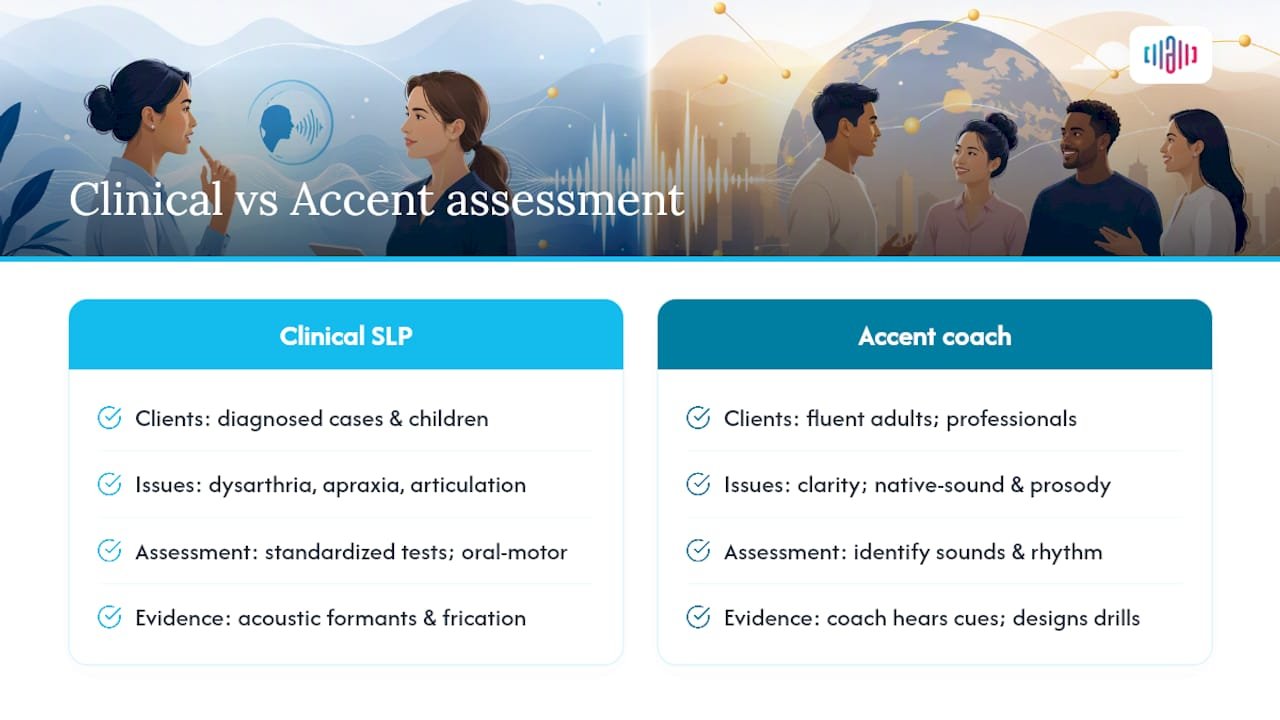
The answer depends on whether the issue is clinical or coaching-appropriate. SLPs handle medically diagnosed conditions such as dysarthria, apraxia, and articulation disorders in children. Accent coaches address clarity, native-sound patterns, and professional communication for adults whose speech is functionally intact.
A clinical SLP assessment typically includes standardized articulation tests, oral-motor examination, and sometimes acoustic or instrumental analysis. The American Speech-Language-Hearing Association (ASHA) is the primary professional body in the United States and maintains a public directory for clinical referrals.
For accent coaching, assessment focuses on identifying which specific sounds, rhythm patterns, or connected-speech habits differ from American English targets. Acoustic research confirms that articulatory gestures produce measurable acoustic cues — formant transitions and frication noise — that listeners use to identify place and manner of articulation. A trained coach can hear those cues, identify the underlying gesture, and design targeted practice.
Timeline expectations differ. Clinical articulation therapy for a diagnosed disorder may span months to years. Accent coaching for a professional who already speaks English fluently often produces noticeable clarity gains within weeks of consistent, targeted practice, though building durable new habits typically takes several months of regular sessions.
Book Your 1 Hour Evaluation Session | Explore curriculum
What teaching articulation to professionals has taught me
Most adult learners arrive believing their articulation problem is a matter of effort or accent thickness. What I consistently find is something more specific: a small number of articulatory gestures that are slightly off-target, compounded by years of automaticity. The /ɹ/ in American English, the distinction between /v/ and /w/, the precise alveolar contact for /t/ and /d/ — these are not vague “accent” issues. They are identifiable, trainable motor patterns.
The professionals who improve fastest are not the ones who practice the most hours. They are the ones who practice with a precise target. That is why the awareness-to-gesture-to-reintegration sequence matters more than repetition volume. Repetition without a correct target only deepens the wrong habit.
If you are a non-native professional who speaks English well but still feels misunderstood in meetings, on calls, or in presentations, the issue is almost certainly articulatory precision, not vocabulary or grammar. That is a coachable problem with a clear solution. Book Your 1 Hour Evaluation Session to find out exactly which gestures to retrain.
How Myaccentway American Accent Program trains articulation for professionals
Clear articulation in American English is not something you develop by listening harder or repeating more. Myaccentway American Accent Program offers a premium 1-on-1 accent training program led by Prof. Alex, Ph.D. Accent Coach, built specifically for non-native professionals who need precise, durable articulatory change.

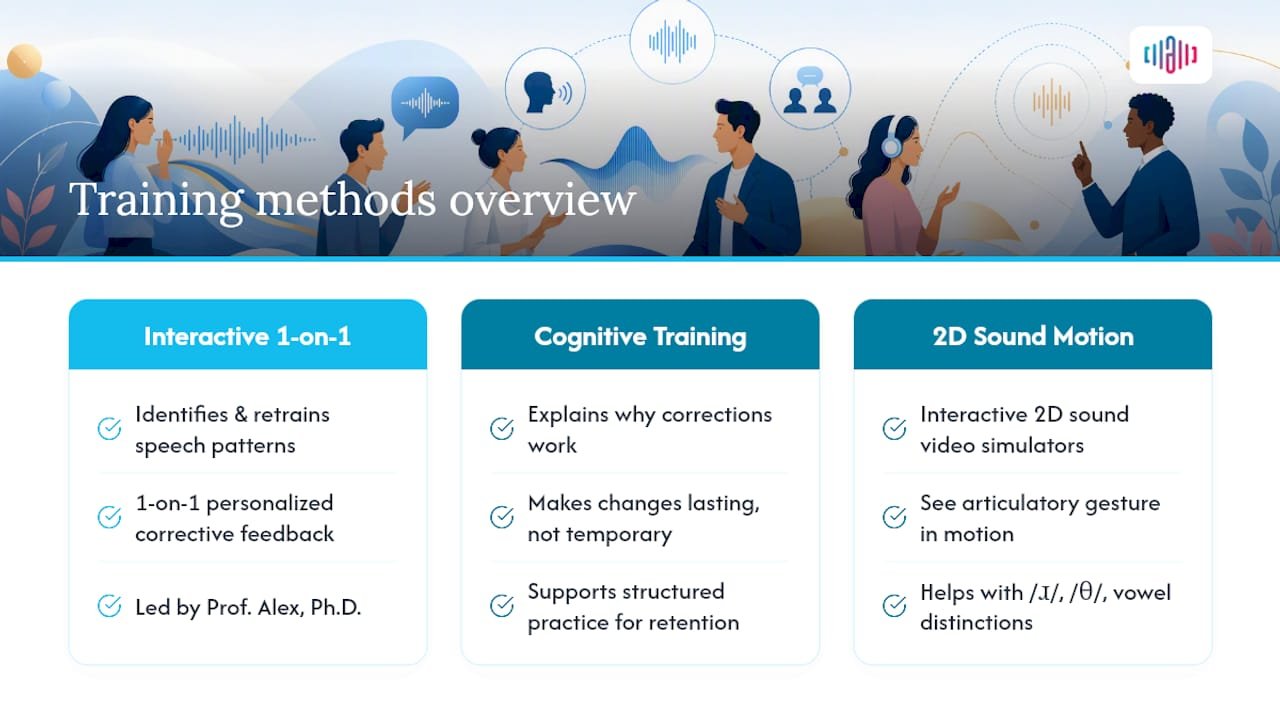
The program is not clinical speech therapy, and it is not a passive online course. Prof. Alex uses three integrated methods: the Interactive 1-on-1 Accent Training Method to identify and retrain the specific speech patterns affecting your clarity; Cognitive Accent Training to help you understand why each correction works, so changes become lasting rather than temporary; and 2D Sound Motion Technology with Interactive Visual 2D Sound Simulators, which train the articulatory gesture in motion rather than relying on a spoken description. This training layer makes the difference for sounds like American /ɹ/, /θ/, and vowel distinctions that are difficult to learn through imitation alone. In MyAccentWay training, these simulators are used to train sound articulation, sound formation, and speech production during live 1-on-1 accent training sessions.
The program covers American pronunciation, consonants, vowels, rhythm, stress, intonation, and connected speech, with ongoing feedback from a Ph.D.-level linguist. Professionals typically notice meaningful clarity gains within weeks of consistent sessions, with durable new habits forming over several months of structured practice.
Explore the curriculum | Book Your 1 Hour Evaluation Session | Read student reviews
MyAccentWay · 2D Sound Motion Technology
American English Pronunciation: Consonant and Vowel Sounds with 2D Sound Motion Technology
Learning American English pronunciation and the American accent is more effective when you train your speech organs, not only listen and repeat. 2D Sound Motion Technology and Interactive Visual 2D Sound Simulators, developed in 2020 by Prof. Alex, Ph.D. Accent Coach, Doctor of Education, and professional linguist, as part of his interactive teaching model based on his Ph.D. research in interactive teaching methods, train your tongue, lips, jaw, teeth, airflow, and voice step by step. They train each American sound and more than 30 sound combinations through Interactive 2D video simulation.
What 2D Sound Motion Technology is
2D Sound Motion Technology is an advanced accent reduction and articulation training tool by Prof. Alex. It corrects, develops, and trains each American sound and more than 30 sound combinations through Interactive 2D video simulation.
What Interactive Visual 2D Sound Simulators do
Interactive Visual 2D Sound Simulators are part of 2D Sound Motion Technology, the articulation-training method Prof. Alex created by applying his Ph.D. research in interactive teaching to American pronunciation. Instead of listening and repeating, students actively train their speech organs. Each simulator uses Interactive 2D mouth movement to train the speech organs (tongue, lips, jaw, teeth, airflow, and voice) to produce each American sound correctly. Every consonant has its own simulator: explore American consonants trained with 2D Sound Motion Technology.
Sample training: the American t sound (aspirated [t])
Practice
Record yourself speaking these words:
Tab · Tacos · Time · Tub · Hotel · Motel · Sit · Pit · Net
Instructions
Play the Interactive Visual 2D Sound Simulator for the American t sound below several times and follow it step by step. Move your tongue, jaw, and airflow together with the simulator and train your articulation.
Interactive Visual 2D Sound Simulator: American unvoiced sound [t]
Practice
Record yourself again speaking these words, but this time focus on the movement of your tongue. Go slow, and you will hear the difference. You’ve got this!
Tab · Tacos · Time · Tub · Hotel · Motel · Sit · Pit · Net
How Interactive Visual 2D Sound Simulators solve pronunciation and speaking problems
- Wrong articulationMost pronunciation problems start with the tongue, lips, jaw, or teeth in the wrong position. Each Interactive Visual 2D Sound Simulator trains the correct articulation of one American sound, so the student corrects the cause of the problem, not only the result.
- Airflow and voicingMany accent problems come from wrong airflow or voicing: sounds that are too weak, too strong, or voiced when they should be unvoiced. The simulators train airflow and voice together with articulation, step by step, for each American sound and more than 30 sound combinations.
- Clear speech and confidenceWhen each sound is trained correctly, words connect into clear American English speech. Listeners can understand you more easily, and speaking at work, in meetings, and on calls becomes more confident.

If you start hearing the aspiration, the short airstream after [t], with one simulator, you can only imagine how successful you can be in 1-on-1 Interactive American Accent Training with Prof. Alex, Ph.D. Accent Coach, where your whole American sound system is trained sound by sound.
In MyAccentWay, the Interactive Visual 2D Sound Simulators are only available in 1-on-1 accent coaching sessions with Prof. Alex.
Useful sources and further reading
The table below points you to the right type of resource depending on your question.
| Resource | Type | Best for |
|---|---|---|
| Speech Production — Introduction to Sensation and Perception | Academic textbook | Understanding the respiration-phonation-articulation pipeline |
| Articulation (phonetics) — Wikipedia | Reference overview | Quick definitions of place, manner, and voicing |
| Speech Articulation — Cambridge excerpt | Academic excerpt | Detailed consonant classification and articulatory phonetics |
| ASHA — American Speech-Language-Hearing Association | Clinical body | Finding a licensed SLP for diagnosed speech disorders |
| 2D Sound Motion Technology — MyAccentWay | Coaching technology | Visual articulatory training for American English sounds |
For clinical questions about a possible speech disorder, start with ASHA. For academic depth on articulatory phonetics, the Cambridge excerpt and the Wikipedia article on articulation are reliable starting points. For practical coaching on American English articulation and accent clarity, the MyAccentWay resources above are built specifically for adult professionals.
American Articulation Training for Foreign-Born Professionals in the United States
Foreign-born professionals in the United States often know their field and speak advanced English. Yet American listeners may still struggle with the clarity of their sounds. MyAccentWay offers private online articulation training through Interactive American Accent Training.
Interactive American Accent Training is led by Prof. Alex, Ph.D. Accent Coach, Doctor of Education, and professional linguist. He first diagnoses each speaker’s native-language patterns. Then he trains American sound articulation and speech-organ movement for real meetings and presentations.
Who this training is for
- Engineers, IT specialists, and data professionals presenting to U.S. teams and clients
- Doctors, nurses, and healthcare professionals explaining care to American patients
- Managers, executives, and founders leading meetings, pitches, and briefings
- Consultants, researchers, and academics speaking at conferences and webinars
- Professionals preparing for interviews, promotions, or client-facing roles
Online training across the U.S.
MyAccentWay is based in Austin, Texas, and all training is online. The program is especially relevant for professionals in Austin, Dallas, Houston, New York City, the San Francisco Bay Area, Los Angeles, Seattle, Boston, Chicago, Miami, Washington DC, Atlanta, and Raleigh.
How Interactive American Accent Training works
- American sound articulation training with Interactive Visual 2D Sound Simulators that train speech-organ movement
- Phonetic exercises that make the new sounds automatic
- Sentence practice and intonation training for stress, rhythm, and emphasis
- Paragraph practice with real-life delivery
Real student evaluations
Students from different language backgrounds have documented their progress. Abishek, a Tamil and Indian English speaker, moved from 62 to 84 in 9 months. Tian, a Mandarin speaker, moved from 58 to 85 in 8 months. Vlad, a Russian speaker, moved from 60 to 83 in 5 months.
The first step is a 1 Hour Evaluation Session with Prof. Alex.
FAQ
What does articulation mean in spoken language?
Articulation is the physical production of speech sounds through the coordinated movement of the tongue, lips, jaw, teeth, and soft palate. It is the final stage of speech production, following respiration and phonation.
What causes poor articulation in adults?
The most common causes are native-language transfer (first-language muscle habits carrying over into English), weak or imprecise articulatory gestures, high speech rate, and insufficient jaw or lip movement. Clinical causes such as dysarthria or apraxia require evaluation by a speech-language pathologist.
What are examples of articulation in speech?
Pressing both lips together and releasing them to produce /p/ in “pie,” touching the tongue tip to the alveolar ridge for /t/ in “top,” and raising the tongue back toward the velum for /k/ in “cat” are all articulation examples in speech.
How can you tell if someone is articulate?
An articulate speaker produces each sound with sufficient precision that listeners can identify it without extra effort. Consonant boundaries are clear, vowels are distinct, and the overall speech signal requires minimal guesswork from the listener.
Is articulation the same as pronunciation?
No. Pronunciation refers to the accepted sound pattern of a word in a given language. Articulation is the physical muscular execution that produces that sound. You can know the correct pronunciation and still produce it unclearly if the articulatory gesture is imprecise.
Recommended
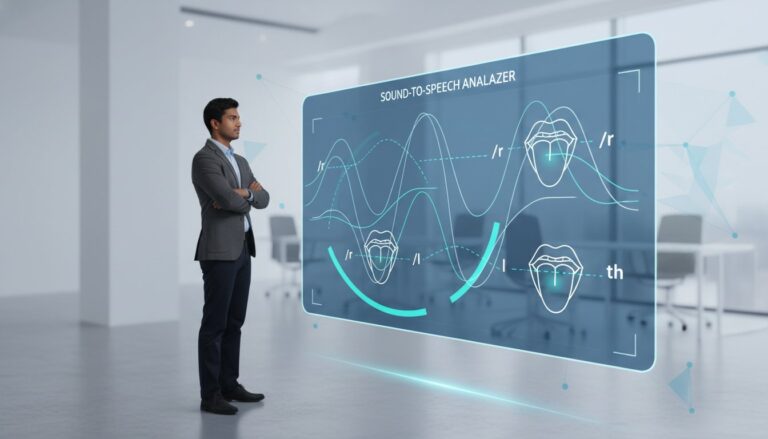
Mastering Voice Clarity Exercises: A Linguist’s Guide for Professionals
Voice clarity exercises are targeted physical drills designed to refine the coordination of your articulators, allowing you to communicate with...

Mouth Articulation Training Benefits for a Native Accent
Mouth articulation training helps students develop clearer, more native-like American pronunciation by retraining speech-organ movement through Interactive Visual 2D Sound Simulators and Prof. Alex’s interactive 1-on-1 accent training method.
What Makes an Accent Hard to Understand? The Science of Speech Clarity
Last Tuesday, a senior software engineer named David sat in a boardroom in Austin, Texas, and felt his confidence sink as he was asked to repeat his...
The problem is not always grammar or vocabulary.
If people understand your words but still miss your message, the deeper issue may be speech clarity, rhythm, intonation, and American pronunciation habits. MyAccentWay helps students retrain the sound system with professional 1-on-1 guidance, so English can feel clearer, freer, and more natural in real communication.
Two training methods that make speech change active.
MyAccentWay is not passive listen-and-repeat coaching. Prof. Alex, Ph.D. Accent Coach, Doctor of Education, and professional linguist, creates a learning situation where students become active learners and active participants in changing their own speech patterns.
Interactive training
Students do not just receive pronunciation instructions passively. They listen, think, compare, adjust, and understand their own speech patterns while Prof. Alex guides the correction process.
Cognitive accent training
Students learn to notice and correct the speech patterns that affect American pronunciation, then implement new American speech patterns into their code-switching process for more natural, long-lasting change.
Build speech habits people can hear in real conversations.
A stronger American accent is not built by memorizing topics or chasing quick pronunciation tips. It comes from structured training, professional feedback, active correction, and repeated application until clearer speech becomes easier to keep.
Continue learning how MyAccentWay connects American sound articulation, Interactive Visual 2D Sound Simulators, accent reduction, student proof, and 1-on-1 training.
- Prof. Alex and the MyAccentWay MethodLearn how Prof. Alex, Ph.D. Accent Coach, Doctor of Education, and professional linguist, created and leads the structured MyAccentWay American accent training system.
- Accent Reduction Curriculum and English Articulation TrainingSee how MyAccentWay trains accent reduction, accent modification, American pronunciation, English articulation, rhythm, and professional speech clarity.
- 2D Sound Motion Technology for American Accent TrainingUnderstand Prof. Alex’s Interactive Visual 2D Sound Simulators for American sound articulation.
- Before-and-After American Accent Training ResultsListen to real before-and-after student proof and accent training outcomes.
- Student Reviews and Accent Training ResultsRead student reviews, testimonials, and trust signals from MyAccentWay learners.
- Book a 1-Hour 1 Hour Evaluation SessionStart with a 1-hour accent evaluation session with Prof. Alex.