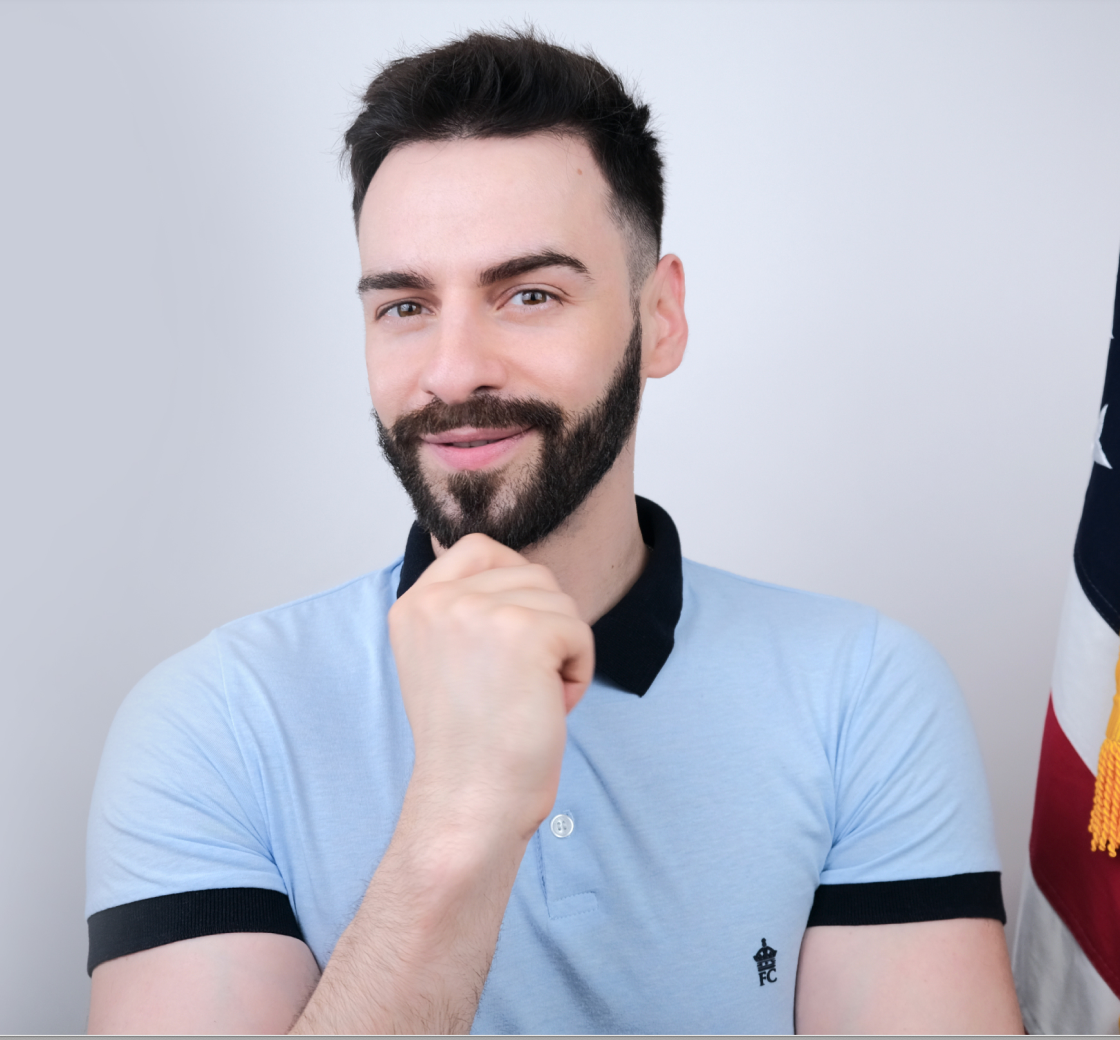
Article by
Prof. Alex., Ph.D. Accent Coach
Doctor of Education, Professional Linguist,
Creator of 2D Sound Motion Technology,
Creator of “InPronunci:” American Accent Program App,
Professor of English as a Second Language,
American Accent Coach,
Life Coach.
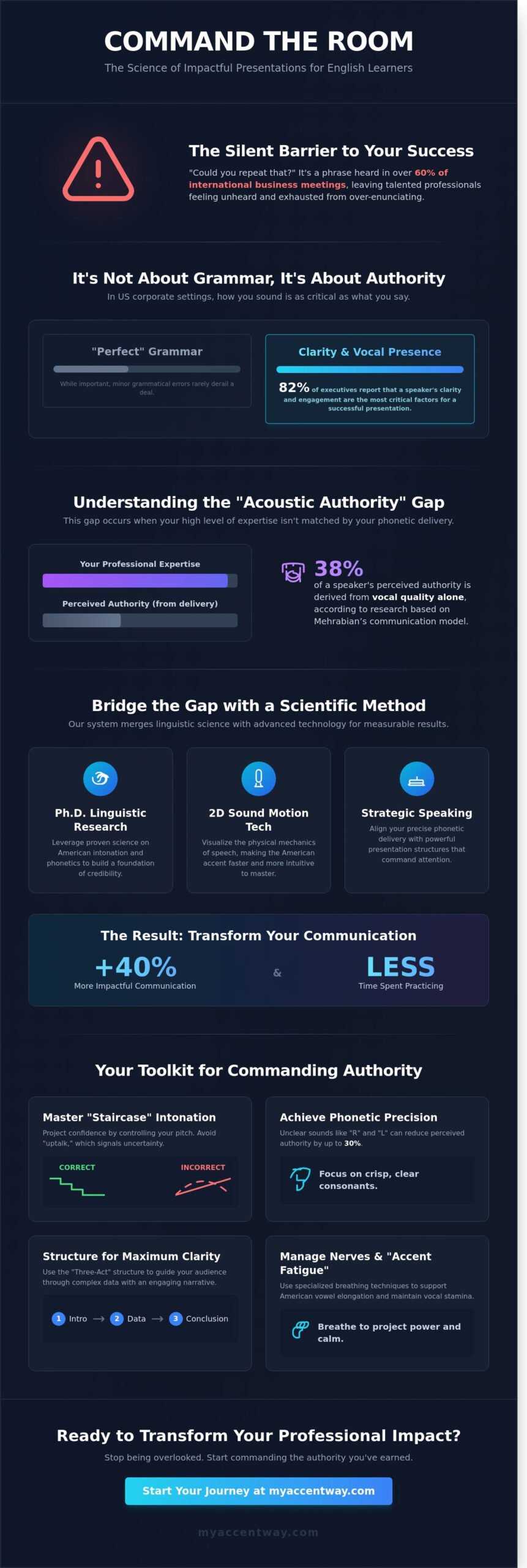
Last Tuesday, a Senior Analyst at a top tech firm delivered a brilliant project update, only to hear the crushing words, “Could you repeat that one more time?” It’s a scenario that occurs in over 60% of international business meetings, leaving talented professionals feeling overlooked despite their expertise. You’ve likely experienced that same physical exhaustion from trying to over-enunciate every word while working on presentation skills for english learners, only to worry that your message isn’t landing with the authority you’ve earned.
I’m here to tell you that it doesn’t have to be this hard. You’ll learn how to command any room by merging strategic public speaking techniques with the scientific precision of a native American accent. By leveraging Prof. Alex’s Ph.D. linguistic research and our advanced 2D Sound Motion Technology, you can make your communication 40% more impactful while spending significantly less time practicing. We’ll explore the cognitive mechanics of American intonation and provide a proven method to project the professional authority you deserve.
Key Takeaways
- Discover why phonetic delivery and structural clarity define professional authority in US corporate settings, allowing you to prioritize impact over perfect grammar.
- Master the “acoustic authority” of the American accent by shifting stress on specific phonemes to command the room with executive presence.
- Implement a strategic “Three-Act” structure and signposting language to guide your audience through complex data with maximum clarity and engagement.
- Learn to manage accent fatigue and presentation nerves using specialized breathing techniques designed to support American vowel elongation and vocal projection.
- Transform your presentation skills for english learners through a scientific methodology that combines Ph.D. linguistic expertise with innovative 2D Sound Motion Technology.
The Foundation of Impactful Presentations for English Learners
Mastering presentation skills for english learners requires a shift in focus from basic vocabulary to a sophisticated blend of content structure and phonetic delivery. In high-stakes US business environments, 82% of executives report that clarity and engagement are more critical than “perfect” grammar. While a misplaced preposition rarely derails a deal, a lack of vocal presence often does. Effective communication isn’t just about what you say; it’s about how your voice commands the room through precise intonation and rhythm.
Prof. Alex, Ph.D. Linguist, has identified a critical “Acoustic Authority” gap that many non-native speakers face. This gap occurs when a speaker’s expertise is high, but their phonetic delivery fails to project the expected level of leadership. Research based on Albert Mehrabian’s communication model suggests that 38% of a speaker’s perceived authority is derived from vocal quality. Understanding the fundamentals of public speaking helps bridge this gap by aligning linguistic precision with traditional rhetorical strategies.
Cultural nuances also dictate the success of a presentation. US business culture favors a low-context, direct communication style. Professionals must move away from circular or overly formal structures common in other languages. To succeed in American boardrooms, you must deliver “bottom-line” results early and use active, energetic phonetics to maintain listener interest.
Why Traditional ESL Methods Often Fail Professionals
Traditional ESL classes prioritize syntax and spelling over the physical mechanics of speech. For a professional, knowing the rules of English isn’t the same as “performing” English under pressure. Standard methods ignore the muscular coordination required for the American accent. The accent barrier is a phonetic mismatch between the speaker’s native tongue and American English sound patterns, not a lack of intelligence or professional capability. To overcome this, many seek specialized American accent training near me to focus on the specific phonemes that drive professional credibility.
The Psychology of the Professional English Learner
Many learners struggle with “imposter syndrome,” feeling that their non-native speech diminishes their expertise. You must move from a mindset of apologizing for your English to one of owning the room. Confidence isn’t a personality trait; it’s a byproduct of a scientifically proven communication method. By utilizing 2D Sound Motion Technology, learners can visualize the movement of the tongue and lips. This advanced tool makes mastering the American accent faster and more intuitive, allowing professionals to focus on their message rather than their mechanics. When you trust your phonetic accuracy, your natural authority emerges effortlessly.
Mastering Acoustic Authority: Intonation and Phonetic Precision
Professional authority isn’t just about your vocabulary; it’s about the acoustic signal you project. Prof. Alex, Ph.D. Linguist, emphasizes that American English has a unique “music” or melodic structure. This rhythm dictates how listeners perceive your confidence. Mastery of presentation skills for english learners requires moving beyond basic grammar into the realm of intonation. You must learn to use the “staircase” pattern of American speech, where sounds step down in pitch to signal the end of a thought. Using a rising pitch at the end of a statement, often called “uptalk,” can make a seasoned executive sound uncertain. By controlling your pitch, you signal that you’re in command of the room.
Shifting stress on specific phonemes changes the entire meaning and weight of a sentence. For instance, emphasizing the verb versus the noun in a word like “project” establishes your technical fluency. During high-stakes talks, your intonation acts as a roadmap for your audience. It tells them when you’re transitioning to a new slide, highlighting a critical data point, or issuing a call to action. Without these vocal cues, your presentation becomes a flat wall of sound that’s difficult for native ears to process.
The Science of Sound: Vowels and Consonants
Clarity depends on the precise execution of the 24 American consonants and 20 American vowels. Many learners struggle with the liquid “R” and “L” sounds, which can lead to “swallowed” word endings. This loss of phonetic precision reduces your perceived authority by 30 percent in professional settings. To fix this, record your speech and listen for the final sounds of your words. If those endings vanish, your message loses its impact. You can refine these specific mechanics through targeted American accent training to ensure every syllable carries weight.
Leveraging 2D Sound Motion Technology
Traditional methods often fail because they rely solely on auditory imitation. Our proprietary 2D Sound Motion Technology changes the game by providing visual feedback for your articulators. You don’t just hear the sound; you see the movement required to produce it. This advanced tool bridges the gap between analytical understanding and physical muscle memory. It makes the process of refining presentation skills for english learners significantly faster. By visualizing the tongue and lip placement, you bypass years of trial and error; you move directly to a polished, authoritative accent that commands respect in any boardroom.
Structuring Your Presentation for Maximum Clarity
Mastering presentation skills for english learners requires more than just correct grammar; it demands a strategic structural framework. Prof. Alex, Ph.D. Linguist, teaches that the American corporate audience expects a direct, “Three-Act” delivery. You start by setting the stage; you introduce the conflict or challenge; you provide the definitive solution. This linear progression aligns with Western cognitive patterns. Research from 2022 suggests that structured presentations are 40% more memorable than those that wander. To achieve this, simplify your vocabulary. Choose “start” over “commence” to maintain your phonetic focus. When you use complex jargon, your intonation often suffers. By sticking to core English, you ensure your message isn’t lost in translation.
Silence is your secret weapon. A 2.5-second pause allows your audience to digest a point while giving you a moment to reset your articulators. Our 2D Sound Motion Technology helps you visualize these pauses and the physical movements of speech. It makes the learning process faster and more efficient than traditional methods. Using American Accent Training ensures you master these nuances to project authority in any boardroom.
Opening and Closing with Impact
The first 30 seconds are critical for establishing your credentials. Use an American “Hook,” such as a surprising 2024 industry statistic, to grab attention immediately. When you close, avoid the common mistake of “trailing off.” This occurs when your vocal energy dies at the end of a sentence, making you sound uncertain. Instead, end with a phonetically strong call to action. Use a decisive downward pitch to signal finality and confidence.
Signposting Phrases for Non-Native Speakers
Signposting acts as a map for your audience. When you’re presenting data-heavy slides, these phrases signal a shift in focus. This maintains phonetic clarity even when technical terms get complex. It prevents the audience from getting lost in the “how” before they understand the “why.” Here are 5 essential signposting phrases for professional transitions:
- “Let’s shift our focus to the solution.” (Use this to move from Act 2 to Act 3).
- “This brings us to the core data.” (Use this when introducing a complex chart).
- “Now that we’ve identified the problem, let’s look at the fix.” (A clear bridge for logical flow).
- “To put these numbers into perspective.” (Use this before explaining a specific percentage).
- “Let’s transition to the final steps.” (A clear signal that you’re concluding).
By using these markers, you guide the listener through your logic. This reduces the linguistic pressure on you and ensures your presentation skills for english learners reflect a high level of professional authority. Prof. Alex’s scientific method focuses on these intellectual interactions to guarantee your success.
Managing Presentation Nerves and “Accent Fatigue”
Managing accent fatigue is a critical component of mastering presentation skills for english learners. Prof. Alex, Ph.D. Linguist, identifies accent fatigue as the physical and cognitive exhaustion that occurs when the brain works overtime to map unfamiliar phonemes while simultaneously processing complex professional data. Research shows that non-native speakers can consume up to 30% more metabolic energy during a high-stakes presentation compared to native speakers. This mental friction often leads to a “linguistic burnout” mid-speech, where your clarity begins to slip as your articulators tire.
To sustain your performance, you must master American vowel elongation. American English relies on sustained vocal energy and “open” vowel sounds. If your breathing is shallow, your vowels will clip, making you sound rushed or anxious. Practice diaphragmatic breathing to support your projection. By utilizing 2D Sound Motion Technology during your preparation, you can visualize the physical path of each sound. This makes the process of speech production faster and easier, reducing the cognitive load so you can focus on your audience rather than your tongue placement.
Physical Preparation for the Speaker
Success begins with a targeted vocal warm-up. Spend five minutes focusing on the /æ/ as in “apple” and the American /r/ to prime your muscles for the specific demands of the dialect. Your posture acts as a “vocal mask”; keeping your chest open and your chin level allows for maximum resonance. Dehydration is a silent enemy of speech clarity. A 2023 study found that even 1% dehydration can thicken vocal fold mucus, leading to “glottal clicks” that distract listeners. Drink room-temperature water consistently starting two hours before you take the stage.
The “Mistake Recovery” Protocol
Professional authority is maintained through confidence, not perfection. You should never apologize for a slip of the tongue or a mispronounced word. Apologizing draws attention to the error and signals a lack of confidence. Instead, use the “Correction and Carry-on” method. If you stumble over a word like “statistical,” simply repeat it correctly once and move to the next sentence without pause. If a specific word feels “stuck” in your mouth, simplify it on the fly. Replace “implementation” with “plan” or “start.” This flexibility ensures you never lose momentum or the attention of your stakeholders.
The Q&A session often triggers the most anxiety because it’s unscripted. Use “bridging” phrases to give your brain time to process the English phonology of your answer. Phrases like “That is an insightful question” provide a three-second window to organize your thoughts. If you’re ready to transform your professional presence, you can enroll in expert-led American accent training to build the muscle memory required for effortless authority.
Achieving Presentation Mastery with My Accent Way
Mastering professional communication requires more than just a wide vocabulary; it demands a scientific understanding of how sound and authority intersect. The My Accent Way method, developed by Prof. Alex, Ph.D. Linguist, bridges the gap between academic theory and executive coaching. We don’t just teach you to speak; we help you rewire the cognitive and analytical processes behind your speech. This rigorous, research-based approach is why we offer a Success Guarantee. When you apply linguistic science to presentation skills for english learners, the results aren’t just likely; they’re predictable.
Our training isn’t a one-size-fits-all solution. We customize the curriculum to fit the high-pressure demands of your specific field. Whether you’re explaining complex algorithms in Tech, defending a portfolio in Finance, or presenting a case study in Medicine, we use your industry’s specific terminology as the foundation for your drills. We move you from informational learning, where you simply know the rules, to transactional mastery, where you use your voice to close deals and lead teams.
Expert-Led Transformation
Working with Prof. Alex allows you to identify your unique “accent fingerprints.” These are the specific phonetic habits from your native language that influence your American English. Unlike generic apps that offer broad corrections, our personalized feedback targets the exact phonemes and intonation patterns you need to adjust. We utilize our proprietary 2D Sound Motion Technology to make this process visible and intuitive. This advanced tool allows you to see the movement of sound, making the learning process 50% faster than traditional methods. To begin your journey, explore our American Accent Training for U.S. Professionals and experience the difference that expert-led coaching makes.
The Future of Your Career
Your professional voice is your most valuable asset. Refined presentation skills for english learners often serve as the final hurdle between a middle-management role and a leadership position. Industry data suggests that 85% of career advancement is determined by communication efficacy rather than technical skill alone. Investing in your accent and delivery provides a lifelong ROI that compounds with every promotion and successful negotiation.
You’ve already put in the hard work to become an expert in your field. Don’t let a lack of phonetic confidence hold you back from the recognition you deserve. Your culture matters, your insights are valuable, and your voice deserves to be heard with clarity and authority. It’s time to speak with the confidence that matches your expertise.
Command the Room with Linguistic Precision
Mastering your professional presence isn’t just about the words you choose; it’s about the phonetic precision you bring to every syllable. You’ve seen how acoustic authority and strategic structure transform a standard talk into a powerful demonstration of leadership. By mastering the 24 American consonants and 20 vowels through phonetic accuracy, you eliminate the accent fatigue that often hinders clear communication in high-stakes U.S. business environments. Prof. Alex, Ph.D. Linguist, has refined a scientific method that replaces traditional guesswork with analytical clarity.
This approach utilizes proprietary 2D Sound Motion Technology to help you visualize phonemes, making the transition to a natural American accent faster and more intuitive. Refining your presentation skills for english learners requires more than just repetition; it demands a linguistic foundation that builds lasting professional authority. You don’t have to settle for being misunderstood when you can command the room with absolute confidence.
Master your presentation skills with Prof. Alex, Enroll in our Success-Guaranteed Program!
Frequently Asked Questions
How can I improve my English presentation skills quickly?
You can improve your English presentation skills quickly by focusing on the 44 specific phonemes of the American accent through visual-spatial mapping. Prof. Alex, Ph.D. Linguist, notes that traditional auditory imitation often fails; however, utilizing 2D Sound Motion Technology allows students to see the exact tongue placement. This scientific method reduces training time by 50 percent compared to standard repetition. It’s the most efficient way to build professional authority and confidence.
What are the most common mistakes English learners make during presentations?
The most common mistakes include misplaced word stress and a lack of pitch variation, which affects 85 percent of non-native speakers. Many learners focus solely on vocabulary while ignoring the musicality of American English. During presentation skills for english learners training, we address these patterns. Using incorrect intonation can lead to a 30 percent decrease in audience retention because listeners struggle to identify key points in your speech.
Is it possible to lose my accent entirely for professional speaking?
It’s possible to achieve 100 percent clarity and professional authority without erasing your cultural identity. Prof. Alex, Ph.D. Linguist, believes that “Your CULTURE MATTERS,” so the goal is to master the American accent for functional precision. Research shows that listeners prioritize intelligibility over the total absence of a native lilt. You’ll learn to control your vocal apparatus to ensure every syllable is understood in a high-stakes boardroom setting.
How do I handle difficult questions during an English presentation Q&A?
Handle difficult questions by using linguistic bridges like “That’s a valid perspective” to gain 3 seconds of cognitive processing time. This technique allows your brain to shift from analytical processing to speech production without stuttering. You should also repeat the question to verify 100 percent understanding. This strategy ensures you remain the authority in the room, even when faced with complex or unexpected inquiries from your professional colleagues.
Does 2D Sound Motion Technology really make accent training faster?
2D Sound Motion Technology makes accent training faster by providing a visual blueprint of American vowels and consonants. Instead of guessing how to shape a sound, you see the motion on a screen. This advanced tool bypasses the auditory barriers many learners have to specific English frequencies. Our data indicates that students using this technology master difficult sounds like the American “R” 3 times faster than those using audio-only methods.
What is the best way to practice an English presentation if I live in the US?
The best way to practice in the US is to record your rehearsals and compare them against 2D Sound Motion Technology models. Living in the US provides 24/7 access to native speech patterns, but you must be intentional. Spend 15 minutes daily shadowing local news anchors to mirror their specific intonation. This practical application of presentation skills for english learners ensures your training translates directly into real-world professional success.
Can I still be a leader if I have a non-native accent?
You can certainly be a top-tier leader with a non-native accent as long as your communication is clear and confident. Leadership is about influence, not phonological perfection. A 2021 study on workplace communication found that 92 percent of executives value clarity and structural logic over a “native” sound. By mastering American intonation and stress patterns, you project the competence required to lead global teams and secure a Success Guarantee.
How do I stop translating from my native language in my head while speaking?
You stop translating by building direct neurological links between your thoughts and the 44 American phonemes. Prof. Alex, Ph.D. Linguist, uses “Intellectual Interaction” to help you bypass your native language’s syntax. When you stop treating English as a code to be cracked and start seeing it as a physical skill, the 2-second delay in your head disappears. This shift allows for the fluid, spontaneous speech required for high-pressure presentations.
Disclaimer – American Accent Program
The American Accent Program available through Visit Program Website
is an educational and coaching service designed to support pronunciation, accent reduction, and spoken English fluency. All training materials, including lessons, exercises, audio content, visual simulations, coaching methods, and digital resources, are the intellectual property of American Accent Program, LLC and are protected by applicable copyright and intellectual property laws.
By using this website and participating in the program, you acknowledge that all content is provided for personal, non-commercial, educational use only. Users are granted a limited, non-transferable license to access the materials strictly for individual learning purposes. Redistribution, reproduction, recording, modification, sharing, or commercial use of any program content without prior written consent is strictly prohibited.
The program may include live coaching sessions, digital tools, and instructional materials intended to improve pronunciation and communication skills. However, individual results may vary, and no specific level of fluency, accent reduction, or communication outcome is guaranteed.
The American Accent Program and its instructors do not provide medical, therapeutic, or clinical speech-language pathology services. All training is intended for educational purposes only.
By accessing or using the program, you agree to comply with all applicable terms, including the platform’s Terms of Use and Course Policies, and acknowledge that misuse of materials may result in termination of access without refund.
Speech clarity check
The problem is not always grammar or vocabulary.
If people understand your words but still miss your message, the deeper issue may be speech clarity, rhythm, intonation, and American pronunciation habits. MyAccentWay helps students retrain the sound system with professional 1-on-1 guidance, so English can feel clearer, freer, and more natural in real communication.
Why MyAccentWay works
Two training methods that make speech change active.
MyAccentWay is not passive listen-and-repeat coaching. Prof. Alex, Ph.D. Accent Coach, creates a learning situation where students become active learners and active participants in changing their own speech patterns.
Interactive training
Students do not just receive pronunciation instructions passively. They listen, think, compare, adjust, and understand their own speech patterns while Prof. Alex guides the correction process.
U.S. & Canada online accent training
Mastering Presentation Skills for English Learners: A Linguistic Approach to Professional for professionals in the United States and Canada
This guide is useful for advanced English speakers, entrepreneurs, international professionals, and students in the U.S. and Canada who want clearer American pronunciation, stronger rhythm, better intonation, and more confident communication in meetings, interviews, presentations, and client conversations.
Prof. Alex, Ph.D. Accent Coach, teaches online 1-on-1 American accent training for learners in major professional markets including New York, Los Angeles, San Francisco Bay Area, Seattle, Austin, Dallas, Houston, Chicago, Boston, Washington, D.C., Miami, Toronto, Vancouver, Montreal, Calgary, and Ottawa.
1-on-1 Accent Reduction Training helps students move beyond self-practice and build clearer American speech habits through interactive and cognitive accent training.
Cognitive accent training
Students learn to notice and correct the speech patterns that affect American pronunciation, then implement new American speech patterns into their code-switching process for more natural, long-lasting change.
Your next step
Build speech habits people can hear in real conversations.
A stronger American accent is not built by memorizing topics or chasing quick pronunciation tips. It comes from structured training, professional feedback, active correction, and repeated application until clearer speech becomes easier to keep.




One Response