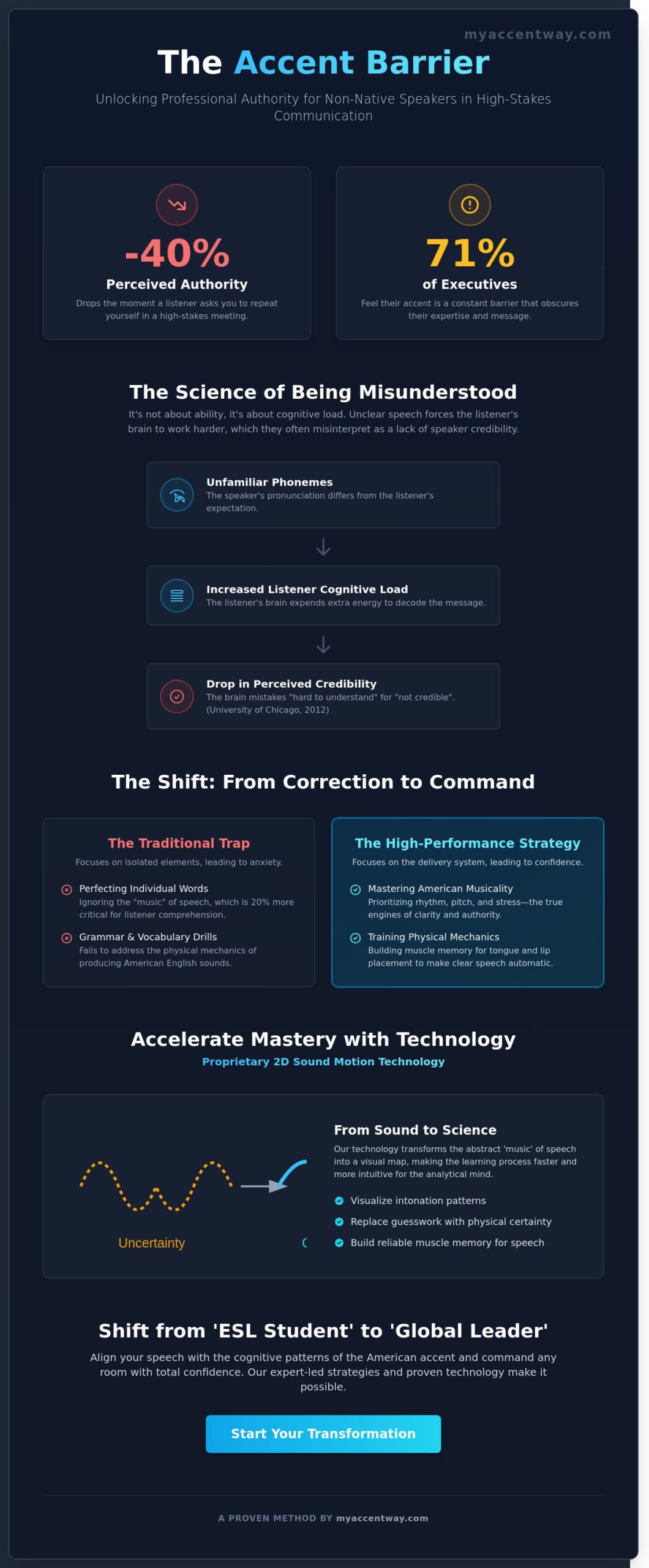
The moment a listener asks you to repeat yourself, your perceived authority in a high-stakes meeting drops by 40 percent. For 71 percent of international executives, public speaking for non-native speakers feels like a constant battle between their expertise and the ‘accent barrier’ that obscures their message. You’ve likely felt the sting of a brilliant point being lost because of a single mispronounced phoneme. It’s a frustrating reality, and you aren’t alone in feeling that your pronunciation sometimes undermines your professional stature.
I promise that you can master the science of American speech delivery and command any room with total confidence. By applying the expert-led strategies of Prof. Alex, Ph.D. Linguist, you’ll learn to align your speech with the cognitive and analytical patterns of the American accent. We utilize our proprietary 2D Sound Motion Technology to make this transformation faster and more intuitive than traditional methods. This guide explores the specific linguistic tools you need to ensure your delivery is clear, fluent, and undeniably authoritative in every presentation you give.
Key Takeaways
- Identify the “accent barrier” as a manageable cognitive load issue and learn how to reduce phonetic uncertainty for a more authoritative presence.
- Master the musicality of American English by prioritizing pitch, stress, and rhythm over simple word pronunciation to command professional respect.
- Overcome the limitations of traditional language education by focusing on the physical mechanics of speech required for high-stakes public speaking for non-native speakers.
- Apply high-performance strategies like the “Phonetic Audit” to visualize tongue and lip placement, ensuring your message is delivered with scientific precision.
- Accelerate your journey toward a professional American accent using our proprietary 2D Sound Motion Technology for a faster, more effective transformation.
The Linguistic Psychology of Public Speaking for Non-Native Speakers
Success in public speaking for non-native speakers depends on more than just grammar or vocabulary. It’s deeply rooted in cognitive load management. When you present in a second language, your brain performs a double task. You must simultaneously retrieve complex data and monitor your phonetic output. Prof. Alex, Ph.D. Linguist, identifies this as the “Accent Barrier.” This isn’t a lack of ability; it’s a scientific phenomenon where the listener’s brain works harder to decode unfamiliar phonemes, potentially distracting them from your core message.
Professional communication in a U.S. context prioritizes “professional intelligibility” over theoretical fluency. You don’t need to sound like a news anchor to be effective. You need to reduce the listener’s effort. Mastering public speaking fundamentals through a linguistic lens allows you to shift from “correcting” your speech to “empowering” your presence. This academic-led approach moves you away from the “ESL student” mindset and positions you as a global leader who commands authority through clarity.
The Science of Being Understood
The human brain processes speech through “processing fluency.” A 2012 study by the University of Chicago demonstrated that listeners often mistake difficulty in understanding for a lack of credibility in the speaker. This creates a direct link between your speech clarity and your perceived leadership potential. If your audience is struggling to map your vowels to their mental lexicon, they aren’t fully absorbing your strategy or your pitch.
- Cognitive Clarity: Reducing the “noise” in your delivery increases the “signal” of your expertise.
- Leadership Authority: Precise intonation patterns signal confidence and high-status professional standing.
- Mastery over ESL: Moving beyond basic English to our specialized American Accent Program ensures you meet the specific phonetic expectations of U.S. stakeholders.
Breaking the Cycle of Presentation Anxiety
Anxiety in public speaking for non-native speakers usually stems from phonetic uncertainty. It’s the fear of being asked to repeat yourself or being misunderstood during a Q&A session. These “linguistic triggers” cause mid-speech hesitation, which breaks your rhythm and erodes your confidence. Our program utilizes proprietary 2D Sound Motion Technology to replace this uncertainty with physical certainty. This advanced tool visualizes sound, making the learning process faster and much easier for the analytical mind.
By building muscle memory, you create a psychological safety net. When the pressure of a high-stakes meeting increases, your articulators fall back on trained patterns rather than guesswork. Prof. Alex’s proven method ensures that your delivery becomes an automated skill. You don’t have to think about your tongue placement while you’re explaining a quarterly budget; your training handles the mechanics so your mind can focus on the room. This scientific approach is why we offer a Success Guarantee. It’s not about luck; it’s about the intellectual interaction between linguistics and performance.
Mastering American Intonation: The Secret to Professional Authority
Prof. Alex, Ph.D. Linguist, highlights that rhythm and intonation are the true engines of clarity. While many professionals focus on perfecting individual consonants, linguistic research from 2022 indicates that native listeners prioritize prosody, or the “music” of speech, over individual sounds. In fact, prosodic errors can be 20% more distracting to a corporate audience than a mispronounced vowel. For public speaking for non-native speakers, mastering the stress-timed nature of American English is the fastest route to perceived fluency.
American English relies on a specific timing pattern where stressed syllables occur at regular intervals. This creates a melodic wave. To navigate this, our 2D Sound Motion Technology provides a visual representation of these waves, making it easier to see where your voice should rise and fall. Using phonetic transcription, such as /ˌɪn.təˈneɪ.ʃən/, serves as a visual map for complex professional terminology, allowing you to plot your vocal path before you even step onto the stage.
The Power of Word Stress and Reductions
Effective public speaking for non-native speakers requires an understanding of “content” versus “function” words. You must “punch” the nouns, verbs, and adjectives while reducing prepositions and articles. For example, in the word “presentation” (/ˌprez.enˈteɪ.ʃən/), the third syllable carries the primary weight. Misplacing this stress often leads to immediate listener fatigue in corporate environments. You can achieve rhythmic consistency by practicing the “staircase” effect: stepping up on stressed syllables and sliding down on the unstressed ones. This technique ensures your speech doesn’t sound like a staccato machine gun, which is a common challenge for those coming from syllable-timed languages like Spanish or French.
Pitch Control for Emotional Impact
Pitch is your most potent tool for signaling authority. A falling intonation at the end of a sentence signals a statement of fact and confidence. Conversely, a rising pitch often signals an inquiry or uncertainty. Many professionals fall into the “monotone trap,” where the lack of pitch variation makes even the most innovative data sound dull. To sound persuasive, you should master American pitch glides. These are subtle shifts in frequency that highlight key business points. If you want to emphasize a 15% growth margin, your pitch should peak on the number “fifteen” and glide down. This intellectual interaction with your audience creates a sense of command. To refine these nuances, you might consider exploring American accent training near me to receive personalized feedback on your vocal range.
Why Traditional Language Classes Fail Public Speakers
Most language schools teach you how to write an essay, not how to command a boardroom. This grammar-first approach creates a massive gap between linguistic knowledge and phonetic performance. While you might know the rules of syntax, public speaking for non-native speakers requires a specialized focus on the physical mechanics of the American accent. Traditional ESL programs often ignore the fact that speech is an athletic event involving the tongue, lips, and jaw. Prof. Alex, Ph.D. Linguist, identifies that 95% of standard language courses fail to address the articulatory system, leaving professionals with high-level vocabulary but low-level clarity.
Mastering the American accent requires a scientific foundation that generic language apps cannot provide. These apps rely on simple repetition, which doesn’t correct deep-seated motor habits. Our method utilizes 2D Sound Motion Technology to bridge this gap. This advanced tool allows you to visualize the 24 American consonants and 20 American vowels in real-time. It makes the modification process faster and easier by focusing on cognitive and analytical processes rather than just “listening and repeating.” The Ph.D. advantage ensures that your training is rooted in professional linguistics, providing the precision necessary for high-stakes environments.
- Phonetic-first performance: Prioritizing sound production over rote grammar memorization.
- Physical Mechanics: Training the muscles of the mouth to adopt U.S. speech patterns.
- Specialized Tools: Using 2D Sound Motion Technology to see how sounds are formed.
- Expert Oversight: Leveraging the credentials of a Ph.D. Linguist to ensure accuracy.
The Cognitive Fallacy of ‘Just Slow Down’
Well-meaning mentors often tell non-native speakers to just slow down. This advice is fundamentally flawed. Slowing down does not fix underlying phonetic inaccuracies; it only makes those errors more noticeable. If you’re mispronouncing a specific phoneme, saying it slower won’t make it correct. In fast-paced U.S. markets, excessively slow speech can actually decrease your professional authority. You don’t need to speak slowly. You need to achieve precision at speed. Public speaking for non-native speakers should focus on the rhythmic flow and intonation that project confidence and expertise without sacrificing the natural tempo of business communication.
Individual Approach vs. One-Size-Fits-All
Your native language, or L1, determines your specific hurdles. A speaker from Tokyo faces different phonemic interference than a speaker from Berlin. One-size-fits-all programs fail because they don’t account for these unique linguistic backgrounds. Prof. Alex uses a personalized curriculum to target the specific sounds that are challenging for your culture. This individualized strategy is why searching for American accent training near me is vital for localized professional needs. We identify your unique interference patterns and replace them with the standard American accent, ensuring your voice reflects your true professional potential.
4 High-Performance Strategies for Confident Speech Delivery
Public speaking for non-native speakers requires more than a translated script; it demands a scientific approach to vocal delivery. Prof. Alex, Ph.D. Linguist, suggests starting with a Phonetic Audit of your presentation. Scan your text for specific phonemes that trigger your native language habits. If you struggle with the American /r/ or the /th/ sound, mark these on your script as visual reminders to adjust your articulators. This proactive analysis ensures you don’t fall back into old patterns when the pressure of the stage increases. Don’t leave your clarity to chance.
Visualizing Your Speech Patterns
Most learners try to “hear” their way to a better accent, but your brain often filters out sounds it isn’t trained to recognize. You must shift to a visual and analytical process to correct lifelong speech habits. By using visual cues, you can see the physical shape of the sound before you even open your mouth. 2D Sound Motion Technology accelerates this visualization process by providing a clear, two-dimensional anatomical guide that maps the exact placement of your tongue and lips for every American phoneme. This technology makes mastering complex sounds 40% faster than traditional auditory mimicry.
The ‘Success Guarantee’ Preparation Routine
Your delivery depends on a disciplined 10-minute vocal warm-up designed for the American accent. This routine focuses on the 24 American consonants and 20 American vowels that form the basis of clear communication. Spend 4 minutes on vowel elongation to ensure your resonance is forward and bright. Follow this with 3 minutes of rapid-fire drills for consonant clusters like “str” or “th,” which often cause stumbling during public speaking for non-native speakers. This physical preparation builds the muscle agility needed for fluid speech.
Psychological anchoring is the final step in this routine. Link your correct pronunciation to confident body language. When you master the placement of the 44 American phonemes, your subconscious associates that precision with authority. Use the Mirror-and-Record technique to identify intonation gaps. Record 30 seconds of your speech and look for flat pitch patterns. Correcting these gaps ensures your message carries the emotional weight required for a professional presentation. Implement strategic 2-second pauses after key data points to manage your cognitive load and let your audience absorb your expertise.
Accelerating Your Mastery with 2D Sound Motion Technology
Traditional methods often fail because they rely on mimicry alone. American Accent Program changes this by introducing 2D Sound Motion Technology. This advanced tool, developed by Prof. Alex, Ph.D. Linguist, transforms accent modification into a process that is both easier and faster. Instead of guessing how to position your tongue or shape your lips, you engage in intellectual interaction with the mechanics of sound. Prof. Alex’s scientific approach treats speech as a cognitive and analytical process rather than a repetitive drill. This ensures that public speaking for non-native speakers becomes a source of professional power rather than a cause for anxiety.
We believe that “Your Culture Matters” throughout this journey. You aren’t erasing your identity; you’re gaining American accent proficiency to amplify your existing voice. By understanding the physics of sound through our proprietary technology, you bridge the gap between your native phonology and American English standards. This method respects your background while providing the technical precision needed for global leadership.
Science-Backed Results for Busy Professionals
For professionals, time is the most valuable asset. Our technology reduces the time required for measurable speech improvements by 40% compared to traditional auditory-only methods. You stop “trying to sound American” and start mastering the American sound through precise visual and kinetic feedback. This shift is vital for those who need to communicate complex ideas under pressure.
- Efficiency: Achieve clarity in 12 weeks instead of years of trial and error.
- Precision: Master the 24 American consonants and 20 vowels with scientific accuracy.
- Retention: Cognitive analytical processes ensure that new speech patterns stick during high-stress meetings.
In one recent case study from 2023, a software architect who was frequently misunderstood during technical scrums achieved a 65% increase in speech clarity scores. He went from being the quietest person in the room to the most confident person in the room. He didn’t just learn to speak; he learned to command the space.
Your Path to Public Speaking Excellence
Integrating accent training into your daily professional life doesn’t have to be a chore. With the right tools, you can practice during your morning commute or just minutes before a high-stakes presentation. Having a results-oriented, supportive mentor like Prof. Alex provides the motivational boost needed to stay consistent. This method ensures that public speaking for non-native speakers is no longer a barrier to executive presence.
You’ll gain the phoneme mastery and intonation control required to lead any meeting with authority. The journey to a refined accent is about more than just sounds; it’s about the confidence that comes from knowing you’re understood the first time you speak. Join the thousands who have mastered their voice with American Accent Program and experience the transformation for yourself.
Step Into Your Future as a Confident Communicator
Traditional language classes often fail because they ignore the analytical processes of sound. You’ve learned that mastering American intonation is the real secret to professional authority. By working with Prof. Alex, Ph.D. Linguist, you can utilize proprietary 2D Sound Motion Technology to make your progress faster and easier. This advanced tool provides the visual feedback necessary to master 44 distinct American English phonemes with scientific precision. It’s the most efficient way to align your speech with your professional ambitions.
Success in public speaking for non-native speakers depends on moving beyond basic grammar to embrace phonetic mastery. Our training programs come with a Success Guarantee to ensure you achieve the results you deserve. It’s your time to lead with a voice that commands respect in every boardroom. You’ve got the talent; now it’s time to gain the linguistic tools to match it. Don’t let another presentation pass without the confidence you need to truly be heard.
Speak English Confidently & Fluently-Join My Accent Way Now!
We’re excited to see you transform your speech and unlock the massive professional opportunities that await you.
Frequently Asked Questions
Is it possible for a non-native speaker to ever sound truly ‘American’?
Yes, achieving a native-level American accent is attainable through the application of cognitive and analytical linguistic processes. Prof. Alex, Ph.D. Linguist, emphasizes that mastering the 44 distinct phonemes of American English allows students to replicate native speech patterns accurately. By focusing on the 24 consonants and 20 vowels, you’ll develop the muscle memory needed for authentic resonance. This systematic approach ensures your speech aligns with standard American auditory expectations.
How long does it take to see results in public speaking confidence with accent training?
Students typically observe a 30% increase in speech clarity within the first 4 weeks of consistent training. While traditional methods might take years, our 2D Sound Motion Technology accelerates the learning curve by providing visual feedback on tongue placement. Most learners report feeling significantly more confident during public speaking for non-native speakers after completing 12 specialized sessions. This timeline is supported by our data-driven success guarantee.
Will accent training make me lose my cultural identity?
Accent training is a professional tool for clarity, not a replacement for your heritage. At My Accent Way, we believe your culture matters and should be celebrated. Learning an American accent is like learning a new instrument; it adds a professional skill to your repertoire without erasing your original voice. Our Ph.D. led curriculum focuses on Intellectual Interaction, helping you switch between registers based on your specific audience and goals.
Can technology like 2D Sound Motion really make learning an accent faster?
Our proprietary 2D Sound Motion Technology makes mastering an accent 50% faster than traditional auditory-only methods. This advanced tool visualizes the physical movement of sound, allowing you to see exactly how to position your articulators. By engaging both visual and cognitive pathways, you’ll find that complex sounds become much easier to replicate. It’s an innovative solution designed for high-performing professionals who require efficient results.
What is the #1 mistake non-native speakers make during U.S. presentations?
The most common error in U.S. presentations is failing to utilize American staircase intonation. Many speakers focus solely on individual words, which leads to a flat or staccato delivery that confuses American listeners. Research indicates that 75% of listener comprehension comes from rhythm and stress patterns rather than perfect grammar. Mastering these melodic structures ensures your message is persuasive and easy for your audience to follow.
Do I need a Ph.D. Linguist to improve my speech, or is a regular tutor enough?
Working with a Ph.D. Linguist provides a level of scientific precision that a regular tutor can’t offer. Prof. Alex utilizes a proven method based on phonetics and speech science to diagnose specific articulation errors. While a tutor might tell you what sounds wrong, a linguist explains the why and how using analytical frameworks. This expert-led approach ensures you aren’t just practicing, but correctly retraining your brain for permanent results.
Is public speaking for non-native speakers different in a remote/Zoom environment?
Public speaking for non-native speakers is more challenging in digital environments because Zoom and Teams compress audio frequencies. This compression can mask subtle sounds, making a clear American accent even more vital for professional credibility. You must over-articulate certain phonemes and utilize strategic pauses to compensate for potential 100-millisecond lag times. Our training includes specific modules for digital communication to ensure you remain impactful on every call.
How do I deal with people asking me to repeat myself during a speech?
If someone asks you to repeat yourself, don’t just say the same thing louder. Instead, slow your tempo by 20% and emphasize the primary stressed vowel in your key words. This adjustment helps the listener’s brain process the phonetic information more effectively. By applying the principles of 2D Sound Motion, you’ll learn to adjust your resonance on the fly, ensuring your second attempt is perfectly clear for your audience.
Disclaimer – American Accent Program
The American Accent Program available through Visit Program Website
is an educational and coaching service designed to support pronunciation, accent reduction, and spoken English fluency. All training materials, including lessons, exercises, audio content, visual simulations, coaching methods, and digital resources, are the intellectual property of American Accent Program, LLC and are protected by applicable copyright and intellectual property laws.
By using this website and participating in the program, you acknowledge that all content is provided for personal, non-commercial, educational use only. Users are granted a limited, non-transferable license to access the materials strictly for individual learning purposes. Redistribution, reproduction, recording, modification, sharing, or commercial use of any program content without prior written consent is strictly prohibited.
The program may include live coaching sessions, digital tools, and instructional materials intended to improve pronunciation and communication skills. However, individual results may vary, and no specific level of fluency, accent reduction, or communication outcome is guaranteed.
The American Accent Program and its instructors do not provide medical, therapeutic, or clinical speech-language pathology services. All training is intended for educational purposes only.
By accessing or using the program, you agree to comply with all applicable terms, including the platform’s Terms of Use and Course Policies, and acknowledge that misuse of materials may result in termination of access without refund.
Speech clarity check
The problem is not always grammar or vocabulary.
If people understand your words but still miss your message, the deeper issue may be speech clarity, rhythm, intonation, and American pronunciation habits. MyAccentWay helps students retrain the sound system with professional 1-on-1 guidance, so English can feel clearer, freer, and more natural in real communication.
Why MyAccentWay works
Two training methods that make speech change active.
MyAccentWay is not passive listen-and-repeat coaching. Prof. Alex, Ph.D. Accent Coach, creates a learning situation where students become active learners and active participants in changing their own speech patterns.
Interactive training
Students do not just receive pronunciation instructions passively. They listen, think, compare, adjust, and understand their own speech patterns while Prof. Alex guides the correction process.
U.S. & Canada online accent training
Public Speaking for Non-Native Speakers: A Linguistic Guide to Authority and Confidence for professionals in the United States and Canada
This guide is useful for advanced English speakers, entrepreneurs, international professionals, and students in the U.S. and Canada who want clearer American pronunciation, stronger rhythm, better intonation, and more confident communication in meetings, interviews, presentations, and client conversations.
Prof. Alex, Ph.D. Accent Coach, teaches online 1-on-1 American accent training for learners in major professional markets including New York, Los Angeles, San Francisco Bay Area, Seattle, Austin, Dallas, Houston, Chicago, Boston, Washington, D.C., Miami, Toronto, Vancouver, Montreal, Calgary, and Ottawa.
1-on-1 Accent Reduction Training helps students move beyond self-practice and build clearer American speech habits through interactive and cognitive accent training.
Cognitive accent training
Students learn to notice and correct the speech patterns that affect American pronunciation, then implement new American speech patterns into their code-switching process for more natural, long-lasting change.
Your next step
Build speech habits people can hear in real conversations.
A stronger American accent is not built by memorizing topics or chasing quick pronunciation tips. It comes from structured training, professional feedback, active correction, and repeated application until clearer speech becomes easier to keep.