Daily Immersion’s Role in American Accent Improvement
(512) 265-9515Updated October 14, 2026 ◆ 11 min read
Daily immersion is defined as the consistent, structured exposure to and active practice of a target language across every day, and its role in accent improvement is foundational to mastering American English pronunciation. Unlike passive listening or occasional study, daily immersion triggers neurocognitive adaptation, the biological process by which the brain reshapes how it tracks and processes speech signals. Linguistics research confirms that immersion reshapes brain processing of speech sounds over time, making it a biological necessity, not just a study habit. Myaccentway’s structured training program is built on this science, combining speech-organ awareness, phonetic exercises, and procedural muscle memory retraining to help non-native English speakers speak with clarity and confidence.
Real student result

“I feel confident enough to speak American English!”
Interactive American Accent Training9monthsof hard work and dedication
Listen to the starting point0:00
Listen to the result0:00
“Many of my students once believed they could never sound like this. School taught them grammar and vocabulary, but not how to train their English speech. That is what we do together, step by step, until you speak English independently and with confidence.”
Abishek’s result was achieved through Prof. Alex’s research-based Interactive 1-on-1 American Accent Training. His doctoral research found this interactive method more effective than traditional, teacher-centered methods. See the research basis →
How does daily immersion biologically and cognitively enhance accent learning?
Immersion is not passive exposure. It is a biological process that changes how the brain processes speech. Neurocognitive adaptation from immersion improves the brain’s ability to sharpen target speech signals, even in noisy environments, as time in the second language environment increases. This means your brain is physically rewiring itself each day you engage with American English.

Research on suprasegmental features, the stress patterns, rhythm, and intonation that define American speech, shows that immersion shifts perceptual cue weighting toward native-like patterns through extensive second-language input. In plain terms, the more structured daily contact you have with American English, the more your brain begins to hear and produce stress and rhythm the way native speakers do.
Pronunciation is also a motor skill. Your tongue, lips, jaw, and soft palate must learn new positions and movement sequences. This is why effective accent training requires daily spaced repetition and visual awareness of articulatory organs. Repeating a sound without understanding the physical movement behind it produces little lasting change.
“Immersion is not a lifestyle choice alone. It is a biological process that improves how the brain processes speech signals in a noisy environment as time in the second language environment increases.”
Pro Tip: Focus your first five minutes of each daily session on articulatory organ awareness. Touch your tongue tip to the alveolar ridge, feel your lips round or spread, and notice jaw height before you produce any sound. This physical awareness accelerates muscle retraining faster than audio repetition alone.
Why is consistent daily practice superior to sporadic or passive learning?
Short, focused daily sessions build procedural memory more effectively than long, infrequent ones. Muscle retraining quality drops after 20–30 minutes of practice, which means a two-hour weekend session delivers far less benefit than six focused 20-minute sessions spread across the week. Your speech muscles fatigue just like any other muscle group.
Passive listening, such as background podcasts or TV, does not retrain your speech organs. Active shadowing is necessary for pronunciation improvement because it forces you to physically replicate the rhythm and articulation of a native speaker in real time. Shadowing is not imitation for its own sake. It is a motor retraining exercise.
Pronunciation failures most often occur because students treat training as repetition rather than muscle retraining. The distinction matters. Repetition reinforces what you already do. Muscle retraining, guided by visual and physical awareness of speech-organ placement, builds new motor patterns that replace old ones.
For busy professionals, a structured daily schedule works best:
- Articulatory warm-up (3–5 minutes): Activate speech organs with targeted movements before producing sounds.
- Minimal-pair drills (5–7 minutes): Train your ear and mouth to distinguish and produce similar sounds, such as /ɪ/ versus /iː/ or /θ/ versus /d/.
- Shadowing practice (5–7 minutes): Choose one short audio clip from an American speaker and replicate rhythm, stress, and intonation in real time.
- Sentence application (5 minutes): Apply the target sound or pattern in full sentences from your professional context.
Pro Tip: Record yourself during every session. Comparing recordings from week one to week four gives you concrete evidence of progress and tells you exactly which sounds still need attention.
What role does accent variability and multiple-speaker exposure play?
Single-accent training limits how broadly your brain generalizes new phonetic patterns. High variability training with multiple accents leads to faster language learning than training on a single regional accent. This finding comes from research on Mandarin tone acquisition by English speakers, and the principle applies directly to American English consonant and vowel learning.
Natural phonetic variability across speakers helps your brain build an abstract phonetic representation of each sound rather than a rigid copy of one speaker’s voice. When you hear the American /r/ from ten different speakers, your brain extracts the shared acoustic core. That abstraction is what lets you recognize and produce the sound independently.
Practical ways to build variability into your daily immersion routine:
- Watch American films and TV programs featuring speakers from different regions: New York, Texas, the Midwest, and California all carry distinct phonetic features.
- Listen to podcasts hosted by different speakers each week rather than following one host exclusively.
- Practice conversation with multiple English-speaking partners, not just one tutor or colleague.
- Use listening skills training to sharpen your ear before attempting production.
| Training type | Phonetic generalization | Learning speed | Real-world transfer |
|---|---|---|---|
| Single-accent exposure | Narrow | Slower | Limited |
| Multiple-accent exposure | Broad | Faster | Strong |
The data is clear. Multiple-speaker exposure is not a bonus feature of daily immersion. It is a core requirement for durable accent improvement.
What practical immersion techniques best support daily accent improvement?
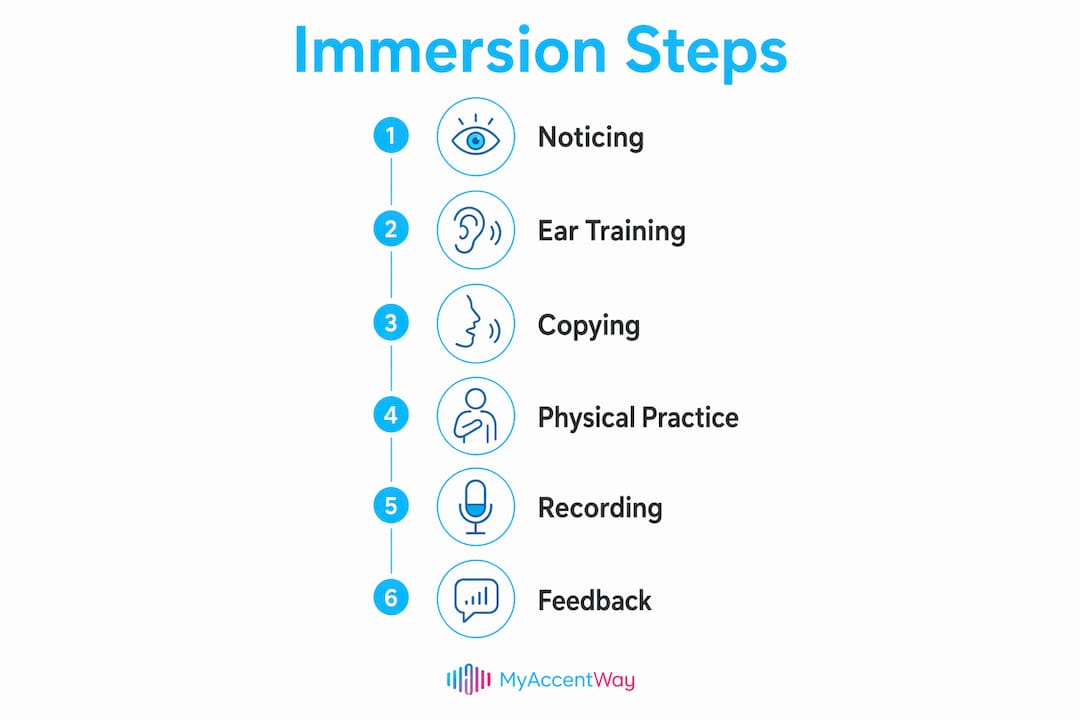
The NECTAR Daily Practice Cycle is a structured framework that sequences six phases: Noticing, Ear training, Copying, Thinking about articulation, Application, and Repetition. The NECTAR method yields noticeable accent changes within a month when practiced for 25–30 minutes daily. Each phase builds on the previous one, moving from perception to production to habitual use.
Myaccentway’s approach goes further by adding training in speech-organ movement through Interactive Visual 2D Sound Simulators. These simulators train students to coordinate the tongue, lips, and jaw to produce each American sound. Students stop guessing and start practicing. This is the critical difference between traditional “repeat after me” instruction and structured motor retraining. In MyAccentWay training, these simulators are used to train sound articulation, sound formation, and speech production during live 1-on-1 accent training sessions.
A practical daily immersion routine built on these principles looks like this:
- Noticing phase: Identify one target sound or pattern from your professional speech context.
- Ear training: Listen to three to five examples of the target sound from different speakers.
- Copying with awareness: Shadow the sound while consciously placing your speech organs correctly.
- Articulation check: Use a mirror or a 2D Sound Motion Technology visual reference to confirm organ placement.
- Application: Use the sound in five sentences from your work vocabulary.
- Repetition: Repeat the sentence set until the sound feels automatic, not deliberate.
Pro Tip: Limit each daily session to one target sound or pattern. Spreading attention across five sounds in one session produces shallow learning. Depth on one sound per day builds the habitual muscle memory that transfers to spontaneous speech.
MyAccentWay · 2D Sound Motion Technology
American English Pronunciation: Consonant and Vowel Sounds with 2D Sound Motion Technology
Learning American English pronunciation and the American accent is more effective when you train your speech organs, not only listen and repeat. 2D Sound Motion Technology and Interactive Visual 2D Sound Simulators, developed in 2020 by Prof. Alex, Ph.D. Accent Coach, Doctor of Education, and professional linguist, as part of his interactive teaching model based on his Ph.D. research in interactive teaching methods, train your tongue, lips, jaw, teeth, airflow, and voice step by step. They train each American sound and more than 30 sound combinations through Interactive 2D video simulation.
What 2D Sound Motion Technology is
2D Sound Motion Technology is an advanced accent reduction and articulation training tool by Prof. Alex. It corrects, develops, and trains each American sound and more than 30 sound combinations through Interactive 2D video simulation.
What Interactive Visual 2D Sound Simulators do
Interactive Visual 2D Sound Simulators are part of 2D Sound Motion Technology, the articulation-training method Prof. Alex created by applying his Ph.D. research in interactive teaching to American pronunciation. Instead of listening and repeating, students actively train their speech organs. Each simulator uses Interactive 2D mouth movement to train the speech organs (tongue, lips, jaw, teeth, airflow, and voice) to produce each American sound correctly. Every consonant has its own simulator: explore American consonants trained with 2D Sound Motion Technology.
Sample training: the American t sound (aspirated [t])
Practice
Record yourself speaking these words:
Tab · Tacos · Time · Tub · Hotel · Motel · Sit · Pit · Net
Instructions
Play the Interactive Visual 2D Sound Simulator for the American t sound below several times and follow it step by step. Move your tongue, jaw, and airflow together with the simulator and train your articulation.
Interactive Visual 2D Sound Simulator: American unvoiced sound [t]
Practice
Record yourself again speaking these words, but this time focus on the movement of your tongue. Go slow, and you will hear the difference. You’ve got this!
Tab · Tacos · Time · Tub · Hotel · Motel · Sit · Pit · Net
How Interactive Visual 2D Sound Simulators solve pronunciation and speaking problems
- Wrong articulationMost pronunciation problems start with the tongue, lips, jaw, or teeth in the wrong position. Each Interactive Visual 2D Sound Simulator trains the correct articulation of one American sound, so the student corrects the cause of the problem, not only the result.
- Airflow and voicingMany accent problems come from wrong airflow or voicing: sounds that are too weak, too strong, or voiced when they should be unvoiced. The simulators train airflow and voice together with articulation, step by step, for each American sound and more than 30 sound combinations.
- Clear speech and confidenceWhen each sound is trained correctly, words connect into clear American English speech. Listeners can understand you more easily, and speaking at work, in meetings, and on calls becomes more confident.
If you start hearing the aspiration, the short airstream after [t], with one simulator, you can only imagine how successful you can be in 1-on-1 Interactive American Accent Training with Prof. Alex, Ph.D. Accent Coach, where your whole American sound system is trained sound by sound.
In MyAccentWay, the Interactive Visual 2D Sound Simulators are only available in 1-on-1 accent coaching sessions with Prof. Alex.
Key Takeaways
Daily immersion drives American accent improvement by combining neurocognitive adaptation, motor skill retraining, and structured phonetic practice across consistent, focused sessions.
| Point | Details |
|---|---|
| Immersion is biological | The brain physically rewires speech signal processing through daily second-language exposure. |
| Short sessions outperform long ones | Sessions of 15–25 minutes daily build procedural memory better than infrequent marathon practice. |
| Active beats passive | Shadowing and articulatory drills retrain speech muscles; background listening does not. |
| Variability accelerates learning | Exposure to multiple American speakers speeds up phonetic generalization and real-world transfer. |
| Visual awareness is the missing link | Understanding speech-organ movement, not just sound repetition, produces lasting accent change. |
What 20 years of teaching taught me about daily immersion
Most students who come to me have already tried repeating after audio recordings for months. They are frustrated because they sound the same as when they started. The problem is not effort. The problem is method.
Consistency without structure produces consistent mediocrity. I have seen students practice every single day and make almost no progress because they were reinforcing the wrong muscle patterns. Daily immersion only works when each session includes physical awareness of how sounds are made, not just how they sound.
The students who improve fastest are the ones who treat each session like a short physical workout. They warm up their speech organs, focus on one target, and stop when their attention drops. Thiago, a Portuguese speaker, followed this structured approach and reached a level of clarity that surprised even him.
Watch his progress to see what consistent, structured daily practice actually produces.
Passive listening has its place, but it belongs at the end of a session as a reward, not as the session itself. The students who treat TV watching as accent training are the ones who plateau. The students who shadow, drill, and apply sounds in professional sentences are the ones who call me six weeks later to say their colleagues finally stopped asking them to repeat themselves.
Daily immersion is not about living inside English. It is about making every minute of practice count.
— Prof. Alex, Ph.D. Accent Coach
Myaccentway’s science-backed American Accent Training Program and Accent Reduction Curriculum
Myaccentway’s American accent training program is built on the same neurocognitive and motor learning principles covered in this article. Prof. Alex, Ph.D., leads every 1-on-1 session with a structured sequence: speech-organ awareness, consonant and vowel retraining, rhythm, and intonation, all supported by Interactive Visual 2D Sound Simulators, part of Prof. Alex’s interactive teaching model based on his Ph.D. research in interactive teaching, where students actively train the movement of the tongue, lips, jaw, teeth, and airflow while Prof. Alex corrects them live.
This is not generic pronunciation coaching. Every session targets your specific phonetic challenges, drawn from your native language background and your professional communication goals. Students from Russian, Mandarin, Portuguese, and Arabic backgrounds have all achieved measurable progress through this method. The accent reduction curriculum is structured to move you from guessing how sounds work to knowing exactly how to produce them.
Explore Curriculum | Book Your 1 Hour Evaluation Session | Read Reviews
Interactive American Accent Training for Foreign-Born Professionals in the United States
Foreign-born professionals in the United States often know their field and speak advanced English. Yet American listeners may still struggle with their sounds, stress, and rhythm. MyAccentWay offers private online American accent training through Interactive American Accent Training.
Interactive American Accent Training is led by Prof. Alex, Ph.D. Accent Coach, Doctor of Education, and professional linguist. He first diagnoses each speaker’s native-language patterns. Then he trains American sound articulation, stress, rhythm, and intonation for real real conversations.
Who this training is for
- Engineers, IT specialists, and data professionals presenting to U.S. teams and clients
- Doctors, nurses, and healthcare professionals explaining care to American patients
- Managers, executives, and founders leading meetings, pitches, and briefings
- Consultants, researchers, and academics speaking at conferences and webinars
- Professionals preparing for interviews, promotions, or client-facing roles
Online training across the U.S.
MyAccentWay is based in Austin, Texas, and all training is online. The program is especially relevant for professionals in Austin, Dallas, Houston, New York City, the San Francisco Bay Area, Los Angeles, Seattle, Boston, Chicago, Miami, Washington DC, Atlanta, and Raleigh.
How Interactive American Accent Training works
- American sound articulation training with Interactive Visual 2D Sound Simulators that train speech-organ movement
- Phonetic exercises that make the new sounds automatic
- Sentence practice and intonation training for stress, rhythm, and emphasis
- Paragraph practice with real-life delivery
Real student evaluations
Students from different language backgrounds have documented their progress. Abishek, a Tamil and Indian English speaker, moved from 62 to 84 in 9 months. Tian, a Mandarin speaker, moved from 58 to 85 in 8 months. Vlad, a Russian speaker, moved from 60 to 83 in 5 months.
The first step is a 1 Hour Evaluation Session with Prof. Alex.
FAQ
What is daily immersion in accent improvement?
Daily immersion in accent improvement is structured, active engagement with American English every day through shadowing, phonetic drills, and speech-organ practice. It is defined by consistency and physical retraining, not passive exposure.
How long should a daily accent practice session be?
Sessions of 15–25 minutes daily build procedural memory more effectively than longer, infrequent sessions, because muscle retraining quality drops after 20–30 minutes of focused practice.
Does listening to English TV or podcasts count as immersion?
Passive listening alone does not retrain speech muscles. Active shadowing is necessary for real pronunciation improvement because it forces physical replication of rhythm and articulation.
Why does exposure to multiple American accents help?
High variability training with multiple speakers leads to faster phonetic learning by helping the brain build a broader, more flexible representation of each target sound.
How does Myaccentway support daily immersion practice?
Myaccentway provides 1-on-1 structured sessions with Prof. Alex, Ph.D., using Interactive Visual 2D Sound Simulators to actively train the movement of the tongue, lips, jaw, teeth, and airflow, with Prof. Alex correcting students live for precise, repeatable motor retraining.
Recommended

Why Immigrants Struggle with American Pronunciation
Discover why immigrants struggle with American pronunciation and how tailored training can overcome these challenges. Learn more here!

The Role of Listening Skills in Accent Training
Discover the vital role of listening skills in accent training. Improve your pronunciation and communication by mastering sound perception.
Navigate American Social Settings with a Foreign Accent
Master how to navigate American social settings with a foreign accent. Enhance your speech clarity and confidence with research-based techniques.
The problem is not always grammar or vocabulary.
If people understand your words but still miss your message, the deeper issue may be speech clarity, rhythm, intonation, and American pronunciation habits. MyAccentWay helps students retrain the sound system with professional 1-on-1 guidance, so English can feel clearer, freer, and more natural in real communication.
Two training methods that make speech change active.
MyAccentWay is not passive listen-and-repeat coaching. Prof. Alex, Ph.D. Accent Coach, Doctor of Education, and professional linguist, creates a learning situation where students become active learners and active participants in changing their own speech patterns.
Interactive training
Students do not just receive pronunciation instructions passively. They listen, think, compare, adjust, and understand their own speech patterns while Prof. Alex guides the correction process.
Cognitive accent training
Students learn to notice and correct the speech patterns that affect American pronunciation, then implement new American speech patterns into their code-switching process for more natural, long-lasting change.
Build speech habits people can hear in real conversations.
A stronger American accent is not built by memorizing topics or chasing quick pronunciation tips. It comes from structured training, professional feedback, active correction, and repeated application until clearer speech becomes easier to keep.
Continue learning how MyAccentWay connects student results, reviews, before-and-after proof, Prof. Alex’s method, and structured American accent training.
- Prof. Alex and the MyAccentWay MethodLearn how Prof. Alex, Ph.D. Accent Coach, Doctor of Education, and professional linguist, created and leads the structured MyAccentWay American accent training system.
- Accent Reduction Curriculum and English Articulation TrainingSee how MyAccentWay trains accent reduction, accent modification, American pronunciation, English articulation, rhythm, and professional speech clarity.
- 2D Sound Motion Technology for American Accent TrainingUnderstand Prof. Alex’s Interactive Visual 2D Sound Simulators for American sound articulation.
- Before-and-After American Accent Training ResultsListen to real before-and-after student proof and accent training outcomes.
- Student Reviews and Accent Training ResultsRead student reviews, testimonials, and trust signals from MyAccentWay learners.
- Book a 1-Hour 1 Hour Evaluation SessionStart with a 1-hour accent evaluation session with Prof. Alex.