TL;DR:
- Listening skills are essential in accent training, helping learners perceive speech sounds, rhythm, and intonation patterns. Combining auditory discrimination with articulation practice and exposure to multiple accents significantly improves speech clarity and adaptability. Active, focused listening exercises, especially within sentence contexts and with visual feedback tools, accelerate the perception-production connection needed for effective American English pronunciation.
Listening skills are the foundation of successful accent training, giving you the ability to perceive the sounds, rhythm, and intonation patterns that define clear American English speech. The role of listening skills in accent training goes far beyond simply hearing words. Research from 2026 shows that articulatory-target-based training improves both sound production and auditory discrimination simultaneously. Professor Alex, Ph.D., Linguist and Accent Coach at Myaccentway, builds every training program around this perception-production connection, using tools like 2D Sound Motion Technology to make the invisible mechanics of speech visible and trainable.
How does listening shape phonetic and pronunciation accuracy?
Accurate pronunciation begins with accurate perception. Before you can produce a sound correctly, your brain must first recognize it as distinct from similar sounds. This is called auditory discrimination, and it directly controls articulatory precision.

Articulatory-target-based training improves both vowel perception and production, as shown in a 2026 study published in Frontiers in Human Neuroscience with Japanese speakers. That finding confirms that training the mouth and training the ear are not separate tasks. They reinforce each other in a continuous feedback loop.
Passive listening alone does not close this loop. Adults often plateau after understanding words but still fail to distinguish crucial phonetic differences. Motor and auditory training combined tightens the discrimination-production cycle in ways that passive exposure never achieves. The practical implication is clear: you need structured listening practice that targets specific sound contrasts, not just general audio immersion.
- Focused contrast drills: Practice minimal pairs like “ship” vs. “sheep” or “bit” vs. “beat” to sharpen phonemic boundaries.
- Articulatory feedback: After hearing a sound, physically attempt to reproduce it and compare the result to the target.
- Repetition with attention: Replay the same audio segment multiple times, each time focusing on one specific phonetic feature.
- Guided correction cycles: Work with a coach who identifies your specific discrimination gaps rather than practicing random sounds.
Pro Tip: Record yourself immediately after a focused listening drill. Comparing your production to the original audio reveals gaps your ear alone might miss.
Why does prosody perception matter more than individual sounds?
Prosody predicts comprehensibility more reliably than isolated phoneme accuracy in real conversation. Prosody refers to the stress, rhythm, and intonation patterns that carry meaning across a sentence. Getting individual sounds right while missing prosody leaves listeners confused about your intent.
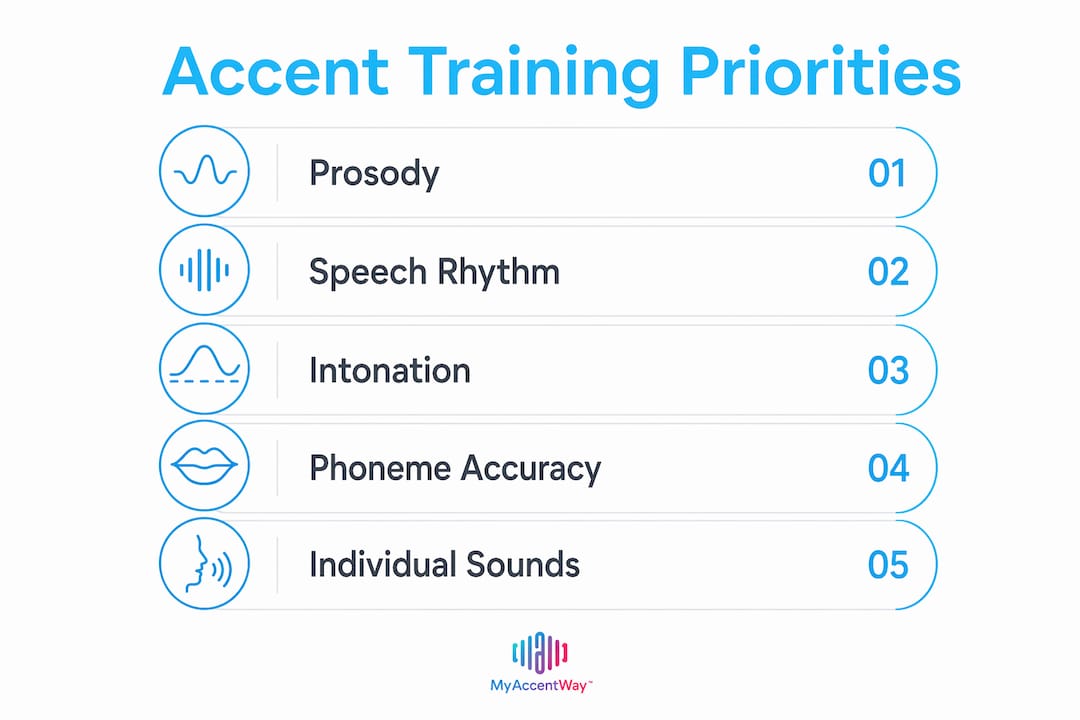
A 2026 study in Frontiers in Education found that prosodic training produces strong gains in speech comprehensibility in classroom research. That result matters because most accent learners spend the majority of their time on individual sounds and very little time on the melody of speech. Shifting that balance produces faster, more noticeable results.
English lexical stress is carried by multiple acoustic cues: duration, intensity, pitch, and vowel quality. Duration and intensity are more stable stress indicators than pitch across different speaking contexts. Training your ear to detect these cues gives you a reliable internal compass for where stress falls in any new word you encounter.
Here are four practical steps to build prosody perception:
- Listen for sentence stress. Choose one sentence from a podcast or film and identify which word carries the most emphasis. Replay it until the stress pattern becomes obvious.
- Use LyricTraining. This tool pairs song lyrics with audio, making rhythm and stress patterns visible in real time. Music naturally exaggerates prosodic features, making them easier to perceive.
- Analyze with Praat. This free acoustic analysis software displays pitch, duration, and intensity visually. Seeing stress as a waveform trains your eye and ear together.
- Shadow native speakers. Choose a short clip, listen once, then speak along with the audio. Focus on matching the rhythm, not just the words.
Pro Tip: Choose audio with clear, natural speech rather than slow instructional recordings. Real-world speech trains your ear for real-world listening.
How does accent familiarity improve training outcomes?
Listeners adapt their speech perception using talker identity cues and semantic context. Research shows that auditory and visual talker cues modulate processing efficiency in cross-dialectal speech perception. In plain terms, the more accents you have heard, the faster your brain processes new ones.
Exposure to a single accent creates over-dependence on one speaker’s patterns. When you encounter a different speaker, your comprehension drops sharply. Varied talker exposure builds a flexible perceptual system that adapts quickly.
Explicit phonemic discrimination combined with diverse accent exposure improves listening comprehension more than accent purity focus. This is a direct challenge to the traditional approach of drilling one “correct” accent in isolation.
| Listening approach | Effect on accent training |
|---|---|
| Single talker, repeated exposure | Builds familiarity with one speaker; limits adaptability |
| Multiple talkers, same content | Accelerates perceptual recalibration across accents |
| Full sentence context | Triggers perceptual learning better than isolated words |
| Isolated word practice only | Slower adaptation; misses prosodic and contextual cues |
Practical strategies to build accent familiarity include:
- Watch films and documentaries featuring speakers from different English-speaking regions, including American, British, and Australian English.
- Use mixed-accent audio in training sessions rather than a single model voice.
- Practice listening in noisy or fast-speech conditions to build perceptual flexibility.
- Prioritize full sentence contexts over word lists, since sentence-level semantic context triggers perceptual recalibration more effectively.
What listening techniques maximize accent training results?
Active listening techniques produce results that passive exposure cannot. The most effective approach combines focused attention, deliberate contrast perception, shadowing, and feedback loops within meaningful sentence contexts.
Sentence-level semantic context drives perceptual adaptation more powerfully than isolated word practice. Listening to full sentences gives your brain the contextual cues it needs to recalibrate sound categories in real time. This is why Myaccentway’s training uses real-world conversation samples rather than decontextualized drills.
Myaccentway’s 2D Sound Motion Technology adds a visual layer to the listening process. The technology shows exactly how the tongue, lips, jaw, and airflow move during each American sound. Watch this 2D Sound Simulator demonstration for the American [T] sound:
https://youtu.be/3EzjosgnzJE. When sound becomes visible, students stop guessing and start training the physical movement behind each sound.
| Technique | Best use case |
|---|---|
| Shadowing | Rhythm and intonation matching in real time |
| Minimal pair drills | Phoneme discrimination for similar sounds |
| Sentence-context listening | Perceptual recalibration and vocabulary stress |
| 2D Sound Motion Technology | Articulatory training tied to auditory input |
| Repeated listening with focus shifts | Building layered perception of one audio sample |
Pro Tip: Do not practice every sound equally. Identify the three phoneme contrasts that most affect your intelligibility and focus your listening drills there first.
For professionals seeking structured guidance, Myaccentway’s science-backed accent training integrates all of these techniques into a personalized program built around your specific speech patterns.
Key Takeaways
Listening is not a passive skill in accent training. It is the active, trainable foundation that connects sound perception to speech production and drives real communication clarity.
| Point | Details |
|---|---|
| Perception drives production | Auditory discrimination training directly improves your ability to produce accurate sounds. |
| Prosody outweighs phonemes | Stress, rhythm, and intonation predict comprehensibility more than individual sound accuracy. |
| Context accelerates learning | Full sentence listening triggers perceptual recalibration faster than isolated word practice. |
| Accent variety builds flexibility | Exposure to multiple talkers and accents speeds up perceptual adaptation in real conversation. |
| Active beats passive | Structured contrast drills with feedback outperform unstructured audio immersion every time. |
What I have learned from watching students listen their way to clarity
Most students arrive believing their accent problem is a speaking problem. After years of working with non-native professionals, I can tell you with confidence: the speaking problem is almost always a listening problem first.
The students who improve fastest are not the ones who practice speaking the most. They are the ones who develop a sharp, discriminating ear. They hear the difference between the American flap T and a full stop. They feel the stress shift in “REcord” versus “reCORD.” They notice that a native speaker’s rhythm is not just faster but differently weighted.
What I find underestimated in most accent programs is prosodic listening. Students spend months on individual sounds and then wonder why they still sound foreign in a meeting. Rhythm and intonation carry the emotional and grammatical meaning of speech. When those are off, the listener’s brain works harder, and communication breaks down even when every phoneme is technically correct.
My advice: build a daily listening habit that is deliberate, not decorative. Choose one short clip. Listen three times. First for meaning, then for stress, then for one specific sound. That kind of focused listening, combined with one-on-one coaching, is what moves students from plateau to progress. Vlad, a Russian speaker who trained with Myaccentway, shows exactly what this progress looks like in real speech: https://youtube.com/shorts/OE0q7Y8cV74?si=xxmZVxedUPbunfdZ.
— Prof.
Myaccentway’s listening-integrated American accent training
Myaccentway combines auditory training with physical speech production in a way that most programs do not. Professor Alex, Ph.D., conducts a personalized assessment to identify exactly which sounds, stress patterns, and intonation features are affecting your clarity.
The program integrates 2D Sound Motion Technology so you see the tongue, lip, and jaw movements behind every American sound, not just hear them. This visual layer accelerates the perception-production connection that research identifies as the core of effective accent training. Students working through Myaccentway’s American accent training program receive structured listening exercises, prosody coaching, and real-world sentence practice tailored to their professional communication goals. Book Your 1 Hour Evaluation Session to get a personalized speech pattern assessment and a clear path forward.
FAQ
Can listening alone improve my accent?
Passive listening produces limited results. Active, contrast-focused listening combined with production practice and feedback is what drives measurable accent improvement.
How does listening aid accent acquisition?
Listening builds auditory discrimination, the ability to hear fine phonetic differences. That perceptual accuracy then guides your speech organs to produce sounds more precisely.
What is the best listening exercise for accent training?
Shadowing full sentences from natural speech recordings is one of the most effective techniques. It trains rhythm, stress, and intonation simultaneously rather than targeting sounds in isolation.
Why is prosody more important than individual sounds?
Prosodic competence predicts how comprehensible you sound to listeners better than phoneme accuracy alone. Stress and rhythm carry meaning that individual sounds cannot convey on their own.
How many accents should I listen to during training?
Exposure to multiple talkers and accents speeds up perceptual adaptation. Training with only one model voice limits your ability to communicate clearly with diverse speakers in real-world settings.
Recommended
- Communication Skills for U.S. Professionals
- American Accent Training: Improve English Accent
- How Accent Clarity Shapes Interpersonal Communication at Work – MyAccentWay
- How to Measure Accent Improvement: A Data-Driven Guide for Professionals
Speech clarity check
The problem is not always grammar or vocabulary.
If people understand your words but still miss your message, the deeper issue may be speech clarity, rhythm, intonation, and American pronunciation habits. MyAccentWay helps students retrain the sound system with professional 1-on-1 guidance, so English can feel clearer, freer, and more natural in real communication.
Why MyAccentWay works
Two training methods that make speech change active.
MyAccentWay is not passive listen-and-repeat coaching. Prof. Alex, Ph.D. Accent Coach, Doctor of Education, and professional linguist, creates a learning situation where students become active learners and active participants in changing their own speech patterns.
Interactive training
Students do not just receive pronunciation instructions passively. They listen, think, compare, adjust, and understand their own speech patterns while Prof. Alex guides the correction process.
U.S. & Canada online accent training
The Role of Listening Skills in Accent Training for professionals in the United States and Canada
This guide is useful for advanced English speakers, entrepreneurs, international professionals, and students in the U.S. and Canada who want clearer American pronunciation, stronger rhythm, better intonation, and more confident communication in meetings, interviews, presentations, and client conversations.
Prof. Alex, Ph.D. Accent Coach, Doctor of Education, and professional linguist, teaches online 1-on-1 American accent training for learners in major professional markets including New York, Los Angeles, San Francisco Bay Area, Seattle, Austin, Dallas, Houston, Chicago, Boston, Washington, D.C., Miami, Toronto, Vancouver, Montreal, Calgary, and Ottawa.
1-on-1 Accent Reduction Training helps students move beyond self-practice and build clearer American speech habits through interactive and cognitive accent training.
Cognitive accent training
Students learn to notice and correct the speech patterns that affect American pronunciation, then implement new American speech patterns into their code-switching process for more natural, long-lasting change.
Your next step
Build speech habits people can hear in real conversations.
A stronger American accent is not built by memorizing topics or chasing quick pronunciation tips. It comes from structured training, professional feedback, active correction, and repeated application until clearer speech becomes easier to keep.