Thiago — Documented Before-and-After Phonetic Transformation: Brazilian Portuguese to American English
(512) 265-9515
Updated November 2, 2026 ◆ 6 min read
Thiago’s recordings show a noticeable change in his English pronunciation, particularly in consonant articulation, word endings, syllable timing, and the overall organization of connected speech.
Native-language influence: Brazilian Portuguese | Target: General American English
Sound-by-sound evaluation by Prof. Alex, Ph.D. Accent Coach, Doctor of Education, and professional linguist, based on Thiago’s before and after recordings of the same passage.
The important distinction is between reducing Portuguese-influenced pronunciation patterns and developing a natural American speech rhythm. These are related, but they are not identical achievements.
I’ll evaluate his consonants, vowels, word stress, intonation, and speech melody separately, using the recordings rather than treating his improvement as a single numerical score.
Thiago’s before-and-after recordings
Student testimonial

“Today I feel so much more confident to speak in English. Even when I make mistakes, I feel so much more confident to try again. If you are looking for a way to learn English, I think Alex’s classes are the best way.”
Interactive American Accent Training
Listen to the starting point0:00
Listen to the result0:00
MyAccentWay pronunciation training incorporates educational conditions developed and experimentally investigated in Prof. Alex’s doctoral research. The following before-and-after recordings document individual students’ pronunciation development through personalized instruction based on these research-informed principles.
This before-and-after comparison documents Thiago’s individual pronunciation development in MyAccentWay’s research-based pronunciation training, which incorporates educational conditions developed and investigated in Prof. Alex’s doctoral research. It is an individual student case, not part of the original experiment.
Sound-by-sound phonetic comparison
The most useful evidence comes from words repeated in both recordings, such as android, drives, down, street, deliver, device, hydrated, water, important, drone, and ordered.
| Sound or feature | Before training | After training |
|---|---|---|
| /d/ — down, deliver, device | Some consonant releases are strongly articulated, with less natural transition into following vowels. | Clearer /d/ articulation and smoother transitions into adjacent sounds. |
| /t/ — street, hot, important | Portuguese-influenced releases and additional vowel-like transitions are noticeable in some contexts. | Better control of final /t/ and consonant sequences, although the realization is not uniformly native-like. |
| /ɹ/ — drives, street, drone | The English /r/ is inconsistently rhotic and some /dr/ combinations sound Portuguese-influenced. | More recognizable American /ɹ/, especially in drives and drone. Further refinement remains possible. |
| /h/ — hot, he, hydrated | /h/ is less consistent in hydrated, with a noticeable interruption to the word’s flow. | More controlled initial aspiration, especially in he and hot. |
| /w/ — was, water | The transitions into /w/ are sometimes less fluid. | More consistent lip rounding and smoother transitions in water. |
| /v/ — device, deliver, drove | Generally recognizable, but consonant-to-vowel transitions are sometimes separated. | More integrated articulation within the words. |
| /θ/ — the | The recording does not provide a clear test of /θ/, because the normally begins with voiced /ð/. | No reliable conclusion about /θ/ from this passage. |
| /ð/ — the, this | Some tokens approach a dental or stop-like realization rather than a sustained English dental fricative. | Improved consistency in several tokens, though some dental influence remains. |
| Final consonants — street, device, important | Some endings are weakened or followed by slight vowel-like releases. | More complete word endings and clearer consonant boundaries. |
Portuguese-language influence
The initial recording contains patterns compatible with Brazilian Portuguese influence, particularly in consonant-cluster transitions, certain dental consonants, and the tendency to give individual syllables more prominence.
The after recording shows better control of several of these patterns. However, not every difference can be attributed exclusively to Portuguese. Reading familiarity, speaking effort, recording conditions, and individual pronunciation habits may also contribute.
Vowel transformation
| Target vowel | Example | Evaluation |
|---|---|---|
| /aʊ/ | down | The after recording has a more recognizable diphthong movement and a smoother transition into the final nasal. |
| /aɪ/ | drives, device | Improved diphthong continuity, with less segmentation between the vowel and surrounding consonants. |
| /ɔ/ or /ɑ/ | water | The after pronunciation is more consistent with an American target, although the precise vowel quality varies by American dialect. |
| /ʌ/ | some | The after recording sounds more controlled, but the word is not sufficiently consistent to establish complete mastery. |
| /ə/ | Unstressed syllables in deliver, important | Some improvement in vowel reduction, an important feature of American English rhythm. |
Overall vowel finding: Thiago’s improvement is more apparent in vowel transitions and unstressed-syllable management than in a complete transformation of every vowel category.
Intonation, rhythm, and American speech melody
| Evaluation | |
|---|---|
| Before training More segmented | Thiago’s speech is comparatively syllable-oriented. Several words receive similar prominence, and pauses interrupt the flow between phrases. The pitch movement is less consistently organized around the important words in each sentence. |
| After training Improved phrasing | The speech has clearer phrase boundaries and more coherent stress placement. Some sentences show a more natural downward intonation toward completion, and the transitions between words are smoother. |
Examples of melody and stress
“The android drives down the street.”
In the before recording, the phrase is delivered with relatively separated syllables. In the after recording, drives, down, and street are more coherently organized into a single spoken phrase. The final movement toward street is better controlled.
“It was too hot in the street.”
The after recording shows better emphasis around too hot, with a more recognizable distinction between prominent and less prominent words. The rhythm is still somewhat deliberate rather than fully spontaneous.
“He drove down the garden to drink some water.”
The after version demonstrates smoother connections between several words. There is still some interruption between rhythmic groups, but the overall phrase is less fragmented.
“So he could continue to deliver this important drone.”
This is one of the more demanding sentences. The after recording shows better organization of the multisyllabic words and their relationship to the sentence rhythm, although continue and important still require further work on stress and reduction.
What changed most?
Professional interpretation
Thiago demonstrates progress toward General American pronunciation in several identifiable areas:
- Greater control of American consonant articulation, including /ɹ/ and consonant clusters.
- Improved diphthong production and vowel transitions.
- More consistent pronunciation of word-final consonants.
- Better differentiation between stressed and unstressed syllables.
- More coherent sentence-level phrasing and pitch movement.
His speech still retains audible Portuguese-influenced characteristics, particularly in some vowel qualities, dental consonants, and rhythmic transitions. This means the after recording is not fully native-equivalent, but it demonstrates meaningful pronunciation development.
Conclusion
Thiago’s before-and-after recordings document his development from noticeably Brazilian Portuguese-influenced English pronunciation toward more controlled General American articulation and speech rhythm.
The changes are evident in consonant production, diphthong transitions, word-final articulation, connected speech, and sentence-level intonation. His after-training performance shows improved phonetic consistency and more coherent American-English phrasing.
Assessment limitation: These are qualitative listening observations of two recordings of a prepared passage. They are not a controlled experiment or an independently validated proficiency measurement. The recordings support conclusions about the pronunciation differences heard in this particular performance, not a claim that every sound has been permanently mastered.
Related reading: American accent training before and after results
MyAccentWay · 2D Sound Motion Technology
American English Pronunciation: Consonant and Vowel Sounds with 2D Sound Motion Technology
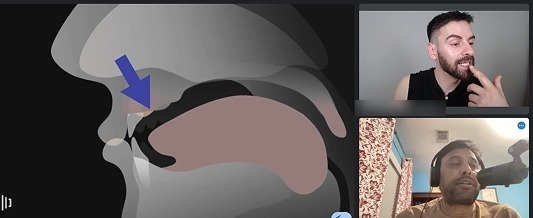
Learning American English pronunciation and the American accent is more effective when you train your speech organs, not only listen and repeat. 2D Sound Motion Technology and Interactive Visual 2D Sound Simulators, developed in 2020 by Prof. Alex, Ph.D. Accent Coach, Doctor of Education, and professional linguist, as part of his interactive teaching model based on his doctoral research in interactive teaching methods, train your tongue, lips, jaw, teeth, airflow, and voice step by step. They train each American sound and more than 30 sound combinations.
What 2D Sound Motion Technology is
2D Sound Motion Technology is an advanced accent reduction and articulation training tool by Prof. Alex. It corrects, develops, and trains each American sound and more than 30 sound combinations through Interactive Visual 2D Sound Simulators.
What Interactive Visual 2D Sound Simulators do
Interactive Visual 2D Sound Simulators are part of 2D Sound Motion Technology, the articulation-training method Prof. Alex created by applying his doctoral research in interactive teaching to American pronunciation. Instead of listening and repeating, students actively train their speech organs. Each simulator uses Interactive 2D mouth movement to train the speech organs (tongue, lips, jaw, teeth, airflow, and voice) to produce each American sound correctly. Every consonant has its own simulator: explore American consonants trained with 2D Sound Motion Technology.
Sample training: the American t sound (aspirated [t])
Practice
Record yourself speaking these words:
Tab · Tacos · Time · Tub · Hotel · Motel · Sit · Pit · Net
Instructions
Play the Interactive Visual 2D Sound Simulator for the American t sound below several times and follow it step by step. Move your tongue, jaw, and airflow together with the simulator and train your articulation.
Interactive Visual 2D Sound Simulator: American unvoiced sound [t]
Practice
Record yourself again speaking these words, but this time focus on the movement of your tongue. Go slow, and you will hear the difference. You’ve got this!
Tab · Tacos · Time · Tub · Hotel · Motel · Sit · Pit · Net
How Interactive Visual 2D Sound Simulators solve pronunciation and speaking problems
- Wrong articulationMost pronunciation problems start with the tongue, lips, jaw, or teeth in the wrong position. Each Interactive Visual 2D Sound Simulator trains the correct articulation of one American sound, so the student corrects the cause of the problem, not only the result.
- Airflow and voicingMany accent problems come from wrong airflow or voicing: sounds that are too weak, too strong, or voiced when they should be unvoiced. The simulators train airflow and voice together with articulation, step by step, for each American sound and more than 30 sound combinations.
- Clear speech and confidenceWhen each sound is trained correctly, words connect into clear American English speech. Listeners can understand you more easily, and speaking at work, in meetings, and on calls becomes more confident.
If you start hearing the aspiration, the short airstream after [t], with one simulator, you can only imagine how successful you can be in 1-on-1 Interactive American Accent Training with Prof. Alex, Ph.D. Accent Coach, where your whole American sound system is trained sound by sound.
In MyAccentWay, the Interactive Visual 2D Sound Simulators are only available in 1-on-1 accent coaching sessions with Prof. Alex.
Related MyAccentWay resources
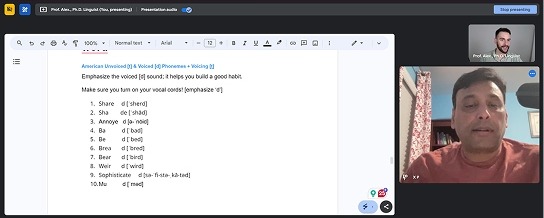
Interactive 1-on-1 vs Traditional Accent Coaching
How Prof. Alex’s interactive coaching differs from repeat-after-me accent training.

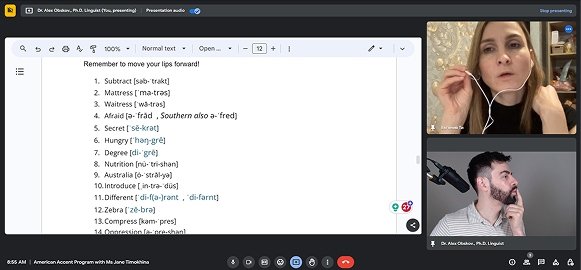
Best Accent Reduction Coaching for Business Professionals
What business professionals should look for in accent reduction and communication training.
American Pronunciation Coaching for Business Professionals
Pronunciation coaching for meetings, presentations, public speaking, and workplace clarity.
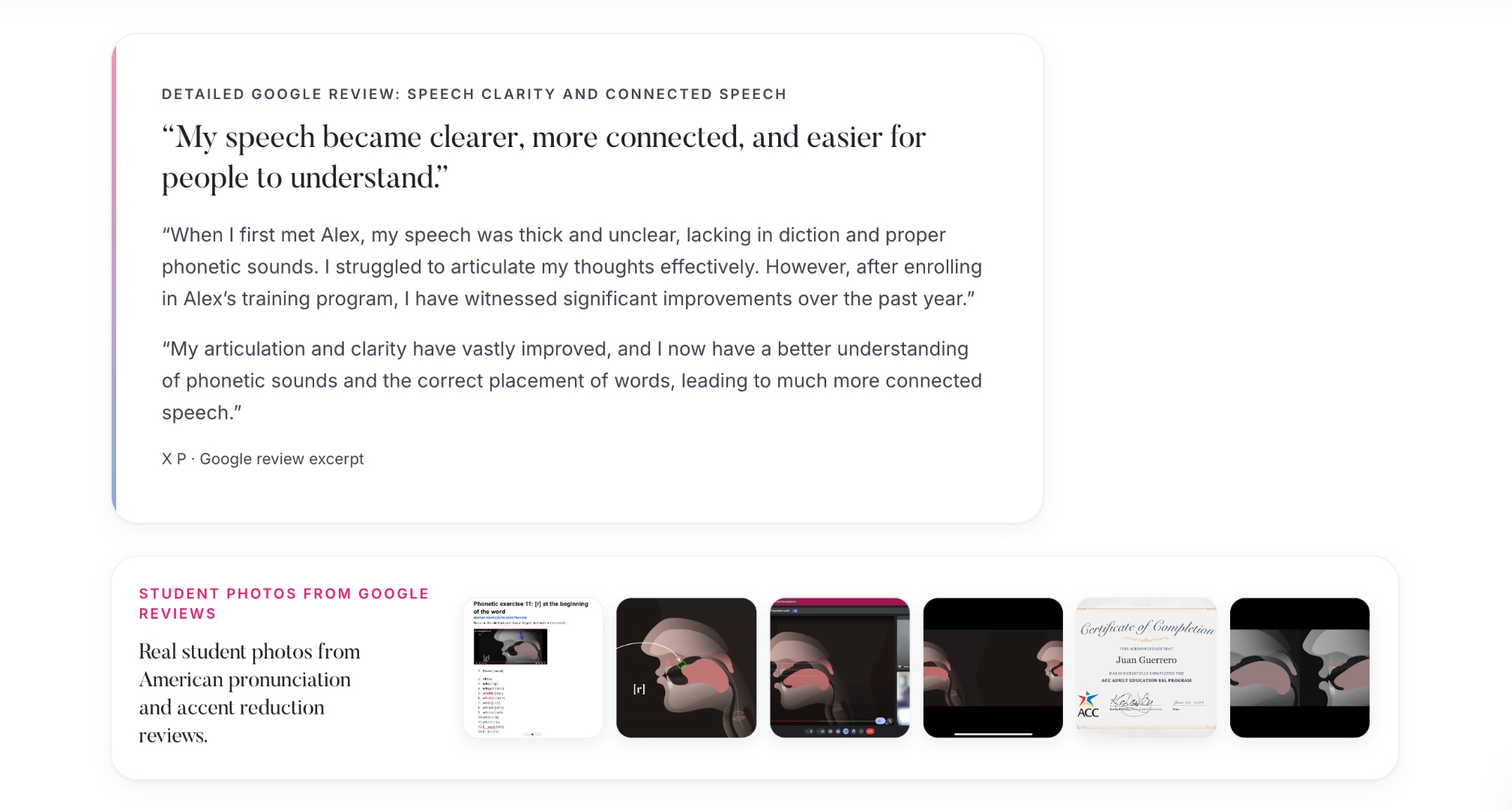
Best American Accent Coach for Non-Native Professionals
What 1-on-1 American accent training with Prof. Alex includes.
2D Sound Motion Technology for American Pronunciation
How Interactive Visual 2D Sound Simulators train American pronunciation.

MyAccentWay vs Accent Advisor
How Prof. Alex’s method differs from traditional live 1-on-1 video lessons.

Prof. Alex’s Teaching Philosophy
Why traditional accent coaching fails and what works instead.

Before-and-After Results
Real student recordings, including Abishek, Tian, Vlad, Alain, and Andrew.
Student Reviews and Results
Reviews and results from MyAccentWay students.