American English Speech Melody Explained for Learners
(512) 265-9515Updated October 14, 2026 ◆ 16 min read
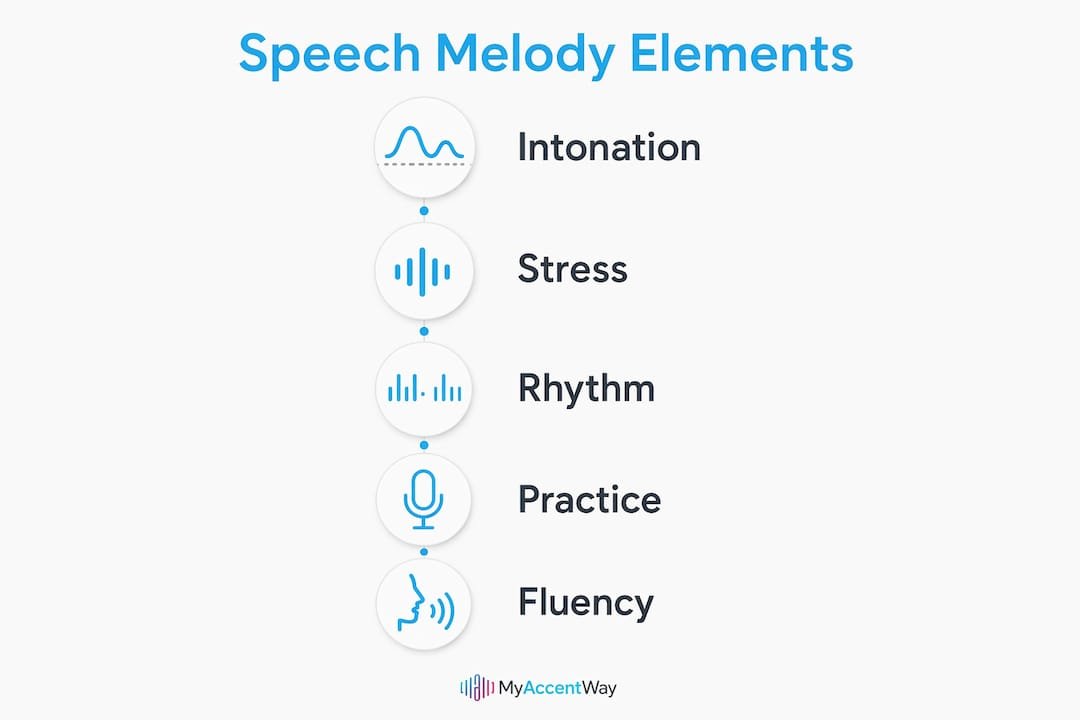
American English speech melody is the interaction of three elements working together across every phrase you speak: intonation (how your pitch rises and falls), stress (which syllables and words carry prominence), and rhythm (the timing between stressed and unstressed beats). This is the core of American English prosody, and it is what makes a native speaker sound natural rather than word-by-word mechanical.
Real student result

“I feel confident enough to speak American English!”
Interactive American Accent Training9monthsof hard work and dedication
Listen to the starting point0:00
Listen to the result0:00
“Many of my students once believed they could never sound like this. School taught them grammar and vocabulary, but not how to train their English speech. That is what we do together, step by step, until you speak English independently and with confidence.”
Abishek’s result was achieved through Prof. Alex’s research-based Interactive 1-on-1 American Accent Training. His doctoral research found this interactive method more effective than traditional, teacher-centered methods. See the research basis →
The single highest-leverage practice target? Control your end-of-phrase pitch contour and consistently reduce unstressed syllables to a schwa. Those two habits alone will shift how listeners perceive your fluency faster than almost anything else.
TL;DR:
-
Speech melody = intonation + stress + rhythm, all working together
-
Final pitch contour (falling vs. rising) signals meaning more than any single word
-
Schwa reduction of unstressed syllables is what creates natural American rhythm
-
A short daily routine of focused practice produces measurable progress
What are the three components of American English speech melody?
Intonation, stress, and rhythm are not separate features you layer on top of words. They are woven into every phrase simultaneously, and listeners process all three at once to interpret your meaning, focus, and emotion.
-
Intonation shapes the pitch contour of a phrase. Example: “She LEFT?” (rising pitch signals genuine surprise or a yes/no question).
-
Stress marks which syllable or word carries the most prominence. Example: “I didn’t say HE stole it” (nuclear stress on “he” implies someone else did).
-
Rhythm controls the timing between stressed beats and compresses everything in between. Example: “I wanna go to the store” — the unstressed syllables collapse toward schwa, keeping the beat steady.
When all three align, your speech sounds fluent and intentional. When one is off, listeners notice something feels “foreign” even if every word is correct. That is why kinesthetic rhythm exercises, such as walking or clapping on stressed beats, are recommended in pronunciation pedagogy — they train the body to feel the beat before the mouth has to produce it.
How do intonation patterns work in American English?
Intonation operates through pitch contours called nuclear tunes, the sequence of pitch movements at the end of each phrase. Four contours cover the vast majority of everyday American English speech.
| Contour | Plain description | Communicative function | Sample sentence |
|---|---|---|---|
| Falling (↘) | Pitch drops at the end | Statement, assertion, completed thought | “She’s already left.” |
| Rising (↗) | Pitch rises at the end | Yes/no question, uncertainty, checking | “You’re coming tonight?” |
| Fall–rise (↘↗) | Falls then lifts slightly | Contrast, softening, implication | “I liked the first one…” |
| Rise–fall (↗↘) | Rises then drops sharply | Surprise, strong contrast, emphasis | “That was AMAZING.” |
Notation tip: mark the nuclear stress syllable with a capital letter or underline, then draw an arrow after it to show direction. For example: “She’s ALready left ↘” or “You’re COMing tonight ↗.” This simple system, drawn from autosegmental-metrical theory, helps you see where the pitch peak falls relative to the stressed syllable — a small shift in that alignment changes how focused or assertive you sound.
Six practice sentences to copy and analyze:
-
“The meeting starts at nine.” ↘ (statement)
-
“Did you finish the report?” ↗ (yes/no question)
-
“I can come on Friday…” ↘↗ (but not Saturday — implied contrast)
-
“That’s incredible.” ↗↘ (genuine surprise)
-
“You want me to do it?” ↗ (clarifying, slightly incredulous)
-
“He said he’d call.” ↘ (neutral statement, closed)
Record yourself reading each sentence, then compare your pitch trace to a native model. The falling vs. rising intonation contrast is the most immediately noticeable difference listeners pick up.
How does word stress differ from sentence stress in American English?
These are two distinct levels of the same system, and confusing them is one of the most common errors non-native speakers make.

Lexical (word) stress is fixed in the dictionary. The word “PREsent” (noun) versus “preSENT” (verb) never changes regardless of context. Getting this wrong makes individual words hard to recognize.
Discourse (sentence) stress is flexible. It shifts based on what information is new, contrastive, or important in the conversation. Content words (nouns, main verbs, adjectives, adverbs) typically carry stress; function words (articles, prepositions, auxiliary verbs) are reduced. The word that receives the strongest stress in a phrase is called the nuclear accent or pitch accent, and it signals focus.
Try this contrastive stress exercise with the same sentence:
-
“I want the RED one.” (not the blue one)
-
“I want the red ONE.” (not the red two, not the red set)
-
“I WANT the red one.” (stop arguing — I’ve decided)
Each version carries a different meaning with identical words. Pitch-accent placement also shifts based on rhythmic context and phrase structure, which is why rhythm drills and stress drills reinforce each other.
Common learner errors with stress:
-
Placing equal stress on every syllable (syllable-timed transfer from Spanish, French, or Mandarin)
-
Stressing function words (“I AM going TO the store”) instead of content words
-
Missing the nuclear accent shift in contrastive contexts, making responses sound flat or ambiguous
-
Misplacing lexical stress on multi-syllable words (“deCISion” → correct; “DEcision” → incorrect)
For a deeper look at American English stress patterns, the rules governing word-level stress are more systematic than most learners realize.
Why does rhythm and timing matter so much for natural speech?
American English is often described as stress-timed: stressed syllables tend to recur at roughly regular intervals, while unstressed syllables compress to fit between them. This is a useful teaching model, not a rigid law of physics. The practical implication is real, though: unstressed syllables must be reduced, or the rhythm sounds choppy and unnatural.
The main tool for reduction is the schwa (/ə/), the most common vowel sound in American English. Words like “of,” “to,” “a,” “the,” “and,” “for” almost always reduce to schwa in connected speech. “I’m going to the store” becomes “I’m gonna thuh store” in natural conversation. Learners who fail to reduce unstressed syllables often sound robotic or overly formal, even when their grammar is perfect.
Three short rhythm drills:
-
Clapping drill: Clap only on stressed syllables while saying a sentence aloud. “She WENT to the STORE on MONday.” Three claps, three beats. Feel the compression between them.
-
Chunking drill: Break a long sentence into breath groups and practice each chunk at speed before combining. “I was thinking / about going / to the conference / next week.”
-
Reduction drill: Take a sentence and deliberately reduce every function word to schwa. “Can you give me a hand?” → “Kn yuh giv mee uh hand?” Then blend it back into natural speech.
Pro Tip: Don’t force a mechanical, metronome-like beat. The goal is compression around stressed syllables, not robotic regularity. Natural American rhythm breathes — it has slight variations at phrase boundaries and before important words.
Listening skills also accelerate this process. Active listening practice trains your ear to hear reduction patterns before your mouth has to produce them, which shortens the learning curve significantly.
Why does the end-of-phrase pitch contour matter most?
Of all the elements in speech melody, the final pitch contour of a phrase carries the heaviest communicative load. Listeners use it to judge whether you are making a statement or asking a question, whether you sound confident or uncertain, and whether your tone is polite or abrupt.
Research on pitch contour interpretation confirms that final F0 contour strongly guides listener judgments of assertiveness versus inquisitiveness. A falling contour signals a closed, confident statement. A rising contour signals openness, a question, or uncertainty. A shallow rise can read as polite or tentative depending on context. These are not subtle differences — listeners make these judgments in milliseconds.
Key finding from speech research: Read speech shows more consistent declination (a gradual lowering of pitch across a phrase), while spontaneous speech shows considerably more variation. Terminal falls and rises at phrase boundaries are the primary cues listeners use to identify phrase meaning and speaker intent. (Lieberman et al., JASA, 1985)
Quick practice exercise:
Record yourself saying the same phrase three ways and listen back:
-
“The project is done.” with a clear fall ↘
-
“The project is done?” with a clear rise ↗
-
“The project is done…” with a shallow rise ↘↗
You will hear immediately how dramatically the meaning shifts. This is the exercise that produces the fastest perceptual shift for most learners, because the difference is so audible.
| Final contour | Listener perception | Professional context |
|---|---|---|
| Clear fall ↘ | Confident, assertive, complete | Presenting conclusions, giving instructions |
| Clear rise ↗ | Questioning, uncertain, checking | Asking for confirmation, expressing doubt |
| Shallow rise ↘↗ | Polite, tentative, open | Softening a request, leaving room for discussion |
What does a daily practice routine for speech melody look like?
A focused 15–25 minute daily routine, practiced consistently, produces measurable improvement in rhythm and intonation within weeks. The key is structured repetition, not random exposure.
-
Warm-up (3 minutes): Hum a simple melody on a single vowel, then speak a short paragraph aloud at 70% speed. Focus only on feeling where your pitch rises and falls naturally.
-
Intonation drills (5 minutes): Take 4–6 sentences from the contour table above. Say each one three times with the correct contour, then record the third repetition.
-
Rhythm and reduction (5 minutes): Run the clapping drill and the reduction drill from the rhythm section. Pick one sentence and compress it until it sounds natural at full speed.
-
Shadowing (7 minutes): Choose a short audio clip of a native American English speaker (a podcast, a TED Talk excerpt, or the Myaccentway demo video). Shadow it phrase by phrase, matching pitch, stress, and timing as closely as possible.
-
Review (3–5 minutes): Play back your recordings from steps 2 and 4. Ask yourself: Did my final contours land clearly? Were my unstressed syllables reduced? Did my rhythm feel compressed or choppy?
Self-evaluation checklist:
-
Final pitch contour is distinct (clearly falling or rising, not flat)
-
Stressed syllables are noticeably louder and longer than unstressed ones
-
Function words are reduced, not fully pronounced
-
Phrase boundaries are marked by a slight pause or pitch reset
-
Overall rhythm feels forward-moving, not word-by-word
For a complete structured approach to daily pronunciation practice, including timed routines and self-assessment tools, Myaccentway’s curriculum covers each of these steps in sequence.
How do visual tools and coaching accelerate your mastery?
Most pronunciation programs ask you to listen and repeat. The problem is that you cannot see what your mouth is doing, and you cannot see the pitch contour you are producing. Guessing from audio alone is slow and often inaccurate.
Myaccentway’s approach is structurally different. Prof. Alex, Ph.D., begins with speech-organ awareness so students understand the physical movements behind each sound. The curriculum then moves through American consonants, vowels, rhythm, and intonation in a deliberate sequence. At every stage, as part of Prof. Alex’s interactive teaching model based on his Ph.D. research in interactive teaching methods, students use Interactive Visual 2D Sound Simulators to actively train the movement of the tongue, lips, jaw, and teeth, as well as airflow, while training pitch movement and articulatory position simultaneously, with Prof. Alex correcting them live. Practice turns doubt into clarity. In MyAccentWay training, these simulators are used to train sound articulation, sound formation, and speech production during live 1-on-1 accent training sessions.
What happens in a 1-on-1 coaching session:
-
Prof. Alex assesses your current pitch contours and identifies where your melody diverges from American norms
-
Visual pitch traces show the exact alignment of your F0 peaks relative to stressed syllables
-
Guided reduction exercises target your specific unstressed syllable patterns
-
Tailored daily drills are assigned based on your native language background and current error patterns
Student result: Vlad, a Russian speaker, completed structured training with Myaccentway and demonstrated clear improvement in American accent fluency. Watch his progress: Vlad’s before/after.
Russian speakers typically transfer a syllable-timed rhythm and flatter intonation contours into English. Vlad’s result shows what targeted work on nuclear stress placement and final contour control can produce.
Why does American English have its own distinct speech melody?
American English developed its specific prosodic character through centuries of geographic isolation, dialect mixing, and cultural influence. When English settlers spread across North America, regional dialects blended rather than staying separate, producing what linguists call Mainstream American English (MAE), a relatively uniform prosodic baseline compared to the sharper regional distinctions found in British English.
Several forces shaped the melody specifically. The Great Vowel Shift affected British English more dramatically than American varieties, leaving American vowels and their associated rhythmic patterns somewhat closer to earlier English forms. Immigration waves from dozens of language backgrounds created pressure toward a shared, learnable prosodic norm. Mass media in the 20th century, particularly radio and television broadcasting from Midwestern and West Coast centers, reinforced a consistent intonation model that became the de facto standard for professional American speech.
The result is a stress-timed system with clear nuclear accents, consistent schwa reduction, and a falling terminal contour as the default for statements. These are not arbitrary features. They reflect the history of a language that needed to be understood across vast distances and diverse speaker backgrounds.
What most learners get wrong about speech melody
Most learners focus almost entirely on individual sounds — the /r/, the /th/, the vowel distinctions — and treat melody as something that will “come naturally” once the sounds are right. In my experience working with non-native speakers across dozens of language backgrounds, that assumption costs learners months of progress.
Melody does not come naturally from a different prosodic system. A Mandarin speaker’s tonal habits, a Spanish speaker’s syllable-timed rhythm, a Russian speaker’s flatter intonation contours — these are deeply ingrained patterns that require direct, structured retraining. The good news is that melody responds faster to focused practice than most learners expect, precisely because it operates at the phrase level. You do not need to fix every word. You need to fix the contour of every phrase ending, and the rhythm of every unstressed syllable between beats. That is a finite, learnable target. Start with the final contour exercise from this article today. Record three versions of one sentence, listen back, and you will hear the difference immediately. That moment of hearing your own pitch is where real learning begins.
Ready to train your speech melody with a linguist?
Myaccentway offers 1-on-1 American accent training built specifically for non-native professionals who want measurable results, not generic repetition. Prof. Alex’s structured curriculum covers speech-organ awareness, consonants, vowels, rhythm, and intonation in sequence, with 2D Sound Motion Technology giving you visual feedback on your pitch contours that no audio-only method can provide.

The 1 Hour Evaluation Session includes a personalized speech assessment, a review of your current melody and rhythm patterns, and a clear plan for what to work on first. You leave with specific, targeted drills, not a list of things to “keep practicing.”
Explore Curriculum | Book Your 1 Hour Evaluation Session | Read Reviews
For a full overview of the scientific approach behind the program, visit the American accent training guide.
Useful sources and further reading
-
American English Speech — Intonation & Prosody (Open Text, University of Kansas)
-
Pitch Accent Variation and Rising/Falling Intonation in American English (Sostarics & Cole, Interspeech 2023)
-
Role of F0 alignment in distinguishing intonation categories
-
Rhythm and intonational phrase structure influences on pitch accent placement
-
Rhythm pedagogies and ESL pronunciation (MITESOL conference paper)
-
Prosody in English (EnglishCenter)
-
Intonational categories and continua in American English rising nuclear tunes (NSF)
-
American English Speech — Open & Free (OLI, Carnegie Mellon University)
-
Myaccentway — American Accent Training
MyAccentWay · 2D Sound Motion Technology
American English Pronunciation: Consonant and Vowel Sounds with 2D Sound Motion Technology
Learning American English pronunciation and the American accent is more effective when you train your speech organs, not only listen and repeat. 2D Sound Motion Technology and Interactive Visual 2D Sound Simulators, developed in 2020 by Prof. Alex, Ph.D. Accent Coach, Doctor of Education, and professional linguist, as part of his interactive teaching model based on his Ph.D. research in interactive teaching methods, train your tongue, lips, jaw, teeth, airflow, and voice step by step. They train each American sound and more than 30 sound combinations through Interactive 2D video simulation.
What 2D Sound Motion Technology is
2D Sound Motion Technology is an advanced accent reduction and articulation training tool by Prof. Alex. It corrects, develops, and trains each American sound and more than 30 sound combinations through Interactive 2D video simulation.
What Interactive Visual 2D Sound Simulators do
Interactive Visual 2D Sound Simulators are part of 2D Sound Motion Technology, the articulation-training method Prof. Alex created by applying his Ph.D. research in interactive teaching to American pronunciation. Instead of listening and repeating, students actively train their speech organs. Each simulator uses Interactive 2D mouth movement to train the speech organs (tongue, lips, jaw, teeth, airflow, and voice) to produce each American sound correctly. Every consonant has its own simulator: explore American consonants trained with 2D Sound Motion Technology.
Sample training: the American t sound (aspirated [t])
Practice
Record yourself speaking these words:
Tab · Tacos · Time · Tub · Hotel · Motel · Sit · Pit · Net
Instructions
Play the Interactive Visual 2D Sound Simulator for the American t sound below several times and follow it step by step. Move your tongue, jaw, and airflow together with the simulator and train your articulation.
Interactive Visual 2D Sound Simulator: American unvoiced sound [t]
Practice
Record yourself again speaking these words, but this time focus on the movement of your tongue. Go slow, and you will hear the difference. You’ve got this!
Tab · Tacos · Time · Tub · Hotel · Motel · Sit · Pit · Net
How Interactive Visual 2D Sound Simulators solve pronunciation and speaking problems
- Wrong articulationMost pronunciation problems start with the tongue, lips, jaw, or teeth in the wrong position. Each Interactive Visual 2D Sound Simulator trains the correct articulation of one American sound, so the student corrects the cause of the problem, not only the result.
- Airflow and voicingMany accent problems come from wrong airflow or voicing: sounds that are too weak, too strong, or voiced when they should be unvoiced. The simulators train airflow and voice together with articulation, step by step, for each American sound and more than 30 sound combinations.
- Clear speech and confidenceWhen each sound is trained correctly, words connect into clear American English speech. Listeners can understand you more easily, and speaking at work, in meetings, and on calls becomes more confident.

If you start hearing the aspiration, the short airstream after [t], with one simulator, you can only imagine how successful you can be in 1-on-1 Interactive American Accent Training with Prof. Alex, Ph.D. Accent Coach, where your whole American sound system is trained sound by sound.
In MyAccentWay, the Interactive Visual 2D Sound Simulators are only available in 1-on-1 accent coaching sessions with Prof. Alex.
American Intonation and Rhythm Training for Foreign-Born Professionals in the United States
Foreign-born professionals in the United States often know their field and speak advanced English. Yet American listeners may still struggle with their stress, rhythm, and intonation. MyAccentWay offers private online intonation training through Interactive American Accent Training.
Interactive American Accent Training is led by Prof. Alex, Ph.D. Accent Coach, Doctor of Education, and professional linguist. He first diagnoses each speaker’s native-language patterns. Then he trains American word stress, sentence stress, rhythm, and intonation for real meetings and presentations.
Who this training is for
- Engineers, IT specialists, and data professionals presenting to U.S. teams and clients
- Doctors, nurses, and healthcare professionals explaining care to American patients
- Managers, executives, and founders leading meetings, pitches, and briefings
- Consultants, researchers, and academics speaking at conferences and webinars
- Professionals preparing for interviews, promotions, or client-facing roles
Online training across the U.S.
MyAccentWay is based in Austin, Texas, and all training is online. The program is especially relevant for professionals in Austin, Dallas, Houston, New York City, the San Francisco Bay Area, Los Angeles, Seattle, Boston, Chicago, Miami, Washington DC, Atlanta, and Raleigh.
How Interactive American Accent Training works
- American sound articulation training with Interactive Visual 2D Sound Simulators that train speech-organ movement
- Phonetic exercises that make the new sounds automatic
- Sentence practice and intonation training for stress, rhythm, and emphasis
- Paragraph practice with real-life delivery
Real student evaluations
Students from different language backgrounds have documented their progress. Abishek, a Tamil and Indian English speaker, moved from 62 to 84 in 9 months. Tian, a Mandarin speaker, moved from 58 to 85 in 8 months. Vlad, a Russian speaker, moved from 60 to 83 in 5 months.
The first step is a 1 Hour Evaluation Session with Prof. Alex.
FAQ
What is speech melody in American English?
Speech melody is the combined effect of intonation (pitch patterns), stress (syllable and word prominence), and rhythm (timing and reduction) working together across phrases. It is what makes American English sound distinctly different from other varieties of English or other languages.
What is the rhythm of speech called?
The rhythmic pattern of speech is called prosody, and the specific timing system in American English is described as stress-timed. Stressed syllables recur at roughly regular intervals while unstressed syllables compress between them.
How do American accents sound to non-native listeners?
Non-native listeners often describe American English as fast, with many syllables “swallowed” or reduced. This perception comes directly from schwa reduction and linking patterns — the same features that make the speech melody sound natural to American ears.
What makes American English intonation hard for learners?
The biggest challenge is that American English intonation signals meaning at the phrase level, not the word level. Learners from tonal or syllable-timed languages must retrain their default pitch and rhythm habits, which requires direct, structured practice rather than passive exposure.
How can I improve my American English speech melody quickly?
The fastest gains come from two focused habits: controlling your final pitch contour (clear fall for statements, clear rise for questions) and reducing unstressed syllables to schwa. A 15–25 minute daily routine combining intonation drills, rhythm compression, and shadowing produces noticeable results within weeks. Myaccentway’s 1-on-1 coaching with visual pitch feedback accelerates this process further.
Recommended
Mastering American Intonation: Falling vs. Rising Practice for Professionals
The melody of your voice often carries more weight than the precise vocabulary you choose. Even with flawless grammar, a misplaced pitch can make a...


Speech Sounds: Vowels and Consonants in American English
Every time you open your mouth to speak, something remarkable happens.
American English Sound Blending Best Practices
Master American English sound blending best practices to improve your speech clarity and fluency. Discover techniques that boost your confidence!
The problem is not always grammar or vocabulary.
If people understand your words but still miss your message, the deeper issue may be speech clarity, rhythm, intonation, and American pronunciation habits. MyAccentWay helps students retrain the sound system with professional 1-on-1 guidance, so English can feel clearer, freer, and more natural in real communication.
Two training methods that make speech change active.
MyAccentWay is not passive listen-and-repeat coaching. Prof. Alex, Ph.D. Accent Coach, Doctor of Education, and professional linguist, creates a learning situation where students become active learners and active participants in changing their own speech patterns.
Interactive training
Students do not just receive pronunciation instructions passively. They listen, think, compare, adjust, and understand their own speech patterns while Prof. Alex guides the correction process.
Cognitive accent training
Students learn to notice and correct the speech patterns that affect American pronunciation, then implement new American speech patterns into their code-switching process for more natural, long-lasting change.
Build speech habits people can hear in real conversations.
A stronger American accent is not built by memorizing topics or chasing quick pronunciation tips. It comes from structured training, professional feedback, active correction, and repeated application until clearer speech becomes easier to keep.
Continue learning how MyAccentWay connects accent reduction, accent modification, English articulation, Prof. Alex’s method, student proof, and 1-on-1 American accent training.
- Prof. Alex and the MyAccentWay MethodLearn how Prof. Alex, Ph.D. Accent Coach, Doctor of Education, and professional linguist, created and leads the structured MyAccentWay American accent training system.
- Accent Reduction Curriculum and English Articulation TrainingSee how MyAccentWay trains accent reduction, accent modification, American pronunciation, English articulation, rhythm, and professional speech clarity.
- 2D Sound Motion Technology for American Accent TrainingUnderstand Prof. Alex’s Interactive Visual 2D Sound Simulators for American sound articulation.
- Before-and-After American Accent Training ResultsListen to real before-and-after student proof and accent training outcomes.
- Student Reviews and Accent Training ResultsRead student reviews, testimonials, and trust signals from MyAccentWay learners.
- Book a 1-Hour 1 Hour Evaluation SessionStart with a 1-hour accent evaluation session with Prof. Alex.