American English Sound Blending Best Practices
(512) 265-9515Updated October 14, 2026 ◆ 11 min read
Sound blending in American English, known formally as connected speech, is the process by which individual words link and change when spoken in natural, flowing sentences. American English sound blending best practices center on five core techniques: linking, weak forms, assimilation, elision, and palatalization. Mastering these techniques is not optional for professional clarity. Listeners judge fluency and competence by how naturally speech flows, not just by vocabulary. Professor Alex, Ph.D., Linguist and Accent Coach at Myaccentway, builds every training program around these exact mechanisms because they produce the fastest, most measurable gains in American pronunciation clarity.
Real student result

“I feel confident enough to speak American English!”
Interactive American Accent Training9monthsof hard work and dedication
Listen to the starting point0:00
Listen to the result0:00
“Many of my students once believed they could never sound like this. School taught them grammar and vocabulary, but not how to train their English speech. That is what we do together, step by step, until you speak English independently and with confidence.”
Abishek’s result was achieved through Prof. Alex’s research-based Interactive 1-on-1 American Accent Training. His doctoral research found this interactive method more effective than traditional, teacher-centered methods. See the research basis →
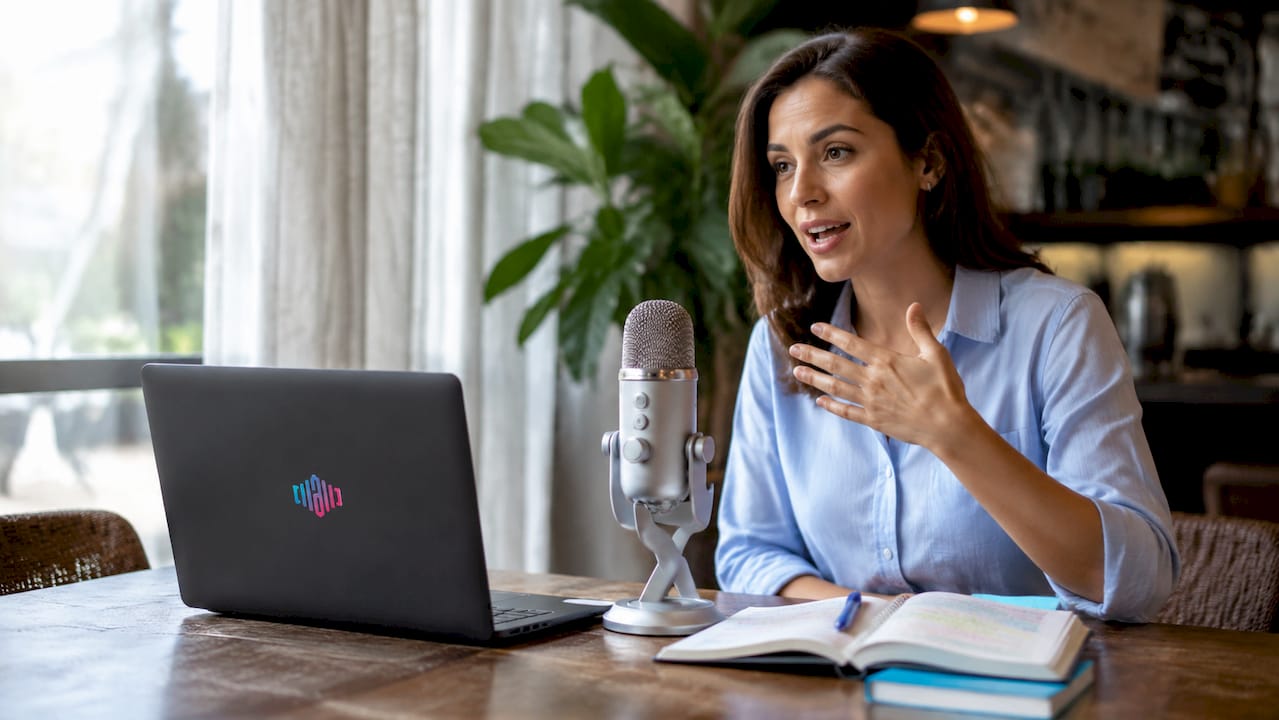
1. American English sound blending best practices: the five core rules
Connected speech processes such as linking, elision, assimilation, and weak forms are universal across languages, but American English features more flapping and linking than most other varieties. Understanding each rule gives you a clear target to practice toward.
- Linking (consonant to vowel): When a word ends in a consonant and the next begins with a vowel, the sounds merge. “Turn it on” becomes “tur-ni-ton.” This is the most frequent blending pattern in American speech.
- Linking (vowel to vowel): When two vowel sounds meet, a glide sound appears between them. “Go away” gains a subtle /w/ glide: “go-w-away.” “See it” gains a /y/ glide: “see-y-it.”
- Weak forms: Native speakers reduce unstressed function words roughly 90% of the time. “Can” becomes /kən/, “for” becomes /fər/, and “of” becomes /əv/. Skipping weak forms is the single most common reason non-native speech sounds formal or robotic.
- Assimilation: Neighboring sounds influence each other. “In person” shifts to “im person” because the /n/ anticipates the /p/. This is not sloppy speech. It is how the American speech system works at normal pace.
- Elision: Sounds disappear entirely in fast speech. T and D between consonants often vanish: “next week” sounds like “nex week,” and the H in unstressed pronouns drops: “tell him” becomes “tell ‘im.”
- Palatalization: Consonant plus Y combinations create new sounds. “Got you” becomes “gotcha” and “did you” becomes “didja.” These are not casual shortcuts. They are standard features of fluent American speech.
| Rule | Example | What changes |
|---|---|---|
| Consonant-to-vowel linking | “pick it up” → “pi-ki-tup” | Consonant attaches to next vowel |
| Weak forms | “I want to go” → “I wanna go” | Unstressed words reduce to schwa |
| Assimilation | “in person” → “im person” | Sound changes to match neighbor |
| Elision | “next week” → “nex week” | Sound disappears entirely |
| Palatalization | “did you” → “didja” | Two sounds merge into one new sound |
2. Top exercises to build sound blending skills daily
Accent training experts recommend focusing on 10–12 key sounds, including the rhotic /r/, flap T, dark L, schwa, and flat A, for the highest impact on American accent clarity. These sounds appear constantly in connected speech, so mastering them accelerates blending progress faster than studying the full phoneme inventory.
- Practice phrases, not isolated words. Single words do not trigger blending. Phrases like “a lot of them” or “I need to ask him” force your mouth to navigate real linking patterns. Start with three-word chunks and build up.
- Shadow native speakers. Play a short audio clip of a native American speaker, then repeat the exact phrase immediately, matching rhythm and melody. Shadowing native recordings trains your ear and your muscle memory at the same time.
- Record and compare. Record yourself saying a target phrase, then play a native model. Listen for where your sounds stop and the native sounds flow. The gap you hear is your practice target.
- Use connected speech drills. Repeat phrases like “What do you want to do?” until the weak forms and linking become automatic. The goal is to stop thinking about each sound and let the pattern run on its own.
- Practice with the 2D Sound Motion Technology video for the American T. Following exactly how the tongue, lips, and jaw move during the flap T removes the guesswork entirely.
American T sound simulator to train the physical movement.
Pro Tip: Daily sessions of 10–15 minutes produce stronger results than one long session per week. Short daily practice builds muscle memory that activates automatically during live conversation, which is exactly where clarity matters most.
MyAccentWay · 2D Sound Motion Technology
American English Pronunciation: Consonant and Vowel Sounds with 2D Sound Motion Technology
Learning American English pronunciation and the American accent is more effective when you train your speech organs, not only listen and repeat. 2D Sound Motion Technology and Interactive Visual 2D Sound Simulators, developed in 2020 by Prof. Alex, Ph.D. Accent Coach, Doctor of Education, and professional linguist, as part of his interactive teaching model based on his Ph.D. research in interactive teaching methods, train your tongue, lips, jaw, teeth, airflow, and voice step by step. They train each American sound and more than 30 sound combinations through Interactive 2D video simulation.
What 2D Sound Motion Technology is
2D Sound Motion Technology is an advanced accent reduction and articulation training tool by Prof. Alex. It corrects, develops, and trains each American sound and more than 30 sound combinations through Interactive 2D video simulation.
What Interactive Visual 2D Sound Simulators do
Interactive Visual 2D Sound Simulators are part of 2D Sound Motion Technology, the articulation-training method Prof. Alex created by applying his Ph.D. research in interactive teaching to American pronunciation. Instead of listening and repeating, students actively train their speech organs. Each simulator uses Interactive 2D mouth movement to train the speech organs (tongue, lips, jaw, teeth, airflow, and voice) to produce each American sound correctly. Every consonant has its own simulator: explore American consonants trained with 2D Sound Motion Technology.
Sample training: the American t sound (aspirated [t])
Practice
Record yourself speaking these words:
Tab · Tacos · Time · Tub · Hotel · Motel · Sit · Pit · Net
Instructions
Play the Interactive Visual 2D Sound Simulator for the American t sound below several times and follow it step by step. Move your tongue, jaw, and airflow together with the simulator and train your articulation.
Interactive Visual 2D Sound Simulator: American unvoiced sound [t]
Practice
Record yourself again speaking these words, but this time focus on the movement of your tongue. Go slow, and you will hear the difference. You’ve got this!
Tab · Tacos · Time · Tub · Hotel · Motel · Sit · Pit · Net
How Interactive Visual 2D Sound Simulators solve pronunciation and speaking problems
- Wrong articulationMost pronunciation problems start with the tongue, lips, jaw, or teeth in the wrong position. Each Interactive Visual 2D Sound Simulator trains the correct articulation of one American sound, so the student corrects the cause of the problem, not only the result.
- Airflow and voicingMany accent problems come from wrong airflow or voicing: sounds that are too weak, too strong, or voiced when they should be unvoiced. The simulators train airflow and voice together with articulation, step by step, for each American sound and more than 30 sound combinations.
- Clear speech and confidenceWhen each sound is trained correctly, words connect into clear American English speech. Listeners can understand you more easily, and speaking at work, in meetings, and on calls becomes more confident.
If you start hearing the aspiration, the short airstream after [t], with one simulator, you can only imagine how successful you can be in 1-on-1 Interactive American Accent Training with Prof. Alex, Ph.D. Accent Coach, where your whole American sound system is trained sound by sound.
In MyAccentWay, the Interactive Visual 2D Sound Simulators are only available in 1-on-1 accent coaching sessions with Prof. Alex.
3. Common challenges and how to overcome them
Non-native speakers often struggle with continuous sounds and rhythm timing because their native language phonetics create different default patterns. A Spanish speaker may add a vowel before consonant clusters. A Mandarin speaker may pause between syllables where American speech flows through. These are not errors in intelligence. They are deeply trained habits that need new physical training to replace.
- The flap T problem: The American flap T, the sound in “water” or “better,” does not exist in most languages. Students often substitute a hard /t/ or a /d/, which breaks the natural flow. The solution is physical: train the tongue to tap lightly against the ridge behind the upper teeth, not press firmly.
- Rhythm and stress timing: American English is stress-timed, meaning stressed syllables occur at roughly regular intervals. Non-native speakers from syllable-timed languages (Spanish, French, Italian) give equal weight to every syllable, which disrupts the natural blending rhythm.
- Dropped sounds feel wrong: Students often resist elision because omitting sounds feels like making a mistake. Elision is not a mistake. It is a rule. Practicing it deliberately removes the hesitation.
2D Sound Motion Technology addresses the root cause of these challenges by having students actively train the movement of the tongue, lips, jaw, teeth, and airflow with the Interactive Visual 2D Sound Simulators, while Prof. Alex corrects them live. As part of Prof. Alex’s interactive teaching model, based on his Ph.D. research in interactive teaching methods, the simulators help students refine each sound through active practice rather than listening and repeating alone.
Pro Tip: Focus on one blending rule per week. Trying to fix linking, elision, and weak forms simultaneously overloads your attention. Mastering one rule at a time builds a solid foundation that compounds quickly.
4. Blending in formal versus informal American English settings
The intensity of sound blending changes with context. Professional presentations call for clearer enunciation than casual conversation, but even formal American speech uses linking and weak forms. Removing all blending from formal speech does not sound professional. It sounds foreign.
Linguistics experts argue that training connected speech mechanisms rather than memorizing fixed phrases prepares speakers for varied real-world contexts. This principle applies directly to formal versus informal settings: once you understand the rules, you can dial the intensity up or down based on the situation.
| Feature | Formal setting | Informal setting |
|---|---|---|
| Weak forms | Present but less reduced | Fully reduced (“gonna,” “wanna”) |
| Elision | Minimal (T and D may stay) | Common (sounds drop freely) |
| Linking | Active between content words | Active across all word boundaries |
| Palatalization | Rare (“did you” stays separate) | Common (“didja,” “gotcha”) |
| Pace | Slower, more deliberate | Faster, more compressed |
The practical takeaway is straightforward. In a board presentation, you keep the T in “next step” and say “did you” clearly. In a team meeting, “didja see that?” is natural and appropriate. Knowing both registers and switching between them is the mark of a truly fluent speaker.
Key takeaways
Mastering American English sound blending requires consistent daily practice of linking, weak forms, assimilation, elision, and palatalization across both formal and informal speech contexts.
| Point | Details |
|---|---|
| Five core blending rules | Linking, weak forms, assimilation, elision, and palatalization form the foundation of natural American speech. |
| Prioritize key sounds | Focus on the rhotic R, flap T, dark L, schwa, and flat A for the fastest clarity gains. |
| Daily short sessions win | Ten to fifteen minutes of daily practice builds automatic blending faster than infrequent long sessions. |
| Context shapes intensity | Formal speech uses blending with more care; informal speech uses full reduction and palatalization freely. |
| Visual training accelerates results | 2D Sound Motion Technology trains physical articulation, removing guesswork from sound production. |
What I have learned after years of training non-native professionals
After working with hundreds of non-native professionals, the pattern I see most often is this: students arrive knowing the rules intellectually but still sounding choppy in real conversation. The gap is not knowledge. It is muscle memory.
The students who progress fastest are not the ones who study the hardest in one sitting. They are the ones who practice for 10 minutes every morning before their first meeting. That daily repetition rewires the speech organs to produce blending automatically, without conscious effort. When blending becomes automatic, clarity follows naturally.
The other insight I want to share is about weak forms specifically. Most students underestimate how much weak forms matter. Native speakers reduce function words the vast majority of the time. If you are giving every “the,” “of,” and “for” its full vowel, you are working against the natural rhythm of American English. That single habit, once corrected, changes how listeners perceive your fluency almost immediately.
I also want to address a concern I hear often: “Am I too old to change my accent?” The answer is no. The speech organs are muscles. Muscles respond to training at any age. What changes with age is not the capacity to learn. It is the need for more deliberate, structured practice. That is exactly what a program like Myaccentway is designed to provide.
— Prof.
Myaccentway’s structured path to sound blending mastery
Myaccentway offers a structured American accent training program built specifically for non-native professionals who need real results in real communication settings.
Professor Alex begins with a one-on-one assessment to identify your specific speech patterns and blending gaps. From there, Professor Alex uses the Interactive Visual 2D Sound Simulators, part of his interactive teaching model based on his Ph.D. research in interactive teaching, to train the movement of your tongue, lips, jaw, teeth, and airflow for each blend while he corrects you live. Vlad, a Russian speaker, went through this process and the results speak for themselves: watch his pronunciation improvement directly. Book Your 1 Hour Evaluation Session with Professor Alex to get a personalized assessment and start building the connected speech clarity your professional communication deserves.
Connected Speech Training for Foreign-Born Professionals in the United States
Foreign-born professionals in the United States often know their field and speak advanced English. Yet American listeners may still struggle with their linking and reductions. MyAccentWay offers private online connected speech training through Interactive American Accent Training.
Interactive American Accent Training is led by Prof. Alex, Ph.D. Accent Coach, Doctor of Education, and professional linguist. He first diagnoses each speaker’s native-language patterns. Then he trains American linking, reductions, and rhythm for real fast conversations.
Who this training is for
- Engineers, IT specialists, and data professionals presenting to U.S. teams and clients
- Doctors, nurses, and healthcare professionals explaining care to American patients
- Managers, executives, and founders leading meetings, pitches, and briefings
- Consultants, researchers, and academics speaking at conferences and webinars
- Professionals preparing for interviews, promotions, or client-facing roles
Online training across the U.S.
MyAccentWay is based in Austin, Texas, and all training is online. The program is especially relevant for professionals in Austin, Dallas, Houston, New York City, the San Francisco Bay Area, Los Angeles, Seattle, Boston, Chicago, Miami, Washington DC, Atlanta, and Raleigh.
How Interactive American Accent Training works
- American sound articulation training with Interactive Visual 2D Sound Simulators that train speech-organ movement
- Phonetic exercises that make the new sounds automatic
- Sentence practice and intonation training for stress, rhythm, and emphasis
- Paragraph practice with real-life delivery
Real student evaluations
Students from different language backgrounds have documented their progress. Abishek, a Tamil and Indian English speaker, moved from 62 to 84 in 9 months. Tian, a Mandarin speaker, moved from 58 to 85 in 8 months. Vlad, a Russian speaker, moved from 60 to 83 in 5 months.
The first step is a 1 Hour Evaluation Session with Prof. Alex.
FAQ
What is sound blending in American English?
Sound blending, formally called connected speech, is the process by which words link and change in natural spoken American English. It includes techniques like linking, weak forms, assimilation, elision, and palatalization.
Why do native speakers sound so fast?
Native speakers apply weak forms and elision automatically, reducing unstressed words and dropping sounds between consonants. This compression creates the perception of speed.
What are the most important sounds to master for American blending?
Accent training experts point to the rhotic R, flap T, dark L, schwa, and flat A as the highest-impact sounds for American English clarity and natural blending.
How long does it take to improve sound blending?
Progress depends on consistency. Daily short sessions of 10–15 minutes build muscle memory faster than infrequent longer sessions, with noticeable improvement typically appearing within weeks of structured practice.
Does blending apply in formal professional speech?
Yes. Even formal American speech uses linking and weak forms. The difference is that palatalization and full elision are less common in formal settings, while linking and reduced function words remain active throughout.
Recommended
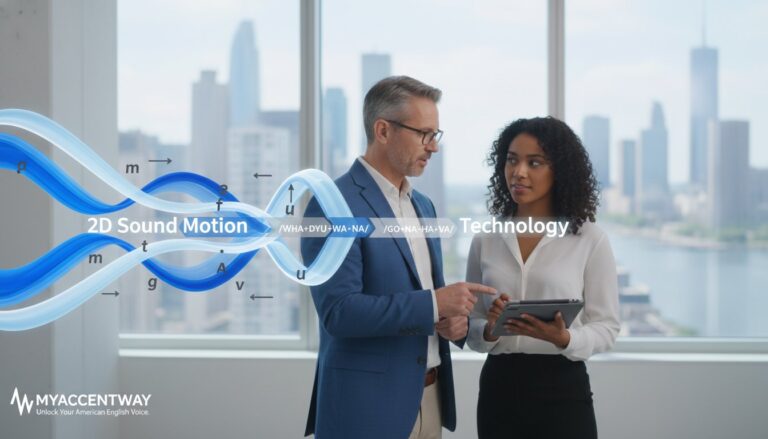
American English Connected Speech Rules: A Professional Guide to Natural Flow
Speaking English clearly isn't about pronouncing every single letter. In fact, trying to be too perfect is exactly why you might sound robotic or...

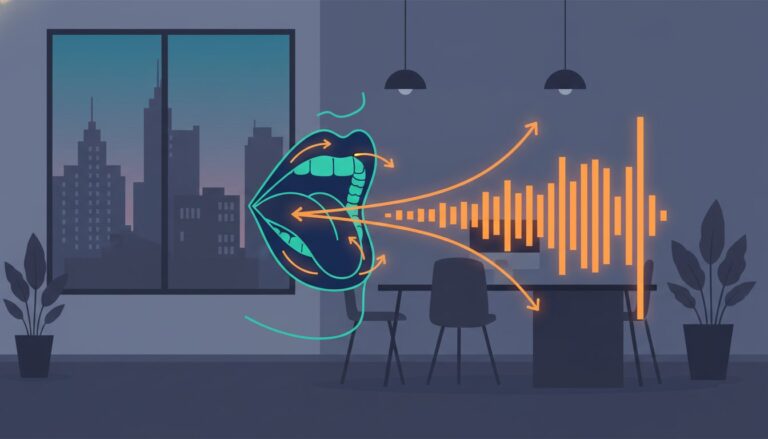
American English Pronunciation Practice: The 2026 Expert Guide
Last week, a senior project manager was asked to repeat his quarterly report findings for the third time. He knew his data was flawless, but the...

Linked Sounds in English: The Ultimate Guide to Sounding Fluent
Have you ever listened to a native English speaker and felt completely lost, even though you know every single word they said? Or perhaps you feel...
The problem is not always grammar or vocabulary.
If people understand your words but still miss your message, the deeper issue may be speech clarity, rhythm, intonation, and American pronunciation habits. MyAccentWay helps students retrain the sound system with professional 1-on-1 guidance, so English can feel clearer, freer, and more natural in real communication.
Two training methods that make speech change active.
MyAccentWay is not passive listen-and-repeat coaching. Prof. Alex, Ph.D. Accent Coach, Doctor of Education, and professional linguist, creates a learning situation where students become active learners and active participants in changing their own speech patterns.
Interactive training
Students do not just receive pronunciation instructions passively. They listen, think, compare, adjust, and understand their own speech patterns while Prof. Alex guides the correction process.
Cognitive accent training
Students learn to notice and correct the speech patterns that affect American pronunciation, then implement new American speech patterns into their code-switching process for more natural, long-lasting change.
Build speech habits people can hear in real conversations.
A stronger American accent is not built by memorizing topics or chasing quick pronunciation tips. It comes from structured training, professional feedback, active correction, and repeated application until clearer speech becomes easier to keep.
Continue learning how MyAccentWay connects American sound articulation, Interactive Visual 2D Sound Simulators, accent reduction, student proof, and 1-on-1 training.
- Prof. Alex and the MyAccentWay MethodLearn how Prof. Alex, Ph.D. Accent Coach, Doctor of Education, and professional linguist, created and leads the structured MyAccentWay American accent training system.
- Accent Reduction Curriculum and English Articulation TrainingSee how MyAccentWay trains accent reduction, accent modification, American pronunciation, English articulation, rhythm, and professional speech clarity.
- 2D Sound Motion Technology for American Accent TrainingUnderstand Prof. Alex’s Interactive Visual 2D Sound Simulators for American sound articulation.
- Before-and-After American Accent Training ResultsListen to real before-and-after student proof and accent training outcomes.
- Student Reviews and Accent Training ResultsRead student reviews, testimonials, and trust signals from MyAccentWay learners.
- Book a 1-on-1 American 1 Hour Evaluation SessionStart with a 1-hour interactive American accent training session with Prof. Alex.