Mastering American Intonation: Falling vs. Rising Practice for Professionals
(512) 265-9515Updated October 16, 2026 ◆ 17 min read
The melody of your voice often carries more weight than the precise vocabulary you choose. Even with flawless grammar, a misplaced pitch can make a confident statement sound like a hesitant question, which is why consistent falling vs rising intonation practice is the secret to professional authority. Most international professionals I work with feel this frustration daily, sensing a disconnect between their expertise and how they’re perceived during high-stakes presentations. You aren’t alone if you feel your tone doesn’t always match your intent.
Real student result

“I feel confident enough to speak American English!”
Interactive American Accent Training9monthsof hard work and dedication
Listen to the starting point0:00
Listen to the result0:00
“Many of my students once believed they could never sound like this. School taught them grammar and vocabulary, but not how to train their English speech. That is what we do together, step by step, until you speak English independently and with confidence.”
Abishek’s result was achieved through Prof. Alex’s research-based Interactive 1-on-1 American Accent Training. His doctoral research found this interactive method more effective than traditional, teacher-centered methods. See the research basis →
I’m Prof. Alex, Ph.D. Accent Coach, and I’m here to help you bridge that gap by mastering the musicality of American English. In this guide, I’ll show you how to command your pitch with specific drills designed for clarity and impact. We’ll explore the linguistic mechanics of the “American flow,” how the Interactive Visual 2D Sound Simulators train the movement of your tongue, lips, jaw, teeth, and airflow while Prof. Alex corrects you live, and how they are part of his interactive teaching model based on his Ph.D. research in interactive teaching methods. We’ll also provide a step-by-step roadmap to sounding more natural and self-assured in every conversation. By focusing on speech clarity and the science of sound, you can ensure your voice finally reflects your professional stature.
The Melody of Speech Clarity: Why Intonation Matters
Intonation is the “hidden music” of American English. It’s the way your pitch moves up and down as you speak, acting as a form of vocal punctuation. While grammar provides the structure of your message, intonation provides the context. Without it, your speech can sound flat or, worse, convey an emotion you didn’t intend. In my work as a linguist, I see many professionals struggle because their pitch patterns don’t match their expertise. This is why falling vs rising intonation practice is so vital for anyone seeking high-level career growth in the U.S.
At its core, Intonation in linguistics refers to the use of pitch to distinguish different types of utterances. Generally, a falling pitch signals finality or the end of a thought. A rising pitch signals an inquiry or that more information is on the way. Mastering these curves isn’t about cultural erasure or hiding your background. It’s about speech clarity. My goal at the American Accent Program is to give you the tools to be understood exactly as you intended, ensuring your message is never lost in translation.
The Impact of Pitch on Professional Confidence
Your voice is a tool for leadership. If you use a rising pitch at the end of a definitive statement, you might unintentionally sound uncertain or as if you’re asking for permission. This can erode listener trust during a presentation. Conversely, using a harsh falling pitch where a rise is expected can make you sound aggressive. Transitioning from a robotic rhythm to a professional American flow requires a deep understanding of these subtle shifts. When you command your pitch, you command the room.
Linguistic Foundations of American Pitch
According to the research-backed methods I’ve developed as Prof. Alex, Ph.D. Accent Coach, American English relies heavily on thought groups. These are clusters of words that represent a single idea. Pitch shifts usually happen at the end of these groups. It’s also essential to distinguish between word stress and sentence intonation. While word stress focuses on which syllable is emphasized, intonation looks at the entire sentence’s melody. If you’re looking for specialized support, exploring American accent training through the American Accent Program can help you train these patterns through 2D Sound Motion Technology.
The Falling Intonation Pattern: Communicating Finality
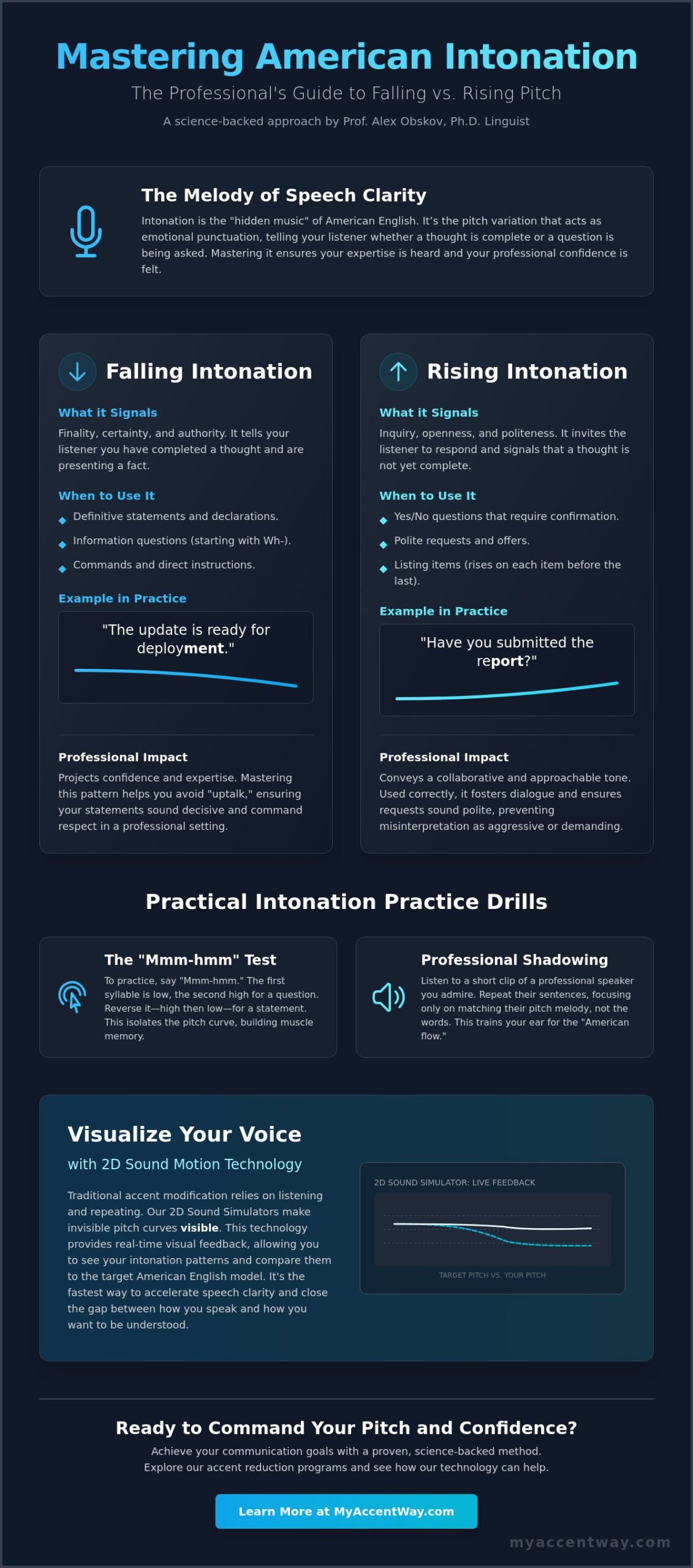
Falling intonation is the vocal signal that you’ve completed a thought. In American English, this pattern involves a noticeable drop in pitch on the last stressed syllable of a sentence. It tells your listener that you’ve finished speaking and that the information provided is a definitive fact. For international professionals, mastering this downward glide is an effective way to project confidence and certainty during meetings. Without a clear fall, your statements can sound like they’re hanging in the air, leaving your audience waiting for a conclusion that never comes.
A common hurdle I see in my coaching is “uptalk,” which is the habit of ending a statement with a rising pitch. While common in some casual settings, frequent uptalk in a corporate environment can undermine your authority. It makes a firm declaration sound like a hesitant question, as if you’re asking the listener for permission or validation. Engaging in consistent falling vs rising intonation practice helps you identify these subtle pitch shifts and replace them with the “American flow” that commands respect. When you drop your pitch at the end of a sentence, you signal that you’re an expert who is sure of their data.
Statements and Declarations in Technical Demos
In high-stakes environments like a software demo or a project post-mortem, your intonation must match your expertise. When you state a technical fact, your voice should move downward at the end of the thought group. Consider these examples:
- “The update is ready for deployment.” (Pitch drops on deployment)
- “We’ve successfully migrated the database.” (Pitch drops on database)
- “The security patch is live.” (Pitch drops on live)
If you rise at the end of these sentences, you might unintentionally suggest that you’re unsure if the update is actually ready. To help you visualize these movements, I recommend using our American accent training tools, which allow you to see your pitch curve in real-time.
Information Questions (Wh- Questions)
One of the most misunderstood rules of American intonation involves “Wh-” questions. Questions starting with who, what, where, when, why, or how typically end with a falling pitch. Unlike “Yes/No” questions, these are requests for specific information. A downward inflection makes these inquiries sound professional and direct. If you use a rising pitch for a question like “What is the timeline?”, it can sound overly emotional or even demanding. By using a fall, you maintain a calm, authoritative presence while seeking the data you need to move a project forward.
The Rising Intonation Pattern: Expressing Inquiry
While the falling pattern we discussed previously establishes authority, the rising intonation pattern is your primary tool for connection and inquiry. In American English, a rising pitch acts as a vocal bridge. It signals that a thought is incomplete, that you’re inviting a response, or that you’re checking for mutual understanding. For many international professionals, mastering this upward glide is the key to sounding approachable and collaborative rather than overly blunt. Dedicated falling vs rising intonation practice ensures you don’t accidentally sound like you’re giving an order when you meant to ask a polite question.
Rising intonation isn’t just about the end of a sentence. It’s about the psychological space you create for your listener. When your pitch rises, you’re physically opening the “vocal loop,” which encourages active listening and participation. This is a vital component of accent reduction because it helps align your vocal energy with the social expectations of a U.S. corporate environment. Without this rise, you might sound disinterested or even dismissive, even if your words are perfectly polite.
Yes/No Questions and Polite Requests
The most common use of rising intonation is in questions that can be answered with a simple “yes” or “no.” Unlike the “Wh-” questions we covered earlier, these require an upward shift at the end. For example, “Is the server back online?” should end with a clear rise. This pattern is also essential for comprehension checks. Asking “Does that make sense?” with a rising pitch invites your team to share their thoughts. If you use a falling pitch here, it can sound like a rhetorical question, as if you don’t actually care about their answer. Using the “politeness rise” is a research-based way to soften requests and foster better collaboration with your colleagues.
Lists and Introductory Phrases
Rising pitch is also used to signal that more information is coming. When you’re providing a list, your pitch should rise on every item until you reach the final one, which then falls. Consider this practice sentence: “We need the report (rise), the data (rise), and the summary (fall).” This keeps your audience engaged because they know you aren’t finished yet. Similarly, introductory phrases like “Actually,” “In my opinion,” or “To be honest,” should end with a slight rise. This alerts the listener that the main point of your sentence is about to follow. Mastering these subtle shifts through intentional falling vs rising intonation practice is what creates that natural, professional American flow.
Practical Falling vs. Rising Intonation Practice Drills
Understanding the rules of pitch is the first step, but integrating them into your daily speech requires intentional, repetitive action. You must train your ears to hear the melody and your vocal cords to produce it reliably. This is why falling vs rising intonation practice is more than just a phonetic exercise; it’s a method for building muscle memory. By following a structured approach, you can bridge the gap between knowing how a sentence should sound and actually saying it with professional confidence.
The first step in my method is the “Mmm-hmm” Test. This simple awareness drill helps you feel the physical sensation of pitch shifts without the distraction of complex words. Try saying “Mmm-hmm” as a definitive agreement. You’ll feel your voice glide downward. Now, say “Mmm-hmm?” as a question. You’ll feel the pitch lift at the end. Once you can feel this movement in isolation, you’re ready to apply it to the high-stakes professional scenarios you face every day.
The Contrastive Meaning Drill
In American English, pitch effectively replaces punctuation in spoken communication. A statement and a question might have the exact same words, yet they convey opposite meanings based on the curve of your voice. Consider the sentence: “He’s a doctor.” When you use a falling pitch, you’re stating a fact. If you use a rising pitch, you’re expressing surprise or asking for confirmation. Practicing these contrastive pairs helps you realize that pitch is a primary carrier of meaning. If your pitch doesn’t match your intent, your message will be misunderstood despite your correct grammar.
Shadowing for Professional Rhythm
To master the “American flow,” I recommend shadowing professional speakers. This involves listening to a recording of a keynote speech or a technical demo and mimicking the speaker’s pitch in real-time. You can find excellent resources in our American Accent Training for U.S. Professionals guide. Focus specifically on the “glide” between high and low notes. Don’t just repeat the words; mimic the energy and the pauses. This auditory-visual feedback loop is essential for long-term speech clarity.
Finally, record yourself during these drills. Listening to a playback of your own voice reveals the disconnect between what you think you’re saying and what others actually hear. While simple recording is helpful, our 2D Sound Motion Technology takes this a step further by training you to adjust your pitch toward the target. If you’re ready to see your voice in action and accelerate your progress, I invite you to explore our American accent training program today.
MyAccentWay · 2D Sound Motion Technology
American English Pronunciation: Consonant and Vowel Sounds with 2D Sound Motion Technology
Learning American English pronunciation and the American accent is more effective when you train your speech organs, not only listen and repeat. 2D Sound Motion Technology and Interactive Visual 2D Sound Simulators, developed in 2020 by Prof. Alex, Ph.D. Accent Coach, Doctor of Education, and professional linguist, as part of his interactive teaching model based on his Ph.D. research in interactive teaching methods, train your tongue, lips, jaw, teeth, airflow, and voice step by step. They train each American sound and more than 30 sound combinations through Interactive 2D video simulation.
What 2D Sound Motion Technology is
2D Sound Motion Technology is an advanced accent reduction and articulation training tool by Prof. Alex. It corrects, develops, and trains each American sound and more than 30 sound combinations through Interactive 2D video simulation.
What Interactive Visual 2D Sound Simulators do
Interactive Visual 2D Sound Simulators are part of 2D Sound Motion Technology, the articulation-training method Prof. Alex created by applying his Ph.D. research in interactive teaching to American pronunciation. Instead of listening and repeating, students actively train their speech organs. Each simulator uses Interactive 2D mouth movement to train the speech organs (tongue, lips, jaw, teeth, airflow, and voice) to produce each American sound correctly. Every consonant has its own simulator: explore American consonants trained with 2D Sound Motion Technology.
Sample training: the American t sound (aspirated [t])
Practice
Record yourself speaking these words:
Tab · Tacos · Time · Tub · Hotel · Motel · Sit · Pit · Net
Instructions
Play the Interactive Visual 2D Sound Simulator for the American t sound below several times and follow it step by step. Move your tongue, jaw, and airflow together with the simulator and train your articulation.
Interactive Visual 2D Sound Simulator: American unvoiced sound [t]
Practice
Record yourself again speaking these words, but this time focus on the movement of your tongue. Go slow, and you will hear the difference. You’ve got this!
Tab · Tacos · Time · Tub · Hotel · Motel · Sit · Pit · Net
How Interactive Visual 2D Sound Simulators solve pronunciation and speaking problems
- Wrong articulationMost pronunciation problems start with the tongue, lips, jaw, or teeth in the wrong position. Each Interactive Visual 2D Sound Simulator trains the correct articulation of one American sound, so the student corrects the cause of the problem, not only the result.
- Airflow and voicingMany accent problems come from wrong airflow or voicing: sounds that are too weak, too strong, or voiced when they should be unvoiced. The simulators train airflow and voice together with articulation, step by step, for each American sound and more than 30 sound combinations.
- Clear speech and confidenceWhen each sound is trained correctly, words connect into clear American English speech. Listeners can understand you more easily, and speaking at work, in meetings, and on calls becomes more confident.

If you start hearing the aspiration, the short airstream after [t], with one simulator, you can only imagine how successful you can be in 1-on-1 Interactive American Accent Training with Prof. Alex, Ph.D. Accent Coach, where your whole American sound system is trained sound by sound.
In MyAccentWay, the Interactive Visual 2D Sound Simulators are only available in 1-on-1 accent coaching sessions with Prof. Alex.
Training Your Voice with 2D Sound Motion Technology
One of the most significant challenges for adult learners is that the human brain becomes “hard-wired” to the sounds and rhythms of a native language. This often means you might not even hear the subtle pitch shifts that define American English. While traditional falling vs rising intonation practice relies solely on your ears, our approach adds a powerful speech-organ training dimension. By using Interactive Visual 2D Sound Simulators for American Sounds, you can actually follow the melody of your speech through a simulation, which transforms an abstract concept into a concrete, manageable skill.
Visual feedback is a breakthrough in the field of accent modification. It provides an objective standard that removes the guesswork from your training sessions. Instead of wondering if your pitch dropped enough at the end of a statement, you can look at a real-time graph of your vocal frequency. This visual-auditory memory loop accelerates the learning process by allowing you to make instant adjustments. When you see your voice mapping against a native standard, your brain begins to recognize the “American flow” much faster than through listening alone.
Beyond Hearing: Seeing the Pitch Glide
Our proprietary 2D Sound Motion Technology, delivered through the Interactive Visual 2D Sound Simulators, is specifically designed to train the movements of your tongue, lips, jaw, teeth, and airflow. As part of Prof. Alex’s interactive teaching model, based on his Ph.D. research in interactive teaching methods, the simulators let you actively train these movements while Prof. Alex corrects you live. For an international professional, this means you can train the exact moment your voice should rise for a question or fall for a definitive statement. By training the pitch glide, you build a stronger mental map of how to navigate complex thought groups. This technology doesn’t just help you produce a sound; it helps you understand the physical mechanics of intonation. It’s a precise, detail-oriented way to achieve the speech clarity required for high-stakes corporate environments.
Personalized Coaching with Prof. Alex, Ph.D. Accent Coach
While technology is a vital tool, it’s effective when guided by expert linguistic insight. As Prof. Alex, Ph.D. Accent Coach, I provide the personalized coaching necessary to translate these visual patterns into career-defining confidence. Generic apps often fail to address the specific nuances of your professional goals. In my program, we customize your falling vs rising intonation practice to mirror the real-world scenarios you face, from board meetings to technical presentations. This combination of advanced science and individualized mentorship ensures you develop a voice that is both authoritative and authentic.
If you’re ready to stop guessing and start seeing your progress, I invite you to explore our American Accent Training Near Me program. We’ll work together to build a customized plan that focuses on your long-term success and communication goals. By mastering the melody of your voice, you ensure that your expertise is always heard with the clarity and respect it deserves.
Elevating Your Professional Voice with Pitch Mastery
Your voice is a powerful tool for professional success. By mastering the distinction between a definitive fall and an inquisitive rise, you ensure your message is received with the exact intent you planned. We’ve explored how pitch acts as the hidden punctuation of American English, helping you command the room or foster collaboration with ease. Consistent falling vs rising intonation practice is the most reliable path to achieving the speech clarity that defines modern leadership.
Under the guidance of Prof. Alex, Ph.D. Accent Coach, you can transform your communication using our proprietary 2D Sound Motion Technology. This results-oriented method is specifically designed for U.S. professionals who want to project confidence and authority without losing their unique cultural identity. You have the expertise; now let’s make sure your voice reflects it. It’s time to move beyond simple grammar and embrace the “American flow” that earns trust and builds connections.
Master your professional American accent with our science-backed training today!
Your journey toward more natural and professional communication starts with a single pitch shift. I’m here to support you every step of the way as you achieve your communication goals and unlock new career opportunities.
American Intonation and Rhythm Training for Foreign-Born Professionals in the United States
Foreign-born professionals in the United States often know their field and speak advanced English. Yet American listeners may still struggle with their stress, rhythm, and intonation. MyAccentWay offers private online intonation training through Interactive American Accent Training.
Interactive American Accent Training is led by Prof. Alex, Ph.D. Accent Coach, Doctor of Education, and professional linguist. He first diagnoses each speaker’s native-language patterns. Then he trains American word stress, sentence stress, rhythm, and intonation for real meetings and presentations.
Who this training is for
- Engineers, IT specialists, and data professionals presenting to U.S. teams and clients
- Doctors, nurses, and healthcare professionals explaining care to American patients
- Managers, executives, and founders leading meetings, pitches, and briefings
- Consultants, researchers, and academics speaking at conferences and webinars
- Professionals preparing for interviews, promotions, or client-facing roles
Online training across the U.S.
MyAccentWay is based in Austin, Texas, and all training is online. The program is especially relevant for professionals in Austin, Dallas, Houston, New York City, the San Francisco Bay Area, Los Angeles, Seattle, Boston, Chicago, Miami, Washington DC, Atlanta, and Raleigh.
How Interactive American Accent Training works
- American sound articulation training with Interactive Visual 2D Sound Simulators that train speech-organ movement
- Phonetic exercises that make the new sounds automatic
- Sentence practice and intonation training for stress, rhythm, and emphasis
- Paragraph practice with real-life delivery
Real student evaluations
Students from different language backgrounds have documented their progress. Abishek, a Tamil and Indian English speaker, moved from 62 to 84 in 9 months. Tian, a Mandarin speaker, moved from 58 to 85 in 8 months. Vlad, a Russian speaker, moved from 60 to 83 in 5 months.
The first step is a 1 Hour Evaluation Session with Prof. Alex.
Frequently Asked Questions
What is the difference between falling and rising intonation?
The primary difference lies in the direction of the pitch glide at the end of a thought group. Falling intonation moves from a higher to a lower note to signal that a statement is complete or a fact is being stated. Rising intonation moves upward to show that you’re asking a yes/no question or that a list is unfinished. Mastering this distinction is the core of effective falling vs rising intonation practice for professional clarity.
Why do I sound like I am asking a question when I am making a statement?
You likely sound like you’re asking a question because of a habit known as “uptalk,” where your pitch rises at the end of a declaration. This often happens when a speaker is seeking validation or is influenced by the melody of their native language. In a corporate setting, this can make you sound uncertain or hesitant. Replacing this rise with a firm downward glide helps you project the authority expected of a leader.
Does American English always use falling intonation for questions?
No, American English uses both patterns depending on the type of question being asked. Information questions that begin with words like “who,” “where,” or “why” typically end with a falling pitch. Only yes/no questions and polite requests generally require a rising pitch. Understanding these specific rules is a vital part of falling vs rising intonation practice and ensures you don’t sound overly emotional or demanding during information-seeking inquiries.
How can I practice intonation at home without a coach?
You can practice effectively at home by using the shadowing technique and recording your own voice for self-assessment. Listen to professional American speakers and try to match their pitch curves exactly. For more precise results, I recommend using our Interactive Visual 2D Sound Simulators for American Sounds. This technology allows you to actively train the movement of your tongue, lips, jaw, teeth, and airflow with the simulators while Prof. Alex corrects you live as part of his interactive teaching model, based on his Ph.D. research in interactive teaching methods.
Is intonation more important than perfect pronunciation?
Intonation is often more critical than individual sound production because it carries the emotional intent and “punctuation” of your message. While clear pronunciation of American sounds is important, incorrect intonation can lead to significant misunderstandings of your attitude or level of certainty. Even if every consonant is perfect, a flat or misplaced pitch can make you sound bored or aggressive. Balancing both is the goal of a comprehensive accent reduction program.
What is “uptalk” and why should professionals avoid it?
Uptalk is the linguistic habit of ending statements with a rising intonation, as if you’re asking a question. Professionals should avoid it because it can unintentionally signal a lack of confidence or expertise. Listeners may perceive you as hesitant or as if you’re constantly seeking approval from the audience. By learning to use a definitive falling pitch, you communicate to your colleagues and clients that you’re certain of your facts and ready to lead.
The problem is not always grammar or vocabulary.
If people understand your words but still miss your message, the deeper issue may be speech clarity, rhythm, intonation, and American pronunciation habits. MyAccentWay helps students retrain the sound system with professional 1-on-1 guidance, so English can feel clearer, freer, and more natural in real communication.
Two training methods that make speech change active.
MyAccentWay is not passive listen-and-repeat coaching. Prof. Alex, Ph.D. Accent Coach, Doctor of Education, and professional linguist, creates a learning situation where students become active learners and active participants in changing their own speech patterns.
Interactive training
Students do not just receive pronunciation instructions passively. They listen, think, compare, adjust, and understand their own speech patterns while Prof. Alex guides the correction process.
Cognitive accent training
Students learn to notice and correct the speech patterns that affect American pronunciation, then implement new American speech patterns into their code-switching process for more natural, long-lasting change.
Build speech habits people can hear in real conversations.
A stronger American accent is not built by memorizing topics or chasing quick pronunciation tips. It comes from structured training, professional feedback, active correction, and repeated application until clearer speech becomes easier to keep.
Continue learning how MyAccentWay connects American sound articulation, Interactive Visual 2D Sound Simulators, accent reduction, student proof, and 1-on-1 training.
- Prof. Alex and the MyAccentWay MethodLearn how Prof. Alex, Ph.D. Accent Coach, Doctor of Education, and professional linguist, created and leads the structured MyAccentWay American accent training system.
- Accent Reduction Curriculum and English Articulation TrainingSee how MyAccentWay trains accent reduction, accent modification, American pronunciation, English articulation, rhythm, and professional speech clarity.
- 2D Sound Motion Technology for American Accent TrainingUnderstand Prof. Alex’s Interactive Visual 2D Sound Simulators for American sound articulation.
- Before-and-After American Accent Training ResultsListen to real before-and-after student proof and accent training outcomes.
- Student Reviews and Accent Training ResultsRead student reviews, testimonials, and trust signals from MyAccentWay learners.
- Book a 1-Hour 1 Hour Evaluation SessionStart with a 1-hour accent evaluation session with Prof. Alex.
Disclaimer – American Accent Program
The American Accent Program available through Visit Program Website
is an educational and coaching service designed to support pronunciation, accent reduction, and spoken English fluency. All training materials, including lessons, exercises, audio content, visual simulations, coaching methods, and digital resources, are the intellectual property of American Accent Program, LLC and are protected by applicable copyright and intellectual property laws.
By using this website and participating in the program, you acknowledge that all content is provided for personal, non-commercial, educational use only. Users are granted a limited, non-transferable license to access the materials strictly for individual learning purposes. Redistribution, reproduction, recording, modification, sharing, or commercial use of any program content without prior written consent is strictly prohibited.
The program may include live coaching sessions, digital tools, and instructional materials intended to improve pronunciation and communication skills. However, individual results may vary, and no specific level of fluency, accent reduction, or communication outcome is guaranteed.
The American Accent Program and its instructors do not provide medical, therapeutic, or clinical speech-language pathology services. All training is intended for educational purposes only.
By accessing or using the program, you agree to comply with all applicable terms, including the platform’s Terms of Use and Course Policies, and acknowledge that misuse of materials may result in termination of access without refund.