American Business Communication Style Guide for Non-Native Professionals
(512) 265-9515Updated October 14, 2026 ◆ 15 min read
The most direct path to clearer, more authoritative business speech in the U.S. is targeted 1-on-1 American pronunciation and prosody training — not grammar review, not passive listening, and not generic ESL conversation practice. Start here:
Real student result

“I feel confident enough to speak American English!”
Interactive American Accent Training9monthsof hard work and dedication
Listen to the starting point0:00
Listen to the result0:00
“Many of my students once believed they could never sound like this. School taught them grammar and vocabulary, but not how to train their English speech. That is what we do together, step by step, until you speak English independently and with confidence.”
Abishek’s result was achieved through Prof. Alex’s research-based Interactive 1-on-1 American Accent Training. His doctoral research found this interactive method more effective than traditional, teacher-centered methods. See the research basis →
- Quick intelligibility check: Record yourself giving a 60-second status update. Play it back and note where you slow down, where stress falls on the wrong syllable, and where vowels blur together. Those three patterns are your first training targets.
- 2-minute pre-meeting warm-up: Read three sentences aloud from your agenda, marking each stressed word with a tap on your desk. Then say each sentence again at natural speed. This activates stress awareness before you walk into the room.
- Book Your 1 Hour Evaluation Session: A structured, evidence-backed 1-on-1 session with a Ph.D.-level accent coach gives you a personalized baseline and a concrete plan within the first hour.
Professionals who commit to this kind of targeted training typically notice faster listener processing, fewer requests to repeat themselves, and stronger confidence within the first few weeks.
What this guide actually covers (and what it doesn’t)
This is a pronunciation and speech-pattern training guide. “American business communication style guide” here means the phonological and prosodic skills that make your spoken English clearer and more professional in U.S. contexts: American sound targets, rhythm, word stress, sentence stress, intonation, linked speech, and articulation mechanics.
This guide does not cover written style, email grammar, or corporate etiquette norms. Those are separate disciplines with separate training paths.
The core speaking contexts addressed throughout are:
- Meetings: turn-taking, status updates, and real-time clarity under pressure
- Presentations: pacing, stress marking, and attention control
- Interviews: answer structure, closing lines, and competence signals
- Client calls: phone-friendly articulation and recovery strategies
Core American pronunciation and prosody skills to train
The goal of pronunciation training in professional contexts is comfortable intelligibility, not accent elimination. That reframe matters: you are not trying to sound like someone else. You are training your speech system to produce sounds and rhythms that U.S. listeners process easily.
Segmental targets (individual sounds):
- Vowel contrasts that cause the most confusion: /ɪ/ vs. /iː/ (bit vs. beat), /æ/ vs. /ɛ/ (bad vs. bed), and the American /ɑ/ in words like not, job, and call
- High-impact consonants: the American flap /ɾ/ (the t in better, meeting), the /θ/ and /ð/ sounds (think, the), and final consonant clarity, which U.S. listeners rely on heavily for word recognition
Suprasegmentals (rhythm, stress, intonation):
- Word stress: English is a stress-timed language. Misplaced stress on a single syllable can make a familiar word unrecognizable.
- Sentence stress: content words (nouns, main verbs, adjectives) carry stress; function words (articles, prepositions) reduce. This pattern creates the characteristic rhythm of American speech.
- Intonation: falling intonation signals certainty and authority on statements and commands; rising intonation signals a question or that you are not finished. In business speech, consistent falling intonation on closing statements projects confidence.
Connected speech:
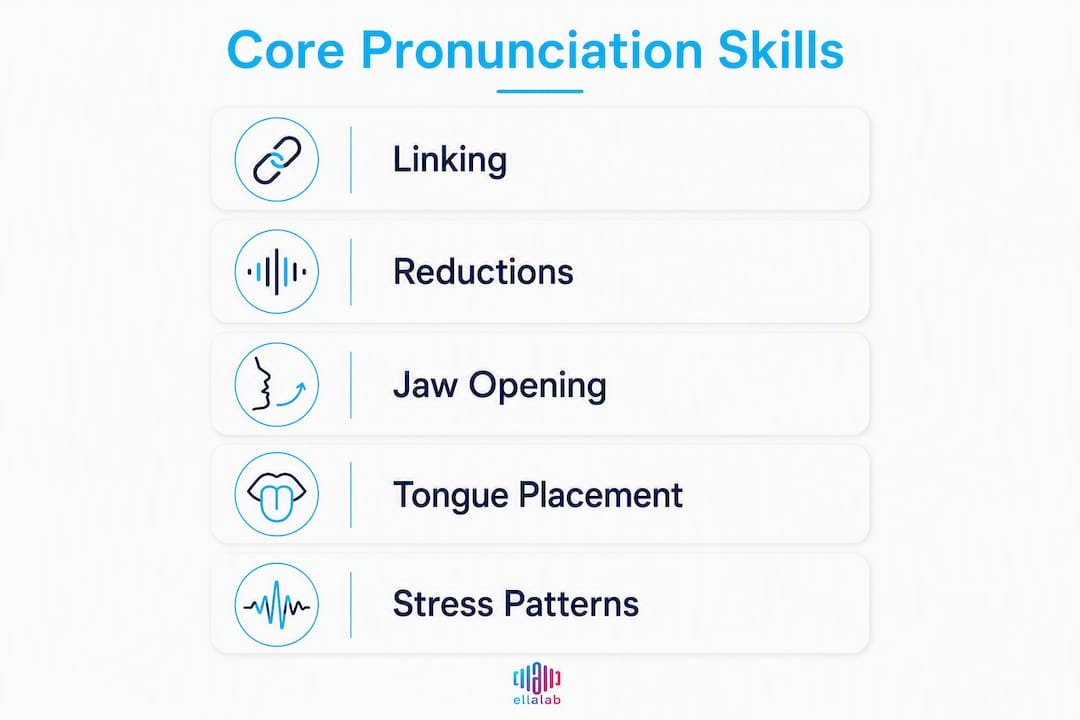
Linking (carrying a final consonant onto the next vowel: pick it up → pi-ki-tup) and reductions (going to → gonna) are natural in casual American speech. In professional contexts, use linking freely but apply reductions selectively. Full forms in presentations and interviews signal care and precision.

Articulation mechanics:
Jaw opening, tongue placement, lip rounding, and breath support are physical skills. Wider jaw opening improves vowel clarity. Tongue-tip contact on the alveolar ridge sharpens /t/, /d/, /n/, and /l/. Steady breath flow prevents trailing-off at the end of sentences, a pattern that undermines authority.
Pro Tip: Train stress patterns and vowel clarity before anything else. Research confirms that rhythm and stress are the features that most affect how easily U.S. listeners process non-native speech.
Practical drills for meetings, presentations, interviews, and client calls
Meetings: Practice turn-taking with pivot sentences: “That’s a good point. What I’d add is…” or “Before we move on, I want to clarify…” Record yourself saying these at natural speed. Stress the content word in each phrase and notice how the sentence lands differently.
Presentations: Mark your transcript before every high-stakes delivery. Use a slash (/) for a short pause, a double slash (//) for a full stop, and underline stressed words. Then record yourself reading the marked version. This converts your content into a controlled delivery tool and builds perceived authority.
Interviews: Structure answers with a clear stress arc: state the main point first, stress the key noun or verb, then support. Practice closing lines like “I’m confident this approach would work well here” with a deliberate falling intonation on “here.” That final fall signals conviction.
Client calls: Phone articulation requires more jaw opening and slower pacing than face-to-face speech, because the listener has no visual cues. Practice signal phrases: “Let me make sure I understand…” and “I’ll repeat that for clarity…” These buy time and model professional communication standards.
Practice schedule: 20 minutes of daily micro-practice (minimal pairs, stress marking, recording review) plus a full run-through 48 hours before any live event produces the most consistent gains.
How to assess your baseline and set realistic goals
Five-step self-assessment:
- Record a 2-minute professional monologue (introduce yourself and describe a recent project).
- Play it back and count how many times you pause mid-word or misplace stress.
- Send the recording to a trusted colleague and ask one question: “Were there any moments where you had to work to understand me?”
- Transcribe 30 seconds of your own speech and mark every stressed syllable. Compare to how a native speaker would stress the same sentences.
- Note your three most frequent error patterns. Those become your first measurable goals.
Research on accent interventions consistently shows that pre/post audio comparisons and external listener ratings are the most reliable ways to validate improvement. Build both into your plan from day one.
Sample measurable goals: “Reduce vowel confusions in /ɪ/ vs. /iː/ pairs during meetings” or “Use falling intonation consistently on closing statements in presentations.”
Typical milestones for premium 1-on-1 coaching:
| Milestone | Focus | Session frequency |
|---|---|---|
| Weeks 1–4 | Baseline diagnostic, priority sound targets, stress patterns | 2x per week |
| Weeks 5–8 | Intonation, connected speech, context application | 1–2x per week |
| — | Transfer to live events, consolidation, and recorded review | 1x per week |
Premium 1-on-1 accent coaching in the U.S. is typically priced per session or in multi-session packages. Higher-end programs often led by Ph.D.-level linguists or certified speech-language pathologists generally reflect the depth of diagnostic work, individualized curriculum, and ongoing feedback included.
What an effective American-accent program does
A systematic review of accent interventions found that programs led by trained language experts — including linguists and speech-language pathologists — produced measurable improvements in stress, intonation, vowel and consonant clarity, and professional confidence. The common thread across effective programs was expert-led, individualized practice with feedback, not passive exposure.
A quality program includes:
- Initial diagnostic: identifies your specific phonological patterns before any drilling begins
- Targeted phoneme drills: minimal pairs, articulation cues, and physical speech-organ instruction
- Suprasegmental practice: rhythm, stress, and intonation work integrated into real sentences
- Rehearsal for live events: practice tied to your actual meetings, presentations, and calls
- Recorded homework and coached feedback: the combination that produces measurable, lasting change
Research on interactive teaching confirms that active, coached participation produces stronger learning outcomes than passive listening. This is why Myaccentway American Accent Program’s approach is built on the Interactive 1-on-1 Accent Training Method and Cognitive Accent Training, where Prof. Alex leads you to actively retrain speech patterns rather than simply explaining how sounds work.
The program’s 2D Sound Motion Technology adds a layer that traditional coaching cannot replicate: Interactive Visual 2D Sound Simulators train the positioning and movement of every speech organ involved in producing a target American sound. When articulation problems are stubborn, simulator practice accelerates the retraining process significantly. In MyAccentWay training, these simulators are used to train sound articulation, sound formation, and speech production during live 1-on-1 accent training sessions.
Research also shows that non-native accents can affect managers’ judgments of fluency and performance ability, with downstream effects on career advancement. Targeted pronunciation training directly addresses that dynamic.
MyAccentWay · 2D Sound Motion Technology
American English Pronunciation: Consonant and Vowel Sounds with 2D Sound Motion Technology
Learning American English pronunciation and the American accent is more effective when you train your speech organs, not only listen and repeat. 2D Sound Motion Technology and Interactive Visual 2D Sound Simulators, developed in 2020 by Prof. Alex, Ph.D. Accent Coach, Doctor of Education, and professional linguist, as part of his interactive teaching model based on his Ph.D. research in interactive teaching methods, train your tongue, lips, jaw, teeth, airflow, and voice step by step. They train each American sound and more than 30 sound combinations through Interactive 2D video simulation.
What 2D Sound Motion Technology is
2D Sound Motion Technology is an advanced accent reduction and articulation training tool by Prof. Alex. It corrects, develops, and trains each American sound and more than 30 sound combinations through Interactive 2D video simulation.
What Interactive Visual 2D Sound Simulators do
Interactive Visual 2D Sound Simulators are part of 2D Sound Motion Technology, the articulation-training method Prof. Alex created by applying his Ph.D. research in interactive teaching to American pronunciation. Instead of listening and repeating, students actively train their speech organs. Each simulator uses Interactive 2D mouth movement to train the speech organs (tongue, lips, jaw, teeth, airflow, and voice) to produce each American sound correctly. Every consonant has its own simulator: explore American consonants trained with 2D Sound Motion Technology.
Sample training: the American t sound (aspirated [t])
Practice
Record yourself speaking these words:
Tab · Tacos · Time · Tub · Hotel · Motel · Sit · Pit · Net
Instructions
Play the Interactive Visual 2D Sound Simulator for the American t sound below several times and follow it step by step. Move your tongue, jaw, and airflow together with the simulator and train your articulation.
Interactive Visual 2D Sound Simulator: American unvoiced sound [t]
Practice
Record yourself again speaking these words, but this time focus on the movement of your tongue. Go slow, and you will hear the difference. You’ve got this!
Tab · Tacos · Time · Tub · Hotel · Motel · Sit · Pit · Net
How Interactive Visual 2D Sound Simulators solve pronunciation and speaking problems
- Wrong articulationMost pronunciation problems start with the tongue, lips, jaw, or teeth in the wrong position. Each Interactive Visual 2D Sound Simulator trains the correct articulation of one American sound, so the student corrects the cause of the problem, not only the result.
- Airflow and voicingMany accent problems come from wrong airflow or voicing: sounds that are too weak, too strong, or voiced when they should be unvoiced. The simulators train airflow and voice together with articulation, step by step, for each American sound and more than 30 sound combinations.
- Clear speech and confidenceWhen each sound is trained correctly, words connect into clear American English speech. Listeners can understand you more easily, and speaking at work, in meetings, and on calls becomes more confident.
If you start hearing the aspiration, the short airstream after [t], with one simulator, you can only imagine how successful you can be in 1-on-1 Interactive American Accent Training with Prof. Alex, Ph.D. Accent Coach, where your whole American sound system is trained sound by sound.
In MyAccentWay, the Interactive Visual 2D Sound Simulators are only available in 1-on-1 accent coaching sessions with Prof. Alex.
A sample 8-week training plan
| Week | Focus | Daily practice (20 min) |
|---|---|---|
| 1 | Baseline diagnostic, priority sound identification | Record monologue, mark stress errors |
| 2 | High-impact vowels (/ɪ/, /iː/, /æ/, /ɑ/) | Minimal pairs + Interactive Visual 2D Sound Simulator |
| 3 | Priority consonants (/θ/, /ð/, flap /ɾ/, final consonants) | Articulation drills + recording review |
| 4 | Word stress and sentence stress patterns | Stress-marking exercises, shadowing |
| 5 | Intonation (falling/rising patterns in business speech) | Marked transcript reading, intonation practice |
| — | Connected speech: linking and selective reductions | Sentence-level drills, recorded self-review |
| — | Transfer: meetings, presentations, interview answers | Role-play recordings, listener feedback |
| 8 | Consolidation and pre/post comparison | Full monologue re-recording, progress review |
Progress metrics: Compare your Week 1 and Week 8 recordings. Count stress errors per minute, note vowel confusion frequency, and collect one round of external listener ratings. These three data points give you a concrete intelligibility score.
Tools and technology that speed up your training
The right tools reduce the gap between coached sessions and daily practice.
- Interactive Visual 2D Sound Simulators: unique to Myaccentway American Accent Program; train the speech organs for each American sound, making articulation retraining faster and more precise
Integration tip: Use your recorder app immediately after each coached session to practice the day’s target sounds while the feedback is fresh. Review the recording the next morning before your daily drill. That 24-hour feedback loop accelerates retention.
Motor learning research supports why visualization works: seeing the physical movement of the tongue, jaw, and lips creates a mental model that guides muscle memory during production. The Interactive Visual 2D Sound Simulators make that model explicit and repeatable.
How to choose an American-accent coach or program
The U.S. market for accent coaching has grown steadily, with demand increasing across business, healthcare, and technology sectors. That growth means more options, and more variation in quality.
When evaluating a coach or program, look for:
- Credentials: a Ph.D. in linguistics, phonetics, or a related field, or certification as a speech-language pathologist (CCC-SLP from ASHA)
- Diagnostic-first approach: any reputable program begins with an assessment of your specific patterns, not a generic curriculum
- Suprasegmental coverage: rhythm, stress, and intonation must be explicitly taught, not assumed
- Feedback mechanisms: recorded homework review and pre/post comparisons are markers of a structured, evidence-based method
- Availability for U.S. professionals: confirm the coach works with professionals in your time zone and understands U.S. workplace speech contexts
Avoid programs that promise accent elimination or that rely entirely on passive listening and imitation. Effective interventions are structured, expert-led, and individualized.
Cultural nuances in American business speech beyond pronunciation
Pronunciation is the foundation, but a few pragmatic patterns also affect how you are perceived in U.S. professional settings.
American business communication tends toward directness: state your point first, then support it. Burying the main idea at the end of a long explanation reads as hesitant in most U.S. corporate contexts. Politeness is expressed through tone and word choice (“Would you be able to…” rather than “You must…”), not through indirectness.
Formality levels shift by context. A client pitch calls for full sentences, careful stress, and deliberate pacing. A team stand-up allows contractions, faster speech, and casual connectors. Matching your register to the room is a communication skill that develops alongside pronunciation. For deeper guidance on these pragmatic signals, the American English social communication materials at Myaccentway American Accent Program address tone and formality directly.
One underestimated pitfall: over-apologizing or over-hedging. Phrases like “I’m not sure, but maybe…” before every statement undermine credibility, regardless of how clear your pronunciation is. Train yourself to open statements with the claim, then qualify if needed.
Integrating pronunciation with email and phone etiquette
Pronunciation training and written communication reinforce each other more than most professionals realize. The stress and chunking patterns you practice in speech translate directly into how you structure sentences in email: lead with the main point, keep sentences short, and place emphasis on the key noun or verb.
On phone calls, the skills are almost identical to your presentation drills: slower pacing, wider jaw opening, and deliberate stress on key words. Add one phone-specific habit: confirm understanding explicitly. “Just to confirm, you’re saying the deadline is Friday?” This phrase models professional communication standards and removes ambiguity without sounding defensive.
For written correspondence, apply the same directness principle: subject line states the action needed, first sentence states the purpose, and the closing line states the next step. The rhythm of clear American business writing mirrors the rhythm of clear American speech.
What most pronunciation guides get wrong
Most pronunciation guides treat speech improvement as a knowledge problem. Learn the rules, memorize the sounds, and clarity will follow. That assumption is wrong, and it is why so many professionals spend months studying phonetics charts without hearing a real difference in their own speech.
Speech change is a motor learning problem. The tongue, jaw, and lips are muscles. They have habits. Knowing that the American /ɑ/ requires a lower jaw and a retracted tongue does not automatically retrain the muscle memory that has been producing a different vowel for 20 or 30 years. What retrains it is guided physical practice, immediate feedback, and enough repetition for the new pattern to become automatic.
This is also why passive listening, apps, and self-study materials have a ceiling. They can build awareness. They cannot build the feedback loop that catches a misarticulation in real time and corrects it before it reinforces the old habit. That feedback loop requires a trained human ear and a structured method. The professionals who make the fastest progress are not the ones who study the most. They are the ones who practice with the most precision, under the guidance of someone who can hear what they cannot hear themselves.
Ready to train with a Ph.D. accent coach?
Myaccentway American Accent Program offers premium 1-on-1 American accent training for non-native professionals working in the U.S. Every session is led by Prof. Alex, Ph.D., and built around your specific phonological patterns, not a generic curriculum. The program covers vowels, consonants, rhythm, intonation, connected speech, and real-context application for meetings, presentations, interviews, and client calls.
What makes the program distinct is the combination of Cognitive Accent Training and 2D Sound Motion Technology, which uses Interactive Visual 2D Sound Simulators to train you in exactly how each American sound is physically produced. No other program in the U.S. offers this tool.
The best starting point is a sample 1-on-1 class, where you receive a personalized speech assessment and a clear picture of your training priorities. Sessions are available online for professionals across the U.S.
Business English Pronunciation Coaching for Foreign-Born Professionals in the United States
Foreign-born professionals in the United States often know their field and speak advanced English. Yet American listeners may still struggle with their sounds, stress, and rhythm. MyAccentWay offers private online business pronunciation coaching through Interactive American Accent Training.
Interactive American Accent Training is led by Prof. Alex, Ph.D. Accent Coach, Doctor of Education, and professional linguist. He first diagnoses each speaker’s native-language patterns. Then he trains American sound articulation, stress, rhythm, and intonation for real meetings and client conversations.
Who this training is for
- Managers, executives, and founders leading meetings, pitches, and briefings
- Engineers, IT specialists, and data professionals presenting to U.S. teams and clients
- Doctors, nurses, and healthcare professionals explaining care to American patients
- Consultants, researchers, and academics speaking at conferences and webinars
- Professionals preparing for interviews, promotions, or client-facing roles
Online training across the U.S.
MyAccentWay is based in Austin, Texas, and all training is online. The program is especially relevant for professionals in Austin, Dallas, Houston, New York City, the San Francisco Bay Area, Los Angeles, Seattle, Boston, Chicago, Miami, Washington DC, Atlanta, and Raleigh.
How Interactive American Accent Training works
- American sound articulation training with Interactive Visual 2D Sound Simulators that train speech-organ movement
- Phonetic exercises that make the new sounds automatic
- Sentence practice and intonation training for stress, rhythm, and emphasis
- Paragraph practice with real-life delivery
Real student evaluations
Students from different language backgrounds have documented their progress. Abishek, a Tamil and Indian English speaker, moved from 62 to 84 in 9 months. Tian, a Mandarin speaker, moved from 58 to 85 in 8 months. Vlad, a Russian speaker, moved from 60 to 83 in 5 months.
The first step is a 1 Hour Evaluation Session with Prof. Alex.
FAQ
What does an American business communication style guide cover for non-native speakers?
For non-native professionals, it covers the pronunciation and prosody skills that make spoken English clearer in U.S. workplaces: American sound targets, word and sentence stress, intonation patterns, connected speech, and articulation mechanics for meetings, presentations, interviews, and client calls.
How long does it take to see measurable improvement in speech clarity?
Many professionals working with a structured 1-on-1 program notice measurable gains in intelligibility and confidence within weeks, particularly when sessions are combined with regular practice and recorded self-review.
What is 2D Sound Motion Technology and how does it help?
2D Sound Motion Technology, developed by Prof. Alex at Myaccentway American Accent Program, uses Interactive Visual 2D Sound Simulators to train the speech organs in the exact positions and movements required for each American sound, making articulation retraining faster and more precise than description alone.
How do I choose a qualified American-accent coach?
Look for a Ph.D. in linguistics or ASHA-certified speech-language pathologist, a diagnostic-first approach, explicit suprasegmental training, and recorded feedback mechanisms. Avoid programs that rely solely on passive imitation.
Does pronunciation training also improve written business communication?
The stress and chunking patterns trained in pronunciation work directly reinforce written clarity: leading with the main point, keeping sentences concise, and placing emphasis on key words. The structural logic of clear American speech and clear American business writing is the same.
Recommended
American English Social Communication Explained for Professionals
Discover the nuances of american english social communication explained. Enhance your professional interactions with essential verbal and nonverbal skills.

American English Negotiation Language Explained for Professionals
Master the American English negotiation language explained in this article. Gain confidence, build trust, and close deals effectively.
Clear American Pronunciation: A Guide for Non-Native Professionals
Discover what is clear American pronunciation and how it enhances your communication in the workplace. Improve your clarity and confidence today!
The problem is not always grammar or vocabulary.
If people understand your words but still miss your message, the deeper issue may be speech clarity, rhythm, intonation, and American pronunciation habits. MyAccentWay helps students retrain the sound system with professional 1-on-1 guidance, so English can feel clearer, freer, and more natural in real communication.
Two training methods that make speech change active.
MyAccentWay is not passive listen-and-repeat coaching. Prof. Alex, Ph.D. Accent Coach, Doctor of Education, and professional linguist, creates a learning situation where students become active learners and active participants in changing their own speech patterns.
Interactive training
Students do not just receive pronunciation instructions passively. They listen, think, compare, adjust, and understand their own speech patterns while Prof. Alex guides the correction process.
Cognitive accent training
Students learn to notice and correct the speech patterns that affect American pronunciation, then implement new American speech patterns into their code-switching process for more natural, long-lasting change.
Build speech habits people can hear in real conversations.
A stronger American accent is not built by memorizing topics or chasing quick pronunciation tips. It comes from structured training, professional feedback, active correction, and repeated application until clearer speech becomes easier to keep.
Continue learning how MyAccentWay connects American sound articulation, Interactive Visual 2D Sound Simulators, accent reduction, student proof, and 1-on-1 training.
- Prof. Alex and the MyAccentWay MethodLearn how Prof. Alex, Ph.D. Accent Coach, Doctor of Education, and professional linguist, created and leads the structured MyAccentWay American accent training system.
- Accent Reduction Curriculum and English Articulation TrainingSee how MyAccentWay trains accent reduction, accent modification, American pronunciation, English articulation, rhythm, and professional speech clarity.
- 2D Sound Motion Technology for American Accent TrainingUnderstand Prof. Alex’s Interactive Visual 2D Sound Simulators for American sound articulation.
- Before-and-After American Accent Training ResultsListen to real before-and-after student proof and accent training outcomes.
- Student Reviews and Accent Training ResultsRead student reviews, testimonials, and trust signals from MyAccentWay learners.
- Book a 1-Hour 1 Hour Evaluation SessionStart with a 1-hour accent evaluation session with Prof. Alex.