Clear American Pronunciation: A Guide for Non-Native Professionals
(512) 265-9515Updated October 14, 2026 ◆ 10 min read
Clear American pronunciation is defined as the ability to speak American English so that your message is easily understood, with correct word stress, clean consonant endings, and natural rhythm. This is the standard term in linguistics: speech intelligibility. For non-native professionals, mastering this skill directly affects how colleagues, clients, and managers perceive your competence. Pronunciation clarity shapes perceptions of preparedness and confidence far more than accent perfection does. Myaccentway, led by Professor Alex, Ph.D., Linguist and Accent Coach, builds this skill through personalized, science-backed training.
Real student result

“It feels amazing when people say, ‘Your accent is so good. Where did you learn it?’ My answer is always, ‘Thanks to my great teacher, Alex.’”
Interactive American Accent Training5monthsof hard work and dedication
Listen to the starting point0:00
Listen to the result0:00
“Many of my students once believed they could never sound like this. School taught them grammar and vocabulary, but not how to train their English speech. That is what we do together, step by step, until you speak English independently and with confidence.”
Vlad’s result was achieved through Prof. Alex’s research-based Interactive 1-on-1 American Accent Training. His doctoral research found this interactive method more effective than traditional, teacher-centered methods. See the research basis →
What is clear American pronunciation?
Clear American pronunciation centers on three core elements: word stress, consonant articulation, and sentence rhythm. Get these right, and your speech becomes easy to follow. Miss them, and even grammatically correct sentences create confusion.
The phonetics of American English include several features that set it apart from other varieties:
- Word stress: Stress the wrong syllable and the meaning changes. “REcord” (noun) versus “reCORD” (verb) are two different words to an American ear.
- Consonant endings: Dropping final consonants is one of the most common errors. “Tes” instead of “test” or “fac” instead of “fact” forces listeners to guess.
- Vowel length: American English uses distinct long and short vowel sounds. Confusing the vowel in “ship” with the one in “sheep” changes the word entirely.
- Schwa and reduction: English is stress-timed, meaning unstressed syllables reduce to a schwa sound (the “uh” in “about”). Avoiding schwa makes speech sound unnatural and harder to follow.
- Connected speech and flaps: Americans link words together and often turn the /t/ between vowels into a soft flap, so “better” sounds like “bedder.” American vowel and consonant mastery, including these flap sounds, is foundational for clear speech.
One feature that surprises many students is that clarity does not come from speaking louder or more forcefully. Over-enunciation degrades speech quality by creating tension in the jaw and tongue. Relaxed, coordinated articulation produces cleaner sound than forced precision.
Pro Tip: Record yourself reading a short paragraph aloud. Listen for dropped consonants at the end of words. That one habit alone reveals the most common clarity gap for non-native speakers.

Why does clear pronunciation matter for non-native professionals?
Pronunciation clarity affects professional credibility more than any other speech feature. Listeners form judgments about your competence within seconds of hearing you speak. Unclear speech forces them to work harder to understand you, and that extra effort shifts their attention away from your ideas.
The most damaging errors in professional settings include:
- Misplaced word stress that changes meaning (“INcrease” vs. “inCREASE”)
- Dropped final consonants that blur word boundaries
- Flat intonation that makes statements sound like questions
- Overly stiff rhythm caused by avoiding natural reduction
Incorrect word stress causes greater comprehension issues than minor vowel variations. This means a student who focuses on stress patterns will see faster results than one who drills individual vowel sounds in isolation.
The goal is not to erase your accent. Every fluent speaker has an accent. The goal is intelligibility: your listener understands you on the first try, without asking you to repeat yourself. That shift, from doubt to clarity, changes how you show up in meetings, presentations, and client calls.
What techniques improve clear American pronunciation?
Structured, daily practice produces the fastest results. The following methods are research-backed and practical for busy professionals.
-
Minimal pair drills. Practice word pairs that differ by one sound, such as “ship/sheep” or “bat/bad.” Minimal pair drills refine sound perception, which is the first step toward producing sounds correctly.
-
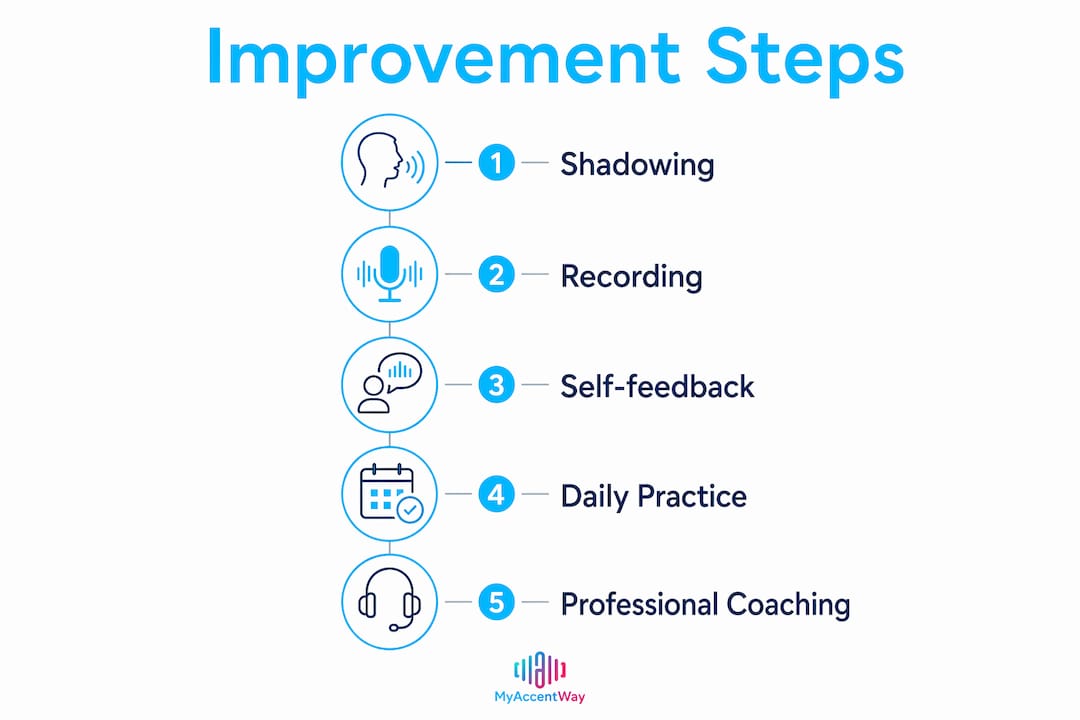
Shadowing. Listen to a native speaker and repeat immediately, matching rhythm and intonation. Shadowing builds the stress-timed rhythm of American English faster than any other single method.
-
Record and review. Recording your voice and comparing it to a native speaker reveals errors you cannot hear in real time. Your brain compensates for what it expects to hear. A recording does not.
-
Practice schwa and linking. Choose a sentence from a meeting or presentation. Identify every unstressed syllable and reduce it. Then link the words together as a native speaker would. This one exercise transforms your rhythm.
-
Use 2D Sound Motion Technology. Myaccentway’s Interactive Mouth Training Technology helps you actively train the tongue, lips, jaw, and airflow during each American sound. Instead of only listening and repeating, you train your speech organs directly with the Interactive Visual 2D Sound Simulators while Prof. Alex corrects you live. Train the American [T] sound:
Here is a quick comparison of practice approaches by depth of feedback:
| Method | Feedback type | Best for |
|---|---|---|
| Shadowing | Self-assessed | Rhythm and intonation |
| Recording and review | Self-assessed | Identifying specific errors |
| Minimal pair drills | Self-assessed | Sound discrimination |
| 2D Sound Motion Technology | Visual and physical | Correct speech-organ placement |
| One-on-one coaching with Professor Alex | Expert, personalized | Full pronunciation system |
Pro Tip: Practice daily for 10–15 minutes rather than one long session per week. Short, focused sessions build muscle memory faster and prevent fatigue-related errors.
MyAccentWay · 2D Sound Motion Technology
American English Pronunciation: Consonant and Vowel Sounds with 2D Sound Motion Technology
Learning American English pronunciation and the American accent is more effective when you train your speech organs, not only listen and repeat. 2D Sound Motion Technology and Interactive Visual 2D Sound Simulators, developed in 2020 by Prof. Alex, Ph.D. Accent Coach, Doctor of Education, and professional linguist, as part of his interactive teaching model based on his Ph.D. research in interactive teaching methods, train your tongue, lips, jaw, teeth, airflow, and voice step by step. They train each American sound and more than 30 sound combinations through Interactive 2D video simulation.
What 2D Sound Motion Technology is
2D Sound Motion Technology is an advanced accent reduction and articulation training tool by Prof. Alex. It corrects, develops, and trains each American sound and more than 30 sound combinations through Interactive 2D video simulation.
What Interactive Visual 2D Sound Simulators do
Interactive Visual 2D Sound Simulators are part of 2D Sound Motion Technology, the articulation-training method Prof. Alex created by applying his Ph.D. research in interactive teaching to American pronunciation. Instead of listening and repeating, students actively train their speech organs. Each simulator uses Interactive 2D mouth movement to train the speech organs (tongue, lips, jaw, teeth, airflow, and voice) to produce each American sound correctly. Every consonant has its own simulator: explore American consonants trained with 2D Sound Motion Technology.
Sample training: the American t sound (aspirated [t])
Practice
Record yourself speaking these words:
Tab · Tacos · Time · Tub · Hotel · Motel · Sit · Pit · Net
Instructions
Play the Interactive Visual 2D Sound Simulator for the American t sound below several times and follow it step by step. Move your tongue, jaw, and airflow together with the simulator and train your articulation.
Interactive Visual 2D Sound Simulator: American unvoiced sound [t]
Practice
Record yourself again speaking these words, but this time focus on the movement of your tongue. Go slow, and you will hear the difference. You’ve got this!
Tab · Tacos · Time · Tub · Hotel · Motel · Sit · Pit · Net
How Interactive Visual 2D Sound Simulators solve pronunciation and speaking problems
- Wrong articulationMost pronunciation problems start with the tongue, lips, jaw, or teeth in the wrong position. Each Interactive Visual 2D Sound Simulator trains the correct articulation of one American sound, so the student corrects the cause of the problem, not only the result.
- Airflow and voicingMany accent problems come from wrong airflow or voicing: sounds that are too weak, too strong, or voiced when they should be unvoiced. The simulators train airflow and voice together with articulation, step by step, for each American sound and more than 30 sound combinations.
- Clear speech and confidenceWhen each sound is trained correctly, words connect into clear American English speech. Listeners can understand you more easily, and speaking at work, in meetings, and on calls becomes more confident.
If you start hearing the aspiration, the short airstream after [t], with one simulator, you can only imagine how successful you can be in 1-on-1 Interactive American Accent Training with Prof. Alex, Ph.D. Accent Coach, where your whole American sound system is trained sound by sound.
In MyAccentWay, the Interactive Visual 2D Sound Simulators are only available in 1-on-1 accent coaching sessions with Prof. Alex.
How to apply clear speaking skills in real professional situations
Knowing the techniques is one thing. Using them under pressure in a meeting or presentation is another. The gap between practice and performance closes with deliberate application.
- Presentations: Slow your pace by 10–15 percent compared to casual conversation. Slower pacing gives you time to hit word stress correctly and gives listeners time to process.
- Phone and video calls: Without body language, your voice carries the full weight of your message. Focus on clean consonant endings and clear sentence stress. Every word needs to land.
- Networking conversations: Use short, well-structured sentences. Shorter sentences reduce the chance of losing stress patterns mid-thought.
- Self-assessment after meetings: Listening back to recordings of real conversations, not just practice sessions, shows how your pronunciation holds up under real conditions.
Myaccentway’s training addresses all of these contexts directly. Professor Alex conducts a personalized assessment to identify each student’s specific speech patterns, then builds a structured program around those findings. Vlad, a Russian-speaking professional, went through this process and achieved measurable improvement in real speech. Watch his results:
Tone and resonance also matter in professional settings. A voice that carries well, with relaxed breath support and open resonance, projects confidence. Tension in the throat or jaw reduces both clarity and presence. The science-backed approach to speech clarity addresses these physical foundations alongside phonetic training.
Key takeaways
Clear American pronunciation requires correct word stress, clean consonant endings, natural rhythm, and relaxed articulation, not accent perfection.
| Point | Details |
|---|---|
| Word stress drives clarity | Misplaced stress causes more confusion than minor vowel errors. |
| Schwa is not optional | Avoiding vowel reduction makes speech sound unnatural and harder to understand. |
| Over-enunciation hurts | Forcing consonants creates tension and degrades speech quality. |
| Recording reveals blind spots | Your brain compensates for errors in real time; a recording does not. |
| Physical training accelerates progress | 2D Sound Motion Technology trains speech organs directly, not just by ear. |
What I have learned after years of coaching non-native professionals
After working with hundreds of non-native professionals, the single biggest misconception I see is this: students believe they need to sound American to be understood. They do not. They need to be intelligible. Those are different goals, and chasing the wrong one wastes months of effort.
The students who improve fastest are the ones who stop trying to imitate and start training their speech organs deliberately. When you understand that the American /r/ requires a specific tongue position, not just a sound you mimic, the sound becomes achievable. That is exactly what 2D Sound Motion Technology makes possible: actively training the speech organs with the Interactive Visual 2D Sound Simulators while Prof. Alex corrects students live, as part of his interactive teaching model based on his Ph.D. research in interactive teaching methods. Doubt becomes clarity.
Patience matters too. Speech is physical. You are retraining muscles that have operated one way for decades. Ten to fifteen minutes of focused daily practice, done consistently, produces real results within weeks. Sporadic two-hour sessions do not. The students I see struggle the most are the ones who practice intensely for a few days and then stop. Consistency is the method.
— Prof.
Myaccentway’s American Accent Training Program and Accent Reduction Curriculum
Myaccentway offers structured American accent training built specifically for non-native professionals who need results in real communication, not just in practice sessions.
Professor Alex, Ph.D., conducts a one-on-one assessment to map your specific speech patterns before any training begins. The program then targets your actual gaps: stress, rhythm, consonant endings, connected speech, and physical sound production through Interactive Mouth Training Technology. Every session is personalized. You are not following a generic curriculum. You are training the exact sounds and patterns your speech needs. Book Your 1 Hour Evaluation Session to see how the assessment works and what a structured path to clearer American English looks like for you.
Interactive American Accent Training for Foreign-Born Professionals in the United States
Foreign-born professionals in the United States often know their field and speak advanced English. Yet American listeners may still struggle with their sounds, stress, and rhythm. MyAccentWay offers private online American accent training through Interactive American Accent Training.
Interactive American Accent Training is led by Prof. Alex, Ph.D. Accent Coach, Doctor of Education, and professional linguist. He first diagnoses each speaker’s native-language patterns. Then he trains American sound articulation, stress, rhythm, and intonation for real real conversations.
Who this training is for
- Engineers, IT specialists, and data professionals presenting to U.S. teams and clients
- Doctors, nurses, and healthcare professionals explaining care to American patients
- Managers, executives, and founders leading meetings, pitches, and briefings
- Consultants, researchers, and academics speaking at conferences and webinars
- Professionals preparing for interviews, promotions, or client-facing roles
Online training across the U.S.
MyAccentWay is based in Austin, Texas, and all training is online. The program is especially relevant for professionals in Austin, Dallas, Houston, New York City, the San Francisco Bay Area, Los Angeles, Seattle, Boston, Chicago, Miami, Washington DC, Atlanta, and Raleigh.
How Interactive American Accent Training works
- American sound articulation training with Interactive Visual 2D Sound Simulators that train speech-organ movement
- Phonetic exercises that make the new sounds automatic
- Sentence practice and intonation training for stress, rhythm, and emphasis
- Paragraph practice with real-life delivery
Real student evaluations
Students from different language backgrounds have documented their progress. Abishek, a Tamil and Indian English speaker, moved from 62 to 84 in 9 months. Tian, a Mandarin speaker, moved from 58 to 85 in 8 months. Vlad, a Russian speaker, moved from 60 to 83 in 5 months.
The first step is a 1 Hour Evaluation Session with Prof. Alex.
FAQ
What is clear American pronunciation?
Clear American pronunciation is intelligible American English speech built on correct word stress, clean consonant endings, natural rhythm, and connected speech. It prioritizes being understood over sounding like a native speaker.
How is clear pronunciation different from accent reduction?
Accent reduction focuses on reducing foreign accent features, while clear pronunciation focuses on intelligibility. Both goals overlap, but clarity is the more practical target for professional communication.
What causes unclear pronunciation in non-native speakers?
The most common causes are misplaced word stress, dropped final consonants, and avoiding natural vowel reduction. Incorrect stress alone causes more comprehension problems than any other single error.
How long does it take to improve American pronunciation?
Focused daily practice of 10–15 minutes produces noticeable improvement within weeks. The timeline depends on your starting point and the consistency of your practice routine.
Does Myaccentway offer personalized pronunciation training?
Yes. Professor Alex conducts a one-on-one assessment to identify your specific speech patterns and builds a structured program around your needs, using 2D Sound Motion Technology for physical sound training.
Recommended
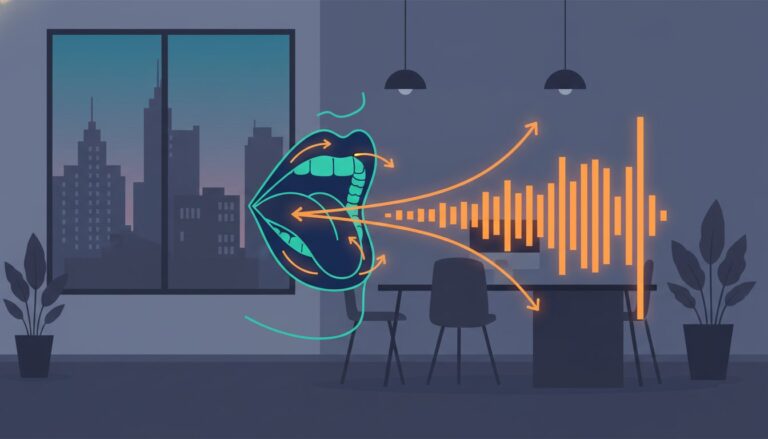
American English Pronunciation Practice: The 2026 Expert Guide
Last week, a senior project manager was asked to repeat his quarterly report findings for the third time. He knew his data was flawless, but the...


American Accent Vowels and Consonants: A Complete Linguistics Guide
Few linguistic systems reveal as much about identity, history, and phonological complexity as the sounds that define American English.
What Makes Speech Sound Natively American: A Pro Guide
Discover what makes speech sound natively American. Master key phonetic features to enhance your communication skills in the U.S.
The problem is not always grammar or vocabulary.
If people understand your words but still miss your message, the deeper issue may be speech clarity, rhythm, intonation, and American pronunciation habits. MyAccentWay helps students retrain the sound system with professional 1-on-1 guidance, so English can feel clearer, freer, and more natural in real communication.
Two training methods that make speech change active.
MyAccentWay is not passive listen-and-repeat coaching. Prof. Alex, Ph.D. Accent Coach, Doctor of Education, and professional linguist, creates a learning situation where students become active learners and active participants in changing their own speech patterns.
Interactive training
Students do not just receive pronunciation instructions passively. They listen, think, compare, adjust, and understand their own speech patterns while Prof. Alex guides the correction process.
Cognitive accent training
Students learn to notice and correct the speech patterns that affect American pronunciation, then implement new American speech patterns into their code-switching process for more natural, long-lasting change.
Build speech habits people can hear in real conversations.
A stronger American accent is not built by memorizing topics or chasing quick pronunciation tips. It comes from structured training, professional feedback, active correction, and repeated application until clearer speech becomes easier to keep.
Continue learning how MyAccentWay connects American sound articulation, Interactive Visual 2D Sound Simulators, accent reduction, student proof, and 1-on-1 training.
- Prof. Alex and the MyAccentWay MethodLearn how Prof. Alex, Ph.D. Accent Coach, Doctor of Education, and professional linguist, created and leads the structured MyAccentWay American accent training system.
- Accent Reduction Curriculum and English Articulation TrainingSee how MyAccentWay trains accent reduction, accent modification, American pronunciation, English articulation, rhythm, and professional speech clarity.
- 2D Sound Motion Technology for American Accent TrainingUnderstand Prof. Alex’s Interactive Visual 2D Sound Simulators for American sound articulation.
- Before-and-After American Accent Training ResultsListen to real before-and-after student proof and accent training outcomes.
- Student Reviews and Accent Training ResultsRead student reviews, testimonials, and trust signals from MyAccentWay learners.
- Book a 1-on-1 American 1 Hour Evaluation SessionStart with a 1-hour interactive American accent training session with Prof. Alex.