American English Negotiation Language Explained for Professionals
(512) 265-9515Updated October 16, 2026 ◆ 10 min read
American English negotiation language is defined as the set of phrases, communication patterns, and cultural conventions that govern business discussions in U.S. professional settings. It centers on directness, explicit information exchange, and professional politeness working together. Non-native professionals who master this system gain a measurable advantage: they signal competence, build trust faster, and close deals with less friction. The low-context communication style that defines American business culture rewards clarity above all else. Myaccentway’s training programs are built specifically to help non-native speakers develop that clarity at the level of pronunciation, rhythm, and phrasing.
Real student result

“I feel confident enough to speak American English!”
Interactive American Accent Training9monthsof hard work and dedication
Listen to the starting point0:00
Listen to the result0:00
“Many of my students once believed they could never sound like this. School taught them grammar and vocabulary, but not how to train their English speech. That is what we do together, step by step, until you speak English independently and with confidence.”
Abishek’s result was achieved through Prof. Alex’s research-based Interactive 1-on-1 American Accent Training. His doctoral research found this interactive method more effective than traditional, teacher-centered methods. See the research basis →
What cultural traits define American negotiation language?
American negotiation culture is low-context, meaning speakers state their meaning explicitly rather than relying on shared background or implication. This contrasts sharply with high-context cultures, where meaning is embedded in tone, silence, or relationship history. In an American boardroom, what you say is what you mean. Ambiguity reads as evasion, not politeness.

Egalitarianism shapes phrase choice in ways non-native professionals often underestimate. American negotiators address counterparts by first name, challenge ideas openly, and expect the same in return. This is not disrespect. It signals that both parties are equals at the table. Adapting to this norm means dropping overly formal address and speaking with measured confidence.
Cultural misalignment causes negotiation breakdown when American directness is read as aggression by professionals from high-context cultures. The solution is not to abandon your own communication style entirely. The goal is to recognize the cultural code and respond within it professionally.
Common pitfalls for non-native professionals include:
- Excessive hedging. Phrases like “I’m not sure, but maybe…” signal weakness, not politeness.
- Avoiding eye contact. In American business culture, eye contact signals confidence and engagement.
- Over-apologizing. Saying sorry before stating a position undercuts your credibility immediately.
- Silence as agreement. Americans rarely interpret silence as consent. State your position clearly.
Pro Tip: Before your next negotiation, record yourself making a simple request in English. Listen for hedging words like “kind of,” “sort of,” or “I guess.” Replace each one with a direct statement.
Which key negotiation techniques should non-native professionals know?
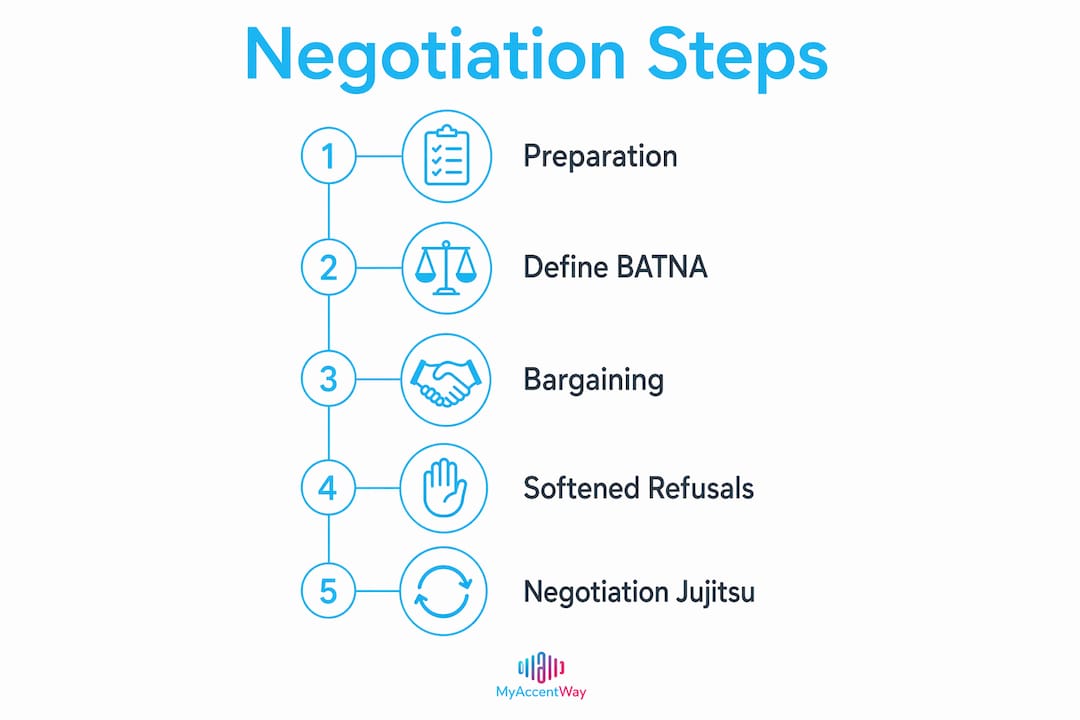
Preparation accounts for approximately 80% of successful negotiation outcomes in U.S. business contexts. That figure reframes how most professionals allocate their time. The work happens before you enter the room, not during. The four-step American negotiation process is preparation, bargaining, closing, and learning.
Preparation means defining your BATNA, which stands for Best Alternative to a Negotiated Agreement. Your BATNA is the strongest option you have if talks fail. Knowing it prevents you from accepting a bad deal under pressure.
During bargaining, softened refusal phrases like “That’s not something we could agree to” keep the conversation open without conceding ground. Blunt refusals shut doors. Softened ones redirect the discussion toward solutions.
The negotiation jujitsu strategy involves refusing to react to aggressive tactics and redirecting focus toward shared interests and objective criteria. Instead of pushing back against pressure, you name the tactic and return to the problem. This technique turns an opponent’s force into shared momentum.
| Phase | Goal | Example phrase |
|---|---|---|
| Preparation | Define BATNA and priorities | “Our minimum acceptable terms are…” |
| Bargaining | Exchange offers and test flexibility | “If you could adjust the timeline, we might be able to…” |
| Closing | Confirm agreement and next steps | “Let’s put this in writing and circle back by Friday.” |
| Learning | Review outcomes and improve | “What worked well, and what would we do differently?” |
Pro Tip: Write your BATNA on paper before every negotiation. Professionals who know their walk-away point make better decisions under pressure than those who calculate it in the moment.
What are essential American English negotiation phrases to master?
Conditional language using modal verbs such as “would,” “could,” and “might” signals flexibility without premature concession. “If you could extend the deadline, we might be able to increase the order volume” is more effective than “We need more time.” The conditional structure invites trade-offs rather than demanding them.
Idioms like “ballpark figure,” “sweeten the deal,” and “circle back” keep the negotiation tone conversational and build rapport. Used correctly, these expressions signal fluency and cultural familiarity. They tell your counterpart that you understand the room, not just the words.
American business negotiators blend formal vocabulary with idiomatic expressions to maintain a professional yet conversational tone. You do not need to choose between sounding educated and sounding natural. The best negotiators do both.
Here are eight phrases every non-native professional should practice:
- “What’s your ballpark figure?” Opens a price discussion without committing to a number first.
- “We’d be open to that, provided…” Signals conditional agreement and invites specifics.
- “That doesn’t quite work for us.” Replaces a blunt “No” with a professional, softened refusal that keeps talks moving.
- “Can we circle back to that point?” Defers a difficult topic without dismissing it.
- “Is there any flexibility on your end?” Invites the other party to move without revealing your position.
- “Let’s see if we can find a middle ground.” Frames the negotiation as collaborative problem-solving.
- “Could you help me understand your reasoning?” Requests clarification without confrontation.
- “If you could sweeten the deal, we’d be in a much stronger position to say yes.” Signals willingness while asking for more.
Understanding American English social communication norms gives these phrases their full power. The words matter, but so does the tone, rhythm, and pacing behind them.
How can non-native professionals adapt their style for American negotiations?
Direct communication signals competence and confidence to American counterparts. Balancing directness with tact avoids unintentional signals of weakness. The goal is not to become someone else. The goal is to communicate your actual position with enough clarity that your counterpart hears it correctly.
Tone management under pressure separates effective negotiators from reactive ones. When a counterpart pushes hard, the instinct is to either capitulate or escalate. Successful negotiation means not reacting emotionally to aggressive tactics but steering conversations toward mutual gains. Pause, breathe, and return to the shared problem.
Approaching negotiation as collaborative problem-solving rather than zero-sum competition produces better long-term outcomes. Value creation means expanding the total benefit so both parties gain without either side sacrificing core interests. This mindset shift changes how you phrase every offer and counter-offer.
- Practice your opening statement. Record it, listen back, and cut every hedge word.
- Use pauses deliberately. Silence after a firm offer signals confidence, not uncertainty.
- Prepare three counter-offer phrases. Know exactly how you will respond to “no” before it happens.
- Study American informal speech patterns. Understanding connected speech in American English helps you follow fast-paced discussions without losing key information.
- Debrief after every negotiation. Write down what you said, what worked, and what you would change.
Pro Tip: Cross-cultural communication training, such as the resources at Spanish Explorer, shows that language learners who study cultural context alongside vocabulary retain phrases far more effectively than those who study words alone.
Key Takeaways
Mastering American English negotiation language requires combining low-context directness, conditional phrasing, and cultural awareness to communicate with clarity and professional confidence.
| Point | Details |
|---|---|
| Low-context communication | American negotiation rewards explicit, direct statements over implied meaning or silence. |
| Preparation drives outcomes | Defining your BATNA before talks begin is an effective preparation step. |
| Conditional phrasing signals flexibility | Modal verbs like “would,” “could,” and “might” invite trade-offs without premature concession. |
| Softened refusals keep talks open | Phrases like “That doesn’t quite work for us” replace blunt rejections and preserve momentum. |
| Cultural adaptation is a skill | Recognizing American communication norms and adjusting your style prevents costly misunderstandings. |
What I’ve learned from watching professionals negotiate in a second language
After years of working with non-native professionals on American English speech and communication, one pattern stands out clearly. The students who struggle most in negotiations are not the ones with the heaviest accents. They are the ones who have not yet internalized that directness in American business culture is a sign of respect, not aggression.
I have watched highly educated professionals from Japan, Brazil, Russia, and Germany lose ground in negotiations not because their English was poor, but because their phrasing signaled hesitation. A phrase like “Perhaps we could consider…” lands very differently than “We’d be willing to, if…” The second phrase is direct, conditional, and professional. The first sounds uncertain.
The other lesson I keep returning to is this: preparation is not just about knowing your numbers. It is about knowing your phrases. When you have rehearsed your counter-offer language, your brain is free to listen and respond rather than search for words under pressure. That cognitive freedom is where real negotiation skill lives.
Pronunciation clarity matters more than most professionals expect. When your counterpart has to work hard to understand you, they spend cognitive energy on decoding rather than on the deal. Clear speech is not about sounding American. It is about being understood the first time, every time.
— Prof.
How Myaccentway helps you negotiate with clarity and confidence
Non-native professionals who want to negotiate effectively in American English need more than vocabulary lists. They need pronunciation clarity, natural rhythm, and the confidence that comes from knowing their speech lands correctly.
Myaccentway offers one-on-one American accent training led by Professor Alex, Ph.D., Linguist and Accent Coach. The program uses 2D Sound Motion Technology to train the physical movements of the tongue, lips, and jaw during American sounds, not just imitation. Practice the American [T] sound:
youtu.be/3EzjosgnzJE. youtube.com/shorts/OE0q7Y8cV74. Book Your 1 Hour Evaluation Session with Professor Alex to identify your specific speech patterns and build the pronunciation foundation your negotiations deserve.
MyAccentWay · 2D Sound Motion Technology
American English Pronunciation: Consonant and Vowel Sounds with 2D Sound Motion Technology
Learning American English pronunciation and the American accent is more effective when you train your speech organs, not only listen and repeat. 2D Sound Motion Technology and Interactive Visual 2D Sound Simulators, developed in 2020 by Prof. Alex, Ph.D. Accent Coach, Doctor of Education, and professional linguist, as part of his interactive teaching model based on his Ph.D. research in interactive teaching methods, train your tongue, lips, jaw, teeth, airflow, and voice step by step. They train each American sound and more than 30 sound combinations through Interactive 2D video simulation.
What 2D Sound Motion Technology is
2D Sound Motion Technology is an advanced accent reduction and articulation training tool by Prof. Alex. It corrects, develops, and trains each American sound and more than 30 sound combinations through Interactive 2D video simulation.
What Interactive Visual 2D Sound Simulators do
Interactive Visual 2D Sound Simulators are part of 2D Sound Motion Technology, the articulation-training method Prof. Alex created by applying his Ph.D. research in interactive teaching to American pronunciation. Instead of listening and repeating, students actively train their speech organs. Each simulator uses Interactive 2D mouth movement to train the speech organs (tongue, lips, jaw, teeth, airflow, and voice) to produce each American sound correctly. Every consonant has its own simulator: explore American consonants trained with 2D Sound Motion Technology.
Sample training: the American t sound (aspirated [t])
Practice
Record yourself speaking these words:
Tab · Tacos · Time · Tub · Hotel · Motel · Sit · Pit · Net
Instructions
Play the Interactive Visual 2D Sound Simulator for the American t sound below several times and follow it step by step. Move your tongue, jaw, and airflow together with the simulator and train your articulation.
Interactive Visual 2D Sound Simulator: American unvoiced sound [t]
Practice
Record yourself again speaking these words, but this time focus on the movement of your tongue. Go slow, and you will hear the difference. You’ve got this!
Tab · Tacos · Time · Tub · Hotel · Motel · Sit · Pit · Net
How Interactive Visual 2D Sound Simulators solve pronunciation and speaking problems
- Wrong articulationMost pronunciation problems start with the tongue, lips, jaw, or teeth in the wrong position. Each Interactive Visual 2D Sound Simulator trains the correct articulation of one American sound, so the student corrects the cause of the problem, not only the result.
- Airflow and voicingMany accent problems come from wrong airflow or voicing: sounds that are too weak, too strong, or voiced when they should be unvoiced. The simulators train airflow and voice together with articulation, step by step, for each American sound and more than 30 sound combinations.
- Clear speech and confidenceWhen each sound is trained correctly, words connect into clear American English speech. Listeners can understand you more easily, and speaking at work, in meetings, and on calls becomes more confident.

If you start hearing the aspiration, the short airstream after [t], with one simulator, you can only imagine how successful you can be in 1-on-1 Interactive American Accent Training with Prof. Alex, Ph.D. Accent Coach, where your whole American sound system is trained sound by sound.
In MyAccentWay, the Interactive Visual 2D Sound Simulators are only available in 1-on-1 accent coaching sessions with Prof. Alex.
Business English Pronunciation Coaching for Foreign-Born Professionals in the United States
Foreign-born professionals in the United States often know their field and speak advanced English. Yet American listeners may still struggle with their sounds, stress, and rhythm. MyAccentWay offers private online business pronunciation coaching through Interactive American Accent Training.
Interactive American Accent Training is led by Prof. Alex, Ph.D. Accent Coach, Doctor of Education, and professional linguist. He first diagnoses each speaker’s native-language patterns. Then he trains American sound articulation, stress, rhythm, and intonation for real meetings and client conversations.
Who this training is for
- Managers, executives, and founders leading meetings, pitches, and briefings
- Engineers, IT specialists, and data professionals presenting to U.S. teams and clients
- Doctors, nurses, and healthcare professionals explaining care to American patients
- Consultants, researchers, and academics speaking at conferences and webinars
- Professionals preparing for interviews, promotions, or client-facing roles
Online training across the U.S.
MyAccentWay is based in Austin, Texas, and all training is online. The program is especially relevant for professionals in Austin, Dallas, Houston, New York City, the San Francisco Bay Area, Los Angeles, Seattle, Boston, Chicago, Miami, Washington DC, Atlanta, and Raleigh.
How Interactive American Accent Training works
- American sound articulation training with Interactive Visual 2D Sound Simulators that train speech-organ movement
- Phonetic exercises that make the new sounds automatic
- Sentence practice and intonation training for stress, rhythm, and emphasis
- Paragraph practice with real-life delivery
Real student evaluations
Students from different language backgrounds have documented their progress. Abishek, a Tamil and Indian English speaker, moved from 62 to 84 in 9 months. Tian, a Mandarin speaker, moved from 58 to 85 in 8 months. Vlad, a Russian speaker, moved from 60 to 83 in 5 months.
The first step is a 1 Hour Evaluation Session with Prof. Alex.
FAQ
What is American English negotiation language?
American English negotiation language is the system of phrases, communication norms, and cultural conventions used in U.S. business discussions. It prioritizes directness, explicit information, and professional politeness over implied meaning.
Why do non-native speakers struggle with American negotiation style?
Cultural misalignment causes the most common breakdowns, especially when American directness is misread as aggression by professionals from high-context cultures. Adapting to the low-context style requires both language practice and cultural awareness.
What are the most useful phrases for negotiating in English?
Conditional phrases using modal verbs, such as “If you could…, we might be able to…,” are effective tools for signaling flexibility. Idioms like “ballpark figure” and “circle back” build rapport and signal cultural fluency.
How does pronunciation affect negotiation outcomes?
When speech is unclear, counterparts spend cognitive energy decoding rather than engaging with the substance of the deal. Clear American English pronunciation keeps the focus on your message, not your accent.
What is BATNA and why does it matter in American negotiations?
BATNA stands for Best Alternative to a Negotiated Agreement. Knowing your BATNA before talks begin prevents you from accepting unfavorable terms under pressure and anchors every decision you make at the table.
Recommended
American English Social Communication Explained for Professionals
Discover the nuances of american english social communication explained. Enhance your professional interactions with essential verbal and nonverbal skills.


How to Sound More Persuasive in English: A Linguistic Guide for Professionals
Have you ever noticed that the person who gets the most buy-in during a meeting isn't always the one with the best data, but the one with the most...
American English Connected Speech Rules: A Professional Guide to Natural Flow
Speaking English clearly isn't about pronouncing every single letter. In fact, trying to be too perfect is exactly why you might sound robotic or...
The problem is not always grammar or vocabulary.
If people understand your words but still miss your message, the deeper issue may be speech clarity, rhythm, intonation, and American pronunciation habits. MyAccentWay helps students retrain the sound system with professional 1-on-1 guidance, so English can feel clearer, freer, and more natural in real communication.
Two training methods that make speech change active.
MyAccentWay is not passive listen-and-repeat coaching. Prof. Alex, Ph.D. Accent Coach, Doctor of Education, and professional linguist, creates a learning situation where students become active learners and active participants in changing their own speech patterns.
Interactive training
Students do not just receive pronunciation instructions passively. They listen, think, compare, adjust, and understand their own speech patterns while Prof. Alex guides the correction process.
Cognitive accent training
Students learn to notice and correct the speech patterns that affect American pronunciation, then implement new American speech patterns into their code-switching process for more natural, long-lasting change.
Build speech habits people can hear in real conversations.
A stronger American accent is not built by memorizing topics or chasing quick pronunciation tips. It comes from structured training, professional feedback, active correction, and repeated application until clearer speech becomes easier to keep.
Continue learning how MyAccentWay connects accent reduction, accent modification, English articulation, Prof. Alex’s method, student proof, and 1-on-1 American accent training.
- Prof. Alex and the MyAccentWay MethodLearn how Prof. Alex, Ph.D. Accent Coach, Doctor of Education, and professional linguist, created and leads the structured MyAccentWay American accent training system.
- Accent Reduction Curriculum and English Articulation TrainingSee how MyAccentWay trains accent reduction, accent modification, American pronunciation, English articulation, rhythm, and professional speech clarity.
- 2D Sound Motion Technology for American Accent TrainingUnderstand Prof. Alex’s Interactive Visual 2D Sound Simulators for American sound articulation.
- Before-and-After American Accent Training ResultsListen to real before-and-after student proof and accent training outcomes.
- Student Reviews and Accent Training ResultsRead student reviews, testimonials, and trust signals from MyAccentWay learners.
- Book a 1-on-1 American 1 Hour Evaluation SessionStart with a 1-hour interactive American accent training session with Prof. Alex.