English Conversation by Phone: Speak Clearly on Calls
(512) 265-9515Updated October 16, 2026 ◆ 14 min read
Three micro-habits make every professional phone call more manageable right now: signpost your transitions (“Before we move on…”), run confirmation loops (“Let me read that back…”), and sharpen mic-friendly articulation by emphasizing consonants at word endings. These are not fluency tricks — they are call-management skills that work regardless of accent level. For professionals who want to build the pronunciation foundation behind those habits, Myaccentway American Accent Program offers 1-on-1 coaching with Prof. Alex, Ph.D., using 2D Sound Motion Technology as part of his interactive teaching model, based on his Ph.D. research in interactive teaching methods. Students actively train the movement of their tongue, lips, jaw, teeth, and airflow with the Interactive Visual 2D Sound Simulators while Prof. Alex corrects them live.
Real student result

“I feel confident enough to speak American English!”
Interactive American Accent Training9monthsof hard work and dedication
Listen to the starting point0:00
Listen to the result0:00
“Many of my students once believed they could never sound like this. School taught them grammar and vocabulary, but not how to train their English speech. That is what we do together, step by step, until you speak English independently and with confidence.”
Abishek’s result was achieved through Prof. Alex’s research-based Interactive 1-on-1 American Accent Training. His doctoral research found this interactive method more effective than traditional, teacher-centered methods. See the research basis →
Explore Curriculum | Book Your 1 Hour Evaluation Session | Read Reviews
What tactics can you use right now on a phone call in English?
Phone calls reward preparation more than fluency. A short identity block at the start of a call (“Hi, this is [Name] from [Company] — I’m calling about…”) reduces listener processing time and sets a confident tone before the conversation’s real content begins. Pair that with a reference sheet of key phrases at your workstation, and your working memory stays free for actual listening.
Signposting phrases tell the listener where the conversation is going, which reduces cognitive load on business calls:
- “Before we move on, let me confirm…”
- “Just to summarize what we’ve covered…”
- “I have two quick questions for you.”
Confirmation loops are professional risk control, not a sign of weakness:
- “So, if I understand correctly, the deadline is Friday the 14th — is that right?”
- “Let me read that number back: five-five-five, two-one-oh-nine. Correct?”
- “I want to make sure I’ve got this right — you’re saying the order ships Monday?”
Mic-friendly articulation means leaning into consonant clarity. On compressed phone audio, final consonants (“t,” “k,” “s,” “f”) are the first sounds to disappear. Slightly over-articulate word endings, slow your pace by about 15%, and stress the key word in each sentence rather than rushing through it.
Quick scripts for three common call types:
- Appointment booking: “Good morning, this is [Name]. I’d like to schedule a follow-up for next week — does Thursday at 2 PM work for you?”
- Technical support: “Hi, I’m calling about ticket number 4-4-7-2. The issue is still open. Could you walk me through the current status?”
- Client check-in: “Hi [Name], this is [Your Name] from [Company]. I’m calling to touch base on the proposal — do you have three minutes?”
“Taking control of the call — through confirmations, pacing, and channel choices — matters more than waiting for perfect grammar.”
Language communication experts consistently make this point: managed calls produce correct outcomes even when speech is imperfect.
Pro Tip: Before any high-stakes call, write your identity block and the three key points you need to cover on a sticky note. Keeping it visible means you never lose your place, even when nerves spike.

Why are phone calls harder than face-to-face conversations?
Phone calls strip away more than half of your communicative toolkit. Research with EFL migrants shows that the loss of gestures, facial expressions, and body posture creates a genuine semiotic disadvantage — listeners cannot use visual cues to signal confusion or prompt a speaker to rephrase, so misunderstandings accumulate silently.
The audio channel itself compounds this. Telephone audio compresses into a narrow frequency band that attenuates high-frequency consonant energy. Sounds like “s,” “f,” “th,” “t,” and “k” lose acoustic definition, which is exactly why “fifteen” and “fifty” become genuinely confusing on a bad line.
“When you cannot see the other person, you feel more insecure about your language skills, and it is harder to ask them to repeat.”
University of Oulu research on second-language speakers confirms that phone calls consistently rank as the most stressful communication mode for non-native speakers.
There is also a psychological layer. Silence on a phone call feels like failure, which triggers a panic loop: you rush to fill the gap, articulation suffers, and the listener understands less. Reframing silence as composure — a deliberate pause to process — breaks that loop. Confirmation loops serve the same function: they buy time while signaling professionalism.
How does Myaccentway American Accent Program solve phone-call problems specifically?
Most pronunciation programs teach sounds in isolation. Myaccentway American Accent Program builds from the phone call outward: the sounds that survive audio compression, the stress patterns that carry meaning when consonants blur, and the intonation contours that signal confidence rather than uncertainty.
Prof. Alex’s method has four core components:
- 1-on-1 speech assessment to identify which specific sounds and patterns create confusion on calls
- Structured phonetic practice covering consonants (especially high-frequency sounds), vowels, stress, and intonation
- Cognitive accent training that shifts students from passive repetition to active awareness of speech-organ movement
- Interactive Visual 2D Sound Simulators that help students actively train tongue, lip, jaw, and teeth movements and airflow while Prof. Alex corrects them live, as part of his interactive teaching model based on his Ph.D. research in interactive teaching methods
That last point is the real differentiator. Traditional “repeat after me” coaching asks students to copy a sound without guidance on how it is produced. As part of Prof. Alex’s interactive teaching model, based on his Ph.D. research in interactive teaching methods, the Interactive Visual 2D Sound Simulators train students in the movement of the tongue, lips, jaw, teeth, and airflow, while Prof. Alex corrects them live. In MyAccentWay training, these simulators are used to train sound articulation, sound formation, and speech production during live 1-on-1 accent training sessions.
Thiago, a Portuguese speaker, documented measurable clarity gains through this structured approach. His progress is visible in his before-and-after result video — a concrete example of what targeted phonetic retraining produces.
Pro Tip: When evaluating any pronunciation program, ask whether it addresses the specific consonants that phone audio compresses most (“s,” “f,” “th,” “t,” “k”). A program that only covers general fluency will not close the phone-clarity gap.
Phone-focused drills and sample scripts you can practice today
Simulation-based practice — scripts, role-plays, and number drills — is an effective preparation for real calls. Structure a 30-minute practice block this way:
- Warm-up (5 min): Read your identity block aloud three times at normal pace, then once slightly slower with exaggerated final consonants.
- Drills (10 min): Number echo drill (say a 10-digit number, record it, play it back, check clarity); minimal-pairs drill for compressed sounds (“seat/feet,” “think/sink,” “coat/goat”).
- Role-play (10 min): Run one of the scripts below with a partner or record both sides yourself.
- Feedback (5 min): Listen to the recording and mark one specific sound to improve next session.
Sample role-play: Client update call
Caller: “Hi David, this is Ana from the project team. I’m calling with a quick update on the timeline.”
Listener: “Hi Ana, go ahead.”
Caller: “We’re on track for the March 20th delivery. I just need to confirm the shipping address — can you verify that for me?”
Listener: “Sure — it’s 412 West Oak Street, Suite 7.”
Caller: “Let me read that back: 412 West Oak, Suite 7. Got it. Is there anything else before I let you go?”
“Preparing a short identity block and reference document before important calls reduces working-memory load” and frees cognitive resources for active listening, according to professional phone communication guides.
Pro Tip: Record yourself running a script, then listen specifically for final consonants on words like “project,” “correct,” and “next.” Those endings are the first things a listener loses on compressed audio.
What timeline and pricing should you expect from accent coaching?
Progress is measurable and faster than most students expect when training targets specific sounds rather than general fluency.
- Sessions 1–2: Baseline assessment; identify the 3–5 sounds causing the most phone-call confusion
- Sessions 3–6: Measurable clarity gains on targeted consonants and stress patterns
- Sessions 8–12: Systemic accent shift; new patterns begin to feel automatic in real conversations
- Sessions 12+: Ongoing refinement for high-stakes contexts (presentations, client calls, interviews)
Typical coaching packages follow these shapes: a single diagnostic session, a 5-session starter package, a 10–20 session structured program, or ongoing monthly coaching. Pricing varies by session length, package size, and goal complexity. For current ranges, the accent reduction coaching cost guide provides a detailed breakdown.
Pro Tip: Book a diagnostic session before committing to a package. A qualified coach should be able to identify your top three phone-clarity targets in the first session and give you a realistic timeline.
How do you choose the right phone-focused accent coach?
The right coach has a measurable method, not just enthusiasm. Ask these questions before booking:
- Do you assess my specific sounds before designing a training plan?
- Can you show me a before-and-after recording from a student with a similar background?
- Does your curriculum specifically address the consonants that phone audio compresses?
- How do you track progress between sessions?
- What is your cancellation and refund policy?
Red flags to avoid:
- No initial assessment — training starts with generic drills regardless of your accent
- Purely repetition-based methods with no explanation of speech-organ movement
- No 1 Hour Evaluation Session or diagnostic option before a long-term commitment
- Vague progress markers (“you’ll feel more confident”) with no phonetic benchmarks
First steps to start:
- Book a diagnostic session and bring three real phone scenarios you find difficult
- Prepare your identity block in writing before the first session
- Note the specific words or sounds that caused confusion on your last difficult call
Pro Tip: A coach who can explain exactly why a sound is hard for speakers of your native language — not just that it is hard — is working from linguistics, not intuition. That distinction shows up in results.
Managing technical issues and staying clear on any phone system
Even strong pronunciation loses impact when the connection is poor. A few practical habits protect your clarity regardless of the platform.
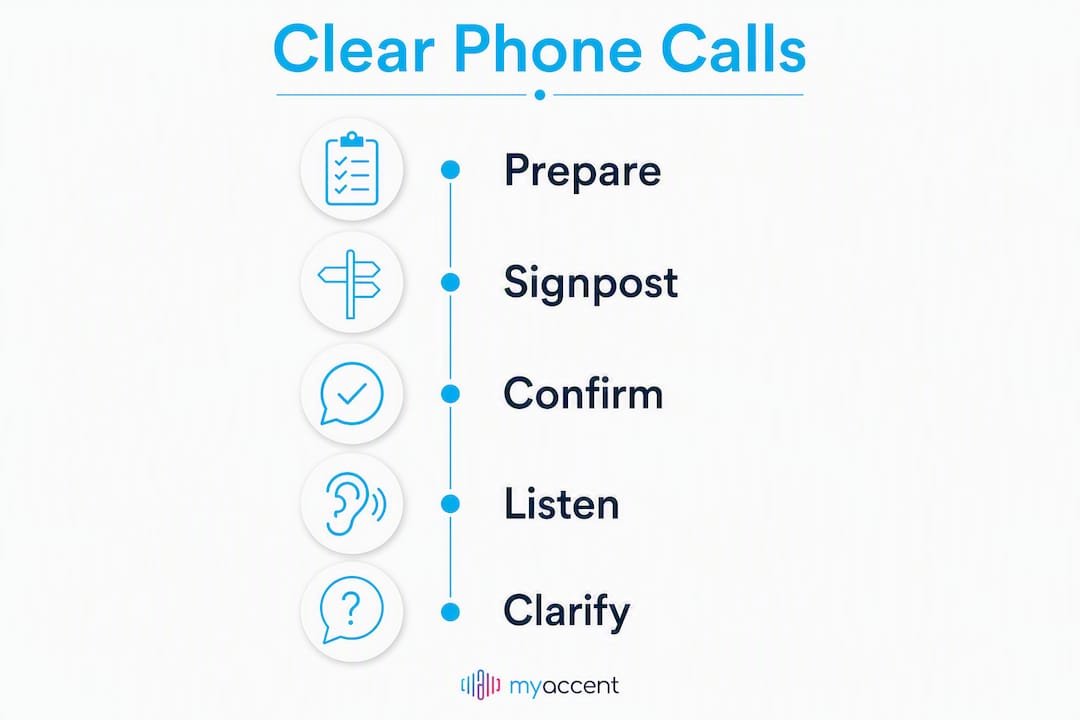
Use a wired headset or a quality Bluetooth headset rather than your phone’s built-in speaker. Speakerphone introduces room echo that further degrades high-frequency consonants. Position the microphone about two finger-widths from the corner of your mouth, not directly in front of your lips, to reduce plosive distortion on “p” and “b” sounds.
When audio quality drops mid-call, name it directly: “I think we have a poor connection — could you repeat that?” or “You’re breaking up slightly; let me move to a better spot.” This is professional, not apologetic. If the call quality is genuinely too poor for the conversation’s stakes, offer an alternative: “Would it be easier if I sent a quick email summary after this call?” Switching channels is active call management, not a retreat.
For calls over VoIP platforms (Teams, Zoom phone, Google Meet), test your audio settings before the call, not during it. A 30-second self-recording in the app confirms whether your microphone is picking up final consonants clearly.
The gap between “more fluent” and “clearer on calls”
Most professionals who come to me for phone-call coaching are not struggling with vocabulary or grammar. They are struggling with a much narrower problem: the sounds that survive telephone audio compression, and the confidence to manage a call when those sounds blur anyway.
The conventional advice — “practice more,” “listen to podcasts,” “immerse yourself” — addresses general fluency. It does not address the acoustic reality of a compressed phone line or the psychological reality of silence anxiety. Those require targeted work: specific consonant retraining, stress-pattern awareness, and the kind of call-management habits that let you stay composed when the audio is imperfect.
What I find most encouraging is that this gap closes faster than students expect. The students who make the clearest gains are not the ones who studied the longest — they are the ones who understood why a sound was difficult and trained it with that understanding. That is exactly what cognitive accent training and visual simulators are designed to provide.
Ready to sound clearer on every professional call?
Phone-ready pronunciation is a specific, trainable skill. Myaccentway American Accent Program gives you a direct path to it: a 1-on-1 session with Prof. Alex, Ph.D., a personalized speech assessment, and a structured plan targeting the exact sounds and patterns that matter on calls.
The 1 Hour Evaluation Session is the fastest way to see the method in action. You will hear where your phone clarity breaks down, understand the speech-organ mechanics behind it, and leave with a concrete training direction. No generic drills, no passive repetition — just targeted work grounded in linguistics and 2D Sound Motion Technology.
Book Your 1 Hour Evaluation Session and bring one real call scenario that gave you trouble. That is the most productive first session you can have.
MyAccentWay · 2D Sound Motion Technology
American English Pronunciation: Consonant and Vowel Sounds with 2D Sound Motion Technology
Learning American English pronunciation and the American accent is more effective when you train your speech organs, not only listen and repeat. 2D Sound Motion Technology and Interactive Visual 2D Sound Simulators, developed in 2020 by Prof. Alex, Ph.D. Accent Coach, Doctor of Education, and professional linguist, as part of his interactive teaching model based on his Ph.D. research in interactive teaching methods, train your tongue, lips, jaw, teeth, airflow, and voice step by step. They train each American sound and more than 30 sound combinations through Interactive 2D video simulation.
What 2D Sound Motion Technology is
2D Sound Motion Technology is an advanced accent reduction and articulation training tool by Prof. Alex. It corrects, develops, and trains each American sound and more than 30 sound combinations through Interactive 2D video simulation.
What Interactive Visual 2D Sound Simulators do
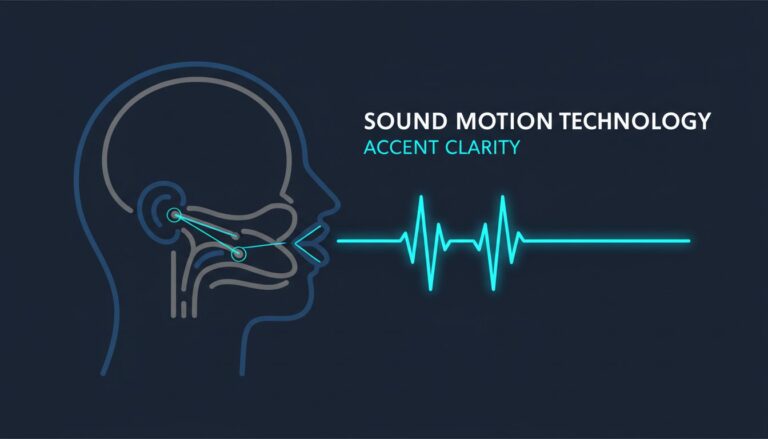
Interactive Visual 2D Sound Simulators are part of 2D Sound Motion Technology, the articulation-training method Prof. Alex created by applying his Ph.D. research in interactive teaching to American pronunciation. Instead of listening and repeating, students actively train their speech organs. Each simulator uses Interactive 2D mouth movement to train the speech organs (tongue, lips, jaw, teeth, airflow, and voice) to produce each American sound correctly. Every consonant has its own simulator: explore American consonants trained with 2D Sound Motion Technology.
Sample training: the American t sound (aspirated [t])
Practice
Record yourself speaking these words:
Tab · Tacos · Time · Tub · Hotel · Motel · Sit · Pit · Net
Instructions
Play the Interactive Visual 2D Sound Simulator for the American t sound below several times and follow it step by step. Move your tongue, jaw, and airflow together with the simulator and train your articulation.
Interactive Visual 2D Sound Simulator: American unvoiced sound [t]
Practice
Record yourself again speaking these words, but this time focus on the movement of your tongue. Go slow, and you will hear the difference. You’ve got this!
Tab · Tacos · Time · Tub · Hotel · Motel · Sit · Pit · Net
How Interactive Visual 2D Sound Simulators solve pronunciation and speaking problems
- Wrong articulationMost pronunciation problems start with the tongue, lips, jaw, or teeth in the wrong position. Each Interactive Visual 2D Sound Simulator trains the correct articulation of one American sound, so the student corrects the cause of the problem, not only the result.
- Airflow and voicingMany accent problems come from wrong airflow or voicing: sounds that are too weak, too strong, or voiced when they should be unvoiced. The simulators train airflow and voice together with articulation, step by step, for each American sound and more than 30 sound combinations.
- Clear speech and confidenceWhen each sound is trained correctly, words connect into clear American English speech. Listeners can understand you more easily, and speaking at work, in meetings, and on calls becomes more confident.
If you start hearing the aspiration, the short airstream after [t], with one simulator, you can only imagine how successful you can be in 1-on-1 Interactive American Accent Training with Prof. Alex, Ph.D. Accent Coach, where your whole American sound system is trained sound by sound.
In MyAccentWay, the Interactive Visual 2D Sound Simulators are only available in 1-on-1 accent coaching sessions with Prof. Alex.
Useful sources
- Phones as a semiotic disadvantage — academic research on EFL migrants
- Why phone calls are harder than face-to-face conversation
- Business Call English: signposting and confirmation loops
- How to handle phone calls in a new language — simulation practice guide
- Learning professional English: phone communication skills
- Why foreign language calls are hard — call management over grammar
- Comparing face-to-face and telephone conversations
- 2D Sound Motion Technology — Myaccentway American Accent Program
- American accent training 1 Hour Evaluation Session
Clear Phone English for Foreign-Born Professionals in the United States
Foreign-born professionals in the United States often know their field and speak advanced English. Yet American listeners may still struggle with their sounds and rhythm on calls. MyAccentWay offers private online American accent training through Interactive American Accent Training.
Interactive American Accent Training is led by Prof. Alex, Ph.D. Accent Coach, Doctor of Education, and professional linguist. He first diagnoses each speaker’s native-language patterns. Then he trains American sound articulation, stress, and rhythm for real phone and video calls.
Who this training is for
- Engineers, IT specialists, and data professionals presenting to U.S. teams and clients
- Doctors, nurses, and healthcare professionals explaining care to American patients
- Managers, executives, and founders leading meetings, pitches, and briefings
- Consultants, researchers, and academics speaking at conferences and webinars
- Professionals preparing for interviews, promotions, or client-facing roles
Online training across the U.S.
MyAccentWay is based in Austin, Texas, and all training is online. The program is especially relevant for professionals in Austin, Dallas, Houston, New York City, the San Francisco Bay Area, Los Angeles, Seattle, Boston, Chicago, Miami, Washington DC, Atlanta, and Raleigh.
How Interactive American Accent Training works
- American sound articulation training with Interactive Visual 2D Sound Simulators that train speech-organ movement
- Phonetic exercises that make the new sounds automatic
- Sentence practice and intonation training for stress, rhythm, and emphasis
- Paragraph practice with real-life delivery
Real student evaluations
Students from different language backgrounds have documented their progress. Abishek, a Tamil and Indian English speaker, moved from 62 to 84 in 9 months. Tian, a Mandarin speaker, moved from 58 to 85 in 8 months. Vlad, a Russian speaker, moved from 60 to 83 in 5 months.
The first step is a 1 Hour Evaluation Session with Prof. Alex.
FAQ
Why is English conversation by phone harder than in person?
Phone audio compresses into a narrow frequency band that attenuates high-frequency consonants, and the loss of visual cues removes the gestures and facial expressions that normally support meaning. Both factors increase listener cognitive load and the chance of misunderstanding.
What phrases help most on a professional phone call in English?
Signposting phrases (“Before we move on…”), confirmation loops (“Let me read that back…”), and repair phrases (“Sorry, I didn’t catch that — could you say it again?”) are the three categories that professional communication guides consistently recommend for non-native speakers.
How long does it take to improve phone English with accent coaching?
Most students see measurable clarity gains on targeted sounds within 4–6 sessions; a systemic accent shift typically takes 8–12 sessions. The timeline depends on which sounds need retraining and how consistently the student practices between sessions.
How does Myaccentway American Accent Program help with phone calls specifically?
Prof. Alex’s method targets the consonants and stress patterns that phone audio compresses most, using Interactive Visual 2D Sound Simulators to help students actively train the movement of their tongue, lips, jaw, teeth, and airflow while Prof. Alex corrects them live. This replaces guesswork with grounded, structured retraining.
Do I need to be fluent before working on phone English practice?
No. Language communication experts consistently find that active call management — pacing, confirmations, channel-switching — produces correct outcomes even when grammar is imperfect. Targeted pronunciation work and call-management habits can begin at any fluency level.
Can American accent training help with job interviews and client calls?
Yes. MyAccentWay’s 1-on-1 training with Prof. Alex practices real interview answers and client-call speech, focusing on clear sounds, sentence stress, and intonation so listeners understand you the first time, including on the phone where there are no visual cues.
Recommended
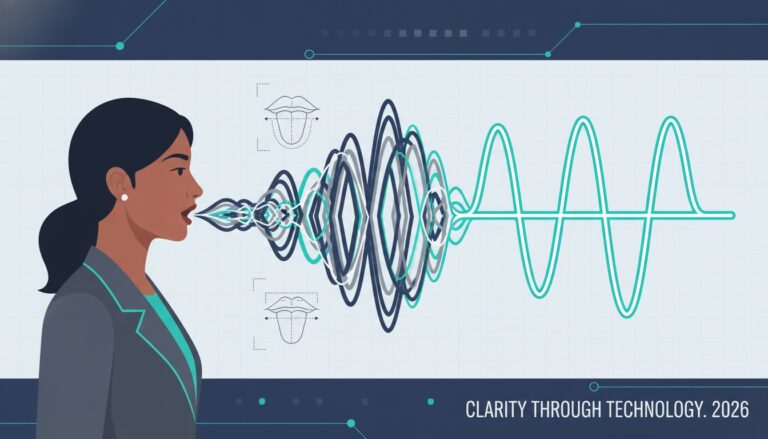
How to Speak English More Clearly: The Definitive Guide for 2026
Last Tuesday, a project manager felt her stomach drop. She had just finished a key presentation, only to be met with blank stares. Her brilliant...

Clear American Pronunciation: A Guide for Non-Native Professionals
Discover what is clear American pronunciation and how it enhances your communication in the workplace. Improve your clarity and confidence today!
Mastering Clarity: How to Choose a Clear English Speaking Course in 2026
What if mastering a clear, confident American accent wasn't about endless repetition, but about applying research-based linguistic science? For too long,...
The problem is not always grammar or vocabulary.
If people understand your words but still miss your message, the deeper issue may be speech clarity, rhythm, intonation, and American pronunciation habits. MyAccentWay helps students retrain the sound system with professional 1-on-1 guidance, so English can feel clearer, freer, and more natural in real communication.
Two training methods that make speech change active.
MyAccentWay is not passive listen-and-repeat coaching. Prof. Alex, Ph.D. Accent Coach, Doctor of Education, and professional linguist, creates a learning situation where students become active learners and active participants in changing their own speech patterns.
Interactive training
Students do not just receive pronunciation instructions passively. They listen, think, compare, adjust, and understand their own speech patterns while Prof. Alex guides the correction process.
Cognitive accent training
Students learn to notice and correct the speech patterns that affect American pronunciation, then implement new American speech patterns into their code-switching process for more natural, long-lasting change.
Build speech habits people can hear in real conversations.
A stronger American accent is not built by memorizing topics or chasing quick pronunciation tips. It comes from structured training, professional feedback, active correction, and repeated application until clearer speech becomes easier to keep.
Continue learning how MyAccentWay connects American sound articulation, Interactive Visual 2D Sound Simulators, accent reduction, student proof, and 1-on-1 training.
- Prof. Alex and the MyAccentWay MethodLearn how Prof. Alex, Ph.D. Accent Coach, Doctor of Education, and professional linguist, created and leads the structured MyAccentWay American accent training system.
- Accent Reduction Curriculum and English Articulation TrainingSee how MyAccentWay trains accent reduction, accent modification, American pronunciation, English articulation, rhythm, and professional speech clarity.
- 2D Sound Motion Technology for American Accent TrainingUnderstand Prof. Alex’s Interactive Visual 2D Sound Simulators for American sound articulation.
- Before-and-After American Accent Training ResultsListen to real before-and-after student proof and accent training outcomes.
- Student Reviews and Accent Training ResultsRead student reviews, testimonials, and trust signals from MyAccentWay learners.
- Book a 1-Hour 1 Hour Evaluation SessionStart with a 1-hour accent evaluation session with Prof. Alex.