American English Stress Patterns for Indians: 2026 Guide
(512) 265-9515Updated October 27, 2026 ◆ 11 min read
American English is a stress-timed language where stressed syllables occur at regular intervals and unstressed syllables are reduced, a pattern that differs sharply from the syllable-timed rhythm of most Indian English varieties. For Indian professionals and students working to refine their speech, understanding American English stress patterns for Indians is the first step toward clearer, more natural communication. The difference is not about right or wrong. It is about rhythm, vowel reduction, and where your voice lands in a sentence. This guide explains the core rules, common errors, and practical strategies to help you build real, measurable progress.
Student testimonial

“I feel confident enough to speak American English!”
Interactive American Accent Training9monthsof hard work and dedication
Listen to the starting point0:00
Listen to the result0:00
Independent phonetic evaluation
Jane Timokhin, Ph.D. in Applied Linguistics
Independent evaluator Jane Timokhin, Ph.D. in Applied Linguistics, assessed Abishek’s before and after audio recordings and documented measurable improvements in American English pronunciation after nine months of training at MyAccentWay.
Interactive American Accent Training, informed by Prof. Alex’s doctoral research. Prof. Alex’s doctoral research identified four educational conditions for interactive foreign-language teaching, including placing students in an active position in the learning process and shifting the teacher’s role toward organizing and guiding student participation. At MyAccentWay, he applies these research-informed conditions through Interactive American Accent Training, integrating 2D Sound Motion Technology (active articulatory simulation), guided pronunciation practice, and personalized feedback. Students actively simulate, train, and refine American English speech sounds rather than relying exclusively on traditional listen-and-repeat instruction. Learn more about Prof. Alex’s doctoral research.
How do American English stress patterns differ from Indian English?
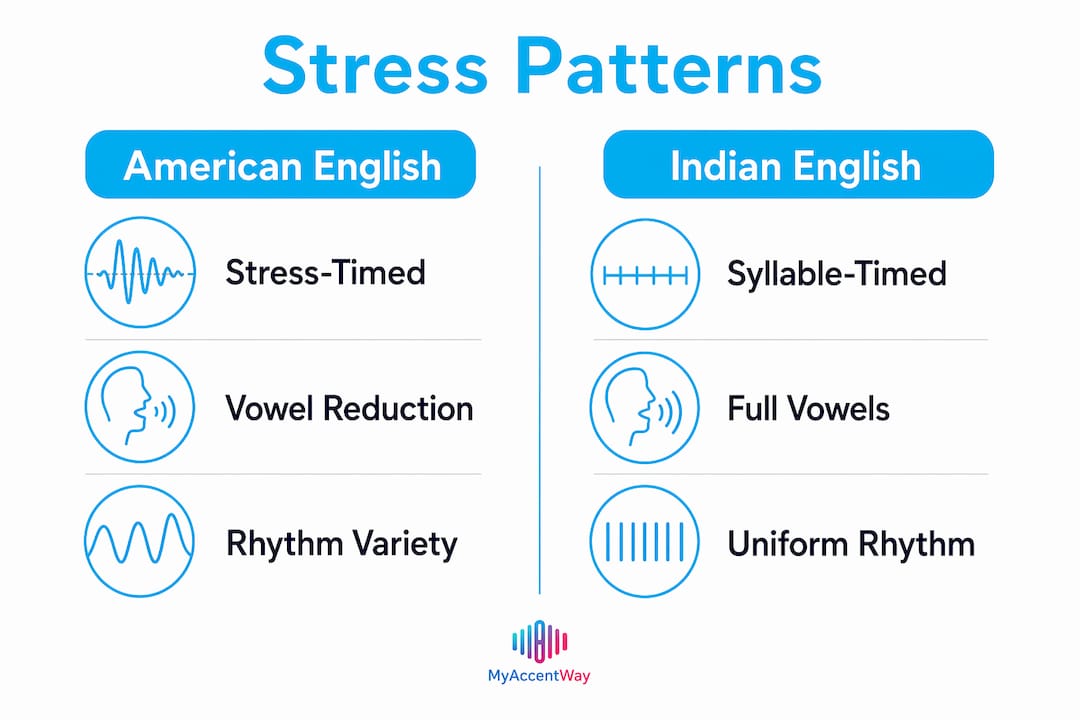
American English is stress-timed, meaning stressed syllables fall at roughly equal time intervals regardless of how many unstressed syllables sit between them. Indian English, by contrast, is syllable-timed, giving each syllable nearly equal duration. That single difference creates the most noticeable rhythmic gap between the two varieties.

The practical effect shows up immediately in vowel sounds. In American English, unstressed syllables are reduced to a schwa /ə/, the neutral, relaxed vowel sound in words like “banana” /bəˈnænə/ or “computer” /kəmˈpjuːtər/. Indian speakers tend to avoid vowel reduction, pronouncing full vowel sounds in those same syllables, which produces a more even, mechanical rhythm to American ears.
The table below shows how stress and vowel treatment differ across common words.
| Word | American English stress | Indian English tendency |
|---|---|---|
| banana | bəˈnænə (stress on 2nd syllable, schwa on 1st and 3rd) | bæˈnɑːnɑː (full vowels throughout) |
| computer | kəmˈpjuːtər (stress on 2nd, schwa on 1st) | kɒmˈpjuːtɑːr (full vowels) |
| magazine | ˌmæɡəˈziːn (stress on 3rd syllable) | ˈmæɡəziːn (stress on 1st syllable) |
| about | əˈbaʊt (schwa on 1st syllable) | æˈbaʊt (full vowel on 1st) |
The rhythm difference is not subtle. American English bounces between strong and weak syllables. Indian English maintains equal syllable length, which can make speech sound flat or rushed to American listeners, even when every word is technically correct.
What are the fundamental word stress rules in American English?
American English word stress follows predictable patterns, and knowing them gives you a reliable system rather than a word-by-word guessing game. Two-syllable nouns and adjectives stress the first syllable, while two-syllable verbs stress the second syllable. This single rule explains dozens of common words.
| Word | Part of speech | Stress placement | Example |
|---|---|---|---|
| REcord | noun | 1st syllable | “Play the REcord.” |
| reCORD | verb | 2nd syllable | “Please reCORD this.” |
| PREsent | noun/adjective | 1st syllable | “Here is your PREsent.” |
| preSENT | verb | 2nd syllable | “I will preSENT the data.” |
| OBject | noun | 1st syllable | “Move that OBject.” |
| obJECT | verb | 2nd syllable | “I obJECT to that.” |
Beyond two-syllable words, suffixes also shift stress placement. Words ending in -tion, -sion, or -ic place stress on the syllable directly before the suffix. “COMmunication” stresses the fourth syllable because of the -tion ending. “eLECtric” stresses the second syllable because of -ic.
Compound nouns follow their own rule. The stress falls on the first word: “BLACKboard,” “AIRport,” “TOOTHbrush.” This contrasts with noun phrases, where both words receive stress: “black BOARD” (a board that is black) versus “BLACKboard” (a chalkboard). Getting this wrong changes meaning, not just accent.
Pro Tip: Record yourself saying noun-verb pairs like “REcord” and “reCORD” back to back. If both sound identical, your stress placement needs work. The difference should be clear even to your own ear on playback.
For a deeper look at word stress rules in American English, Myaccentway offers a full linguist-authored guide with phonetic examples.
What common challenges do Indian speakers face with American English stress?
The most persistent challenge is carrying syllable-timed habits into American English speech. Many Indian languages assign equal length to syllables, so the brain defaults to that pattern even when speaking English. The result is a “machine-gun” rhythm where every syllable fires with equal force, instead of the bouncing, wave-like rhythm of American English.
Common stress errors Indian speakers make include:
- Wrong syllable stress in familiar words. “Magazine” stressed on the first syllable instead of the third is a well-documented example. Indian English stress placement often shifts stress to positions that American English does not recognize.
- Full vowels in unstressed syllables. Pronouncing “about” as /æˈbaʊt/ instead of /əˈbaʊt/ adds weight to a syllable that American English deliberately reduces.
- Function word stress. Words like “to,” “and,” and “of” are reduced in American English to /tə/, /ən/, and /əv/ in connected speech. Indian speakers often give these words their full dictionary pronunciation, which disrupts sentence rhythm.
- Sentence-level stress errors. American English stresses content words (nouns, main verbs, adjectives, adverbs) and reduces function words. Stressing function words equally makes sentences sound unnatural and harder to process.
The impact on intelligibility is real. When stress lands on the wrong syllable, American listeners spend cognitive effort decoding what they heard instead of following the message. This is not about accent preference. It is about communication efficiency.
Pro Tip: Listen to a 30-second clip of American news audio and tap your finger only on the words that carry the most weight. Those are the content words. Notice how the function words between them almost disappear. That contrast is the target.
You can also study reduced speech patterns in detail to understand exactly which sounds American English drops and why.
How can Indian professionals effectively improve their American English stress?
Improving American stress patterns requires structured practice, not passive listening. The following steps build the skill progressively.
-
Mark and clap content words. Clapping on stressed content words while speaking a sentence trains your body to feel the rhythm, not just hear it. Take a sentence like “She WORKS at a BIG comPAny” and clap on “works,” “big,” and the stressed syllable of “company.” Repeat until the rhythm feels physical.
-
Practice schwa reduction deliberately. Take a word like “banana” and consciously reduce the first and third syllables to /ə/. Say it slowly: /bə.ˈnæ.nə/. Then speed up. The goal is for the reduction to become automatic, not something you think about mid-sentence.
-
Use Interactive Visual 2D Sound Simulators. Traditional “repeat after me” methods leave you guessing about mouth position and tongue placement. 2D Sound Motion Technology trains the speech organs in American sound production. As you practice speech-organ movement, you stop guessing and start retraining. In MyAccentWay training, these simulators are used to train sound articulation, sound formation, and speech production during live 1-on-1 accent training sessions.
-
Apply stress rules to new vocabulary immediately. When you learn a new word, identify its part of speech and apply the stress rule before you practice saying it. This builds a habit of stress-first thinking.
-
Record and compare. Record a paragraph of your own speech, then record the same paragraph after focused practice. Compare the rhythm. Progress becomes audible within weeks of consistent work.
Research on pronunciation improvement consistently shows that combining physical awareness with auditory practice accelerates progress faster than audio-only methods.
MyAccentWay · 2D Sound Motion Technology
American English Pronunciation: Consonant and Vowel Sounds with 2D Sound Motion Technology
Learning American English pronunciation involves more than listening and repeating. Active articulatory training helps students practice the coordinated movements of the tongue, lips, jaw, airflow, and voicing needed to produce American English sounds. 2D Sound Motion Technology and Interactive Visual 2D Sound Simulators, developed in 2020 by Prof. Alex, Ph.D. Accent Coach, Doctor of Education, and professional linguist, as part of his interactive teaching model that applies principles from his doctoral research in interactive teaching methods, train your tongue, lips, jaw, teeth, airflow, and voice step by step. They train each American sound.
What 2D Sound Motion Technology is
2D Sound Motion Technology is an advanced accent reduction and articulation training tool by Prof. Alex. It trains each American sound through Interactive Visual 2D Sound Simulators.
What Interactive Visual 2D Sound Simulators do
Interactive Visual 2D Sound Simulators are part of 2D Sound Motion Technology, the articulation-training method Prof. Alex created in 2020. It applies one of the four conditions of interactive teaching identified in his doctoral research: placing students in an active position in the learning process. Instead of listening and repeating, students actively train their speech organs. With each simulator, students control articulation movement sequences and physically train the speech organs (tongue, lips, jaw, airflow, and voicing) with synchronized voice-over instructions to produce each American sound correctly. Every consonant has its own simulator: explore American consonants trained with 2D Sound Motion Technology.
Sample training: the American t sound (aspirated [t])
Practice
Record yourself speaking these words:
Tab · Tacos · Time · Tub · Hotel · Motel · Sit · Pit · Net
Instructions
Play the Interactive Visual 2D Sound Simulator for the American t sound below several times and follow it step by step. Control the simulator’s articulation movement sequence and practice the corresponding tongue and jaw movements, coordinating airflow and voicing as you pronounce [t].
Interactive Visual 2D Sound Simulator: American unvoiced sound [t]
Practice
Record yourself again speaking these words, but this time focus on the movement of your tongue. Go slow, and you will hear the difference. You’ve got this!
Tab · Tacos · Time · Tub · Hotel · Motel · Sit · Pit · Net
How Interactive Visual 2D Sound Simulators solve pronunciation and speaking problems
- Wrong articulationMost pronunciation problems start with the tongue, lips, jaw, or teeth in the wrong position. Each Interactive Visual 2D Sound Simulator trains the correct articulation of one American sound, so the student corrects the cause of the problem, not only the result.
- Airflow and voicingMany accent problems come from wrong airflow or voicing: sounds that are too weak, too strong, or voiced when they should be unvoiced. The simulators train airflow and voice together with articulation, step by step, for each American sound.
- Clear speech and confidenceWhen each sound is trained correctly, words connect into clear American English speech. Listeners can understand you more easily, and speaking at work, in meetings, and on calls becomes more confident.

If you start hearing the aspiration, the short airstream after [t], with one simulator, you can only imagine how successful you can be in 1-on-1 Interactive American Accent Training with Prof. Alex, Ph.D. Accent Coach, where your whole American sound system is trained sound by sound.
The simulators are integrated into Prof. Alex’s 1-on-1 Interactive American Accent Training and are also available through the InPronunci learning platform.
Key Takeaways
Mastering American English stress patterns for Indians requires shifting from syllable-timed rhythm to stress-timed rhythm, reducing unstressed vowels to schwa, and applying consistent word and sentence stress rules.
| Point | Details |
|---|---|
| Stress timing is the core difference | American English spaces stressed syllables evenly; Indian English gives each syllable equal length. |
| Schwa reduction is non-negotiable | Unstressed syllables must be reduced to /ə/ for natural American rhythm. |
| Noun-verb stress pairs change meaning | Words like “REcord” and “reCORD” are different words based on stress alone. |
| Function words must be reduced | “To,” “and,” and “of” use weak forms in connected speech, not full dictionary vowels. |
| Structured practice beats passive listening | Clapping rhythms, recording comparisons, and visual simulators build faster, lasting results. |
What I have learned coaching Indian speakers for over 20 years
After two decades of working with Indian professionals and students, I can tell you the single most underestimated obstacle: most students believe they have a pronunciation problem when they actually have a rhythm problem. They spend months perfecting individual sounds while their overall speech still sounds non-native because the stress-timing is off.
Indian English is a legitimate variety with its own internal logic. Accent coaching does not ask you to abandon it. The goal is to add American stress-timing as a second system you can activate when the situation calls for it. That framing matters because it removes the shame and replaces it with a skill-building mindset.
The students who progress fastest are the ones who stop focusing on individual sounds and start listening for rhythm. Once they hear the bouncing pattern of American English and feel it physically through clapping exercises, the schwa reductions and stress shifts follow much more naturally. The connection between musical rhythm and accent is real. Rhythm is learned through the body, not just the ear.
At Myaccentway, I do not teach students to imitate me. I train them in the exact speech-organ movements behind each sound using 2D Sound Motion Technology, so doubt becomes clarity and the sound becomes precise. Once students understand the physical system, they can apply it to words they have never practiced before, just as they do in their native language. That independence is the real goal.
— Prof. Alex, Ph.D. Accent Coach
Myaccentway’s American accent training for Indian learners
Myaccentway’s American accent training program is built specifically for non-native speakers who want measurable, lasting results. Prof. Alex leads every session 1-on-1, combining speech-organ awareness, phonetic exercises, and Interactive Visual 2D Sound Simulators that students use to actively train the movement of the tongue, lips, jaw, teeth, and airflow while Prof. Alex corrects them live. The simulators are part of his interactive teaching model, based on Prof. Alex’s doctoral research in interactive teaching methods.

Thiago, a Portuguese speaker, completed structured training with Myaccentway and achieved clear, confident American pronunciation.
Watch Thiago’s results to hear the difference structured training makes. If you are ready to build the same clarity and confidence, the next step is straightforward.
Explore the full curriculum or Book Your 1 Hour Evaluation Session to experience Prof. Alex’s method directly.
More than articulation: Prof. Alex doesn’t teach only the articulation of sounds. Interactive 1-on-1 training with 2D Sound Motion Technology helps students become confident, fluent English speakers through a step-by-step system. Training may begin with how each American sound is made. Then it moves into sound combinations, sound contractions, phonetic exercises, practice sentences, and paragraphs in real rapid speech, so students start speaking English fluently and comfortably.
American Intonation and Rhythm Training for Foreign-Born Professionals in the United States
Foreign-born professionals in the United States often know their field and speak advanced English. Yet American listeners may still struggle with their stress, rhythm, and intonation. MyAccentWay offers private online intonation training through Interactive American Accent Training with Prof. Alex.
Training is online and 1-on-1 for learners anywhere in the U.S. It starts with a 1 Hour Evaluation Session.
FAQ
What makes American English stress-timed?
American English spaces stressed syllables at regular time intervals, compressing or reducing unstressed syllables between them. This creates a bouncing rhythm that differs from the even syllable length of Indian English.
Why do Indian speakers struggle with the schwa sound?
Indian languages assign equal duration to syllables, so reducing a vowel to schwa feels unnatural at first. Deliberate practice with specific words builds the habit over time.
How does word stress change meaning in American English?
Stress placement distinguishes nouns from verbs in pairs like “REcord” (noun) and “reCORD” (verb). Placing stress on the wrong syllable can change the word’s grammatical function entirely.
How long does it take to improve American English stress patterns?
Progress depends on practice consistency and the quality of feedback. Students who combine structured phonetic training with daily rhythm exercises typically notice clear improvement within several weeks.
What is the best way to practice American stress patterns at home?
Clapping on content words while speaking sentences is an effective home practice method. Recording and comparing your speech weekly tracks real progress.
Recommended

American English Stress Patterns Explained for Learners
Unlock clear communication with our guide on American English stress patterns explained. Master the rules for natural-sounding speech today!


Sentence Stress in American English: The 2026 Guide to Natural Rhythm
Imagine standing in a high-stakes boardroom in 2024, presenting a breakthrough strategy, only to have your lead director ask you to repeat yourself...
American Accent for Indian Speakers: The 2026 Mastery Guide
Last Tuesday, Arjun, a Senior Lead Developer, felt his confidence evaporate when his Seattle-based director asked him to repeat his strategy update...
The problem is not always grammar or vocabulary.
If people understand your words but still miss your message, the deeper issue may be speech clarity, rhythm, intonation, and American pronunciation habits. MyAccentWay helps students retrain the sound system with professional 1-on-1 guidance, so English can feel clearer, freer, and more natural in real communication.
Two training methods that make speech change active.
MyAccentWay is not passive listen-and-repeat coaching. Prof. Alex, Ph.D. Accent Coach, Doctor of Education, and professional linguist, creates a learning situation where students become active learners and active participants in changing their own speech patterns.
Interactive training
Students do not just receive pronunciation instructions passively. They listen, think, compare, adjust, and understand their own speech patterns while Prof. Alex guides the correction process.
Cognitive accent training
Students learn to notice and correct the speech patterns that affect American pronunciation, then implement new American speech patterns into their code-switching process for more natural, long-lasting change.
Build speech habits people can hear in real conversations.
A stronger American accent is not built by memorizing topics or chasing quick pronunciation tips. It comes from structured training, professional feedback, active correction, and repeated application until clearer speech becomes easier to keep.
Continue learning how MyAccentWay connects American sound articulation, Interactive Visual 2D Sound Simulators, accent reduction, student proof, and 1-on-1 training.
- Prof. Alex and the MyAccentWay MethodLearn how Prof. Alex, Ph.D. Accent Coach, Doctor of Education, and professional linguist, created and leads the structured MyAccentWay American accent training system.
- Accent Reduction Curriculum and English Articulation TrainingSee how MyAccentWay trains accent reduction, accent modification, American pronunciation, English articulation, rhythm, and professional speech clarity.
- 2D Sound Motion Technology for American Accent TrainingUnderstand Prof. Alex’s Interactive Visual 2D Sound Simulators for American sound articulation.
- Before-and-After American Accent Training ResultsListen to real before-and-after student proof and accent training outcomes.
- Student Reviews and Accent Training ResultsRead student reviews, testimonials, and trust signals from MyAccentWay learners.
- Book a 1-Hour 1 Hour Evaluation SessionStart with a 1-hour accent evaluation session with Prof. Alex.



