American English Stress Patterns Explained for Learners
(512) 265-9515Updated October 14, 2026 ◆ 10 min read
American English stress patterns are the systematic rules that determine which syllables in a word receive emphasis through greater loudness, longer duration, and higher pitch. Mastering these patterns is the single most direct path to sounding natural and being understood clearly in American English. Stress-timed rhythm defines American English, meaning stressed syllables occur at roughly regular intervals while unstressed syllables compress and reduce. For non-native speakers, getting stress wrong can confuse listeners even when every vowel and consonant is correct. This guide covers american english stress patterns explained from foundational rules through suffix behavior, American versus British differences, and practical training methods.
Real student result

“I feel confident enough to speak American English!”
Interactive American Accent Training9monthsof hard work and dedication
Listen to the starting point0:00
Listen to the result0:00
“Many of my students once believed they could never sound like this. School taught them grammar and vocabulary, but not how to train their English speech. That is what we do together, step by step, until you speak English independently and with confidence.”
Abishek’s result was achieved through Prof. Alex’s research-based Interactive 1-on-1 American Accent Training. His doctoral research found this interactive method more effective than traditional, teacher-centered methods. See the research basis →
What are the basic rules for American English stress patterns?
About 80% of two-syllable words stress the first syllable, and that statistic applies most reliably to nouns and adjectives. This single rule covers an enormous portion of everyday vocabulary, so learning it first gives you the fastest return.
Here is how the core rules break down:
- Two-syllable nouns and adjectives: stress falls on the first syllable. Examples: PARliament, CElebrate, HAPpy, CLEver.
- Two-syllable verbs and prepositions: stress shifts to the second syllable. Examples: reLAX, deCIDE, beGIN, aBOVE.
- Compound nouns: the first word carries primary stress. Examples: BLACKbird, SUNshine, AIRport.
- Stressed syllables: sound louder, last longer, and carry a higher or more prominent pitch.
- Unstressed syllables: reduce to a shorter, quieter sound, often collapsing toward the schwa sound /ə/.
One of the most useful patterns for American pronunciation involves noun-verb pairs that share the same spelling but shift stress by word class. The word REcord is a noun. The word reCORD is a verb. Noun-verb stress pairs like PREsent/preSENT, PROtest/proTEST, and PERmit/perMIT follow this pattern consistently. Recognizing the pattern helps you both produce the correct form and understand meaning from context.
Most three-syllable nouns without suffixes also follow a first-syllable rule. Words like DAngerous, NAtural, and CHOcolate all carry primary stress on syllable one. Adjectives and adverbs ending in -ous, -al, -er, and -ly follow the same pattern.
Pro Tip: When you learn a new word, mark its stress immediately. Write it in capital letters for the stressed syllable, like this: proNUNciation. Training your eye to see stress helps your mouth produce it.
How do suffixes influence stress patterns in multi-syllable words?
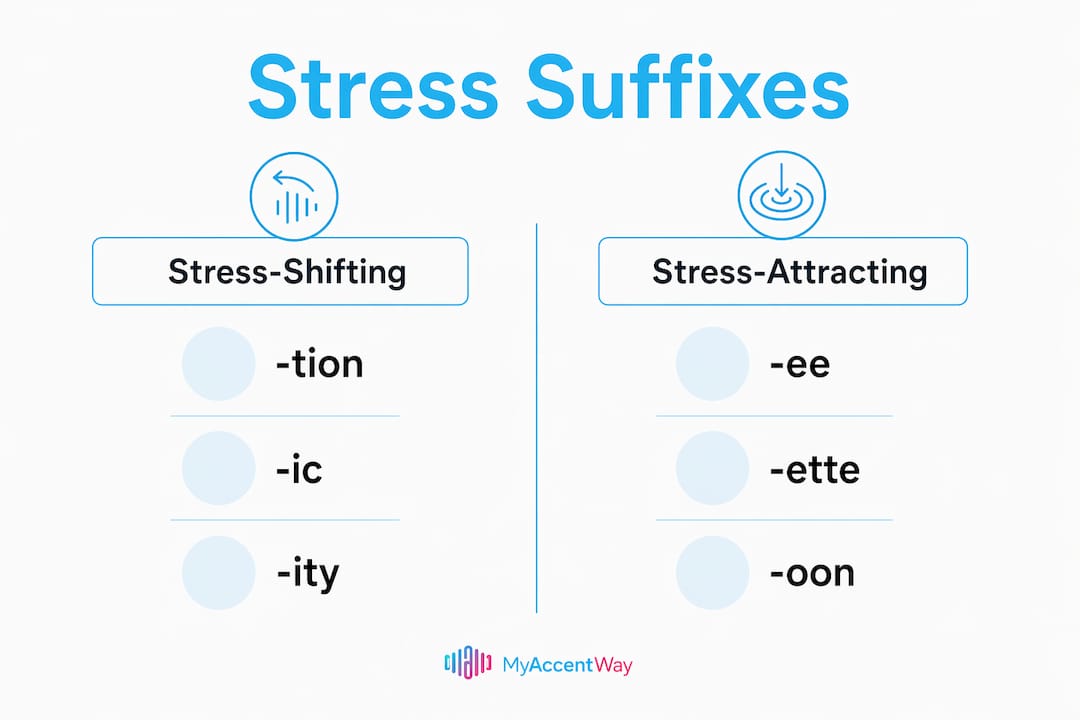
Suffixes are one of the most reliable tools for predicting stress in unfamiliar vocabulary. Two categories of suffixes operate in opposite ways, and knowing both gives you a significant advantage.
Category 1: Stress-shifting suffixes. These suffixes pull stress to the syllable immediately before them. The suffix itself does not receive the stress. The most common are -tion, -sion, -ic, -ical, and -ity. Suffixes like -tion and -ity reliably shift stress in words like eduCAtion, phoTOgraphic, and comMUnity. This pattern also explains why related word families sound different: PHOtograph shifts to phoTOgraphy when the suffix changes.
Category 2: Stress-attracting suffixes. These suffixes take primary stress directly onto themselves. Suffixes like -ee, -eer, -ese, and -ette always carry the main stress: employEE, voluntEER, japanESE, cigareTTE. This rule is highly consistent and comes from the French origin of these endings, which entered English with their original stress placement intact.
| Suffix type | Suffix examples | Stress location | Word examples |
|---|---|---|---|
| Stress-shifting | -tion, -sion, -ic, -ity | Syllable before suffix | eduCAtion, phoTOgraphic |
| Stress-attracting | -ee, -eer, -ese, -ette | On the suffix itself | employEE, voluntEER |
| Neutral (no shift) | -ous, -al, -ly, -er | First syllable (usually) | DAngerous, NAtural |
Exceptions exist, and they matter. Coffee ends in -ee but stresses the first syllable: COFfee. Etiquette ends in -ette but stresses the first syllable: ETiquette. These words entered English before the French stress rule became fixed. Dictionary stress marks remain the most reliable check when a word feels uncertain.
Pro Tip: Build a personal word list organized by suffix. Group words like employee, trainee, and refugee together. Hearing the pattern across multiple words trains your ear faster than studying each word in isolation.
How do American and British English stress patterns differ?
American and British English share the vast majority of their stress rules. The core patterns for nouns, verbs, adjectives, and suffixes work the same way in both varieties. The differences affect only a small subset of vocabulary.
American and British stress diverge in roughly 5% or fewer of common words. The differences that matter most for accent clarity include:
- Garage: Americans say ga-RAGE (stress on syllable two). British speakers say GAR-age (stress on syllable one).
- Advertisement: Americans say ad-ver-TISE-ment (stress on syllable three). British speakers say ad-VER-tise-ment (stress on syllable two).
- Weekend: Americans stress the second syllable: week-END. British speakers often stress the first: WEEK-end.
Beyond individual words, American English vowel reduction in unstressed syllables is broader and more consistent than in British English. American speakers compress unstressed syllables more aggressively, which gives American speech its characteristic rhythm and pace. For learners targeting an American accent, this reduction is not optional. It is a defining feature of how the language sounds.
The practical guidance is straightforward. Focus your study on American stress placement and American vowel reduction. When you encounter a word you have heard in British English, check an American dictionary for its stress mark before adopting the pronunciation.
What are the best strategies to master American English stress patterns?
Knowing the rules is the first step. Training your mouth and ear to produce them automatically is the real work. These four methods build that automaticity.
-
Use a dictionary with stress marks. Merriam-Webster marks primary stress with a bold mark (ˈ) before the stressed syllable. Make checking stress a habit every time you learn a new word. This confirms the rule and catches exceptions before they become errors.
-
Practice minimal pairs and word families. Compare REcord and reCORD out loud. Compare PHOtograph, phoTOgraphy, and photoGRAPHic as a set. Hearing the shift within a word family trains your ear to recognize stress as a meaningful signal, not just a pronunciation detail.
-
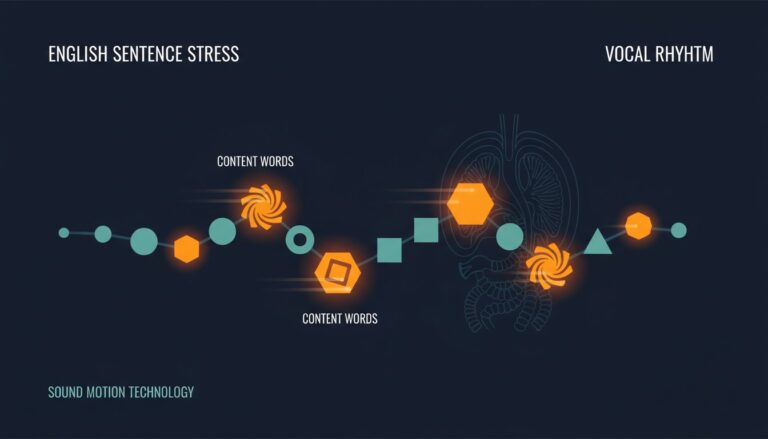
Work on sentence stress alongside word stress. Natural American rhythm depends on both word-level and sentence-level stress working together. Content words (nouns, main verbs, adjectives, adverbs) receive stress in sentences. Function words (articles, prepositions, auxiliary verbs) reduce. Practicing both levels together produces the connected, rhythmic sound of fluent American speech.
-
Use visual pronunciation technology. 2D Sound Motion Technology trains learners how the tongue, lips, jaw, and airflow move during each sound. Speech organ training gives learners a physical model to replicate, not just an audio model to imitate.
Pro Tip: Record yourself reading a paragraph aloud, then listen back and mark every word where your stress felt uncertain. Targeted repetition on those specific words produces faster improvement than general reading practice.
Mastering word stress improves intelligibility and perceived fluency more than perfecting individual vowels or consonants. That finding should reorder your practice priorities if you have been spending most of your time on individual sounds.
MyAccentWay · 2D Sound Motion Technology
American English Pronunciation: Consonant and Vowel Sounds with 2D Sound Motion Technology
Learning American English pronunciation and the American accent is more effective when you train your speech organs, not only listen and repeat. 2D Sound Motion Technology and Interactive Visual 2D Sound Simulators, developed in 2020 by Prof. Alex, Ph.D. Accent Coach, Doctor of Education, and professional linguist, as part of his interactive teaching model based on his Ph.D. research in interactive teaching methods, train your tongue, lips, jaw, teeth, airflow, and voice step by step. They train each American sound and more than 30 sound combinations through Interactive 2D video simulation.
What 2D Sound Motion Technology is
2D Sound Motion Technology is an advanced accent reduction and articulation training tool by Prof. Alex. It corrects, develops, and trains each American sound and more than 30 sound combinations through Interactive 2D video simulation.
What Interactive Visual 2D Sound Simulators do
Interactive Visual 2D Sound Simulators are part of 2D Sound Motion Technology, the articulation-training method Prof. Alex created by applying his Ph.D. research in interactive teaching to American pronunciation. Instead of listening and repeating, students actively train their speech organs. Each simulator uses Interactive 2D mouth movement to train the speech organs (tongue, lips, jaw, teeth, airflow, and voice) to produce each American sound correctly. Every consonant has its own simulator: explore American consonants trained with 2D Sound Motion Technology.
Sample training: the American t sound (aspirated [t])
Practice
Record yourself speaking these words:
Tab · Tacos · Time · Tub · Hotel · Motel · Sit · Pit · Net
Instructions
Play the Interactive Visual 2D Sound Simulator for the American t sound below several times and follow it step by step. Move your tongue, jaw, and airflow together with the simulator and train your articulation.
Interactive Visual 2D Sound Simulator: American unvoiced sound [t]
Practice
Record yourself again speaking these words, but this time focus on the movement of your tongue. Go slow, and you will hear the difference. You’ve got this!
Tab · Tacos · Time · Tub · Hotel · Motel · Sit · Pit · Net
How Interactive Visual 2D Sound Simulators solve pronunciation and speaking problems
- Wrong articulationMost pronunciation problems start with the tongue, lips, jaw, or teeth in the wrong position. Each Interactive Visual 2D Sound Simulator trains the correct articulation of one American sound, so the student corrects the cause of the problem, not only the result.
- Airflow and voicingMany accent problems come from wrong airflow or voicing: sounds that are too weak, too strong, or voiced when they should be unvoiced. The simulators train airflow and voice together with articulation, step by step, for each American sound and more than 30 sound combinations.
- Clear speech and confidenceWhen each sound is trained correctly, words connect into clear American English speech. Listeners can understand you more easily, and speaking at work, in meetings, and on calls becomes more confident.

If you start hearing the aspiration, the short airstream after [t], with one simulator, you can only imagine how successful you can be in 1-on-1 Interactive American Accent Training with Prof. Alex, Ph.D. Accent Coach, where your whole American sound system is trained sound by sound.
In MyAccentWay, the Interactive Visual 2D Sound Simulators are only available in 1-on-1 accent coaching sessions with Prof. Alex.
Key takeaways
Mastering American English stress patterns requires learning syllable-level rules, suffix behavior, and vowel reduction together as one integrated system.
| Point | Details |
|---|---|
| Two-syllable noun rule | About 80% of two-syllable nouns and adjectives stress the first syllable. |
| Noun-verb stress shift | The same word changes stress by part of speech: REcord (noun) vs. reCORD (verb). |
| Suffix-based prediction | Suffixes like -tion and -ity shift stress to the preceding syllable; -ee and -eer take stress directly. |
| American vowel reduction | Unstressed syllables in American English reduce aggressively, shaping the rhythm of natural speech. |
| Dictionary as final check | Suffix rules have exceptions; always confirm stress with a Merriam-Webster stress mark for unfamiliar words. |
Why stress patterns are the most underestimated skill in accent training
I have worked with hundreds of non-native professionals, and the pattern I see most often is this: students spend months perfecting individual sounds while their stress placement stays wrong. The result is speech that sounds careful but not natural. Listeners can follow it, but something feels off. That “something” is almost always stress.
The rules in this article are real and reliable. But rules alone do not produce fluent speech. What produces fluent speech is training your mouth to apply those rules without conscious thought, at full speaking speed, in real conversations. That is where most self-study programs fall short. They teach the rule but not the physical habit.
The learners I see make the fastest progress are the ones who combine rule knowledge with physical training. Vlad, a Russian speaker, is a strong example of what focused, structured training produces.
Stress is not decoration. It is the architecture of the word. Get it right, and your pronunciation clicks into place. Get it wrong, and even perfect vowels will not save you.
— Prof.
Train American stress patterns with Myaccentway
Myaccentway offers one-on-one American accent training led by Professor Alex, Ph.D., Linguist and Accent Coach. The program begins with a personalized assessment to identify your specific stress and rhythm errors, then builds a structured training plan around them. Professor Alex uses 2D Sound Motion Technology to train your tongue, lips, and jaw to move for each American sound, including stressed syllables. You train the physical movement, not just the audio memory. Book Your 1 Hour Evaluation Session to see your own speech patterns identified and addressed from the first session. You can also explore the full accent training course catalog to find the program that fits your goals and schedule.
American Intonation and Rhythm Training for Foreign-Born Professionals in the United States
Foreign-born professionals in the United States often know their field and speak advanced English. Yet American listeners may still struggle with their stress, rhythm, and intonation. MyAccentWay offers private online intonation training through Interactive American Accent Training.
Interactive American Accent Training is led by Prof. Alex, Ph.D. Accent Coach, Doctor of Education, and professional linguist. He first diagnoses each speaker’s native-language patterns. Then he trains American word stress, sentence stress, rhythm, and intonation for real meetings and presentations.
Who this training is for
- Engineers, IT specialists, and data professionals presenting to U.S. teams and clients
- Doctors, nurses, and healthcare professionals explaining care to American patients
- Managers, executives, and founders leading meetings, pitches, and briefings
- Consultants, researchers, and academics speaking at conferences and webinars
- Professionals preparing for interviews, promotions, or client-facing roles
Online training across the U.S.
MyAccentWay is based in Austin, Texas, and all training is online. The program is especially relevant for professionals in Austin, Dallas, Houston, New York City, the San Francisco Bay Area, Los Angeles, Seattle, Boston, Chicago, Miami, Washington DC, Atlanta, and Raleigh.
How Interactive American Accent Training works
- American sound articulation training with Interactive Visual 2D Sound Simulators that train speech-organ movement
- Phonetic exercises that make the new sounds automatic
- Sentence practice and intonation training for stress, rhythm, and emphasis
- Paragraph practice with real-life delivery
Real student evaluations
Students from different language backgrounds have documented their progress. Abishek, a Tamil and Indian English speaker, moved from 62 to 84 in 9 months. Tian, a Mandarin speaker, moved from 58 to 85 in 8 months. Vlad, a Russian speaker, moved from 60 to 83 in 5 months.
The first step is a 1 Hour Evaluation Session with Prof. Alex.
FAQ
What is word stress in American English?
Word stress is the emphasis placed on one syllable in a word through greater loudness, longer duration, and higher pitch. In American English, every word of two or more syllables has one primary stressed syllable.
How do I know which syllable to stress?
Start with the rule that about 80% of two-syllable nouns and adjectives stress the first syllable, while most two-syllable verbs stress the second. For longer words, check the suffix type and confirm with a Merriam-Webster dictionary stress mark.
Do American and British English stress the same words?
The two varieties share the same stress rules for the vast majority of words. Differences appear in a small set of words such as garage, advertisement, and weekend, where stress placement and vowel quality diverge.
Why does stress matter more than individual sounds?
Correct word stress improves intelligibility and perceived fluency more than perfecting individual vowels or consonants. Listeners rely on stress to identify word boundaries and meaning in connected speech.
What is the fastest way to improve stress patterns?
Combine rule study with physical training. Use a dictionary to confirm stress, practice word families with shifting stress, and use tools like 2D Sound Motion Technology to follow and replicate the mouth movements behind each stressed sound.
Recommended

Word Stress Rules in American English: A Linguist’s Guide to Speech Clarity
Mastering the word stress rules in american english is an effective way to achieve immediate speech clarity by emphasizing one primary syllable...


Sentence Stress in American English: The 2026 Guide to Natural Rhythm
Imagine standing in a high-stakes boardroom in 2024, presenting a breakthrough strategy, only to have your lead director ask you to repeat yourself...
Sentence Stress Rules: The Ultimate Guide to Sounding Natural in English
Have you ever spoken English with perfect grammar, only to be met with a confused look? You know the words are right, but something is missing-the...
The problem is not always grammar or vocabulary.
If people understand your words but still miss your message, the deeper issue may be speech clarity, rhythm, intonation, and American pronunciation habits. MyAccentWay helps students retrain the sound system with professional 1-on-1 guidance, so English can feel clearer, freer, and more natural in real communication.
Two training methods that make speech change active.
MyAccentWay is not passive listen-and-repeat coaching. Prof. Alex, Ph.D. Accent Coach, Doctor of Education, and professional linguist, creates a learning situation where students become active learners and active participants in changing their own speech patterns.
Interactive training
Students do not just receive pronunciation instructions passively. They listen, think, compare, adjust, and understand their own speech patterns while Prof. Alex guides the correction process.
Cognitive accent training
Students learn to notice and correct the speech patterns that affect American pronunciation, then implement new American speech patterns into their code-switching process for more natural, long-lasting change.
Build speech habits people can hear in real conversations.
A stronger American accent is not built by memorizing topics or chasing quick pronunciation tips. It comes from structured training, professional feedback, active correction, and repeated application until clearer speech becomes easier to keep.
Continue learning how MyAccentWay connects American sound articulation, Interactive Visual 2D Sound Simulators, accent reduction, student proof, and 1-on-1 training.
- Prof. Alex and the MyAccentWay MethodLearn how Prof. Alex, Ph.D. Accent Coach, Doctor of Education, and professional linguist, created and leads the structured MyAccentWay American accent training system.
- Accent Reduction Curriculum and English Articulation TrainingSee how MyAccentWay trains accent reduction, accent modification, American pronunciation, English articulation, rhythm, and professional speech clarity.
- 2D Sound Motion Technology for American Accent TrainingUnderstand Prof. Alex’s Interactive Visual 2D Sound Simulators for American sound articulation.
- Before-and-After American Accent Training ResultsListen to real before-and-after student proof and accent training outcomes.
- Student Reviews and Accent Training ResultsRead student reviews, testimonials, and trust signals from MyAccentWay learners.
- Book a 1-on-1 American 1 Hour Evaluation SessionStart with a 1-hour interactive American accent training session with Prof. Alex.