Andrew Pronunciation Evaluation for Russian Speakers
(512) 265-9515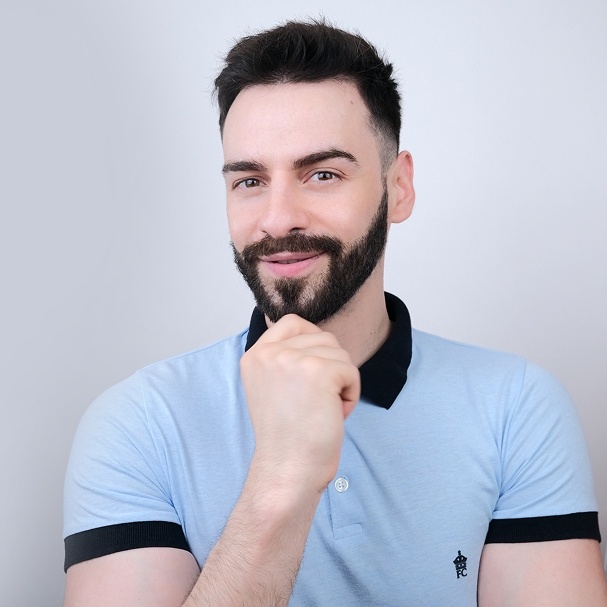
Updated October 11, 2026 ◆ 5 min read
This Andrew pronunciation evaluation shows how a Russian speaker reduced his Russian accent after 5 months of structured 1-on-1 American accent training with Prof. Alex, Ph.D. Accent Coach, Doctor of Education, and professional linguist. Andrew moved from 52/100 to 76/100, where 100 = native speaker. The before-and-after recordings and the sound-by-sound evaluation below explain exactly which Russian sound patterns changed.
Evaluation by Prof. Alex, Ph.D. Accent Coach, Doctor of Education, and professional linguist, based on Andrew’s before and after recordings of the same passage.
Andrew’s before-and-after pronunciation transformation
Overall American-sounding quality moved from 52/100 to 76/100 after 5 months of Interactive American Accent Training.
Real student result

AndrewRussian speaker
Interactive American Accent Training5monthsof hard work and dedication
Listen to the starting point0:00
Listen to the result0:00
“Many of my students once believed they could never sound like this. School taught them grammar and vocabulary, but not how to train their English speech. That is what we do together, step by step, until you speak English independently and with confidence.”
Listen to both recordings to hear the TH, W, H, R, T and vowel changes described in this evaluation.
What Andrew sounded like before and how he sounds now
Andrew read the same passage before and after 5 months of 1-on-1 American accent training with Prof. Alex. His overall American-sounding quality moved from 52/100 to 76/100, where 100 = native speaker. Prof. Alex listened to both recordings and evaluated the passage sound by sound.
| Word | Sound | Before training | After training |
|---|---|---|---|
| the | TH /ð/ | /z/: “za” | A voiced American TH /ð/ |
| water | W | /v/ in place of /w/: “voter” | A clear rounded-lip /w/ |
| water | T and R | A hard Russian /t/ and a tapped R: “wah-ter” | The American flap T and an R-colored ending: “wah-der” |
| hot | H and vowel | A harsh Russian /x/ and a rounded “o”: “khot” | A soft /h/ and an open American “ah”: “haht” |
| dehydrated | H and vowels | A harsh /x/ for H and flat vowels: “dee-khee-drah-ted” | A soft /h/ and full diphthongs: “dee-HAI-dray-ted” |
| street | R | A rolled Russian R | The American R /ɹ/ |
| bottle | Vowel and T | A rounded “o” and a hard /t/: “boh-tel” | An open “ah” and a flapped T: “bah-dul” |
Andrew’s recordings are almost the same length: 23.6 seconds before and 23.5 seconds after. His higher score comes from more accurate American sounds, not from reading faster.
What this means
Before training, Andrew’s English carried the classic Russian sound patterns: Z for TH, V for W, a harsh Russian H, a rolled R, a hard T and rounded Russian vowels. After 5 months of structured training, each of these moved to its American target: a voiced TH, a clear W, a soft H, the American R, the flap T and open American vowels. Together these changes took Andrew from 52/100 to 76/100, a gain of 24 points.
The American accent sound system for Russian speakers
Russian and American English use different speech-organ habits. Most Russian-accented features in English come from a small set of predictable patterns: sounds that do not exist in Russian, sounds Russian treats differently, and a different rhythm. The tables below are a training map for Russian speakers. They describe typical Russian-speaker patterns, not a diagnosis of any one student.
Consonants
| American sound | Example words | Typical Russian-speaker pattern | American target |
|---|---|---|---|
| TH /θ/ | think, three, month | /s/ or /t/: “sink”, “tree” | Tongue tip lightly between the teeth, air flows out, no voice |
| TH /ð/ | the, this, mother | /z/ or /d/: “za”, “dis” | Same tongue position as /θ/, with voice |
| W /w/ | west, water, wine | /v/: “vest”, “voter” | Rounded lips, no contact between teeth and lip |
| H /h/ | hot, house, hello | Harsh /x/ from the back of the mouth: “khot” | Soft breath from the throat, no friction in the mouth |
| American R /ɹ/ | red, street, car | Rolled or tapped R | Tongue pulled back and up, never touching the roof of the mouth |
| Aspirated P, T, K | pen, time, cat | No puff of air: “pen” sounds close to “ben” | A clear puff of air at the start of stressed syllables |
| Flap T /ɾ/ | water, better, city | Full hard /t/ | A quick tongue tap, close to a soft D: “wah-der” |
| Dark L /ɫ/ | full, milk, bottle | Too light, or too hard and Russian-like | Back of the tongue raised at the end of words |
| NG /ŋ/ | sing, thinking | /n/ or /ŋɡ/: “sin”, “singg” | Back of the tongue on the soft palate, no added G |
| Voiced final consonants | bed, dog, his, love | Final devoicing: “bet”, “dock”, “hiss”, “luff” | Keep the voice to the end of the word |
| Soft consonants | tea, dear, need | Russian-style softening (palatalization) before /i/ | Plain American consonants, no extra “y” quality |
Vowels
| American sound | Example pair | Typical Russian-speaker pattern | American target |
|---|---|---|---|
| /ɪ/ vs /i/ | ship / sheep, live / leave | One vowel for both | Short and relaxed /ɪ/; long and tense /i/ |
| /æ/ vs /ɛ/ | bad / bed, man / men | One vowel for both, close to Russian “э” | Jaw lower and tongue forward for /æ/ |
| /ʊ/ vs /u/ | full / fool, pull / pool | One vowel for both | Short and relaxed /ʊ/; long and rounded /u/ |
| /ɑ/ | hot, stop, job | Rounded Russian “о”: “khot” | Open, unrounded “ah”: “haht” |
| /ʌ/ | cup, love, money | Russian “а” | Short, central, relaxed vowel |
| Schwa /ə/ | about, banana, the | Every vowel pronounced fully | Weak syllables reduced to a short, neutral schwa |
| R-colored vowels /ɝ/, /ɚ/ | bird, work, water | A vowel plus a rolled R | One R-colored sound throughout the vowel |
| Diphthongs /eɪ/, /oʊ/ | day, go, drove | Flat single vowels | Full glide to the second part |
Stress, rhythm and intonation
| Feature | Typical Russian-speaker pattern | American target |
|---|---|---|
| Word stress | Stress on the wrong syllable in long words | Correct strong syllable: de-LIV-er, de-VICE, im-POR-tant |
| Sentence rhythm | Every word given similar weight | Content words strong, function words light and reduced |
| Weak forms | “to”, “for”, “and”, “can” said fully | Reduced: “tə”, “fər”, “ən”, “kən” |
| Linking | Words separated, with small breaks | Words connected smoothly: “drove_down”, “a_bottle_of” |
| Intonation | Flat or falling patterns that can sound serious or abrupt | Wider pitch movement that fits the meaning |
How Andrew trained in the structured American accent program
Andrew trained 1-on-1 with Prof. Alex for 5 months and followed the same structured MyAccentWay path every student follows:
- Evaluation session. Prof. Alex first evaluated Andrew’s speech and identified his native-language patterns: which Russian habits shaped his English sounds, stress and rhythm.
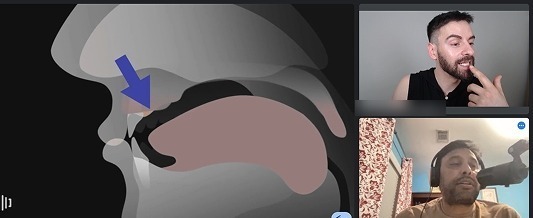
- American sound articulation. Andrew trained each American sound with Interactive Visual 2D Sound Simulators, which train the position and movement of the tongue, lips and jaw. For a Russian speaker, this stage targets the sounds that do not exist in Russian, such as TH, W, the American R and the short vowels.
- Phonetic exercises. Word-level exercises made the new sounds automatic, so the correct sound comes out without stopping to think.
- Sentence practice and intonation. Andrew trained word stress, sentence stress, rhythm, weak forms and linking.
- Paragraph practice. Andrew practiced full passages with real-life delivery, bringing the sounds, rhythm and intonation together in connected speech.
The result after 5 months: from 52/100 to 76/100, a gain of 24 points.
Important note
This is an accent-performance evaluation, not a measure of English proficiency or intelligence. Prof. Alex listened to both recordings and created this evaluation. The 76/100 score should not be read as “76% native.” It is a practical score used to describe the before-and-after change in American accent patterns.
Related reading: American accent training before and after results.
American Accent Training for Russian-Speaking Professionals in the United States
Foreign-born professionals in the United States often know their field and speak advanced English. Yet American listeners may still struggle with their sounds, stress, and rhythm. MyAccentWay offers private online American accent training through Interactive American Accent Training.
Interactive American Accent Training is led by Prof. Alex, Ph.D. Accent Coach, Doctor of Education, and professional linguist. He first diagnoses each speaker’s native-language patterns. Then he trains American sound articulation, stress, rhythm, and intonation for real meetings, calls, and presentations.
Who this training is for
- Engineers, IT specialists, and data professionals presenting to U.S. teams and clients
- Doctors, nurses, and healthcare professionals explaining care to American patients
- Managers, executives, and founders leading meetings, pitches, and briefings
- Consultants, researchers, and academics speaking at conferences and webinars
- Professionals preparing for interviews, promotions, or client-facing roles
Online training across the U.S.
MyAccentWay is based in Austin, Texas, and all training is online. The program is especially relevant for professionals in Austin, Dallas, Houston, New York City, the San Francisco Bay Area, Los Angeles, Seattle, Boston, Chicago, Miami, Washington DC, Atlanta, and Raleigh.
How Interactive American Accent Training works
- American sound articulation training with Interactive Visual 2D Sound Simulators that train speech-organ movement
- Phonetic exercises that make the new sounds automatic
- Sentence practice and intonation training for stress, rhythm, and emphasis
- Paragraph practice with real-life delivery
Real student evaluations
Real students have documented their progress. Andrew, a Russian speaker, moved from 52 to 76 in 5 months. Vlad, also a Russian speaker, moved from 60 to 83 in 5 months. Abishek, a Tamil and Indian English speaker, moved from 62 to 84 in 9 months. Tian, a Mandarin speaker, moved from 58 to 85 in 8 months. Alain, a Nigerian English speaker, moved from 57 to 72 in 8 months.
The first step is a 1 Hour Evaluation Session with Prof. Alex.
MyAccentWay · 2D Sound Motion Technology
American English Pronunciation: Consonant and Vowel Sounds with 2D Sound Motion Technology
Learning American English pronunciation and the American accent is more effective when you train your speech organs, not only listen and repeat. 2D Sound Motion Technology and Interactive Visual 2D Sound Simulators, developed in 2020 by Prof. Alex, Ph.D. Accent Coach, Doctor of Education, and professional linguist, as part of his interactive teaching model based on his Ph.D. research in interactive teaching methods, train your tongue, lips, jaw, teeth, airflow, and voice step by step. They train each American sound and more than 30 sound combinations through Interactive 2D video simulation.
What 2D Sound Motion Technology is
2D Sound Motion Technology is an advanced accent reduction and articulation training tool by Prof. Alex. It corrects, develops, and trains each American sound and more than 30 sound combinations through Interactive 2D video simulation.
What Interactive Visual 2D Sound Simulators do
Interactive Visual 2D Sound Simulators are part of 2D Sound Motion Technology, the articulation-training method Prof. Alex created by applying his Ph.D. research in interactive teaching to American pronunciation. Instead of listening and repeating, students actively train their speech organs. Each simulator uses Interactive 2D mouth movement to train the speech organs (tongue, lips, jaw, teeth, airflow, and voice) to produce each American sound correctly. Every consonant has its own simulator: explore American consonants trained with 2D Sound Motion Technology.
Sample training: the American t sound (aspirated [t])
Practice
Record yourself speaking these words:
Tab · Tacos · Time · Tub · Hotel · Motel · Sit · Pit · Net
Instructions
Play the Interactive Visual 2D Sound Simulator for the American t sound below several times and follow it step by step. Move your tongue, jaw, and airflow together with the simulator and train your articulation.
Interactive Visual 2D Sound Simulator: American unvoiced sound [t]
Practice
Record yourself again speaking these words, but this time focus on the movement of your tongue. Go slow, and you will hear the difference. You’ve got this!
Tab · Tacos · Time · Tub · Hotel · Motel · Sit · Pit · Net
How Interactive Visual 2D Sound Simulators solve pronunciation and speaking problems
- Wrong articulationMost pronunciation problems start with the tongue, lips, jaw, or teeth in the wrong position. Each Interactive Visual 2D Sound Simulator trains the correct articulation of one American sound, so the student corrects the cause of the problem, not only the result.
- Airflow and voicingMany accent problems come from wrong airflow or voicing: sounds that are too weak, too strong, or voiced when they should be unvoiced. The simulators train airflow and voice together with articulation, step by step, for each American sound and more than 30 sound combinations.
- Clear speech and confidenceWhen each sound is trained correctly, words connect into clear American English speech. Listeners can understand you more easily, and speaking at work, in meetings, and on calls becomes more confident.
If you start hearing the aspiration, the short airstream after [t], with one simulator, you can only imagine how successful you can be in 1-on-1 Interactive American Accent Training with Prof. Alex, Ph.D. Accent Coach, where your whole American sound system is trained sound by sound.
In MyAccentWay, the Interactive Visual 2D Sound Simulators are only available in 1-on-1 accent coaching sessions with Prof. Alex.
FAQ: Andrew Pronunciation Evaluation for Russian Speakers
How can a Russian speaker lose their accent in English?
By training the specific sounds and rhythm that Russian shapes differently: TH, W, H, the American R, the flap T, short vowels and stress-timed rhythm. Andrew trained these 1-on-1 with Prof. Alex in a structured program and moved from 52/100 to 76/100 in 5 months.
What sounds are hardest for Russian speakers in American English?
The most common are TH (said as Z, S, D or T), W (said as V), H (said as a harsh Russian /x/), the American R (rolled instead), the flap T in words like water, and vowel pairs such as ship/sheep, bad/bed and full/fool.
How long does Russian accent reduction take?
It depends on the speaker and the training. Andrew, a Russian speaker, moved from 52/100 to 76/100 after 5 months of structured 1-on-1 training. Vlad, another Russian speaker, moved from 60/100 to 83/100 in 5 months.
Who created this evaluation?
Prof. Alex, Ph.D. Accent Coach, Doctor of Education, and professional linguist. It is based on Andrew’s before and after recordings of the same passage.
Does 76/100 mean Andrew sounds 76% native?
No. It is a practical accent-performance score where 100 = native speaker. It is not a measure of English proficiency or intelligence.
How can I get my own evaluation?
Book the 1 Hour Evaluation Session with Prof. Alex.
Related MyAccentWay resources
Interactive 1-on-1 vs Traditional Accent Coaching
How Prof. Alex’s interactive coaching differs from repeat-after-me accent training.

Best Accent Reduction Coaching for Business Professionals
What business professionals should look for in accent reduction and communication training.
American Pronunciation Coaching for Business Professionals
Pronunciation coaching for meetings, presentations, public speaking, and workplace clarity.
Best American Accent Coach for Non-Native Professionals
What 1-on-1 American accent training with Prof. Alex includes.
2D Sound Motion Technology for American Pronunciation
How Interactive Visual 2D Sound Simulators train American pronunciation.

MyAccentWay vs Accent Advisor
How Prof. Alex’s method differs from traditional live 1-on-1 video lessons.

Prof. Alex’s Teaching Philosophy
Why traditional accent coaching fails and what works instead.
Before-and-After Results
Real student recordings, including Abishek, Tian, Vlad, Alain, and Andrew.
Student Reviews and Results
Reviews and results from MyAccentWay students.