Tongue Twisters With Pronunciation: A Sound-by-Sound Practice Guide
(512) 265-9515Updated October 14, 2026 ◆ 20 min read
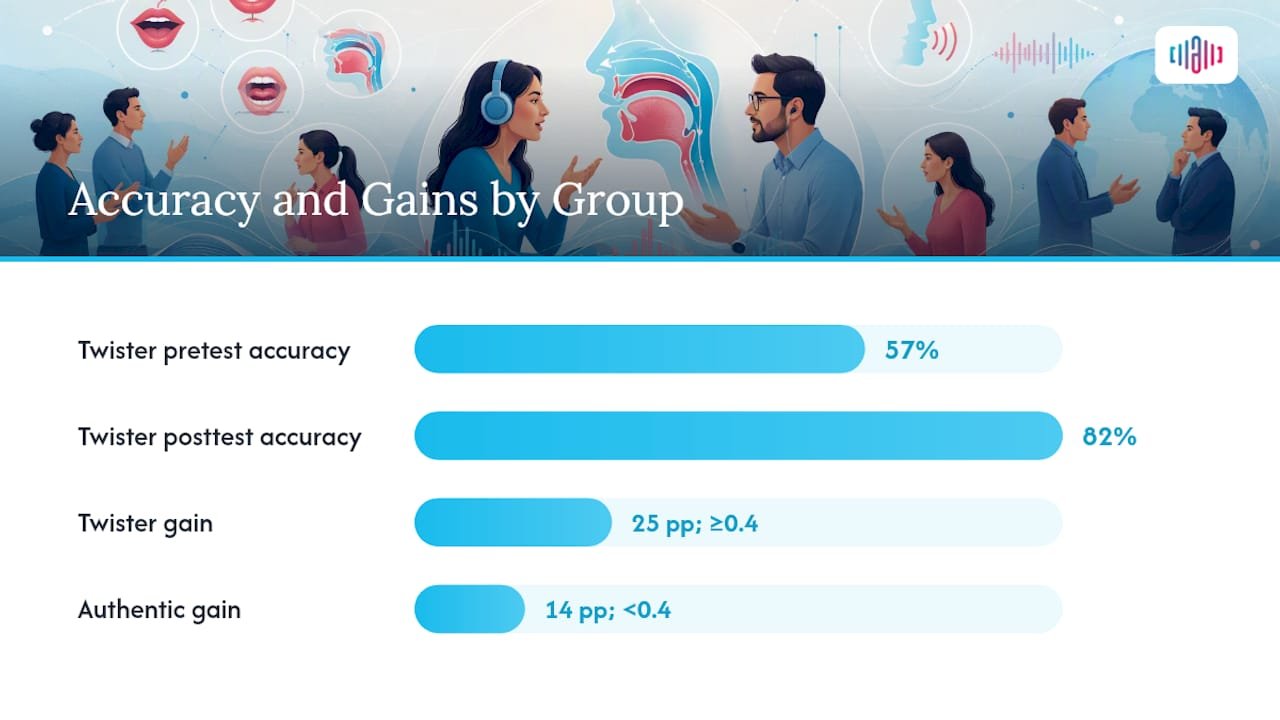
Use “Peter Piper,” “She sells seashells,” “Red lorry, yellow lorry,” “Betty Botter,” “Toy boat,” and “How much wood” as your core practice set. Each one isolates a distinct trouble spot for American English learners: /p/ versus /b/ plosive control, /s/ versus /ʃ/, /r/ versus /l/, vowel and consonant clusters around /t/ and /ɔɪ/, and the rounded /ʊ/ to /ʊd/ transition. A teaching experiment by Tergujeff and Kuronen found that learners who trained specifically with tongue twisters improved their correct production from 57% to 82%, a 25 percentage-point gain that outpaced a comparison group working with ordinary sentences. That is a big enough shift to cross Hattie’s 0.4 effect-size threshold for an educational intervention worth taking seriously, even accounting for the study’s small sample.
Real student result

“I feel confident enough to speak American English!”
Interactive American Accent Training9monthsof hard work and dedication
Listen to the starting point0:00
Listen to the result0:00
“Many of my students once believed they could never sound like this. School taught them grammar and vocabulary, but not how to train their English speech. That is what we do together, step by step, until you speak English independently and with confidence.”
Abishek’s result was achieved through Prof. Alex’s research-based Interactive 1-on-1 American Accent Training. His doctoral research found this interactive method more effective than traditional, teacher-centered methods. See the research basis →
None of that means twisters work by accident or by brute repetition. They work when you isolate the sound, slow it down, and rebuild speed only after the mouth has learned the correct shape. That progression, along with a practice-first breakdown of each phoneme, is what the rest of this guide walks through.
Here is your starting shortlist and what each phrase actually trains:
- “Peter Piper picked a peck of pickled peppers” → aspirated /p/ and plosive control
- “She sells seashells by the seashore” → /s/ versus /ʃ/ discrimination
- “Red lorry, yellow lorry” → /r/ versus /l/ liquid contrast
- “Betty Botter bought some butter” → /t/ flapping and vowel precision
- “How much wood would a woodchuck chuck” → /ʊ/ rounding and /w/ onset
- “Toy boat, toy boat, toy boat” → diphthong /ɔɪ/ and /oʊ/ under speed pressure
- “Fred fed Ted bread” → /f/, /d/, /r/ cluster sequencing
Once you know your target sound, jump to the practice template later in this guide: slow, then segmented, then a tempo build, capped at 15 focused minutes per session.
Tongue Twisters With Pronunciation Guidance, Sound by Sound
Each twister below includes the phrase, a phonetic cue, the sound it targets, and a three-step drill. Work through the groups in order if you are new to focused pronunciation practice; jump straight to Advanced if you already have solid consonant control and want more demanding sequencing.
Beginner: single-sound isolation
Peter Piper picked a peck of pickled peppers
Phonetic cue: /ˈpitər ˈpaɪpər pɪkt ə pɛk əv ˈpɪkəld ˈpɛpərz/
Target sound: aspirated /p/, repeated at the start of eight syllables.
Slow segmented version: Pea. Ter. Pie. Per. Pick. Say each syllable with a visible puff of air on the /p/. Hold a piece of paper an inch from your lips. It should move on every /p/.
Three-step progression: (1) Isolate: say “puh, puh, puh” ten times with full aspiration. (2) Combine: say “Peter Piper” slowly, five times. (3) Tempo: say the full line at conversational speed, three times.
Common error: swallowing the aspiration mid-phrase as fatigue sets in, so the later /p/ sounds turn into weak, unaspirated stops.

Betty Botter bought some butter
Phonetic cue: /ˈbɛti ˈbɑtər bɔt sʌm ˈbʌtər/
Target sound: American /t/ flapping (the “d” sound American speakers make in the middle of “butter” and “Betty”) plus the /ɑ/ versus /ʌ/ vowel contrast.
Slow segmented version: Bet. Ee. Bot. Er. Practice the flap by saying “budder” consciously, then “butter” naturally. The tongue tap should feel almost identical to a quick /d/.
Three-step progression: (1) Isolate the flap in “city,” “water,” “little.” (2) Combine into “Betty Botter.” (3) Build to the full line, focusing on keeping the /ɑ/ in “Botter” distinct from the /ʌ/ in “butter.”
Common error: over-articulating the /t/ as a hard stop, which sounds formal and non-native in casual American speech.
Intermediate: sound pairs and contrast
She sells seashells by the seashore
Phonetic cue: /ʃi sɛlz ˈsiʃɛlz baɪ ðə ˈsiʃɔr/
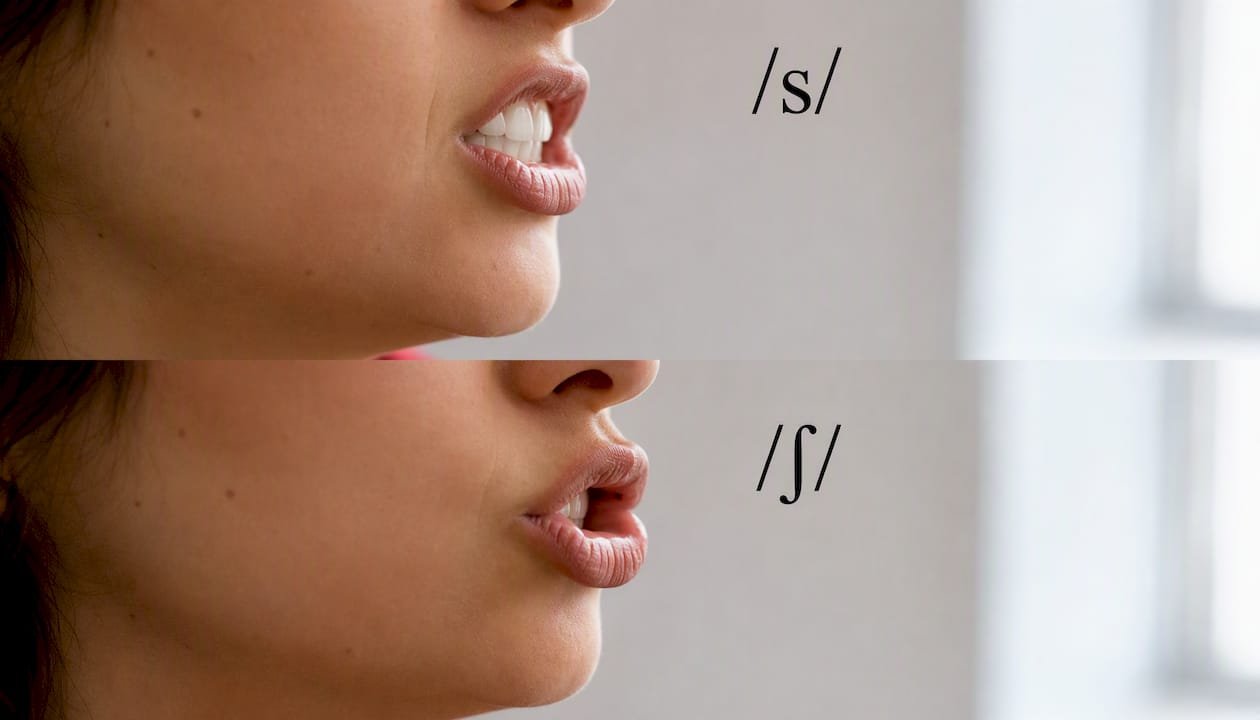
Target sound: /s/ versus /ʃ/, the single most common confusion pair for learners whose first language does not distinguish these fricatives.
Slow segmented version: Break “seashells” into “sea” and “shells” separately before joining them. For /s/, the tongue tip sits just behind the top teeth with a narrow channel. For /ʃ/, the tongue pulls back slightly and the lips round forward.
Three-step progression: (1) Isolate: alternate “sss, shh, sss, shh” for 20 seconds, exaggerating the lip movement for /ʃ/. (2) Combine: say “she sells” and “seashells” as separate chunks, five times each. (3) Tempo: build to full-speed delivery, watching for the /s/ sliding into /ʃ/ under speed.
Common error: letting the /s/ in “sells” drift toward /ʃ/ once the tongue tires, especially in the third repetition of “seashells.”
Red lorry, yellow lorry
Phonetic cue: /rɛd ˈlɔri ˈjɛloʊ ˈlɔri/
Target sound: /r/ versus /l/, a contrast that trips up speakers of Japanese, Korean, and several other languages where the two sounds overlap.
Slow segmented version: For /r/, the tongue tip curls back without touching the roof of the mouth. For /l/, the tongue tip presses firmly against the ridge behind the top teeth. Say “red” and “lorry” ten times each in isolation before combining.
Three-step progression: (1) Isolate: alternate “rrr, lll” until the tongue positions feel distinct, not just sound distinct. (2) Combine: “red lorry” then “yellow lorry” as separate two-word chunks. (3) Tempo: repeat the full phrase five times, increasing speed only when the first three repetitions come out clean.
Common error: blending /r/ and /l/ into a single intermediate sound under speed, which is the exact failure mode this twister is built to expose.
How much wood would a woodchuck chuck
Phonetic cue: /haʊ mʌtʃ wʊd wʊd ə ˈwʊdtʃʌk tʃʌk/
Target sound: /ʊ/ rounding and the /w/ glide onset, plus repeated /d/ and /tʃ/ endings that force rhythm control.
Slow segmented version: Round your lips fully before starting each /w/. Say “wood” in isolation five times, checking that your lips form a small circle before the vowel begins.
Three-step progression: (1) Isolate “wood” and “would” as a minimal pair. (2) Combine into “how much wood.” (3) Add the full tail “would a woodchuck chuck” at a slower tempo before building speed.
Common error: flattening the lip rounding on /w/ so it sounds closer to a plain vowel start, losing the glide.
Advanced: clusters and sequencing under speed
Toy boat, toy boat, toy boat
Phonetic cue: /tɔɪ boʊt tɔɪ boʊt tɔɪ boʊt/
Target sound: the diphthongs /ɔɪ/ and /oʊ/ repeated back to back, which forces the jaw and tongue to reset quickly between two different glide directions.
Slow segmented version: Say “toy” and hold the glide from /ɔ/ to /ɪ/ deliberately slow. Do the same for “boat,” gliding from /o/ to /oʊ/.
Three-step progression: (1) Isolate each diphthong separately, five repetitions. (2) Combine “toy boat” once, slowly. (3) Repeat three times at increasing speed, since the phrase’s difficulty comes entirely from repetition, not vocabulary.
Common error: the phrase collapses into “toy bot” or “toy boyt” once speed increases, because the tongue takes a shortcut between the two diphthongs.
Fred fed Ted bread, and Ted fed Fred bread
Phonetic cue: /frɛd fɛd tɛd brɛd ænd tɛd fɛd frɛd brɛd/
Target sound: /fr/ and /br/ consonant clusters combined with /d/ endings and a name-swap structure that punishes any lapse in sequencing attention.
Slow segmented version: Isolate “fr” and “br” as onset clusters before attaching a vowel: “fruh,” “bruh.” Then build “Fred,” “fed,” “Ted,” “bread” as separate one-syllable units.
Three-step progression: (1) Isolate the two clusters. (2) Combine “Fred fed Ted” as one chunk. (3) Add “bread, and Ted fed Fred bread,” building tempo only after three clean slow passes.
Common error: swapping the names under speed pressure, a sign the sequencing, not the sounds themselves, needs more segmented practice.
Pro Tip: Record every “tempo” repetition on your phone, not just your slow ones. Mistakes that vanish at slow speed almost always reappear under time pressure, and you can’t fix what you don’t hear played back.
After each block, run five repetitions targeting the group’s hardest segment alone, then three full-sentence attempts at your natural speaking speed. For a deeper phoneme-by-phoneme breakdown of these same twisters inside a full American accent training context, see this linguist’s guide to mastering American English.
How Do You Practice Tongue Twisters the Right Way?
The twister itself does almost none of the work. What changes your pronunciation is the structure you wrap around it: warm-up, isolation, segmented drilling, recombination, and only then, speed. Practitioner guidance from italki’s pronunciation coaches makes the same point directly. Slow, accurate repetition builds better motor patterns than rushing for speed, and isolating the problem syllable before drilling the full phrase produces more durable gains than repeating the whole sentence over and over.
Here is the session template, built for a 15-minute focused block:
- Warm-up (1 to 2 minutes). Loosen your jaw and lips with a few exaggerated vowel stretches. This is not optional theater. Cold articulators produce sloppier consonants for the first several repetitions of any drill.
- Isolate the target sound (2 to 3 minutes). Pull the specific phoneme or transition out of the twister and drill it alone, the way you saw in the “isolate” step above.
- Segment the phrase (3 to 4 minutes). Break the twister into two or three chunks and say each chunk slowly, five times, before joining them.
- Recombine at slow speed (2 to 3 minutes). Say the full twister slowly, aiming for three consecutive correct repetitions before moving on.
- Increase tempo gradually (3 to 4 minutes). Add speed in small increments. If you make an error, drop back to the previous speed rather than pushing through.
- Transfer to context (1 minute). Say a short unscripted sentence using the same target sound, so the drill doesn’t stay locked inside the twister’s specific wording.
Work on two to three twisters per session, not five or six. Practical pedagogy research on learner motivation backs this up: short, varied sessions sustain attention and reduce frustration far better than long, monotonous drilling, and the same principle behind spaced repetition in pronunciation learning applies directly here. A twister practiced for five focused minutes today and five more tomorrow builds stronger muscle memory than twenty minutes crammed into one sitting.
The single rule most learners break: they increase speed before earning it. The correct rule is that speed only increases after three consecutive correct slow repetitions. If the fourth repetition breaks down, you go back to slow, not sideways to “a little faster than before.”
Pro Tip: Set up your phone to film your mouth from the side, not just record audio. Seeing whether your lips actually round for /w/ or your tongue tip actually reaches the ridge for /l/ often reveals the real problem faster than listening alone. If self-recording isn’t giving you clear enough feedback on tongue or lip position, an articulatory tool like 2D Sound Motion Technology trains tongue and lip movements from the inside, which is often the missing piece for stubborn errors.
MyAccentWay · 2D Sound Motion Technology
American English Pronunciation: Consonant and Vowel Sounds with 2D Sound Motion Technology
Learning American English pronunciation and the American accent is more effective when you train your speech organs, not only listen and repeat. 2D Sound Motion Technology and Interactive Visual 2D Sound Simulators, developed in 2020 by Prof. Alex, Ph.D. Accent Coach, Doctor of Education, and professional linguist, as part of his interactive teaching model based on his Ph.D. research in interactive teaching methods, train your tongue, lips, jaw, teeth, airflow, and voice step by step. They train each American sound and more than 30 sound combinations through Interactive 2D video simulation.
What 2D Sound Motion Technology is
2D Sound Motion Technology is an advanced accent reduction and articulation training tool by Prof. Alex. It corrects, develops, and trains each American sound and more than 30 sound combinations through Interactive 2D video simulation.
What Interactive Visual 2D Sound Simulators do
Interactive Visual 2D Sound Simulators are part of 2D Sound Motion Technology, the articulation-training method Prof. Alex created by applying his Ph.D. research in interactive teaching to American pronunciation. Instead of listening and repeating, students actively train their speech organs. Each simulator uses Interactive 2D mouth movement to train the speech organs (tongue, lips, jaw, teeth, airflow, and voice) to produce each American sound correctly. Every consonant has its own simulator: explore American consonants trained with 2D Sound Motion Technology.
Sample training: the American t sound (aspirated [t])
Practice
Record yourself speaking these words:
Tab · Tacos · Time · Tub · Hotel · Motel · Sit · Pit · Net
Instructions
Play the Interactive Visual 2D Sound Simulator for the American t sound below several times and follow it step by step. Move your tongue, jaw, and airflow together with the simulator and train your articulation.
Interactive Visual 2D Sound Simulator: American unvoiced sound [t]
Practice
Record yourself again speaking these words, but this time focus on the movement of your tongue. Go slow, and you will hear the difference. You’ve got this!
Tab · Tacos · Time · Tub · Hotel · Motel · Sit · Pit · Net
How Interactive Visual 2D Sound Simulators solve pronunciation and speaking problems
- Wrong articulationMost pronunciation problems start with the tongue, lips, jaw, or teeth in the wrong position. Each Interactive Visual 2D Sound Simulator trains the correct articulation of one American sound, so the student corrects the cause of the problem, not only the result.
- Airflow and voicingMany accent problems come from wrong airflow or voicing: sounds that are too weak, too strong, or voiced when they should be unvoiced. The simulators train airflow and voice together with articulation, step by step, for each American sound and more than 30 sound combinations.
- Clear speech and confidenceWhen each sound is trained correctly, words connect into clear American English speech. Listeners can understand you more easily, and speaking at work, in meetings, and on calls becomes more confident.

If you start hearing the aspiration, the short airstream after [t], with one simulator, you can only imagine how successful you can be in 1-on-1 Interactive American Accent Training with Prof. Alex, Ph.D. Accent Coach, where your whole American sound system is trained sound by sound.
In MyAccentWay, the Interactive Visual 2D Sound Simulators are only available in 1-on-1 accent coaching sessions with Prof. Alex.
Which Sound Does Each Twister Actually Train?
Matching a twister to your specific trouble sound saves you from practicing phrases that don’t address your real problem. Here is a direct map from common American English confusion pairs to the twisters that train them, plus a quick articulatory cue for each.
- /s/ vs. /ʃ/ → “She sells seashells.” Cue: for /s/, tongue tip close behind the top teeth, narrow airflow channel; for /ʃ/, tongue pulls back and lips round forward. Minimal pair to drill alongside it: “sip” vs. “ship.”
- /r/ vs. /l/ → “Red lorry, yellow lorry.” Cue: /r/ curls the tongue tip back without contact; /l/ presses the tip firmly against the ridge behind the top teeth. Minimal pair: “right” vs. “light.”
- Voiced /ð/ vs. voiceless /θ/ → practice with “This thin thread” (a short custom drill, not a classic twister, but effective). Cue: tongue tip lightly between the teeth for both; /ð/ vibrates the vocal cords, /θ/ does not. Minimal pair: “then” vs. “thin.”
- /æ/ vs. /ɑ/ → “Betty Botter bought some butter.” Cue: /æ/ pulls the jaw down and forward with a wide mouth shape; /ɑ/ drops the jaw straight down with a rounder back position. Minimal pair: “cat” vs. “cot.”
- /p/, /b/, /t/, /d/ plosive clusters → “Peter Piper” and “Fred fed Ted bread.” Cue: voiceless plosives (/p/, /t/) release with a burst of air; voiced ones (/b/, /d/) release with the vocal cords already vibrating. Minimal pair: “pat” vs. “bat.”
- /ʊ/ rounding and /w/ onset → “How much wood would a woodchuck chuck.” Cue: round the lips into a small circle before the vowel starts, don’t let the glide flatten into a plain vowel.
- /ɔɪ/ and /oʊ/ diphthongs → “Toy boat.” Cue: let the tongue and jaw glide fully from the first vowel position to the second; a “clipped” diphthong sounds rushed and unclear to American listeners.
The International Phonetic Association’s chart remains the standard cross-language reference if you want to see exactly where each of these sounds sits on the tongue-height and place-of-articulation grid. For the mechanics behind why tongue and lip position matter this much, see this breakdown of mouth articulation training.
Do Tongue Twisters Actually Improve Pronunciation?
Yes, with real limits worth knowing before you build a practice plan around them. The clearest evidence comes from a 2023 teaching experiment that put two matched groups of learners through a controlled comparison. One group drilled with tongue twisters; the other worked with ordinary authentic sentences targeting the same sounds.
The tongue-twister group’s correct production rose from 57% to 82%, a 25 percentage-point gain, compared to a 14 percentage-point gain in the authentic-sentence group. The twister group’s effect size crossed Hattie’s 0.4 threshold, the benchmark researchers use to flag an intervention as educationally meaningful rather than a marginal fluctuation.
That is a genuinely useful finding, but it comes from a small study, and the researchers themselves caution that sample size limits how confidently the result generalizes. A broader literature review on tongue-twister strategies echoes this: multiple smaller classroom studies report gains in accuracy, fluency, and learner motivation, but the overall evidence base is still thinner than for more established methods like explicit phonetic instruction.
Motor-level research adds a second layer. A study using ultrasound and oral diadochokinesis (ODK) measures tracked how tongue-twister training changed actual tongue movement for the sounds /ta/ and /ka/ over one to seven months. The result was sound-specific: repetition rate for /ta/ increased notably after just one month, while /ka/ showed refined motor precision rather than faster raw repetition, and both patterns held at the seven-month mark.
| Measure | Group 1 (Tongue Twisters) | Group 2 (Authentic Sentences) |
|---|---|---|
| Pretest accuracy | 57% | Comparable baseline |
| Posttest accuracy | 82% | 14-point gain overall |
| Gain | 25 percentage points | 14 percentage points |
| Effect size | Crossed Hattie’s 0.4 threshold | Below threshold |
Separately, articulatory-target training research found that real-time motor feedback on tongue position improved both production and perception of the vowel /æ/ in learners whose first language lacks that sound. This matters practically: twister drilling alone trains the motor pattern, but if you can’t perceive the target sound accurately in the first place, visual or articulatory feedback closes that gap faster than repetition alone.
The practical recommendation, drawn across these sources, is straightforward. Use tongue twisters for phonemes and clusters you can already hear correctly but struggle to produce consistently. If a sound genuinely sounds the same to you as its target, no amount of twister repetition will fix that. That’s a perception problem, and it usually needs articulatory feedback, a trained ear correcting you in real time, or both.
Common Mistakes That Waste Your Tongue-Twister Practice
Most learners who feel twister practice “doesn’t work” are making one of a handful of avoidable errors. Fix these and the same ten minutes of daily practice becomes dramatically more productive.
- Rushing for speed too early. Speed exposes weaknesses; it does not build accuracy. Fix: stay slow until you get three clean repetitions in a row, every time.
- Never isolating the actual transition. Repeating the whole twister without ever drilling the specific syllable pair that trips you up wastes most of your session. Fix: identify the exact two sounds that break down and drill just those in isolation first.
- Ignoring voicing. Confusing /s/ and /z/, or /f/ and /v/, often isn’t a tongue-placement problem at all. It’s a vocal-cord timing problem. Fix: place a hand on your throat and feel for the vibration difference before you drill the full phrase.
- Choosing twisters with unfamiliar vocabulary. If you’re decoding word meaning while trying to fix pronunciation, you’re splitting attention across two hard tasks at once. Fix: pick twisters where every word is already familiar, so your full focus goes to articulation.
- Sessions that run too long. Twenty or thirty minutes of monotonous repetition breeds fatigue, not accuracy, and fatigue produces sloppier articulation, not sharper. Fix: cap sessions at 15 minutes and stop even if you feel like continuing.
Pro Tip: If a twister feels impossible on day one, simplify it. Drop “Peter Piper picked a peck of pickled peppers” down to just “Peter picked peppers” until the plosive control feels automatic, then rebuild the full phrase. Repeating the same simplified twister across several sessions until it becomes automatic beats abandoning it out of frustration.
If accuracy hasn’t improved after a full week of consistent practice, that’s your signal to change approach, not to keep pushing the same drill harder. At that point, minimal-pair practice targeting the specific contrast, or live feedback from Interactive 1-on-1 Accent Training, tends to break through where solo repetition has stalled.
Where Tongue Twisters Fit in a Real Accent Training Plan
I recommend tongue twisters constantly, but always for a specific reason, never as a stand-alone fix. They earn their place when a learner has a diagnosed, segment-level issue: a consistent /r/-for-/l/ substitution, a flattened diphthong, a plosive that never gets fully aspirated. In those cases, the repetitive structure of a twister does something ordinary conversation practice can’t: it forces the same sound transition to occur ten or fifteen times in thirty seconds, which builds the muscle memory faster than waiting for that sound to show up naturally in speech.
Where twisters fall short is anything involving rhythm, sentence stress, intonation, or connected speech across a full conversation. Those patterns don’t live inside an isolated phrase; they live in how you link words together across a real sentence, under real conversational pressure. That’s a different training problem, and it’s exactly why MyAccentWay was never built as a “repeat after me” program. Repetition alone doesn’t tell a learner why a correction works, and it rarely transfers past the drilled phrase.
Our American Accent Training Program combines targeted phoneme drills like the ones in this guide with Cognitive Accent Training, which helps you recognize your own speech patterns and understand the mechanics behind each correction rather than just imitating a sound. For sounds that resist correction through audio drilling alone, we use 2D Sound Motion Technology, interactive visual simulators that guide tongue, lip, and jaw movement in ways a mirror or a recording never can. You can practice with them in this short
For professionals preparing for interviews, presentations, or client calls, the highest-value combination is targeted twister drills for your specific weak sounds, paired with structured 1-on-1 coaching that addresses rhythm and intonation at the sentence and conversation level. Twisters handle the sound. Coaching handles the sentence. You need both to sound genuinely clearer, not just technically correct.
Turn Tongue Twister Practice Into Measurable Progress
Tongue twisters are one of the fastest tools for isolating a stuck sound, but on their own, they can’t tell you whether your /r/ actually reached the target position or just sounded close enough to your own ear. That gap, between what you think you’re producing and what a listener actually hears, is precisely what a trained coach identifies in minutes.

MyAccentWay is built around Interactive 1-on-1 Accent Training with Prof. Alex, not a “repeat after me” model. Every session starts with a real diagnostic of your specific sound patterns, followed by Cognitive Accent Training that helps you understand why a correction works, so the change sticks in real conversation, not just inside a drilled phrase. For sounds that resist correction through listening alone, we use 2D Sound Motion Technology, interactive visual simulators that train the precise tongue and lip movements you need.
If you’ve been drilling twisters on your own and want to know which specific sounds are actually holding your clarity back, Book Your 1 Hour Evaluation Session and get a real diagnostic instead of guessing. You can also review the full American Accent Training Program curriculum, or see how other professionals describe their progress in our student reviews and results.
Sources
- Teaching classic put to the test: Do tongue twisters work for L2 pronunciation? – Tergujeff & Kuronen (Foreign Language Annals)
- Improvement of speech perception following articulatory-target based production training for second language acquisition (Frontiers, 2026)
- Can Tongue Twisters Help Your Pronunciation? Benefits, Examples, and Practice Tips – italki
American Articulation Training for Foreign-Born Professionals in the United States
Foreign-born professionals in the United States often know their field and speak advanced English. Yet American listeners may still struggle with the clarity of their sounds. MyAccentWay offers private online articulation training through Interactive American Accent Training.
Interactive American Accent Training is led by Prof. Alex, Ph.D. Accent Coach, Doctor of Education, and professional linguist. He first diagnoses each speaker’s native-language patterns. Then he trains American sound articulation and speech-organ movement for real meetings and presentations.
Who this training is for
- Engineers, IT specialists, and data professionals presenting to U.S. teams and clients
- Doctors, nurses, and healthcare professionals explaining care to American patients
- Managers, executives, and founders leading meetings, pitches, and briefings
- Consultants, researchers, and academics speaking at conferences and webinars
- Professionals preparing for interviews, promotions, or client-facing roles
Online training across the U.S.
MyAccentWay is based in Austin, Texas, and all training is online. The program is especially relevant for professionals in Austin, Dallas, Houston, New York City, the San Francisco Bay Area, Los Angeles, Seattle, Boston, Chicago, Miami, Washington DC, Atlanta, and Raleigh.
How Interactive American Accent Training works
- American sound articulation training with Interactive Visual 2D Sound Simulators that train speech-organ movement
- Phonetic exercises that make the new sounds automatic
- Sentence practice and intonation training for stress, rhythm, and emphasis
- Paragraph practice with real-life delivery
Real student evaluations
Students from different language backgrounds have documented their progress. Abishek, a Tamil and Indian English speaker, moved from 62 to 84 in 9 months. Tian, a Mandarin speaker, moved from 58 to 85 in 8 months. Vlad, a Russian speaker, moved from 60 to 83 in 5 months.
The first step is a 1 Hour Evaluation Session with Prof. Alex.
FAQ
What are 10 popular tongue twisters for pronunciation practice?
A strong starter set includes “Peter Piper picked a peck of pickled peppers,” “She sells seashells by the seashore,” “Betty Botter bought some butter,” “How much wood would a woodchuck chuck,” “Toy boat, toy boat, toy boat,” “Red lorry, yellow lorry,” “Fred fed Ted bread,” and their simplified versions for beginners. Each one targets a different American English sound pair, from plosives to liquids to diphthongs.
What is the hardest tongue twister to pronounce?
Difficulty depends on which sounds trip up your specific accent, but “Fred fed Ted bread, and Ted fed Fred bread” tends to challenge advanced speakers most, since it combines /fr/ and /br/ consonant clusters with a name-swap sequence that punishes any lapse in attention.
Are there 50 or 100 tongue twisters worth practicing?
Long lists exist, but most learners get more value from a focused set of twisters that map directly to their weak sounds than from working through large numbers of unrelated ones. Depth on a targeted phrase beats breadth across dozens of unfamiliar ones.
Do tongue twisters actually help you sound more American?
They help train specific sound production when paired with slow, segmented practice, according to controlled research showing a large accuracy gain. They work best on isolated sounds and transitions, though, not on the rhythm and intonation patterns that shape an overall accent.
How long should I practice tongue twisters each day?
Fifteen minutes focused on two to three twisters produces better results than longer, unfocused sessions, based on pedagogy research on sustained attention and learner motivation. Consistency across several days matters more than session length.
When should I get coaching instead of practicing alone?
If accuracy hasn’t improved after about a week of consistent solo practice, that’s a signal the issue may be perception-based rather than motor-based. Interactive 1-on-1 Accent Training with a coach, combined with tools like 2D Sound Motion Technology, can identify what solo repetition alone tends to miss.
Recommended

Tongue Twisters for Pronunciation: A Linguist’s Guide to Mastering American English
Practice American sounds with tongue twisters, guided audio, and professional American accent training for U.S. and Texas learners. Includes SH, W, TH, vowel clarity, and T-D flap pronunciation practice.


How to Pronounce the TH Sound: A Complete Guide for English Learners
Do you ever feel a moment of hesitation before saying words like “three,” “think,” or “the”? For many English learners, this common sound-a phoneme...
![Practice American Sound [t] with Interactive Visual 2D Sound Simulator: A Professional Guide | MyAccentWay](https://myaccentway.com/wp-content/uploads/2026/05/Practice-American-Sound-t-with-2D-Sound-Motion-Simulator-A-Professional-Guide-Hero-Image-768x439.jpg)
Practice American Sound [t] with Interactive Visual 2D Sound Simulator: A Professional Guide
What if the secret to losing that "robotic" quality in your professional speech isn't practicing more, but seeing the sound instead? To Practice...
The problem is not always grammar or vocabulary.
If people understand your words but still miss your message, the deeper issue may be speech clarity, rhythm, intonation, and American pronunciation habits. MyAccentWay helps students retrain the sound system with professional 1-on-1 guidance, so English can feel clearer, freer, and more natural in real communication.
Two training methods that make speech change active.
MyAccentWay is not passive listen-and-repeat coaching. Prof. Alex, Ph.D. Accent Coach, Doctor of Education, and professional linguist, creates a learning situation where students become active learners and active participants in changing their own speech patterns.
Interactive training
Students do not just receive pronunciation instructions passively. They listen, think, compare, adjust, and understand their own speech patterns while Prof. Alex guides the correction process.
Cognitive accent training
Students learn to notice and correct the speech patterns that affect American pronunciation, then implement new American speech patterns into their code-switching process for more natural, long-lasting change.
Build speech habits people can hear in real conversations.
A stronger American accent is not built by memorizing topics or chasing quick pronunciation tips. It comes from structured training, professional feedback, active correction, and repeated application until clearer speech becomes easier to keep.
Continue learning how MyAccentWay connects American sound articulation, Interactive Visual 2D Sound Simulators, accent reduction, student proof, and 1-on-1 training.
- Prof. Alex and the MyAccentWay MethodLearn how Prof. Alex, Ph.D. Accent Coach, Doctor of Education, and professional linguist, created and leads the structured MyAccentWay American accent training system.
- Accent Reduction Curriculum and English Articulation TrainingSee how MyAccentWay trains accent reduction, accent modification, American pronunciation, English articulation, rhythm, and professional speech clarity.
- 2D Sound Motion Technology for American Accent TrainingUnderstand Prof. Alex’s Interactive Visual 2D Sound Simulators for American sound articulation.
- Before-and-After American Accent Training ResultsListen to real before-and-after student proof and accent training outcomes.
- Student Reviews and Accent Training ResultsRead student reviews, testimonials, and trust signals from MyAccentWay learners.
- Book a 1-Hour 1 Hour Evaluation SessionStart with a 1-hour accent evaluation session with Prof. Alex.