TL;DR:
- Repetition helps non-native speakers develop accurate and automatic speech through consistent practice. Combining articulatory awareness and visual technology enhances pronunciation improvement and reduces errors. Short, daily, self-monitored sessions produce faster progress and lasting speech clarity.
Repetition is the primary mechanism through which non-native English speakers build accurate, automatic speech. The role of repetition in pronunciation learning goes far beyond simple “repeat after me” drills. Research shows that consistent daily practice of 15–30 minutes produces noticeable gains in phoneme accuracy, stress, and rhythm within about one month. Techniques like minimal pair drills, shadowing, and recording-and-compare sessions are the industry standard for accelerating speech clarity. At Myaccentway, Prof. Alex, Ph.D., Accent Coach, builds on these methods by adding articulatory awareness and 2D Sound Motion Technology so students understand exactly how each American sound is physically produced before they repeat it.
Explore Curriculum | Book Your 1 Hour Evaluation Session | Read Reviews
How does repetition improve pronunciation accuracy and speech clarity?
Repetition builds procedural memory in the speech organs. Every time you produce a sound correctly, the muscles of your tongue, lips, and jaw reinforce that motor pattern. Over many repetitions, the movement becomes automatic, which is the same process you used to master sounds in your native language.

Structured oral repetition improves phoneme accuracy, stress placement, and rhythm with noticeable results in approximately 30 days. That timeline matters because it gives you a realistic, motivating target rather than a vague promise of eventual improvement.
Task repetition with purposeful variation enables better transfer of pronunciation skills to new conversational contexts. Repeating the same sentence word-for-word has limited value. Repeating the same sound across different words, phrases, and sentence types trains your brain to apply the skill wherever it is needed.
Stability from repetition also frees cognitive resources. When a sound becomes automatic, you stop spending mental energy on how to produce it. That freed attention goes toward vocabulary, grammar, and meaning, which is exactly how fluent speakers operate.
Pro Tip: Active repetition requires conscious attention to each attempt. Notice what changed, what improved, and what still needs work. Passive drilling without self-monitoring reinforces errors instead of correcting them.
What are the most effective repetition-based techniques for pronunciation practice?
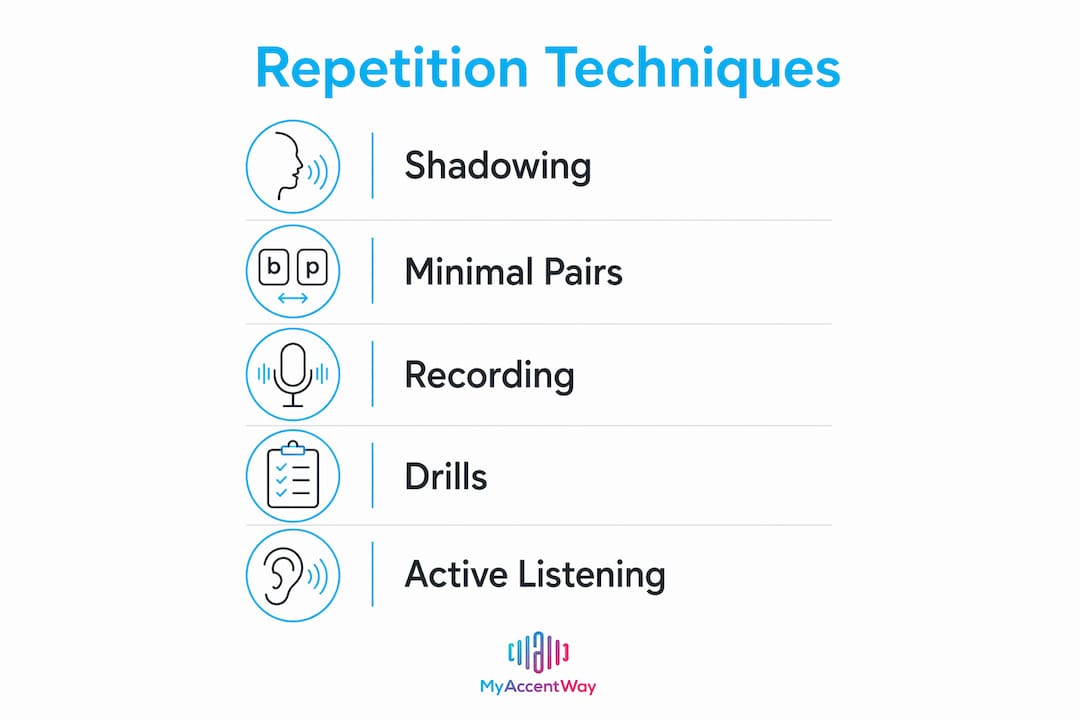
The four techniques below are supported by linguistics research and used consistently in structured pronunciation programs. Each one targets a different layer of speech: individual sounds, connected speech, self-awareness, and physical production.
-
Minimal pair drills. A minimal pair is two words that differ by only one sound, such as “ship” and “sheep” or “bit” and “beat.” Drilling these pairs trains your ear and your mouth to detect and produce subtle sound contrasts that do not exist in many native languages.
-
Shadowing. Shadowing means listening to a native speaker and repeating their words a half-second behind them in real time. Research shows that shadowing improves rhythm, intonation, and natural speech flow by engaging the motor and auditory systems at the same time. It is the fastest method for developing connected speech patterns.
-
Recording and comparing. Record yourself reading a sentence, then listen back and compare it to a native speaker’s version. Learners improve clarity significantly faster with self-recording and feedback compared to non-recorded repetition. The gap between what you think you sound like and what you actually sound like is often large, and recording closes that gap.
-
Mirror and articulatory work. Watch your mouth in a mirror while producing a difficult sound. Better still, use a visual tool that shows the internal position of the tongue and lips. Students often cannot pronounce sounds correctly because they do not understand the speech-organ movement behind the sound. Guessing or copying a coach’s mouth from across a room is far less effective than seeing the exact mechanics.
Pro Tip: Use short clips of 10–15 seconds for shadowing practice. Shorter segments allow you to focus on one rhythm pattern or intonation curve at a time, which produces faster improvement than shadowing full paragraphs.
Here is a demonstration of how Interactive 2D Sound Video Simulators make sound production visible: In MyAccentWay training, these simulators are used to train sound articulation, sound formation, and speech production during live 1-on-1 accent training sessions.
What common challenges hinder pronunciation improvement through repetition?
Repetition alone does not guarantee progress. The way you repeat matters as much as how often you repeat. These are the most common pitfalls students face, along with clear ways to address each one.
-
Mindless drilling. Repeating a sound without checking whether it is correct reinforces the wrong habit. Repetition combined with conscious self-correction prevents fossilization of errors and builds the metacognitive awareness needed for real improvement. Every repetition should include a moment of evaluation.
-
Skipping self-recording. Your brain hears your own voice differently from how a microphone captures it. Auditory perception differs from self-heard voice, so without recording and listening back, you risk reinforcing mistakes you cannot detect in real time.
-
Drilling one sound in isolation for too long. Repeating a single sound without applying it in words and sentences creates a plateau. Progress requires moving from isolated phoneme practice to words, then phrases, then full sentences.
-
Irregular practice sessions. Long, infrequent sessions are less effective than short, daily ones. The motor learning research is clear: daily micro-practice builds muscle memory faster and reduces cognitive load over time.
-
No clear goal per session. Practicing without a specific target, such as “today I focus on the American /r/ in word-final position,” leads to unfocused effort and slow results.
Pro Tip: Set one narrow goal per practice session. “I will drill the /th/ sound in 10 different words and record myself three times” produces more measurable progress than a general 20-minute pronunciation session.
How to build a practical daily repetition routine for lasting improvement
A structured drill-imitate-apply routine produces measurable improvement within 2–4 weeks with daily practice. The key is balance: drills build accuracy, shadowing builds fluency, and application builds confidence. Here is a reliable daily structure:
-
Minutes 1–5: Warm up with minimal pair drills. Choose one sound contrast and drill 8–10 word pairs aloud. This activates your speech organs and focuses your attention before the main practice.
-
Minutes 6–12: Shadowing. Select a short audio or video clip of a native American English speaker. Shadow the clip three times, focusing on rhythm and intonation rather than individual words.
-
Minutes 13–18: Articulatory focus. Pick one target sound and practice it in isolation, then in words, then in a sentence. Use 2D Sound Motion Technology to visualize the correct tongue and lip position before you attempt the sound.
-
Minutes 19–25: Record and compare. Read three sentences aloud and record yourself. Listen back, compare to a native model, and note one specific difference to address in tomorrow’s session.
-
Minutes 26–30: Apply in context. Use your target sound in a short paragraph or a few spontaneous sentences. This step transfers the skill from controlled practice to real speech.
Thiago, a Portuguese speaker, followed a structured daily repetition program with Prof. Alex and achieved clear, measurable gains in his American English pronunciation.
Watch Thiago’s progress to see what consistent, guided practice produces.
For a ready-to-use template, the professional 15-minute routine at Myaccentway gives you a structured daily plan built on the same principles.
Key Takeaways
Repetition improves pronunciation only when it is active, varied, and paired with articulatory awareness and consistent self-correction feedback.
| Point | Details |
|---|---|
| Daily micro-practice wins | 15–30 minutes of daily practice outperforms long, infrequent sessions for building speech muscle memory. |
| Active repetition beats passive drilling | Every repetition must include self-monitoring and correction to prevent reinforcing errors. |
| Recording accelerates progress | Listening back to your own recordings reveals gaps between perceived and actual pronunciation. |
| Variation transfers skills | Repeating sounds across different words and sentence types trains real-world conversational use. |
| Articulatory awareness is the foundation | Understanding how a sound is physically produced makes every repetition more accurate and effective. |
Why repetition without understanding is only half the work
After more than 20 years of coaching non-native English speakers, I have seen one pattern repeat itself: students who practice the most do not always improve the fastest. The students who improve fastest are the ones who understand what they are practicing and why.
Repetition is foundational. Without it, no sound becomes automatic. But repetition without articulatory understanding is like practicing a golf swing with the wrong grip. You get faster at doing it wrong.
The students I work with at Myaccentway learn the physical mechanics of each American sound before they repeat it. When a student sees exactly where the tongue contacts the palate for the American /t/, or how the lips shape for the /æ/ vowel, their repetitions become precise from the first attempt. That precision compounds. After two or three weeks of structured daily practice, the sound stops requiring conscious effort.
The Interactive 2D Sound Video Simulators I use in 1-on-1 sessions make the invisible visible. Students stop guessing. Doubt becomes clarity, and clarity becomes habit through repetition.
The goal is not to think about every sound forever. The goal is to retrain your sound system so thoroughly that you can pronounce unfamiliar words independently, just as you do in your native language. Steady, structured repetition gets you there.
— Prof. Alex, Ph.D. Accent Coach
Myaccentway’s structured approach to pronunciation training
Myaccentway combines the science of repetition with articulatory awareness and visual technology to produce results that standard audio-only programs cannot match.

Prof. Alex’s American accent training program begins with a personalized speech assessment, then moves through consonants, vowels, rhythm, and intonation using structured phonetic exercises and Interactive 2D Sound Video Simulators. Students practice with precision from day one because they can see the sound before they repeat it. The program is available online for professionals across the U.S. and internationally. Explore the curriculum, Book Your 1 Hour Evaluation Session, or read student reviews to see what structured repetition-based training produces.
FAQ
How long does repetition take to improve pronunciation?
Consistent daily practice of 15–30 minutes produces noticeable improvements in phoneme accuracy, stress, and rhythm within approximately one month. Results depend on the consistency and quality of each practice session.
Does repetition alone fix a foreign accent?
Repetition is necessary but not sufficient. Repetition combined with articulatory awareness and self-correction prevents error fossilization and produces lasting change. Passive drilling without understanding how sounds are physically produced slows progress significantly.
What is the best repetition technique for pronunciation?
Shadowing is the most effective single technique for rhythm and intonation, while minimal pair drills target individual sound accuracy. Combining both with daily self-recording produces the fastest overall improvement.
How often should I practice pronunciation through repetition?
Daily practice of 15–25 minutes is more effective than longer sessions done two or three times per week. Short, frequent sessions build motor memory faster and reduce the cognitive load of producing new sounds.
Why do I keep making the same pronunciation mistakes despite repeating?
Repeating an error reinforces it. Without recording yourself and comparing your output to a native model, you cannot detect the gap between what you think you sound like and what you actually produce. Add self-recording and targeted correction to every session.
Recommended
- Grammar and Vocabulary Are Not Enough | American Accent Training
- Pronunciation Checklist for Non-Native Speakers: 2026 Guide
- Mastering Clarity: The Ultimate Guide to Daily Pronunciation Exercises
- Mastering the Mechanics: A Professional Guide to Pronouncing American English Consonants
Speech clarity check
The problem is not always grammar or vocabulary.
If people understand your words but still miss your message, the deeper issue may be speech clarity, rhythm, intonation, and American pronunciation habits. MyAccentWay helps students retrain the sound system with professional 1-on-1 guidance, so English can feel clearer, freer, and more natural in real communication.
Why MyAccentWay works
Two training methods that make speech change active.
MyAccentWay is not passive listen-and-repeat coaching. Prof. Alex, Ph.D. Accent Coach, Doctor of Education, and professional linguist, creates a learning situation where students become active learners and active participants in changing their own speech patterns.
Interactive training
Students do not just receive pronunciation instructions passively. They listen, think, compare, adjust, and understand their own speech patterns while Prof. Alex guides the correction process.
U.S. & Canada online accent training
The Role of Repetition in Pronunciation Learning for professionals in the United States and Canada
This guide is useful for advanced English speakers, entrepreneurs, international professionals, and students in the U.S. and Canada who want clearer American pronunciation, stronger rhythm, better intonation, and more confident communication in meetings, interviews, presentations, and client conversations.
Prof. Alex, Ph.D. Accent Coach, Doctor of Education, and professional linguist, teaches online 1-on-1 American accent training for learners in major professional markets including New York, Los Angeles, San Francisco Bay Area, Seattle, Austin, Dallas, Houston, Chicago, Boston, Washington, D.C., Miami, Toronto, Vancouver, Montreal, Calgary, and Ottawa.
1-on-1 Accent Reduction Training helps students move beyond self-practice and build clearer American speech habits through interactive and cognitive accent training.
Cognitive accent training
Students learn to notice and correct the speech patterns that affect American pronunciation, then implement new American speech patterns into their code-switching process for more natural, long-lasting change.
Your next step
Build speech habits people can hear in real conversations.
A stronger American accent is not built by memorizing topics or chasing quick pronunciation tips. It comes from structured training, professional feedback, active correction, and repeated application until clearer speech becomes easier to keep.