Pronunciation Challenges for Software Engineers: American-Accent Fixes
(512) 265-9515Updated October 14, 2026 ◆ 14 min read
Real student result

“I feel confident enough to speak American English!”
Interactive American Accent Training9monthsof hard work and dedication
Listen to the starting point0:00
Listen to the result0:00
“Many of my students once believed they could never sound like this. School taught them grammar and vocabulary, but not how to train their English speech. That is what we do together, step by step, until you speak English independently and with confidence.”
Abishek’s result was achieved through Prof. Alex’s research-based Interactive 1-on-1 American Accent Training. His doctoral research found this interactive method more effective than traditional, teacher-centered methods. See the research basis →
A focused guide for non-native software engineers who want clearer American pronunciation, stronger speech rhythm, and more confidence in standups, demos, code reviews, and technical interviews.
|
2–4
Syllables per second — target speech rate for standup clarity
|
0.3–0.8s
Ideal silent pause length
|
70%
Min. stress accuracy on polysyllabic words
|
20+
Years of coaching experience
|
Training rhythm should be prioritized over individual sounds for non-native engineers’ intelligibility.
Consistent practice targeting prosody, consonant clusters, and technical word stress significantly improves clarity and confidence.
The single most impactful fix for non-native software engineers is not perfecting individual sounds. It is training your rhythm first. NSF intelligibility research on 405 L2 English samples shows that speakers using a syllable rate within a moderate range and well-placed silent pauses achieve the highest listener intelligibility. After rhythm, the three highest-impact problem areas are schwa and reduced vowels, consonant clusters, and word stress on technical terms. Prof. Alex, Ph.D., with 20+ years of linguistics and accent coaching experience, addresses all three through MyAccentWay’s structured curriculum. Vlad, a Russian-speaking student, shows measurable progress after working through that exact sequence.
Your three immediate actions:
| 1 | Slow your speaking rate to the 2–4 syllables/second target during standups |
| 2 | Reduce vowels in unstressed syllables rather than pronouncing every syllable with equal weight |
| 3 | Drill onset consonant clusters with timing cues, not just repetition |
Why pronunciation affects your engineering team’s performance
Listeners process technical speech by tracking rhythm, stress, and pause placement before they decode individual sounds. When those suprasegmental features break down, even technically accurate words become hard to follow.
| Metric | Target Range | Listener Impact |
|---|---|---|
| Speech rate | 2–4 syllables/second | Rates outside this range reduce comprehension significantly |
| Silent pause length | 0.3–0.8 seconds | Pauses in this window help listeners segment and process speech |
| Lexical stress accuracy | Appropriate stress on technical terms and at least 70% accuracy on polysyllabic words | Below this threshold, intelligibility drops sharply |
“Listeners track rhythm and pause placement first. When your rhythm is off, even correctly pronounced words get lost.”
Prof. Alex, Ph.D., Accent Coach
Consider a standup line: “I pushed the update” versus “I pushed the update.” Stressing pushed signals the action is complete. Stressing update signals which item changed. In a fast-paced debugging session, that difference determines whether your teammate opens the right branch or the wrong one.
The workplace consequences of unaddressed pronunciation challenges tech professionals face include:
- Repeated requests to clarify during standups and code reviews
- Missed action items when key words are not heard correctly
- Slowed debugging cycles when technical terms are misunderstood
- Reduced perceived confidence during demos and job interviews
Acronyms and library names amplify every one of these problems. A team that hears “cue-ber-NET-eez” instead of “KYOO-ber-NET-eez” for Kubernetes may not immediately connect the word to the concept, adding friction to an already fast conversation.
The specific challenges software engineers face
A. Schwa and reduced vowels
American English compresses unstressed syllables into a short, centralized vowel called the schwa. Phonetics research from MIT shows that medial schwa durations can range from 34 to 153 milliseconds depending on context, making it a moving target rather than a fixed sound. Non-native speakers who give every syllable equal length sound choppy, and listeners lose the rhythmic cues they rely on to parse speech. The fix is not finding the “right” schwa vowel quality, as explained in the Challenges of Learning a New Language guide. It is training the timing and movement that produces reduction automatically.

B. Consonant clusters
English onset clusters like “str-,” “spl-,” and “skr-” require precise articulatory coordination that many L1 systems do not use. A controlled PMC study found that explicit instruction with timed production drills produced significantly better cluster accuracy than explanation alone. The perceptual effect of cluster errors is immediate: “string” becomes “es-tring,” “split” becomes “es-plit,” and listeners hear a hesitation or an extra syllable that disrupts the rhythm they were tracking.
Interactive Visual 2D Sound Simulator for the American sound [t]For engineers working on consonant clarity, the Interactive Visual 2D Sound Simulator trains the tongue, airflow, and speech movement for the American sound [t]. This helps students improve American consonants faster and makes consonant training extremely effective because they can follow, understand, simulate, and retrain the sound instead of only listening to an explanation.
C. Word stress and prosody on technical terms
Technical vocabulary follows predictable stress patterns that engineers can learn as rules. Noun/verb pairs shift stress by syllable: UP-date (noun) vs. up-DATE (verb). Words ending in “-tion” or “-sion” stress the syllable before the suffix: in-te-GRA-tion, re-GRES-sion. Compound tech nouns stress the first element: DA-ta-base, FRAME-work, BACK-end. Getting these wrong in a standup does not just sound off. It can make a colleague momentarily unsure which concept you mean.
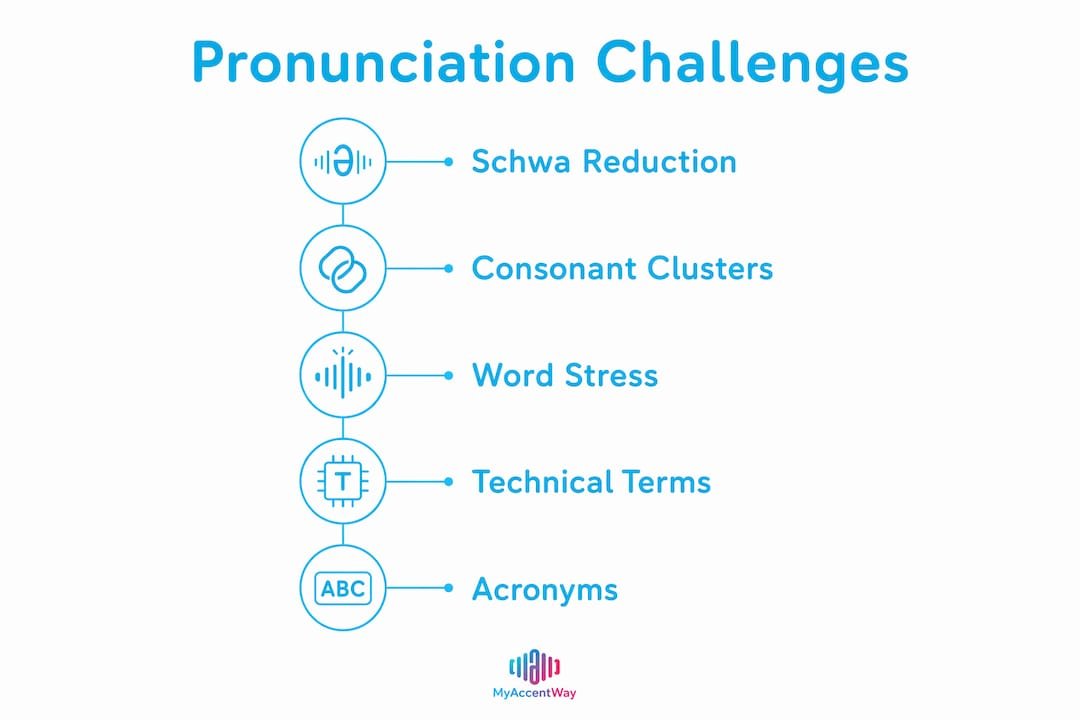
D. Technical vocabulary and acronyms
Common mispronunciations cluster around a few patterns: acronyms that should be spelled out letter by letter (API as “ay-pee-eye,” not “AH-pi”), open-source names that follow their creator’s pronunciation (Linux as “LIN-uks,” not “LYE-nux”), and words with silent letters (cache as “KASH,” never two syllables). Practicing these deliberately, before a meeting where they will appear, is the fastest way to remove that friction.
03Training beyond “repeat after me”
For software engineers, accent training works best when it feels like debugging a speech system. First, the unclear pattern must be identified. Then the student needs to see how the sound is produced, practice the movement, test it in real words, and apply it in standups, demos, code reviews, and technical interviews.
That is why MyAccentWay does not rely on passive “repeat after me” coaching. Prof. Alex uses interactive 1-on-1 guidance, cognitive accent training, and measurable practice so engineers can understand what affects clarity and build more reliable American speech patterns. Automatic pronunciation assessment research also shows that sound accuracy alone is not enough; rhythm, pauses, stress, and connected speech must be trained for clearer communication.
Active diagnosis, not passive correction
Prof. Alex leads engineers to identify the speech patterns and habits that affect clarity in technical communication. The student is not only listening to an explanation; the student actively tests, corrects, and applies American pronunciation during real speaking tasks.
Critical thinking for speech change
Through cognitive accent training, engineers learn to compare their current speech habits with American pronunciation patterns. This helps them understand why a correction works and use it more naturally in standups, demos, interviews, and client conversations.
- Baseline assessment. Record a 30-second standup. Count syllables per second and note pause lengths. This gives you a concrete starting point.
- Speech-organ awareness drills. Before drilling sounds, understand the tongue, jaw, and lip positions behind them. MyAccentWay’s 2D Sound Motion Technology trains you to actively move your tongue, lips, jaw, and teeth and control airflow with the Interactive Visual 2D Sound Simulators while Prof. Alex corrects you live, so you are not guessing from audio alone.
- Consonant-cluster coordination. Use minimal-pair drills with timing cues. Cluster instruction research shows that combining perception activities with timed production drills outperforms explanation-only methods.
- Schwa and reduction exercises. Practice shortening unstressed vowels in context. Because schwa’s acoustic position shifts with duration, this must be trained as a movement-and-timing skill, not a vowel-quality target.
- Prosody drills. Read standup lines aloud at 2–4 syllables/second. Place deliberate pauses at phrase boundaries.
- Apply to technical vocabulary. Run the same drills on acronyms, library names, and compound nouns your team uses daily.
- Record, compare, and iterate. Weekly recordings with targeted feedback close the loop. Visual simulator feedback from MyAccentWay shortens the habit-formation window compared to audio-only drilling.
MyAccentWay’s structured path follows this sequence: speech-organ awareness, consonants and vowels, rhythm and intonation, then workplace application. It is built for accent training for tech professionals who need results in real meetings, not just in practice sessions.
04MyAccentWay · 2D Sound Motion Technology
American English Pronunciation: Consonant and Vowel Sounds with 2D Sound Motion Technology
Learning American English pronunciation and the American accent is more effective when you train your speech organs, not only listen and repeat. 2D Sound Motion Technology and Interactive Visual 2D Sound Simulators, developed in 2020 by Prof. Alex, Ph.D. Accent Coach, Doctor of Education, and professional linguist, as part of his interactive teaching model based on his Ph.D. research in interactive teaching methods, train your tongue, lips, jaw, teeth, airflow, and voice step by step. They train each American sound and more than 30 sound combinations through Interactive 2D video simulation.
What 2D Sound Motion Technology is
2D Sound Motion Technology is an advanced accent reduction and articulation training tool by Prof. Alex. It corrects, develops, and trains each American sound and more than 30 sound combinations through Interactive 2D video simulation.
What Interactive Visual 2D Sound Simulators do
Interactive Visual 2D Sound Simulators are part of 2D Sound Motion Technology, the articulation-training method Prof. Alex created by applying his Ph.D. research in interactive teaching to American pronunciation. Instead of listening and repeating, students actively train their speech organs. Each simulator uses Interactive 2D mouth movement to train the speech organs (tongue, lips, jaw, teeth, airflow, and voice) to produce each American sound correctly. Every consonant has its own simulator: explore American consonants trained with 2D Sound Motion Technology.
Sample training: the American t sound (aspirated [t])
Practice
Record yourself speaking these words:
Tab · Tacos · Time · Tub · Hotel · Motel · Sit · Pit · Net
Instructions
Play the Interactive Visual 2D Sound Simulator for the American t sound below several times and follow it step by step. Move your tongue, jaw, and airflow together with the simulator and train your articulation.
Interactive Visual 2D Sound Simulator: American unvoiced sound [t]
Practice
Record yourself again speaking these words, but this time focus on the movement of your tongue. Go slow, and you will hear the difference. You’ve got this!
Tab · Tacos · Time · Tub · Hotel · Motel · Sit · Pit · Net
How Interactive Visual 2D Sound Simulators solve pronunciation and speaking problems
- Wrong articulationMost pronunciation problems start with the tongue, lips, jaw, or teeth in the wrong position. Each Interactive Visual 2D Sound Simulator trains the correct articulation of one American sound, so the student corrects the cause of the problem, not only the result.
- Airflow and voicingMany accent problems come from wrong airflow or voicing: sounds that are too weak, too strong, or voiced when they should be unvoiced. The simulators train airflow and voice together with articulation, step by step, for each American sound and more than 30 sound combinations.
- Clear speech and confidenceWhen each sound is trained correctly, words connect into clear American English speech. Listeners can understand you more easily, and speaking at work, in meetings, and on calls becomes more confident.
If you start hearing the aspiration, the short airstream after [t], with one simulator, you can only imagine how successful you can be in 1-on-1 Interactive American Accent Training with Prof. Alex, Ph.D. Accent Coach, where your whole American sound system is trained sound by sound.
In MyAccentWay, the Interactive Visual 2D Sound Simulators are only available in 1-on-1 accent coaching sessions with Prof. Alex.
A focused 15-minute daily routine
A short, consistent routine beats long irregular sessions. Use this timed sequence every day:
- 0–3 min: Warm up mouth, jaw, and tongue with articulation exercises
- 3–7 min: Schwa and reduction drills, targeting short unstressed syllables in context
- 7–11 min: Consonant-cluster drills with timing cues (onset and coda)
- 11–14 min: Prosody practice using 10–20 word standup lines at your target syllable rate
- 14–15 min: Record one line, measure one metric, note one improvement
Track your progress with this simple template:
| Date | Target syll/sec | Observed syll/sec | Pause sample (sec) | Improvement note |
|---|---|---|---|---|
| — | 2–4 | — | 0.3–0.8 | — |
Realistic expectations: small, measurable clarity gains appear after a few weeks of daily practice. Noticeable intelligibility and confidence improvements typically emerge within a few months with guided feedback. For tracking accent improvement with objective metrics, record weekly and compare against your baseline.
05When 1-on-1 coaching makes sense
Self-practice works well when you have clear targets and honest feedback. Coaching becomes the faster path when self-practice stalls or when workplace stakes are high.
Signs you need professional coaching:
- Slow or no measurable progress after four weeks of daily practice
- Colleagues regularly ask you to repeat yourself in standups or demos
- Frequent misunderstandings during debugging sessions or code reviews
- Upcoming job interviews or conference talks where clarity is critical
Professional coaching through MyAccentWay provides a structured diagnostic, personalized speech-organ training, weekly measurable targets, and Interactive Visual 2D Sound Simulators that train students to produce each sound. Vlad, a Russian-speaking engineer, worked through this program and demonstrated clear, measurable progress in his pronunciation clarity. In MyAccentWay training, these simulators are used to train sound articulation, sound formation, and speech production during live 1-on-1 accent training sessions.
For remote meetings specifically: slow your rate slightly when introducing new technical concepts, use screen-share to anchor key terms visually, and pre-practice the pronunciation of any new acronym before the call.
0607The gap between sounding fluent and being understood
Most pronunciation programs focus on sounds in isolation. That is the wrong starting point for an engineer who needs to be understood in a standup at 9 AM, not in a phonetics lab. The research is clear: listeners track rhythm and pause placement first. They use those signals to segment your speech and predict what is coming next. When your rhythm is off, even correctly pronounced words get lost.
What I find most underestimated is the role of speech-organ awareness. Many students have spent years repeating words after audio recordings without ever understanding where the tongue should be, how far the jaw opens, or what the lips are doing. That is why progress stalls. When an Interactive Visual 2D Sound Simulator trains speech-organ movement rather than relying on sound alone, the learning curve shortens considerably. Doubt becomes clarity through speech-organ training.
The 15-minute routine in this article is not a shortcut. It is a structured entry point. If you do it consistently and measure one metric per session, you will have objective evidence of your own progress within a month. That evidence is motivating in a way that vague encouragement never is.
Prof. Alex, Ph.D. Accent Coach
How MyAccentWay helps engineers speak with clarity and confidence
MyAccentWay delivers something specific that generic pronunciation apps cannot: a structured, science-backed curriculum taught 1-on-1 by Prof. Alex, Ph.D., using the Interactive 1-on-1 Accent Training Method, 2D Sound Motion Technology, Interactive Visual 2D Sound Simulators, and cognitive accent training.
Students actively participate instead of passively listening to sound explanations.
Students see how the tongue, lips, jaw, airflow, and vocal cords move for American sounds.
Critical thinking helps students retrain speech patterns and apply them in real communication.
The program begins with a diagnostic assessment, moves through speech-organ awareness, consonants, vowels, rhythm, and intonation, and applies every skill to real workplace speech, including standups, demos, and code reviews.
Practical deliverables include weekly measurable targets, simulator-driven drills, recorded progress comparisons, and direct mentor feedback from Prof. Alex. For engineers who want to review program structure and pricing before booking, the accent reduction coaching cost guide covers current options in detail.
Book Your 1 Hour Evaluation SessionExplore CurriculumRead Reviews09Useful sources
- NSF Intelligibility Research: The primary source for syllable-rate and pause-window targets; read this for the prosody and rhythm metrics used throughout this article.
- MIT Schwa Phonetics — Flemming: Detailed acoustic analysis of reduced vowels; useful for understanding why schwa varies by position and duration.
- PMC Cluster Instruction Study: Controlled research on onset cluster instruction; read this for the evidence behind explicit drills over awareness-only methods.
- J-STAGE Cluster Outcomes: Companion study showing that perception-plus-production drills outperform explanation alone.
- ACL Anthology — Automatic Pronunciation Assessment: Research on measurable prosody features; supports the case for tracking rhythm and pauses as objective metrics.
- SpeakTechEnglish — Word Stress for Developers: Practical stress patterns for technical vocabulary with audio examples.
- MyAccentWay 2D Sound Motion Technology: Visual simulator overview and how it accelerates pronunciation training.
- Vlad — Student Progress Video: Measurable before-and-after demonstration from a Russian-speaking engineer in MyAccentWay’s program.
American Accent Training for Foreign-Born Tech Professionals in the United States
Foreign-born professionals in the United States often know their field and speak advanced English. Yet American listeners may still struggle with their sounds, stress, and rhythm. MyAccentWay offers private online American accent training through Interactive American Accent Training.
Interactive American Accent Training is led by Prof. Alex, Ph.D. Accent Coach, Doctor of Education, and professional linguist. He first diagnoses each speaker’s native-language patterns. Then he trains American sound articulation, stress, rhythm, and technical terms for real stand-ups, demos, and client calls.
Who this training is for
- Engineers, IT specialists, and data professionals presenting to U.S. teams and clients
- Doctors, nurses, and healthcare professionals explaining care to American patients
- Managers, executives, and founders leading meetings, pitches, and briefings
- Consultants, researchers, and academics speaking at conferences and webinars
- Professionals preparing for interviews, promotions, or client-facing roles
Online training across the U.S.
MyAccentWay is based in Austin, Texas, and all training is online. The program is especially relevant for professionals in Austin, Dallas, Houston, New York City, the San Francisco Bay Area, Los Angeles, Seattle, Boston, Chicago, Miami, Washington DC, Atlanta, and Raleigh.
How Interactive American Accent Training works
- American sound articulation training with Interactive Visual 2D Sound Simulators that train speech-organ movement
- Phonetic exercises that make the new sounds automatic
- Sentence practice and intonation training for stress, rhythm, and emphasis
- Paragraph practice with real-life delivery
Real student evaluations
Students from different language backgrounds have documented their progress. Abishek, a Tamil and Indian English speaker, moved from 62 to 84 in 9 months. Tian, a Mandarin speaker, moved from 58 to 85 in 8 months. Vlad, a Russian speaker, moved from 60 to 83 in 5 months.
The first step is a 1 Hour Evaluation Session with Prof. Alex.
FAQ
What are the biggest pronunciation challenges for software engineers?
The three highest-impact problems are schwa reduction, consonant clusters, and word stress on technical terms. Rhythm and pause placement affect intelligibility more than any single sound error.
How fast should a non-native engineer speak in English?
NSF research on L2 English intelligibility identifies 2–4 syllables per second as the target range, with silent pauses of 0.3–0.8 seconds at phrase boundaries.
How do you correctly pronounce common tech terms like API or Kubernetes?
API is always spelled out as “ay-pee-eye.” Kubernetes is pronounced “KYOO-ber-NET-eez.” Most acronyms follow the letter-by-letter rule unless an industry-standard spoken form exists, such as “sequel” for SQL.
How long does it take to improve pronunciation with daily practice?
Small, measurable clarity gains typically appear in 2–4 weeks of consistent daily practice. Noticeable intelligibility and confidence improvements emerge in 8–12 weeks when practice is paired with guided feedback.
How does MyAccentWay differ from standard pronunciation apps?
MyAccentWay is different because the training is not a passive “repeat after me” lesson. Prof. Alex works 1-on-1 with students to identify the speech patterns affecting clarity, use critical thinking to understand the correction, and apply the new pattern in real professional speech. When a student struggles with a specific American sound, Prof. Alex can use the Interactive Visual 2D Sound Simulators as part of his interactive teaching model, based on his Ph.D. research in interactive teaching methods, to train the movement of the tongue, lips, jaw, teeth, and airflow while he corrects the student live.
Be understood the first time
A 1 Hour Evaluation Session gives you an honest assessment of your speech and a clear, structured plan for clearer American English in technical communication.
The problem is not always grammar or vocabulary.
If people understand your words but still miss your message, the deeper issue may be speech clarity, rhythm, intonation, and American pronunciation habits. MyAccentWay helps students retrain the sound system with professional 1-on-1 guidance, so English can feel clearer, freer, and more natural in real communication.
Two training methods that make speech change active.
MyAccentWay is not passive listen-and-repeat coaching. Prof. Alex, Ph.D. Accent Coach, Doctor of Education, and professional linguist, creates a learning situation where students become active learners and active participants in changing their own speech patterns.
Interactive training
Students do not just receive pronunciation instructions passively. They listen, think, compare, adjust, and understand their own speech patterns while Prof. Alex guides the correction process.
Cognitive accent training
Students learn to notice and correct the speech patterns that affect American pronunciation, then implement new American speech patterns into their code-switching process for more natural, long-lasting change.
Build speech habits people can hear in real conversations.
A stronger American accent is not built by memorizing topics or chasing quick pronunciation tips. It comes from structured training, professional feedback, active correction, and repeated application until clearer speech becomes easier to keep.
Continue learning how MyAccentWay connects American sound articulation, Interactive Visual 2D Sound Simulators, accent reduction, student proof, and 1-on-1 training.
- Prof. Alex and the MyAccentWay MethodLearn how Prof. Alex, Ph.D. Accent Coach, Doctor of Education, and professional linguist, created and leads the structured MyAccentWay American accent training system.
- Accent Reduction Curriculum and English Articulation TrainingSee how MyAccentWay trains accent reduction, accent modification, American pronunciation, English articulation, rhythm, and professional speech clarity.
- 2D Sound Motion Technology for American Accent TrainingUnderstand Prof. Alex’s Interactive Visual 2D Sound Simulators for American sound articulation.
- Before-and-After American Accent Training ResultsListen to real before-and-after student proof and accent training outcomes.
- Student Reviews and Accent Training ResultsRead student reviews, testimonials, and trust signals from MyAccentWay learners.
- Book a 1-Hour 1 Hour Evaluation SessionStart with a 1-hour accent evaluation session with Prof. Alex.