Prof. Alex, Ph.D. Accent Coach · American pronunciation clarity
10 Pronunciation Mistakes That Hurt Your American English Clarity
If people understand your words but still miss your message, the problem is not always grammar or vocabulary. It may be pronunciation, rhythm, intonation, connected speech, and the speech habits that need structured retraining.
Speech clarity
Interactive Accent Training
Prof. Alex, Ph.D. Accent Coach
Do you want to keep collecting pronunciation tips, or actually change how you speak?
If the same pronunciation mistakes keep coming back, the problem is usually not motivation. The old speech pattern has not been retrained yet.

Student proof
Abishek changed the way he speaks by training with Prof. Alex.
“Thank you, Alex! You taught me, pushed me off of my limits, and I love how I speak today!”
This is the result-focused side of Interactive Accent Training: students do not just collect pronunciation tips. They learn to listen, adjust, and build speech control they can keep.
MyAccentWay focuses on long-term speech change through Interactive Accent Training and Cognitive Accent Training, not passive correction.
The goal is not to copy a native speaker mechanically. The goal is to become an independent English speaker with clearer American pronunciation, stronger rhythm, better intonation, and speech clarity you can use in professional communication.

Article by
Prof. Alex, Ph.D. Accent Coach
Doctor of Education, professional linguist,
Creator of 2D Sound Motion Technology,
Founder of MyAccentWay: American Accent Program,
Professor of English as a Second Language,
American Accent Coach,
Life Coach.
Have you ever felt the frustration of being asked to repeat yourself, even when you know your vocabulary and grammar are perfect? Do you worry that your accent might be overshadowing your expertise, making you feel less confident in professional settings? This is a challenge many brilliant English speakers face, and it often comes down to a few surprisingly common pronunciation mistakes that are completely correctable once you know what they are.
The journey to a clear American accent isn’t about endless, frustrating self-study. It’s about targeted, intelligent practice based on linguistic science. As a Ph.D. Linguist, I’ve dedicated my career to pinpointing the exact phonemes and intonation patterns that create the biggest barriers to clear communication. It’s a precise science, not a guessing game, and with the right guidance, you can achieve incredible results.
This guide is your actionable plan. We will identify the top 10 pronunciation errors and provide you with proven, easy-to-follow techniques to fix them. Get ready to master the sounds of American English and start speaking with the confidence and clarity you’ve been working toward.
10 Common Pronunciation Mistakes in American English
This guide by Prof. Alex, Ph.D. Accent Coach, explains the American English pronunciation mistakes that most often reduce speech clarity for advanced English speakers and professionals.
- Sound accuracyCommon problems with American vowels, consonants, TH sounds, American R, V/W, and final consonants.
- Speech rhythmWord stress, sentence stress, intonation, reductions, and connected speech patterns that affect natural American English.
- Self-correctionHow to notice pronunciation habits, practice with structure, and avoid repeating the same speech mistakes.
- Training pathWhen students need personal feedback, sound-by-sound correction, and 1-on-1 American accent training with Prof. Alex.
For personal correction, start with the 1-on-1 1 Hour Evaluation Session or continue to the Accent Reduction Curriculum.
Find the pronunciation mistakes that affect your real speech
This article shows the most common errors, but your speech pattern is individual. In a 1-on-1 1 Hour Evaluation Session, Prof. Alex listens to your pronunciation, identifies what blocks clarity, and explains what needs to change first.
- Know your priority soundsFind the consonants, vowels, rhythm, or stress patterns that make your speech less clear.
- Get direct correctionUnderstand what your tongue, lips, jaw, airflow, and voice need to do differently.
- Leave with a pathSee whether you need sound-by-sound training, rhythm work, or a full accent reduction plan.
Call Rachel +1 (512) 265-9515
Private 1-on-1 assessment with Prof. Alex
Key Takeaways
- True clarity begins with mastering individual vowel and consonant sounds, especially those that don’t exist in your native language.
- Sounding like a native speaker goes beyond correct sounds; you must master the unique stress, rhythm, and intonation of American English.
- Many common pronunciation mistakes can be fixed by understanding connected speech-the ‘shortcuts’ native speakers use to link words together fluently.
- Simply knowing your errors isn’t enough; this guide provides a linguist-approved framework for effective practice and explains why expert feedback is essential for real progress.
Beyond Sounds: The Top Vowel and Consonant Pronunciation Errors
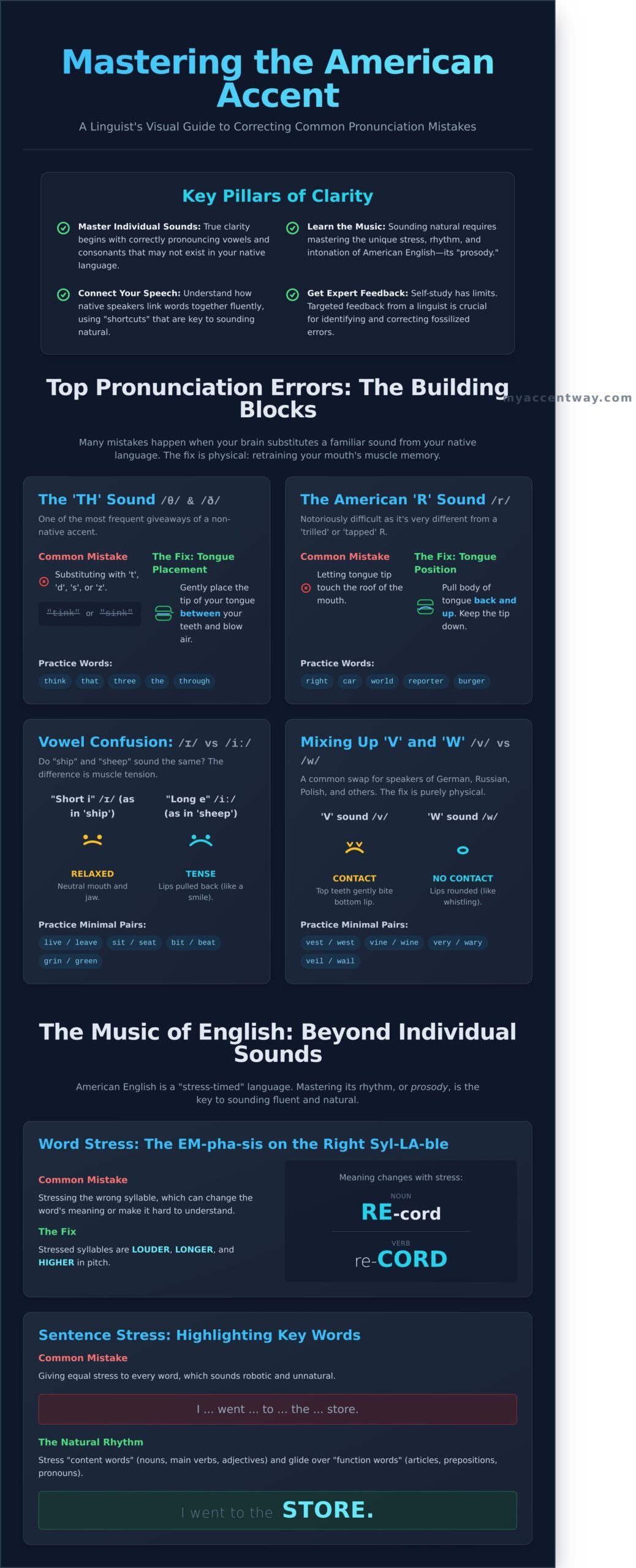
To master the American accent, we must begin with its building blocks: the individual sounds. These sounds, or phonemes, are the foundation of clear, confident speech. Many of the most common pronunciation mistakes arise when a specific English sound doesn’t exist in your native language, causing your brain to substitute the closest sound it knows. The good news? This is a physical skill you can learn. By focusing on the precise placement of your tongue and lips, you can retrain your muscle memory. While the complete system of English phonology is complex, mastering a few key sounds makes a dramatic difference. Let’s target the most frequent errors together.
The ‘TH’ Sound (/θ/ and /ð/) Confusion
One of the most common pronunciation mistakes involves substituting the ‘TH’ sounds with /t/, /d/, /s/, or /z/, making ‘think’ sound like ‘tink’ or ‘sink’. To correct this, gently place the tip of your tongue between your top and bottom teeth and blow air through the gap. For the voiced /ð/ sound in ‘that’, you’ll do the same motion but also vibrate your vocal cords.
- Practice: think, three, that, the, through, them
The American ‘R’ Sound (/r/)
The American ‘R’ is notoriously difficult because it’s unlike the ‘trilled’ or ‘tapped’ R found in many other languages. The mistake is letting the tip of your tongue flap or touch the roof of your mouth. For the correct American ‘R’, pull the body of your tongue back and up toward the roof of your mouth, keeping the tip down and away from any contact. Your lips should be slightly rounded.
- Practice: right, car, world, reporter, burger, run
Vowel Confusion: ‘Short i’ /ɪ/ vs. ‘Long e’ /iː/
Do ‘ship’ and ‘sheep’ sound the same when you say them? This vowel confusion is extremely common. The key is muscle tension. The ‘long e’ /iː/ sound (as in ‘sheep’) is a tense vowel made with your lips pulled back into a smile. The ‘short i’ /ɪ/ sound (as in ‘ship’) is a relaxed vowel, with a neutral mouth and jaw.
- Practice Minimal Pairs: live/leave, sit/seat, bit/beat, grin/green
Mixing Up ‘V’ /v/ and ‘W’ /w/
Speakers of German, Russian, Polish, and other languages often swap these two sounds. The fix is purely physical. For the /v/ sound, your top teeth must gently bite your bottom lip as you push air through. For the /w/ sound, your teeth and lips should not touch; instead, your lips should be rounded as if you’re about to whistle.
- Practice Minimal Pairs: vest/west, vine/wine, very/wary, veil/wail
The Music of English: Mastering Stress, Rhythm, and Intonation
Have you ever mastered the individual sounds of a word, yet still felt that something was missing? This is a universal challenge, and it highlights a crucial truth: sounding natural in English goes far beyond correct vowel and consonant pronunciation. The real key to fluency lies in mastering the prosody-the music, rhythm, and melody-of the language. This is often the biggest giveaway of a non-native accent and a primary source of common pronunciation mistakes.
American English is a “stress-timed” language. This means that the rhythm is determined by the stressed syllables, which occur at relatively regular intervals, while the unstressed syllables are compressed between them. This rhythmic pulse is one of the core linguistic differences in pronunciation that distinguishes American English from “syllable-timed” languages (like Spanish or French), where each syllable receives roughly equal time. Mastering this rhythm is your next step toward authentic, confident speech.
Word Stress: Putting the Em-PHA-sis in the Right Place
One of the most frequent errors is placing stress on the wrong syllable. For example, saying ‘HO-tel’ instead of ‘ho-TEL‘. The fix is to understand that stressed syllables are not just louder; they are also typically longer and higher in pitch. Practice with words that change meaning based on stress, like the noun ‘a RE-cord’ versus the verb ‘to re-CORD‘. Internalizing these patterns is essential.
Sentence Stress: Highlighting the Most Important Words
Another of the most common pronunciation mistakes is giving equal weight to every word, which can sound robotic. Native speakers instinctively stress “content words” (like nouns, main verbs, adjectives) and glide over “function words” (like articles, prepositions, pronouns). This creates a natural rhythm. For instance, in the sentence “I went to the STORE for some BREAD,” the key information is carried in the stressed words, making your meaning clear and effective.
Intonation Patterns: The Rise and Fall of Your Voice
Intonation is the melody of your speech, and using a flat, monotone pattern can unintentionally convey boredom or disinterest. You can instantly make your speech more dynamic by mastering basic patterns. Use a falling pitch at the end of statements (“I’m going to the park.”). For yes/no questions, use a rising pitch (“Are you going to the park?”). Practicing this rise and fall will not only make you easier to understand but will also allow you to express emotion and nuance confidently.
Unlocking Fluent Speech: Connected Speech and Silent Letters
Have you ever listened to a native speaker and felt that their words flow together in a way yours don’t? This isn’t your imagination; it’s a core feature of the American accent called connected speech. Native speakers don’t pronounce every single letter of every single word distinctly. Instead, they use linguistic shortcuts-linking words, reducing sounds, and dropping letters-to create a smooth, rhythmic flow. Learning to navigate these features is essential for moving beyond some of the most common pronunciation mistakes.
While these rules can seem illogical at first, they follow predictable patterns. Understanding them is your key to not only sounding more natural but also dramatically improving your listening comprehension. By learning the system behind the sounds, you can adopt a linguist’s framework for effective self-correction and transform your speech from disjointed to fluid and confident.
The Puzzle of Silent Letters
One of the most confusing parts of English spelling is the silent letter. Pronouncing letters that should be silent is a clear indicator of a non-native accent. Unfortunately, there are no simple rules; mastering silent letters requires exposure and practice. Your goal is to train your brain to see a word and instantly know which sounds to ignore.
- The silent ‘b’ in debt, doubt, or subtle.
- The silent ‘l’ in walk, talk, or could.
- The silent ‘k’ in know, knife, or knock.
Linking: Connecting Words for Smooth Flow
A frequent mistake is pausing unnaturally between each word, making speech sound robotic. To achieve a native-like rhythm, you must link words together. The most common rule is to connect a word ending in a consonant sound to a word beginning with a vowel sound. Think of them as one continuous word.
For example, “an apple” becomes “anapple.” Practice these phrases to feel the connection:
- Turn it off → “turnitoff”
- Come on in → “comon_in”
Reductions: The Disappearing Sounds
Not all words carry the same weight in a sentence. Native speakers often “reduce” small, unstressed function words like ‘to’, ‘for’, and ‘a’. Over-pronouncing these is one of the more subtle but significant common pronunciation mistakes. Instead of enunciating the full vowel, the sound is softened to a “schwa” (/ə/).
- “I’m going to the store” becomes “I’m going /tə/ the store.”
- “This is for you” becomes “This is /fər/ you.”
Actively listen for these reductions in movies and conversations to train your ear. Mastering them is a powerful step toward achieving true fluency.
A Linguist’s Framework for Effective Self-Correction
Understanding which words you mispronounce is a crucial first step, but awareness alone doesn’t create change. To truly master the American accent, you need a systematic approach to practice. As a Ph.D. Linguist, I can assure you that consistent, focused effort is far more effective than long, infrequent sessions. This framework transforms your knowledge of common pronunciation mistakes into confident, clear speech. The goal isn’t instant perfection; it’s tangible progress.
Step 1: Isolate and Identify Your Target
Trying to fix every pronunciation error at once is a recipe for frustration. Instead, empower yourself by focusing your efforts. Choose just one target sound or pattern that challenges you-for example, the American ‘R’ sound or the vowel in “cat”-and dedicate a week to mastering it. Create a practice list of 10-15 words and a few sentences containing that specific sound. This micro-goal approach builds momentum and makes improvement feel achievable.
Step 2: Record, Listen, and Analyze
Leverage the powerful tool you carry every day: your smartphone. Record yourself saying the words and sentences from your practice list. Then, listen back with a critical ear. Find a recording of a native speaker saying the same words and compare them side-by-side. Don’t just listen for a general difference; try to pinpoint exactly where your mouth position, tongue placement, or airflow diverges. This analytical process is key to developing self-awareness.
Step 3: Use Minimal Pairs for Contrastive Practice
One of the most effective techniques used by speech professionals is practicing with minimal pairs. These are words that differ by only a single sound (a phoneme), such as ship/sheep, live/leave, or desk/disk. Saying these pairs aloud forces your brain and mouth to recognize and produce the subtle distinctions. This contrastive drill is a core technique used in professional American accent training because it directly retrains your muscle memory for new sounds.
By implementing this three-step cycle, you move from passively knowing your mistakes to actively correcting them. This is how real, lasting change is made. For a guided experience that accelerates this process, explore the structured programs at myaccentway.com.
Self-study can show the mistake. Feedback changes the habit.
Recording yourself is useful, but most students cannot hear every pronunciation error in their own speech. Professional feedback helps you notice the exact mismatch between your native speech habits and American pronunciation patterns.
- Correct fasterTrain the sound that causes the problem instead of repeating the same word again and again.
- Build awarenessHear the difference between what you intended to say and what listeners actually hear.
- Practice with structureUse phonetic exercises, sentences, and paragraph practice designed around your needs.
Why Self-Study Fails: The Critical Role of Expert Feedback
You’ve read articles, watched countless videos, and practiced diligently. But if you feel stuck, you are not alone. The single greatest challenge in mastering a new accent is an auditory illusion: it is nearly impossible to accurately hear your own errors. Your brain knows the word you intend to say, and it often masks the subtle mispronunciations in your actual speech. This is where self-study hits a wall, and where personalized, expert feedback becomes the key to unlocking your true potential.
The Limitation of Apps and Videos
While language apps and online videos are excellent resources for vocabulary, they fall short for pronunciation. Their “one-size-fits-all” approach provides generic advice that doesn’t account for your unique linguistic background. An app can flag a word as “incorrect,” but it cannot explain why. Is your tongue too flat for the American ‘R’? Is your jaw not open enough for the vowel in “hot”? Without this specific diagnosis, you may practice the wrong way, unintentionally reinforcing the very habits you’re trying to eliminate.
How a Professional Coach Changes the Game
Working with a trained linguist completely transforms your learning journey. A true expert doesn’t just hear a mistake; they diagnose its phonetic root cause, often tracing it back to the speech patterns of your native language. This deep understanding allows them to move beyond generic tips on common pronunciation mistakes and provide targeted, effective solutions. This is the fastest path to tangible progress.
With an expert coach, you will:
- Receive a personalized curriculum based on a scientific analysis of your specific speech patterns.
- Get real-time correction and clear, physical guidance on precise tongue, lip, and jaw placement.
- Build lasting confidence with a structured, supportive learning plan that guarantees measurable results.
- Master proven methods with expert American accent training designed for success.
Information alone cannot correct ingrained motor skills. To achieve a clear and confident American accent, you need targeted feedback. It is the essential difference between simply practicing and making real, accelerated progress. If you are ready to stop guessing and start transforming your speech, discover the power of a personalized approach at myaccentway.com.
From Mistakes to Mastery: Your Path to a Confident American Accent
Mastering an American accent is about more than just correcting individual sounds. As we’ve explored, true clarity comes from understanding the music of the language-its unique rhythm, stress, and intonation. While self-correction is a valuable start, overcoming these common pronunciation mistakes for good requires the trained ear of an expert to guide you past the plateaus where self-study often ends.
Turn this article into a clear American pronunciation plan
If these mistakes sound familiar, the goal is not to memorize more rules. The goal is to retrain how you produce American sounds, stress, rhythm, intonation, and connected speech until clearer pronunciation becomes natural in real communication.
- Clearer soundsImprove the individual American sounds that affect your intelligibility.
- More natural flowTrain sentence stress, rhythm, reductions, and connected speech patterns.
- Confident speakingUse your improved pronunciation in meetings, interviews, presentations, and daily speech.
Frequently Asked Questions About English Pronunciation
Can I completely lose my accent?
The goal is not to “lose” your accent, as it is a core part of your identity. Instead, our proven method focuses on accent modification-mastering the phonemes and intonation of American English to achieve clear, confident communication. We believe your culture matters, and the aim is to add a new skill, not erase your background. You can achieve a native-like proficiency where your original accent is barely perceptible, empowering you to speak with absolute clarity in any situation.
How long does it take to improve my English pronunciation?
The timeline for improvement is a personal journey, but with consistent, guided practice, most students report significant gains in confidence and clarity within a few months. Mastering pronunciation isn’t just about time; it’s about the quality of practice. Our scientifically-backed approach, designed by a Ph.D. Linguist, accelerates this process by focusing on the most critical cognitive and analytical skills needed for success. With dedication, you can achieve your goals faster than you think.
What is the hardest English sound for non-native speakers to learn?
While this varies based on a speaker’s native language, the ‘th’ sounds-both voiced /ð/ (as in ‘this’) and unvoiced /θ/ (as in ‘think’)-are notoriously difficult. Many languages lack these specific phonemes, causing speakers to substitute them with /d/, /z/, or /s/. Mastering the precise tongue placement for these sounds is a key focus in our training, as it dramatically improves clarity and helps learners overcome one of the most common pronunciation mistakes.
Is the American or British accent easier to learn?
Neither accent is inherently “easier,” as the difficulty depends entirely on your linguistic background and exposure. The American accent, particularly the General American standard, has a rhotic ‘r’ (pronouncing the ‘r’ in ‘car’) that can be challenging. However, its widespread presence in global media often makes its rhythm and intonation more familiar to learners. Ultimately, success comes from choosing the accent you are most motivated to master and using a proven, effective learning method.
Will improving my pronunciation help me find a better job?
Absolutely. Clear, confident pronunciation is a powerful asset in the professional world. It ensures your ideas are understood precisely, removes communication barriers, and boosts your confidence in interviews, presentations, and meetings. Employers highly value strong communication skills, and mastering your pronunciation signals professionalism and attention to detail. This investment in yourself can directly translate into greater career opportunities and success, empowering you to achieve your goals without hesitation.
What are ‘phonemes’ and why are they important for pronunciation?
A phoneme is the smallest unit of sound that distinguishes one word from another. For example, the sounds /p/ and /b/ are different phonemes in English because they change ‘pat’ into ‘bat’. Understanding phonemes is the scientific foundation for mastering an accent. By focusing on each individual sound of American English-the 24 consonants and 20 vowels-we can systematically correct common pronunciation mistakes at their source for guaranteed, lasting results.
Disclaimer – American Accent Program
The American Accent Program available through Visit Program Website
is an educational and coaching service designed to support pronunciation, accent reduction, and spoken English fluency. All training materials, including lessons, exercises, audio content, visual simulations, coaching methods, and digital resources, are the intellectual property of American Accent Program, LLC and are protected by applicable copyright and intellectual property laws.
By using this website and participating in the program, you acknowledge that all content is provided for personal, non-commercial, educational use only. Users are granted a limited, non-transferable license to access the materials strictly for individual learning purposes. Redistribution, reproduction, recording, modification, sharing, or commercial use of any program content without prior written consent is strictly prohibited.
The program may include live coaching sessions, digital tools, and instructional materials intended to improve pronunciation and communication skills. However, individual results may vary, and no specific level of fluency, accent reduction, or communication outcome is guaranteed.
The American Accent Program and its instructors do not provide medical, therapeutic, or clinical speech-language pathology services. All training is intended for educational purposes only.
By accessing or using the program, you agree to comply with all applicable terms, including the platform’s Terms of Use and Course Policies, and acknowledge that misuse of materials may result in termination of access without refund.
Speech clarity check
The problem is not always grammar or vocabulary.
If people understand your words but still miss your message, the deeper issue may be speech clarity, rhythm, intonation, and American pronunciation habits. MyAccentWay helps students retrain the sound system with professional 1-on-1 guidance, so English can feel clearer, freer, and more natural in real communication.
Why MyAccentWay works
Two training methods that make speech change active.
MyAccentWay is not passive listen-and-repeat coaching. Prof. Alex, Ph.D. Accent Coach, Doctor of Education, and professional linguist, creates a learning situation where students become active learners and active participants in changing their own speech patterns.
Interactive training
Students do not just receive pronunciation instructions passively. They listen, think, compare, adjust, and understand their own speech patterns while Prof. Alex guides the correction process.
U.S. & Canada online accent training
10 Common Pronunciation Mistakes & How to Fix Them for a Clear American Accent for professionals in the United States and Canada
This guide is useful for advanced English speakers, entrepreneurs, international professionals, and students in the U.S. and Canada who want clearer American pronunciation, stronger rhythm, better intonation, and more confident communication in meetings, interviews, presentations, and client conversations.
Prof. Alex, Ph.D. Accent Coach, Doctor of Education, and professional linguist, teaches online 1-on-1 American accent training for learners in major professional markets including New York, Los Angeles, San Francisco Bay Area, Seattle, Austin, Dallas, Houston, Chicago, Boston, Washington, D.C., Miami, Toronto, Vancouver, Montreal, Calgary, and Ottawa.
1-on-1 Accent Reduction Training helps students move beyond self-practice and build clearer American speech habits through interactive and cognitive accent training.
Cognitive accent training
Students learn to notice and correct the speech patterns that affect American pronunciation, then implement new American speech patterns into their code-switching process for more natural, long-lasting change.
Your next step
Build speech habits people can hear in real conversations.
A stronger American accent is not built by memorizing topics or chasing quick pronunciation tips. It comes from structured training, professional feedback, active correction, and repeated application until clearer speech becomes easier to keep.