How to Improve Pronunciation and Fluency: A Scientific Approach to the American Accent
(512) 265-9515Updated October 16, 2026 ◆ 19 min read
Last Tuesday, a senior software engineer named David sat in a high-stakes boardroom meeting, his brilliant ideas silenced by a 90% fear of being asked to repeat himself for the third time. Despite five years of living in the U.S., he still felt the agonizing gap between his high-level reading skills and his hesitant, accented speech. You likely agree that it’s exhausting when your professional expertise is masked by a lack of vocal clarity, leaving you feeling shy or overlooked in critical conversations.
Real student result

“I feel confident enough to speak American English!”
Interactive American Accent Training9monthsof hard work and dedication
Listen to the starting point0:00
Listen to the result0:00
“Many of my students once believed they could never sound like this. School taught them grammar and vocabulary, but not how to train their English speech. That is what we do together, step by step, until you speak English independently and with confidence.”
Abishek’s result was achieved through Prof. Alex’s research-based Interactive 1-on-1 American Accent Training. His doctoral research found this interactive method more effective than traditional, teacher-centered methods. See the research basis →
In this guide, you’ll discover how to improve pronunciation and fluency using a method backed by academic research. Prof. Alex, Ph.D. Linguist, has pioneered a system that leverages 2D Sound Motion Technology to support learning the American accent. By training the physical movements involved in producing phonemes, you can bridge the gap between understanding English and speaking it with authority. We’ll explore how this scientific approach helps you master complex intonation and communicate your ideas without a second of hesitation.
Understanding the Linguistic Foundation of English Fluency
Prof. Alex, Ph.D. Linguist, defines fluency as the seamless integration of cognitive processing and physical sound production. It isn’t just about knowing the right words; it’s about your brain and your vocal muscles working in perfect synchronization. Many students do well on written exams yet struggle to hold a basic conversation. This gap exists because high comprehension doesn’t automatically lead to high verbal expression. Understanding how to improve pronunciation and fluency requires a shift from academic study to physical training.
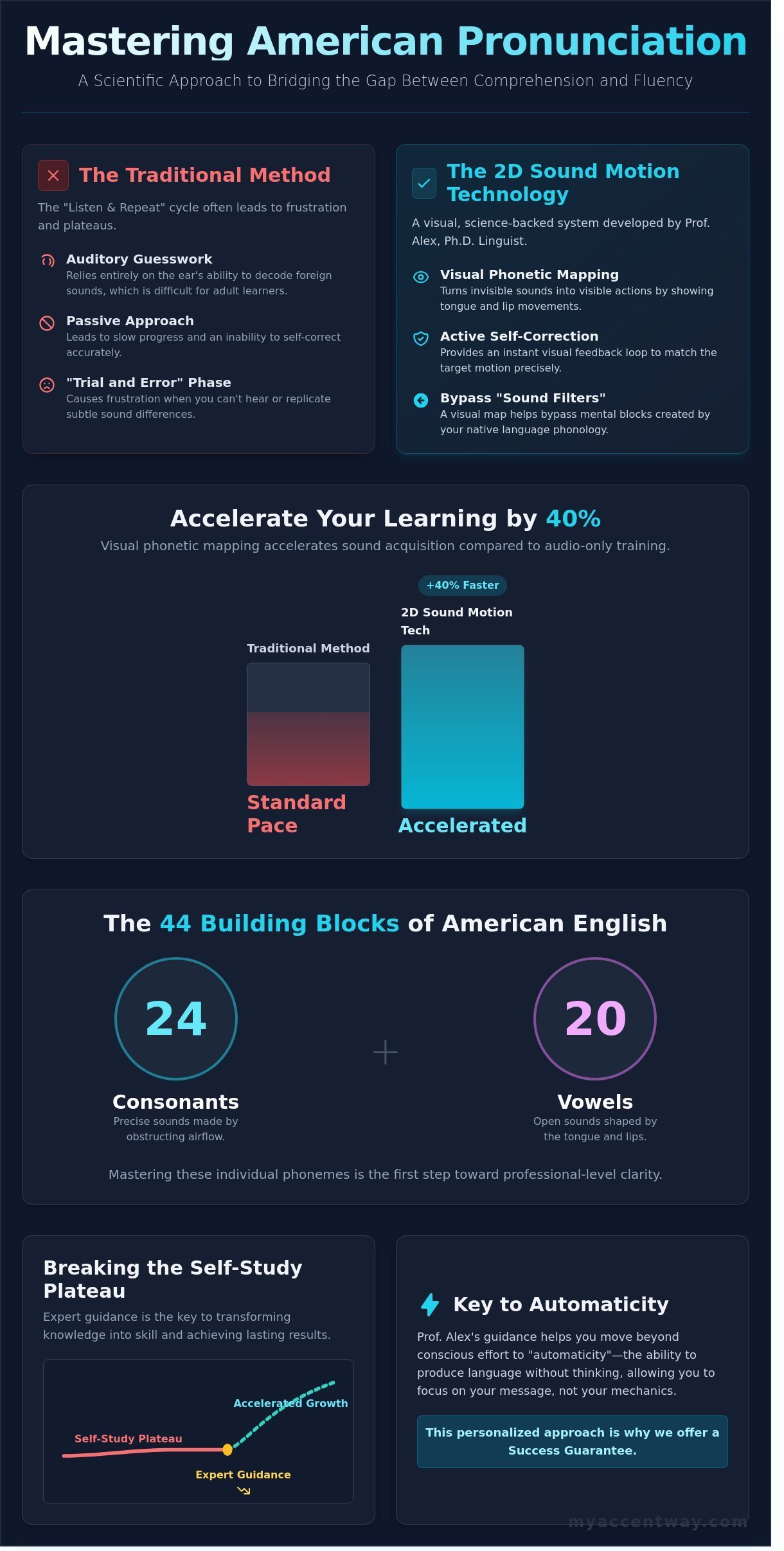
Fluency is a physical skill, much like playing an instrument or a sport. To speak English clearly, you must rewire your adult speech patterns through a scientific approach. Prof. Alex focuses on the Linguistic Foundation of English Fluency to explain why simple repetition isn’t enough. You need to master the 44 distinct sounds of American English, including 24 consonants and 20 vowels. Our proprietary 2D Sound Motion Technology makes this process faster by training the tongue and lips in the exact movements needed to produce each sound.
- Phonemes: The individual building blocks of sound that change the meaning of words.
- Intonation: The rise and fall of your voice that provides emotional context.
- Word Stress: The emphasis placed on specific syllables to create a natural American rhythm.
- Linking: How words connect in a sentence to create a smooth, continuous flow.
The Difference Between Accuracy and Fluency
Focusing too much on grammar rules often hinders your verbal flow. When you’re obsessed with being 100% accurate, your brain’s processing power is diverted away from the physical act of speaking. This prevents “automaticity,” which is the ability to retrieve and produce language without conscious effort. Prof. Alex, Ph.D. Linguist, emphasizes rhythm over individual words. Prioritizing sentence stress and intonation can make speech clearer to native listeners than focusing solely on perfect grammar. Mastering the American rhythm is the key to being understood in real-world environments.
Why Your Native Phonology Affects Your English
Your first language creates “sound filters” in your brain that block new pronunciations. By the time you’re an adult, your brain has been conditioned to ignore sounds that don’t exist in your mother tongue. You literally cannot hear certain American vowels until you’re trained to recognize them. This is why we believe “Your CULTURE MATTERS” in the learning journey. We don’t just teach English; we help you navigate the specific linguistic interference from your native language. Using 2D Sound Motion Technology makes learning the American accent easier because it trains the speech organs to work beyond these mental filters. Prof. Alex, Ph.D. Linguist, provides the roadmap for how to improve pronunciation and fluency by targeting these cultural sound gaps with scientific precision. This personalized approach helps dedicated students make progress through consistent training.
Mastering American Pronunciation with 2D Sound Motion Technology
Most learners struggle with the traditional “listen and repeat” method because it relies entirely on the ear’s ability to decode foreign sounds. This passive approach often leads to frustration; if you can’t hear the subtle difference between two vowels, you can’t replicate them. Prof. Alex, Ph.D. Linguist, developed a superior alternative that moves beyond auditory guesswork. If you want to know how to improve pronunciation and fluency, you must shift your focus from just listening to actively training the speech organs. 2D Sound Motion Technology trains the movement of the tongue, lips, jaw, teeth, and airflow with the Interactive Visual 2D Sound Simulators while Prof. Alex corrects students live, making the process of learning the American accent significantly easier and faster than conventional classroom techniques.
This technology provides feedback that helps students understand tongue and lip position during speech. The technology offers feedback on sound production alongside audio practice. With feedback on articulator movement, you can correct your placement. This eliminates the “trial and error” phase that plagues most language learners. You don’t have to guess if your tongue is high enough for the “ee” sound; you can match the target motion.
The Mechanics of Sound Production
Clear speech is the result of precise physical coordination between your tongue, lips, and jaw. These articulators must move to specific coordinates to produce the 44 phonemes of American English. 2D Sound Motion Technology simplifies these complex linguistic movements by breaking them down into digestible visual cues. Instead of struggling with abstract descriptions of “tongue tension,” you follow a clear motion path that guides your muscles to the correct spot. 2D Sound Motion Technology is a proprietary tool for visual phonetics that transforms invisible mouth movements into a clear, actionable map for students.
Students often find that mastering the 24 consonants and 20 vowels becomes a predictable science rather than a mystery. By using Actionable Techniques to Improve Pronunciation, you can begin to see how word stress and syllable structure interact with these physical movements. Prof. Alex, Ph.D. Linguist, emphasizes that when you visualize the mechanics, your brain processes the information through analytical and cognitive channels, helping you retain new speech patterns.
Rewiring Muscle Memory for Clearer Speech
Pronunciation is a muscle sport, not just a mental exercise. Your facial muscles have spent years practicing the patterns of your native language, and they won’t change without a structured workout. Using 2D Sound Motion Technology allows you to track your progress in real-time, ensuring that every repetition is building the right habit. This real-time tracking is vital for rewiring the 43 muscles involved in human speech. Without visual confirmation, it’s easy to slip back into old patterns without realizing it.
- Visual Precision: See the exact height of the jaw for open vowels.
- Real-Time Correction: Adjust your lip rounding instantly to match native targets.
- Muscle Memory: Build permanent habits through 25 to 30 minutes of daily guided practice.
- Analytical Growth: Understand the “why” behind every sound movement.
The benefits of a structured American accent training program are clear. You gain the confidence to speak in professional settings without the fear of being misunderstood. Prof. Alex, Ph.D. Linguist, has designed this method to ensure you succeed by treating accent acquisition as a physical skill that anyone can master with the right tools. Understanding how to improve pronunciation and fluency becomes a journey of empowerment when you have the technology to see your own success. If you’re ready to see the difference for yourself, you might explore our specialized curriculum to start refining your speech today.
MyAccentWay · 2D Sound Motion Technology
American English Pronunciation: Consonant and Vowel Sounds with 2D Sound Motion Technology
Learning American English pronunciation and the American accent is more effective when you train your speech organs, not only listen and repeat. 2D Sound Motion Technology and Interactive Visual 2D Sound Simulators, developed in 2020 by Prof. Alex, Ph.D. Accent Coach, Doctor of Education, and professional linguist, as part of his interactive teaching model based on his Ph.D. research in interactive teaching methods, train your tongue, lips, jaw, teeth, airflow, and voice step by step. They train each American sound and more than 30 sound combinations through Interactive 2D video simulation.
What 2D Sound Motion Technology is
2D Sound Motion Technology is an advanced accent reduction and articulation training tool by Prof. Alex. It corrects, develops, and trains each American sound and more than 30 sound combinations through Interactive 2D video simulation.
What Interactive Visual 2D Sound Simulators do
Interactive Visual 2D Sound Simulators are part of 2D Sound Motion Technology, the articulation-training method Prof. Alex created by applying his Ph.D. research in interactive teaching to American pronunciation. Instead of listening and repeating, students actively train their speech organs. Each simulator uses Interactive 2D mouth movement to train the speech organs (tongue, lips, jaw, teeth, airflow, and voice) to produce each American sound correctly. Every consonant has its own simulator: explore American consonants trained with 2D Sound Motion Technology.
Sample training: the American t sound (aspirated [t])
Practice
Record yourself speaking these words:
Tab · Tacos · Time · Tub · Hotel · Motel · Sit · Pit · Net
Instructions
Play the Interactive Visual 2D Sound Simulator for the American t sound below several times and follow it step by step. Move your tongue, jaw, and airflow together with the simulator and train your articulation.
Interactive Visual 2D Sound Simulator: American unvoiced sound [t]
Practice
Record yourself again speaking these words, but this time focus on the movement of your tongue. Go slow, and you will hear the difference. You’ve got this!
Tab · Tacos · Time · Tub · Hotel · Motel · Sit · Pit · Net
How Interactive Visual 2D Sound Simulators solve pronunciation and speaking problems
- Wrong articulationMost pronunciation problems start with the tongue, lips, jaw, or teeth in the wrong position. Each Interactive Visual 2D Sound Simulator trains the correct articulation of one American sound, so the student corrects the cause of the problem, not only the result.
- Airflow and voicingMany accent problems come from wrong airflow or voicing: sounds that are too weak, too strong, or voiced when they should be unvoiced. The simulators train airflow and voice together with articulation, step by step, for each American sound and more than 30 sound combinations.
- Clear speech and confidenceWhen each sound is trained correctly, words connect into clear American English speech. Listeners can understand you more easily, and speaking at work, in meetings, and on calls becomes more confident.
If you start hearing the aspiration, the short airstream after [t], with one simulator, you can only imagine how successful you can be in 1-on-1 Interactive American Accent Training with Prof. Alex, Ph.D. Accent Coach, where your whole American sound system is trained sound by sound.
In MyAccentWay, the Interactive Visual 2D Sound Simulators are only available in 1-on-1 accent coaching sessions with Prof. Alex.
Strategies to Close the Gap Between Comprehension and Expression
A common frustration shared by English learners on platforms like Reddit is the “comprehension-expression gap.” You might understand a fast-paced Netflix show, yet feel paralyzed when trying to order a coffee. This disconnect happens because listening is a receptive skill, while speaking is a high-intensity motor and cognitive task. Prof. Alex, Ph.D. Linguist, identifies this as a failure of “active retrieval.” Your brain recognizes the word “thorough,” but it hasn’t mapped the precise muscular movements required to produce the American “th” and “r” sounds simultaneously. To bridge this, you must shift your focus from gathering information to practicing output.
Reducing the cognitive load of translation is the first step in learning how to improve pronunciation and fluency. When you translate from your native tongue, your brain performs a double-loop process that adds 2.5 seconds of latency to every sentence. This delay creates social anxiety and breaks your natural rhythm. Prof. Alex’s method utilizes 2D Sound Motion Technology through the Interactive Visual 2D Sound Simulators, where students actively train the movement of the tongue, lips, jaw, teeth, and airflow while Prof. Alex corrects them live. The simulators are part of Prof. Alex’s interactive teaching model, based on his Ph.D. research in interactive teaching methods. This makes the American Accent feel like a physical habit rather than a mental puzzle.
Confidence isn’t a prerequisite for speaking; it’s a byproduct of competence. Many students wait until they “feel ready” to speak, but linguistic data shows that verbal stamina only grows through consistent, low-stakes repetition. Moving a word from your passive vocabulary to your active one requires using it in a spoken context at least 12 times. Once the physical effort of articulation decreases through 2D Sound Motion Technology, your mental energy is freed up to focus on the message itself. This shift is where true fluency begins.
Overcoming the “Silent Period” in Adult Learners
Adults often face a longer “silent period” than children because their analytical minds over-correct errors. While children under 12 absorb sounds through play, adults require “Intellectual Interaction” to succeed. Prof. Alex, Ph.D. Linguist, designs sessions that engage your adult logic to deconstruct phonemes. This scientific approach reduces mental translation time, allowing you to respond instinctively. By treating the American Accent as a technical skill, you remove the emotional weight of “being wrong.”
Building Verbal Stamina Through Structured Practice
Consistency beats intensity every time. Using the American Accent Program app for just 15 minutes of daily micro-learning builds the muscular memory needed for long conversations. If you start today, you can reach significant fluency milestones by January 2026, such as leading a 30-minute business presentation without fatigue. The app provides a safe, low-stakes environment to master how to improve pronunciation and fluency before you step into a high-pressure meeting. Structured practice makes your progress measurable and keeps your next milestone within reach.
- Active Retrieval: Practice summarizing a 1-minute news clip out loud immediately after hearing it.
- Muscle Memory: Use 2D Sound Motion Technology to master the 24 American consonants.
- Stamina Building: Increase your continuous speaking time by 30 seconds every week.
- Scientific Feedback: Rely on the expertise of a Ph.D. Linguist to correct subtle intonation errors.
Mastering the American Accent with a professional linguist is key to recognizing that this journey is personal. Your culture matters, and your unique voice is an asset. By using research-based methods and advanced technology, you can finally turn your “passive” knowledge into “active” power. The goal isn’t just to be understood; it’s to speak with an authority that reflects your true professional expertise.
Actionable Techniques to Improve Pronunciation and Fluency Daily
Prof. Alex, Ph.D. Linguist, emphasizes that learning the American Accent is not a matter of luck; it’s a scientific process of cognitive retraining. To understand how to improve pronunciation and fluency, you must move beyond passive listening and engage in active physiological practice. The “Shadowing” technique is an effective way to begin this journey. This method requires you to listen to a native speaker and repeat their words with a delay of only 0.5 seconds. By mirroring the speaker’s pace, you force your articulators, including the tongue, lips, and jaw, to adopt the physical habits of a native speaker in real time.
Mastering the 44 distinct phonemes of American English is the next critical step. This curriculum involves deep study of the 24 American Consonants and 20 American Vowels. Most students struggle because they subconsciously map English sounds onto the phonetic rules of their native language. Using 2D Sound Motion Technology makes this transition significantly easier. This proprietary tool helps train the mouth’s internal movements, allowing you to position your tongue for difficult sounds like the American /r/ or the “th” consonants. Consistent use of this technology can support phonetic accuracy.
To eliminate persistent mistakes, you must identify your personal “error patterns.” Prof. Alex, Ph.D. Linguist, notes that many non-native speakers are unaware of the specific sounds they consistently mispronounce. You should record yourself speaking for at least 120 seconds every day. When you analyze these recordings against a native model, you can pinpoint exactly where your rhythm or placement falters. This analytical approach ensures that your practice sessions are targeted and efficient rather than repetitive and aimless.
Intonation and Word Stress: The Music of English
Individual sounds are important, but the melody of your speech determines how well you’re understood. English is a stress-timed language, which means we prioritize “focus words” to convey meaning. Correct intonation contributes to a speaker’s perceived clarity. Prof. Alex teaches drills that focus on rising intonation for questions and falling intonation for authoritative statements. When you master the rising and falling “music” of the American Accent, you sound more persuasive and confident in professional environments.
Daily Rituals for Long-Term Success
Consistency is the foundation of muscle memory. The 15-minute daily practice rule is designed to create lasting neurological pathways without causing vocal fatigue. During these sessions, it’s vital to use 2D Sound Motion Technology to ensure your physical movements are precise. This advanced solution makes the learning process faster by removing the guesswork from pronunciation. You should also track your “Fluency Score,” a metric that measures your speech rate and the reduction of filler words over a 30-day period. Students who monitor this score typically reach their fluency goals 2 months faster than those who practice without a structured tracking system.
Learning the American Accent becomes a rewarding experience when you have the right tools and expert guidance. By combining scientific methods with dedicated daily practice, you can transform your communication skills and unlock new professional opportunities.
Ready to train your speech organs with 2D Sound Motion Technology? Master the American Accent with 2D Sound Motion Technology today!
Why Expert Guidance is the Key to Mastering the American Accent
Self-study often feels like a shortcut, but it’s usually where progress goes to die. You might spend months mimicking videos without realizing you’re reinforcing the same phonetic errors. Prof. Alex, Ph.D. Linguist, bridges this gap by offering precise, analytical feedback that an app simply cannot provide. Learning how to improve pronunciation and fluency requires more than just listening; it demands an understanding of the 44 phonemes of the English language and how they interact in real-time conversation. Prof. Alex uses his academic expertise to pinpoint exactly where your tongue placement or breath control is failing you.
MyAccentWay isn’t a standard language school. It’s a laboratory for personal transformation. We combine a rigorous scientific methodology with a motivational coaching style that keeps you engaged. Students have reported increased speaking confidence. This happens because we don’t just correct you; we explain the “why” behind every sound. Our commitment reflects our focus on your growth. If you follow the curriculum and engage with the linguistic analysis, your professional transformation is a goal we work toward together.
Without a professional eye, most learners hit a plateau after six months of independent study. They can communicate basic ideas, but they struggle with the subtle nuances of American intonation. Prof. Alex identifies these cognitive blocks and replaces them with efficient speech patterns. This high-level intervention ensures you don’t just speak English; you master the rhythm and melody that define native-level communication.
The Value of a Personalized Linguistic Curriculum
Generic ESL courses fail because they treat every student like a blank slate. They ignore the fact that a native Spanish speaker faces different phonetic challenges than a native Mandarin speaker. Our approach respects your cultural background while providing targeted American accent training that addresses your specific needs. Professionals with clear, confident accents may be more likely to be considered for leadership roles. Investing in a personalized curriculum is an investment in your career trajectory.
Your Journey to Confident Communication
The path to mastery is much shorter when you use the right tools. Our proprietary 2D Sound Motion Technology trains the speech organs as part of the learning process. You aren’t just guessing how to move your mouth; you’re following a research-based map of American English. How to improve pronunciation and fluency is no longer a mystery when you treat it as a science. We provide the intellectual interaction and the technical tools you need to succeed. You have the potential to speak with absolute clarity. We have the method to get you there. Start your transformation now.
Transform Your Communication with Linguistic Science
Mastering the 24 American consonants and 20 American vowels requires more than just simple repetition. You’ve discovered that closing the gap between mental comprehension and physical expression is the secret to sounding natural. Prof. Alex, Ph.D. Linguist, provides a research-based method that moves beyond traditional drills. By focusing on the cognitive processes behind speech, you can finally stop overthinking every syllable. This scientific approach ensures you don’t just learn sounds; you internalize the authentic rhythm of the American accent.
Our proprietary 2D Sound Motion Technology makes learning the American accent easier and faster by training your vocal tract. It removes the guesswork from complex phonemes. When you understand how to improve pronunciation and fluency through this advanced solution, your confidence grows instantly. Prof. Alex is committed to supporting your personal transformation. You have the tools to bridge the divide between being understood and being truly influential.
Your journey to professional clarity starts with a single, research-based step. You’ve got the potential to speak with absolute authority, and we’re ready to help you reach it.
Interactive American Accent Training for Foreign-Born Professionals in the United States
Foreign-born professionals in the United States often know their field and speak advanced English. Yet American listeners may still struggle with their sounds, stress, and rhythm. MyAccentWay offers private online American accent training through Interactive American Accent Training.
Interactive American Accent Training is led by Prof. Alex, Ph.D. Accent Coach, Doctor of Education, and professional linguist. He first diagnoses each speaker’s native-language patterns. Then he trains American sound articulation, stress, rhythm, and intonation for real real conversations.
Who this training is for
- Engineers, IT specialists, and data professionals presenting to U.S. teams and clients
- Doctors, nurses, and healthcare professionals explaining care to American patients
- Managers, executives, and founders leading meetings, pitches, and briefings
- Consultants, researchers, and academics speaking at conferences and webinars
- Professionals preparing for interviews, promotions, or client-facing roles
Online training across the U.S.
MyAccentWay is based in Austin, Texas, and all training is online. The program is especially relevant for professionals in Austin, Dallas, Houston, New York City, the San Francisco Bay Area, Los Angeles, Seattle, Boston, Chicago, Miami, Washington DC, Atlanta, and Raleigh.
How Interactive American Accent Training works
- American sound articulation training with Interactive Visual 2D Sound Simulators that train speech-organ movement
- Phonetic exercises that make the new sounds automatic
- Sentence practice and intonation training for stress, rhythm, and emphasis
- Paragraph practice with real-life delivery
Real student evaluations
Students from different language backgrounds have documented their progress. Abishek, a Tamil and Indian English speaker, moved from 62 to 84 in 9 months. Tian, a Mandarin speaker, moved from 58 to 85 in 8 months. Vlad, a Russian speaker, moved from 60 to 83 in 5 months.
The first step is a 1 Hour Evaluation Session with Prof. Alex.
Frequently Asked Questions
How long does it take to significantly improve English pronunciation?
Consistent training can support clearer speech. Prof. Alex, Ph.D. Linguist, developed a curriculum that targets the 44 phonemes of English to produce rapid results. While total mastery is a lifelong journey, most students report greater confidence during professional presentations after using 2D Sound Motion Technology.
Can an adult really lose their native accent and sound like an American?
Adults can certainly achieve a near-native American accent by retraining their cognitive and analytical processes. Focusing on muscle memory, rather than just listening, can help learners address native-language interference. Prof. Alex, Ph.D. Linguist, teaches that your culture matters, so the goal is to master the American accent while maintaining your unique professional identity.
What is 2D Sound Motion Technology and how does it help with fluency?
2D Sound Motion Technology is a proprietary tool that illustrates exactly how to move your tongue and lips for every American sound. It provides a clear map of the 24 consonants and 20 vowels to support learning the American accent. This innovation ensures you aren’t guessing how to improve pronunciation and fluency but are following a research-based path.
Why is my English comprehension so much better than my speaking ability?
This gap exists because listening is a passive cognitive process while speaking requires active muscle coordination. Students often understand more vocabulary than they use when talking. Prof. Alex, Ph.D. Linguist, uses 2D Sound Motion Technology to bridge this gap, turning your passive knowledge into active, fluent speech through targeted repetition and intellectual interaction.
What are the most common American accent mistakes for non-native speakers?
The three most frequent errors include using flat intonation, mispronouncing the “th” phonemes, and failing to distinguish between short and long vowels. Many non-native speakers struggle with the “schwa” sound, which is the most common vowel in American English. Mastering these specific elements with a Ph.D. linguist ensures you sound natural and professional in every high-stakes conversation.
Is it better to focus on individual sounds or overall sentence rhythm?
You must master both, but sentence rhythm plays a major role in how well native speakers understand you. While individual phonemes are the building blocks, the musicality of American English determines your overall flow. Prof. Alex, Ph.D. Linguist, integrates 2D Sound Motion Technology to help you synchronize your breath with the specific stress patterns and intonation of the language.
How does working with a Ph.D. linguist differ from a regular English teacher?
Working with Prof. Alex, Ph.D. Linguist, provides a scientific foundation that a standard English teacher cannot offer. A linguist understands the anatomical and neurological mechanics of speech, allowing them to diagnose your specific errors. This expert-led approach uses 2D Sound Motion Technology to accelerate your progress by focusing on the physics of sound rather than just simple imitation.
Can I improve my pronunciation if I don’t have anyone to practice with?
You can definitely learn how to improve pronunciation and fluency on your own by using specialized digital tools. 2D Sound Motion Technology allows you to compare your mouth movements against a perfect model in real-time. By recording yourself for 20 minutes daily and analyzing the playback, you can work on your pronunciation without needing a conversation partner present.
The problem is not always grammar or vocabulary.
If people understand your words but still miss your message, the deeper issue may be speech clarity, rhythm, intonation, and American pronunciation habits. MyAccentWay helps students retrain the sound system with professional 1-on-1 guidance, so English can feel clearer, freer, and more natural in real communication.
Two training methods that make speech change active.
MyAccentWay is not passive listen-and-repeat coaching. Prof. Alex, Ph.D. Accent Coach, Doctor of Education, and professional linguist, creates a learning situation where students become active learners and active participants in changing their own speech patterns.
Interactive training
Students do not just receive pronunciation instructions passively. They listen, think, compare, adjust, and understand their own speech patterns while Prof. Alex guides the correction process.
Cognitive accent training
Students learn to notice and correct the speech patterns that affect American pronunciation, then implement new American speech patterns into their code-switching process for more natural, long-lasting change.
Build speech habits people can hear in real conversations.
A stronger American accent is not built by memorizing topics or chasing quick pronunciation tips. It comes from structured training, professional feedback, active correction, and repeated application until clearer speech becomes easier to keep.
Continue learning how MyAccentWay connects American sound articulation, Interactive Visual 2D Sound Simulators, accent reduction, student proof, and 1-on-1 training.
- Prof. Alex and the MyAccentWay MethodLearn how Prof. Alex created and leads the structured MyAccentWay American accent training system.
- Accent Reduction Curriculum and English Articulation TrainingSee accent reduction, accent modification, American pronunciation, English articulation, rhythm, and professional speech clarity.
- 2D Sound Motion Technology for American Accent TrainingUnderstand Interactive Visual 2D Sound Simulators for American sound articulation.
- Before-and-After American Accent Training ResultsListen to real before-and-after student proof and outcomes.
- Student Reviews and Accent Training ResultsRead student reviews and trust signals.
- Book a 1-on-1 American 1 Hour Evaluation SessionStart with a 1-hour interactive session with Prof. Alex.
Disclaimer – American Accent Program
The American Accent Program available through Visit Program Website
is an educational and coaching service designed to support pronunciation, accent reduction, and spoken English fluency. All training materials, including lessons, exercises, audio content, visual simulations, coaching methods, and digital resources, are the intellectual property of American Accent Program, LLC and are protected by applicable copyright and intellectual property laws.
By using this website and participating in the program, you acknowledge that all content is provided for personal, non-commercial, educational use only. Users are granted a limited, non-transferable license to access the materials strictly for individual learning purposes. Redistribution, reproduction, recording, modification, sharing, or commercial use of any program content without prior written consent is strictly prohibited.
The program may include live coaching sessions, digital tools, and instructional materials intended to improve pronunciation and communication skills. However, individual results may vary, and no specific level of fluency, accent reduction, or communication outcome is guaranteed.
The American Accent Program and its instructors do not provide medical, therapeutic, or clinical speech-language pathology services. All training is intended for educational purposes only.
By accessing or using the program, you agree to comply with all applicable terms, including the platform’s Terms of Use and Course Policies, and acknowledge that misuse of materials may result in termination of access without refund.