
Article by
Prof. Alex., Ph.D. Accent Coach
Doctor of Education, Professional Linguist,
Creator of 2D Sound Motion Technology,
Creator of “InPronunci:" American Accent Program App,
Professor of English as a Second Language,
American Accent Coach,
Life Coach.
Have you ever listened to a native English speaker and felt completely lost, even though you know every single word they said? Or perhaps you feel your own speech sounds robotic and disconnected, lacking the smooth, natural rhythm you admire. The secret isn’t about learning more vocabulary or grammar; it’s about mastering a core component of natural speech: linked sounds in English. This is the invisible glue that connects words, creating the fluid melody of the American accent that can be so difficult to decipher-and replicate.
In this ultimate guide, we will demystify the science behind connected speech. You will learn the essential rules that govern how sounds blend, change, and disappear in everyday conversation. Get ready to transform your listening skills, allowing you to finally catch every word in fast-paced movies and real-life discussions. More importantly, you’ll gain the tools to apply these techniques to your own speech, replacing awkward pauses with a confident, effortless flow that will help you sound more like a native speaker than ever before.
Why Your English Sounds ‘Choppy’ (And How Linking Fixes It)
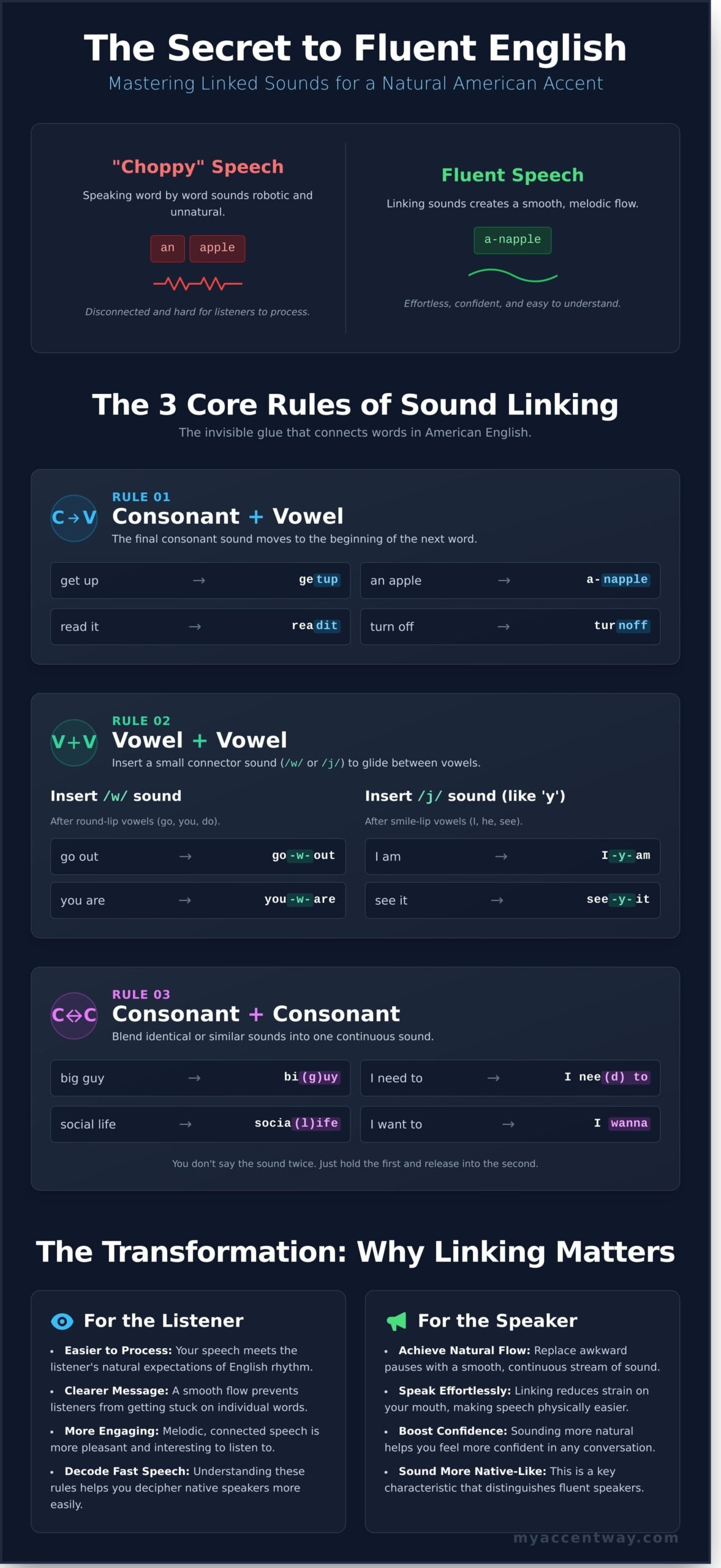
Have you ever perfected the pronunciation of a word, only to feel your sentences still sound robotic and unnatural? The issue isn’t your vocabulary or grammar; it’s the space between your words. Most learners are taught "dictionary pronunciation," where each word is spoken perfectly and separately. But native speakers don’t talk like that. They use a powerful technique to create a smooth, melodic flow.
This technique is called sound linking. It’s the reason "an apple" naturally sounds more like "a napple," and "turn it off" becomes "tur-ni-toff." Instead of hard stops, words flow into one another, creating a seamless stream of sound. Understanding the system of linked sounds english offers is not a complicated grammar rule-it’s the essential bridge from sounding like a student to speaking like a confident native.
The Listener’s Challenge: Decoding Fast Speech
When you speak word by word, a native listener has to work harder to process your meaning. Their brains are wired to anticipate the natural rhythm and flow of connected speech, a linguistic term for the way sounds change when words are joined together in conversation. These changes create predictable phonetic patterns. By not linking your words, you’re breaking these patterns, which can make your speech sound jarring or difficult to follow. Recognizing these links is the key to decoding fast speech; it’s like learning to hear the underlying ‘music’ of the American accent.
The Speaker’s Goal: Achieving a Natural Flow
For the speaker, the difference is profound. Word-by-word speech is often filled with tiny, unnatural hesitations that create a choppy, disjointed rhythm. In contrast, linking sounds allows your speech to flow effortlessly from one word to the next, reducing strain on your mouth and your mind. This smoothness is critical for building confidence in professional meetings and social situations. Remember, the goal isn’t to speak faster. It’s to speak more smoothly, replacing abrupt stops with fluid connections to achieve a truly natural and sophisticated American accent.
The 3 Core Rules of Linking in American English
To master the American accent, you don’t need to memorize a thousand complex rules. Instead, focus on the core principles of connected speech that native speakers use unconsciously every day. As a linguist, I can assure you that understanding these three simple patterns of linked sounds english will transform your fluency and make your speech sound incredibly natural.
Let’s break down the science behind the flow. Practice saying each example out loud to feel the difference!
Rule 1: Consonant to Vowel Linking (C+V)
This is the most common and impactful linking rule. When a word ends in a consonant sound and the next word begins with a vowel sound, the consonant sound effectively jumps over and attaches to the beginning of the next word. This creates a smooth, uninterrupted sound bridge.
Written Form
Spoken Sound
get up
ge-tup
an apple
a-napple
read it
rea-dit
turn off
tur-noff
Rule 2: Vowel to Vowel Linking (V+V)
When one word ends in a vowel sound and the next word also starts with a vowel sound, your mouth naturally inserts a tiny connector sound-a /w/ or a /j/ (which sounds like ‘y’)-to glide between them. This prevents a clumsy pause.
-
Use a /w/ sound after round-lip vowels (like in go, you, do).
-
Use a /j/ sound after smile-lip or tense vowels (like in I, he, see).
Written Form
Spoken Sound
go out
go-w-out
I am
I-y-am
you are
you-w-are
Rule 3: Consonant to Consonant Linking (C+C)
This rule helps you speak more efficiently. When a word ends with a consonant sound that is identical or very similar to the consonant sound at the start of the next word, you don’t say the sound twice. Instead, you hold the first sound for a moment and release it directly into the second, blending them into one continuous articulation.
Written Form
Spoken Sound
big guy
bi(g)uy (hold the ‘g’ sound)
I need to
I nee(d)to (the /d/ and /t/ are similar)
I want to
I wanna (a very common reduction)
By consciously practicing these three rules, you are building the muscle memory required for authentic, fluid American English. You can do this!
Advanced Linking for a Native-Like American Accent
You’ve built a strong foundation. Now, let’s move beyond the basics to the subtle nuances that create the characteristic rhythm of American English. These advanced techniques are the secret behind the smooth, connected speech you hear from native speakers. Mastering them is what separates good English from truly great, confident communication. As a linguist, I can assure you these are not random changes but predictable phonetic patterns. Understanding these advanced linked sounds english is your key to unlocking that authentic American flow.
Elision: The Art of Dropping Sounds
Elision is the linguistic term for when a sound disappears to make pronunciation easier, a key feature of casual, fast speech. Think of it as a natural shortcut your mouth takes in complex consonant clusters. This most often happens to the /t/ and /d/ sounds when they are squeezed between other consonants.
-
next door becomes ‘nex door’
-
and then becomes ‘an’ then’
-
most common becomes ‘mos’ common’
Flapping: The American T and D Sound
Perhaps the most recognizable feature of the American accent, the ‘flap t’ is a crucial sound to master. This occurs when a /t/ is positioned between two vowel sounds, causing it to soften into a sound very similar to a quick ‘d’. Failing to use the flap is one of the quickest ways to sound non-native or overly formal in American English.
-
water sounds like ‘wadder’
-
better sounds like ‘bedder’
-
a lot of links to sound like ‘a lodda’
Assimilation: When Sounds Change Each Other
Assimilation is a fascinating process where one sound changes to become more like a neighboring sound. This phonetic shortcut makes your speech more efficient, allowing for faster and smoother transitions between words. It’s a powerful tool for achieving a truly native-like cadence and rhythm.
-
have to often becomes ‘hafta’ (the /v/ changes to /f/ to match the voiceless /t/)
-
don’t you can become ‘doncha’ (the /t/ and /y/ sounds combine into a ‘ch’ sound)
How to Practice Linking: From Drills to Daily Conversation
Understanding the theory behind linked sounds is the first step, but true mastery comes from dedicated practice. To make linking a natural, automatic part of your speech, you must develop new muscle memory. This journey isn’t about intense, hours-long sessions; it’s about consistent, focused effort that retrains both your mouth and your ear. This structured, three-step approach will guide you from passive knowledge to active, confident application in your daily life.
Step 1: Train Your Ear with Active Listening
Before you can produce linked sounds correctly, you must be able to hear them. Native speakers use them so seamlessly that they can be difficult to notice at first. Active listening trains your brain to identify these connections, building the crucial foundation for your own speech. Start by focusing on one linking pattern at a time to avoid feeling overwhelmed.
-
Listen to short audio clips: Use podcasts, news reports, or movie scenes where the speech is clear and at a moderate pace.
-
Identify and transcribe: Listen for a specific linking rule (like a consonant connecting to a vowel) and write down every example you hear.
-
Check your work: Use resources with transcripts, such as TED Talks or ESL websites, to verify how accurate you were.
Step 2: Build Muscle Memory with Speaking Drills
Once your ear is tuned in, it’s time to train your mouth. Speaking drills are the most effective way to build the physical coordination required for smooth transitions between words. This is where your cognitive understanding of linked sounds english transforms into a physical, automatic skill. Remember, mastering these patterns requires dedicated, focused practice.
-
Use minimal pair drills: Practice phrases that sound different only because of linking, like distinguishing "why I…" from the single word "Y."
-
Read sentences aloud: Find short texts and read them slowly, consciously applying the linking rules you’ve learned. Focus on creating a smooth flow, not on speed.
-
Record and compare: Record yourself reading a phrase, then listen to a native speaker’s version. Analyze the differences in rhythm and connection.
Step 3: Apply Your Skills in the Real World
Drills build the foundation, but real-world conversation is what solidifies your skills. The ultimate goal is to move linking from a conscious, deliberate effort to an unconscious, natural habit. This final step bridges that gap.
-
Try shadowing: Listen to a native speaker and repeat what they say in real-time, mimicking their rhythm, intonation, and connections as closely as possible.
-
Start in low-pressure situations: Consciously use one or two linked phrases in conversations with a trusted friend or language partner.
-
Aim for progress, not perfection: You won’t sound perfect overnight. Celebrate the small victories and focus on gradual, consistent improvement.
-
Get expert feedback: For structured improvement and personalized guidance, a professional American Accent Program provides the expert feedback needed to master these subtle but powerful skills.
Linking: Your Pathway to Confidence and Fluency
Understanding the rules of connected speech is a powerful technical skill. But its true value lies in what it unlocks: the confidence to express yourself freely and fully. When your words flow together smoothly, you are not just easier to understand-you are perceived as more competent, credible, and authoritative. The ultimate goal isn’t just to speak English; it’s to feel a deep sense of pride and ease every time you do. Mastering linked sounds english is the bridge from knowing the language to truly owning it.
How Linked Speech Reduces a Foreign Accent
What is often described as a "foreign accent" is frequently the result of choppy, disconnected speech that fights against the natural flow of English. By mastering linking, you adopt the inherent rhythm and melody of the American accent. This makes your speech significantly less work for a native listener to process, leading to fewer misunderstandings and a dramatic improvement in communication clarity. Your message is heard, not just your words.
The Role of a Professional Coach in Mastering Linking
While self-study can build a foundation, expert feedback is essential for true mastery. A trained linguist can identify your specific linking challenges-often patterns you can’t hear yourself-and provide personalized drills to correct fossilized errors. At American Accent Program, our proven method ensures you practice correctly and efficiently. A professional coach doesn’t just show you the path; they walk it with you, guaranteeing faster and more profound results.
Your Next Steps to Fluent, Confident Speech
You now understand the science behind why linked sounds english are so critical for fluency. The next step is to move from knowledge to action. Begin by consciously practicing the core rules in your daily conversations. For those who are serious about achieving a complete transformation and speaking with unwavering confidence, professional guidance is the key to unlocking your potential. Ready to master the rhythm of American English? Enroll in our American Accent Training to master connected speech.
Mastering Linked Sounds: Your Final Step to Fluency
You’ve now uncovered the secret behind the smooth, connected rhythm of native speakers. The journey from choppy, word-by-word speech to effortless fluency is built on understanding and applying the core principles of linking. By mastering how consonants flow into vowels and similar sounds merge, you’re not just learning rules; you’re re-shaping the very music of your speech. Remember that consistent practice is what turns this knowledge about linked sounds english into an intuitive, natural skill.
Taking this knowledge to the next level requires a proven, scientific method. If you are serious about achieving measurable results, our program offers a direct path to success. Designed by a Ph.D. Linguist, our training utilizes proprietary 2D Sound Motion Technology to give you precise, visual feedback, and we back our method with a Success Guarantee. ******Ready to transform your speech? Discover our American Accent Training program! **
Your goal of speaking English with confidence and clarity is within reach. Embrace the journey and start speaking like the fluent, confident person you are meant to be.
Frequently Asked Questions About Linked Sounds
Is linking the same as slurring words or speaking incorrectly?
Not at all. Linking is a precise, rule-based feature of natural, fluent English, not a mistake or a form of sloppy speech. While slurring results in unclear pronunciation, linking is a sophisticated skill that connects words smoothly, such as saying "an apple" as "a-napple." From a linguistic perspective, it’s a key element of connected speech that demonstrates an advanced command of English phonology and rhythm.
Do I have to use linked sounds to be understood in English?
While you can be understood speaking word-by-word, mastering linked sounds is essential for achieving true fluency and a natural flow. Without linking, your speech can sound robotic and disjointed to native listeners. Embracing this skill allows you to communicate your ideas more effortlessly and effectively, ensuring you are not just understood, but that you also sound confident and polished in any conversation.
How long does it take to master English linking?
The time it takes to master linking is unique to each individual’s journey. With consistent practice and expert guidance, students often notice a significant improvement in their flow within a few weeks. To make linking an automatic, unconscious habit can take several months of dedicated effort. A structured, scientific approach accelerates this process by targeting the specific cognitive skills required for fluent, connected speech.
Will improving my linking help me in my professional career?
Absolutely. In the professional world, clear and confident communication is critical. Mastering linked sounds makes your speech smoother, more authoritative, and easier for colleagues to understand in meetings and presentations. This allows your powerful ideas to be the focus, rather than your pronunciation. Polished speech enhances your professional credibility and can open doors to new opportunities for career advancement.
What are the five most common examples of linking I should learn first?
To build a strong foundation, start with these five key linking patterns. First is Consonant-to-Vowel linking (e.g., "get_on"). Second is Vowel-to-Vowel ("I_am"). Third is linking two identical consonants ("good_day"). Fourth, learn the T + Y rule, which creates a "CH" sound ("don’t_you"). Finally, master the D + Y rule, which creates a "J" sound ("could_you").
Can I learn linking if I have a very strong accent?
Yes, you absolutely can. Learning the rules of linked sounds english is one of the most powerful strategies for improving clarity and reducing a strong accent. Our proven method is designed to work with your unique linguistic background. We identify the specific phonological habits from your native language and build a personalized plan to help you develop new muscle memory for a clear, connected American accent.
Disclaimer – American Accent Program
The American Accent Program available through Visit Program Website
is an educational and coaching service designed to support pronunciation, accent reduction, and spoken English fluency. All training materials, including lessons, exercises, audio content, visual simulations, coaching methods, and digital resources, are the intellectual property of American Accent Program, LLC and are protected by applicable copyright and intellectual property laws.
By using this website and participating in the program, you acknowledge that all content is provided for personal, non-commercial, educational use only. Users are granted a limited, non-transferable license to access the materials strictly for individual learning purposes. Redistribution, reproduction, recording, modification, sharing, or commercial use of any program content without prior written consent is strictly prohibited.
The program may include live coaching sessions, digital tools, and instructional materials intended to improve pronunciation and communication skills. However, individual results may vary, and no specific level of fluency, accent reduction, or communication outcome is guaranteed.
The American Accent Program and its instructors do not provide medical, therapeutic, or clinical speech-language pathology services. All training is intended for educational purposes only.
By accessing or using the program, you agree to comply with all applicable terms, including the platform’s Terms of Use and Course Policies, and acknowledge that misuse of materials may result in termination of access without refund.
Speech clarity check
The problem is not always grammar or vocabulary.
If people understand your words but still miss your message, the deeper issue may be speech clarity, rhythm, intonation, and American pronunciation habits. MyAccentWay helps students retrain the sound system with professional 1-on-1 guidance, so English can feel clearer, freer, and more natural in real communication.
Why MyAccentWay works
Two training methods that make speech change active.
MyAccentWay is not passive listen-and-repeat coaching. Prof. Alex, Ph.D. Accent Coach, creates a learning situation where students become active learners and active participants in changing their own speech patterns.
Interactive training
Students do not just receive pronunciation instructions passively. They listen, think, compare, adjust, and understand their own speech patterns while Prof. Alex guides the correction process.
Cognitive accent training
Students learn to notice and correct the speech patterns that affect American pronunciation, then implement new American speech patterns into their code-switching process for more natural, long-lasting change.
Your next step
Build speech habits people can hear in real conversations.
A stronger American accent is not built by memorizing topics or chasing quick pronunciation tips. It comes from structured training, professional feedback, active correction, and repeated application until clearer speech becomes easier to keep.




One Response