American English Pacing for Speakers: A Clear Guide
(512) 265-9515Updated October 14, 2026 ◆ 13 min read
Pacing in American English is the controlled regulation of speaking speed and rhythm that makes speech clear, natural, and easy to follow. It is not simply about talking fast or slow. Pacing involves how you group words, where you pause, which syllables you stress, and how your speech tempo shifts to signal meaning. When pacing works, listeners absorb your message without effort. When it breaks down, even grammatically correct speech becomes hard to follow.
Real student result

“I feel confident enough to speak American English!”
Interactive American Accent Training9monthsof hard work and dedication
Listen to the starting point0:00
Listen to the result0:00
“Many of my students once believed they could never sound like this. School taught them grammar and vocabulary, but not how to train their English speech. That is what we do together, step by step, until you speak English independently and with confidence.”
Abishek’s result was achieved through Prof. Alex’s research-based Interactive 1-on-1 American Accent Training. His doctoral research found this interactive method more effective than traditional, teacher-centered methods. See the research basis →
Three elements shape pacing in American English:
- Articulation rate: the speed at which speech sounds are physically produced
- Thought groups: meaningful chunks of 3–7 words separated by brief pauses
- Stress and emphasis: lengthening and pitch changes on key words that guide listener attention
What pacing challenges do non-native speakers face most often?
The most common pacing mistake is speaking continuously without pauses. When you remove all pauses, listeners must work much harder to identify where one idea ends and the next begins. The Harvard Bok Center describes this as the equivalent of removing all punctuation from written text: the words are there, but the structure that carries meaning is gone.
Other frequent challenges include:
- Pausing in the wrong places, such as mid-phrase, which fragments meaning and confuses listeners
- Speaking too fast under pressure, which compresses stressed syllables and strips out the pitch variation listeners rely on
- Ignoring thought group boundaries, so speech sounds like one long, unbroken stream
- Misplacing stress, which causes listeners to search for meaning in the wrong syllable
- Linking sounds incorrectly, which blurs word boundaries and makes speech harder to parse
A 2024 study found that listener comprehension drops within 2–3 seconds after a speaker pauses mid-phrase or stresses the wrong syllable. That is a fast penalty for a small error.
How does pacing shape emphasis, emotion, and meaning?
Pacing is one of the primary tools American English speakers use to signal what matters. Slowing down on a key word, pausing just before an important phrase, or raising pitch on a focus word all tell the listener: pay attention here. Without those cues, every word carries equal weight, and the listener cannot tell what to prioritize.

Emotion travels through pacing too. Urgency comes from a faster tempo with shorter pauses. Confidence sounds like deliberate, steady rhythm with clear stress on content words. Hesitation shows up as irregular pausing and reduced pitch variation. Native speakers regulate all of this intuitively, but it is a learnable skill.
Pro Tip: To practice emphasis, record yourself reading one sentence three times, stressing a different word each time. Notice how the meaning shifts. That awareness is the foundation of natural American English speech patterns.
The Harvard Bok Center notes that emphatic stress involves pausing before important terms, slowing down on those terms, and changing pitch. Volume alone does not create emphasis in American English.
What does linguistics research say about articulation rate?
The relationship between utterance length and speech speed is one of the most consistent findings in phonetics. A 2024 study modeling speech rate across 13 English corpora found that articulation rate increases by 2.1–2.4 syllables per second from the shortest to the longest utterances. Longer sentences are naturally spoken faster, not because speakers rush, but because articulatory gestures compress as the utterance extends.
“Utterance length has the largest effect on speech rate, though this effect itself varies little across corpora and speakers.” — 2024 articulation rate study across 13 English speech corpora
Age and gender also influence rate, but their effects are much smaller. Older speakers tend to speak more slowly, and the gender difference amounts to roughly 0.25 syllables per second. Dialect, however, produces more noticeable differences.
| Factor | Effect on articulation rate |
|---|---|
| Utterance length | Largest effect: +2.1–2.4 syllables/sec from short to long |
| Speaker age | Older speakers tend to speak more slowly |
| Speaker gender | Female speakers tend to speak somewhat more slowly |
| Dialect (Northern vs. Southern) | Northern speakers are noticeably faster in spontaneous speech compared to Southern speakers |
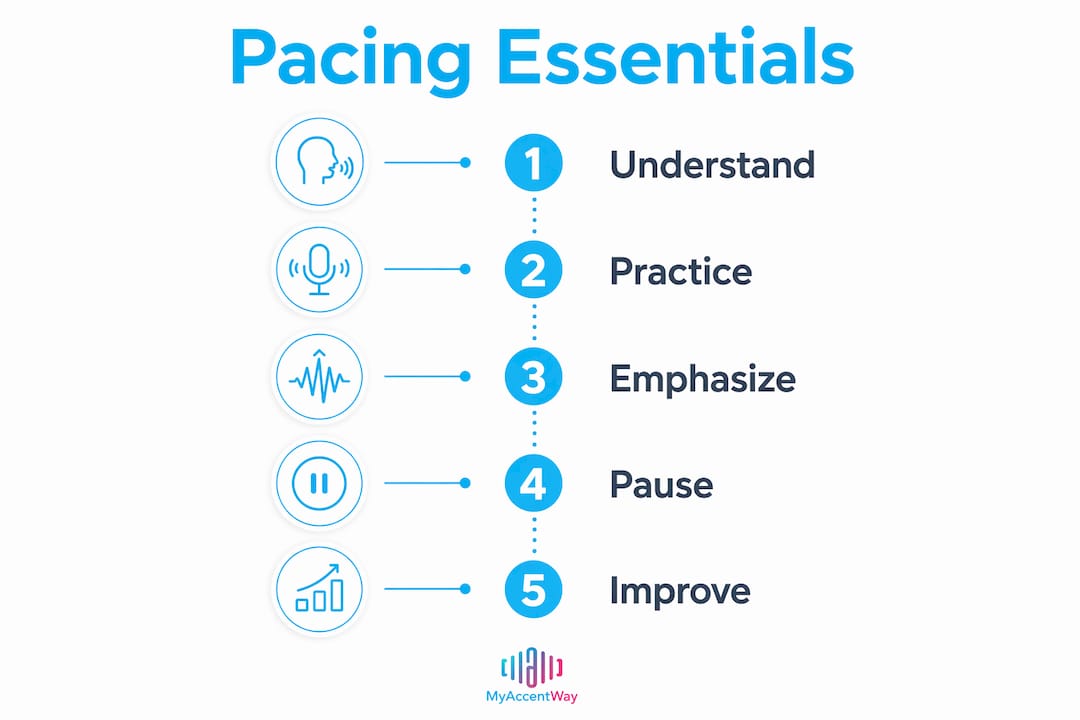
Thought groups of 3–7 words are the structural unit that makes this variable rate manageable for listeners. Pausing at thought group boundaries gives listeners time to process each chunk before the next one arrives.
Practical tips to improve your American English pacing
Improving pacing starts with awareness, then moves into deliberate practice. These techniques work because they target the specific mechanisms that make American English speech patterns feel natural.
- Mark thought groups before you speak. Take a written text, draw a slash at each natural pause point, then read it aloud. This trains your ear and your breath to align with meaning boundaries.
- Slow down by lengthening stressed syllables, not by adding extra pauses everywhere. Stretching the vowel in a key word gives listeners processing time without breaking the rhythm.
- Shadow native speakers. Choose a short audio clip, listen once, then speak along with it in real time. Shadowing trains your ear to match rhythm, stress, and tempo simultaneously.
- Record and compare. Play back your recording next to a native speaker saying the same content. The differences in pause placement and stress become immediately audible.
- Practice with sentence stress patterns to build the rhythmic foundation that pacing depends on.
Pro Tip: Focus on one focus word per thought group. That word gets lengthened, a pitch rise, and slightly more mouth movement. Everything else in the group can be softer and faster. This single habit produces the most noticeable improvement in natural-sounding pacing.
Proper pacing also reduces listener cognitive load by signaling thought boundaries through pausing and emphasis, helping listeners stay engaged rather than working to decode your speech.

How Myaccentway trains pacing through science and structured coaching
Myaccentway’s approach to American accent training is built on a principle most programs skip: you cannot reliably control pacing until you understand how your speech organs physically produce each sound. When you know where your tongue, lips, and jaw should be, you can slow down or speed up with precision rather than guessing.
The training sequence follows a clear structure:
- Speech-organ awareness: Students learn the physical mechanics of American sounds before practicing them.
- Consonant and vowel retraining: Each sound is practiced in isolation, then in words, then in phrases.
- Rhythm and thought group work: Students practice chunking speech into natural groups with correct stress placement.
- Intonation and pacing integration: Pitch variation and tempo are layered in once the sound system is stable.
A core tool in this process is Prof. Alex’s Interactive Visual 2D Sound Simulators, which let students actively train speech movements. Instead of guessing what your tongue should do, or trying to copy a coach’s mouth from across a screen, you actively train the movement of your tongue, lips, jaw, teeth, and airflow with the Interactive Visual 2D Sound Simulators while Prof. Alex corrects you live. In MyAccentWay training, these simulators are part of Prof. Alex’s interactive teaching model, based on his Ph.D. research in interactive teaching methods, and are used to train sound articulation, sound formation, and speech production during live 1-on-1 accent training sessions.
Vlad, a Russian speaker, worked through this structured method and achieved measurable improvement in his rhythm and speech clarity.
This is not “repeat after me” coaching. Students retrain the sound system, practice it through phonetic exercises, and apply it in sentences until the pattern becomes automatic. The goal is for you to stop overthinking each word and speak the way you do in your native language: fluently, without conscious effort on every syllable.
What are typical speaking speeds in American English?
Conversational American English typically falls within a range of words per minute, though the rate shifts considerably by context. Formal presentations tend to run slower, around 120–150 words per minute, because speakers pause more deliberately and stress key terms. Casual conversation moves faster, often toward the upper end of that range or beyond.
At the syllable level, a study comparing Wisconsin and North Carolina speakers found spontaneous speech rates of 5.41 syllables per second for Northern speakers and 4.81 for Southern speakers. Read speech was slower for both groups. Your target should fall within this range, with Northern speech typically faster than Southern, but the most important thing is clarity and natural pacing.
How does pacing differ across American English dialects?
Regional dialect is one of the clearest predictors of speaking rate in American English. Research comparing Wisconsin (Northern) and North Carolina (Southern) speakers found that Northern speakers read faster and spoke faster in spontaneous speech than Southern speakers.
A separate study of six regional dialects found that Southern American English is characterized by a slow overall articulation rate, long pauses, and highly variable vowel durations. New England speech shows the opposite pattern: faster articulation and shorter pauses. The Midland, Northern, and Western dialects fall between these poles, with less distinctive temporal patterns.
For non-native speakers, this means there is no single “correct” American pacing speed. What matters is that your rhythm, stress placement, and thought group boundaries align with natural American English speech patterns, regardless of which regional variety you are targeting.
How can you identify and fix your own pacing mistakes?
Self-assessment is the fastest path to improvement, and it requires only a recording device and honest listening. Record yourself speaking for 60–90 seconds on any topic, then evaluate against these checkpoints:
- Do you pause at thought group boundaries, or do you run phrases together?
- Are your pauses placed between clauses, or do they interrupt phrases mid-thought?
- Can you hear a clear focus word in each thought group, with a pitch rise and lengthening?
- Does your speech speed up under pressure, compressing stressed syllables?
The most common self-assessment error is listening for accent features rather than rhythm. Pacing mistakes are often louder than sound errors. A mid-phrase pause or a flat, unstressed delivery will disrupt comprehension faster than a mispronounced vowel. For a structured checklist, the pronunciation checklist for non-native speakers covers pacing alongside other clarity markers.
Why pauses and rhythm are the architecture of clear speech
Pauses are not silence. They are oral punctuation, the spoken equivalent of commas and periods that tell listeners when one idea ends and another begins. The Harvard Bok Center describes pausing as the mechanism that creates “oral grammar,” the structure listeners need to parse meaning in real time. Without it, even well-pronounced speech becomes a blur.
Rhythm in American English is stress-timed, meaning the language organizes itself around the beat of stressed syllables, with unstressed syllables compressed in between. This creates a characteristic pulse that listeners expect. When your rhythm matches that pulse, your speech feels natural. When it does not, listeners sense something is off even if they cannot name what it is. Studying American English thought groups gives you the structural framework to build that rhythm deliberately.
Pacing is the skill most coaches underestimate
Most accent training programs focus on individual sounds: the American “r,” the short vowel, the voiced “th.” Those matter. But in 20+ years of coaching non-native speakers, the pattern I see most consistently is this: students who fix their pacing are understood more clearly, faster, than students who spend the same time perfecting individual phonemes.
The reason is straightforward. Listeners process speech in chunks, not in individual sounds. When your thought groups are clear and your pauses land in the right places, listeners can follow you even if a few sounds are still accented. When your pacing is broken, even clean pronunciation gets lost in the noise of a disorganized rhythm.
What I find most students underestimate is how physical pacing control is. It is not just a matter of slowing down or thinking more carefully. It requires retraining the breath, the stress habits, and the muscle memory of how you deliver a phrase. That is why tools like 2D Sound Motion Technology matter: as part of Prof. Alex’s interactive teaching model, grounded in his Ph.D. research in interactive teaching methods, the Interactive Visual 2D Sound Simulators help students actively train the movement of the tongue, lips, jaw, teeth, and airflow while Prof. Alex corrects them live.
The students who make the fastest progress are not the ones who practice the most. They are the ones who practice with the clearest understanding of what they are trying to change.
MyAccentWay · 2D Sound Motion Technology
American English Pronunciation: Consonant and Vowel Sounds with 2D Sound Motion Technology
Learning American English pronunciation and the American accent is more effective when you train your speech organs, not only listen and repeat. 2D Sound Motion Technology and Interactive Visual 2D Sound Simulators, developed in 2020 by Prof. Alex, Ph.D. Accent Coach, Doctor of Education, and professional linguist, as part of his interactive teaching model based on his Ph.D. research in interactive teaching methods, train your tongue, lips, jaw, teeth, airflow, and voice step by step. They train each American sound and more than 30 sound combinations through Interactive 2D video simulation.
What 2D Sound Motion Technology is
2D Sound Motion Technology is an advanced accent reduction and articulation training tool by Prof. Alex. It corrects, develops, and trains each American sound and more than 30 sound combinations through Interactive 2D video simulation.
What Interactive Visual 2D Sound Simulators do
Interactive Visual 2D Sound Simulators are part of 2D Sound Motion Technology, the articulation-training method Prof. Alex created by applying his Ph.D. research in interactive teaching to American pronunciation. Instead of listening and repeating, students actively train their speech organs. Each simulator uses Interactive 2D mouth movement to train the speech organs (tongue, lips, jaw, teeth, airflow, and voice) to produce each American sound correctly. Every consonant has its own simulator: explore American consonants trained with 2D Sound Motion Technology.
Sample training: the American t sound (aspirated [t])
Practice
Record yourself speaking these words:
Tab · Tacos · Time · Tub · Hotel · Motel · Sit · Pit · Net
Instructions
Play the Interactive Visual 2D Sound Simulator for the American t sound below several times and follow it step by step. Move your tongue, jaw, and airflow together with the simulator and train your articulation.
Interactive Visual 2D Sound Simulator: American unvoiced sound [t]
Practice
Record yourself again speaking these words, but this time focus on the movement of your tongue. Go slow, and you will hear the difference. You’ve got this!
Tab · Tacos · Time · Tub · Hotel · Motel · Sit · Pit · Net
How Interactive Visual 2D Sound Simulators solve pronunciation and speaking problems
- Wrong articulationMost pronunciation problems start with the tongue, lips, jaw, or teeth in the wrong position. Each Interactive Visual 2D Sound Simulator trains the correct articulation of one American sound, so the student corrects the cause of the problem, not only the result.
- Airflow and voicingMany accent problems come from wrong airflow or voicing: sounds that are too weak, too strong, or voiced when they should be unvoiced. The simulators train airflow and voice together with articulation, step by step, for each American sound and more than 30 sound combinations.
- Clear speech and confidenceWhen each sound is trained correctly, words connect into clear American English speech. Listeners can understand you more easily, and speaking at work, in meetings, and on calls becomes more confident.

If you start hearing the aspiration, the short airstream after [t], with one simulator, you can only imagine how successful you can be in 1-on-1 Interactive American Accent Training with Prof. Alex, Ph.D. Accent Coach, where your whole American sound system is trained sound by sound.
In MyAccentWay, the Interactive Visual 2D Sound Simulators are only available in 1-on-1 accent coaching sessions with Prof. Alex.
Interactive American Accent Training for Foreign-Born Professionals in the United States
Foreign-born professionals in the United States often know their field and speak advanced English. Yet American listeners may still struggle with their sounds, stress, and rhythm. MyAccentWay offers private online American accent training through Interactive American Accent Training.
Interactive American Accent Training is led by Prof. Alex, Ph.D. Accent Coach, Doctor of Education, and professional linguist. He first diagnoses each speaker’s native-language patterns. Then he trains American sound articulation, stress, rhythm, and intonation for real real conversations.
Who this training is for
- Engineers, IT specialists, and data professionals presenting to U.S. teams and clients
- Doctors, nurses, and healthcare professionals explaining care to American patients
- Managers, executives, and founders leading meetings, pitches, and briefings
- Consultants, researchers, and academics speaking at conferences and webinars
- Professionals preparing for interviews, promotions, or client-facing roles
Online training across the U.S.
MyAccentWay is based in Austin, Texas, and all training is online. The program is especially relevant for professionals in Austin, Dallas, Houston, New York City, the San Francisco Bay Area, Los Angeles, Seattle, Boston, Chicago, Miami, Washington DC, Atlanta, and Raleigh.
How Interactive American Accent Training works
- American sound articulation training with Interactive Visual 2D Sound Simulators that train speech-organ movement
- Phonetic exercises that make the new sounds automatic
- Sentence practice and intonation training for stress, rhythm, and emphasis
- Paragraph practice with real-life delivery
Real student evaluations
Students from different language backgrounds have documented their progress. Abishek, a Tamil and Indian English speaker, moved from 62 to 84 in 9 months. Tian, a Mandarin speaker, moved from 58 to 85 in 8 months. Vlad, a Russian speaker, moved from 60 to 83 in 5 months.
The first step is a 1 Hour Evaluation Session with Prof. Alex.
FAQ
What is pacing in spoken American English?
Pacing is the controlled regulation of speaking speed and rhythm, including where you pause, how long you hold stressed syllables, and how you chunk speech into thought groups of several words.
At what speed should American English speech be delivered?
Conversational American English typically ranges around 120–150 words per minute. At the syllable level, spontaneous speech averages 5.41 syllables per second for Northern speakers and 4.81 syllables per second for Southern speakers based on regional dialect.
How do pauses improve comprehension for listeners?
Pauses placed at clause and phrase boundaries act as oral punctuation, giving listeners time to process each thought group. Mid-phrase pauses have the opposite effect, increasing listener confusion within 2–3 seconds.
How can non-native speakers practice American English pacing?
Shadow native speakers in real time, record and compare your phrasing to a native model, mark thought group boundaries in written texts before reading aloud, and focus on lengthening stressed syllables rather than simply slowing down overall speed.
How does Myaccentway help with pacing and accent training?
Myaccentway’s accent reduction program combines speech-organ awareness, structured phonetic training, and Interactive Visual 2D Sound Simulators to retrain rhythm, stress, and intonation in a fixed sequence that builds toward natural, confident American English speech.
Recommended
Mastering American English Rhythm: A Linguist’s Guide to Professional Speech Clarity
Did you know that poor business communication costs U.S. companies an estimated $1.2 trillion annually? This staggering figure represents over...

American English Connected Speech Rules: A Professional Guide to Natural Flow
Speaking English clearly isn't about pronouncing every single letter. In fact, trying to be too perfect is exactly why you might sound robotic or...
How to Improve English Speaking Clarity: A Scientific Guide for 2026
What if the secret to being understood isn't about speaking louder, but about mastering the cognitive and analytical processes behind every phoneme?...
The problem is not always grammar or vocabulary.
If people understand your words but still miss your message, the deeper issue may be speech clarity, rhythm, intonation, and American pronunciation habits. MyAccentWay helps students retrain the sound system with professional 1-on-1 guidance, so English can feel clearer, freer, and more natural in real communication.
Two training methods that make speech change active.
MyAccentWay is not passive listen-and-repeat coaching. Prof. Alex, Ph.D. Accent Coach, Doctor of Education, and professional linguist, creates a learning situation where students become active learners and active participants in changing their own speech patterns.
Interactive training
Students do not just receive pronunciation instructions passively. They listen, think, compare, adjust, and understand their own speech patterns while Prof. Alex guides the correction process.
Cognitive accent training
Students learn to notice and correct the speech patterns that affect American pronunciation, then implement new American speech patterns into their code-switching process for more natural, long-lasting change.
Build speech habits people can hear in real conversations.
A stronger American accent is not built by memorizing topics or chasing quick pronunciation tips. It comes from structured training, professional feedback, active correction, and repeated application until clearer speech becomes easier to keep.
Continue learning how MyAccentWay connects American sound articulation, Interactive Visual 2D Sound Simulators, accent reduction, student proof, and 1-on-1 training.
- Prof. Alex and the MyAccentWay MethodLearn how Prof. Alex, Ph.D. Accent Coach, Doctor of Education, and professional linguist, created and leads the structured MyAccentWay American accent training system.
- Accent Reduction Curriculum and English Articulation TrainingSee how MyAccentWay trains accent reduction, accent modification, American pronunciation, English articulation, rhythm, and professional speech clarity.
- 2D Sound Motion Technology for American Accent TrainingUnderstand Prof. Alex’s Interactive Visual 2D Sound Simulators for American sound articulation.
- Before-and-After American Accent Training ResultsListen to real before-and-after student proof and accent training outcomes.
- Student Reviews and Accent Training ResultsRead student reviews, testimonials, and trust signals from MyAccentWay learners.
- Book a 1-Hour 1 Hour Evaluation SessionStart with a 1-hour accent evaluation session with Prof. Alex.