What is Accent Reduction? A Guide to Speaking Clearer, More Confident English
(512) 265-9515Updated October 7, 2026 ◆ 15 min read
Have you ever shared a brilliant idea in a meeting, only to be met with confused looks? Or found yourself repeating a simple coffee order for the third time? This frustrating gap between what you know and what others hear can undermine your confidence, making you feel that your accent is holding you back. It’s a common challenge that leads many skilled professionals to ask: what is accent reduction, and can it truly help me be understood?
Real student result

“I feel confident enough to speak American English!”
Interactive American Accent Training9monthsof hard work and dedication
Listen to the starting point0:00
Listen to the result0:00
“Many of my students once believed they could never sound like this. School taught them grammar and vocabulary, but not how to train their English speech. That is what we do together, step by step, until you speak English independently and with confidence.”
Many people worry that it means erasing their cultural identity or sounding unnatural. But the reality, grounded in linguistic science, is far more empowering. True accent reduction isn’t about losing who you are; it’s about mastering the specific phonemes, rhythm, and intonation of American English to gain clarity and control. It’s about adding a powerful new skill to ensure your message is heard, every single time. This comprehensive guide will explain how this transformative process works, unlocking new levels of confidence in your professional and personal life.
Defining Accent Reduction: Clarity, Not Elimination
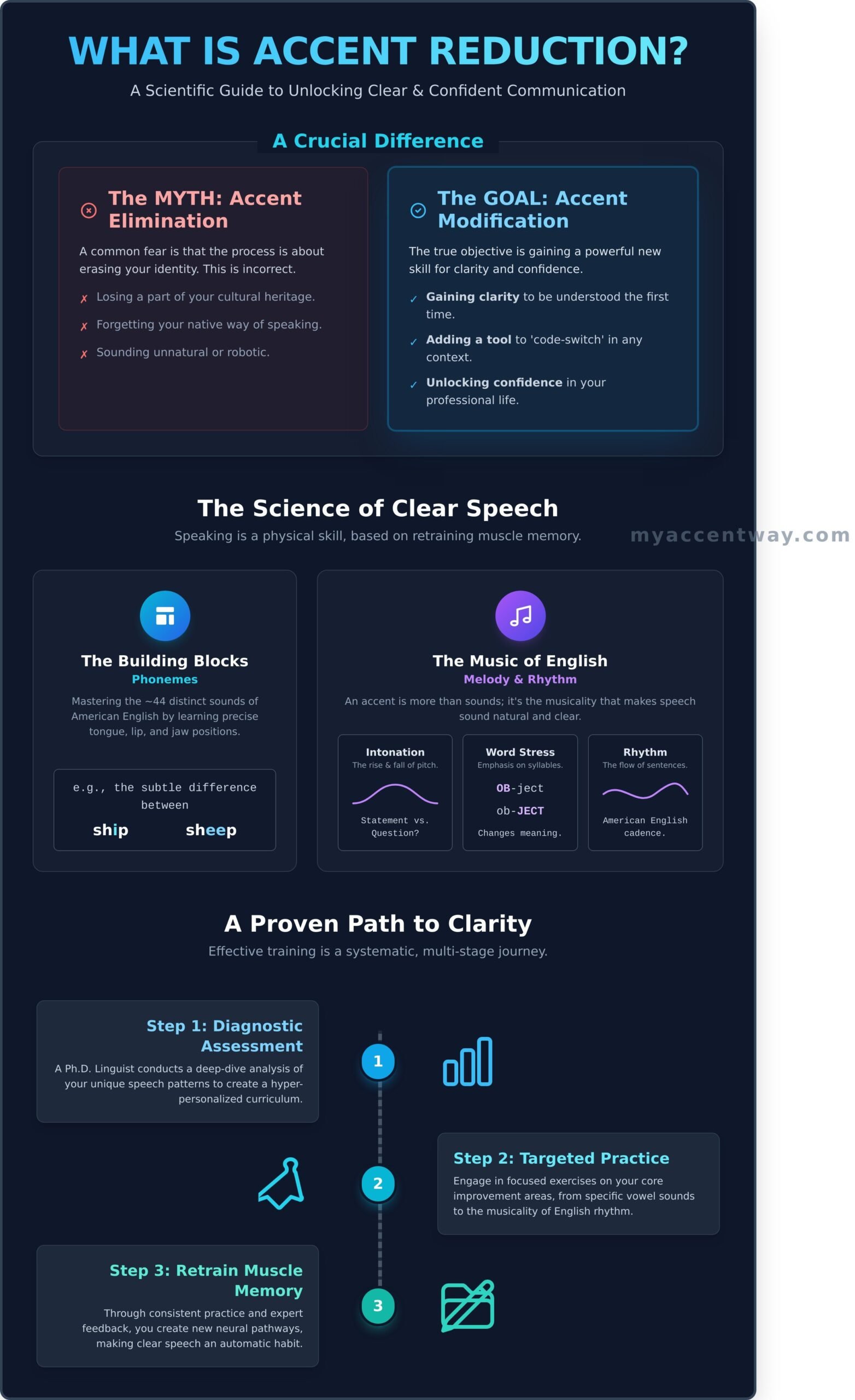
Many aspiring professionals ask, "what is accent reduction?" At its core, it is a systematic process for learning the speech patterns of a new accent. This goes far beyond basic English lessons that focus on grammar and vocabulary. Instead, professional training focuses on the specific mechanics of speech: the pronunciation of individual vowels and consonants (phonemes), the rhythm and stress of sentences, and the musicality of speech, known as intonation. The primary goal is not to erase your original accent, but to master a new one for clear, effective, and confident communication.
As a field of study, accent reduction involves a highly analytical approach to mastering new sounds. It’s about training your ear to hear subtle differences and training your mouth to produce them accurately. Think of it as adding a powerful new tool to your professional skillset, allowing you to articulate your ideas with precision and authority, ensuring your message is always heard exactly as you intend.
Accent Modification vs. Accent Elimination: A Crucial Difference
A common fear is that this process means losing a part of your cultural identity. Let’s be clear: the goal is accent modification, not elimination. Your original accent is a vital part of your heritage. Learning an American accent is like becoming bilingual in speech; you don’t forget your native way of speaking, but you gain the ability to code-switch and adapt your speech for any professional or social context you choose.
The True Goal: Unlocking Confident Communication
We prefer to shift the focus from "reducing" something negative to gaining something incredibly positive. The true objective is to unlock a new level of confidence that comes from being understood the first time, every time. This clarity translates directly into tangible results-leading meetings more effectively, building stronger client relationships, and excelling in high-stakes presentations. Mastering clear speech is about empowering your voice so your expertise can truly shine.
The Science of Speech: How Your Accent Can Be Reshaped
Many people wonder, what is accent reduction from a scientific perspective? At its core, speaking is a physical skill, much like playing the piano or mastering a new sport. Your accent is simply the result of highly practiced, automatic muscle habits-the specific ways your tongue, lips, and jaw have been trained to move to produce the sounds of your native language. You’ve performed these movements thousands of times, creating strong muscle memory.
Therefore, reshaping an accent isn’t about erasing your identity; it’s about developing a new set of physical skills. As the American Speech-Language-Hearing Association (ASHA) outlines in its professional guidelines on Accent Modification , the goal is to enhance clarity and confidence. By understanding the mechanics behind speech, you can consciously retrain these muscles to produce the sounds of an American accent with precision and ease.
The Building Blocks: Mastering Vowels and Consonants
Every language is built from a unique set of distinct sounds called phonemes. The American English accent, for example, has around 44 phonemes. Mastering them requires learning the precise physical actions needed to produce each one. This involves the exact placement of your tongue (e.g., touching the ridge behind your teeth for the /t/ sound), the shape of your lips (rounded for "oo," spread for "ee"), and the opening of your jaw. These subtle differences are what distinguish words like ship from sheep.
The Music of English: Rhythm, Stress, and Intonation
An accent is far more than just individual vowel and consonant sounds. It’s also defined by the "music" of the language. This includes:
-
Intonation: The rise and fall of your voice. A rising intonation at the end of "You’re finished" turns a statement into a question.
-
Word Stress: Emphasizing the correct syllable in a word, which can change its meaning entirely (e.g., an ob-ject vs. to ob-ject).
-
Sentence Rhythm: The flow and timing of words in a sentence, which gives American English its characteristic cadence.
Mastering this musicality is essential for sounding natural and being clearly understood.
Retraining Muscle Memory for Lasting Change
The final step is transforming conscious effort into an automatic habit. Through consistent, targeted practice, you create new neural pathways in your brain. This is why simply repeating words from a video isn’t enough; without expert feedback from a trained linguist, you may be reinforcing incorrect movements. The goal is to practice correctly until the new patterns-the right tongue positions, intonation, and rhythm-become your new, confident way of speaking English automatically.
How Accent Reduction Training Works: A Step-by-Step Process
Many people wonder, what is accent reduction in practice? It’s far more than just mimicking sounds from a language app. True, effective training is a systematic, scientific journey designed to reshape your speech habits for clarity and confidence. Unlike a one-size-fits-all program, professional coaching follows a proven, multi-stage process that begins with understanding your unique voice. This structured method, which is detailed in many academic overviews of what is accent reduction, ensures that every moment of your practice is targeted and effective, leading to tangible results.
Step 1: The Initial Assessment and Speech Analysis
Your journey begins with a comprehensive diagnostic assessment. A trained accent coach, ideally a Ph.D. Linguist, will conduct a detailed analysis of your speech. This isn’t just casual listening; it’s a linguistic deep-dive to identify your specific phonetic patterns, intonation, rhythm, and stress that differ from the standard American accent. Based on this analysis, a hyper-personalized curriculum is created just for you. This customized roadmap targets your exact areas for improvement, ensuring your training is efficient and addresses the core habits influencing your accent.
Step 2: Targeted Practice on Core Speech Elements
With your personalized plan in place, the foundational work begins. This phase involves a methodical approach to mastering the building blocks of the American accent. You won’t just be repeating words; you will engage in targeted drills focusing on:
-
Individual Sounds (Phonemes): Learning the precise tongue, lip, and jaw positions for challenging vowels and consonants using tools like mouth placement diagrams and audio feedback.
-
Word and Phrase Level: Applying these new sounds in single words and short phrases to build muscle memory and accuracy.
-
Rhythm and Intonation: Mastering the "music" of American English, including word stress and sentence melody, which is crucial for sounding natural and clear.
Step 3: Integrating Skills into Natural Conversation
Once you have a strong grasp of the individual components, the final and most crucial step is integration. The goal is to move your new skills from conscious effort to automatic habit in real-world conversations. This is achieved through dynamic exercises like reading passages aloud, engaging in role-playing scenarios, and practicing spontaneous speech on various topics. It’s about applying your knowledge under pressure until it becomes second nature. For those seeking expert guidance through this vital stage, enrolling in structured American accent training provides the feedback and consistent practice needed to achieve true conversational confidence.
Who Needs Accent Reduction? Key Professions and Personal Goals
The question of what is accent reduction often leads to a more personal one: "Is this for me?" The answer is deeply tied to your individual goals. For many ambitious individuals, mastering an American accent isn’t about erasing their identity, but about adding a powerful tool for clear, effective communication. It’s about ensuring your voice is as strong as your ideas.
Let’s explore some specific scenarios where accent modification training provides a clear advantage.
For Ambitious Professionals in Tech, Business, and Medicine
In high-stakes professional environments, clarity is currency. When your expertise is your greatest asset, you cannot afford to be misunderstood. Accent modification helps you communicate with precision and authority, ensuring your message is received exactly as intended. This is critical for:
-
Client-Facing Roles: Building immediate rapport and trust with clients who need to understand complex information quickly.
-
Team Leadership: Motivating your team and giving clear, unambiguous direction during crucial projects.
-
Presentations & Meetings: Commanding a room, conveying confidence, and solidifying your reputation as an expert in your field.
For Actors, Voice-Over Artists, and Public Speakers
For performers and public figures, the voice is a finely tuned instrument. Here, accent modification is a fundamental skill of the craft. Actors must master different accents to authentically portray characters, while voice-over artists need a versatile and clear sound. Public speakers often work to neutralize their accent to connect with the broadest possible audience. This demonstrates the incredible level of phonetic control that can be achieved through dedicated training.
For Anyone Seeking Greater Social Confidence
Beyond the boardroom or the stage, many people seek accent training for a deeply personal reason: to connect more easily with others. If you’ve ever felt the frustration of having to repeat yourself in a coffee shop or seeing a flicker of confusion in a conversation with a new friend, you know how draining it can be. The goal here is simple but life-changing: smoother, more joyful, and more confident social interactions every single day.
Ultimately, understanding what is accent reduction is the first step toward unlocking your communication potential. With a proven, scientific approach, you can achieve your personal and professional goals with a clear, confident voice.
The Real-World Benefits: More Than Just Clearer Speech
While understanding the technical side of what is accent reduction is important, the true value lies in the profound and positive impact it has on your daily life. This journey is about more than just mastering new sounds; it’s about unlocking new levels of confidence and opportunity. The training empowers you to communicate your true self, ensuring your ideas, expertise, and personality are what people remember most.
A Major Boost in Professional and Social Confidence
Imagine walking into a meeting or joining a social conversation and speaking up without hesitation. This is the most powerful outcome of accent modification: a deep sense of self-assurance. When you no longer worry about being misunderstood, you feel free to lead discussions, network with industry leaders, and share your unique perspective. This newfound confidence radiates through every interaction, transforming how you see yourself and how others see you.
Enhanced Listening and Comprehension Skills
A surprising yet significant benefit of this training is that you become a better listener. As you learn to physically produce the specific phonemes and intonation patterns of the American accent, your brain becomes expertly tuned to hear them in fast-paced, natural speech. This means you’ll find it easier to follow complex conversations, understand various speakers on conference calls, and engage more effectively in any discussion.
Opening Doors to New Career Opportunities
Clear, confident communication is a critical asset in the global marketplace. Mastering the American accent can be a direct investment in your professional growth, making you a stronger applicant for a wide range of roles and promotions. This skill is particularly vital for:
-
Leadership and management positions
-
Client-facing roles in sales, consulting, and customer success
-
Public speaking, teaching, and corporate training
-
Collaborating effectively on international teams
Ultimately, the true answer to what is accent reduction is found in these life-changing results. It’s an investment that pays dividends in confidence, clarity, and career success. Ready to start your transformation? Discover the proven, linguist-led method at myaccentway.com.
Your Journey to Clearer, More Confident Communication
Ultimately, understanding what is accent reduction is the first step toward transformative personal and professional growth. It’s not about losing your identity, but gaining a powerful tool for clarity and connection. By reshaping the physical habits of speech, you can ensure your ideas are always heard and understood, boosting your confidence in every conversation.
If you are ready to master clear, confident English, the right guidance is essential. MyAccentWay offers a personalized program designed by a Ph.D. Linguist, combining personalized coaching with proprietary 2D Sound Motion Technology. This is your opportunity to learn from an expert and achieve your communication goals with a proven method. Discover the proven, linguist-led method to master the American accent. Your voice has power-it’s time to let it shine.
MyAccentWay · 2D Sound Motion Technology
American English Pronunciation: Consonant and Vowel Sounds with 2D Sound Motion Technology
Learning American English pronunciation and the American accent is more effective when you train your speech organs, not only listen and repeat. 2D Sound Motion Technology and Interactive Visual 2D Sound Simulators, developed in 2020 by Prof. Alex, Ph.D. Accent Coach, Doctor of Education, and professional linguist, as part of his interactive teaching model based on his Ph.D. research in interactive teaching methods, train your tongue, lips, jaw, teeth, airflow, and voice step by step. They train each American sound and more than 30 sound combinations through Interactive 2D video simulation.
What 2D Sound Motion Technology is
2D Sound Motion Technology is an advanced accent reduction and articulation training tool by Prof. Alex. It corrects, develops, and trains each American sound and more than 30 sound combinations through Interactive 2D video simulation.
What Interactive Visual 2D Sound Simulators do
Interactive Visual 2D Sound Simulators are part of 2D Sound Motion Technology, the articulation-training method Prof. Alex created by applying his Ph.D. research in interactive teaching to American pronunciation. Instead of listening and repeating, students actively train their speech organs. Each simulator uses Interactive 2D mouth movement to train the speech organs (tongue, lips, jaw, teeth, airflow, and voice) to produce each American sound correctly. Every consonant has its own simulator: explore American consonants trained with 2D Sound Motion Technology.
Sample training: the American t sound (aspirated [t])
Practice
Record yourself speaking these words:
Tab · Tacos · Time · Tub · Hotel · Motel · Sit · Pit · Net
Instructions
Play the Interactive Visual 2D Sound Simulator for the American t sound below several times and follow it step by step. Move your tongue, jaw, and airflow together with the simulator and train your articulation.
Interactive Visual 2D Sound Simulator: American unvoiced sound [t]
Practice
Record yourself again speaking these words, but this time focus on the movement of your tongue. Go slow, and you will hear the difference. You’ve got this!
Tab · Tacos · Time · Tub · Hotel · Motel · Sit · Pit · Net
How Interactive Visual 2D Sound Simulators solve pronunciation and speaking problems
- Wrong articulationMost pronunciation problems start with the tongue, lips, jaw, or teeth in the wrong position. Each Interactive Visual 2D Sound Simulator trains the correct articulation of one American sound, so the student corrects the cause of the problem, not only the result.
- Airflow and voicingMany accent problems come from wrong airflow or voicing: sounds that are too weak, too strong, or voiced when they should be unvoiced. The simulators train airflow and voice together with articulation, step by step, for each American sound and more than 30 sound combinations.
- Clear speech and confidenceWhen each sound is trained correctly, words connect into clear American English speech. Listeners can understand you more easily, and speaking at work, in meetings, and on calls becomes more confident.

If you start hearing the aspiration, the short airstream after [t], with one simulator, you can only imagine how successful you can be in 1-on-1 Interactive American Accent Training with Prof. Alex, Ph.D. Accent Coach, where your whole American sound system is trained sound by sound.
In MyAccentWay, the Interactive Visual 2D Sound Simulators are only available in 1-on-1 accent coaching sessions with Prof. Alex.
Speech Clarity Training for Foreign-Born Professionals in the United States
Foreign-born professionals in the United States often know their field and speak advanced English. Yet American listeners may still struggle with the clarity of their sounds and rhythm. MyAccentWay offers private online speech clarity training through Interactive American Accent Training.
Interactive American Accent Training is led by Prof. Alex, Ph.D. Accent Coach, Doctor of Education, and professional linguist. He first diagnoses each speaker’s native-language patterns. Then he trains American sound articulation, stress, rhythm, and intonation for real conversations.
Who this training is for
- Engineers, IT specialists, and data professionals presenting to U.S. teams and clients
- Doctors, nurses, and healthcare professionals explaining care to American patients
- Managers, executives, and founders leading meetings, pitches, and briefings
- Consultants, researchers, and academics speaking at conferences and webinars
- Professionals preparing for interviews, promotions, or client-facing roles
Online training across the U.S.
MyAccentWay is based in Austin, Texas, and all training is online. The program is especially relevant for professionals in Austin, Dallas, Houston, New York City, the San Francisco Bay Area, Los Angeles, Seattle, Boston, Chicago, Miami, Washington DC, Atlanta, and Raleigh.
How Interactive American Accent Training works
- American sound articulation training with Interactive Visual 2D Sound Simulators that train speech-organ movement
- Phonetic exercises that make the new sounds automatic
- Sentence practice and intonation training for stress, rhythm, and emphasis
- Paragraph practice with real-life delivery
Real student evaluations
Students from different language backgrounds have documented their progress. Abishek, a Tamil and Indian English speaker, moved from 62 to 84 in 9 months. Tian, a Mandarin speaker, moved from 58 to 85 in 8 months. Vlad, a Russian speaker, moved from 60 to 83 in 5 months.
The first step is a 1 Hour Evaluation Session with Prof. Alex.
Frequently Asked Questions About Accent Reduction
How long does accent reduction training typically take?
The timeline for accent reduction is highly personal and depends on your starting point, goals, and dedication to practice. With a structured program and consistent effort, most students see a significant, noticeable improvement in their clarity and confidence within 3 to 6 months. Mastering the nuances of the American accent is a journey, and our expert-led method is designed to accelerate your progress and ensure you achieve lasting, effective results.
Will I completely lose my original accent?
The goal of our training is not to erase your identity but to empower you with choice and clarity. We focus on accent modification, giving you the skills to speak with a standard American accent when you choose, especially in professional settings. Your original accent is a part of your cultural heritage. Our program adds a powerful new communication tool to your skillset, allowing you to switch between accents and express yourself confidently in any situation.
Do I need to be an advanced English speaker to start accent reduction?
While a good command of English is helpful, you don’t need to be perfectly fluent to begin. Our training focuses specifically on the phonetics-the sounds, rhythm, and intonation-of American English. Learners at an intermediate level often find this is the perfect time to build clear pronunciation habits. As long as you can communicate and are motivated to master new speech patterns, our program is designed to elevate your spoken English, regardless of your current level.
Can I learn to reduce my accent on my own with apps?
Apps can be a supplementary tool, but they lack the crucial, personalized feedback required for true mastery. An app cannot correct subtle errors in tongue placement or intonation like a trained Ph.D. Linguist can. Effective accent reduction relies on expert guidance to diagnose your specific patterns and provide tailored exercises. This live, intellectual interaction is essential for building correct muscle memory and achieving genuine, lasting improvement in your speech clarity and confidence.
What’s the difference between accent reduction and speech therapy?
This is a critical distinction. Speech therapy is a clinical practice that diagnoses and treats medical speech disorders, such as stuttering or aphasia. In contrast, understanding what is accent reduction involves an elective educational process. It is specialized coaching for non-native speakers who want to modify their pronunciation to enhance communication clarity. It is not about fixing a disorder but about mastering the phonological system of a new language for greater confidence.
Is accent reduction training expensive?
Investing in professional accent reduction training is an investment in your career and personal confidence. The cost reflects the personalized, expert guidance from a Ph.D. Linguist, which supports focused progress that self-study alone may not provide. We offer various programs tailored to different needs and budgets. The value lies in the transformation-gaining the clarity and confidence to unlock new opportunities and communicate without barriers or misunderstandings.
What is the difference between accent reduction and accent modification?
Accent reduction focuses on reducing native-language features that make speech harder to understand. Accent modification focuses on adjusting and adding American speech patterns while keeping the speaker’s identity. MyAccentWay’s training with Prof. Alex covers both, through sound articulation, rhythm, stress, intonation, and connected speech.
The problem is not always grammar or vocabulary.
If people understand your words but still miss your message, the deeper issue may be speech clarity, rhythm, intonation, and American pronunciation habits. MyAccentWay helps students retrain the sound system with professional 1-on-1 guidance, so English can feel clearer, freer, and more natural in real communication.
Two training methods that make speech change active.
MyAccentWay is not passive listen-and-repeat coaching. Prof. Alex, Ph.D. Accent Coach, Doctor of Education, and professional linguist, creates a learning situation where students become active learners and active participants in changing their own speech patterns.
Interactive training
Students do not just receive pronunciation instructions passively. They listen, think, compare, adjust, and understand their own speech patterns while Prof. Alex guides the correction process.
Cognitive accent training
Students learn to notice and correct the speech patterns that affect American pronunciation, then implement new American speech patterns into their code-switching process for more natural, long-lasting change.
Build speech habits people can hear in real conversations.
A stronger American accent is not built by memorizing topics or chasing quick pronunciation tips. It comes from structured training, professional feedback, active correction, and repeated application until clearer speech becomes easier to keep.
Continue learning how MyAccentWay connects American sound articulation, Interactive Visual 2D Sound Simulators, accent reduction, student proof, and 1-on-1 training.
- Prof. Alex and the MyAccentWay MethodLearn how Prof. Alex created and leads the structured MyAccentWay American accent training system.
- Accent Reduction Curriculum and English Articulation TrainingSee accent reduction, accent modification, American pronunciation, English articulation, rhythm, and professional speech clarity.
- 2D Sound Motion Technology for American Accent TrainingUnderstand Interactive Visual 2D Sound Simulators for American sound articulation.
- Before-and-After American Accent Training ResultsListen to real before-and-after student proof and outcomes.
- Student Reviews and Accent Training ResultsRead student reviews and trust signals.
- Book a 1-on-1 American 1 Hour Evaluation SessionStart with a 1-hour interactive session with Prof. Alex.
Disclaimer – American Accent Program
The American Accent Program available through Visit Program Website
is an educational and coaching service designed to support pronunciation, accent reduction, and spoken English fluency. All training materials, including lessons, exercises, audio content, visual simulations, coaching methods, and digital resources, are the intellectual property of American Accent Program, LLC and are protected by applicable copyright and intellectual property laws.
By using this website and participating in the program, you acknowledge that all content is provided for personal, non-commercial, educational use only. Users are granted a limited, non-transferable license to access the materials strictly for individual learning purposes. Redistribution, reproduction, recording, modification, sharing, or commercial use of any program content without prior written consent is strictly prohibited.
The program may include live coaching sessions, digital tools, and instructional materials intended to improve pronunciation and communication skills. However, individual results may vary, and no specific level of fluency, accent reduction, or communication outcome is guaranteed.
The American Accent Program and its instructors do not provide medical, therapeutic, or clinical speech-language pathology services. All training is intended for educational purposes only.
By accessing or using the program, you agree to comply with all applicable terms, including the platform’s Terms of Use and Course Policies, and acknowledge that misuse of materials may result in termination of access without refund.