What Causes a Foreign Accent in English?
(512) 265-9515Updated October 14, 2026 ◆ 12 min read
A foreign accent in American English is caused by your first language: your speech organs learned its sounds, stress, rhythm, and melody first, and they carry those habits into English automatically.
Real student result

“I feel confident enough to speak American English!”
Interactive American Accent Training9monthsof hard work and dedication
Listen to the starting point0:00
Listen to the result0:00
“Many of my students once believed they could never sound like this. School taught them grammar and vocabulary, but not how to train their English speech. That is what we do together, step by step, until you speak English independently and with confidence.”
Abishek’s result was achieved through Prof. Alex’s research-based Interactive 1-on-1 American Accent Training. His doctoral research found this interactive method more effective than traditional, teacher-centered methods. See the research basis →
Professor Alex explains the science of accent
A foreign accent is not a mistake. It is a learned sound system speaking through English.
When I work with students, I do not tell them to erase their voice. I help them understand why their native language patterns appear in English, then we train the specific sounds, rhythm, stress, and intonation that affect clarity.
The goal is not accent elimination. The goal is clearer, more confident American English communication through structured, science-informed training.
Have questions before starting accent training?
Students can contact the MyAccentWay Support Center to ask questions, learn how the program works, and get connected with Professor Alex.
TL;DR
A foreign accent in English mainly results from phonological transfer and differences in speech rhythm and stress patterns. These features are influenced by the typological distance between the speaker’s native language and English, with greater differences leading to more persistent accents. Focused perception and rhythm training are essential for reducing accent and improving intelligibility.
A foreign accent comes from the first language’s sound system, rhythm, and stress transferring into English. Research cited by ASHA shows accent and intelligibility are separate: speakers with strong accents can still be clear. MyAccentWay focuses training on what affects clarity, measured sound by sound (100 = native speaker).
Transfer
Your first-language sound system shapes how you hear, organize, and produce English sounds.
A foreign accent in English is defined as the influence of a speaker’s native language sound system on their English pronunciation, rhythm, and intonation. Linguists call this phonological transfer, the process by which patterns from your first language shape how you produce and perceive sounds in a second language. The critical period hypothesis identifies ages 6 to 12 as the window when native-like phonological acquisition is most achievable. After that window closes, accent features become increasingly persistent. Understanding what causes foreign accent in English is the first step toward doing something about it.

Accent reduction, speech modification, and pronunciation coaching for clearer American English
For non-native English-speaking professionals in the United States, a foreign accent can affect meetings, interviews, presentations, leadership communication, customer conversations, and daily workplace speech. The right American Accent Training should not simply ask students to repeat words. It should identify the causes of accent patterns and train pronunciation, speech clarity, rhythm, stress, intonation, connected speech, and professional communication.
MyAccentWay uses linguistics-based accent reduction and speech modification to help students understand how American English sounds are physically produced. This is especially helpful for adults who want clearer American pronunciation, better intelligibility, stronger confidence, and more natural speech in U.S. professional environments. Popular search terms for this kind of training include American accent training, accent reduction, foreign accent reduction, speech modification, American English pronunciation, pronunciation coaching, speech clarity training, accent coach online, and English pronunciation for professionals.
What causes foreign accent in English: phonological transfer
Phonological transfer is the primary driver of foreign accents in English. When you learn English as an adult, your brain maps new English sounds onto the phoneme categories already established by your native language. This process is called categorical perception, and it means you literally hear and produce English sounds through a first-language filter.
The critical period for phonology closes between ages 6 and 12. After this age, acquiring native-like pronunciation becomes significantly harder. This does not mean improvement is impossible. It means your brain requires more deliberate, structured training to rewire existing sound categories.
One of the most counterintuitive findings in phonetics is the Similarity Paradox. English sounds that are very close to sounds in your native language are actually harder to master than completely foreign sounds. Your brain assimilates similar sounds into existing first-language categories, which blocks accurate perception and production.
| Native language | Common English sound affected | Typical error pattern |
|---|---|---|
| Spanish | /b/ vs. /v/ | Both produced as /b/ |
| Mandarin | Final consonants | Consonants dropped or unreleased |
| Hindi | Retroflex vs. alveolar /t/, /d/ | Retroflex substitution |
| Japanese | /r/ vs. /l/ | Merged into one approximant |
| Arabic | Short vowels /ɪ/ vs. /iː/ | Vowel length distinctions lost |
Record yourself saying English minimal pairs like “ship/sheep” or “bet/bat.” If you cannot hear the difference on playback, your perception needs training before your production can improve.
Neuromuscular habituation compounds this challenge. Your tongue, lips, and jaw have spent years executing the precise muscle movements of your native language. Retraining those muscles for English requires explicit, physical practice, not just passive listening.
How do rhythm and stress shape a foreign accent?
Rhythm and stress differences between your native language and English are frequently the greatest source of listener difficulty. This area of speech is called suprasegmentals, which covers rhythm, stress, intonation, and timing patterns that operate above the level of individual sounds.
English is a stress-timed language. Stressed syllables occur at roughly regular intervals, and unstressed syllables are compressed to fit between them. When speakers of syllable-timed languages apply their native rhythm to English, every syllable sounds equally weighted. A listener may understand your individual sounds but still struggle to follow your speech because the stress pattern signals the wrong words as important.
Syllable-timed languages
Spanish, French, Italian, and Hindi often give every syllable more equal duration.
Mora-timed languages
Japanese timing is based on morae, which are shorter timing units than syllables.
Tone languages
Mandarin, Cantonese, and Vietnamese use pitch changes to carry word meaning.
Intonation is equally significant. English uses falling intonation to signal completed statements and rising intonation for questions. When native intonation patterns transfer to English, statements can sound like questions, and confident assertions can sound uncertain.
What is foreign accent syndrome and how is it different?
Foreign Accent Syndrome is a rare neurological condition in which a person suddenly begins speaking their native language with what sounds like a foreign accent, despite having no prior exposure to that accent. It is not caused by language learning. It is caused by neurological damage to brain areas controlling speech melody and rhythm, most commonly after a stroke or brain injury.
| Feature | Typical foreign accent | Foreign Accent Syndrome |
|---|---|---|
| Cause | L1 phonological transfer | Stroke, brain injury, neurological damage |
| Onset | Gradual, over years of learning | Sudden, following neurological event |
| Language affected | Second language | Native language |
| Reversible | Yes, with training | Partially, with speech therapy |
How does typological distance affect accent persistence?
Typological distance refers to how structurally different your native language is from English. The greater the distance, the more persistent and noticeable the accent tends to be. Research confirms that structural transfer is particularly persistent in speaking and writing when significant typological distance exists between the first language and English.
Phonological distance
Languages with fewer vowel distinctions often produce merged English vowels.
Grammatical distance
Languages without clusters, tense marking, or articles can create transfer errors.
Lexical distance
Different word stress rules create consistent stress placement errors.
The factors that increase foreign accent influence on English speech include limited early exposure to English, learning English primarily through reading rather than listening, receiving no systematic pronunciation feedback, and speaking a language with high typological distance from English.
A noticeable accent does not automatically mean poor clarity. Research confirms that a foreign accent is often a subjective listener perception and does not necessarily correspond with reduced intelligibility. The goal of accent training is not erasure. It is targeted improvement in the features that most affect listener understanding. You can read more about this in MyAccentWay’s guide on speaking without mother tongue influence.
Key takeaways
Foreign accents in English are caused by phonological transfer, rhythmic mismatch, and typological distance between the native language and English, all of which require structured, perception-first training to address.
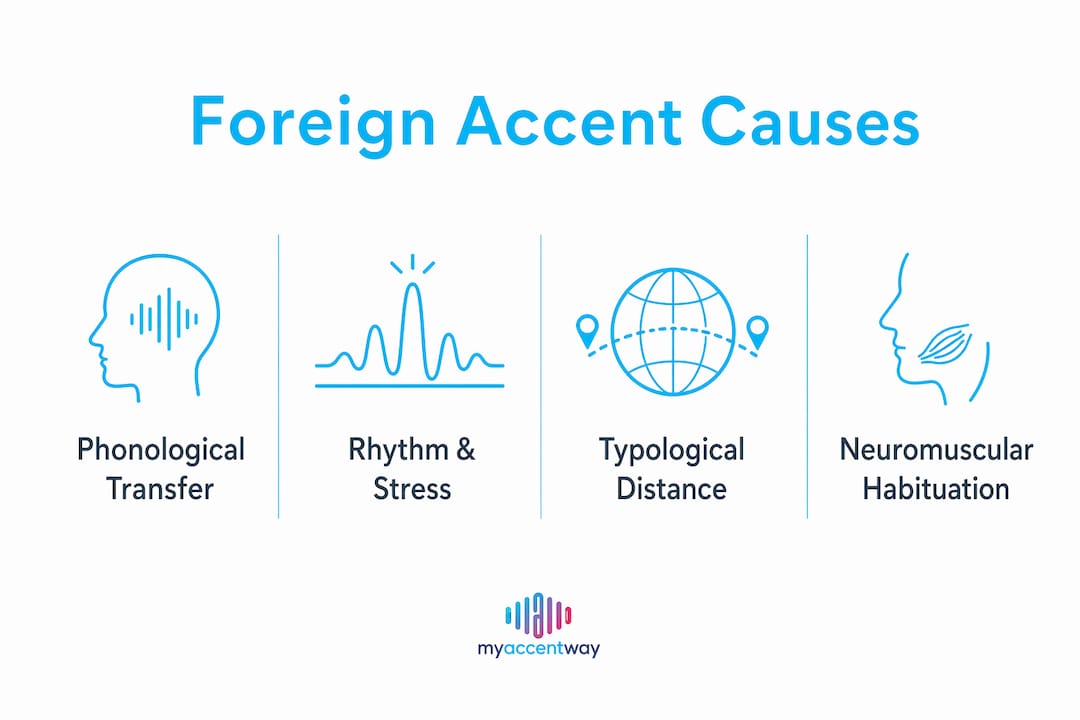
Your brain maps English sounds onto L1 categories.
Close sounds are often harder to correct.
Stress-timing mismatch can affect clarity most.
Greater distance often predicts persistence.
Foreign Accent Syndrome is neurological.
Why rhythm training beats sound drills every time
Most learners spend their practice time drilling individual sounds. I understand why. Sounds feel concrete. You can point to a letter and say, “I need to fix that.” But in my experience working with non-native English speakers across dozens of language backgrounds, isolated sound drills produce the slowest results.
Rhythm and intonation are what listeners process first. Before your listener registers whether you said /v/ or /b/, they have already processed your stress pattern and decided whether your speech is easy or hard to follow. When rhythm is off, even accurate sounds feel foreign. When rhythm is right, small sound errors become nearly invisible.
The second thing I have learned is that accent modification should be driven by personal goals, not external pressure. Students who train because they want clearer communication in their professional lives make faster, more durable progress than those training because someone told them their accent was a problem.
Perception training must come before production training. If you cannot hear the difference between two sounds or two stress patterns, no amount of tongue exercises will fix the output. Start with your ears.
Train the causes, not just the symptoms
Understanding why a foreign accent forms is only useful if it points you toward the right training. MyAccentWay’s American Accent Training is built around exactly the causes covered in this article: phonological transfer, suprasegmental patterns, and the perceptual training that must come first. You can also read the full American accent training program guide for a deeper overview.
Professor Alex uses 2D Sound Motion Technology and the Interactive Visual 2D Sound Simulators to train the movement of the tongue, lips, jaw, teeth, and airflow while he corrects you live, so you train the physical movement behind each sound, not just the sound itself. The program addresses both segmental accuracy and the rhythm and intonation patterns that most affect real communication. If you are ready to work on the specific features driving your accent, explore MyAccentWay’s online accent training courses or start with 1-on-1 American accent training.
2D Sound Video Mouth Training Simulator
Available only inside 1-on-1 accent training sessions, this simulator helps students train the tongue, lip, jaw, airflow, and speech-organ movements used to produce American sounds. Instead of only listening and repeating, students train the movement behind the sound.
Interactive visual accent training is supported by scientific evidence showing that interactive learning can lead to better training outcomes. Review the study here: scientific evidence for interactive training.
MyAccentWay · 2D Sound Motion Technology
American English Pronunciation: Consonant and Vowel Sounds with 2D Sound Motion Technology
Learning American English pronunciation and the American accent is more effective when you train your speech organs, not only listen and repeat. 2D Sound Motion Technology and Interactive Visual 2D Sound Simulators, developed in 2020 by Prof. Alex, Ph.D. Accent Coach, Doctor of Education, and professional linguist, as part of his interactive teaching model based on his Ph.D. research in interactive teaching methods, train your tongue, lips, jaw, teeth, airflow, and voice step by step. They train each American sound and more than 30 sound combinations through Interactive 2D video simulation.
What 2D Sound Motion Technology is
2D Sound Motion Technology is an advanced accent reduction and articulation training tool by Prof. Alex. It corrects, develops, and trains each American sound and more than 30 sound combinations through Interactive 2D video simulation.
What Interactive Visual 2D Sound Simulators do
Interactive Visual 2D Sound Simulators are part of 2D Sound Motion Technology, the articulation-training method Prof. Alex created by applying his Ph.D. research in interactive teaching to American pronunciation. Instead of listening and repeating, students actively train their speech organs. Each simulator uses Interactive 2D mouth movement to train the speech organs (tongue, lips, jaw, teeth, airflow, and voice) to produce each American sound correctly. Every consonant has its own simulator: explore American consonants trained with 2D Sound Motion Technology.
Sample training: the American t sound (aspirated [t])
Practice
Record yourself speaking these words:
Tab · Tacos · Time · Tub · Hotel · Motel · Sit · Pit · Net
Instructions
Play the Interactive Visual 2D Sound Simulator for the American t sound below several times and follow it step by step. Move your tongue, jaw, and airflow together with the simulator and train your articulation.
Interactive Visual 2D Sound Simulator: American unvoiced sound [t]
Practice
Record yourself again speaking these words, but this time focus on the movement of your tongue. Go slow, and you will hear the difference. You’ve got this!
Tab · Tacos · Time · Tub · Hotel · Motel · Sit · Pit · Net
How Interactive Visual 2D Sound Simulators solve pronunciation and speaking problems
- Wrong articulationMost pronunciation problems start with the tongue, lips, jaw, or teeth in the wrong position. Each Interactive Visual 2D Sound Simulator trains the correct articulation of one American sound, so the student corrects the cause of the problem, not only the result.
- Airflow and voicingMany accent problems come from wrong airflow or voicing: sounds that are too weak, too strong, or voiced when they should be unvoiced. The simulators train airflow and voice together with articulation, step by step, for each American sound and more than 30 sound combinations.
- Clear speech and confidenceWhen each sound is trained correctly, words connect into clear American English speech. Listeners can understand you more easily, and speaking at work, in meetings, and on calls becomes more confident.

If you start hearing the aspiration, the short airstream after [t], with one simulator, you can only imagine how successful you can be in 1-on-1 Interactive American Accent Training with Prof. Alex, Ph.D. Accent Coach, where your whole American sound system is trained sound by sound.
In MyAccentWay, the Interactive Visual 2D Sound Simulators are only available in 1-on-1 accent coaching sessions with Prof. Alex.
Who is this accent reduction training for?
This article is especially useful for foreign-born professionals, international employees, graduate students, physicians, engineers, managers, executives, interpreters, translators, teachers, and public speakers who want to improve American English pronunciation and reduce accent barriers in the United States.
Improve how clearly you speak in meetings, presentations, interviews, and client conversations.
Train vowels, consonants, rhythm, stress, intonation, reductions, and connected speech.
Work on accent reduction and speech modification from anywhere in the U.S. through online training.
Interactive American Accent Training for Foreign-Born Professionals in the United States
Foreign-born professionals in the United States often know their field and speak advanced English. Yet American listeners may still struggle with their sounds, stress, and rhythm. MyAccentWay offers private online American accent training through Interactive American Accent Training.
Interactive American Accent Training is led by Prof. Alex, Ph.D. Accent Coach, Doctor of Education, and professional linguist. He first diagnoses each speaker’s native-language patterns. Then he trains American sound articulation, stress, rhythm, and intonation for real real conversations.
Who this training is for
- Engineers, IT specialists, and data professionals presenting to U.S. teams and clients
- Doctors, nurses, and healthcare professionals explaining care to American patients
- Managers, executives, and founders leading meetings, pitches, and briefings
- Consultants, researchers, and academics speaking at conferences and webinars
- Professionals preparing for interviews, promotions, or client-facing roles
Online training across the U.S.
MyAccentWay is based in Austin, Texas, and all training is online. The program is especially relevant for professionals in Austin, Dallas, Houston, New York City, the San Francisco Bay Area, Los Angeles, Seattle, Boston, Chicago, Miami, Washington DC, Atlanta, and Raleigh.
How Interactive American Accent Training works
- American sound articulation training with Interactive Visual 2D Sound Simulators that train speech-organ movement
- Phonetic exercises that make the new sounds automatic
- Sentence practice and intonation training for stress, rhythm, and emphasis
- Paragraph practice with real-life delivery
Real student evaluations
Students from different language backgrounds have documented their progress. Abishek, a Tamil and Indian English speaker, moved from 62 to 84 in 9 months. Tian, a Mandarin speaker, moved from 58 to 85 in 8 months. Vlad, a Russian speaker, moved from 60 to 83 in 5 months.
The first step is a 1 Hour Evaluation Session with Prof. Alex.
FAQ
What causes a foreign accent in English?
A foreign accent in English is caused by phonological transfer from the speaker’s native language, where first-language sound categories and rhythmic patterns are applied to English speech.
Why do some accents in English persist longer than others?
Accents persist longer when typological distance between the native language and English is greater.
What is the difference between a foreign accent and foreign accent syndrome?
A foreign accent results from language transfer. Foreign Accent Syndrome is a rare neurological condition caused by stroke or brain injury.
Does rhythm or individual sounds matter more for accent clarity?
Rhythmic mismatch is frequently the primary cause of listener difficulty, more so than individual sound errors.
Can adults reduce a foreign accent after the critical period?
Yes. Adults can improve through structured perception training, systematic pronunciation feedback, and targeted practice of both sounds and rhythm patterns.
Is accent reduction the same as speech modification?
Accent reduction and speech modification are closely related. Both focus on improving pronunciation, rhythm, stress, intonation, and speech clarity so non-native English speakers can communicate more clearly and confidently.
Does MyAccentWay offer online American accent training across the United States?
Yes. MyAccentWay provides online American accent training and 1-on-1 pronunciation coaching for non-native English-speaking professionals across the United States.
What causes a foreign accent in American English?
A foreign accent comes from native-language speech habits carried into English: different sound articulation, vowel and consonant substitutions, and different rhythm, stress, and intonation patterns. MyAccentWay helps students understand these habits through Cognitive Accent Training and retrain them in 1-on-1 sessions with Prof. Alex.
Recommended
Article generated by BabyLoveGrowth
The problem is not always grammar or vocabulary.
If people understand your words but still miss your message, the deeper issue may be speech clarity, rhythm, intonation, and American pronunciation habits. MyAccentWay helps students retrain the sound system with professional 1-on-1 guidance, so English can feel clearer, freer, and more natural in real communication.
Two training methods that make speech change active.
MyAccentWay is not passive listen-and-repeat coaching. Prof. Alex, Ph.D. Accent Coach, Doctor of Education, and professional linguist, creates a learning situation where students become active learners and active participants in changing their own speech patterns.
Interactive training
Students do not just receive pronunciation instructions passively. They listen, think, compare, adjust, and understand their own speech patterns while Prof. Alex guides the correction process.
Cognitive accent training
Students learn to notice and correct the speech patterns that affect American pronunciation, then implement new American speech patterns into their code-switching process for more natural, long-lasting change.
Build speech habits people can hear in real conversations.
A stronger American accent is not built by memorizing topics or chasing quick pronunciation tips. It comes from structured training, professional feedback, active correction, and repeated application until clearer speech becomes easier to keep.
Continue learning how MyAccentWay connects accent reduction, accent modification, English articulation, Prof. Alex’s method, student proof, and 1-on-1 American accent training.
- Prof. Alex and the MyAccentWay MethodLearn how Prof. Alex, Ph.D. Accent Coach, Doctor of Education, and professional linguist, created and leads the structured MyAccentWay American accent training system.
- Accent Reduction Curriculum and English Articulation TrainingSee how MyAccentWay trains accent reduction, accent modification, American pronunciation, English articulation, rhythm, and professional speech clarity.
- 2D Sound Motion Technology for American Accent TrainingUnderstand Prof. Alex’s Interactive Visual 2D Sound Simulators for American sound articulation.
- Before-and-After American Accent Training ResultsListen to real before-and-after student proof and accent training outcomes.
- Student Reviews and Accent Training ResultsRead student reviews, testimonials, and trust signals from MyAccentWay learners.
- Book a 1-on-1 American 1 Hour Evaluation SessionStart with a 1-hour interactive American accent training session with Prof. Alex.