American intonation guide
Master English Intonation Patterns: The Ultimate Guide to Sounding Natural
A calm, structured guide to understanding how American rhythm, melody, stress, and speech flow help English sound more natural and easier to follow.
Study tip: Read this guide slowly. Intonation is easier to improve when students understand the sound system first, then practice rhythm, melody, stress, and connected speech in controlled steps.

Article by
Prof. Alex., Ph.D. Accent Coach
Doctor of Education, Professional Linguist,
Creator of 2D Sound Motion Technology,
Creator of “InPronunci:” American Accent Program App,
Professor of English as a Second Language,
American Accent Coach,
Life Coach.
Do you ever feel like you’ve mastered English grammar and vocabulary, yet your speech still comes across as flat or robotic? This common frustration can lead to misunderstandings and chip away at your confidence, leaving you feeling that you just don’t sound natural. The secret you’re searching for isn’t in another word list; it’s in the music of the language. This essential ‘music’ is created by english intonation patterns-the powerful rise and fall of your voice that signals the difference between a question and a statement, excitement and boredom, or confidence and uncertainty.
For many dedicated learners, intonation feels like an abstract, difficult concept. But it doesn’t have to be. In this ultimate guide, we will demystify the melody of American English. You won’t just learn the theory; you will gain practical, effective exercises designed by a Ph.D. Linguist to help you master the core patterns that native speakers use every day. Get ready to transform your speech, stop being misunderstood, and finally unlock the confident, clear, and engaging voice you’ve been working toward.
What is Intonation (and Why It’s Your Secret to Fluency)
Have you ever noticed how native English speakers seem to make their words sing? That musical quality is called intonation, and it’s the melody of the English language. Put simply, intonation is the way your pitch-the highness or lowness of your voice-rises and falls as you speak. It’s the difference between speaking like a robot and speaking with genuine, human expression.
Imagine saying, “I am so happy to be here” with a completely flat, monotone voice. The words are correct, but the meaning feels wrong. Now, imagine saying it with a voice that rises and falls naturally. The second version is not just easier to understand; it’s more credible and engaging. Mastering intonation is as crucial as correct grammar and pronunciation. It’s the final, transformative step toward true fluency and confidence.
How Intonation Changes Meaning
The incredible power of intonation is its ability to change the entire meaning of a sentence without changing a single word. It’s the invisible grammar that native speakers use instinctively. Let’s take a simple phrase:
“You’re coming.”
- With a falling pitch at the end, this is a clear statement. You are confirming a fact: You’re coming.↘
- With a rising pitch at the end, it instantly becomes a question. You are asking for confirmation: You’re coming?↗
This subtle shift in pitch is fundamental to daily conversation. Getting it right prevents misunderstandings and ensures your message is received exactly as you intend, making you a much more effective and clear communicator.
The Three Core Elements of English Prosody
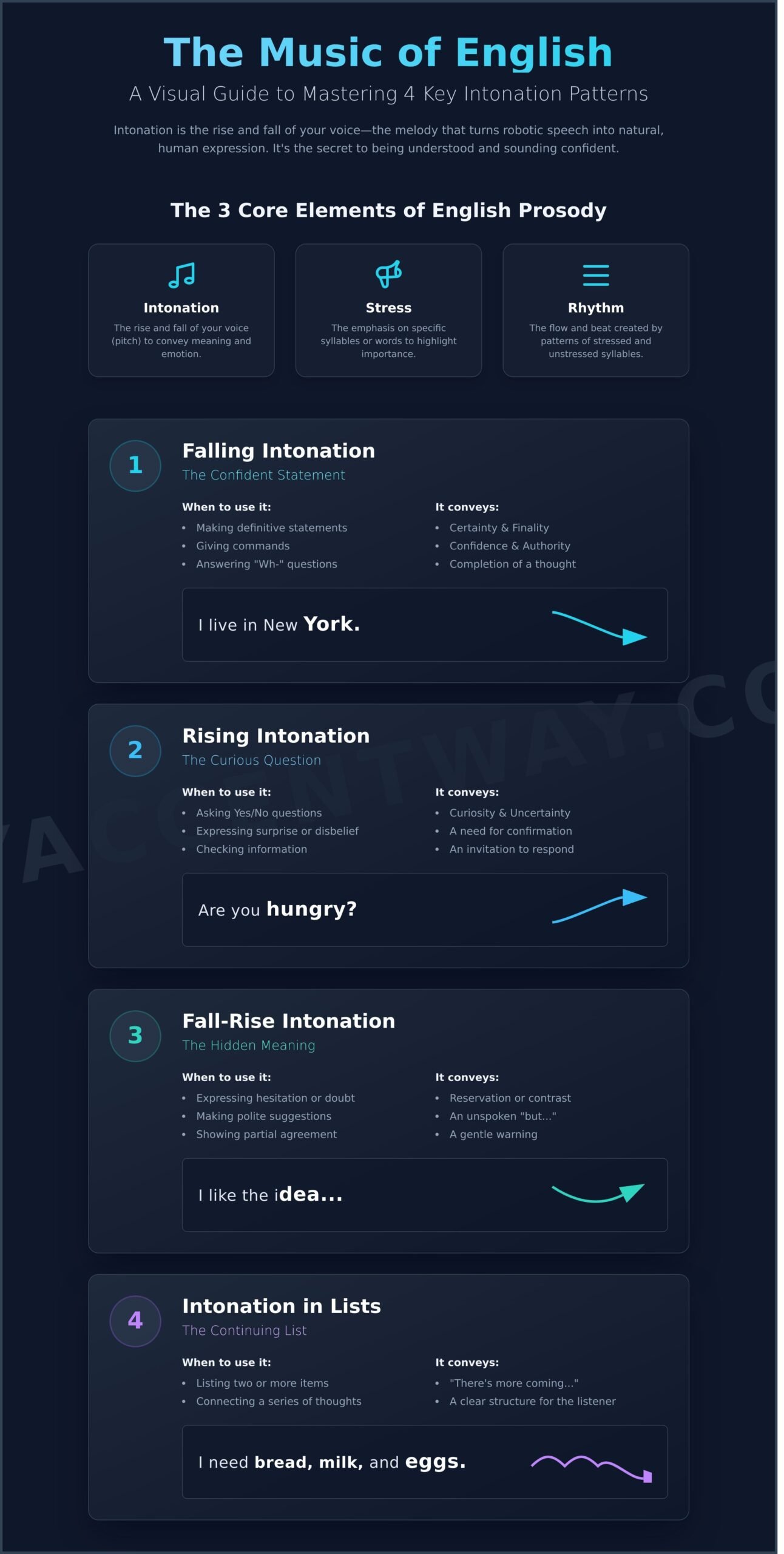
Intonation doesn’t work alone. It’s part of a powerful trio of features known as English prosody-the rhythm, stress, and intonation of speech. This system is the foundation for all natural-sounding Intonation (linguistics) and is key to moving beyond textbook English. To master the music of the language, you must understand all three components:
- Intonation: The rise and fall of your voice (pitch) across a sentence to convey meaning and emotion.
- Stress: The emphasis placed on specific syllables or words to highlight what is most important.
- Rhythm: The overall flow and beat of the language, created by the pattern of stressed and unstressed syllables.
These three elements are deeply interconnected. Together, they create the sophisticated and nuanced English intonation patterns that define a fluent, natural American accent. By mastering them, you aren’t just learning rules; you’re learning to speak with clarity, emotion, and impact.
Student awareness
If people understand your words but still miss your message, intonation may be the reason.
Many students think their problem is vocabulary or grammar. Very often, the real issue is that their voice does not carry the right stress, melody, confidence, or emotional meaning in English.
A 1-hour accent training session helps Prof. Alex identify whether your speech needs pronunciation work, rhythm training, intonation training, or a deeper sound-system reset.
Low-risk first step: diagnose what actually makes your English sound less natural.
The 4 Fundamental Intonation Patterns in American English
To master the American accent, you don’t need to learn dozens of complex melodic variations. You can achieve clarity and sound incredibly natural by focusing on the most powerful and common english intonation patterns. While some languages use pitch to change a word’s core meaning (known as tone), English uses intonation across entire phrases to signal grammatical meaning and emotion. As explained in McMaster University’s Essentials of Linguistics: Tone and Intonation, this melodic contour is what turns flat speech into dynamic communication. By mastering these four patterns, you will unlock the key to confident, fluent-sounding English.
Pattern 1: Falling Intonation (The Confident Statement)
This is the most common pattern in American English. The pitch of your voice starts higher and drops on the final stressed syllable of a sentence. It signals that your thought is complete.
- When to use it: Making definitive statements, giving commands, and answering “Wh-” questions (who, what, where, when, why).
- It conveys: Certainty, finality, and authority.
- Example: “My name is Alex.” “Turn off the light.” “I live in New York.”
Pattern 2: Rising Intonation (The Curious Question)
Here, the pitch of your voice rises at the end of the sentence, typically on the last stressed syllable. This pattern invites a response from the listener.
- When to use it: Asking Yes/No questions or expressing surprise and disbelief.
- It conveys: Curiosity, uncertainty, and a need for confirmation.
- Example: “Are you hungry?” “You’re moving to Paris?!”
Pattern 3: Fall-Rise Intonation (The Hidden Meaning)
This more complex pattern involves the voice falling and then rising, often on a single, important word. It suggests that there is more to say than the words themselves express.
- When to use it: Expressing hesitation, politeness, partial agreement, or a gentle warning.
- It conveys: Doubt, reservation, or an unspoken “but…”
- Example: “I like the idea…” (implying you have concerns).
Pattern 4: Intonation in Lists (The Continuing List)
When listing items, you use rising intonation on each item to signal that the list is not yet finished. The final item in the list uses falling intonation to mark completion.
- When to use it: Listing two or more items in a series.
- It conveys: A clear structure that helps the listener follow along.
- Example: “I need to buy bread (rise), milk (rise), and eggs (fall).”
Why practice alone can feel stuck
Repeating videos is not enough if your ear cannot hear the difference yet.
Students often practice intonation for weeks but keep the same flat rhythm or native-language melody because they cannot clearly hear what is different in their own voice.
- You may stress the wrong words without noticing it.
- You may copy the sentence but keep your original melody.
- You may sound polite, uncertain, or too strong when you do not mean to.
In a 1-hour accent training session, Prof. Alex can show you the exact pattern that makes your speech sound less natural and what to train first.
Students move faster when they know the specific pattern to fix.
Actionable Exercises to Practice and Master Your Intonation
Understanding the theory behind English intonation is the first step. Now, it’s time to move from intellectual knowledge to physical skill. Mastering the ‘music’ of English requires building new muscle memory, and just like any physical training, consistency is the key to your success. Think of these exercises as a workout for your voice-a focused way to train your mouth, tongue, and vocal cords to produce new pitch movements with confidence and precision.
We recommend starting slow and focusing on one pattern at a time. Just as linguistic experts consult resources like the British Council’s comprehensive guide to English intonation for teachers to deconstruct these musical elements, you can use these targeted drills to build them into your own speech. Your goal is to make these new habits feel natural and automatic.
The Shadowing Technique
Shadowing is one of the most effective methods for internalizing native speech rhythms. The process is simple but powerful: listen to a short audio clip of a native speaker and immediately repeat what they say, doing your best to mimic their pitch, rhythm, and intonation exactly. Start with short, simple sentences and gradually move to more complex ones as you gain confidence. Excellent resources for this include:
- Short clips from TED talks
- Podcasts with clear, articulate speakers
- Lines of dialogue from your favorite movies or TV shows
Record and Analyze Your Own Voice
Objective feedback is your fastest path to improvement. Choose a few sentences-you can even use some from this article-and record yourself saying them on your phone. Then, listen back with a critical ear. Compare your intonation to the examples we’ve discussed. This simple act of self-analysis will instantly highlight the specific english intonation patterns you need to work on, providing a clear roadmap for your practice.
Exaggeration and Contrast Drills
To truly feel the difference in pitch movement, you must exaggerate it. This drill helps make the physical mechanics of different english intonation patterns a conscious and controlled process. Take a simple statement and say it with contrasting intonations. For example:
- Statement (Falling): It’s a beautiful day. ↘
- Yes/No Question (Rising): It’s a beautiful day? ↗
Dramatically raise and lower your pitch. By over-emphasizing the movements, you make them easier to recognize, control, and eventually produce naturally in everyday conversation.
Common Intonation Mistakes (and How a Linguist Fixes Them)
As a linguist, I’ve seen thousands of students grapple with the ‘music’ of English. If you find certain aspects of intonation challenging, you are not alone. These are not signs of failure but predictable hurdles on the path to fluency. The most empowering truth is that they are entirely fixable with the right cognitive approach and dedicated practice. Let’s break down the three most common mistakes I see and the proven techniques to master them.
Mistake 1: Monotone or Flat Intonation
The Problem: Speaking with very little pitch variation can make you sound robotic or disengaged, even when you are passionate about your topic. This happens when the natural rise and fall of your voice stays within a very narrow range.
The Linguist’s Fix: You must consciously expand your pitch range. Think of your voice like a musical instrument. Practice stretching the vowel sounds in key content words (nouns, main verbs, adjectives), allowing your pitch to glide up and then down. It will likely feel exaggerated to you at first, but to a native English speaker, it will sound dynamic, engaging, and perfectly natural.
Mistake 2: ‘Uptalk’ or Rising Intonation on Statements
The Problem: Ending declarative statements with a rising pitch, a habit known as ‘uptalk,’ makes you sound uncertain or as if you’re constantly asking for validation. In professional contexts, this can unintentionally undermine your authority.
The Linguist’s Fix: For statements of fact, you must commit to a falling intonation pattern. Your pitch should decisively fall on the final stressed word. A powerful exercise is to record yourself saying simple statements like, “My name is Maria,” or “I work in marketing.” If they sound like questions, practice again, focusing on landing that final note with a clear downward pitch. This is a critical skill for confident communication.
Mistake 3: Incorrect Sentence Stress
The Problem: Placing stress on the wrong word doesn’t just sound awkward; it can completely change your intended meaning. Consider how the meaning of “I didn’t say she stole the money” changes if you stress “I” or “she” instead.
The Linguist’s Fix: Before you speak, identify your ‘focus word’-the single most important piece of new information in the sentence. This is the word that should receive the highest pitch and be slightly elongated. If you find that identifying the focus word is consistently difficult, a targeted program of structured American accent training can provide the essential, personalized guidance needed for a breakthrough. Mastering these complex english intonation patterns is a huge step toward true fluency and confidence.
When to get help
If your English is advanced but still does not sound natural, this is the moment to get professional feedback.
Advanced students usually do not need more random practice. They need a professional diagnosis of pronunciation, intonation, rhythm, stress, connected speech, and the habits carried from their first language.
Prof. Alex uses the 1-hour accent training session to identify the main sound and intonation barriers, explain what is trainable, and recommend the clearest next step for your accent goals.
The goal is clarity before commitment: know what needs to change before choosing a training path.
When to Seek Expert Guidance for Your Accent
Dedicating yourself to self-study is a commendable first step toward mastering the American accent. However, many ambitious learners eventually reach a plateau. While online resources provide a solid foundation, truly mastering the subtle ‘music’ of the language-especially the complex rules governing English intonation patterns-often requires a more targeted and expert approach. This is the point where professional guidance becomes the catalyst for transformation.
The Limits of Self-Correction
It is incredibly difficult to hear our own ingrained speech habits. Our brains are conditioned to our own voices, making it nearly impossible to objectively identify subtle errors in vowel sounds, stress placement, or rhythm. Generic exercises, while helpful, cannot diagnose the specific phonetic interference from your native language. This can lead to slow, frustrating progress, where you feel stuck despite your best efforts.
How a Professional Linguist Can Help
Partnering with a trained linguist is the most effective way to accelerate your progress and achieve true clarity. A Ph.D. linguist acts as your expert guide, providing an objective, analytical ear to pinpoint the precise areas that need refinement. They don’t just offer corrections; they provide a strategic roadmap for success.
- Expert Analysis: A linguist will deconstruct your unique speech patterns to identify the root causes of your accent, from individual phonemes to overarching intonation contours.
- Customized Learning Plan: Based on this analysis and your personal goals, they create a structured program tailored specifically to you, ensuring every minute of practice is effective.
- Proven, Scientific Methods: They use evidence-based techniques to help you unlearn old habits and build new, correct ones faster and more permanently.
This highly personalized approach is the key to unlocking your most confident voice. Ready to move beyond generic lessons? You can get personalized feedback from a professional linguist and experience how a tailored program can transform your speech.
Investing in professional coaching isn’t just about fixing mistakes; it’s about building a deep, cognitive understanding of American English intonation patterns and phonetics. It is the fastest path to speaking with the confidence and clarity you have been working toward. Discover your potential at American Accent Program.
Unlock Your Natural Voice with Perfect Intonation
You’ve now explored the core of what makes English sound natural: intonation is the music of the language, not just random pitch changes. By understanding the four fundamental patterns and actively avoiding common mistakes, you have built a powerful foundation. Mastering these core english intonation patterns is the crucial difference between simply speaking English and truly communicating with clarity and impact.
If you are ready to accelerate your progress, expert guidance is the key to unlocking your full potential. At My Accent Way, our personalized, one-on-one training programs are led by a Ph.D. Linguist. We use a proven scientific methodology to provide the targeted, expert feedback you need to achieve your goals effectively and with a success guarantee.
Don’t wait to be understood. Start your journey to confident English today! Your transformation to a fluent, natural-sounding speaker begins now.
Frequently Asked Questions About English Intonation
What is the difference between intonation and pronunciation?
Pronunciation is about the mechanics of forming individual sounds (phonemes), like the ‘th’ in “the.” Intonation, however, is the melody of speech-the rise and fall of your pitch across a sentence. Think of it as the difference between hitting the right notes (pronunciation) and playing a beautiful song (intonation). For example, saying “Really?” with a rising pitch conveys surprise, while a falling pitch can signal disbelief. This musical quality is essential for clear communication.
How long does it take to improve my English intonation?
The timeline for improvement is personal and depends on consistent, focused practice. With a scientifically-backed method and daily exercises, our students often report feeling more confident and natural within a few months. The key is not just repetition but intellectual engagement with the material-understanding *why* the pitch moves. This cognitive approach accelerates your journey to mastering the music of English and achieving your communication goals, guaranteed.
Are British and American English intonation patterns very different?
Yes, the differences are significant and define the “sound” of each accent. American English typically features a wider pitch range and a “falling” intonation at the end of statements. In contrast, some British accents use a narrower range and distinct pitch movements. To sound truly natural, it’s essential to master the specific english intonation patterns of your target accent, as this melody is a core part of listener perception and comprehension.
Can changing my intonation really make me sound more confident?
Absolutely. Your intonation is a primary tool for conveying confidence. Using a clear falling pitch at the end of a statement-for example, “This is our final rePORT”-signals certainty and authority. Speakers who use a consistently rising or flat pitch can unintentionally sound hesitant or unsure of their own message. Mastering this one pattern is a powerful, scientifically-proven way to immediately enhance your professional presence and perceived confidence in any conversation.
Is it possible to completely lose my native accent’s intonation?
The goal is not to “lose” your native intonation but to master American English intonation as a new, powerful skill. Through targeted cognitive training, you develop the ability to consciously select the correct intonation for American English, much like a bilingual speaker switches between languages. Your cultural and linguistic identity remains intact; you are simply expanding your communicative toolkit to succeed in a new environment. Your culture matters, and so does your clarity.
What’s the single most important intonation pattern to learn first?
The most impactful pattern to master first is the falling intonation on the final key word of a statement. For declarative sentences, WH-questions, and commands, your pitch should fall decisively. For example: “Where do you LIVE?” or “Let’s start the MEEting.” This single pattern is fundamental to American English and is the fastest way to sound more assertive, clear, and authoritative in your daily communication. It’s the foundation of confident speech.
Disclaimer – American Accent Program
The American Accent Program available through Visit Program Website
is an educational and coaching service designed to support pronunciation, accent reduction, and spoken English fluency. All training materials, including lessons, exercises, audio content, visual simulations, coaching methods, and digital resources, are the intellectual property of American Accent Program, LLC and are protected by applicable copyright and intellectual property laws.
By using this website and participating in the program, you acknowledge that all content is provided for personal, non-commercial, educational use only. Users are granted a limited, non-transferable license to access the materials strictly for individual learning purposes. Redistribution, reproduction, recording, modification, sharing, or commercial use of any program content without prior written consent is strictly prohibited.
The program may include live coaching sessions, digital tools, and instructional materials intended to improve pronunciation and communication skills. However, individual results may vary, and no specific level of fluency, accent reduction, or communication outcome is guaranteed.
The American Accent Program and its instructors do not provide medical, therapeutic, or clinical speech-language pathology services. All training is intended for educational purposes only.
By accessing or using the program, you agree to comply with all applicable terms, including the platform’s Terms of Use and Course Policies, and acknowledge that misuse of materials may result in termination of access without refund.
Want to train your intonation with Prof. Alex?
American intonation becomes clearer when students receive structured feedback on rhythm, melody, stress, and connected speech. A 1-hour accent training session helps identify what your speech needs first.
Speech clarity check
The problem is not always grammar or vocabulary.
If people understand your words but still miss your message, the deeper issue may be speech clarity, rhythm, intonation, and American pronunciation habits. MyAccentWay helps students retrain the sound system with professional 1-on-1 guidance, so English can feel clearer, freer, and more natural in real communication.
Why MyAccentWay works
Two training methods that make speech change active.
MyAccentWay is not passive listen-and-repeat coaching. Prof. Alex, Ph.D. Accent Coach, creates a learning situation where students become active learners and active participants in changing their own speech patterns.
Interactive training
Students do not just receive pronunciation instructions passively. They listen, think, compare, adjust, and understand their own speech patterns while Prof. Alex guides the correction process.
U.S. & Canada online accent training
Master English Intonation Patterns: guide to Sounding Natural for professionals in the United States and Canada
This guide is useful for advanced English speakers, entrepreneurs, international professionals, and students in the U.S. and Canada who want clearer American pronunciation, stronger rhythm, better intonation, and more confident communication in meetings, interviews, presentations, and client conversations.
Prof. Alex, Ph.D. Accent Coach, teaches online 1-on-1 American accent training for learners in major professional markets including New York, Los Angeles, San Francisco Bay Area, Seattle, Austin, Dallas, Houston, Chicago, Boston, Washington, D.C., Miami, Toronto, Vancouver, Montreal, Calgary, and Ottawa.
1-on-1 Accent Reduction Training helps students move beyond self-practice and build clearer American speech habits through interactive and cognitive accent training.
Cognitive accent training
Students learn to notice and correct the speech patterns that affect American pronunciation, then implement new American speech patterns into their code-switching process for more natural, long-lasting change.
Your next step
Build speech habits people can hear in real conversations.
A stronger American accent is not built by memorizing topics or chasing quick pronunciation tips. It comes from structured training, professional feedback, active correction, and repeated application until clearer speech becomes easier to keep.




2 Responses