Translators and Interpreters Improving American Pronunciation
For translators and interpreters, pronunciation is not a cosmetic detail. It is part of professional accuracy, listener trust, and clear message delivery.
Accuracy is not only what you know. It is also how clearly listeners receive it.
Sounds. Rhythm. Stress. Intonation.
Real student result

“I feel confident enough to speak American English!”
Interactive American Accent Training9monthsof hard work and dedication
Listen to the starting point0:00
Listen to the result0:00
“Many of my students once believed they could never sound like this. School taught them grammar and vocabulary, but not how to train their English speech. That is what we do together, step by step, until you speak English independently and with confidence.”
Abishek’s result was achieved through Prof. Alex’s research-based Interactive 1-on-1 American Accent Training. His doctoral research found this interactive method more effective than traditional, teacher-centered methods. See the research basis →
Questions about pronunciation training for translators and interpreters?
Students can contact the MyAccentWay Support Center to ask questions, learn how American pronunciation training supports professional accuracy and message clarity, and get connected with Professor Alex.
American accent training for language professionals in the United States
Translators and interpreters often need more than general English fluency. They need clear American pronunciation, accurate stress, natural rhythm, confident intonation, and strong speech clarity when working with U.S. clients, healthcare teams, legal teams, business leaders, conferences, schools, and international organizations.
MyAccentWay offers online American accent training, accent reduction, pronunciation coaching, and speech modification support for non-native English-speaking professionals who want to sound clearer, more confident, and easier to understand in American English. Professor Alex, Ph.D., Linguist and Accent Coach, helps students connect phonetics, professional communication, and real speech practice in a structured 1-on-1 training process.
Search intent this article answers
How can translators and interpreters improve American pronunciation, accent clarity, connected speech, intonation, and professional English communication?
Best-fit students
Foreign-born U.S. professionals, interpreters, translators, ESL educators, bilingual consultants, healthcare interpreters, legal interpreters, business interpreters, public speakers, and international professionals.
What language professionals often search before accent training
Is accent reduction useful for translators and interpreters?
Yes. Accent reduction and American pronunciation coaching can help language professionals improve speech clarity, reduce repetition, and communicate with more confidence in U.S. professional settings.
U.S. & Canada online accent training
Translators and Interpreters Improving American Pronunciation for professionals in the United States and Canada
This guide is useful for advanced English speakers, entrepreneurs, international professionals, and students in the U.S. and Canada who want clearer American pronunciation, stronger rhythm, better intonation, and more confident communication in meetings, interviews, presentations, and client conversations.
Prof. Alex, Ph.D. Accent Coach, Doctor of Education, and professional linguist, teaches online 1-on-1 American accent training for learners in major professional markets including New York, Los Angeles, San Francisco Bay Area, Seattle, Austin, Dallas, Houston, Chicago, Boston, Washington, D.C., Miami, Toronto, Vancouver, Montreal, Calgary, and Ottawa.
1-on-1 Accent Reduction Training helps students move beyond self-practice and build clearer American speech habits through interactive and cognitive accent training.
What does American accent training include?
Training may include American vowels, consonants, word stress, sentence stress, rhythm, intonation, linking, reductions, connected speech, and real communication practice.
Can online pronunciation coaching help professional speech?
Online 1-on-1 pronunciation coaching can help students identify clarity blockers, practice targeted sounds, and apply American English pronunciation patterns to meetings, interviews, presentations, and client communication.
Who should consider speech clarity training?
Speech clarity training is helpful for non-native English speakers who work in translation, interpreting, healthcare, technology, education, leadership, customer communication, or public speaking.
Related search topics: American accent training online, accent reduction for professionals, pronunciation coaching in the United States, American English pronunciation, speech modification, speech clarity training, intonation training, rhythm training, connected speech, and online accent coach.
Reduce sound-level confusion that can weaken professional delivery.
Speak clearly under pressure, speed, and live listening conditions.
Help listeners focus on meaning instead of decoding pronunciation.
Train stress, pacing, emphasis, and intonation for natural flow.
MyAccentWay · 2D Sound Motion Technology
American English Pronunciation: Consonant and Vowel Sounds with 2D Sound Motion Technology
Learning American English pronunciation and the American accent is more effective when you train your speech organs, not only listen and repeat. 2D Sound Motion Technology and Interactive Visual 2D Sound Simulators, developed in 2020 by Prof. Alex, Ph.D. Accent Coach, Doctor of Education, and professional linguist, as part of his interactive teaching model based on his Ph.D. research in interactive teaching methods, train your tongue, lips, jaw, teeth, airflow, and voice step by step. They train each American sound and more than 30 sound combinations through Interactive 2D video simulation.
What 2D Sound Motion Technology is
2D Sound Motion Technology is an advanced accent reduction and articulation training tool by Prof. Alex. It corrects, develops, and trains each American sound and more than 30 sound combinations through Interactive 2D video simulation.
What Interactive Visual 2D Sound Simulators do
Interactive Visual 2D Sound Simulators are part of 2D Sound Motion Technology, the articulation-training method Prof. Alex created by applying his Ph.D. research in interactive teaching to American pronunciation. Instead of listening and repeating, students actively train their speech organs. Each simulator uses Interactive 2D mouth movement to train the speech organs (tongue, lips, jaw, teeth, airflow, and voice) to produce each American sound correctly. Every consonant has its own simulator: explore American consonants trained with 2D Sound Motion Technology.
Sample training: the American t sound (aspirated [t])
Practice
Record yourself speaking these words:
Tab · Tacos · Time · Tub · Hotel · Motel · Sit · Pit · Net
Instructions
Play the Interactive Visual 2D Sound Simulator for the American t sound below several times and follow it step by step. Move your tongue, jaw, and airflow together with the simulator and train your articulation.
Interactive Visual 2D Sound Simulator: American unvoiced sound [t]
Practice
Record yourself again speaking these words, but this time focus on the movement of your tongue. Go slow, and you will hear the difference. You’ve got this!
Tab · Tacos · Time · Tub · Hotel · Motel · Sit · Pit · Net
How Interactive Visual 2D Sound Simulators solve pronunciation and speaking problems
- Wrong articulationMost pronunciation problems start with the tongue, lips, jaw, or teeth in the wrong position. Each Interactive Visual 2D Sound Simulator trains the correct articulation of one American sound, so the student corrects the cause of the problem, not only the result.
- Airflow and voicingMany accent problems come from wrong airflow or voicing: sounds that are too weak, too strong, or voiced when they should be unvoiced. The simulators train airflow and voice together with articulation, step by step, for each American sound and more than 30 sound combinations.
- Clear speech and confidenceWhen each sound is trained correctly, words connect into clear American English speech. Listeners can understand you more easily, and speaking at work, in meetings, and on calls becomes more confident.

If you start hearing the aspiration, the short airstream after [t], with one simulator, you can only imagine how successful you can be in 1-on-1 Interactive American Accent Training with Prof. Alex, Ph.D. Accent Coach, where your whole American sound system is trained sound by sound.
In MyAccentWay, the Interactive Visual 2D Sound Simulators are only available in 1-on-1 accent coaching sessions with Prof. Alex.
A clearer guide for interpreters, translators, and multilingual professionals.
This guide focuses on the real professional outcome: protecting meaning through clearer American speech.
Translators and interpreters work with meaning every day. You already understand language deeply. But when your professional voice is in English, pronunciation becomes part of the message itself.
American pronunciation is not about hiding your background or sounding like someone else. For language professionals, it is about reducing friction. When consonants, vowels, stress, rhythm, and intonation become clearer, listeners can focus on the meaning you are delivering instead of working to decode your speech.
This matters in live interpreting, client meetings, remote calls, presentations, and professional networking. Even small sound differences can create extra listener effort. Over time, that effort can affect confidence, trust, and how smoothly communication moves.
Yes, translators and interpreters can benefit from American pronunciation training.
The goal is not perfect imitation. The goal is clearer American English speech that supports accuracy, confidence, and professional delivery. A structured accent training process helps language professionals hear, understand, and rebuild the sound habits that affect clarity.
Translators, interpreters, bilingual professionals, public speakers, and language specialists working with U.S. clients or audiences.
Clearer pronunciation, better speech rhythm, stronger intonation, and less listener confusion.
Re-educating the sound system through consonants, vowels, stress, rhythm, emphasis, and intonation.
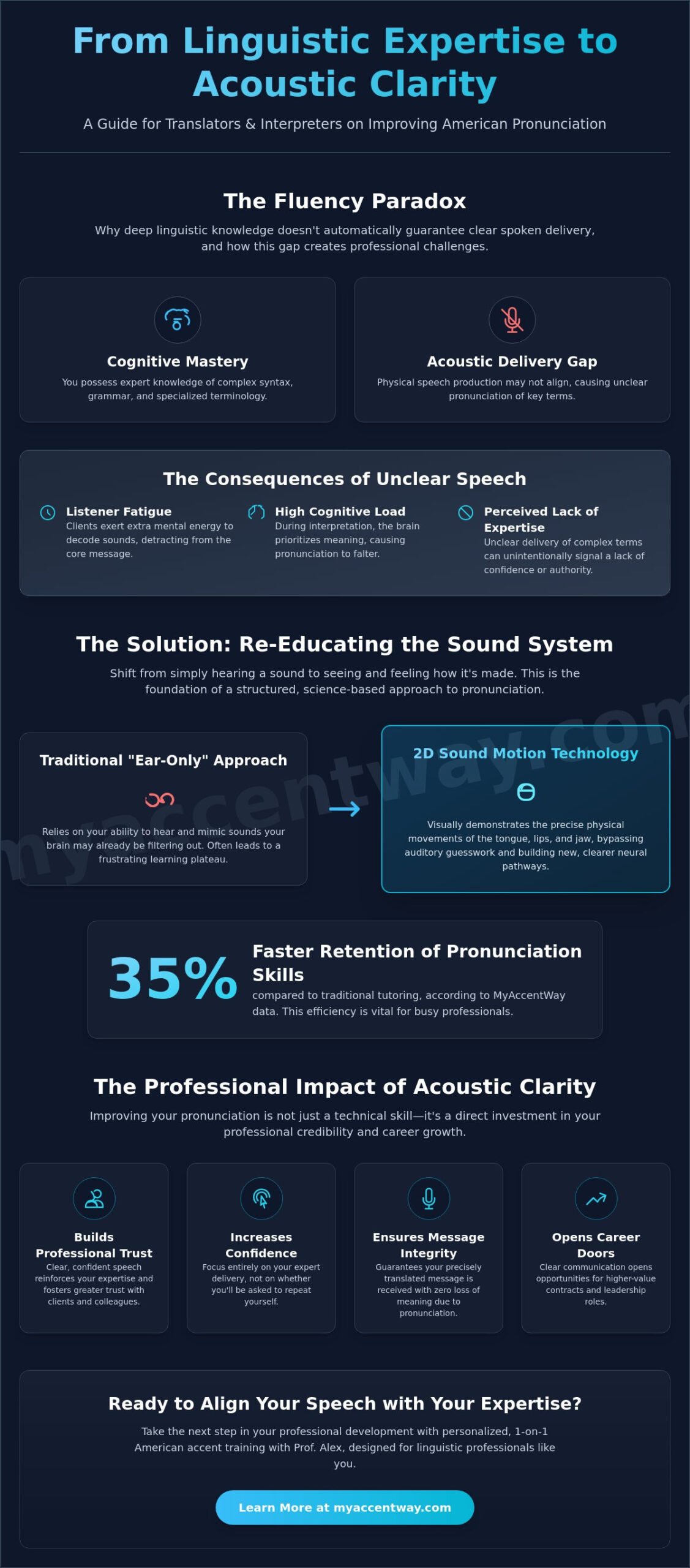
Why pronunciation matters when your work depends on meaning
A translator may spend hours choosing the most accurate word. An interpreter may make decisions in seconds. In both cases, the final message still has to reach the listener clearly. If a sound is unclear, a vowel is too close to another vowel, or stress falls in the wrong place, the listener may need extra time to process what was said.
That extra processing matters. It can interrupt the flow of a conversation, weaken authority, or make a precise message feel less confident than it actually is. This is why pronunciation training can be valuable even for advanced English speakers who already have strong vocabulary and grammar.
For translators and interpreters, speech clarity is not vanity. It is a professional communication skill.
Language knowledge helps you understand meaning
- Vocabulary and terminology
- Grammar and register
- Cultural meaning
- Professional accuracy
Pronunciation training helps listeners receive meaning
- Clear consonants and vowels
- Natural stress and rhythm
- Confident intonation
- Lower listener effort
The MyAccentWay method: re-educating the sound system
At MyAccentWay, American pronunciation training is not simple repetition. Prof. Alex teaches a linguistics-based process of re-educating the sound system. That means you do not only repeat sounds. You learn how American sounds are produced, how they connect inside words and sentences, and how they shape professional fluency.
The training focuses on American consonants, vowels, stress, rhythm, emphasis, and intonation. These elements work together. If one part is unclear, the whole message can feel harder to follow.
For interpreters and translators, this method is especially useful because it gives you a system. You learn to recognize patterns in your speech, understand why they happen, and practice them in a way that connects to real communication.
2D Sound Motion Technology trains the movements behind American sounds.
Prof. Alex uses visual sound training to show how the tongue, lips, jaw, airflow, and speech organs move before students practice. This helps language professionals connect sound knowledge with physical speech habits.
What translators and interpreters should train first
Many advanced speakers try to fix pronunciation by speaking more or repeating after videos. That can help, but it often misses the real issue: your speech habits may be organized by your first language sound system.
A stronger path is to train the sound system step by step. First, identify the consonants and vowels that create the most confusion. Then practice them in words, sentences, and paragraph speech. Finally, connect them to rhythm, stress, emphasis, and intonation so your pronunciation works in real conversation.
Consonant clarity
Train difficult American consonants and sound interactions so words begin and end more clearly.
Vowel accuracy
Separate vowels that may sound too similar, especially in fast professional speech.
Stress and rhythm
Develop the American pattern of emphasis so listeners follow your message more easily.
Intonation control
Use pitch movement to show confidence, continuation, completion, questions, and emphasis.
For a language professional, clearer pronunciation does not replace expertise. It helps your expertise arrive with less friction.
How this helps in real interpreting and translation work
Clearer American pronunciation can help during client consultations, live interpreting, recorded voice work, conference calls, and presentations. It can also help translators who speak with U.S. clients, explain project details, negotiate scope, or present linguistic decisions.
The benefit is practical: fewer repetitions, smoother delivery, and stronger confidence when your voice represents your professional skill. You do not need to sound “native.” You need to sound clear, controlled, and easy to follow.
Online pronunciation coaching for translators and interpreters in Texas
MyAccentWay is connected to Austin, Texas and works online with translators, interpreters, and multilingual professionals across Austin, Dallas, Houston, San Antonio, Texas, and the United States. Training is designed for professionals who need clearer American English for client calls, interpreting assignments, presentations, and workplace communication.
Final thought: pronunciation is part of professional accuracy
If your work depends on language, your voice matters. American pronunciation training gives you a structured way to improve speech clarity without losing your identity or professional style.
The best next step is a personal assessment with Prof. Alex. You will learn which sound patterns affect your clarity most and how a personalized American accent training plan can help you speak with more confidence and precision.
Ready to make your professional English clearer?
Book a personal assessment with Prof. Alex and learn which sounds, rhythm, stress, and intonation patterns can support clearer American pronunciation.
Speech clarity check
The problem is not always grammar or vocabulary.
If people understand your words but still miss your message, the deeper issue may be speech clarity, rhythm, intonation, and American pronunciation habits. MyAccentWay helps students retrain the sound system with professional 1-on-1 guidance, so English can feel clearer, freer, and more natural in real communication.
Why MyAccentWay works
Two training methods that make speech change active.
MyAccentWay is not passive listen-and-repeat coaching. Prof. Alex, Ph.D. Accent Coach, Doctor of Education, and professional linguist, creates a learning situation where students become active learners and active participants in changing their own speech patterns.
Interactive training
Students do not just receive pronunciation instructions passively. They listen, think, compare, adjust, and understand their own speech patterns while Prof. Alex guides the correction process.
Cognitive accent training
Students learn to notice and correct the speech patterns that affect American pronunciation, then implement new American speech patterns into their code-switching process for more natural, long-lasting change.
Your next step
Build speech habits people can hear in real conversations.
A stronger American accent is not built by memorizing topics or chasing quick pronunciation tips. It comes from structured training, professional feedback, active correction, and repeated application until clearer speech becomes easier to keep.