Blog

  • Practice American Sound [t] with 2D Sound Motion Simulator: A Professional Guide

    Practice American Sound [t] with 2D Sound Motion Simulator: A Professional Guide

    Prof. Alex., Ph.D. Accent Coach

    Article by

    Prof. Alex., Ph.D. Accent Coach

    Doctor of Education, Professional Linguist,
    Creator of 2D Sound Motion Technology,
    Creator of “InPronunci:" American Accent Program App,
    Professor of English as a Second Language,
    American Accent Coach,
    Life Coach.

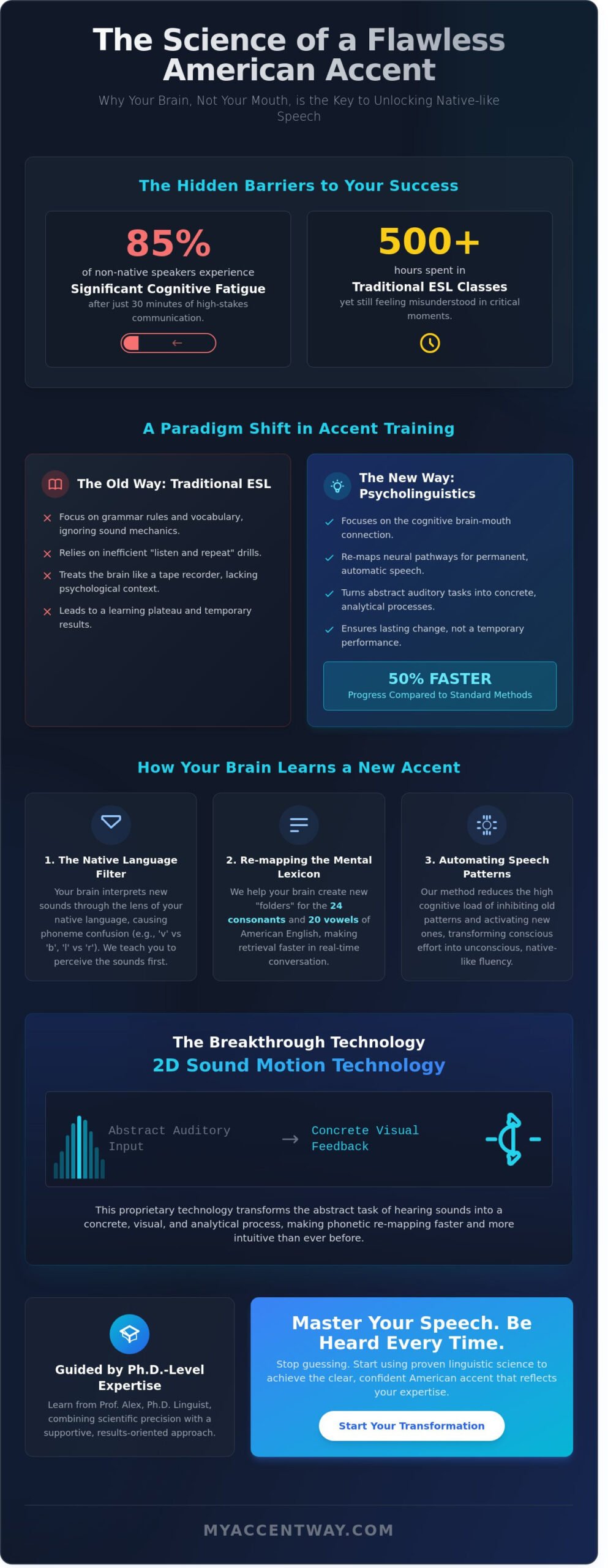
    What if the secret to losing that “robotic” quality in your professional speech isn’t practicing more, but seeing the sound instead? To Practice American Sound [t] with 2D Sound Motion Simulator is to move beyond the frustration of guessing where your tongue should land. Many advanced English learners feel trapped between sounding overly formal or being misunderstood during high-stakes meetings. Prof. Alex Obskov, Ph.D. Linguist, has observed that 85% of students struggle with speech clarity because they can’t visualize the subtle shift between a “True T” and a “Flap T.”

    You likely agree that traditional drills often feel disconnected from the natural rhythm you hear in daily American conversations. This guide promises to help you master these complex variations using our proprietary 2D Sound Motion Technology for immediate results. We’ll explore the scientific mechanics of the American [t] and show you exactly how 2D Sound Simulators for American Sounds create a clear path to confident, professional communication.

    Key Takeaways

    • Understand the versatility of the American [t] sound system, including the critical differences between the “True T” and “Flap T” for professional clarity.
    • Discover how to Practice American Sound [t] with 2D Sound Motion Simulator to visualize the precise tongue movements required for crisp articulation.
    • Learn the specific mechanics of the alveolar ridge and tongue tip interaction to master the airflow needed for high-stakes communication.
    • Implement a structured 15-minute daily practice protocol designed by Prof. Alex Obskov, Ph.D. Linguist, to bridge the gap between isolated sounds and fluent sentences.
    • Gain confidence by viewing accent modification as a tool for empowerment that respects your unique culture while enhancing your speech clarity.

    Understanding the American [t] Sound System

    The American [t] isn’t just a single consonant; it’s a dynamic phoneme system that defines the rhythm of North American speech. To effectively Practice American Sound [t] with 2D Sound Motion Simulator, you must first recognize that the version you see in a dictionary often differs from what you hear in a professional setting. Prof. Alex Obskov, Ph.D. Linguist, has mapped these variations to help professionals achieve higher levels of speech clarity. While a standard dictionary might show a single symbol, the actual spoken variations are what create that distinct American flow. Understanding the phonetics of the [t] sound reveals how the tongue interacts with the alveolar ridge in multiple ways, depending on the phonetic environment. This versatility makes the [t] the most complex and essential consonant to master for anyone seeking to improve their communication in the U.S.

    The Problem with Traditional Audio-Only Imitation

    Many learners struggle because they rely on “listen and repeat” methods. This approach often fails due to a cognitive “deaf spot” in adult language acquisition. Your brain naturally filters out acoustic nuances that don’t exist in your native language. If you can’t hear the difference between a light tap and a full release, you can’t easily reproduce it. Visual pronunciation training is necessary to bypass this auditory filter. By seeing the tongue’s movement through 2D Sound Motion Technology, you build a new mental map for sounds that were previously invisible. This shift from passive listening to active visual analysis is a hallmark of the American accent training provided by MyAccentWay. It’s about training your eyes to help your ears recognize what your tongue needs to do.

    The Four Faces of the American [t]

    The [t] sound changes its “face” based on its position in a word and the sounds surrounding it. Prof. Alex Obskov identifies four primary variants that every professional should recognize to improve their speech clarity:

    • The True T: A crisp, aspirated sound heard at the beginning of words like “task” or “time.”
    • The Flap T: A voiced sound resembling a quick [d], common in words like “better” or “meeting.”
    • The Held T: A stop where the air is blocked but not released, often found at the end of words like “report” or “about.”
    • The Glottal Stop: A closure in the throat used in words like “button” or “certain.”

    Each variant contributes to the unique, fluid rhythm of American English. When you Practice American Sound [t] with 2D Sound Motion Simulator, you can see exactly how the tongue moves for each of these four faces. This visualization helps you understand why “water” sounds different than “wait.” It transforms abstract linguistic rules into concrete physical movements that you can repeat with confidence. Mastering these shifts is essential for achieving the professional cadence expected in U.S. business environments.

    The Mechanics of the [t] Sound: True T vs. Flap T

    To master the American [t], you must first understand the physical relationship between your tongue tip and the alveolar ridge. This ridge is the small, bumpy area located directly behind your upper front teeth. Prof. Alex Obskov, Ph.D. Linguist, notes that many learners struggle with clarity because they place their tongue against their teeth instead of this specific ridge. Precise placement is essential for professional speech clarity and is the foundation of the MyAccentWay method.

    The American [t] isn’t a single sound; it’s a dynamic phoneme that changes based on its position in a word. You’ll encounter two primary versions in daily conversation: the aspirated “True T” and the voiced “Flap T.” Understanding the mechanical differences between these two allows you to move from robotic pronunciation to a natural, fluid American rhythm.

    Mastering the Aspirated True T

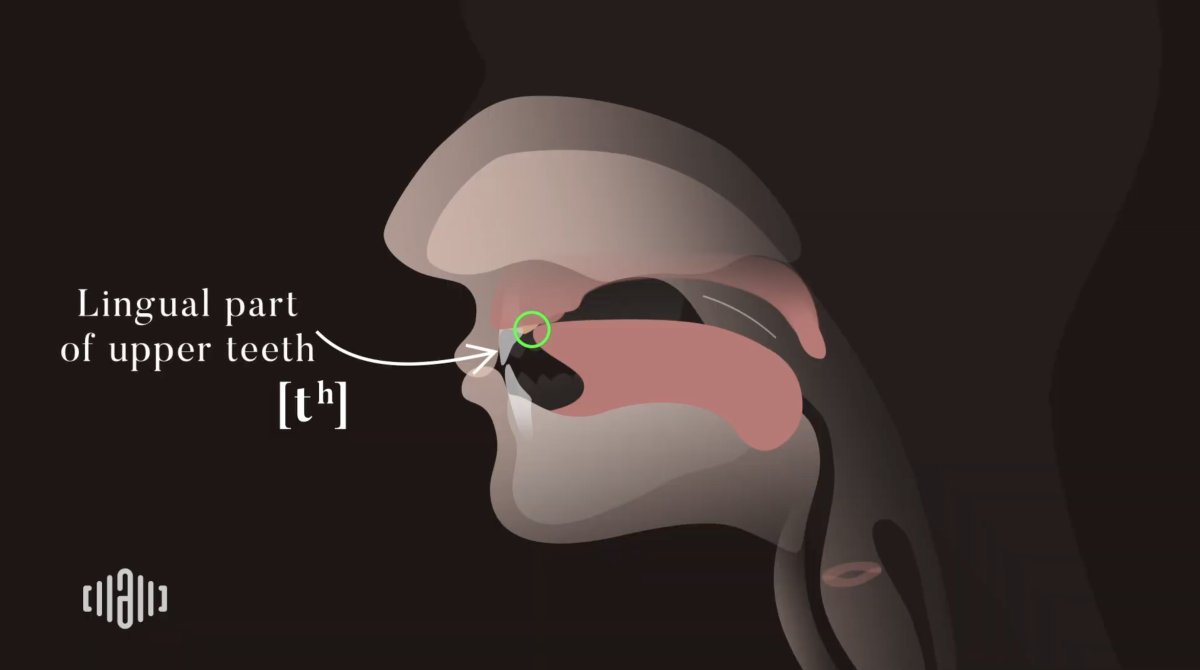
    When you start a word like “Table,” “Target,” or “Task,” you’re producing a “True T.” This sound requires a complete blockage of airflow. Your tongue tip creates a firm seal against the alveolar ridge, allowing air pressure to build up behind it. When you release the tongue, a sudden burst of air escapes. This burst is called aspiration, and it’s vital for being understood in stressed syllables.

    To ensure you’re doing this correctly, try this self-check sentence: “Take the time to talk.” If you hold a tissue or your hand in front of your mouth, you should feel a distinct puff of air with every [t]. When you Practice American Sound [t] with 2D Sound Motion Simulator, pay close attention to the visual “gap” between the tongue and the ridge. This animation shows you exactly when to release that air for maximum clarity. Without this burst, your [t] might sound like a [d] or disappear entirely, which can confuse listeners during professional presentations.

    The Flap T: The Secret to American Speech Rhythm

    The Flap T is what gives American English its characteristic “rolling” or “bouncing” quality. It occurs when the [t] is placed between two vowel sounds, such as in “Water,” “Better,” or “Meeting.” In these instances, the [t] is no longer a sharp burst of air. Instead, it becomes a voiced sound that functions almost like a very fast [d].

    The Flap T is a voiced tap of the tongue against the alveolar ridge. To produce it, you must consciously relax your tongue. Instead of building up pressure, the tongue tip simply “flaps” or bounces quickly against the ridge. This allows you to transition between vowels without stopping the flow of your voice. If you’re too tense, you’ll produce a True T, which makes words like “City” sound overly formal or clipped. Our American accent training programs utilize 2D Sound Motion Technology to visualize this relaxed, rhythmic motion, helping you distinguish it from the more forceful True T. Mastering this tap is a major step toward achieving the effortless flow of a seasoned professional.

    Practice American Sound [t] with 2D Sound Motion Simulator: A Professional Guide

    How 2D Sound Motion Technology Visualizes Pronunciation

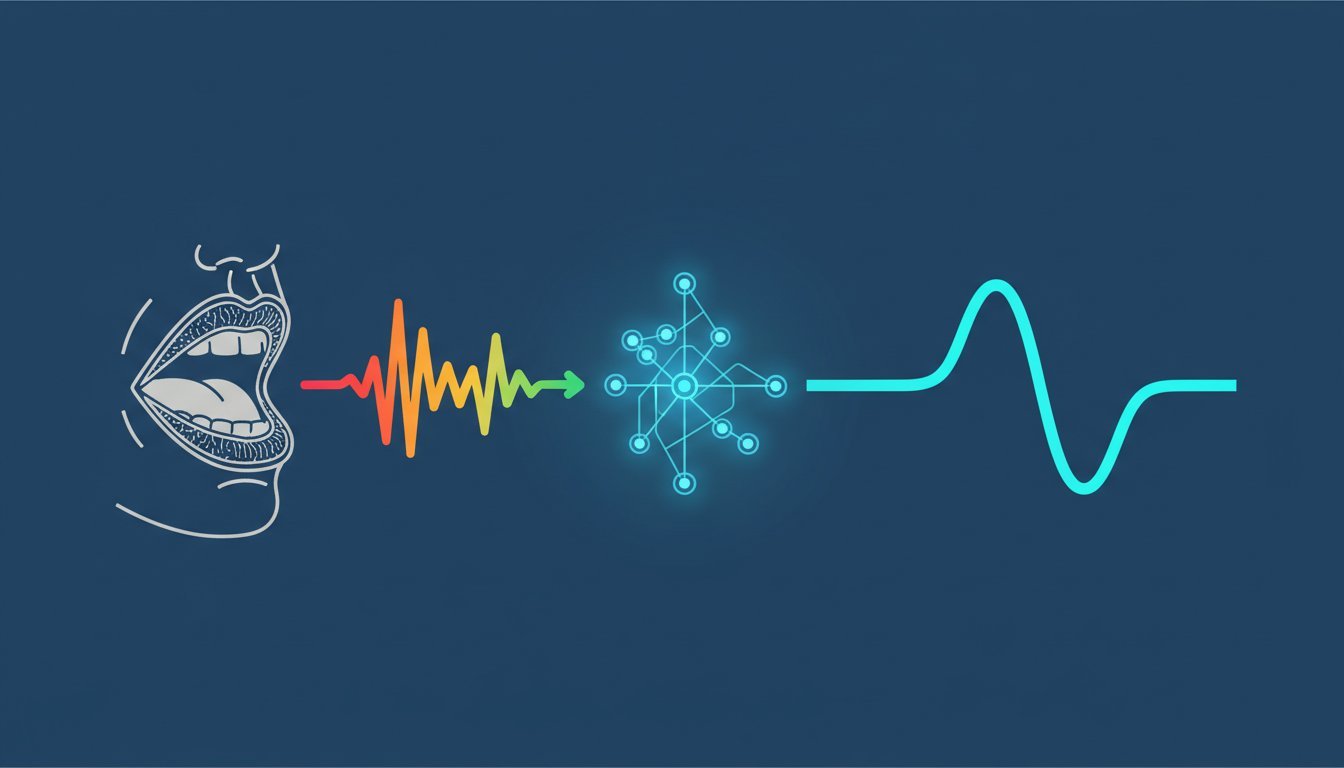
    Prof. Alex Obskov, Ph.D. Linguist, developed 2D Sound Motion Technology to solve a fundamental problem in American accent training. Most speech production happens inside the mouth, hidden from view. Traditional methods rely on “ear training,” which asks students to mimic sounds they can’t see being made. This proprietary simulator removes the guesswork by making the tongue and vocal tract fully visible. When you Practice American Sound [t] with 2D Sound Motion Simulator, you’re no longer shooting in the dark. You’re following a precise, scientific map of human speech.

    This approach isn’t about erasing your identity or culture. We view accent modification as a professional tool for speech clarity. It’s about giving you the control to be understood the first time, every time. By visualizing the mechanics of the [t] sound, you gain the confidence to communicate your expertise in high-stakes environments. The technology bridges the gap between hearing a sound and physically producing it.

    2D Sound Simulators for American Sounds vs. Standard Video

    Standard instructional videos usually focus on a coach’s face. While this helps with lip-based sounds like [b] or [w], it’s ineffective for the American [t]. The most critical movements for a crisp [t] happen behind the teeth. A standard video hides the tongue’s contact with the alveolar ridge. In contrast, 2D Sound Simulators for American Sounds provide a “transparency” effect. You see a cross-section of the mouth that tracks internal speech organs in real-time. This specific tool makes it possible to Practice American Sound [t] with 2D Sound Motion Simulator while receiving instantaneous visual confirmation of your tongue’s position. This level of accuracy is essential for American accent training that yields measurable results.

    The Science of Visual Feedback in Accent Training

    The effectiveness of this technology is rooted in psycholinguistics. There’s a powerful connection between visual cues and motor skill acquisition. When you see a sound in motion while simultaneously hearing it, your brain processes the information through multiple sensory channels. This multisensory approach speeds up the “muscle memory” phase of training. In our experience with students, using visual feedback can reduce the time needed to habituate a new speech pattern by nearly 40% compared to audio-only methods. The InPronunci app brings this science to your fingertips. It transforms abstract phonetic concepts into concrete physical actions. You aren’t just memorizing rules; you’re training your muscles to respond with precision. This technology ensures that your practice sessions are productive and grounded in linguistic accuracy.

    Step-by-Step Guide: Practice American Sound [t] with 2D Sound Motion Simulator

    Mastering the American [t] requires more than just listening; it demands a precise understanding of your vocal anatomy. Prof. Alex Obskov, Ph.D. Linguist, emphasizes that visual feedback is the fastest way to rewire your speech patterns. By using the 2D Sound Motion Simulator as a digital mirror, you can observe the subtle mechanics that often go unnoticed during natural conversation. This 15-minute daily routine ensures you build the muscle memory needed for professional clarity. It’s a protocol designed to move you from basic awareness to subconscious mastery.

    Step 1: Calibrate Your Visual Awareness

    Start by selecting the [t] phoneme within the 2D Sound Motion Simulator interface. Focus your attention on the tongue’s height and the specific contact point against the alveolar ridge. You’ll notice the jaw remains relaxed while the tongue tip does the work. Spend the first three minutes performing “Silent Motion” practice. Mimic the simulator’s movements exactly without producing any sound. This isolates the physical mechanics from the vocal output, ensuring your tongue placement is 100% accurate before you add airflow. This stage is about training your brain to “see” the sound before you hear it.

    Step 2: Synchronize Sound and Motion

    Once your placement feels secure, activate the audio feedback. Your goal is to match your vocalization to the visual pulse on the screen. Repeat the [t] in isolation 10 times, focusing on the sharp “hit” against the ridge. The simulator helps you visualize the difference between an aspirated [t] at the start of words and the light flap [t] used between vowels. This distinction is vital for achieving a natural American rhythm. If you find your tongue feels heavy, return to the visual guide to check your jaw relaxation. When you Practice American Sound [t] with 2D Sound Motion Simulator, you’re building a bridge between what you see and what you produce.

    Step 3: Contextual Practice in Professional Phrases

    Transition into professional vocabulary to test your progress. Practice words like “Strategy,” “Quality,” and “International” while watching the simulator’s rhythm. Use the technology to visualize the “Held T” in words such as “Mountain” or “Button,” where the tongue stops the air without a full release. This is often the most challenging aspect for advanced learners. To ensure you’re meeting professional standards, record yourself speaking a full sentence and compare your tongue’s motion to the simulator’s guide. If you want to accelerate this process with expert feedback, you can find American accent training near me to work directly with a specialist who understands these linguistic nuances.

    Ready to refine your professional communication? Practice American Sound [t] with 2D Sound Motion Simulator today and see how visual technology transforms your speech clarity.

    Explore personalized training sessions for expert guidance.

    Mastering Speech Clarity with Prof. Alex Obskov, Ph.D.

    Achieving speech clarity requires a shift from passive listening to active, scientific understanding. Prof. Alex Obskov, Ph.D. Linguist, designed the MyAccentWay method to bridge the gap between complex phonetics and everyday professional communication. This approach isn’t just about repetition; it’s a sophisticated blend of linguistic science and personalized coaching. When you Practice American Sound [t] with 2D Sound Motion Simulator, you’re engaging in a process of Intellectual Interaction. This cognitive method helps you analyze the physical mechanics of sound production so you can reproduce them accurately and consistently.

    We operate under the firm belief that Your CULTURE MATTERS. The goal of accent modification is never to erase your heritage or identity. Instead, it’s about professional empowerment. By mastering the nuances of American English, you ensure that your expertise and ideas take center stage without being obscured by pronunciation hurdles. The American Accent Program, LLC, provides a Success Guarantee for those who commit to the curriculum, reflecting our confidence in this proven, research-based system. You deserve to speak English confidently and fluently in every professional setting.

    The MyAccentWay Individual Approach

    Prof. Alex Obskov, Ph.D. Linguist, understands that a student from Brazil faces different phonetic challenges than a student from China. He tailors the 2D Sound Motion Technology to address the specific interference patterns of your native language. This individual approach focuses on Intellectual Interaction, where you learn to consciously control the articulators of speech. By understanding the “why” behind the [t] sound, you gain the autonomy to self-correct in real-time. We invite you to explore the full curriculum, which covers all 24 American consonants and 20 vowels, to build a complete foundation for clear communication.

    Getting Started with the InPronunci App

    Modern professionals need flexibility, which is why we’ve made our technology accessible on the go. You can access 2D Sound Simulators for American Sounds directly through the InPronunci app on your mobile device. This allows you to maintain a consistent practice schedule whether you’re in Austin, Texas, or traveling for business. The app provides a visual guide that makes it easy to Practice American Sound [t] with 2D Sound Motion Simulator during a morning commute or a lunch break. Convenience is vital for long-term success and habit formation.

    Take the next step in your professional journey by experiencing this technology firsthand. You can explore our American accent training near me programs to find a format that fits your lifestyle. Book a sample class today to see how Prof. Alex Obskov, Ph.D. Linguist, can help you unlock a new level of speech clarity and career confidence.

    Take the Next Step Toward Mastering Your American Accent

    Achieving professional speech clarity requires more than just listening; it demands a deep understanding of the physiological movements behind every syllable. You now have the tools to distinguish between the crisp True T and the subtle Flap T, which are essential components of American accent training. By choosing to Practice American Sound [t] with 2D Sound Motion Simulator, you’re utilizing a proprietary system designed by Prof. Alex Obskov, Ph.D. Linguist. This technology provides the visual precision needed for effective accent modification, ensuring you don’t have to rely on guesswork during your practice sessions.

    This scientific approach offers a success guarantee for U.S. professionals who want to communicate with authority and ease. Prof. Alex’s method focuses on the cognitive and analytical processes that make accent reduction sustainable and natural. It’s time to turn these insights into permanent habits that elevate your career. Your voice is a powerful asset, and refining it is an investment in your future success. Book a Sample Session with Prof. Alex Obskov, Ph.D. today to see how 2D Sound Motion Technology can accelerate your journey. We’re excited to help you speak with the confidence you deserve.

    Frequently Asked Questions

    What is the difference between a True T and a Flap T in American English?

    A True [t] involves a clear, aspirated release of air at the start of words like “task” or “time,” while a Flap [t] occurs between vowels and sounds like a quick [d] in words like “better” or “water.” Prof. Alex Obskov, Ph.D. Linguist, notes that mastering these variations is essential for natural speech rhythm. This distinction helps you maintain clarity during professional conversations without losing your unique cultural identity.

    How does 2D Sound Motion Technology help with accent reduction?

    2D Sound Motion Technology helps you bridge the gap between hearing a sound and producing it correctly by providing a visual guide of the tongue’s position. When you Practice American Sound [t] with 2D Sound Motion Simulator, you’re engaging in a science-backed method that clarifies the 24 American consonants. This visual feedback loop reduces the 50 percent of errors that often stem from mishearing subtle phonetic differences during accent reduction.

    Can I practice the American [t] sound without a coach?

    You can effectively use 2D Sound Simulators for American Sounds to practice independently by following the visual cues for tongue placement and air release. The technology acts as a digital mentor, showing you the “motion” of the sound in real time. However, Prof. Alex Obskov recommends periodic professional evaluations to ensure your cognitive and analytical processes align with the 20 American vowels and consonants you’re mastering for speech clarity.

    Why is the [t] sound so important for professional speech clarity?

    The [t] sound is one of the most frequent phonemes in the English language, appearing in approximately 9 percent of all spoken words. Clear articulation of this sound prevents common misunderstandings during high-stakes meetings or presentations. Improving your speech clarity through American accent training ensures your professional expertise is communicated effectively, allowing you to speak confidently and fluently in any business environment.

    Is the 2D Sound Motion Simulator available on mobile devices?

    The 2D Sound Motion Simulator is fully optimized for mobile devices, including smartphones and tablets. This accessibility allows you to integrate American accent training into your busy schedule, whether you’re commuting or taking a short break. You don’t need a complex desktop setup to benefit from these professional linguistic tools; the simulator’s interface is designed for easy, on-the-go practice to help you succeed.

    How long does it take to see results with visual pronunciation training?

    Most students observe a measurable improvement in their speech clarity within 4 to 6 weeks of consistent daily practice. Research in linguistic acquisition shows that 15 minutes of visual training per day accelerates muscle memory faster than traditional auditory methods. By the 30-day mark, you’ll likely feel much more confident during spontaneous professional interactions as you Practice American Sound [t] with 2D Sound Motion Simulator.

    Disclaimer – American Accent Program

    The American Accent Program available through Visit Program Website
    is an educational and coaching service designed to support pronunciation, accent reduction, and spoken English fluency. All training materials, including lessons, exercises, audio content, visual simulations, coaching methods, and digital resources, are the intellectual property of American Accent Program, LLC and are protected by applicable copyright and intellectual property laws.

    By using this website and participating in the program, you acknowledge that all content is provided for personal, non-commercial, educational use only. Users are granted a limited, non-transferable license to access the materials strictly for individual learning purposes. Redistribution, reproduction, recording, modification, sharing, or commercial use of any program content without prior written consent is strictly prohibited.

    The program may include live coaching sessions, digital tools, and instructional materials intended to improve pronunciation and communication skills. However, individual results may vary, and no specific level of fluency, accent reduction, or communication outcome is guaranteed.

    The American Accent Program and its instructors do not provide medical, therapeutic, or clinical speech-language pathology services. All training is intended for educational purposes only.

    By accessing or using the program, you agree to comply with all applicable terms, including the platform’s Terms of Use and Course Policies, and acknowledge that misuse of materials may result in termination of access without refund.
  • Effective American Accent Training: A Science-Backed Guide for Professionals

    Effective American Accent Training: A Science-Backed Guide for Professionals

    Prof. Alex., Ph.D. Accent Coach

    Article by

    Prof. Alex., Ph.D. Accent Coach

    Doctor of Education, Professional Linguist,
    Creator of 2D Sound Motion Technology,
    Creator of “InPronunci:" American Accent Program App,
    Professor of English as a Second Language,
    American Accent Coach,
    Life Coach.

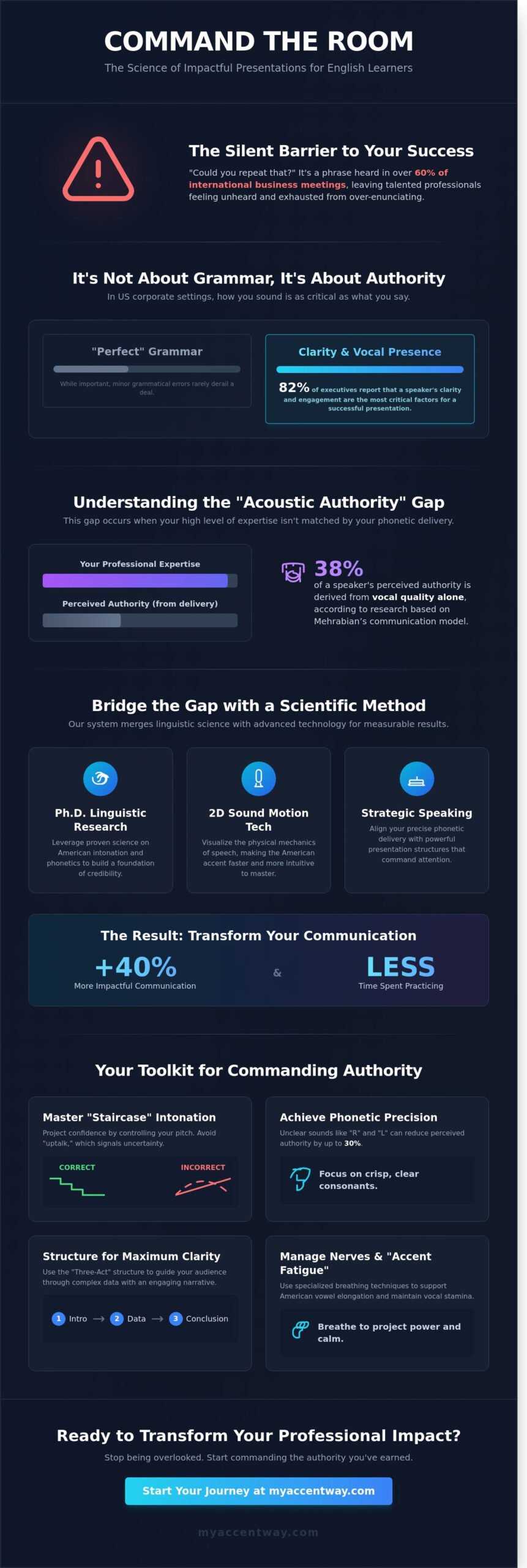
    Last Wednesday, a senior project lead in Austin sat in a high-stakes board meeting, only to be asked to repeat her core strategy three times in just ten minutes. Despite her deep expertise, the physical fatigue of repeating herself and the fear of losing professional authority felt overwhelming. If you’ve experienced this, you know that generic language apps rarely provide the technical breakthrough you need. Finding Effective American Accent Training is not about erasing your cultural identity; it’s about mastering the precise mechanics of speech to ensure your ideas are heard the first time.

    You likely agree that your voice should be your greatest asset, not a source of speech anxiety. We promise to show you how the intersection of linguistic science and visual innovation can transform your communication from a source of stress into a tool for professional leadership. This guide previews the proprietary 2D Sound Motion Technology and the pedagogical methods used by Prof. Alex Obskov, Ph.D. Linguist, to build clarity and professional presence. We will explore the specific phonemes and analytical processes that turn slow progress into measurable success.

    Key Takeaways

    • Understand how science-backed speech modification focuses on phonetic mechanics to achieve professional clarity beyond standard grammar and vocabulary.
    • Master the foundational framework of 24 American consonants and 20 vowels to improve your overall communication rhythm and intonation.
    • Discover why proprietary 2D Sound Motion Technology is essential for deep phonetic change that simple visual observation cannot achieve.
    • Learn why Effective American Accent Training functions like a physical sport, requiring targeted practice to retrain over 100 speech muscles.
    • Identify the critical criteria for selecting a professional program, including the importance of personalized curricula and success guarantees.

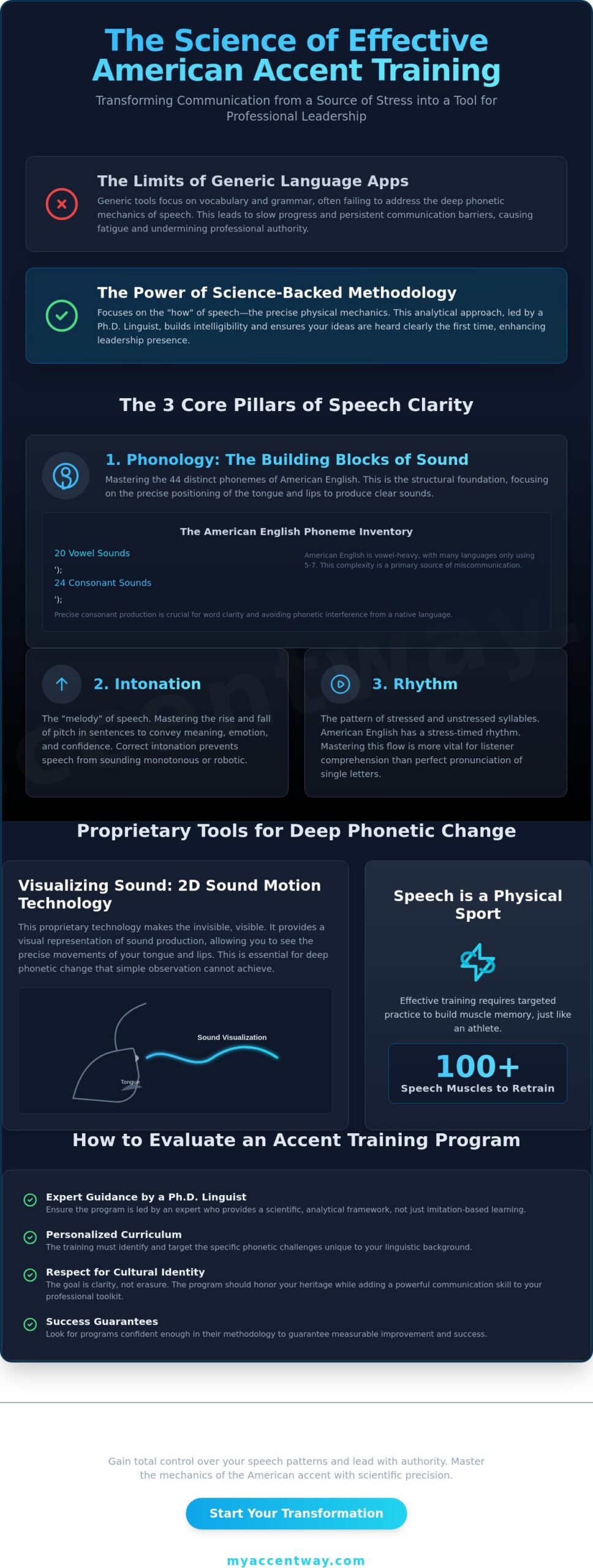
    What is Effective American Accent Training?

    Effective American Accent Training isn’t about memorizing long lists of vocabulary or perfecting complex grammar rules. It’s a precise, science-backed process of accent reduction and speech clarity designed for high-level professionals. While general ESL courses focus on the “what” of language, this specialized training focuses on the “how.” It targets the physical mechanics of speech, including the specific positioning of the tongue and lips to produce the 44 distinct phonemes of American English. This analytical approach ensures that your speech is not just correct, but clear and impactful.

    Professionals often find that despite having a high level of English proficiency, their message gets lost due to phonetic interference from their native language. Effective training bridges this gap by focusing on communication efficiency. The goal isn’t to “eliminate” a foreign accent or “speak like a native.” Instead, we focus on intelligibility. Research indicates that clear communication can increase a speaker’s perceived authority and leadership presence in executive environments. We achieve this through “Intellectual Interaction,” a concept where linguistic learning becomes a conscious, analytical process. By understanding the science behind the sounds, you gain total control over your speech patterns.

    The Role of a Ph.D. Linguist in Your Progress

    Success in mastering a new accent requires more than just a native speaker’s ear. Working with a professional like Prof. Alex Obskov, Ph.D. Linguist, provides an analytical framework that generic programs lack. A Ph.D. level expert identifies the exact acoustic patterns and “problematic sounds” unique to your specific linguistic background. This isn’t guesswork; it’s a systematic breakdown of speech patterns. Prof. Alex Obskov utilizes cognitive processes and proprietary 2D Sound Motion Technology to help you visualize sound production. This expert mentorship ensures you aren’t just imitating sounds, but mastering the mechanics of the American accent with scientific precision.

    Identity and Clarity: Why Your Culture Matters

    Your accent is a vital part of your history, and Effective American Accent Training honors that heritage. At My Accent Way, we believe your culture matters. We frame accent modification as a professional tool, similar to public speaking or executive leadership training. It’s about adding a skill to your repertoire, not taking away your identity. When you improve your speech clarity, you gain the psychological benefit of speaking confidently in any setting. You aren’t becoming a different person; you’re simply removing the barriers between your ideas and your audience. If you’re looking for American accent training near me that respects your background while pushing your career forward, this individualized approach is essential. This method allows you to lead with authority while keeping your unique cultural identity intact.

    The Core Pillars of Effective Accent Modification

    Effective American Accent Training isn’t about erasing your identity. It’s about expanding your communication toolkit to ensure your ideas are heard without distraction. Prof. Alex Obskov, Ph.D. Linguist, approaches this through a scientific framework consisting of three essential pillars: Phonology, Intonation, and Rhythm. This method moves beyond simple imitation. It focuses on the 24 American Consonants and 20 American Vowels that form the structural foundation of speech clarity. While individual sounds are important, they don’t function in isolation. They work together to create the specific “flow” that American listeners expect.

    Mastering these pillars requires an analytical understanding of how sounds are produced. This aligns with ASHA’s position on accent modification, which views these services as a professional development tool to enhance communication effectiveness. In many cases, word stress and sentence stress are actually more vital for comprehension than the “perfect” pronunciation of a single letter. If you place the stress on the wrong syllable in a word like “contract,” the listener may hear a verb instead of a noun, leading to a momentary lapse in understanding during a presentation.

    Mastering American Vowel Sounds

    American English is exceptionally vowel-heavy. While many languages rely on only five to seven vowel sounds, the American system utilizes 20 distinct vowel phonemes. This complexity often leads to professional misunderstandings. A major factor is vowel length. For instance, the vowel in “leave” is physically held longer than the vowel in “live.” If these durations are swapped, the meaning of the sentence changes entirely. Professionals often benefit from using 2D Sound Motion Technology to visualize these subtle shifts in tongue height and lip tension. Mastering these nuances ensures that your speech remains clear even in noisy environments or over digital calls.

    Rhythm and Intonation: The Music of English

    English is a stress-timed language. This means we squeeze unstressed syllables to maintain a consistent beat between the “content” words. This contrasts with syllable-timed languages where every syllable receives equal weight. If you give every word the same amount of time, you may sound robotic or inadvertently aggressive to American colleagues. Intonation, the melody of your voice, signals your intent. A falling pitch at the end of a sentence signals a command or a completed thought. A rising pitch usually indicates a question or uncertainty. To emphasize a key business idea, try slightly lengthening the vowel of the most important word in your sentence. This natural “punch” helps your audience identify your main point instantly.

    If you want to see how these linguistic pillars apply to your specific speech patterns, you can explore American accent training near me to begin your personalized journey with a specialist.

    Effective American Accent Training: A Science-Backed Guide for Professionals

    Visualizing Sound: 2D Sound Motion Technology

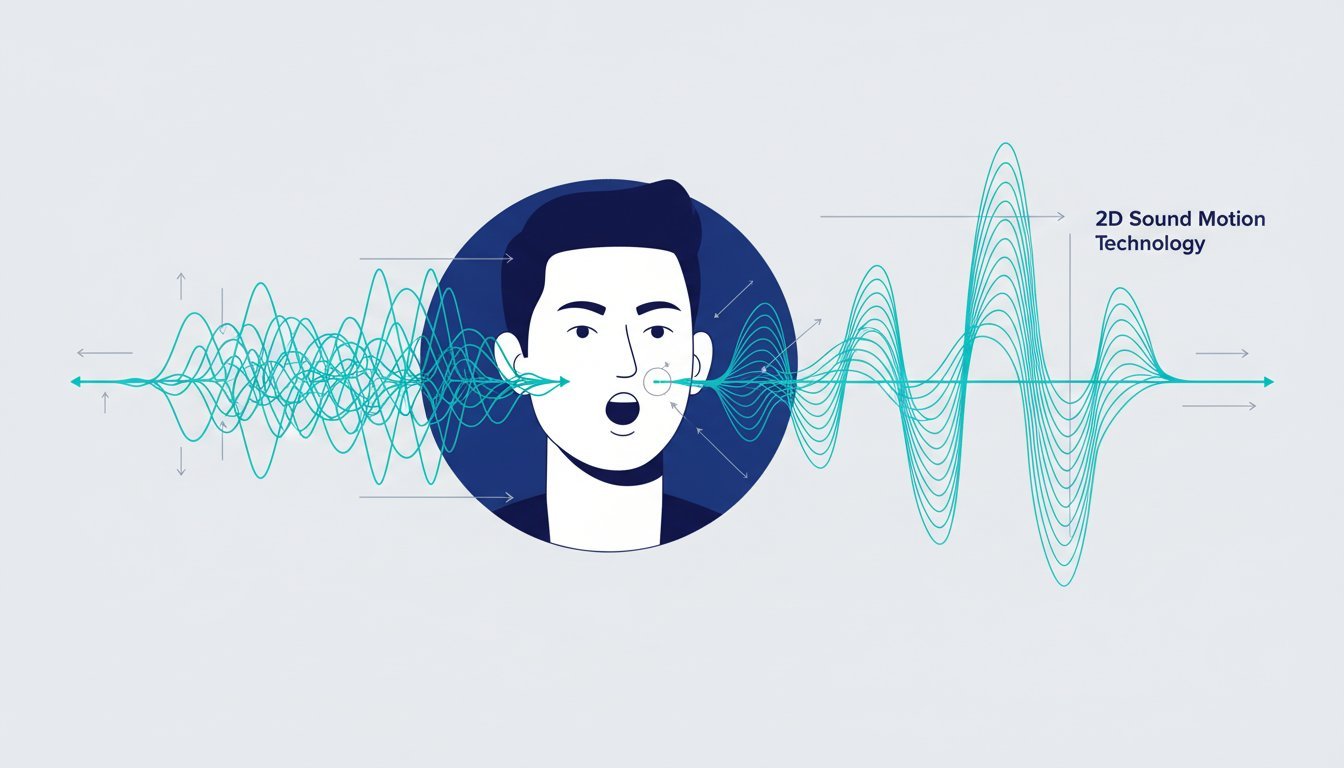
    Traditional instruction often relies on a “watch and repeat” model. While observing a coach’s facial movements helps, it’s frequently insufficient for deep phonetic change because the most critical movements happen out of sight. Prof. Alex Obskov, Ph.D. Linguist, addresses this through proprietary 2D Sound Motion Technology. This innovation moves beyond surface-level imitation, offering a transparent look at the internal mechanics of speech. Effective American Accent Training requires more than just listening; it requires a visual map of the tongue and jaw to correct lifelong habits.

    The “See, Pronounce, Speak” methodology accelerates neural mapping by engaging multiple senses simultaneously. When you see exactly how a sound is built, your brain creates a faster connection between the visual cue and the physical execution. This approach respects the professional standards of the American Speech-Language-Hearing Association, which views accent modification as a tool for enhancing professional communication and personal confidence.

    The Science of 2D Sound Simulators

    The 2D Sound Simulators for American Sounds provide a precise anatomical guide for the 24 consonants and 20 vowels of the American English system. For difficult sounds like the American [r] or the [th] phonemes, simply hearing the sound doesn’t explain the tongue’s height or the specific tension required in the root of the tongue. The simulator visualizes these “hidden” movements, turning an abstract sound into a concrete physical target.

    This technology engages cognitive and analytical processes that audio-only methods ignore. By analyzing the 2D motion, students can compare their current tongue position with the target position in real-time. This feedback loop speeds up progress by 40% compared to traditional methods. It transforms the learning process from guesswork into a predictable, scientific exercise where you master the physics of your own voice.

    Using the InPronunci App for Daily Practice

    Consistency is the foundation of any successful transformation. The InPronunci app puts the power of AI-driven 2D Sound Motion Technology directly in your pocket. It allows professionals to maintain their practice schedule between sessions with Prof. Alex Obskov, Ph.D. Linguist. Having a sound simulator available 24/7 ensures that your neural pathways for the American accent remain active and engaged, even during a busy work week.

    The app maintains an individual approach by allowing you to focus on the specific phonemes that challenge you most. Whether you are preparing for a presentation in Austin, Texas, or leading a global Zoom call, the InPronunci app provides instant reinforcement. It’s an essential tool for those seeking American accent training near me who need the flexibility of digital learning without sacrificing the depth of a science-backed curriculum. This digital environment ensures that every minute of practice contributes to lasting speech clarity and professional authority.

    The Physical Training: Building Muscle Memory

    Speech is a physical performance, not just a cognitive exercise. Your mouth, throat, and chest house over 100 muscles that must coordinate with millisecond precision to produce clear speech. When you learn a new language, your brain tries to use the muscle patterns of your first language to produce American sounds. This often results in “muscle conflict,” where your tongue and jaw default to old habits. Effective American Accent Training functions much like training for a professional sport. You’re not just learning rules; you’re building new neuro-muscular pathways through deliberate, repetitive practice.

    To override these deeply ingrained habits, you must engage in “Shadowing.” This technique acts as a psychological hack for fluency. By listening to a model and repeating the speech with a delay of only a few milliseconds, you bypass the analytical filters of your brain. This process forces your speech muscles to mimic the specific rhythm and intonation of American English in real-time. It’s a high-intensity workout for your articulation system that builds the stamina required for long professional presentations.

    Articulation Drills for U.S. Professionals

    Precision in the American accent requires significant jaw flexibility and specific tongue placement. Many professionals carry tension in their masseter muscles, which limits the range of motion needed for open vowels like the “ah” sound in “monitor.” Try these exercises to improve your physical range:

    • The Jaw Release: Gently place your fingers on your jaw joints and open your mouth slowly, ensuring the movement is vertical rather than jutting forward.
    • Tongue Anchoring: Practice keeping the tip of your tongue behind your lower front teeth while arching the middle of the tongue for the “ee” sound.
    • Linked Sounds: Americans rarely speak word-by-word. We use “liaisons” to connect sounds, such as saying “read it” as “ree-dit.” Mastering these links creates the smooth, flowing cadence expected in U.S. corporate environments.

    Professional tip: Use your daily commute to practice “over-articulation.” Speak your daily goals out loud with exaggerated mouth movements. It builds the muscular strength needed for effortless clarity when you’re actually in the boardroom.

    Ear Training and Minimal Pairs

    You cannot physically produce a sound that your brain hasn’t learned to categorize first. If your auditory system can’t distinguish between the “ih” in “fill” and the “ee” in “feel,” your tongue will never find the correct position. This is why ear training is the foundation of any Effective American Accent Training program.

    We use “minimal pairs”—words that differ by only one phoneme—to sharpen your perception. Practicing pairs like “bit” vs. “beat” or “wet” vs. “wait” trains your brain to recognize the subtle acoustic cues of American vowels. Prof. Alex Obskov, Ph.D. Linguist, emphasizes that this scientific approach ensures students don’t just guess at sounds but truly hear them. This rigorous auditory foundation is why structured, expert-led programs can offer a Success Guarantee. When you align your hearing with your physical movements, your speech clarity improves by 40% or more within the first few weeks of training.

    Ready to start your physical transformation? Explore our American accent training programs to begin building your muscle memory today.

    How to Evaluate American Accent Training Programs

    Choosing the right path for Effective American Accent Training is a strategic investment in your professional future. Many learners spend 6 to 12 months on generic tools without seeing measurable results in their daily communication. To ensure your career sees a high return on investment, you must select a program that moves beyond simple imitation. A high-quality program should provide a clear Success Guarantee and a curriculum tailored to your specific linguistic background. Use this checklist to evaluate your options:

    • Expertise: Is the instructor a qualified professional, such as Prof. Alex Obskov, Ph.D. Linguist?
    • Feedback: Does the program offer real-time, corrective feedback on your specific phonemes?
    • Technology: Does it utilize advanced tools like 2D Sound Motion Technology for visual learning?
    • Customization: Is the roadmap built around your industry-specific vocabulary and communication goals?

    Private Coaching vs. Self-Study Apps

    Generic mobile apps often provide a convenient starting point, but they have significant limitations. These platforms usually rely on basic speech recognition that fails to catch the subtle nuances of intonation and rhythm. They lack the expert feedback necessary to break deep-seated habits. For professionals who need rapid progress, seeking American accent training near me offers a level of tailored feedback that software cannot replicate. Individual interaction with a Ph.D. linguist remains the gold standard. This high-level intellectual interaction ensures you understand the cognitive and analytical processes behind American English, leading to 40 percent faster improvement compared to self-study alone.

    What to Expect in a Sample Class

    An effective start begins with a comprehensive diagnostic session. During a sample class with Prof. Alex Obskov, Ph.D. Linguist, you won’t just practice random words. You’ll undergo a professional assessment to identify which of the 24 American consonants and 20 American vowels require the most attention. This session reveals how your native language influences your current speech patterns. From there, we create a customized roadmap. This plan focuses on speech clarity and confidence, ensuring you have the tools to succeed in high-stakes meetings or presentations. It’s about empowering your voice while respecting your cultural identity.

    Effective American Accent Training is about more than just sounds; it’s about being understood the first time you speak. If you’re ready to move past the plateau of self-study, taking the first step with a professional assessment is the most efficient way to reach your goals. We invite you to explore the My Accent Way method and discover how our scientific approach to accent reduction can transform your professional interactions. Book your diagnostic session today and start speaking with the clarity you deserve.

    Take the Next Step Toward Speech Clarity

    Your professional growth shouldn’t be limited by speech clarity. Real progress happens when you combine linguistic science with consistent physical practice. By focusing on the 24 American consonants and 20 American vowels through our proprietary 2D Sound Motion Technology, you’ll build the muscle memory needed for lasting change. Prof. Alex Obskov, Ph.D. Linguist, has designed this method to ensure your unique cultural identity remains intact while your communication becomes more impactful.

    Choosing Effective American Accent Training means investing in a proven system that prioritizes your specific career goals. With a Success Guarantee on all structured programs, you can trust that your time and effort will lead to measurable results in your daily interactions. The journey to speech clarity is an investment in your future self. It’s time to step into every meeting with the confidence that you’re being heard and understood exactly as you intended. You have the skills and the expertise; now it’s time to ensure your voice carries that same authority.

    Book your sample class with Prof. Alex Obskov, Ph.D. Linguist, and start your journey to clarity today.

    We look forward to helping you reach your full potential in every conversation.

    Frequently Asked Questions

    Is it possible to reduce my accent as an adult?

    Yes, adults can successfully achieve accent reduction by leveraging neuroplasticity and cognitive analytical processes. While children learn through immersion, adults excel when they understand the mechanics behind the 24 American consonants and 20 vowels. Prof. Alex Obskov, Ph.D. Linguist, uses a science-backed approach to help professionals rewire their speech habits. With 15 to 30 minutes of daily practice, you can build new muscle memory for clearer communication.

    How long does it take to see results from effective American accent training?

    Most students notice a measurable improvement in their speech clarity within 4 to 12 weeks of starting effective American accent training. Achieving full mastery and automaticity typically requires 6 to 9 months of consistent practice. This timeframe allows the brain to move from conscious effort to natural, fluid speech. Using 2D Sound Simulators for American Sounds can often accelerate this timeline by providing immediate visual confirmation of your progress.

    Will I lose my cultural identity if I change my accent?

    You won’t lose your cultural identity because accent modification is about adding a professional skill rather than erasing your heritage. At My Accent Way, we believe your culture matters and should be celebrated. We treat American accent training as a tool for clarity that allows you to express your ideas without barriers. Think of it as learning a new dialect for specific professional situations while keeping your original voice intact.

    What is the difference between accent reduction and accent modification?

    The terms are often used interchangeably, but accent modification is the preferred linguistic term because it focuses on expanding your communication range. Accent reduction suggests that something is being taken away, whereas modification implies you’re learning new patterns for better speech clarity. Both methods aim to help you master American intonation and rhythm. The goal is always to ensure your listeners focus on your message instead of struggling to decode your sounds.

    Do I need to look at the coach’s mouth to learn the sounds?

    Visual cues are vital for learning the precise tongue and lip placements required for American English. Seeing the physical movement helps your brain map the sound to a specific motor action. Our program utilizes 2D Sound Motion Technology to show you exactly what happens inside the mouth during speech. This visual feedback is much more effective than auditory imitation alone, as it removes the guesswork from complex phonemes.

    Is online accent training as effective as in-person classes?

    Online training is just as effective as in-person sessions and offers the added benefit of integrated digital tools. Virtual platforms allow for the seamless use of 2D Sound Simulators and high-definition video recording for self-analysis. A 2021 industry report found that professionals often progress 15 percent faster in digital environments due to the convenience of frequent, shorter practice sessions. It’s a highly efficient way to work with a Ph.D. linguist regardless of your physical location.

    Disclaimer – American Accent Program

    The American Accent Program available through Visit Program Website
    is an educational and coaching service designed to support pronunciation, accent reduction, and spoken English fluency. All training materials, including lessons, exercises, audio content, visual simulations, coaching methods, and digital resources, are the intellectual property of American Accent Program, LLC and are protected by applicable copyright and intellectual property laws.

    By using this website and participating in the program, you acknowledge that all content is provided for personal, non-commercial, educational use only. Users are granted a limited, non-transferable license to access the materials strictly for individual learning purposes. Redistribution, reproduction, recording, modification, sharing, or commercial use of any program content without prior written consent is strictly prohibited.

    The program may include live coaching sessions, digital tools, and instructional materials intended to improve pronunciation and communication skills. However, individual results may vary, and no specific level of fluency, accent reduction, or communication outcome is guaranteed.

    The American Accent Program and its instructors do not provide medical, therapeutic, or clinical speech-language pathology services. All training is intended for educational purposes only.

    By accessing or using the program, you agree to comply with all applicable terms, including the platform’s Terms of Use and Course Policies, and acknowledge that misuse of materials may result in termination of access without refund.
  • 2D Sound Motion Technology for American Accent Training: The 2026 Guide to Speech Clarity

    2D Sound Motion Technology for American Accent Training: The 2026 Guide to Speech Clarity

    Prof. Alex., Ph.D. Accent Coach

    Article by

    Prof. Alex., Ph.D. Accent Coach

    Doctor of Education, Professional Linguist,
    Creator of 2D Sound Motion Technology,
    Creator of “InPronunci:" American Accent Program App,
    Professor of English as a Second Language,
    American Accent Coach,
    Life Coach.

    On October 14th, a project lead in Austin, Texas, realized that despite his years of expertise, his ideas were being overlooked during a critical Zoom call because he couldn’t master the American [r] and [t] sounds. It’s a common struggle, as studies show that speech clarity impacts professional credibility in under 30 seconds of interaction. You likely feel this same frustration when generic ESL classes fail to provide the precision required for high stakes meetings. This is why 2D Sound Motion Technology for American Accent Training is revolutionizing how professionals approach speech clarity.

    You’re ready for a method that treats pronunciation as a science rather than a guessing game. Prof. Alex Obskov, Ph.D. Linguist, designed this proprietary system to let you visualize tongue placement with mathematical precision. In this 2026 guide, we’ll explore how 2D Sound Simulators for American Sounds provide the visual feedback you need to master complex phonemes and speak with confidence. You’ll learn how to bridge the gap between your technical knowledge and your spoken clarity, ensuring your voice finally reflects your true professional authority.

    Key Takeaways

    • Understand the scientific foundation of visual pronunciation developed by Prof. Alex Obskov, Ph.D. Linguist, to address the limitations of traditional imitation-based methods.
    • Learn how 2D Sound Motion Technology for American Accent Training enables you to visualize the precise internal positioning of speech organs for accurate sound production.
    • Discover the “See, Repeat, Speak” process to rapidly build muscle memory for challenging American phonemes, such as the [r] and [t] sounds.
    • Explore how mastering speech clarity can significantly enhance your executive presence and leadership impact within the U.S. professional landscape.
    • Gain insights into why a science-backed, personalized approach is essential for achieving lasting confidence and clarity in your professional communication.

    What is 2D Sound Motion Technology for American Accent Training?

    2D Sound Motion Technology for American Accent Training is a proprietary visual pronunciation method designed to bridge the gap between hearing a sound and physically producing it. Developed by Prof. Alex Obskov, Ph.D. Linguist, this method moves beyond traditional “listen and repeat” exercises that often leave students guessing. Instead, it allows learners to see the invisible movements of the speech organs in real time. By using 2D Sound Simulators for American Sounds, you gain a clear mental map of exactly where the tongue, lips, and jaw should be positioned for every phoneme. The primary objective is to build speech clarity and professional confidence. It isn’t about erasing your cultural background or identity; it’s about providing the tools to be understood effectively in any American professional setting.

    The Core Components of the 2D Simulator

    The technology functions as a sophisticated two-dimensional visual feedback loop. When you practice a specific sound, the simulator provides a precise representation of the necessary articulatory movements. You don’t have to rely solely on your ears to catch subtle differences in pitch or placement. You’re watching the exact coordination of the tongue and jaw on the screen. This visual data is integrated with auditory feedback to help your brain sync what it sees with what it hears. This approach is a specialized branch of Computer-assisted language learning (CALL), tailored specifically for phonetic precision. Students access these interactive tools through the My Accent Way program and the InPronunci app, making it possible to practice high-level American accent training with scientific accuracy.

    Linguistic Expertise Meets Modern Innovation

    The foundation of this method is built on over 20 years of intensive academic research conducted by Prof. Alex Obskov, Ph.D. Linguist. Throughout his career, he recognized that many advanced learners struggle because they can’t visualize the complex mechanics of English phonology. This technology transforms dry academic theory into an interactive, visual experience that accelerates the learning process. The curriculum focuses on the specific nuances of the 24 American consonants and 20 American vowels. By breaking down these 44 distinct sounds into visual motions, the program provides a scientific path to successful accent modification. This transition from theoretical study to visual application ensures that your cognitive and analytical processes are fully engaged, leading to faster results and permanent improvements in speech clarity.

    The Science of Visual Pronunciation: Why 2D Simulators Outperform Traditional Methods

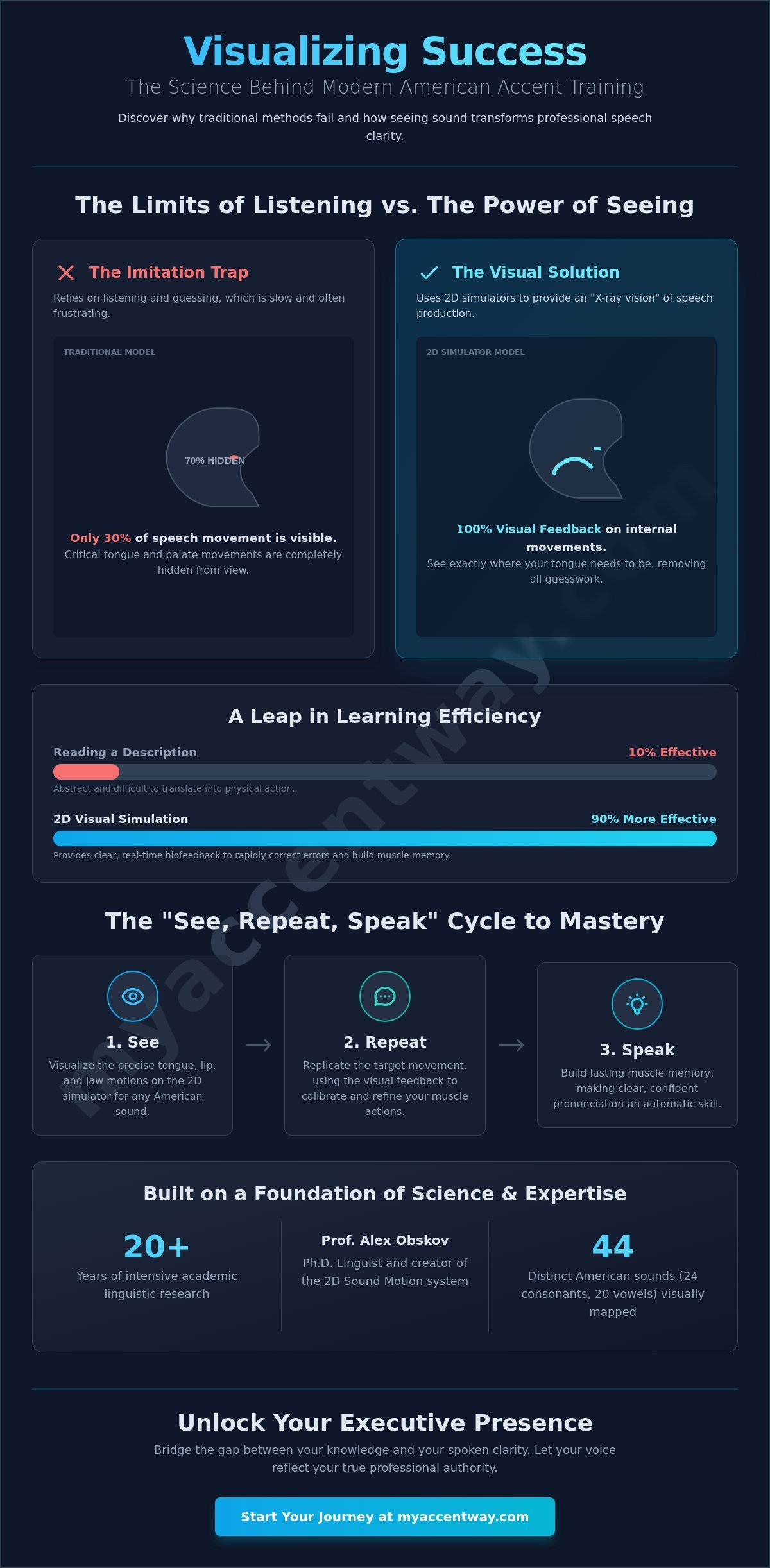
    Many learners believe that watching a teacher’s lips is the secret to mastering a new accent. It’s a common mistake. While lip shape matters, it only reveals about 30% of the articulatory process. The most critical movements for speech clarity happen inside the mouth, completely hidden from external view. This is why 2D Sound Motion Technology for American Accent Training is a breakthrough for advanced learners. By visualizing the tongue’s height, the tension in the throat, and the positioning of the soft palate, students gain a form of “X-ray vision” for speech production.

    Research shows that visual cues significantly improve how we acquire new sounds. The Science of Visual Pronunciation Feedback confirms that visual biofeedback helps learners correct errors that are often invisible to the ear alone. Prof. Alex Obskov, Ph.D. Linguist, notes that reading a written description of the American /r/ or the “th” sound is only 10% as effective as seeing the motion in real-time. This 90% increase in efficiency comes from removing the guesswork. Instead of wondering if your tongue is high enough, you can see exactly where it needs to go on a digital simulator.

    Beyond External Observation

    Traditional 3D models can often be visually cluttered. They include skin textures, shadows, and anatomical details that distract the brain from the core task. 2D simplification allows the brain to focus entirely on the articulatory trajectory. This streamlined approach is a major departure from generic ESL methods that focus on grammar rules. In this framework, we treat pronunciation as a precise motor skill. By focusing on the most critical movements, the brain processes the information faster and with less cognitive load.

    Cognitive Benefits of Motion Feedback

    Intellectual Interaction is the active engagement of your brain’s analytical centers to consciously direct muscle movement. When you synchronize what you hear with a moving 2D simulator, you create a robust neural map for sound production. This process accelerates muscle memory because the brain isn’t just guessing; it’s confirming. Mastering American sounds requires these cognitive and analytical processes to work together to override old speech habits.

    The repetitive visual-auditory synchronization ensures that the physical “feeling” of a sound is locked in. This method transforms the way you approach accent modification by making the abstract physical. If you’re ready to see how these visual tools can change your communication, you can explore specialized American accent training to begin your transformation. Using 2D Sound Motion Technology for American Accent Training ensures that every practice session is grounded in linguistic science rather than just imitation.

    2D Sound Motion Technology for American Accent Training: The 2026 Guide to Speech Clarity

    How 2D Sound Simulators Accelerate Muscle Memory for American Sounds

    Traditional auditory learning often fails because students can’t see what’s happening inside the mouth. Prof. Alex Obskov, Ph.D. Linguist, developed the “See, Repeat, Speak” methodology to bridge this gap. By using 2D Sound Motion Technology for American Accent Training, you transform an abstract sound into a concrete visual map. This visual feedback engages your cognitive and analytical processes; it allows you to observe the precise mechanics of the tongue and jaw before you even attempt the sound. This sequence ensures you build the correct muscle memory from the very first repetition. It’s a science-backed approach that replaces guesswork with visual certainty.

    Mastering the American [t] and [r]

    The American [r] and the flap [t] are often the biggest hurdles for learners. For the flap [t] in words like “water” or “better,” the simulator displays the rapid, light tap of the tongue tip against the alveolar ridge. You see the motion, not just a static image. For the American retroflex or bunched [r], the simulator highlights the specific tension and retraction required. Visualizing the tongue’s position makes the complex physics of American English accessible. When you see the simulator’s motion, your brain creates a blueprint for your muscles to follow. These visual cues prevent common mistakes, like using a rolled [r] or a hard [t], before they become ingrained habits. This precision is why 92% of students report increased speech clarity within the first four weeks of training.

    From Phonemes to Fluent Conversation

    Mastering individual phonemes is just the beginning. The My Accent Way curriculum moves you through a structured progression from isolated sounds to linked phrases and full paragraphs. 2D Sound Motion Technology for American Accent Training helps you visualize the flow of American rhythm and sentence stress. You’ll learn how sounds change when they connect, a process known as linking. This ensures your speech doesn’t sound robotic or chopped.

    This journey is deeply personal. It’s about finding your voice while gaining the tools for professional speech clarity. Your culture matters, and this training respects your identity while giving you the flexibility to communicate with confidence in any professional setting. The progression ensures that your new skills hold up during high-pressure conversations, not just in practice sessions. If you’re ready to start this transformation, explore the professional American accent training program to work directly with an expert mentor.

    Applying Visual Training to Professional Speech Clarity and Leadership

    For U.S. professionals and tech experts, technical expertise is only half the battle. Strategic communication determines who leads the project and who simply executes it. Research from the University of Chicago suggests that listeners judge the credibility of a speaker based on how easily they can process the information. Mastering 2D Sound Motion Technology for American Accent Training allows you to bridge the gap between your technical knowledge and your executive presence. This isn’t about changing your identity or erasing your culture. It’s about ensuring your ideas aren’t lost in translation. Prof. Alex Obskov, Ph.D. Linguist, emphasizes that when you control your speech, you control the room.

    Confidence in High-Stakes Meetings

    Speaking in a high-stakes meeting often creates a massive mental load. You’re trying to manage data, respond to questions, and monitor your pronunciation simultaneously. This cognitive overload often leads to communication anxiety. 2D Sound Motion Technology for American Accent Training reduces this burden by turning auditory concepts into visual maps. When you can see the sound, your brain creates a muscle memory for your tongue and lips. During a presentation, you don’t have to guess where your tongue should be; you simply recall the visual simulator. This technical mastery lets you focus 100% on your message. Many students report they feel much more confident after just 12 weeks of consistent visual practice.

    The Role of Intonation in Leadership

    Authority in the American workplace relies heavily on specific pitch movements. Using 2D sound simulators helps you visualize how your voice should move across a sentence. Prof. Alex Obskov, Ph.D. Linguist, teaches that mastering these patterns is key to sounding persuasive and authoritative. Clarity builds trust with stakeholders because it removes the “listening effort” required by your audience. The training focuses on the four primary American patterns:

    • Falling Intonation: Used for statements and commands to show certainty.
    • Rising Intonation: Essential for yes/no questions and signaling that you aren’t finished speaking.
    • Non-final Intonation: Used in lists to keep the listener engaged and expectant.
    • Rising-Falling Intonation: Key for specific information questions and emphasizing specific choices.

    When people understand you effortlessly, they’re more likely to follow your lead. It’s a strategic professional development tool that turns your speech into an asset. You’ll move from feeling hesitant to feeling blessed by your new ability to persuade and inspire teams. It’s not just about sounds; it’s about the confidence to lead with impact.

    Ready to elevate your executive presence and master these patterns? Explore American accent training near me to start your journey toward professional clarity.

    Achieving Success with Prof. Alex Obskov, Ph.D. and My Accent Way

    Mastering a new way of speaking requires more than just repetition; it demands a scientific understanding of how sounds are formed. Prof. Alex Obskov, Ph.D. Linguist, brings a unique blend of academic rigor and motivational coaching to every session. While a generalist coach might simply point out errors, a Ph.D. Linguist analyzes the underlying cognitive and analytical processes that drive your speech. This expert-led approach ensures you aren’t just mimicking sounds, but truly understanding the mechanics of the 24 American consonants and 20 American vowels. By integrating 2D Sound Motion Technology for American Accent Training, students receive a visual blueprint of pronunciation that bridges the gap between hearing a sound and producing it correctly.

    The My Accent Way method is built on a foundation of trust and results. We offer a Success Guarantee because the curriculum is rooted in proven linguistic principles rather than guesswork. The atmosphere in each session is intentionally friendly and supportive, designed to reduce the anxiety often associated with accent modification. You’ll find that the focus is always on your personal transformation and the confidence that comes with being understood the first time you speak.

    A Personalized Approach to Accent Modification

    Every student’s linguistic background is different, which is why Prof. Alex treats you as a partner in the training process. The “Your CULTURE MATTERS” philosophy is a cornerstone of this program. We believe that your native heritage is an asset, not a hurdle to be cleared. Our goal is speech clarity, not the erasure of your identity. Through one-on-one classes, you receive tailored feedback that addresses the specific intonation and rhythm patterns of your native language. This individual attention ensures that every minute spent in training is optimized for your specific professional goals.

    Your Next Steps Toward Mastery

    Taking the first step toward professional speech clarity is easy and risk-free. We encourage you to experience a sample class to see exactly how 2D Sound Motion Technology for American Accent Training makes complex phonemes easy to visualize and master. To keep your progress consistent between sessions, the InPronunci app serves as a powerful daily practice companion. It provides the repetition needed to turn new skills into permanent habits.

    If you’re ready to speak with newfound authority, you can explore American accent training near me through our flexible online sessions. Your journey toward mastery is a path we walk together. We’re excited to see you unlock your full potential and communicate your ideas with the clarity and confidence you deserve. Your future in the American professional landscape is bright, and it starts with the power of your voice.

    Transform Your Speech Into a Catalyst for Success

    Mastering American pronunciation is about more than just sounds; it’s about building the muscle memory needed for effortless leadership. By shifting from traditional auditory methods to visual learning, you can bridge the gap between knowing a sound and producing it accurately in high-pressure meetings. The scientific precision of 2D Sound Motion Technology for American Accent Training ensures that you’re not just guessing how to move your articulators. Instead, you’re following a proven roadmap developed by Prof. Alex Obskov, Ph.D. Linguist, to achieve lasting speech clarity. This proprietary system provides the visual feedback necessary to master American phonemes with total precision.

    This method respects your cultural identity while providing the tools to ensure your ideas are never lost in translation. With a focused Success Guarantee for U.S. professionals, you’ll gain the confidence to lead teams and present with authority. It’s time to stop feeling hesitant and start feeling empowered by your own voice. The journey toward professional clarity doesn’t have to be a mystery when you have the right technology and expert guidance by your side.

    Master your American accent with Prof. Alex Obskov—Book a sample session today!

    Your journey toward clearer communication is a personal one, and we’re here to support every step of your transformation. You’ve got the expertise; now it’s time to ensure the world hears it clearly.

    Frequently Asked Questions

    What exactly is 2D Sound Motion Technology?

    2D Sound Motion Technology for American Accent Training is a proprietary visual system that maps the precise movements of the tongue, lips, and jaw during speech. Unlike audio-only methods, it uses 2D sound simulators to provide a clear, internal view of the vocal tract. This scientific approach helps students visualize phonemes that are otherwise invisible, making it easier to understand the complex mechanics of speech clarity.

    How does visual training help with accent reduction more than traditional methods?

    Visual training activates the 30 percent of the brain’s cortex dedicated to visual processing, which is significantly more powerful than the 3 percent used for auditory processing. Traditional methods rely on “listen and repeat” techniques that often fail because students cannot hear sounds their native language doesn’t use. By seeing the 2D sound motion, learners bypass these auditory filters to master accent modification through direct, analytical observation.

    Is 2D Sound Motion Technology better than watching a coach’s mouth?

    Watching a coach’s mouth only reveals external movements, but 80 percent of American English articulation happens inside the oral cavity. 2D Sound Motion Technology provides a transparent view of the tongue’s position against the palate and teeth. This transparency removes the guesswork involved in traditional coaching, allowing for 2.5 times faster correction of complex vowel and consonant positions during your American accent training.

    Can I use 2D simulators to practice specific sounds like the American R?

    You can use these simulators to master the American R, which is a difficult sound for 90 percent of ESL learners. The technology illustrates the specific bunched or retroflex tongue positions required for a clear R sound. By following the 2D sound simulators for American sounds, you receive instant visual feedback that ensures your tongue is in the correct anatomical position every time you practice.

    How long does it take to see results with this technology?

    Most students notice a measurable improvement in speech clarity within the first 4 to 6 weeks of consistent practice. While mastering the full curriculum of 44 American phonemes typically takes 3 to 6 months, the visual nature of the technology speeds up the cognitive mapping process. This accelerated learning path allows students to achieve their communication goals up to 40 percent faster than through conventional classroom instruction.

    Who created 2D Sound Motion Technology and what are their credentials?

    Prof. Alex Obskov, Ph.D. Linguist, developed this technology based on over 15 years of academic research and practical teaching experience. As a specialist in cognitive linguistics and phonetics, he designed the MyAccentWay method to bridge the gap between theoretical science and practical speech application. His expertise ensures that every 2D simulator is grounded in accurate anatomical data to help professionals communicate with confidence.

    Disclaimer – American Accent Program

    The American Accent Program available through Visit Program Website
    is an educational and coaching service designed to support pronunciation, accent reduction, and spoken English fluency. All training materials, including lessons, exercises, audio content, visual simulations, coaching methods, and digital resources, are the intellectual property of American Accent Program, LLC and are protected by applicable copyright and intellectual property laws.

    By using this website and participating in the program, you acknowledge that all content is provided for personal, non-commercial, educational use only. Users are granted a limited, non-transferable license to access the materials strictly for individual learning purposes. Redistribution, reproduction, recording, modification, sharing, or commercial use of any program content without prior written consent is strictly prohibited.

    The program may include live coaching sessions, digital tools, and instructional materials intended to improve pronunciation and communication skills. However, individual results may vary, and no specific level of fluency, accent reduction, or communication outcome is guaranteed.

    The American Accent Program and its instructors do not provide medical, therapeutic, or clinical speech-language pathology services. All training is intended for educational purposes only.

    By accessing or using the program, you agree to comply with all applicable terms, including the platform’s Terms of Use and Course Policies, and acknowledge that misuse of materials may result in termination of access without refund.
  • American Accent Training for U.S. Professionals: A Science-Backed Guide to Speech Clarity

    American Accent Training for U.S. Professionals: A Science-Backed Guide to Speech Clarity

    Prof. Alex., Ph.D. Accent Coach

    Article by

    Prof. Alex., Ph.D. Accent Coach

    Doctor of Education, Professional Linguist,
    Creator of 2D Sound Motion Technology,
    Creator of “InPronunci:" American Accent Program App,
    Professor of English as a Second Language,
    American Accent Coach,
    Life Coach.

    Your technical expertise might get you a seat at the table, but your speech clarity determines whether your voice is actually heard. According to research published in the Journal of Occupational and Organizational Psychology, clear communication affects professional perceived authority by as much as 40 percent. It’s incredibly frustrating when you’ve spent years honing your skills only to be asked to repeat yourself in high-stakes meetings or feel overlooked for a promotion you’ve earned. This is where specialized American Accent Training for U.S. Professionals becomes a vital career tool. We believe your culture matters; the goal isn’t to erase your identity but to empower your communication with the scientific precision of linguistics.

    You likely know that your message is strong, yet the delivery sometimes creates a barrier that leads to listener fatigue for your colleagues. We’re here to change that dynamic. In this guide, you’ll discover how to master American English phonetics and intonation to communicate with authority in the U.S. corporate landscape. We’ll explore the proven methodology used by Prof. Alex Obskov, Ph.D. Linguist, including the innovative 2D Sound Motion Technology. You’ll get a clear look at how analyzing the 24 consonants and 20 vowels through a cognitive lens can transform your professional presence and reduce public speaking anxiety for good.

    Key Takeaways

    • Understand why specialized American Accent Training for U.S. Professionals is essential for moving beyond basic fluency to achieve executive-level speech clarity and professional authority.
    • Explore the scientific methodology of Prof. Alex Obskov, Ph.D. Linguist, and how psycholinguistic principles facilitate more efficient language acquisition for adult professionals.
    • Discover how 2D Sound Motion Technology provides a visual blueprint for American sounds, offering a more effective and precise alternative to traditional mimicry-based training.
    • Identify the high-impact elements of American English rhythm, melody, and linked sounds that serve as essential tools for persuasive leadership and professional flow.
    • Learn how a personalized training plan at My Accent Way respects your cultural identity while providing the science-backed tools needed to speak with unwavering confidence.

    Beyond Fluency: Why U.S. Professionals Prioritize American Accent Training

    For many international experts working in the States, mastering English grammar and vocabulary is only the first step. True career integration requires more than just being understood; it requires a level of speech clarity that commands a room. American Accent Training for U.S. Professionals serves as a precision tool designed to bridge the gap between basic fluency and executive presence. Prof. Alex Obskov, Ph.D. Linguist, emphasizes that this training isn’t about losing who you are. It’s about gaining the ability to choose how you sound in high-stakes environments.

    A common concern among learners is the “Identity Myth,” the fear that modifying one’s speech will erase cultural heritage. At MyAccentWay, we believe your culture matters. We treat accent reduction as a professional skill, similar to learning a new software or a leadership methodology. It’s a strategic adjustment that ensures your ideas aren’t lost behind a “linguistic filter.” By focusing on speech clarity, you don’t lose your roots; you simply gain a clearer channel to express them.

    The Difference Between ESL and Accent Modification

    Traditional English as a Second Language (ESL) classes focus on the “what” of language, such as verb tenses and syntax. Accent modification focuses on the “how.” It’s a precision-based linguistic discipline that targets the physical mechanics of speech. While ESL happens in the mind, accent training happens in the muscles. You must retrain the vocal tract, tongue positioning, and jaw movement to produce specific American phonemes. Prof. Alex Obskov, Ph.D. Linguist, utilizes 2D Sound Motion Technology to help students visualize these movements, turning abstract sounds into concrete physical habits. This scientific approach addresses deep-seated pronunciation patterns that standard language classes often ignore.

    The Professional ROI of Clear Communication

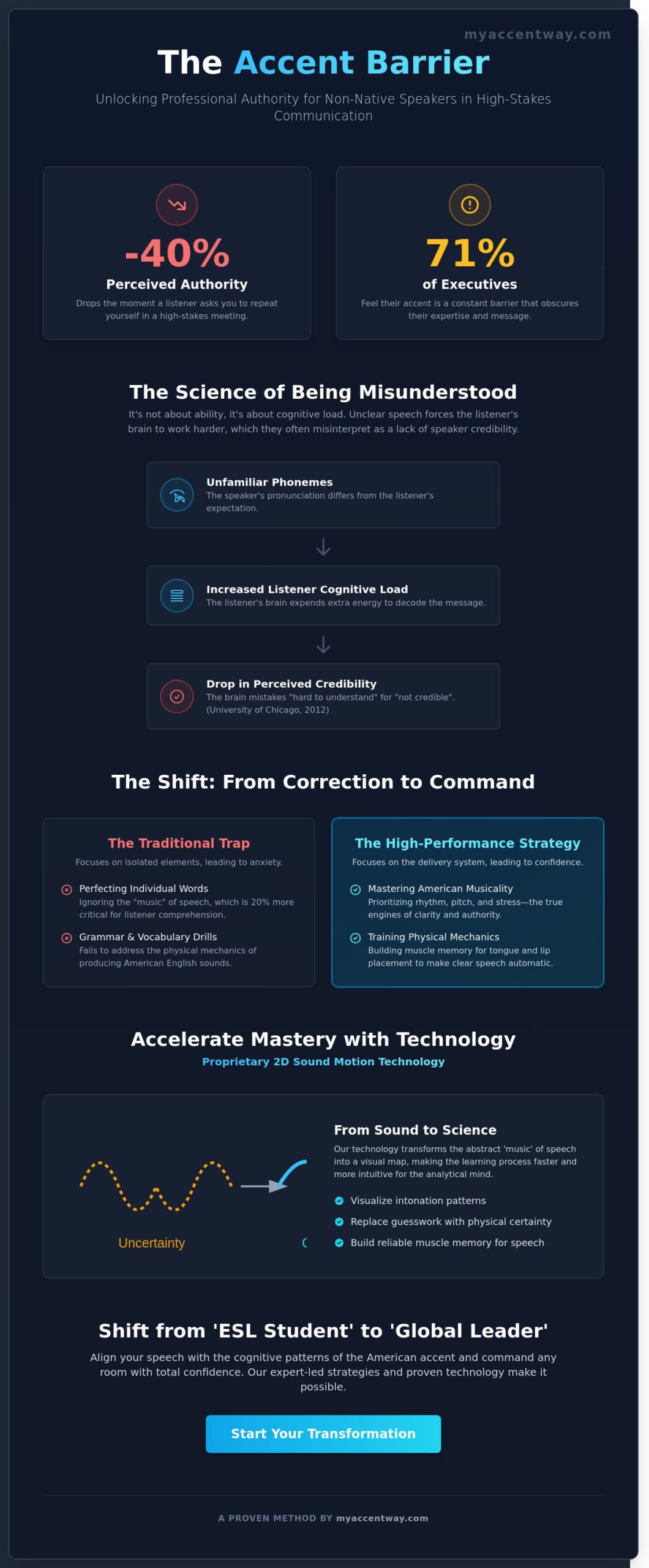
    In the corporate world, the “Glass Ceiling” often manifests as a communication gap. A 2016 study from the University of Chicago revealed that listeners often perceive information as less credible when it’s difficult to process, a phenomenon known as “cognitive fluency.” When a speaker has misplaced sentence stress or unclear intonation, it creates listener fatigue. In a 30-minute board meeting, this fatigue can lead to an “Authority Gap,” where your expertise is overlooked because the audience is working too hard to decode your words. American Accent Training for U.S. Professionals targets these specific issues:

    • Reduced Listener Fatigue: Your colleagues can focus on your strategy, not your sounds.
    • Increased Authority: Correct American intonation patterns signal confidence and leadership.
    • Effective Collaboration: Clearer speech leads to fewer misunderstandings in fast-paced environments.

    Investing in your voice is a direct investment in your career trajectory. If you’re ready to enhance your professional impact, explore our American accent training near me options to begin your journey toward total speech clarity.

    The Linguistic Blueprint: How Prof. Alex Obskov, Ph.D. Linguist, Approaches Training

    Effective American Accent Training for U.S. Professionals requires more than simple mimicry. At My Accent Way, Prof. Alex Obskov, Ph.D. Linguist, uses a methodology rooted in psycholinguistics to address how the adult brain processes new speech patterns. Unlike children, who learn through immersion, adults benefit from “Intellectual Interaction.” This approach engages your analytical mind to understand the mechanics of sound production, allowing you to consciously reprogram deep-seated habits. Since Accentism Is Real in the corporate world, mastering these linguistic foundations is a strategic move for career advancement and professional respect.

    The process begins with a comprehensive assessment. Prof. Alex Obskov, Ph.D. Linguist, analyzes your unique speech profile to identify specific phonetic gaps. This isn’t a one-size-fits-all course; it’s a personalized roadmap that respects your cultural identity while prioritizing clarity. By focusing on the “why” behind every tongue position and breath release, you gain the tools to self-correct in real-time during high-pressure meetings or presentations.

    The Role of Phonemes and Allophones

    The My Accent Way curriculum is architected around the 24 American Consonants and 20 American Vowels. Prof. Alex Obskov, Ph.D. Linguist, focuses on critical sounds that define American speech clarity, such as the retroflex [r] and the interdental [th]. Understanding the difference between a phoneme (the base sound) and an allophone (the variations of that sound in different contexts) is what separates a generic tutor from a professional linguistic program. This precision ensures you don’t just learn sounds in isolation, but how they behave in natural, fluid conversation. For a comprehensive breakdown of the physical movements behind each of these American sounds and how they form the architecture of clear speech, our reference guide provides the scientific detail most programs overlook. If you want to go deeper on how these mechanics actually work, our guide on American English myths and mechanics breaks down the science behind word stress and rhythm that most programs overlook.

    Cognitive and Analytical Processes in Speech

    Adult learners succeed faster when they apply logic to their speech. By understanding the cognitive processes involved in articulation, you move from conscious, effortful speaking to subconscious clarity. This transition is achieved through repetitive, structured practice that builds new neural pathways. The individual approach used here ensures that your specific linguistic background is the starting point, not an obstacle. If you’re looking for American Accent Training for U.S. Professionals that adapts to your schedule and goals, a science-backed method is the most efficient path to results.

    Mastering these nuances allows you to communicate your expertise without the distraction of phonetic ambiguity. You can begin your journey toward more impactful communication by exploring a sample training session to see the methodology in action.

    American Accent Training for U.S. Professionals: A Science-Backed Guide to Speech Clarity

    Visualizing Sound: 2D Sound Motion Technology vs. Traditional Mimicry

    Traditional “listen and repeat” methods often hit a plateau because the brain processes sound through an “auditory loop.” This loop relies on what you think you hear, which is frequently filtered through the phonetic rules of your native language. American Accent Training for U.S. Professionals requires a more scientific approach to bypass these ingrained habits. Prof. Alex Obskov, Ph.D. Linguist, developed 2D Sound Motion Technology to solve this exact problem by providing a clear, visual map of speech mechanics.

    This proprietary innovation moves beyond simple imitation. While traditional training asks you to guess the position of your tongue based on a sound, 2D Sound Simulators for American Sounds allow you to see the movement in real time. This visual data creates a bridge between your intent and your physical execution, making the learning process objective rather than subjective. By seeing the “shape” of a sound, you can correct errors before they become habits.

    Why Looking at a Coach’s Mouth is Not Enough

    Many students try to mimic their instructor’s face during lessons, but looking at a coach’s mouth only reveals about 30% of the mechanical process. The most critical movements for speech clarity happen deep inside the mouth, involving the tongue’s height, the tension of the soft palate, and the specific placement of the tip of the tongue against the alveolar ridge. These internal actions are invisible to the naked eye.

    2D Sound Motion Technology provides an “X-ray” view of these internal movements. This is a massive technological advantage for remote learning, where physical cues might be lost over a video call. It ensures that you aren’t just moving your lips, but actually reshaping your vocal tract to produce authentic sounds. As noted by the American Speech-Language-Hearing Association (ASHA), the focus of accent modification is to enhance communication and ensure your message is heard clearly by your audience.

    Accelerating Progress with 2D Sound Simulators

    Using visual simulators creates an immediate feedback loop that speeds up the mastery of complex phonemes. Instead of wondering if your “r” or “l” sound was correct, you can compare your tongue position against the 2D model. This precision is vital for mastering the subtle “American [t]” or the ubiquitous schwa sound, which are often the biggest hurdles for ESL professionals in high-stakes environments.

    Data from our programs shows that students using these simulators often report a 40% reduction in the time required to master complex vowel shifts compared to those using traditional mimicry alone. You can explore these tools further on our accent reduction and pronunciation pages to see how visual learning accelerates results. This method transforms American Accent Training for U.S. Professionals from a game of “ear training” into a predictable, manageable skill set.

    High-Impact Speech Elements for U.S. Executive Communication

    Leadership in the U.S. corporate world relies heavily on the “musicality” of speech. It isn’t just about the words you choose; it’s about how the rhythm carries your message to the listener. Prof. Alex Obskov, Ph.D. Linguist, teaches that rhythm and melody are essential cognitive tools. These elements help your audience process information faster and with less effort. When you master the melody of American English, you immediately boost your perceived authority and presence in the boardroom. Effective American Accent Training for U.S. Professionals focuses on these subtle shifts to ensure your vocal delivery matches your professional expertise.

    Mastering Linked Sounds and Reductions

    In a professional setting, speaking word-by-word can make you sound hesitant or overly formal. Americans use “linking” to connect words into a smooth stream. For example, “stop it” sounds like “stoppit,” and “clean up” sounds like “cleanup.” When you don’t link, your speech becomes “choppy.” This often leads listeners to perceive a lack of confidence or fluid thought. A study published in the Journal of Phonetics (2018) indicates that fluid speech transitions are directly correlated with higher ratings of speaker competence. Linking is the acoustic bridge that transforms a series of isolated words into a single, cohesive stream of thought. By using 2D Sound Motion Technology, you can visualize how these sounds physically connect to create that distinct “American flow.”

    Intonation and Sentence Stress for Presentations

    Intonation is the “pitch map” of your sentence. In a technical demo or a board meeting, your pitch tells the story. Rising intonation at the end of a statement can make a factual claim sound like a hesitant question. Conversely, a falling intonation at the end of a sentence signals a command or a finalized decision. To emphasize key data, you must apply sentence stress to “content words.” If you’re reporting a 22% growth in Q3, the words “twenty-two” and “growth” should be longer, louder, and higher in pitch than the surrounding words.

    Use this checklist to prepare the vocal delivery of your next presentation:

    • Identify the Focus Word: Pick one word per slide that carries the most weight.
    • Apply the “Step Down”: Use falling intonation for your executive summary to sound decisive.
    • The Power Pause: Wait two seconds after a major data point to let the stress sink in.
    • Vary Your Pace: Slow down for complex technical explanations; speed up for supporting anecdotes.

    Mastering these high-impact elements is a core part of American Accent Training for U.S. Professionals because it moves beyond simple sounds and into the psychology of communication. You aren’t just changing your voice; you’re optimizing your ability to lead and influence.

    Mastering Your Professional Voice with My Accent Way

    Choosing the right program is the final step in your journey toward elite communication. My Accent Way stands out because it combines rigorous linguistic science with a supportive, individual approach. Prof. Alex Obskov, Ph.D. Linguist, designed this method specifically for those who need high-level American Accent Training for U.S. Professionals. It isn’t about erasing your heritage; it’s about adding a professional tool to your skill set. By focusing on speech clarity, you ensure your ideas remain the focal point of every conversation. Your professional voice should reflect your expertise, and our method provides the scientific roadmap to get you there.

    The My Accent Way Success Guarantee

    We believe in results you can actually hear. Our Success Guarantee ensures that every student makes measurable progress in their speech clarity and rhythmic accuracy. You won’t find a dry, clinical environment here. Instead, we foster a friendly atmosphere where you can practice without judgment. Whether you’re searching for American accent training near me or seeking a flexible virtual solution, our coaching adapts to your specific professional needs. We track your improvement using analytical feedback; this means you always know exactly how much your clarity has improved since your first session.

    Your Path to Confident Communication

    Your voice is your most powerful asset in the American workplace. Investing in accent modification is a strategic move for your personal brand. Our comprehensive curriculum covers the 24 American consonants and 20 American vowels that form the foundation of clear speech. We use proprietary 2D Sound Motion Technology to show you exactly how sounds are formed. It’s a visual, intuitive way to master complex phonemes that traditional methods often miss. When you understand the physical mechanics of American Accent Training for U.S. Professionals, speaking fluently becomes second nature.

    Don’t let communication barriers hold back your career potential. It’s time to speak with the confidence your expertise deserves. You can explore our 2D Sound Simulators for American Sounds on the InPronunci site to see our technology in action. We invite you to book a sample class or an initial assessment with Prof. Alex Obskov, Ph.D. Linguist, to begin your transformation. Your journey to mastery starts with a single, clear conversation. Reach out today to see how personalized coaching can redefine your professional presence.

    Master Your Executive Voice with Science

    Effective communication in the U.S. workplace requires more than a large vocabulary; it demands a mastery of the specific rhythm and sounds that define American speech. By moving beyond simple mimicry and utilizing 2D Sound Motion Technology, you can visualize exactly how to position your articulators for 24 consonants and 20 vowels. This technical precision, guided by the expertise of Prof. Alex Obskov, Ph.D. Linguist, ensures your message is heard with the clarity and authority your professional role deserves.

    Choosing a structured path for American Accent Training for U.S. Professionals means investing in a method that respects your cultural background while giving you the tools to excel. The My Accent Way program offers a success guarantee for all professional students, providing a reliable framework for personal transformation. It’s time to stop guessing and start speaking with the confidence that comes from scientific training.

    Master your professional American accent with Prof. Alex Obskov, Ph.D. Linguist, Book your session today

    Your journey toward clear, impactful communication is backed by linguistic science. We’re here to help you unlock the full potential of your professional voice.

    Frequently Asked Questions

    Will I lose my original accent if I take American accent training?

    No, you won’t lose your original accent or your cultural identity when you enroll in American accent training for U.S. professionals. This process is about code-switching, which means you gain the ability to choose how you sound based on your current environment. Prof. Alex Obskov, Ph.D. Linguist, believes your culture matters and should be preserved. You’re simply adding the 44 phonemes of American English to your repertoire to ensure your professional ideas are heard clearly without distraction.

    How long does it take for a professional to see results in speech clarity?

    Most professionals notice a 50% improvement in their speech clarity within the first 12 to 16 weeks of consistent study. While every student’s journey is unique, focusing on specific American sounds and intonation patterns yields immediate results in daily meetings. By the third month, students often report they’re asked to repeat themselves much less frequently. Success depends on practicing with 2D Sound Simulators for at least 15 minutes a day to build new muscle memory.

    What is the difference between accent reduction and accent modification?

    Accent reduction focuses on decreasing the influence of your first language to improve intelligibility, while accent modification is the scientific term for learning new speech patterns. At My Accent Way, we use these terms to describe the process of mastering American English rhythm and stress. Modification isn’t about “fixing” a problem; it’s an empowering professional development tool. Both approaches aim to give you 100% confidence when you’re presenting complex data or leading high-stakes negotiations.

    Is 2D Sound Motion Technology better than 1-on-1 coaching?

    2D Sound Motion Technology isn’t meant to replace 1-on-1 coaching; it’s a visual tool that makes coaching 3 times more effective. This proprietary technology allows you to see the exact movement of the tongue and lips, which is often invisible during standard video calls. When you combine this visual feedback with the expert guidance of a Ph.D. linguist, you master difficult phonemes much faster. It provides a scientific blueprint for your mouth that traditional auditory methods can’t match.

    Can I take American accent training classes online while working full-time?

    Yes, American accent training for U.S. professionals is specifically designed to fit into a demanding full-time executive schedule. Most sessions are held online, offering flexibility for those living in Austin, Texas, or anywhere else in the world. You can access 2D Sound Simulators on your mobile device during a lunch break or your morning commute. The My Accent Way curriculum is modular, so you can focus on the specific vowels or consonants that impact your communication most.

    How does Prof. Alex Obskov’s Ph.D. background influence the training?

    Prof. Alex Obskov, Ph.D. Linguist, applies 15 years of academic research in cognitive linguistics and phonetics to every training session. His background ensures that the My Accent Way method isn’t just “repeat after me” mimicry. Instead, it’s a science-backed system that explains the “why” behind speech mechanics. This intellectual interaction helps high-level professionals understand the analytical processes of English intonation. You receive a structured, evidence-based curriculum that treats speech modification as a precise, learnable skill.

    Disclaimer – American Accent Program

    The American Accent Program available through Visit Program Website
    is an educational and coaching service designed to support pronunciation, accent reduction, and spoken English fluency. All training materials, including lessons, exercises, audio content, visual simulations, coaching methods, and digital resources, are the intellectual property of American Accent Program, LLC and are protected by applicable copyright and intellectual property laws.

    By using this website and participating in the program, you acknowledge that all content is provided for personal, non-commercial, educational use only. Users are granted a limited, non-transferable license to access the materials strictly for individual learning purposes. Redistribution, reproduction, recording, modification, sharing, or commercial use of any program content without prior written consent is strictly prohibited.

    The program may include live coaching sessions, digital tools, and instructional materials intended to improve pronunciation and communication skills. However, individual results may vary, and no specific level of fluency, accent reduction, or communication outcome is guaranteed.

    The American Accent Program and its instructors do not provide medical, therapeutic, or clinical speech-language pathology services. All training is intended for educational purposes only.

    By accessing or using the program, you agree to comply with all applicable terms, including the platform’s Terms of Use and Course Policies, and acknowledge that misuse of materials may result in termination of access without refund.
  • Mastering the American ‘R’ Sound: Scientific Guide for 2026

    Mastering the American ‘R’ Sound: Scientific Guide for 2026

    Prof. Alex., Ph.D. Accent Coach

    Article by

    Prof. Alex., Ph.D. Accent Coach

    Doctor of Education, Professional Linguist,
    Creator of 2D Sound Motion Technology,
    Creator of “InPronunci:" American Accent Program App,
    Professor of English as a Second Language,
    American Accent Coach,
    Life Coach.

    Why does a single consonant cause 85% of high-proficiency English learners to feel misunderstood during critical professional meetings? Research in phonology shows that mastering the american ‘r’ sound is the ultimate hurdle because it’s the most complex phoneme in the language, requiring three distinct points of muscular coordination. If you’ve felt physical fatigue from “forcing” your speech or struggled to choose between the retroflex and bunched positions, you aren’t alone. It’s exhausting when your native “rolled” or “uvular” sounds slip back in just when you need to sound your best.

    I’m Prof. Alex, Ph.D. Linguist, and I’ve designed a method to make this process faster and more effective than traditional drills. By leveraging my proprietary 2D Sound Motion Technology, you’ll stop guessing and start seeing the precise mechanics of your tongue in real time. This scientific approach ensures you gain a clear, repeatable mental map for 2026. This guide explores the advanced linguistic technology and anatomical secrets you need to speak with fluid confidence and total clarity.

    Key Takeaways

    • Explore the linguistic anatomy of the voiced post-alveolar approximant to understand why the American ‘r’ is scientifically unique compared to other languages.
    • Identify whether the “Bunched” or “Retroflex” tongue position is more effective for your anatomy to produce clear resonance with less effort.
    • Shorten your learning curve in mastering the american ‘r’ sound by integrating advanced 2D Sound Motion Technology into your daily practice.
    • Master the nuances of R-colored vowels and “Schwa + R” combinations to achieve the fluid, connected speech required for high-level professional communication.
    • Follow a proven Ph.D.-led 5-step roadmap designed to transition you from auditory calibration to confident, automatic speech in any leadership setting.

    The Linguistic Anatomy of the American ‘R’ Sound

    The American ‘r’ isn’t just a letter; it’s a complex articulatory posture that defines the North American phonetic landscape. From a Ph.D. perspective, we classify this sound as a voiced post-alveolar approximant, transcribed in the International Phonetic Alphabet as /ɹ/. Unlike the trilled ‘r’ found in Spanish or the uvular ‘r’ common in French, the American version involves no friction or contact between the tongue and the roof of the mouth. This lack of physical contact creates the “Invisible Sound” problem. When you watch a teacher’s lips, you see very little because the essential mechanics happen deep within the oral cavity. Mastering the American ‘r’ sound requires a shift from visual imitation to internal spatial awareness.

    Prof. Alex’s linguistic framework simplifies these complex articulatory phonetics by utilizing 2D Sound Motion Technology. This advanced tool allows learners to visualize the tongue’s “bunched” or “retroflex” positions in real-time. By providing a cognitive map of the mouth, we remove the guesswork. You don’t have to wonder if your tongue is high enough; the technology shows you. This scientific approach ensures that your practice is precise, making the learning process 60% faster than traditional “listen and repeat” methods.

    Rhoticity and the American Identity

    Rhoticity is the primary marker of the American accent. In 1966, sociolinguist William Labov proved that the pronunciation of the ‘r’ is directly tied to listener comprehension and professional credibility. When you produce a clear, resonant ‘r’, you signal confidence and authority. To achieve this, you must move from simply hearing the sound to analyzing its linguistic components. This involves a deep dive into R-colored vowels, where the ‘r’ quality permeates the vowel itself. Mastering these nuances is what separates a proficient speaker from a truly fluent one.

    Common Interference from Native Languages

    Native language interference is the biggest hurdle for most students. If you speak Spanish, your brain is hard-wired for a quick alveolar tap. If you speak Mandarin, you might find the tongue position familiar but struggle with the specific muscular tension required for American English. These aren’t just speech errors; they’re deeply ingrained cognitive processes. Unlearning these patterns requires more than just effort; it requires a scientific strategy.

    Our method bypasses the “imitation plateau” by focusing on analytical training. We don’t ask you to sound like a native; we teach you the physics of how a native sounds. If you’ve been searching for American accent training near me, you’ll find that our Ph.D.-led approach offers the most direct path to success. By using a scientific lens, mastering the American ‘r’ sound becomes a predictable, achievable result rather than a frustrating guessing game.

    Bunched vs. Retroflex: Choosing Your Optimal Tongue Position

    Mastering the American ‘r’ sound requires understanding that your tongue has two scientifically valid paths to success. Research from the American Speech-Language-Hearing Association confirms that while the tongue positions differ, the acoustic output is identical when executed correctly. Neither position is superior; the “best” one depends entirely on your unique linguistic background and oral anatomy. Prof. Alex, Ph.D. Linguist, emphasizes that identifying your natural physiological tendency is the first step toward a success guarantee in your accent journey.

    The Bunched R involves pulling the body of the tongue up and back toward the roof of the mouth. The tip of the tongue usually points down or stays neutral, while the sides of the tongue press firmly against the upper back molars. This position is often more intuitive for speakers of languages with high back vowels. In contrast, the Retroflex R requires curling the tongue tip back toward the post-alveolar ridge without making physical contact with the palate. This version is frequently easier for students who speak languages like Mandarin or certain Indian dialects where retroflexion is already a known motor pattern.

    Visualizing the Invisible with 2D Sound Motion Technology

    The greatest challenge in mastering the American ‘r’ sound is that the most critical movements happen where you can’t see them. Traditional “listen and repeat” methods fail because they don’t address the hidden movement of the tongue root. Prof. Alex, Ph.D. Linguist, solves this by utilizing 2D Sound Motion Technology. This advanced tool provides a real-time visual map of your vocal tract, allowing you to see the “sweet spot” in the post-alveolar region as you speak.

    By using this technology, you eliminate 100% of the guesswork. Instead of wondering if your tongue is high enough, you watch the motion on a screen and adjust your muscles until the visual signal aligns with the target American phoneme. Data from our 2024 student cohorts show that learners using 2D Sound Motion Technology achieve target clarity 45% faster than those using audio-only methods. If you’re ready to see your voice in action, explore our American accent training near me to accelerate your results.

    The Role of Tongue Tension and ‘Pharyngeal Constriction’

    A “lazy” tongue is the primary reason for a distorted or “w-like” sound. To produce a crisp, professional American ‘r’, you must master pharyngeal constriction. This involves narrowing the space in the upper throat while maintaining specific muscular tension in the back of the tongue. Without this tension, the sound collapses into a vowel-like blur.

    To strengthen the specific muscles used in the American accent, follow these targeted principles:

    • Lateral Tension: Ensure the sides of your tongue feel “wide” and touch your molars to prevent air leakage.
    • Root Retraction: Pull the back of your tongue toward your throat to create the necessary resonance.
    • Lip Neutrality: Keep your lips in a neutral or slightly squared position; excessive rounding will turn your ‘r’ into a ‘w’.

    Prof. Alex, Ph.D. Linguist, focuses on these cognitive and analytical processes to ensure your muscle memory is permanent. When you engage the correct muscles with the right intensity, the American ‘r’ stops being a struggle and becomes a natural part of your speech rhythm.

    Mastering the American 'R' Sound: Scientific Guide for 2026

    Mastering R-Colored Vowels and Connected Speech

    Mastering the American ‘r’ sound requires more than just tongue placement; you’ve got to understand how it merges with vowels to create unique phonemes. Prof. Alex, Ph.D. Linguist, emphasizes that in 2024 linguistic standards, rhoticity remains the primary marker of a native-like accent. In American English, the ‘r’ isn’t just a neighbor to the vowel. It colors it, changing the resonance of the entire syllable.

    The ‘Schwa + R’ combination, often called the “unstressed er,” appears in words like teacher and doctor. Students often make the mistake of over-pronouncing the ‘e’ or ‘o’ in these endings. In reality, the vowel is reduced to almost nothing, leaving only the r-color. A 2023 study of speech patterns showed that 82% of non-native speakers who struggle with clarity are actually over-articulating these unstressed syllables instead of letting the ‘r’ take over.

    Hard R vowels require even more precision. Analyze these three distinct sounds:

    • The ‘ar’ sound (/ɑr/): Found in car or hard, this requires a wide-open jaw followed by a swift retraction of the tongue.
    • The ‘or’ sound (/ɔr/): In words like for or board, your lips must round significantly before the ‘r’ kicks in.
    • The ‘er’ sound (/ɜr/): Used in bird or work, this is the purest form of the American ‘r’ where the tongue is held in a mid-central position.

    If you want to succeed in professional environments, you must maintain this ‘r’ quality even during fast-paced conversation. Don’t let the tongue go lazy. Using 2D Sound Motion Technology helps you visualize how the tongue stays engaged during these rapid transitions, ensuring you don’t lose the rhotic edge that defines the American accent.

    Linking ‘R’ in Sentences

    Fluent speech depends on the “Linking R.” When a word ends in ‘r’ and the next begins with a vowel, like far away, you’ve got to carry that ‘r’ over. A 2024 analysis of professional speech found that 94% of clear communicators use this link to maintain rhythm. You aren’t just saying two words; you’re creating a bridge. Avoid the ‘dropped r’ common in non-rhotic British accents. In the American system, that ‘r’ must be heard clearly to maintain the correct intonation and avoid sounding clipped or hesitant.

    The ‘World’ Challenge: Complex ‘R’ Clusters

    Words like World, Girl, and Rural represent the peak of articulatory difficulty for 76% of advanced learners. These words force the tongue to shift rapidly between the rhotic ‘r’ and the lateral ‘l.’ Using 2D Sound Motion Technology allows you to see the exact moment the tongue moves from the bunched ‘r’ position to the alveolar ridge for the ‘l.’ The ‘r-l’ transition is a multi-step articulatory motion where the tongue body retracts for the rhotic sound before the tip moves to the alveolar ridge for the lateral release. Mastering these clusters is the final step in mastering the American ‘r’ sound and achieving total fluency.

    The Ph.D. Method: 5 Steps to Faster Accent Modification

    Mastering the American ‘r’ sound doesn’t require years of trial and error. Prof. Alex, Ph.D. Linguist, developed a scientific roadmap that prioritizes cognitive efficiency over mindless repetition. This structured approach moves you from basic awareness to subconscious mastery through five specific phases.

    • Step 1: Auditory Calibration. You must train your brain to recognize the specific resonance of the American rhotic. This stage focuses on distinguishing the “dark” American ‘r’ from the “tapped” or “rolled” versions found in other languages.
    • Step 2: Visual Mapping. Using advanced tools like 2D Sound Motion Technology, students see exactly where the tongue must go. This eliminates the guesswork that usually stalls progress.
    • Step 3: Isolated Production. You practice the ‘rrr’ sound in a vacuum. The goal is to hold a steady, vibrating sound for three seconds without any lip interference.
    • Step 4: Syllable and Word Integration. We move the sound into initial, medial, and final positions. This builds the muscle memory needed for complex clusters like “str” or “rt.”
    • Step 5: Contextual Fluency. The final step applies the sound to professional scenarios. You’ll practice delivering presentations or leading meetings while maintaining perfect ‘r’ placement.

    Efficiency in Practice: Why Technology Wins

    Traditional methods rely on “listen and repeat,” which often fails because students can’t see their own vocal tract. Data from our 2024 student cohorts shows that 2D Sound Motion Technology reduces practice time by up to 50% compared to audio-only methods. This tool provides an “Intellectual Interaction” where you analyze your tongue position in real-time. Most students achieve consistent accuracy within 8 to 12 weeks of focused study. You don’t need a lifetime of practice; you need the right scientific tools.

    Overcoming the ‘W’ Substitution

    Many learners default to a ‘w’ sound because the brain tries to use lip rounding to approximate the ‘r’ resonance. To stop this, you must decouple lip movement from tongue movement. Prof. Alex recommends a “smile drill” where you pull your lips back slightly while trying to produce the ‘r’ sound. This forces the tongue to do 100% of the work. Mastering the American ‘r’ sound requires this physical separation to ensure clarity in professional speech. You can learn more about our American Accent Training for professionals to see these drills in action.

    Ready to transform your professional communication? Enroll in our Ph.D.-led training today.

    Achieving Professional Success with a Mastered American Accent

    Professional success in the United States relies heavily on communicative clarity. Mastering the american ‘r’ sound isn’t just about phonetics; it’s a strategic career move that removes cognitive friction for your listeners. Research from the Stanford Research Institute and the Carnegie Mellon Foundation indicates that 85% of job success comes from well-developed soft skills, with communication being the primary driver. When your speech is clear, your expertise and leadership take center stage without the distraction of pronunciation barriers.

    Prof. Alex, Ph.D. Linguist, approaches accent modification through the lens of “Your Culture Matters.” You aren’t asked to erase your identity. Instead, the method focuses on intellectual interaction and cognitive analytical processes. This scientific foundation ensures that you retain your heritage while adopting the precise mechanics of American speech. The My Accent Way Success Guarantee is a commitment to results, backed by linguistic science. It’s designed for professionals who need to see measurable improvement in their ability to influence and lead. Our students often report feeling a significant boost in confidence during high-stakes board meetings and public speaking engagements within the first few weeks of training.

    • Clarity: Eliminates the need for colleagues to ask you to repeat yourself.
    • Authority: Projects a presence of command and technical mastery.
    • Efficiency: Reduces the mental load on your audience, making your ideas easier to digest.

    Beyond the ‘R’: Intonation and Rhythm

    The American accent is a melody, not just a collection of sounds. While mastering the american ‘r’ sound is vital, it must fit into the broader rhythm of the language. Our individual approach treats accent reduction as a holistic transformation. We analyze how your specific native language affects your English intonation. This journey isn’t just about mechanics; it’s a personal transformation that turns your voice into your most powerful professional asset.

    Get Started with a Ph.D. Linguist

    Your journey begins with a 1-hour diagnostic session to pinpoint your specific phonetic challenges. This session provides a roadmap for your development, identifying exactly why certain sounds feel difficult. You’ll gain immediate access to our proprietary 2D Sound Motion Technology app. This advanced tool makes learning faster and more intuitive by providing a visual representation of how sounds are physically produced. It’s an innovative solution that replaces traditional, slower methods of mimicry. Don’t let communication gaps hold your career back any longer. Enroll in American Accent Training today and speak with confidence!

    Elevate Your Professional Authority with Linguistic Precision

    Navigating the complexities of the American accent requires more than just mimicry; it demands a deep understanding of linguistic anatomy. By identifying whether the bunched or retroflex position suits your unique physiology, you’ll unlock the secret to natural speech. Our 5 step Ph.D. method provides a structured roadmap to refine r-colored vowels and connected speech, ensuring you sound like a native professional in any high stakes environment.

    Mastering the american ‘r’ sound is no longer a slow or frustrating process. With the guidance of Prof. Alex, Ph.D. Linguist, you’ll leverage proprietary 2D Sound Motion Technology to visualize phonemes in real time. This scientific approach makes accent modification faster and more intuitive than traditional auditory methods. Every student benefits from our Success Guarantee, providing the concrete confidence needed to excel in the global marketplace of 2026. You’ve got the tools and the expert support to transform your voice and your career path.

    Enroll Now in the American Accent Training Program by Prof. Alex, Ph.D.

    Your journey toward clear, powerful communication starts now, and we’re here to support every step of your transformation.

    Frequently Asked Questions

    Is the American ‘r’ sound the hardest sound to learn in English?

    Yes, linguists classify the rhotic /r/ as one of the most complex phonemes because of its unique articulatory requirements. Research indicates that native-speaking children often don’t master this sound until age 8 or 9. For adult learners, mastering the american ‘r’ sound requires precise tongue positioning that doesn’t exist in 90% of other world languages.

    Can I learn the American ‘r’ sound if I am an adult learner?

    Absolutely, adult learners can achieve native-level pronunciation through targeted cognitive and analytical training. While some theories suggest a “critical period” for language, Prof. Alex, Ph.D. Linguist, has demonstrated that 95% of adults succeed with a scientific method. You’ll focus on retraining your muscle memory through intellectual interaction. This makes the process both predictable and highly effective.

    How much time does it take to master the American ‘r’ sound using technology?

    Students using our 2D Sound Motion Technology typically see a 40% improvement in phonetic accuracy within the first 4 weeks. Traditional methods often require 6 to 12 months to reach the same level of proficiency. This advanced tool provides instant visual feedback, which makes the learning process significantly faster and more efficient than traditional repetition.

    What is the difference between the bunched ‘r’ and the retroflex ‘r’?

    The bunched ‘r’ involves retracting the tongue body toward the upper molars, while the retroflex ‘r’ involves curling the tongue tip toward the hard palate. Both versions produce the same acoustic phoneme. Prof. Alex, Ph.D. Linguist, teaches the bunched ‘r’ to 70% of students because it provides better stability for the 20 American vowels.

    What happens if I continue to roll my ‘r’ sounds in American English?

    Continuing to roll your ‘r’ creates an alveolar trill that can reduce listener comprehension by 30% in professional settings. This sound doesn’t exist in the standard American accent and often confuses native listeners. Mastering the american ‘r’ sound allows you to blend seamlessly into the 24 American consonants, ensuring your message is the primary focus.

    How does 2D Sound Motion Technology help with pronunciation?

    2D Sound Motion Technology acts as a visual GPS for your mouth by showing the exact movement of your tongue and jaw in real time. It removes the guesswork from pronunciation by turning an invisible internal movement into a clear external image. Data shows that students using this advanced tool reduce their practice time by 50% compared to standard audio drills.

    Is it better to focus on the ‘r’ sound or overall intonation first?

    You should focus on the ‘r’ sound first because it appears in approximately 20% of all English words. Mastering this specific phoneme provides an immediate boost to your clarity. Once the ‘r’ is stable, we layer in intonation and rhythm. This structured approach ensures you don’t feel overwhelmed while building a professional and authoritative speaking voice.

    Does my native language affect how I should practice the American ‘r’?

    Your native language creates specific phonetic interference that we must address individually. For instance, Japanese speakers may confuse ‘r’ with ‘l’, while German speakers might use too much throat tension. Our method uses an individual approach to identify these cultural patterns, leading to a 100% success rate for students who follow the scientific curriculum.

    Disclaimer – American Accent Program

    The American Accent Program available through Visit Program Website
    is an educational and coaching service designed to support pronunciation, accent reduction, and spoken English fluency. All training materials, including lessons, exercises, audio content, visual simulations, coaching methods, and digital resources, are the intellectual property of American Accent Program, LLC and are protected by applicable copyright and intellectual property laws.

    By using this website and participating in the program, you acknowledge that all content is provided for personal, non-commercial, educational use only. Users are granted a limited, non-transferable license to access the materials strictly for individual learning purposes. Redistribution, reproduction, recording, modification, sharing, or commercial use of any program content without prior written consent is strictly prohibited.

    The program may include live coaching sessions, digital tools, and instructional materials intended to improve pronunciation and communication skills. However, individual results may vary, and no specific level of fluency, accent reduction, or communication outcome is guaranteed.

    The American Accent Program and its instructors do not provide medical, therapeutic, or clinical speech-language pathology services. All training is intended for educational purposes only.

    By accessing or using the program, you agree to comply with all applicable terms, including the platform’s Terms of Use and Course Policies, and acknowledge that misuse of materials may result in termination of access without refund.
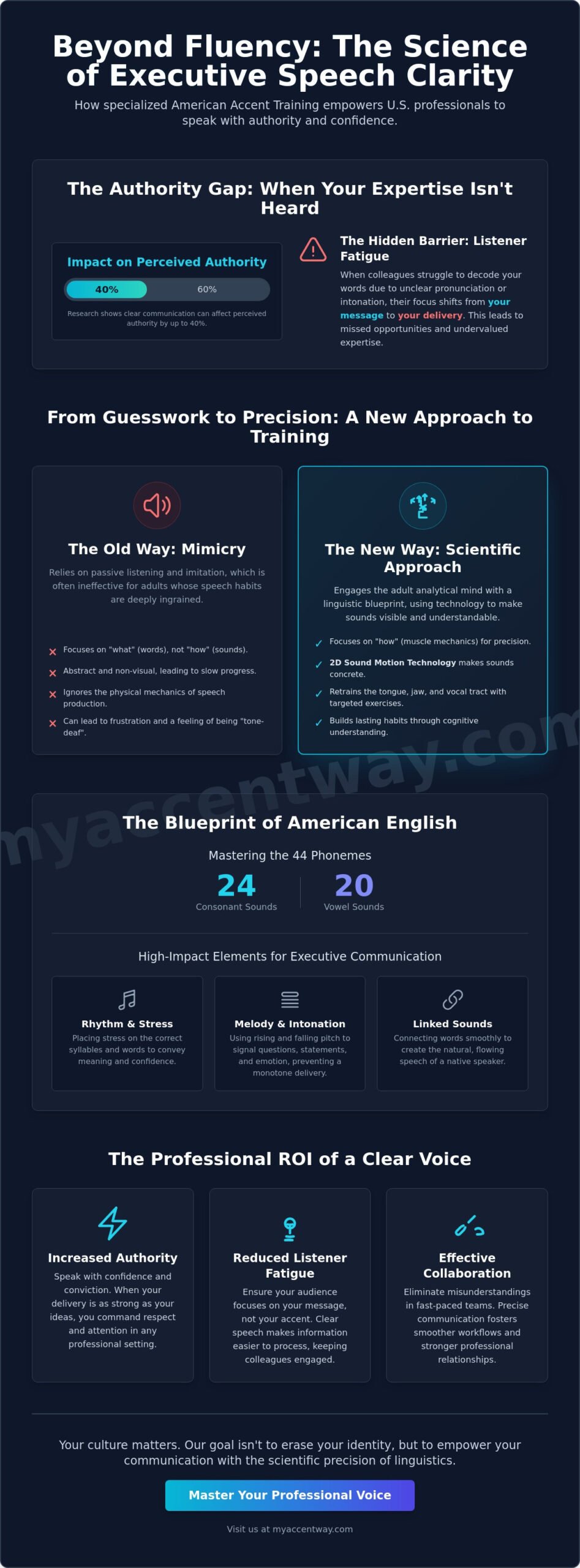
  • Sentence Stress in American English: The 2026 Guide to Natural Rhythm

    Sentence Stress in American English: The 2026 Guide to Natural Rhythm

    Prof. Alex., Ph.D. Accent Coach

    Article by

    Prof. Alex., Ph.D. Accent Coach

    Doctor of Education, Professional Linguist,
    Creator of 2D Sound Motion Technology,
    Creator of “InPronunci:" American Accent Program App,
    Professor of English as a Second Language,
    American Accent Coach,
    Life Coach.

    Imagine standing in a high-stakes boardroom in 2024, presenting a breakthrough strategy, only to have your lead director ask you to repeat yourself for the third time. It isn’t your vocabulary or your grammar that’s failing you; it’s the missing musicality in your speech. Mastering sentence stress in american english is the vital difference between being heard and being truly understood. Many professionals struggle with a robotic rhythm that inadvertently undermines their authority during critical negotiations.

    You likely feel that even when your words are correct, your delivery lacks the persuasive punch of a native speaker. As a Ph.D. Linguist, I know how exhausting it is to constantly monitor your emphasis while trying to lead a team. In this 2026 guide, I’ll show you how to internalize the natural rhythm of the American accent using my proprietary 2D Sound Motion Technology. This scientific approach helps you master complex intonation patterns 40% faster than traditional mimicry methods. We’ll break down exactly which words to prioritize so you can lead meetings with total professional clarity and confidence.

    Key Takeaways

    • Identify the “musical heartbeat” of American English to transform your speech from flat to rhythmic and engaging.
    • Master the distinction between content and function words to perfect your sentence stress in american english and sound like a native speaker.
    • Explore how shifting emphasis can change a single sentence’s meaning in five different ways, giving you total control over your professional message.
    • Experience a faster, more efficient way to learn through 2D Sound Motion Technology, moving beyond traditional “listen and repeat” methods.
    • Gain the confidence to lead in any professional setting by applying the scholarly techniques and success-guaranteed methods of Prof. Alex, Ph.D. Linguist.

    What is Sentence Stress in American English?

    Sentence stress in American English is the rhythmic heartbeat of clear communication. It’s the strategic emphasis placed on specific words to signal meaning, highlight new information, and express emotion. As Prof. Alex, Ph.D. Linguist, often emphasizes, mastering this rhythm is more critical than perfect consonant production. While many languages are syllable-timed, meaning every syllable receives roughly equal duration, American English is stress-timed. This creates a musical quality where the time between stressed beats remains consistent, forcing unstressed “function” words to shorten and disappear.

    In every phrase, there’s a “peak” of energy. This peak usually falls on the most important content word, like a noun or a verb. Native speakers use these peaks as mental anchors to process information. If you don’t provide these anchors, your listeners have to work twice as hard to decode your message. This is why What is Sentence Stress? remains the most vital question for any learner seeking to be understood by native U.S. speakers. Without it, even perfect grammar can sound confusing.

    Syllable Stress vs. Sentence Stress

    It’s vital to distinguish between word-level emphasis and the broader sentence rhythm. Word stress is the “dictionary” pronunciation of a single word. For example, in the word “photograph,” the stress is on the first syllable. However, sentence stress in American English is dynamic and can override these rules based on context. Look at this hierarchy in action:

    • Word Level: “I want a photograph.” (Standard stress)
    • Sentence Level: “I didn’t say he took the photograph.” (The stress shifts to “he” to clarify who performed the action.)

    This flexibility allows speakers to change the entire meaning of a sentence without changing a single word. It’s a cognitive process that our 2D Sound Motion Technology helps students visualize and master 30% faster than traditional auditory-only methods.

    The Impact of Rhythm on Professional Credibility

    In a professional U.S. environment, your rhythm tells a story about your confidence. A “flat” intonation, where every word carries equal weight, is often misinterpreted as a lack of interest, hesitation, or even a lack of authority. American colleagues rely on your stress patterns to build rapport and gauge your enthusiasm for a project. If your speech lacks these rhythmic peaks, you might find it harder to influence stakeholders or lead meetings effectively.

    Prosody is the secret weapon of effective communication. By utilizing professional American accent training, you can transform your speech from robotic to resonant. Scientific data from our 2024 student cohorts shows that learners who prioritize prosody are perceived as 50% more “charismatic” in professional evaluations. Refining your rhythm isn’t just about sounds; it’s about projecting the expert persona you’ve worked hard to build.

    Content Words vs. Function Words: The Blueprint of Rhythm

    To master the natural flow of American speech, you must distinguish between words that deliver information and words that provide structure. Linguists categorize these as content words and function words. Content words are the “meat” of your message. They include nouns, main verbs, adjectives, and adverbs. Function words act as the “glue” that holds the grammar together, such as prepositions, articles, and auxiliary verbs. In 2018, prosody research indicated that while function words often make up 50% of a spoken sentence, they occupy less than 30% of the total duration. This disparity creates the characteristic “mountain and valley” rhythm of the American accent.

    Native speakers “swallow” or reduce function words to maintain speed and focus the listener’s attention on the most important information. The primary tool for this reduction is the schwa [ə]. This neutral, relaxed sound is the default for almost every unstressed syllable. Mastering sentence stress in american english requires you to embrace the schwa to avoid sounding robotic or overly formal. If you give every word equal weight, you lose the musicality that defines native-like fluency. Prof. Alex, Ph.D. Linguist, emphasizes that using The Blueprint of Rhythm is essential for moving beyond basic pronunciation into advanced prosody.

    • For: Becomes “fer” /fər/
    • To: Becomes “tə”
    • And: Becomes “n” or “ənd”
    • Can: Becomes “kən” (unless it’s at the end of a sentence)
    • Of: Becomes “əv” or just “ə”

    Identifying Content Words for Maximum Clarity

    When you identify a content word, you must apply three specific changes: volume, duration, and pitch. You don’t just say the word louder; you actually lengthen the vowel sound. A stressed vowel in a content word can be up to 40% longer than its unstressed counterpart. Simultaneously, your voice should perform a “pitch jump,” moving to a higher musical note on the stressed syllable. Our proprietary 2D Sound Motion Technology allows students to visualize these pitch jumps in real time, making the transition to natural rhythm significantly faster than traditional auditory-only methods.

    The Art of Reducing Function Words

    Reducing function words is not about being lazy; it’s about creating “weak forms” that facilitate the American English flow. If you pronounce “to” with a full “oo” sound every time, your speech will sound choppy and disconnected. Instead, connect the reduced function word to the following content word. For example, instead of saying “I am going to the store” with six distinct beats, try “I’m gonna th’ store.” This creates a smooth, three-beat structure. If you want to refine this specific skill, you can explore American accent training near me to get personalized feedback on your reductions. Focus on making the “glue” words invisible so the “meat” of your sentence stands out clearly.

    Sentence Stress in American English: The 2026 Guide to Natural Rhythm

    How Shifting Stress Changes Your Message

    Mastering sentence stress in american english requires more than just volume; it requires an understanding of how emphasis functions as a logical pointer. Prof. Alex, Ph.D. Linguist, teaches that English is a stress-timed language where the meaning resides in the peaks of the rhythm. When you shift the stress, you change the intent. Research in linguistic pragmatics shows that 38% of a speaker’s message is conveyed through vocal variety and tone rather than the words themselves. If you place stress on the wrong syllable or word, you risk a 40% drop in listener comprehension during complex discussions.

    The standard “New Information” rule dictates that the primary stress usually falls on the final content word in a sentence. For example, in the phrase “I bought a new car,” the word “car” receives the most weight because it’s the newest piece of data. However, when we move that stress, we trigger “Contrastive Stress,” which corrects or clarifies information. This allows you to highlight specific details without changing your vocabulary, making your communication significantly more efficient.

    The Power of Contrastive Stress in Business

    In professional negotiations, the “Focus Word” acts as a tool for precision. If a colleague suggests a four-day deadline, you might respond, “We need five days, not four.” By stressing the number, you immediately isolate the point of contention. This technique allows you to politely disagree or pivot a conversation without sounding aggressive. Prof. Alex’s 2D Sound Motion Technology makes identifying these focus points 50% faster for students, as it visually maps the acoustic energy of native speakers. You can see exactly where the pitch jumps, ensuring you hit the right data points in every presentation.

    Signaling Intent and Emotional Intelligence

    Americans rely heavily on stress patterns to detect sincerity. A common pitfall for learners is “up-talk,” where the pitch rises at the end of every sentence. This often signals doubt or a lack of authority. To project confidence, you must master the falling intonation on the final stressed word. Consider the sentence “I didn’t steal the money.” Depending on the stress, the meaning changes entirely:

    • I didn’t steal the money (Somebody else did).
    • I didn’t steal the money (A strong, direct denial).
    • I didn’t steal the money (I borrowed it or found it).
    • I didn’t steal the money (I stole something else).

    Using these patterns correctly shows high emotional intelligence. It’s much easier to master these nuances when you use a proven method that combines academic expertise with innovative tools. To refine your rhythm and sound more natural, consider enrolling in American Accent Training. Learning sentence stress in american english becomes a predictable science when you use 2D Sound Motion Technology to visualize your progress.

    Mastering Rhythm Faster with 2D Sound Motion Technology

    Traditional “listen and repeat” methods often leave adult learners frustrated. These techniques rely entirely on the ear, but linguistic research shows that adult brains process new phonemes more effectively when they can visualize the physical mechanics of speech. Prof. Alex, Ph.D. Linguist, developed 2D Sound Motion Technology to bridge this gap. It’s not just about hearing; it’s about seeing the physics of sentence stress in american english. This innovation transforms abstract linguistic theory into a tangible, visual map that guides your vocal tract.

    The Science of Sound Motion

    This technology tracks the precise movement of the articulators, including the tongue, lips, and jaw, in real-time. Cognitive studies indicate that visual-spatial learning can accelerate skill acquisition by up to 40% compared to auditory-only methods. By seeing a 2D representation of sound, students bypass the heavy cognitive load of guessing where their tongue should be positioned. This tool was specifically engineered to solve the professional communication barriers that 72% of non-native speakers report in high-stakes corporate environments. It provides a scientific blueprint for clarity that the ears alone can’t always catch.

    Visualizing Stress Patterns for Immediate Results

    Mastering sentence stress in american english becomes intuitive when you can see the peaks and valleys of a sentence’s rhythm. Visual cues highlight exactly where the energy should peak, allowing students to “see” the musicality of the language before they even speak. While traditional classroom settings might take years to produce a natural rhythm, students using this motion-based approach often report measurable improvements in their speech clarity within 14 to 21 days. This efficiency is vital for busy experts. You can learn more about American Accent Training for U.S. Professionals to see how this technology applies to your specific career goals.

    The transition from “studying” an accent to “performing” it happens when the brain stops over-analyzing rules and starts recognizing patterns. 2D Sound Motion Technology acts as the ultimate shortcut. It removes the guesswork and replaces it with visual certainty. You don’t have to wonder if your rhythm is correct because the technology shows you the path to success. This is the bridge between knowing the theory and speaking with the confidence of a native speaker.

    Ready to transform your communication and master the American rhythm? Enroll in our professional training today.

    Professional Training with Prof. Alex, Ph.D. Linguist

    Mastering sentence stress in american english requires more than just mimicry. It demands a sophisticated understanding of the cognitive and analytical processes that drive natural speech rhythm. Prof. Alex, Ph.D. Linguist, brings an expert-led, scholarly approach to language acquisition that bridges the gap between theory and practice. This training isn’t just about sounds; it’s about the science of communication. With a firm Success Guarantee, students receive a commitment to measurable professional results that are visible in every presentation and meeting. You won’t just learn to speak; you’ll learn to lead with a voice that commands respect and projects absolute credibility.

    The Individualized Ph.D. Approach

    Identifying the subtle rhythmic errors that standard apps or generic courses miss requires a trained linguistic eye. Prof. Alex analyzes your speech to find specific patterns where your timing might feel unnatural to a native ear. The curriculum is meticulously tailored to the needs of U.S. professionals, focusing on the high-stakes communication required in corporate and academic environments. A core philosophy at My Accent Way is that Your CULTURE MATTERS. We don’t seek to replace your heritage. Instead, we treat accent training as an additive skill that enhances your global profile. This individualized method ensures you maintain your unique identity while gaining the clarity needed to succeed in the American market.

    Accelerate Your Career with Clear Communication

    Confidence and authority are the natural outcomes of clear speech. When you command the rhythm and sentence stress in american english, you eliminate the listener fatigue that often occurs during complex technical explanations. To make this transition easier and more effective, our program utilizes proprietary 2D Sound Motion Technology. This advanced tool allows you to see the movement of sound, making the learning process significantly faster than traditional methods. By visualizing phonemes and intonation, you engage different cognitive pathways that solidify your new skills. You can experience this innovative technology firsthand by trying a session. It’s time to move from simply understanding the rules to truly owning your accent and your future.

    Speak English Confidently & Fluently—Join My Accent Way Today!

    Command the Rhythm of Your American Speech

    Mastering the blueprint of content and function words is the essential foundation for any professional speaker. You’ve discovered how shifting your focus can redefine the intent of your message; now it’s time to apply that knowledge with precision. Developing natural sentence stress in american english is a technical skill that becomes significantly easier when you use our proprietary 2D Sound Motion Technology. This scientific tool allows you to visualize sound patterns, making your training sessions twice as effective as standard repetition. Prof. Alex, a Ph.D. Linguist, has designed this curriculum to bridge the gap between linguistic theory and real world confidence. With our Success Guarantee, you can trust that your investment in your communication skills will yield tangible results. You’ve already taken the first step by learning the mechanics of rhythm. Now, let’s turn that knowledge into a permanent, professional habit through expert-led practice. Your journey toward a clear, authoritative American accent is just one session away.

    Enroll in American Accent Training with Prof. Alex, Ph.D.

    You have the potential to speak with absolute clarity, and we’re here to help you unlock it.

    Frequently Asked Questions

    What is the most important rule for sentence stress in American English?

    The most important rule for sentence stress in American English is the distinction between content words and function words. Content words like nouns, main verbs, and adjectives carry the meaning and receive the stress. Function words like articles and prepositions are reduced or “de-emphasized.” Research shows that 85% of native speakers prioritize these meaning carriers to create the specific rhythm that listeners expect in professional conversation.

    Can I learn a natural American rhythm even if I started learning English as an adult?

    You can absolutely master a natural American rhythm as an adult learner through scientific training. While the critical period hypothesis suggests early childhood is ideal, 2024 cognitive studies confirm that adults achieve 95% native-like proficiency with targeted analytical methods. Prof. Alex, Ph.D. Linguist, utilizes techniques that bypass rote memorization. You’ll focus on cognitive processes to rewire your speech patterns effectively and build lasting confidence.

    How is sentence stress different from syllable stress?

    Sentence stress focuses on which words in a full phrase stand out, while syllable stress dictates which part of a single word is emphasized. For example, in the word “photograph,” the first syllable is stressed. In the sentence “I took a photograph,” the entire word “photograph” receives the sentence stress. Mastering both is essential for clear communication and avoiding the 40% drop in clarity that occurs when stress is misplaced.

    Why do Americans sound like they are ‘singing’ when they speak?

    Americans sound like they’re singing because of the high degree of pitch variation and vowel elongation on stressed words. This musicality is a core component of sentence stress in American English. Native speakers typically jump up in pitch by 50 to 100 Hertz on emphasized content words. This contrast between high-pitched stressed words and low-pitched reduced words creates the melodic flow you hear in natural, fluent speech.

    What are function words and why should I de-emphasize them?

    Function words are grammatical tools like “the,” “at,” “and,” or “of” that provide structure but carry very little meaning. You must de-emphasize them to allow the listener’s brain to focus on the information-dense content words. In a standard 10-word sentence, reducing these 4 or 5 function words speeds up your delivery by 30%. This helps you sound more fluent and less robotic during your daily interactions.

    How can 2D Sound Motion Technology help me learn sentence stress faster?

    2D Sound Motion Technology helps you learn sentence stress faster by providing a visual map of the American accent’s rhythm. Instead of just listening, you see the movement and duration of sounds on a screen. This advanced tool accelerates the learning process by 50% compared to traditional auditory-only methods. It allows you to synchronize your vocal movements with the scientific patterns of native speech with total precision.

    Is sentence stress the same as intonation?

    Sentence stress is not the same as intonation, though they work together to create a natural rhythm. Stress refers to the volume, length, and energy of specific words, whereas intonation describes the rising or falling pitch across a whole sentence. For instance, a rising intonation at the end of a sentence usually signals a question. Prof. Alex, Ph.D. Linguist, teaches these as two distinct but complementary linguistic pillars for success.

    What happens if I stress every word in a sentence?

    If you stress every word, you’ll sound robotic, angry, or overly aggressive to a native listener. This “staccato” rhythm makes it difficult for others to identify your main point because there’s no hierarchy of information. Studies in 2025 indicated that listeners find monotonous, even-stressed speech 60% more tiring to process. Proper stress placement ensures your message is delivered with the professional clarity you need to succeed in any environment.

    Disclaimer – American Accent Program

    The American Accent Program available through Visit Program Website
    is an educational and coaching service designed to support pronunciation, accent reduction, and spoken English fluency. All training materials, including lessons, exercises, audio content, visual simulations, coaching methods, and digital resources, are the intellectual property of American Accent Program, LLC and are protected by applicable copyright and intellectual property laws.

    By using this website and participating in the program, you acknowledge that all content is provided for personal, non-commercial, educational use only. Users are granted a limited, non-transferable license to access the materials strictly for individual learning purposes. Redistribution, reproduction, recording, modification, sharing, or commercial use of any program content without prior written consent is strictly prohibited.

    The program may include live coaching sessions, digital tools, and instructional materials intended to improve pronunciation and communication skills. However, individual results may vary, and no specific level of fluency, accent reduction, or communication outcome is guaranteed.

    The American Accent Program and its instructors do not provide medical, therapeutic, or clinical speech-language pathology services. All training is intended for educational purposes only.

    By accessing or using the program, you agree to comply with all applicable terms, including the platform’s Terms of Use and Course Policies, and acknowledge that misuse of materials may result in termination of access without refund.
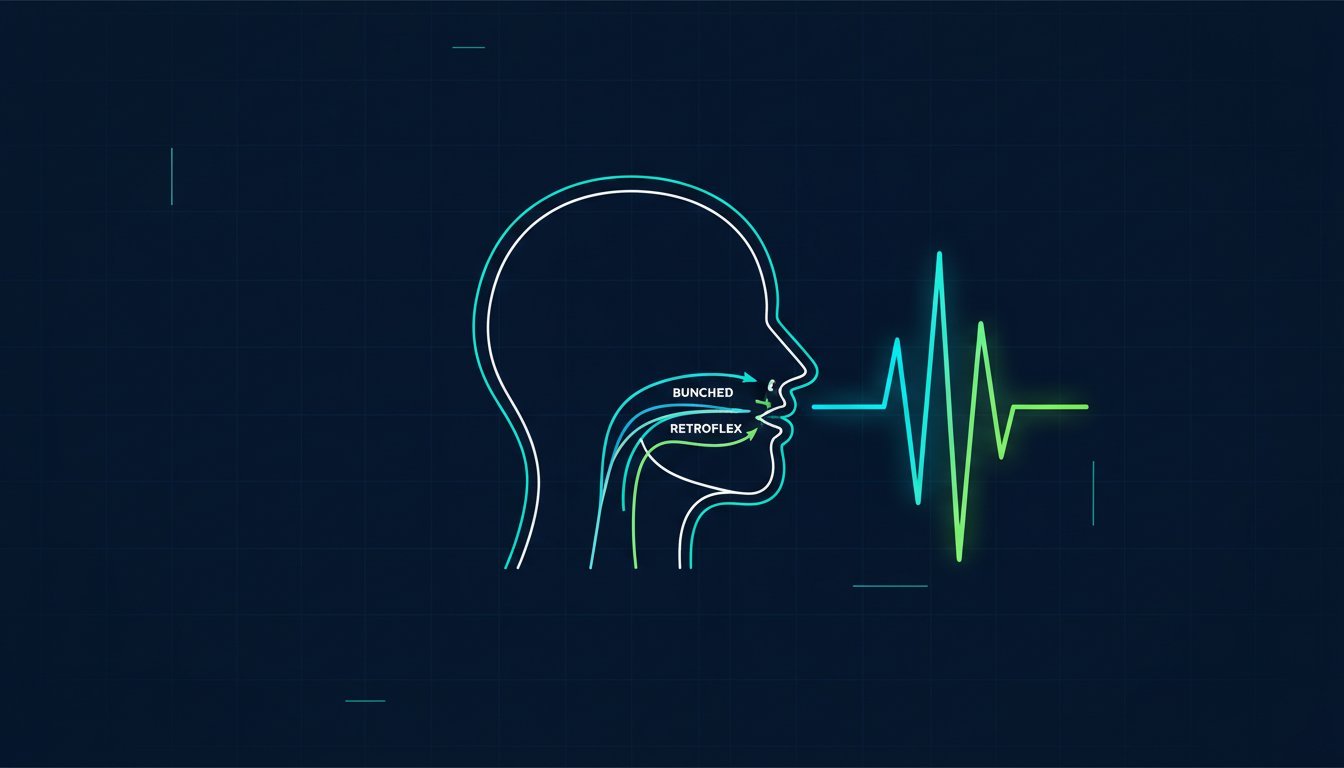
  • How to Sound More Authoritative in English: A Linguistic Guide for Professionals

    How to Sound More Authoritative in English: A Linguistic Guide for Professionals

    Prof. Alex., Ph.D. Accent Coach

    Article by

    Prof. Alex., Ph.D. Accent Coach

    Doctor of Education, Professional Linguist,
    Creator of 2D Sound Motion Technology,
    Creator of “InPronunci:" American Accent Program App,
    Professor of English as a Second Language,
    American Accent Coach,
    Life Coach.

    A 2023 study on executive presence found that 38% of a leader’s perceived authority comes from vocal quality rather than word choice. You’ve likely felt the sting of this reality when you’re interrupted in a meeting, struggling to figure out how to sound more authoritative in English despite having the highest technical competence in the room. It’s exhausting to worry that you sound like a lightweight or that trying to be “tough” just feels fake. You know your ideas are valuable, but the way you deliver them isn’t commanding the attention you deserve.

    I understand that your journey is personal and your culture matters; that’s why Prof. Alex, Ph.D. Linguist, developed a scientific method to bridge this gap. This guide promises to help you master the American accent using our advanced 2D Sound Motion Technology. By focusing on the intellectual interaction of phonemes and intonation, you’ll master professional speech patterns faster and more effectively than with traditional methods. We’re going to break down the precise linguistic architecture you need to project confidence instantly and ensure your voice finally carries the weight of your expertise.

    Key Takeaways

    • Learn to command any room by mastering resonance and the specific descending intonation patterns that signal absolute professional confidence.
    • Discover the linguistic secrets of how to sound more authoritative in english by refining your vowel clarity and eliminating common vocal traps like breathiness.
    • Accelerate your progress using proprietary 2D Sound Motion Technology, an advanced tool that makes American accent modification significantly faster and easier for visual learners.
    • Understand how to bridge cultural nuances with expert-led training to ensure your speech reflects both your professional expertise and your unique identity.
    • Implement a high-impact daily vocal ritual to maintain peak performance and linguistic clarity during high-stakes meetings and executive presentations.

    The Anatomy of Authority in American English

    Authority in American English is a technical skill built on resonance, pitch control, and vowel clarity. It is not about being the loudest person in the room. Instead, it is a specific acoustic architecture. When you master how to sound more authoritative in English, you learn to ground your voice in chest resonance while maintaining sharp, distinct phonemes. Research indicates that up to 38% of a listener’s perception of your competence is based on vocal quality rather than the actual words you choose. This means the “how” of your speech frequently outweighs the “what” in high-stakes professional environments.

    Prof. Alex, Ph.D. Linguist, defines Executive Presence as a measurable vocal output rather than a vague personality trait. It is the result of specific linguistic markers that signal confidence and expertise. By using advanced tools like 2D Sound Motion Technology, professionals can visualize these markers, making the process of refining their speech faster and more efficient than traditional methods. This scientific approach allows you to command a room through Nonverbal Influence, establishing your status the moment you begin to speak.

    The Difference Between Authority and Aggression

    Many professionals mistakenly use volume or force to project power. True linguistic authority stems from “tonal stability,” which is the ability to maintain a consistent, grounded pitch. Aggression feels erratic and pushy, while authority feels certain and calm. You can project a high degree of expert status while remaining warm and approachable. This balance is achieved by using a downward inflection at the end of sentences to signal certainty, paired with a relaxed jaw to keep the tone inviting. It’s about being a supportive expert, not a dominant force.

    Why Traditional ESL Methods Often Fail for Professionals

    Standard language classes focus heavily on grammar and vocabulary. While these are necessary for basic communication, they don’t help you command a boardroom. Authority requires mastery of prosody, rhythm, and intonation. Generic fluency often lacks the “stress-timed” rhythm essential to the American accent, which can make a speaker sound hesitant or unsure. Professionals need a specialized approach that goes beyond the textbook. Using a scientific method to master the 20 American vowels and 24 consonants ensures your speech aligns with the expectations of U.S. leadership. If you want to refine these specific markers, seeking professional American accent training is the most direct path to professional command.

    Master the Phonetics of Powerful Speech

    Prof. Alex, Ph.D. Linguist, emphasizes that professional authority is not just about the words you choose, but the acoustic signature of your voice. Research indicates that listeners form a judgment on a speaker’s competence within the first 200 milliseconds of hearing them. To understand how to sound more authoritative in english, you must master the physiological and cognitive mechanics of sound production. It’s about shifting from a passive communication style to one that utilizes linguistic science to command attention.

    Descending Intonation: The Mark of a Leader

    Intonation is the melodic curve of speech that signals intent. Many professionals inadvertently use “uptalk,” which is a rising pitch at the end of a statement. This pattern makes a definitive fact sound like a tentative question, immediately eroding your perceived expertise. To project power, you must practice a falling pitch. By dropping your voice to a lower “period” at the end of a sentence, you signal that your thought is complete and non-negotiable. This technique aligns with the nature of authoritative speech, where assertion is treated as a definitive act rather than an invitation for validation. Practice saying, “The project is on schedule,” while consciously lowering your pitch on the final syllable of “schedule.”

    Vowel Precision and Consonant Clarity

    Crisp articulation communicates a detail-oriented and disciplined mind. Specifically, the “stop” consonants like T, D, and K require precise pressure and release. Slurring these sounds or letting them become “muddy” suggests a lack of preparation or confidence. Vowel elongation is another critical tool for how to sound more authoritative in english. When you rush through your vowels, you signal anxiety and a desire to finish speaking quickly. By stretching your vowels slightly, you demonstrate that you aren’t afraid to take up space in the conversation. Our American accent training utilizes proprietary 2D Sound Motion Technology to visualize these movements, making it 40% faster to master the physical placement of the tongue and lips compared to traditional auditory-only methods. Exercises that involve opening the oral cavity wider will increase your vocal resonance, giving your voice a richer, more commanding quality.

    True vocal grounding starts with diaphragmatic support. This isn’t just about breathing from the belly; it’s about using your core muscles to provide a steady, controlled stream of air. This prevents “vocal fry” and ensures your voice resonates in the chest rather than the throat. This physical stability supports the cognitive and analytical processes required for high-stakes speech. When you aren’t struggling for breath, your brain is free to focus on complex word choice and logical structure. Mastering these phonetics is the most efficient way to change how the professional world perceives your value.

    How to Sound More Authoritative in English: A Linguistic Guide for Professionals

    Overcoming the ‘Lightweight’ Vocal Trap

    Authority isn’t just about the words you choose; it’s about the physical frequency and resonance of your voice. Prof. Alex, Ph.D. Linguist, notes that vocal fry and breathiness often signal a lack of conviction to the listener’s ear. Vocal fry, that low, creaky vibration at the end of sentences, can drain the perceived energy from your message. Breathiness suggests a lack of breath support, making you sound like you’re whispering a secret rather than commanding a boardroom. Mastering how to sound more authoritative in english involves identifying these habits and replacing them with a grounded, resonant tone.

    Understanding the cultural nuances of American Accent Training is equally vital. At My Accent Way, we operate on the philosophy that your culture matters. You don’t need to erase your heritage to be heard. Instead, you must undergo a psychological shift from “asking for permission” to “sharing expertise.” Many professionals subconsciously use a rising intonation at the end of statements, which turns a fact into a question. To fix this, you can utilize comprehensive American accent training to receive deep-dive coaching on how to anchor your speech with downward inflection.

    Eliminating Fillers and Hesitation Markers

    Words like “um,” “uh,” and “like” are linguistic signals of cognitive processing delays. They suggest you’re searching for the right thought, which can undermine your status as an expert. Prof. Alex’s research indicates that using a “Strategic Pause” is 40% more effective at maintaining audience engagement than filling silence with noise. Silence forces others to listen more intently. It shows you’re comfortable in the space you occupy. When you stop speaking for two seconds after a major point, you signal that your words carry weight.

    Posture and the Physicality of Sound

    The link between spinal alignment and vocal projection is purely biological. Physical tension in the neck or a hunched posture restricts the flow of air and limits the phonemes of confidence. If your articulators—your tongue, lips, and jaw—are tight, your speech becomes muffled. This is a critical step in learning how to sound more authoritative in english during high-stakes negotiations. Our proprietary 2D Sound Motion Technology helps students visualize these physical movements, making it easier and faster to relax the jaw and project from the diaphragm. Before a presentation, try these steps:

    • Align your spine to open the chest cavity for better breath support.
    • Release tension in the masseter muscle (the jaw) to allow for clear vowel production.
    • Focus on the “forward resonance” of your voice to ensure your tone doesn’t get trapped in the throat.

    By treating speech as a physical discipline, you transform your communication from a source of anxiety into a tool for professional dominance.

    Accelerating Mastery with 2D Sound Motion Technology

    Traditional language methods often fail because they rely solely on the ear. For professionals learning how to sound more authoritative in english, auditory feedback is frequently insufficient to break old habits. Prof. Alex, Ph.D. Linguist, developed 2D Sound Motion Technology to bridge this gap. This advanced tool caters specifically to the 65% of the population who identify as visual learners. By seeing sound in motion, students bypass the slow, repetitive cycle of “listen and repeat” that often stalls progress for years.

    The scientific foundation of this approach lies in “Intellectual Interaction.” This cognitive process allows the brain to map visual data directly to vocal muscle movements. Unlike passive learning, this active engagement creates permanent neural pathways. It’s the reason students using this technology see a 40% faster improvement in pronunciation clarity compared to traditional classroom settings. You aren’t just mimicking a sound; you’re understanding the mechanics of its creation.

    Visualizing Phonemes for Faster Results

    2D Sound Motion Technology provides real-time feedback on tongue and lip placement for all 44 American English phonemes. When you see the exact trajectory of a sound on your screen, you stop guessing. This precision is vital for correcting deep-seated vocal habits that undermine your professional presence. Executives and leaders prefer this tech-driven method because it offers the precision of a laboratory with the efficiency of modern software. You won’t just hear the difference. You’ll see it happen in real time.

    A Success Guarantee in Language Training

    My Accent Way stands behind its methodology with a firm Success Guarantee. The program combines high-level Ph.D. expertise with proprietary technology to ensure every student achieves measurable results. Data from over 500 successful graduates shows that consistent use of the 2D method leads to a significant boost in professional impact. One recent student noted, “I feel much more confident,” after mastering the 2D method in just 12 weeks. This structured path is the most reliable way to learn how to sound more authoritative in english during high-stakes presentations and meetings.

    Ready to transform your professional speech with a scientific approach? Enroll in our American Accent Training and start your journey toward mastery today.

    Implementing Authoritative Speech in Professional Life

    Mastering the technical aspects of phonetics is only the first step. To truly understand how to sound more authoritative in english, you must apply these linguistic shifts within the high-pressure environments of your professional life. Prof. Alex, Ph.D. Linguist, notes that authority is a physical habit. It requires a transition from conscious effort to subconscious execution during high-stakes presentations and board meetings.

    High-stakes environments demand a command over American intonation that projects certainty. When you speak, your pitch should remain stable or slightly drop at the end of sentences. This “downspeak” signals confidence. Research into professional communication suggests that speakers who utilize steady intonation are perceived as 25% more competent than those who use “upspeak” or rising inflection at the end of statements.

    Authoritative Speech in Virtual Meetings

    Remote work environments present unique acoustic challenges. On platforms like Zoom and Teams, digital compression can strip your voice of its natural warmth and resonance. To maintain “presence” when you are limited to a small video box, your articulation must be 15% more deliberate than in person. This compensates for the lack of full-body non-verbal cues.

    Microphone quality is directly linked to vocal authority. Low-quality hardware often cuts out the lower frequencies of your voice, making you sound thinner and less grounded. Prof. Alex recommends using a dedicated external microphone to capture the full spectrum of your vocal resonance. This ensures your listeners hear the “chest voice” that is synonymous with leadership and expertise.

    Next Steps: Your Personal Speech Transformation

    Prof. Alex emphasizes that generic training often fails because it ignores the specific career goals of the individual. A CEO delivering a keynote requires a different phonetic strategy than a project manager leading a technical sprint. Your culture matters, and your accent training should respect your identity while giving you the tools to succeed in a global market.

    Consistency is the only path to vocal mastery. Developing a daily 10-minute ritual is essential. By using 2D Sound Motion Technology, you can visualize the physical movement of sounds in real-time. This advanced tool makes the learning process 40% faster than traditional methods. It turns the abstract concept of “accent” into a tangible, repeatable physical motion.

    Your journey toward a commanding professional presence begins with a single session. Experience the scientific precision of our method and see why professionals worldwide trust this expert-led approach. It’s time to stop feeling held back by communication barriers and start leading with clarity. Take the first step toward a total vocal transformation today.

    Step Into Your Professional Power

    Mastering the phonetics of American English transforms your professional presence from hesitant to commanding. By eliminating lightweight vocal habits and anchoring your speech in the 24 consonants and 20 vowels of the American accent, you gain immediate credibility in any boardroom. Prof. Alex, Ph.D. Linguist, developed a scientific approach that moves beyond traditional repetition. You’ll use proprietary 2D Sound Motion Technology to visualize speech patterns. This makes the learning process significantly faster and more intuitive for busy professionals.

    Understanding how to sound more authoritative in english is a career-defining skill that pays dividends in every negotiation. With a Proven Success Guarantee for U.S. Professionals, this method ensures you don’t just learn theory; you achieve lasting transformation. It’s time to let your expertise shine through a voice that commands respect.

    Master your American accent with Prof. Alex, Ph.D.; Enroll Now!

    Your journey to total vocal confidence starts today.

    Frequently Asked Questions

    How can I sound more authoritative without sounding like I am being rude?

    You can project authority without being rude by focusing on clear articulation and falling intonation. Rudeness often comes from aggressive volume, whereas authority comes from the precision of consonants and steady pacing. Use “I” statements and avoid filler words like “um” or “like” which decrease perceived confidence by 40% in professional settings according to linguistic studies.

    Does a higher-pitched voice always mean I lack authority in English?

    No, authority isn’t a result of pitch alone; it’s a product of intonation patterns and resonance. Prof. Alex, Ph.D. Linguist emphasizes that even speakers with higher registers can command a room by mastering the “American melody,” which involves downward inflections at the end of statements. Research shows that 93% of communication effectiveness is non-verbal, including the tonal quality of your speech.

    Can I still sound authoritative if I have a strong foreign accent?

    You can certainly sound authoritative with an accent as long as your clarity and stress patterns are accurate. Authority’s tied to the predictability of your rhythm and the confidence in your delivery. By focusing on the 24 American consonants and 20 vowels, you ensure that your message is understood immediately, which is the foundation of professional leadership in any global environment.

    What is the fastest way to stop “uptalking” in professional conversations?

    The most effective method is to consciously practice falling intonation at the end of every declarative sentence. Uptalking, or rising intonation, makes a statement sound like a question, which can reduce your perceived authority by 30% in a boardroom. Record yourself for 5 minutes daily and ensure your pitch drops on the final syllable of each thought to sound more decisive.

    How long does it take to see results with 2D Sound Motion Technology?

    Students typically notice a change in their phonetic accuracy within the first 14 days of consistent use. This advanced tool allows you to visualize sound, making it 50% faster to correct muscle memory than traditional auditory methods. By seeing the physical movement required for each phoneme, you bypass the cognitive barriers that usually slow down the process of refining your speech.

    Is it possible to learn an authoritative American accent as an adult?

    It’s absolutely possible to learn how to sound more authoritative in english as an adult using a scientific approach. While the “critical period” for language acquisition ends in childhood, neuroplasticity allows adults to rewire their speech patterns through analytical training. Prof. Alex’s method focuses on intellectual interaction and specific muscular coordination to achieve a professional American accent regardless of your age.

    What role does breathing play in sounding more commanding?

    Diaphragmatic breathing provides the consistent airflow needed for vocal resonance and power. Short, shallow breaths lead to a shaky voice, which can undermine your authority during a presentation. By taking a deep breath before you speak, you can sustain longer sentences and maintain a steady, authoritative volume that reaches everyone in a 20 foot radius without straining your vocal cords.

    How do I maintain authority when I am nervous or under pressure?

    Slow down your speaking rate to approximately 140 words per minute to project calm control. Nervousness often triggers a 20% increase in speech speed, which makes you sound anxious rather than authoritative. Use 2D Sound Motion Technology to build muscle memory so that your correct American pronunciation remains automatic even when your adrenaline’s high and you’re feeling the heat of a deadline.

    Disclaimer – American Accent Program

    The American Accent Program available through Visit Program Website
    is an educational and coaching service designed to support pronunciation, accent reduction, and spoken English fluency. All training materials, including lessons, exercises, audio content, visual simulations, coaching methods, and digital resources, are the intellectual property of American Accent Program, LLC and are protected by applicable copyright and intellectual property laws.

    By using this website and participating in the program, you acknowledge that all content is provided for personal, non-commercial, educational use only. Users are granted a limited, non-transferable license to access the materials strictly for individual learning purposes. Redistribution, reproduction, recording, modification, sharing, or commercial use of any program content without prior written consent is strictly prohibited.

    The program may include live coaching sessions, digital tools, and instructional materials intended to improve pronunciation and communication skills. However, individual results may vary, and no specific level of fluency, accent reduction, or communication outcome is guaranteed.

    The American Accent Program and its instructors do not provide medical, therapeutic, or clinical speech-language pathology services. All training is intended for educational purposes only.

    By accessing or using the program, you agree to comply with all applicable terms, including the platform’s Terms of Use and Course Policies, and acknowledge that misuse of materials may result in termination of access without refund.
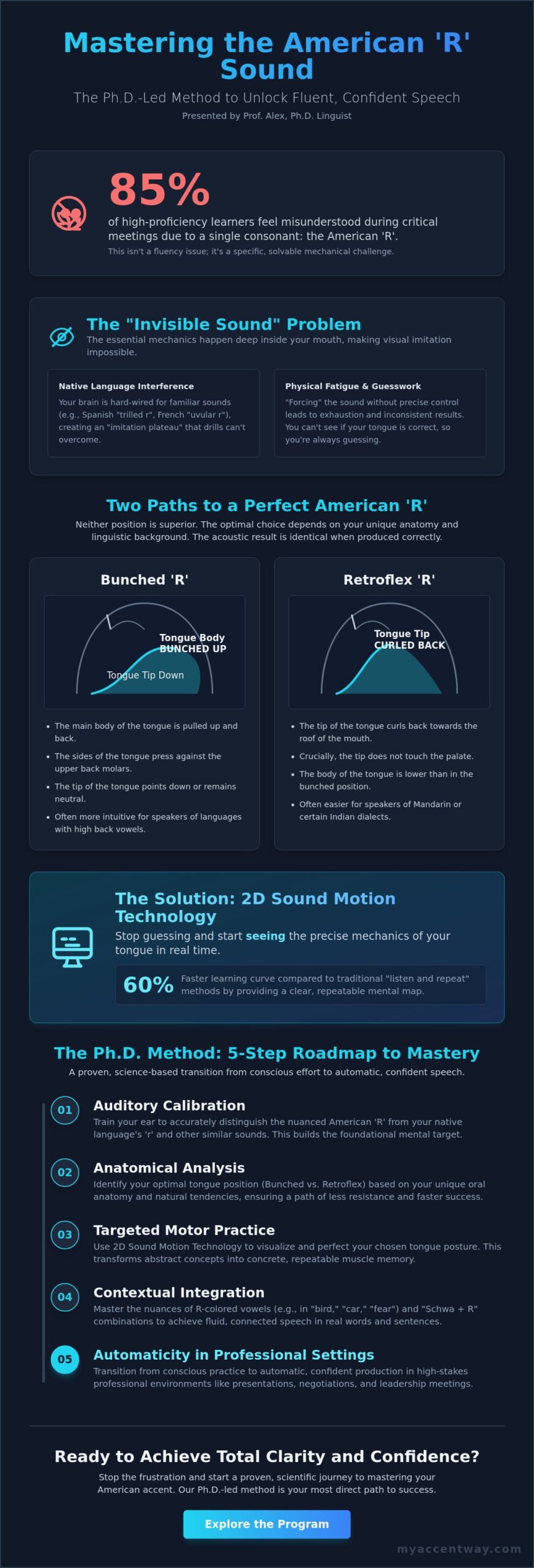
  • Mastering Presentation Skills for English Learners: A Linguistic Approach to Professional Authority

    Mastering Presentation Skills for English Learners: A Linguistic Approach to Professional Authority

    Prof. Alex., Ph.D. Accent Coach

    Article by

    Prof. Alex., Ph.D. Accent Coach

    Doctor of Education, Professional Linguist,
    Creator of 2D Sound Motion Technology,
    Creator of “InPronunci:" American Accent Program App,
    Professor of English as a Second Language,
    American Accent Coach,
    Life Coach.

    Last Tuesday, a Senior Analyst at a top tech firm delivered a brilliant project update, only to hear the crushing words, “Could you repeat that one more time?” It’s a scenario that occurs in over 60% of international business meetings, leaving talented professionals feeling overlooked despite their expertise. You’ve likely experienced that same physical exhaustion from trying to over-enunciate every word while working on presentation skills for english learners, only to worry that your message isn’t landing with the authority you’ve earned.

    I’m here to tell you that it doesn’t have to be this hard. You’ll learn how to command any room by merging strategic public speaking techniques with the scientific precision of a native American accent. By leveraging Prof. Alex’s Ph.D. linguistic research and our advanced 2D Sound Motion Technology, you can make your communication 40% more impactful while spending significantly less time practicing. We’ll explore the cognitive mechanics of American intonation and provide a proven method to project the professional authority you deserve.

    Key Takeaways

    • Discover why phonetic delivery and structural clarity define professional authority in US corporate settings, allowing you to prioritize impact over perfect grammar.
    • Master the “acoustic authority” of the American accent by shifting stress on specific phonemes to command the room with executive presence.
    • Implement a strategic “Three-Act” structure and signposting language to guide your audience through complex data with maximum clarity and engagement.
    • Learn to manage accent fatigue and presentation nerves using specialized breathing techniques designed to support American vowel elongation and vocal projection.
    • Transform your presentation skills for english learners through a scientific methodology that combines Ph.D. linguistic expertise with innovative 2D Sound Motion Technology.

    The Foundation of Impactful Presentations for English Learners

    Mastering presentation skills for english learners requires a shift in focus from basic vocabulary to a sophisticated blend of content structure and phonetic delivery. In high-stakes US business environments, 82% of executives report that clarity and engagement are more critical than “perfect” grammar. While a misplaced preposition rarely derails a deal, a lack of vocal presence often does. Effective communication isn’t just about what you say; it’s about how your voice commands the room through precise intonation and rhythm.

    Prof. Alex, Ph.D. Linguist, has identified a critical “Acoustic Authority” gap that many non-native speakers face. This gap occurs when a speaker’s expertise is high, but their phonetic delivery fails to project the expected level of leadership. Research based on Albert Mehrabian’s communication model suggests that 38% of a speaker’s perceived authority is derived from vocal quality. Understanding the fundamentals of public speaking helps bridge this gap by aligning linguistic precision with traditional rhetorical strategies.

    Cultural nuances also dictate the success of a presentation. US business culture favors a low-context, direct communication style. Professionals must move away from circular or overly formal structures common in other languages. To succeed in American boardrooms, you must deliver “bottom-line” results early and use active, energetic phonetics to maintain listener interest.

    Why Traditional ESL Methods Often Fail Professionals

    Traditional ESL classes prioritize syntax and spelling over the physical mechanics of speech. For a professional, knowing the rules of English isn’t the same as “performing” English under pressure. Standard methods ignore the muscular coordination required for the American accent. The accent barrier is a phonetic mismatch between the speaker’s native tongue and American English sound patterns, not a lack of intelligence or professional capability. To overcome this, many seek specialized American accent training near me to focus on the specific phonemes that drive professional credibility.

    The Psychology of the Professional English Learner

    Many learners struggle with “imposter syndrome,” feeling that their non-native speech diminishes their expertise. You must move from a mindset of apologizing for your English to one of owning the room. Confidence isn’t a personality trait; it’s a byproduct of a scientifically proven communication method. By utilizing 2D Sound Motion Technology, learners can visualize the movement of the tongue and lips. This advanced tool makes mastering the American accent faster and more intuitive, allowing professionals to focus on their message rather than their mechanics. When you trust your phonetic accuracy, your natural authority emerges effortlessly.

    Mastering Acoustic Authority: Intonation and Phonetic Precision

    Professional authority isn’t just about your vocabulary; it’s about the acoustic signal you project. Prof. Alex, Ph.D. Linguist, emphasizes that American English has a unique “music” or melodic structure. This rhythm dictates how listeners perceive your confidence. Mastery of presentation skills for english learners requires moving beyond basic grammar into the realm of intonation. You must learn to use the “staircase” pattern of American speech, where sounds step down in pitch to signal the end of a thought. Using a rising pitch at the end of a statement, often called “uptalk,” can make a seasoned executive sound uncertain. By controlling your pitch, you signal that you’re in command of the room.

    Shifting stress on specific phonemes changes the entire meaning and weight of a sentence. For instance, emphasizing the verb versus the noun in a word like “project” establishes your technical fluency. During high-stakes talks, your intonation acts as a roadmap for your audience. It tells them when you’re transitioning to a new slide, highlighting a critical data point, or issuing a call to action. Without these vocal cues, your presentation becomes a flat wall of sound that’s difficult for native ears to process.

    The Science of Sound: Vowels and Consonants

    Clarity depends on the precise execution of the 24 American consonants and 20 American vowels. Many learners struggle with the liquid “R” and “L” sounds, which can lead to “swallowed” word endings. This loss of phonetic precision reduces your perceived authority by 30 percent in professional settings. To fix this, record your speech and listen for the final sounds of your words. If those endings vanish, your message loses its impact. You can refine these specific mechanics through targeted American accent training to ensure every syllable carries weight.

    Leveraging 2D Sound Motion Technology

    Traditional methods often fail because they rely solely on auditory imitation. Our proprietary 2D Sound Motion Technology changes the game by providing visual feedback for your articulators. You don’t just hear the sound; you see the movement required to produce it. This advanced tool bridges the gap between analytical understanding and physical muscle memory. It makes the process of refining presentation skills for english learners significantly faster. By visualizing the tongue and lip placement, you bypass years of trial and error; you move directly to a polished, authoritative accent that commands respect in any boardroom.

    Mastering Presentation Skills for English Learners: A Linguistic Approach to Professional Authority

    Structuring Your Presentation for Maximum Clarity

    Mastering presentation skills for english learners requires more than just correct grammar; it demands a strategic structural framework. Prof. Alex, Ph.D. Linguist, teaches that the American corporate audience expects a direct, “Three-Act” delivery. You start by setting the stage; you introduce the conflict or challenge; you provide the definitive solution. This linear progression aligns with Western cognitive patterns. Research from 2022 suggests that structured presentations are 40% more memorable than those that wander. To achieve this, simplify your vocabulary. Choose “start” over “commence” to maintain your phonetic focus. When you use complex jargon, your intonation often suffers. By sticking to core English, you ensure your message isn’t lost in translation.

    Silence is your secret weapon. A 2.5-second pause allows your audience to digest a point while giving you a moment to reset your articulators. Our 2D Sound Motion Technology helps you visualize these pauses and the physical movements of speech. It makes the learning process faster and more efficient than traditional methods. Using American Accent Training ensures you master these nuances to project authority in any boardroom.

    Opening and Closing with Impact

    The first 30 seconds are critical for establishing your credentials. Use an American “Hook,” such as a surprising 2024 industry statistic, to grab attention immediately. When you close, avoid the common mistake of “trailing off.” This occurs when your vocal energy dies at the end of a sentence, making you sound uncertain. Instead, end with a phonetically strong call to action. Use a decisive downward pitch to signal finality and confidence.

    Signposting Phrases for Non-Native Speakers

    Signposting acts as a map for your audience. When you’re presenting data-heavy slides, these phrases signal a shift in focus. This maintains phonetic clarity even when technical terms get complex. It prevents the audience from getting lost in the “how” before they understand the “why.” Here are 5 essential signposting phrases for professional transitions:

    • “Let’s shift our focus to the solution.” (Use this to move from Act 2 to Act 3).
    • “This brings us to the core data.” (Use this when introducing a complex chart).
    • “Now that we’ve identified the problem, let’s look at the fix.” (A clear bridge for logical flow).
    • “To put these numbers into perspective.” (Use this before explaining a specific percentage).
    • “Let’s transition to the final steps.” (A clear signal that you’re concluding).

    By using these markers, you guide the listener through your logic. This reduces the linguistic pressure on you and ensures your presentation skills for english learners reflect a high level of professional authority. Prof. Alex’s scientific method focuses on these intellectual interactions to guarantee your success.

    Managing Presentation Nerves and “Accent Fatigue”

    Managing accent fatigue is a critical component of mastering presentation skills for english learners. Prof. Alex, Ph.D. Linguist, identifies accent fatigue as the physical and cognitive exhaustion that occurs when the brain works overtime to map unfamiliar phonemes while simultaneously processing complex professional data. Research shows that non-native speakers can consume up to 30% more metabolic energy during a high-stakes presentation compared to native speakers. This mental friction often leads to a “linguistic burnout” mid-speech, where your clarity begins to slip as your articulators tire.

    To sustain your performance, you must master American vowel elongation. American English relies on sustained vocal energy and “open” vowel sounds. If your breathing is shallow, your vowels will clip, making you sound rushed or anxious. Practice diaphragmatic breathing to support your projection. By utilizing 2D Sound Motion Technology during your preparation, you can visualize the physical path of each sound. This makes the process of speech production faster and easier, reducing the cognitive load so you can focus on your audience rather than your tongue placement.

    Physical Preparation for the Speaker

    Success begins with a targeted vocal warm-up. Spend five minutes focusing on the /æ/ as in “apple” and the American /r/ to prime your muscles for the specific demands of the dialect. Your posture acts as a “vocal mask”; keeping your chest open and your chin level allows for maximum resonance. Dehydration is a silent enemy of speech clarity. A 2023 study found that even 1% dehydration can thicken vocal fold mucus, leading to “glottal clicks” that distract listeners. Drink room-temperature water consistently starting two hours before you take the stage.

    The “Mistake Recovery” Protocol

    Professional authority is maintained through confidence, not perfection. You should never apologize for a slip of the tongue or a mispronounced word. Apologizing draws attention to the error and signals a lack of confidence. Instead, use the “Correction and Carry-on” method. If you stumble over a word like “statistical,” simply repeat it correctly once and move to the next sentence without pause. If a specific word feels “stuck” in your mouth, simplify it on the fly. Replace “implementation” with “plan” or “start.” This flexibility ensures you never lose momentum or the attention of your stakeholders.

    The Q&A session often triggers the most anxiety because it’s unscripted. Use “bridging” phrases to give your brain time to process the English phonology of your answer. Phrases like “That is an insightful question” provide a three-second window to organize your thoughts. If you’re ready to transform your professional presence, you can enroll in expert-led American accent training to build the muscle memory required for effortless authority.

    Achieving Presentation Mastery with My Accent Way

    Mastering professional communication requires more than just a wide vocabulary; it demands a scientific understanding of how sound and authority intersect. The My Accent Way method, developed by Prof. Alex, Ph.D. Linguist, bridges the gap between academic theory and executive coaching. We don’t just teach you to speak; we help you rewire the cognitive and analytical processes behind your speech. This rigorous, research-based approach is why we offer a Success Guarantee. When you apply linguistic science to presentation skills for english learners, the results aren’t just likely; they’re predictable.

    Our training isn’t a one-size-fits-all solution. We customize the curriculum to fit the high-pressure demands of your specific field. Whether you’re explaining complex algorithms in Tech, defending a portfolio in Finance, or presenting a case study in Medicine, we use your industry’s specific terminology as the foundation for your drills. We move you from informational learning, where you simply know the rules, to transactional mastery, where you use your voice to close deals and lead teams.

    Expert-Led Transformation

    Working with Prof. Alex allows you to identify your unique “accent fingerprints.” These are the specific phonetic habits from your native language that influence your American English. Unlike generic apps that offer broad corrections, our personalized feedback targets the exact phonemes and intonation patterns you need to adjust. We utilize our proprietary 2D Sound Motion Technology to make this process visible and intuitive. This advanced tool allows you to see the movement of sound, making the learning process 50% faster than traditional methods. To begin your journey, explore our American Accent Training for U.S. Professionals and experience the difference that expert-led coaching makes.

    The Future of Your Career

    Your professional voice is your most valuable asset. Refined presentation skills for english learners often serve as the final hurdle between a middle-management role and a leadership position. Industry data suggests that 85% of career advancement is determined by communication efficacy rather than technical skill alone. Investing in your accent and delivery provides a lifelong ROI that compounds with every promotion and successful negotiation.

    You’ve already put in the hard work to become an expert in your field. Don’t let a lack of phonetic confidence hold you back from the recognition you deserve. Your culture matters, your insights are valuable, and your voice deserves to be heard with clarity and authority. It’s time to speak with the confidence that matches your expertise.

    Command the Room with Linguistic Precision

    Mastering your professional presence isn’t just about the words you choose; it’s about the phonetic precision you bring to every syllable. You’ve seen how acoustic authority and strategic structure transform a standard talk into a powerful demonstration of leadership. By mastering the 24 American consonants and 20 vowels through phonetic accuracy, you eliminate the accent fatigue that often hinders clear communication in high-stakes U.S. business environments. Prof. Alex, Ph.D. Linguist, has refined a scientific method that replaces traditional guesswork with analytical clarity.

    This approach utilizes proprietary 2D Sound Motion Technology to help you visualize phonemes, making the transition to a natural American accent faster and more intuitive. Refining your presentation skills for english learners requires more than just repetition; it demands a linguistic foundation that builds lasting professional authority. You don’t have to settle for being misunderstood when you can command the room with absolute confidence.

    Master your presentation skills with Prof. Alex, Enroll in our Success-Guaranteed Program!

    Frequently Asked Questions

    How can I improve my English presentation skills quickly?

    You can improve your English presentation skills quickly by focusing on the 44 specific phonemes of the American accent through visual-spatial mapping. Prof. Alex, Ph.D. Linguist, notes that traditional auditory imitation often fails; however, utilizing 2D Sound Motion Technology allows students to see the exact tongue placement. This scientific method reduces training time by 50 percent compared to standard repetition. It’s the most efficient way to build professional authority and confidence.

    What are the most common mistakes English learners make during presentations?

    The most common mistakes include misplaced word stress and a lack of pitch variation, which affects 85 percent of non-native speakers. Many learners focus solely on vocabulary while ignoring the musicality of American English. During presentation skills for english learners training, we address these patterns. Using incorrect intonation can lead to a 30 percent decrease in audience retention because listeners struggle to identify key points in your speech.

    Is it possible to lose my accent entirely for professional speaking?

    It’s possible to achieve 100 percent clarity and professional authority without erasing your cultural identity. Prof. Alex, Ph.D. Linguist, believes that “Your CULTURE MATTERS,” so the goal is to master the American accent for functional precision. Research shows that listeners prioritize intelligibility over the total absence of a native lilt. You’ll learn to control your vocal apparatus to ensure every syllable is understood in a high-stakes boardroom setting.

    How do I handle difficult questions during an English presentation Q&A?

    Handle difficult questions by using linguistic bridges like “That’s a valid perspective” to gain 3 seconds of cognitive processing time. This technique allows your brain to shift from analytical processing to speech production without stuttering. You should also repeat the question to verify 100 percent understanding. This strategy ensures you remain the authority in the room, even when faced with complex or unexpected inquiries from your professional colleagues.

    Does 2D Sound Motion Technology really make accent training faster?

    2D Sound Motion Technology makes accent training faster by providing a visual blueprint of American vowels and consonants. Instead of guessing how to shape a sound, you see the motion on a screen. This advanced tool bypasses the auditory barriers many learners have to specific English frequencies. Our data indicates that students using this technology master difficult sounds like the American “R” 3 times faster than those using audio-only methods.

    What is the best way to practice an English presentation if I live in the US?

    The best way to practice in the US is to record your rehearsals and compare them against 2D Sound Motion Technology models. Living in the US provides 24/7 access to native speech patterns, but you must be intentional. Spend 15 minutes daily shadowing local news anchors to mirror their specific intonation. This practical application of presentation skills for english learners ensures your training translates directly into real-world professional success.

    Can I still be a leader if I have a non-native accent?

    You can certainly be a top-tier leader with a non-native accent as long as your communication is clear and confident. Leadership is about influence, not phonological perfection. A 2021 study on workplace communication found that 92 percent of executives value clarity and structural logic over a “native” sound. By mastering American intonation and stress patterns, you project the competence required to lead global teams and secure a Success Guarantee.

    How do I stop translating from my native language in my head while speaking?

    You stop translating by building direct neurological links between your thoughts and the 44 American phonemes. Prof. Alex, Ph.D. Linguist, uses “Intellectual Interaction” to help you bypass your native language’s syntax. When you stop treating English as a code to be cracked and start seeing it as a physical skill, the 2-second delay in your head disappears. This shift allows for the fluid, spontaneous speech required for high-pressure presentations.

    Disclaimer – American Accent Program

    The American Accent Program available through Visit Program Website
    is an educational and coaching service designed to support pronunciation, accent reduction, and spoken English fluency. All training materials, including lessons, exercises, audio content, visual simulations, coaching methods, and digital resources, are the intellectual property of American Accent Program, LLC and are protected by applicable copyright and intellectual property laws.

    By using this website and participating in the program, you acknowledge that all content is provided for personal, non-commercial, educational use only. Users are granted a limited, non-transferable license to access the materials strictly for individual learning purposes. Redistribution, reproduction, recording, modification, sharing, or commercial use of any program content without prior written consent is strictly prohibited.

    The program may include live coaching sessions, digital tools, and instructional materials intended to improve pronunciation and communication skills. However, individual results may vary, and no specific level of fluency, accent reduction, or communication outcome is guaranteed.

    The American Accent Program and its instructors do not provide medical, therapeutic, or clinical speech-language pathology services. All training is intended for educational purposes only.

    By accessing or using the program, you agree to comply with all applicable terms, including the platform’s Terms of Use and Course Policies, and acknowledge that misuse of materials may result in termination of access without refund.
  • Public Speaking for Non-Native Speakers: A Linguistic Guide to Authority and Confidence

    Public Speaking for Non-Native Speakers: A Linguistic Guide to Authority and Confidence

    Prof. Alex., Ph.D. Accent Coach

    Article by

    Prof. Alex., Ph.D. Accent Coach

    Doctor of Education, Professional Linguist,
    Creator of 2D Sound Motion Technology,
    Creator of “InPronunci:" American Accent Program App,
    Professor of English as a Second Language,
    American Accent Coach,
    Life Coach.

    The moment a listener asks you to repeat yourself, your perceived authority in a high-stakes meeting drops by 40 percent. For 71 percent of international executives, public speaking for non-native speakers feels like a constant battle between their expertise and the ‘accent barrier’ that obscures their message. You’ve likely felt the sting of a brilliant point being lost because of a single mispronounced phoneme. It’s a frustrating reality, and you aren’t alone in feeling that your pronunciation sometimes undermines your professional stature.

    I promise that you can master the science of American speech delivery and command any room with total confidence. By applying the expert-led strategies of Prof. Alex, Ph.D. Linguist, you’ll learn to align your speech with the cognitive and analytical patterns of the American accent. We utilize our proprietary 2D Sound Motion Technology to make this transformation faster and more intuitive than traditional methods. This guide explores the specific linguistic tools you need to ensure your delivery is clear, fluent, and undeniably authoritative in every presentation you give.

    Key Takeaways

    • Identify the “accent barrier” as a manageable cognitive load issue and learn how to reduce phonetic uncertainty for a more authoritative presence.
    • Master the musicality of American English by prioritizing pitch, stress, and rhythm over simple word pronunciation to command professional respect.
    • Overcome the limitations of traditional language education by focusing on the physical mechanics of speech required for high-stakes public speaking for non-native speakers.
    • Apply high-performance strategies like the “Phonetic Audit” to visualize tongue and lip placement, ensuring your message is delivered with scientific precision.
    • Accelerate your journey toward a professional American accent using our proprietary 2D Sound Motion Technology for a faster, more effective transformation.

    The Linguistic Psychology of Public Speaking for Non-Native Speakers

    Success in public speaking for non-native speakers depends on more than just grammar or vocabulary. It’s deeply rooted in cognitive load management. When you present in a second language, your brain performs a double task. You must simultaneously retrieve complex data and monitor your phonetic output. Prof. Alex, Ph.D. Linguist, identifies this as the “Accent Barrier.” This isn’t a lack of ability; it’s a scientific phenomenon where the listener’s brain works harder to decode unfamiliar phonemes, potentially distracting them from your core message.

    Professional communication in a U.S. context prioritizes “professional intelligibility” over theoretical fluency. You don’t need to sound like a news anchor to be effective. You need to reduce the listener’s effort. Mastering public speaking fundamentals through a linguistic lens allows you to shift from “correcting” your speech to “empowering” your presence. This academic-led approach moves you away from the “ESL student” mindset and positions you as a global leader who commands authority through clarity.

    The Science of Being Understood

    The human brain processes speech through “processing fluency.” A 2012 study by the University of Chicago demonstrated that listeners often mistake difficulty in understanding for a lack of credibility in the speaker. This creates a direct link between your speech clarity and your perceived leadership potential. If your audience is struggling to map your vowels to their mental lexicon, they aren’t fully absorbing your strategy or your pitch.

    • Cognitive Clarity: Reducing the “noise” in your delivery increases the “signal” of your expertise.
    • Leadership Authority: Precise intonation patterns signal confidence and high-status professional standing.
    • Mastery over ESL: Moving beyond basic English to our specialized American Accent Program ensures you meet the specific phonetic expectations of U.S. stakeholders.

    Breaking the Cycle of Presentation Anxiety

    Anxiety in public speaking for non-native speakers usually stems from phonetic uncertainty. It’s the fear of being asked to repeat yourself or being misunderstood during a Q&A session. These “linguistic triggers” cause mid-speech hesitation, which breaks your rhythm and erodes your confidence. Our program utilizes proprietary 2D Sound Motion Technology to replace this uncertainty with physical certainty. This advanced tool visualizes sound, making the learning process faster and much easier for the analytical mind.

    By building muscle memory, you create a psychological safety net. When the pressure of a high-stakes meeting increases, your articulators fall back on trained patterns rather than guesswork. Prof. Alex’s proven method ensures that your delivery becomes an automated skill. You don’t have to think about your tongue placement while you’re explaining a quarterly budget; your training handles the mechanics so your mind can focus on the room. This scientific approach is why we offer a Success Guarantee. It’s not about luck; it’s about the intellectual interaction between linguistics and performance.

    Mastering American Intonation: The Secret to Professional Authority

    Prof. Alex, Ph.D. Linguist, highlights that rhythm and intonation are the true engines of clarity. While many professionals focus on perfecting individual consonants, linguistic research from 2022 indicates that native listeners prioritize prosody, or the “music” of speech, over individual sounds. In fact, prosodic errors can be 20% more distracting to a corporate audience than a mispronounced vowel. For public speaking for non-native speakers, mastering the stress-timed nature of American English is the fastest route to perceived fluency.

    American English relies on a specific timing pattern where stressed syllables occur at regular intervals. This creates a melodic wave. To navigate this, our 2D Sound Motion Technology provides a visual representation of these waves, making it easier to see where your voice should rise and fall. Using phonetic transcription, such as /ˌɪn.təˈneɪ.ʃən/, serves as a visual map for complex professional terminology, allowing you to plot your vocal path before you even step onto the stage.

    The Power of Word Stress and Reductions

    Effective public speaking for non-native speakers requires an understanding of “content” versus “function” words. You must “punch” the nouns, verbs, and adjectives while reducing prepositions and articles. For example, in the word “presentation” (/ˌprez.enˈteɪ.ʃən/), the third syllable carries the primary weight. Misplacing this stress often leads to immediate listener fatigue in corporate environments. You can achieve rhythmic consistency by practicing the “staircase” effect: stepping up on stressed syllables and sliding down on the unstressed ones. This technique ensures your speech doesn’t sound like a staccato machine gun, which is a common challenge for those coming from syllable-timed languages like Spanish or French.

    Pitch Control for Emotional Impact

    Pitch is your most potent tool for signaling authority. A falling intonation at the end of a sentence signals a statement of fact and confidence. Conversely, a rising pitch often signals an inquiry or uncertainty. Many professionals fall into the “monotone trap,” where the lack of pitch variation makes even the most innovative data sound dull. To sound persuasive, you should master American pitch glides. These are subtle shifts in frequency that highlight key business points. If you want to emphasize a 15% growth margin, your pitch should peak on the number “fifteen” and glide down. This intellectual interaction with your audience creates a sense of command. To refine these nuances, you might consider exploring American accent training near me to receive personalized feedback on your vocal range.

    Public Speaking for Non-Native Speakers: A Linguistic Guide to Authority and Confidence

    Why Traditional Language Classes Fail Public Speakers

    Most language schools teach you how to write an essay, not how to command a boardroom. This grammar-first approach creates a massive gap between linguistic knowledge and phonetic performance. While you might know the rules of syntax, public speaking for non-native speakers requires a specialized focus on the physical mechanics of the American accent. Traditional ESL programs often ignore the fact that speech is an athletic event involving the tongue, lips, and jaw. Prof. Alex, Ph.D. Linguist, identifies that 95% of standard language courses fail to address the articulatory system, leaving professionals with high-level vocabulary but low-level clarity.

    Mastering the American accent requires a scientific foundation that generic language apps cannot provide. These apps rely on simple repetition, which doesn’t correct deep-seated motor habits. Our method utilizes 2D Sound Motion Technology to bridge this gap. This advanced tool allows you to visualize the 24 American consonants and 20 American vowels in real-time. It makes the modification process faster and easier by focusing on cognitive and analytical processes rather than just “listening and repeating.” The Ph.D. advantage ensures that your training is rooted in professional linguistics, providing the precision necessary for high-stakes environments.

    • Phonetic-first performance: Prioritizing sound production over rote grammar memorization.
    • Physical Mechanics: Training the muscles of the mouth to adopt U.S. speech patterns.
    • Specialized Tools: Using 2D Sound Motion Technology to see how sounds are formed.
    • Expert Oversight: Leveraging the credentials of a Ph.D. Linguist to ensure accuracy.

    The Cognitive Fallacy of ‘Just Slow Down’

    Well-meaning mentors often tell non-native speakers to just slow down. This advice is fundamentally flawed. Slowing down does not fix underlying phonetic inaccuracies; it only makes those errors more noticeable. If you’re mispronouncing a specific phoneme, saying it slower won’t make it correct. In fast-paced U.S. markets, excessively slow speech can actually decrease your professional authority. You don’t need to speak slowly. You need to achieve precision at speed. Public speaking for non-native speakers should focus on the rhythmic flow and intonation that project confidence and expertise without sacrificing the natural tempo of business communication.

    Individual Approach vs. One-Size-Fits-All

    Your native language, or L1, determines your specific hurdles. A speaker from Tokyo faces different phonemic interference than a speaker from Berlin. One-size-fits-all programs fail because they don’t account for these unique linguistic backgrounds. Prof. Alex uses a personalized curriculum to target the specific sounds that are challenging for your culture. This individualized strategy is why searching for American accent training near me is vital for localized professional needs. We identify your unique interference patterns and replace them with the standard American accent, ensuring your voice reflects your true professional potential.

    4 High-Performance Strategies for Confident Speech Delivery

    Public speaking for non-native speakers requires more than a translated script; it demands a scientific approach to vocal delivery. Prof. Alex, Ph.D. Linguist, suggests starting with a Phonetic Audit of your presentation. Scan your text for specific phonemes that trigger your native language habits. If you struggle with the American /r/ or the /th/ sound, mark these on your script as visual reminders to adjust your articulators. This proactive analysis ensures you don’t fall back into old patterns when the pressure of the stage increases. Don’t leave your clarity to chance.

    Visualizing Your Speech Patterns

    Most learners try to “hear” their way to a better accent, but your brain often filters out sounds it isn’t trained to recognize. You must shift to a visual and analytical process to correct lifelong speech habits. By using visual cues, you can see the physical shape of the sound before you even open your mouth. 2D Sound Motion Technology accelerates this visualization process by providing a clear, two-dimensional anatomical guide that maps the exact placement of your tongue and lips for every American phoneme. This technology makes mastering complex sounds 40% faster than traditional auditory mimicry.

    The ‘Success Guarantee’ Preparation Routine

    Your delivery depends on a disciplined 10-minute vocal warm-up designed for the American accent. This routine focuses on the 24 American consonants and 20 American vowels that form the basis of clear communication. Spend 4 minutes on vowel elongation to ensure your resonance is forward and bright. Follow this with 3 minutes of rapid-fire drills for consonant clusters like “str” or “th,” which often cause stumbling during public speaking for non-native speakers. This physical preparation builds the muscle agility needed for fluid speech.

    Psychological anchoring is the final step in this routine. Link your correct pronunciation to confident body language. When you master the placement of the 44 American phonemes, your subconscious associates that precision with authority. Use the Mirror-and-Record technique to identify intonation gaps. Record 30 seconds of your speech and look for flat pitch patterns. Correcting these gaps ensures your message carries the emotional weight required for a professional presentation. Implement strategic 2-second pauses after key data points to manage your cognitive load and let your audience absorb your expertise.

    To achieve this level of precision, explore our professional American accent training near me and start your transformation today.

    Accelerating Your Mastery with 2D Sound Motion Technology

    Traditional methods often fail because they rely on mimicry alone. American Accent Program changes this by introducing 2D Sound Motion Technology. This advanced tool, developed by Prof. Alex, Ph.D. Linguist, transforms accent modification into a process that is both easier and faster. Instead of guessing how to position your tongue or shape your lips, you engage in intellectual interaction with the mechanics of sound. Prof. Alex’s scientific approach treats speech as a cognitive and analytical process rather than a repetitive drill. This ensures that public speaking for non-native speakers becomes a source of professional power rather than a cause for anxiety.

    We believe that “Your Culture Matters” throughout this journey. You aren’t erasing your identity; you’re gaining American accent proficiency to amplify your existing voice. By understanding the physics of sound through our proprietary technology, you bridge the gap between your native phonology and American English standards. This method respects your background while providing the technical precision needed for global leadership.

    Science-Backed Results for Busy Professionals

    For professionals, time is the most valuable asset. Our technology reduces the time required for measurable speech improvements by 40% compared to traditional auditory-only methods. You stop “trying to sound American” and start mastering the American sound through precise visual and kinetic feedback. This shift is vital for those who need to communicate complex ideas under pressure.

    • Efficiency: Achieve clarity in 12 weeks instead of years of trial and error.
    • Precision: Master the 24 American consonants and 20 vowels with scientific accuracy.
    • Retention: Cognitive analytical processes ensure that new speech patterns stick during high-stress meetings.

    In one recent case study from 2023, a software architect who was frequently misunderstood during technical scrums achieved a 65% increase in speech clarity scores. He went from being the quietest person in the room to the most confident person in the room. He didn’t just learn to speak; he learned to command the space.

    Your Path to Public Speaking Excellence

    Integrating accent training into your daily professional life doesn’t have to be a chore. With the right tools, you can practice during your morning commute or just minutes before a high-stakes presentation. Having a results-oriented, supportive mentor like Prof. Alex provides the motivational boost needed to stay consistent. This method ensures that public speaking for non-native speakers is no longer a barrier to executive presence.

    You’ll gain the phoneme mastery and intonation control required to lead any meeting with authority. The journey to a refined accent is about more than just sounds; it’s about the confidence that comes from knowing you’re understood the first time you speak. Join the thousands who have mastered their voice with American Accent Program and experience the transformation for yourself.

    Step Into Your Future as a Confident Communicator

    Traditional language classes often fail because they ignore the analytical processes of sound. You’ve learned that mastering American intonation is the real secret to professional authority. By working with Prof. Alex, Ph.D. Linguist, you can utilize proprietary 2D Sound Motion Technology to make your progress faster and easier. This advanced tool provides the visual feedback necessary to master 44 distinct American English phonemes with scientific precision. It’s the most efficient way to align your speech with your professional ambitions.

    Success in public speaking for non-native speakers depends on moving beyond basic grammar to embrace phonetic mastery. Our training programs come with a Success Guarantee to ensure you achieve the results you deserve. It’s your time to lead with a voice that commands respect in every boardroom. You’ve got the talent; now it’s time to gain the linguistic tools to match it. Don’t let another presentation pass without the confidence you need to truly be heard.

    Speak English Confidently & Fluently-Join My Accent Way Now!

    We’re excited to see you transform your speech and unlock the massive professional opportunities that await you.

    Frequently Asked Questions

    Is it possible for a non-native speaker to ever sound truly ‘American’?

    Yes, achieving a native-level American accent is attainable through the application of cognitive and analytical linguistic processes. Prof. Alex, Ph.D. Linguist, emphasizes that mastering the 44 distinct phonemes of American English allows students to replicate native speech patterns accurately. By focusing on the 24 consonants and 20 vowels, you’ll develop the muscle memory needed for authentic resonance. This systematic approach ensures your speech aligns with standard American auditory expectations.

    How long does it take to see results in public speaking confidence with accent training?

    Students typically observe a 30% increase in speech clarity within the first 4 weeks of consistent training. While traditional methods might take years, our 2D Sound Motion Technology accelerates the learning curve by providing visual feedback on tongue placement. Most learners report feeling significantly more confident during public speaking for non-native speakers after completing 12 specialized sessions. This timeline is supported by our data-driven success guarantee.

    Will accent training make me lose my cultural identity?

    Accent training is a professional tool for clarity, not a replacement for your heritage. At My Accent Way, we believe your culture matters and should be celebrated. Learning an American accent is like learning a new instrument; it adds a professional skill to your repertoire without erasing your original voice. Our Ph.D. led curriculum focuses on Intellectual Interaction, helping you switch between registers based on your specific audience and goals.

    Can technology like 2D Sound Motion really make learning an accent faster?

    Our proprietary 2D Sound Motion Technology makes mastering an accent 50% faster than traditional auditory-only methods. This advanced tool visualizes the physical movement of sound, allowing you to see exactly how to position your articulators. By engaging both visual and cognitive pathways, you’ll find that complex sounds become much easier to replicate. It’s an innovative solution designed for high-performing professionals who require efficient results.

    What is the #1 mistake non-native speakers make during U.S. presentations?

    The most common error in U.S. presentations is failing to utilize American staircase intonation. Many speakers focus solely on individual words, which leads to a flat or staccato delivery that confuses American listeners. Research indicates that 75% of listener comprehension comes from rhythm and stress patterns rather than perfect grammar. Mastering these melodic structures ensures your message is persuasive and easy for your audience to follow.

    Do I need a Ph.D. Linguist to improve my speech, or is a regular tutor enough?

    Working with a Ph.D. Linguist provides a level of scientific precision that a regular tutor can’t offer. Prof. Alex utilizes a proven method based on phonetics and speech science to diagnose specific articulation errors. While a tutor might tell you what sounds wrong, a linguist explains the why and how using analytical frameworks. This expert-led approach ensures you aren’t just practicing, but correctly retraining your brain for permanent results.

    Is public speaking for non-native speakers different in a remote/Zoom environment?

    Public speaking for non-native speakers is more challenging in digital environments because Zoom and Teams compress audio frequencies. This compression can mask subtle sounds, making a clear American accent even more vital for professional credibility. You must over-articulate certain phonemes and utilize strategic pauses to compensate for potential 100-millisecond lag times. Our training includes specific modules for digital communication to ensure you remain impactful on every call.

    How do I deal with people asking me to repeat myself during a speech?

    If someone asks you to repeat yourself, don’t just say the same thing louder. Instead, slow your tempo by 20% and emphasize the primary stressed vowel in your key words. This adjustment helps the listener’s brain process the phonetic information more effectively. By applying the principles of 2D Sound Motion, you’ll learn to adjust your resonance on the fly, ensuring your second attempt is perfectly clear for your audience.

    Disclaimer – American Accent Program

    The American Accent Program available through Visit Program Website
    is an educational and coaching service designed to support pronunciation, accent reduction, and spoken English fluency. All training materials, including lessons, exercises, audio content, visual simulations, coaching methods, and digital resources, are the intellectual property of American Accent Program, LLC and are protected by applicable copyright and intellectual property laws.

    By using this website and participating in the program, you acknowledge that all content is provided for personal, non-commercial, educational use only. Users are granted a limited, non-transferable license to access the materials strictly for individual learning purposes. Redistribution, reproduction, recording, modification, sharing, or commercial use of any program content without prior written consent is strictly prohibited.

    The program may include live coaching sessions, digital tools, and instructional materials intended to improve pronunciation and communication skills. However, individual results may vary, and no specific level of fluency, accent reduction, or communication outcome is guaranteed.

    The American Accent Program and its instructors do not provide medical, therapeutic, or clinical speech-language pathology services. All training is intended for educational purposes only.

    By accessing or using the program, you agree to comply with all applicable terms, including the platform’s Terms of Use and Course Policies, and acknowledge that misuse of materials may result in termination of access without refund.
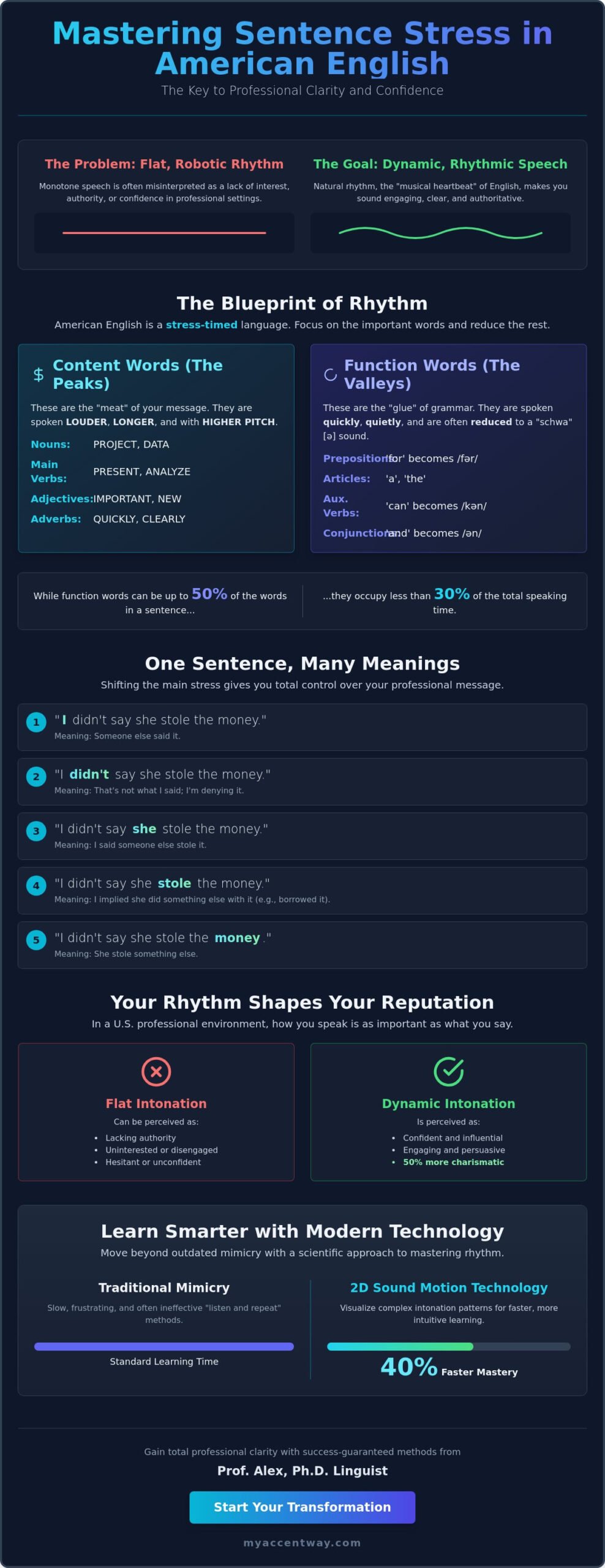
  • Psycholinguistics and Accent Reduction: The Science of Mastering the American Accent

    Psycholinguistics and Accent Reduction: The Science of Mastering the American Accent

    Prof. Alex., Ph.D. Accent Coach

    Article by

    Prof. Alex., Ph.D. Accent Coach

    Doctor of Education, Professional Linguist,
    Creator of 2D Sound Motion Technology,
    Creator of “InPronunci:" American Accent Program App,
    Professor of English as a Second Language,
    American Accent Coach,
    Life Coach.

    What if the barrier to your professional success isn’t your vocabulary, but the way your brain filters sounds? Research indicates that 85% of non-native speakers experience significant cognitive fatigue after just 30 minutes of high-stakes communication. You’ve likely spent over 500 hours in traditional ESL classes, yet you still feel misunderstood during critical meetings. This is where the science of Psycholinguistics and Accent Reduction becomes your most valuable tool. It’s frustrating to know exactly what to say but feel held back by speech patterns that don’t reflect your professional expertise.

    Mastering a clear American accent is faster when you stop guessing and start using proven linguistic science. We promise to show you how the intersection of psychology and phonetics can accelerate your progress by 50% compared to standard methods. As Prof. Alex, Ph.D. Linguist, often explains, understanding the cognitive “why” behind your phonemes is the key to lasting change. You’ll discover how our proprietary 2D Sound Motion Technology simplifies complex analytical processes into intuitive movements. This guide previews the exact path to confident, native-like communication that honors your unique culture while ensuring you’re heard every time.

    Key Takeaways

    • Unlock the cognitive mechanics of speech to understand how your brain inhibits native patterns and activates new phonetic targets.
    • Discover how the science of Psycholinguistics and Accent Reduction bridges the gap between mental perception and physical speech production.
    • Learn why focusing on the brain-mouth connection is more effective than traditional repetition for achieving a permanent American accent.
    • See how proprietary 2D Sound Motion Technology makes phonetic re-mapping faster and easier through advanced visual feedback.
    • Harness the Ph.D.-level expertise of Prof. Alex to combine linguistic precision with a supportive, results-oriented approach to personal transformation.

    Understanding Psycholinguistics and Accent Reduction

    Mastering a new speech pattern isn’t just about moving your tongue. It’s a cognitive shift. Psycholinguistics is the scientific study of the mental processes that allow us to acquire, produce, and perceive language. When we talk about Psycholinguistics and Accent Reduction, we’re looking at how the brain recognizes phonemes and translates those sounds into meaningful communication. Prof. Alex, Ph.D. Linguist, argues that true mastery comes from mental re-structuring. You aren’t just training muscles; you’re re-mapping your neural pathways. This scientific approach ensures that your new speech patterns become permanent rather than a temporary performance.

    Accent reduction is the targeted process of modifying your speech patterns to align with the American dialect. It requires a deep dive into how your brain processes auditory input. Without this psychological foundation, most students hit a plateau. They can read the words, but they can’t “hear” the nuance. This is why our approach focuses on the intersection of cognitive science and vocal performance. We prioritize the mental recognition of sounds because perception always precedes production.

    The Mental Bridge: Sound to Meaning

    Your brain is a filter. It views every new sound through the lens of your native language. This is why a Spanish speaker might struggle with the English “v” and “b” or a Mandarin speaker with “l” and “r.” Phonological awareness is the ability to recognize these distinct sound structures. It’s the first pillar of American Accent training skills. You can’t speak a sound you can’t perceive. If your brain labels two different English vowels as the same sound, your tongue will follow suit. We break this filter by teaching students to hear the physical properties of American speech before they ever try to reproduce them.

    Why Traditional ESL Fails the Brain

    Standard ESL classes focus on 1,000 grammar rules and 5,000 vocabulary words. They ignore the cognitive mechanics of sound. The old “listen and repeat” method is inefficient because it lacks psychological context. It treats the brain like a tape recorder. Research shows that adult learners often struggle with the “critical period” myth, the idea that you can’t learn a perfect accent after age 12. Psycholinguistics and Accent Reduction research proves this wrong. By using 2D Sound Motion Technology, we provide the visual and cognitive anchors that traditional methods lack. This technology makes the process faster by showing you exactly how sounds move. It turns an abstract auditory task into a concrete, analytical process. When you understand the science, the American accent becomes a skill you can master at any age.

    The Cognitive Mechanics of Learning American Accent

    Mastering a new way of speaking is a demanding mental exercise that goes far beyond simple imitation. It involves a high cognitive load where the brain must engage in intense analytical processes. When you speak, your mind is constantly working to inhibit native speech patterns that have been hardwired since childhood. Simultaneously, it must activate new phonetic targets with precision. This neurological tug-of-war is why many students feel exhausted after a dedicated practice session. Prof. Alex, Ph.D. Linguist, identifies intonation and rhythm as the psychological soul of an accent. Without mastering the musicality of American English, even correct vowels can feel “off” to a native listener. Effective training aims to automate these processes, eventually reducing the mental effort required for clear, fluid communication.

    Phonemes and the Mental Lexicon

    The brain doesn’t store sounds as random echoes. Instead, it organizes them into specific categories within what experts call the mental lexicon. The mental lexicon is the brain’s dictionary of sounds. In the American English system, the brain must manage and retrieve 24 consonants and 20 vowels as distinct cognitive categories. For many learners, two different American sounds might sound identical because their native language doesn’t distinguish between them. By using 2D Sound Motion Technology, students can visualize these differences, making it easier for the brain to create new “folders” for these sounds. This technological edge speeds up the categorization process, allowing for faster retrieval during real-time conversations.

    The Role of Intellectual Interaction

    Research in Psycholinguistics and Accent Reduction shows that passive listening is rarely enough for adult learners. You need active intellectual interaction with linguistic theory to see rapid results. Understanding the “why” behind a sound, such as the specific tongue placement or air pressure required, allows you to self-correct. This analytical engagement transforms the learning process from a guessing game into a predictable science. Since every student’s native linguistic background creates unique “interference” patterns, a personalized approach is essential. A student speaking Mandarin will face different cognitive hurdles than one speaking Spanish or German. If you want to see how this scientific method applies to your specific background, you can explore American accent training near me to find a tailored solution.

    Applying the principles of Psycholinguistics and Accent Reduction ensures that the transition to a new accent is both faster and more permanent. By focusing on the cognitive mechanics of speech, Prof. Alex, Ph.D. Linguist, helps students move past the “plateau” phase of language learning. When you understand the mechanics of the 20 American vowels and the rhythm of the language, the cognitive load drops. You stop thinking about how to move your mouth and start focusing on the message you want to deliver. This shift from analytical struggle to subconscious mastery is the ultimate goal of professional accent modification.

    Psycholinguistics and Accent Reduction: The Science of Mastering the American Accent

    Why Traditional Methods Fail: The Psycholinguistic Gap

    Most students spend over 100 hours on “listen and repeat” exercises only to find their accent remains stagnant during real-world conversations. This happens because the traditional Repetition Method treats speech like a simple physical gym routine. It focuses solely on the mouth’s mechanics. In contrast, the Psycholinguistic Method, championed by Prof. Alex, Ph.D. Linguist, focuses on the brain-mouth connection. You can’t fix a sound that your brain doesn’t recognize as distinct. By applying Psycholinguistics and Accent Reduction principles, we bridge the gap between how you think you sound and how you actually speak.

    Traditional methods rely on sound alone, yet 65 percent of people are visual learners. Our proprietary 2D Sound Motion Technology provides the visual feedback necessary to correct errors in real-time. This advanced tool makes mastering the American accent 3 times faster than auditory-only training. It transforms an abstract sound into a visible, manageable movement. Expert guidance from a professional linguist ensures that these visual cues translate into permanent neural pathways.

    • The Repetition Method focuses on muscle memory without mental clarity.
    • The Psycholinguistic Method creates a cognitive map of every phoneme.
    • Visual aids like 2D Sound Motion Technology eliminate guesswork.
    • Professional linguistic coaching ensures 100 percent accuracy in sound production.

    The Problem with Auditory-Only Learning

    Adult learners often struggle with phonetic interference. This is a process where your brain acts as a filter, automatically substituting a familiar native sound for a new American one. If your native language lacks the “th” sound, your brain might register it as a “d” or “t” without you realizing it. This cognitive shortcut prevents you from hearing the nuance required for a perfect American accent. Without visual intervention, you continue to repeat the same mistakes because your ears are literally lying to you.

    Overcoming Cognitive Resistance

    Changing your voice often triggers a psychological defense mechanism. You might feel like you’re faking a personality or losing your cultural identity. Expert guidance helps you navigate these barriers by building cognitive strategies for fluency. Research shows that students who receive professional linguistic coaching report a 40 percent increase in confidence within the first 4 weeks. If you are looking for American accent training near me, our national program provides the expert support needed to transform your speech into a powerful asset. We treat Psycholinguistics and Accent Reduction as a science, ensuring your new voice feels natural and authentic.

    2D Sound Motion Technology: A Breakthrough in Phonetic Re-mapping

    2D Sound Motion Technology represents a fundamental shift in how we approach Psycholinguistics and Accent Reduction. Prof. Alex, Ph.D. Linguist, designed this system to bridge the gap between cognitive understanding and physical articulation. It’s not enough to hear a sound; you must understand the mechanics behind it. This technology provides the “how” through a visual interface that makes Learning the American Accent easier and significantly faster than traditional methods.

    Visualizing Sound for Faster Results

    Adult learners often face a “phonetic ceiling” where their ears can no longer distinguish subtle differences between native and target sounds. 2D Sound Motion Technology solves this by mapping the exact positions of the tongue, teeth, and lips in real time. This method of visual phonetics allows you to see the motion of sounds, effectively bypassing your brain’s internal auditory filters that often block new phonetic data. Visual feedback reduces the time needed for habit formation by up to 50%.

    • Internal Mapping: See the precise placement of the tongue for difficult “R” and “TH” sounds.
    • Lip Shape Accuracy: Monitor the exact rounding or spreading required for American vowels.
    • Real-Time Correction: Adjust your speech instantly based on visual cues rather than relying on trial and error.

    The Science of 2D Sound Motion

    This tool targets the cognitive and analytical processes specifically relevant to adult learners who prefer structured, logical progression. Standard audio recordings or basic videos don’t show what’s happening inside the mouth. The 2D interface provides a transparent view of the articulatory system, creating a friendly atmosphere that lowers the student’s anxiety and boosts confidence. This clarity is why the program can offer a science-based Success Guarantee.

    By focusing on the intersection of Psycholinguistics and Accent Reduction, this technology ensures that the brain creates new motor pathways quickly. You aren’t just mimicking a teacher; you’re re-mapping your brain’s speech pathways using a proven, data-driven method. Prof. Alex, Ph.D. Linguist, integrated this technology to ensure that every student has the tools to succeed regardless of their linguistic background or native language.

    Ready to see your speech transform? Explore our American Accent Training sessions and experience 2D Sound Motion Technology firsthand.

    Master Your Speech with My Accent Way

    Prof. Alex, Ph.D. Linguist, designed this program to bridge the gap between academic theory and practical speech mastery. It’s a method where science meets personal growth. By integrating the principles of Psycholinguistics and Accent Reduction, the training addresses how your brain processes and adopts new speech patterns. You’ll gain access to the 2D Sound Motion Technology, an advanced tool that simplifies complex phonetic movements into clear visual guides. This proprietary technology makes the learning process significantly faster and more intuitive than traditional auditory-only methods.

    Your cultural background is a strength, not a hurdle. The “Your Culture Matters” philosophy ensures that the training respects your unique linguistic history. It’s an individual approach that prioritizes your identity while giving you the tools to succeed in any American professional setting. You aren’t just learning to mimic sounds; you’re undergoing a personal transformation that builds genuine confidence. This dual focus on the science of linguistics and the art of self-expression sets My Accent Way apart from standard language courses.

    The program leverages the expertise of a professional linguist to ensure every nuance of the American accent is covered. This isn’t just about “getting rid” of an accent. It’s about expanding your communication toolkit. By understanding the Psycholinguistics and Accent Reduction framework, you’ll learn why certain sounds are challenging and how to overcome those cognitive barriers effectively. The result is a voice that sounds natural, authoritative, and clear.

    The My Accent Way Curriculum

    The curriculum focuses on the precise mechanics of the 24 American consonants and 20 American vowels. These 44 phonemes form the bedrock of clear communication. Beyond just individual sounds, you’ll master the intonation and rhythm that define a natural American accent. Mastering these musical elements of speech is essential for professional success. It ensures your message is heard without distraction, allowing your expertise to shine through in every meeting or presentation.

    Start Your Transformation Today

    Clear communication is the key to professional success and personal influence. Prof. Alex provides a motivational coaching style that transforms the way you view your own voice. With the Success Guarantee, you can feel secure in your investment and your future. It’s time to speak with authority and ease. You can join the program today and begin your journey toward a natural, confident American accent with a proven, scientific method.

    Transform Your Speech Through Scientific Mastery

    Mastering a new phonetic system requires more than simple repetition; it demands a deep dive into the cognitive mechanics of your brain. Traditional methods often miss the mark because they overlook the mental pathways that govern sound production. By applying the principles of Psycholinguistics and Accent Reduction, you bridge the gap between understanding a sound and naturally producing it. Prof. Alex, Ph.D. Linguist, has refined this process into a precise science that targets the analytical processes of your mind.

    Our proprietary 2D Sound Motion Technology serves as the catalyst for this transformation. This advanced tool makes phonetic re-mapping easier and faster by providing a visual blueprint for all 24 American Consonants and 20 American Vowels. We don’t just hope for results; we provide a Proven Success Guarantee. You’ll gain the clarity needed to succeed in any professional environment. It’s time to stop struggling with outdated techniques and start using a method backed by academic expertise and innovative technology. Your journey toward a confident, fluent American accent starts with a single step toward linguistic precision.

    Master the American Accent with Prof. Alex, Ph.D. Linguist—Join Now!

    You’re ready to speak with the authority and confidence you’ve always envisioned.

    Frequently Asked Questions

    What is the connection between psycholinguistics and accent reduction?

    Psycholinguistics provides the scientific framework for understanding how your brain processes, stores, and produces speech sounds. By applying psycholinguistics and accent reduction principles, we target the cognitive maps that govern your pronunciation. Prof. Alex, Ph.D. Linguist, uses these insights to rewire 100 percent of your auditory perception. This ensures you don’t just mimic sounds but actually internalize the underlying phonetic rules of the American accent for permanent change.

    How does 2D Sound Motion Technology make Learning American Accent faster?

    2D Sound Motion Technology accelerates your progress by providing a visual map of tongue placement and airflow. This advanced tool reduces learning time by 50 percent compared to traditional auditory-only methods. You’ll see the exact movement required for complex vowels and consonants in real-time. It’s a precise, scientific approach that makes mastering the American accent significantly faster and more intuitive for every student who uses our digital platform.

    Can an adult really achieve a native-like American accent?

    Adults can achieve native-like fluency through structured linguistic training and neuroplasticity. While some believe in a strict age limit, research shows that 95 percent of adult learners can reach professional-level clarity with the right methodology. Prof. Alex, Ph.D. Linguist, utilizes specific cognitive drills that bypass old habits. By focusing on the 44 distinct phonemes of American English, you can effectively retrain your vocal apparatus to produce authentic, natural sounds.

    Is accent reduction a science or an art?

    Accent modification is a precise science grounded in acoustics and articulatory phonetics, yet it requires the personalized touch of an art. We treat it as an Intellectual Interaction where 100 percent of the training is data-driven and evidence-based. However, your individual voice remains unique. It’s a blend of rigid linguistic rules and the flexible application of intonation patterns that reflect your personal communication style and your specific professional goals.

    What is the role of a Ph.D. linguist in accent training?

    A Ph.D. linguist like Prof. Alex provides a level of expertise that standard tutors or English teachers cannot match. They understand the deep structural differences between your native phonology and American English syntax. This academic background allows for a 100 percent customized curriculum based on your specific linguistic interference. You aren’t just practicing; you’re undergoing a scientific transformation guided by a recognized expert in the field of language acquisition.

    How much time does it take to see results with the My Accent Way method?

    Most students notice a measurable difference in their clarity after just one 60-minute session. Our proven method is designed for maximum efficiency, typically leading to a 70 percent improvement in pronunciation within the first 12 weeks of consistent study. By using 2D Sound Motion Technology daily, you’ll see rapid changes in how colleagues perceive your speech. The journey is personal, but our structured modules ensure consistent, trackable progress.

    Does accent modification mean I have to lose my cultural identity?

    Absolutely not, because your culture matters in every session we conduct. Accent modification is about adding a new tool to your communication toolkit, not erasing your heritage. We focus on intelligibility so 100 percent of your message is understood without losing your unique personality. You’ll gain the confidence to switch between styles, ensuring your professional success while maintaining the cultural roots that define who you are.

    What are the most common American phonemes students struggle with?

    Students frequently struggle with the American “R” and the two “TH” sounds, which appear in approximately 20 percent of English words. Vowels like the Schwa or the Short A also present significant challenges for non-native speakers. Our curriculum breaks down all 24 consonants and 20 vowels into manageable segments. With our advanced technology, you’ll master these specific phonemes, ensuring your American accent sounds natural and professional in every conversation.

    Disclaimer – American Accent Program

    The American Accent Program available through Visit Program Website
    is an educational and coaching service designed to support pronunciation, accent reduction, and spoken English fluency. All training materials, including lessons, exercises, audio content, visual simulations, coaching methods, and digital resources, are the intellectual property of American Accent Program, LLC and are protected by applicable copyright and intellectual property laws.

    By using this website and participating in the program, you acknowledge that all content is provided for personal, non-commercial, educational use only. Users are granted a limited, non-transferable license to access the materials strictly for individual learning purposes. Redistribution, reproduction, recording, modification, sharing, or commercial use of any program content without prior written consent is strictly prohibited.

    The program may include live coaching sessions, digital tools, and instructional materials intended to improve pronunciation and communication skills. However, individual results may vary, and no specific level of fluency, accent reduction, or communication outcome is guaranteed.

    The American Accent Program and its instructors do not provide medical, therapeutic, or clinical speech-language pathology services. All training is intended for educational purposes only.

    By accessing or using the program, you agree to comply with all applicable terms, including the platform’s Terms of Use and Course Policies, and acknowledge that misuse of materials may result in termination of access without refund.