English Intonation Patterns: 4 Rules & Practice
(512) 265-9515Updated October 14, 2026 ◆ 12 min read
Learn how American English questions rise, fall, and change meaning in real speech, so your questions sound clearer, more natural, and more confident.
In English, yes/no questions usually rise at the end, while wh-questions usually fall. That is the rule most textbooks teach, and it holds true often enough to be a safe default. But real speech breaks this rule constantly, and knowing when native speakers bend it is what actually makes you sound natural.
Real student result

“I feel confident enough to speak American English!”
Interactive American Accent Training9monthsof hard work and dedication
Listen to the starting point0:00
Listen to the result0:00
“Many of my students once believed they could never sound like this. School taught them grammar and vocabulary, but not how to train their English speech. That is what we do together, step by step, until you speak English independently and with confidence.”
Abishek’s result was achieved through Prof. Alex’s research-based Interactive 1-on-1 American Accent Training. His doctoral research found this interactive method more effective than traditional, teacher-centered methods. See the research basis →
Take “Are you coming?” — the pitch climbs on the last word. Compare that to “Where are you going?” — the pitch drops. Both are questions. Both intonation patterns signal something different: openness versus a request for specific information.
- Yes/no questions: rising pitch (↑) on the final word or syllable, most of the time
- Wh-questions: falling pitch (↓) on the final stressed word, most of the time
- The exception that matters: speakers regularly flip these patterns for politeness, sarcasm, or clarification, and a short listening drill later in this article will train your ear to catch it
Intonation Patterns for Questions: Four Contours to Practice
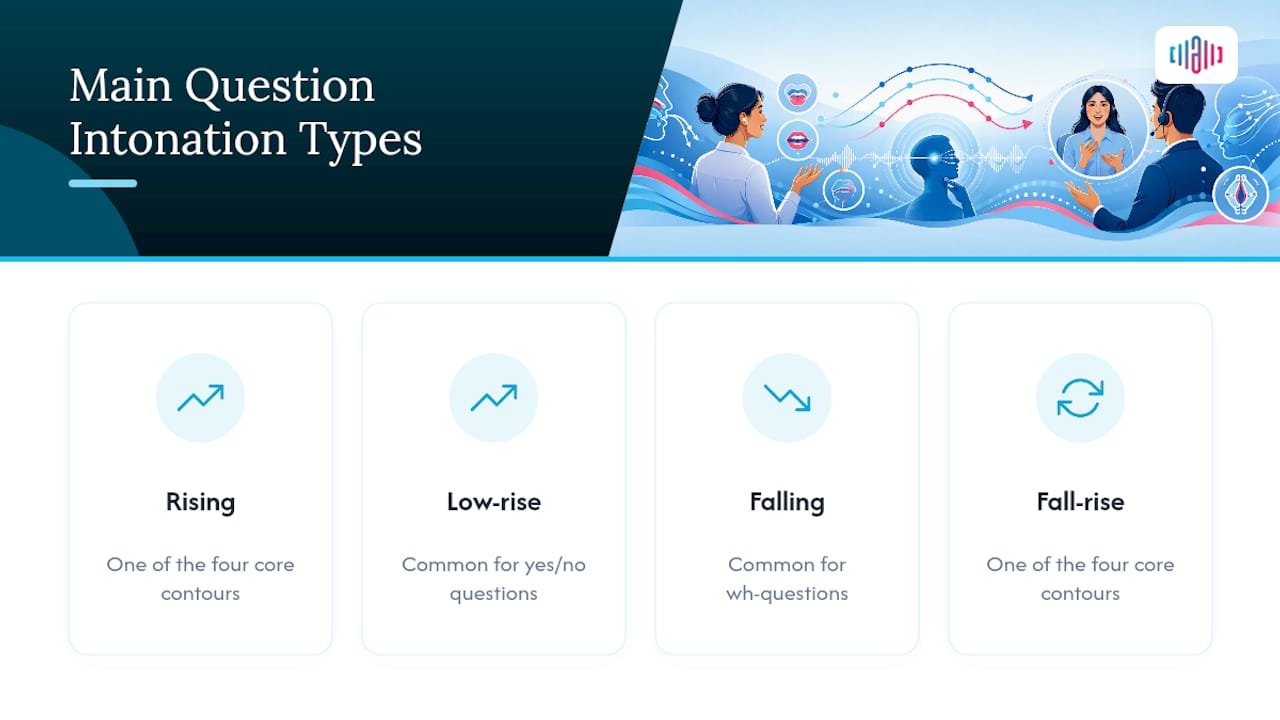
Question intonation in American English relies on four main pitch shapes. Learning to hear and reproduce them is more useful than memorizing grammar rules, because pitch, not word order, carries most of the meaning in spoken English.
- Rising — pitch climbs steadily toward the end of the sentence. Example: “Is this seat taken? ↑”
- Low-rise — pitch dips slightly, then climbs gently at the very end, a softer version of a full rise. Example: “You’re free tonight? ↘↗”
- Falling — pitch peaks on the stressed syllable, then drops. Example: “What time does it start? ↓”
- Fall-rise — pitch falls, then rises again, often signaling doubt or a follow-up. Example: “You already ate? ↓↗”
Two more to have in your ear: “Did you email him? ↑” (rising, standard yes/no) and “Why didn’t you call? ↓” (falling, standard wh-question).
The pitch movement almost always lands on the nuclear stress, the last content word carrying new information in the sentence. In “Are you coming to the party?”, the stress and pitch shift usually land on “party,” not “are” or “coming.” Train your ear to find that word first; the pitch direction follows naturally once you know where to put it.
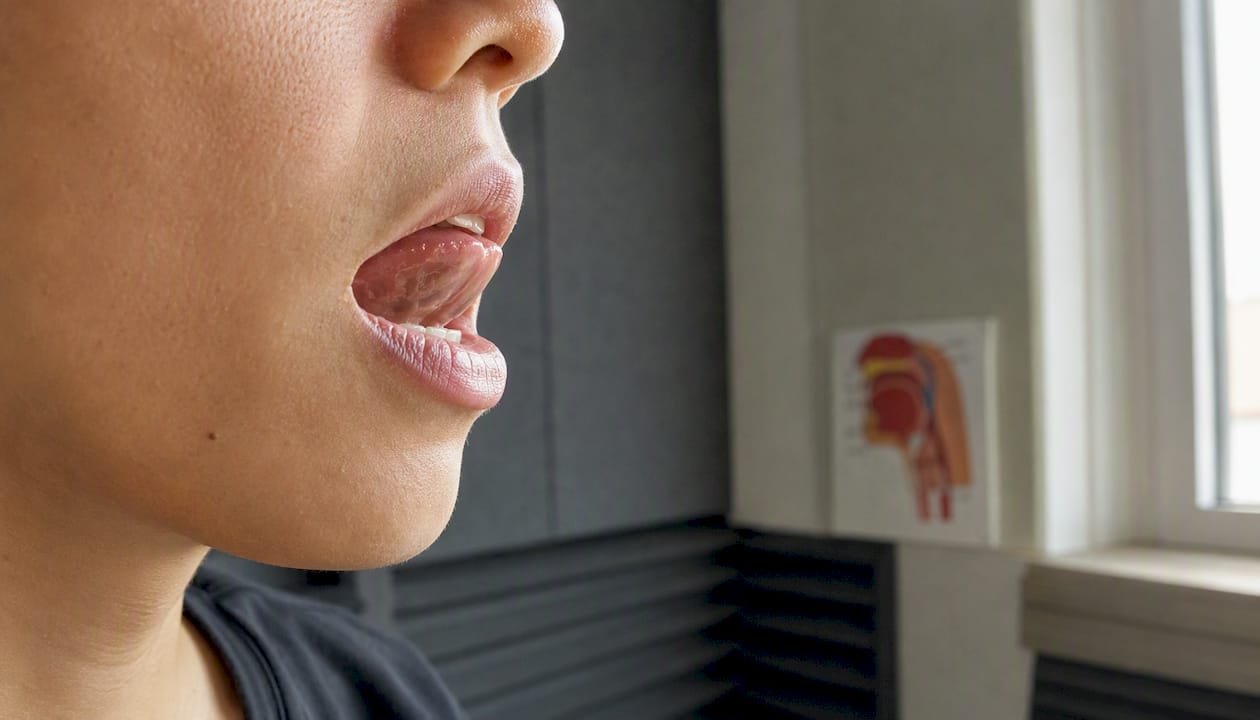
Pro Tip: Record yourself saying five questions, then mark where your pitch peaks. If it consistently lands on the wrong word, you’re likely misplacing stress, not misusing intonation.
What Rising and Falling Questions Actually Communicate
Corpus research on spoken English gives a clearer picture than any grammar rule. A detailed corpus analysis using ToBI annotations found that low-rise contours appear in roughly 79.8% of yes/no questions, while falling contours dominate wh-questions in most cases. These are strong tendencies, not fixed laws, and the remaining cases carry real pragmatic weight.
Corpus finding: In a 410-question sample, low-rise endings appeared in most yes/no questions, with high-rise and falling contours splitting most of the remainder.
- A falling yes/no question (“Did you finish that report?↓”) often functions less like a genuine question and more like a statement seeking confirmation, sometimes even a polite command.
- A rising wh-question (“Where did you say?↑”) usually signals that the speaker already has partial information and wants clarification, not a full new answer.
- Low-rise remains the default for open, genuine yes/no questions, according to the same corpus analysis of question intonation.
This pragmatic layer matters most in professional settings, where the wrong contour can make a genuine question sound like doubt, or a polite request sound like an interrogation.
Practice Drills That Train Your Ear and Your Mouth
Perception comes before production. If you cannot hear the difference between a rise and a fall, you cannot reliably produce one either. These drills are built for busy schedules: each set takes one to two minutes.
- Listen-and-label (perception drill): Play five recorded questions, mix yes/no and wh-questions. Write ↑ or ↓ next to each based on what you hear at the end. Score yourself against a transcript or native-speaker recording; aim for 4 out of 5 correct before moving on.
- Model: Pick one sentence from your listening set and play it three times, focusing only on the pitch shape.
- Mimic: Say the sentence aloud immediately after the recording, matching the rise or fall as closely as you can.
- Record: Say the same sentence into your phone’s voice recorder without the model playing.
- Adjust: Play your recording back next to the original. Note where your pitch flattens or moves in the wrong direction, then repeat the sentence twice more.
Run this four-step production cycle for five to eight sentences per session. A basic phone recorder is enough; some learners also use pitch-visualizer apps that draw a line showing pitch movement over time, which makes a flat or reversed contour easy to spot visually rather than just by ear. This structure, drawn from established ESL pronunciation practice methods, works because it separates hearing the pattern from producing it, rather than mixing both at once.
Pro Tip: Do the listen-and-label drill first thing in a session, before your mouth “warms up.” Fresh ears catch pitch direction more accurately than tired ones.
For a deeper set of guided sentences, this intonation patterns practice guide walks through additional contours with audio-style examples.
Common Mistakes in Question Intonation and How to Fix Them
Most learners fall into one of three traps, and each has a fast fix.
- Flat or falling pitch on yes/no questions. This makes “Are you ready?” sound like a statement. Fix: practice minimal pairs like “You’re ready.↓” versus “You’re ready?↑” back to back, exaggerating the rise until it becomes automatic.
- Overusing high rise on everything, including wh-questions and statements, which makes speech sound perpetually uncertain. Fix: reserve the rise for genuine yes/no questions and clarification requests; practice wh-questions like “What’s your name?↓” with a firm, confident fall.
- Misplaced nuclear stress, which breaks the whole contour even when pitch direction is correct. Fix: chunk longer questions into smaller phrases and mark the one word that should carry the pitch shift before speaking.
Each fix works best in short, repeated bursts, three to five sentences, several times a day, rather than one long session.
When Coaching Speeds Up Progress
Self-practice builds awareness, but many adult learners plateau once they can hear a pattern yet cannot consistently reproduce it under pressure, in a meeting, an interview, or a live presentation. That gap is where structured coaching earns its value.
- Interactive 1-on-1 Accent Training gives you real-time correction on your actual speech, not a generic drill, which matters most once you already grasp the theory but need someone to catch inconsistent patterns you can’t hear yourself.
- Cognitive Accent Training moves intonation from something you consciously monitor to something automatic, by building awareness of your own habitual patterns before retraining them.
- 2D Sound Motion Technology adds articulation and pitch-movement practice, helping learners train mouth position and pitch together.
This is not a “repeat after me” method. It is active retraining grounded in why a correction works, not just what it sounds like.
A Note From Prof. Alex
Intonation is learnable, and progress shows up faster than most adult learners expect once feedback becomes specific rather than general. I have watched professionals shift from flat, uncertain-sounding questions to confident, natural contours within a handful of focused sessions. If you have been drilling on your own and feel stuck, a short, guided session can pinpoint exactly what to adjust.
MyAccentWay · 2D Sound Motion Technology
American English Pronunciation: Consonant and Vowel Sounds with 2D Sound Motion Technology
Learning American English pronunciation and the American accent is more effective when you train your speech organs, not only listen and repeat. 2D Sound Motion Technology and Interactive Visual 2D Sound Simulators, developed in 2020 by Prof. Alex, Ph.D. Accent Coach, Doctor of Education, and professional linguist, as part of his interactive teaching model based on his Ph.D. research in interactive teaching methods, train your tongue, lips, jaw, teeth, airflow, and voice step by step. They train each American sound and more than 30 sound combinations through Interactive 2D video simulation.
What 2D Sound Motion Technology is
2D Sound Motion Technology is an advanced accent reduction and articulation training tool by Prof. Alex. It corrects, develops, and trains each American sound and more than 30 sound combinations through Interactive 2D video simulation.
What Interactive Visual 2D Sound Simulators do
Interactive Visual 2D Sound Simulators are part of 2D Sound Motion Technology, the articulation-training method Prof. Alex created by applying his Ph.D. research in interactive teaching to American pronunciation. Instead of listening and repeating, students actively train their speech organs. Each simulator uses Interactive 2D mouth movement to train the speech organs (tongue, lips, jaw, teeth, airflow, and voice) to produce each American sound correctly. Every consonant has its own simulator: explore American consonants trained with 2D Sound Motion Technology.
Sample training: the American t sound (aspirated [t])
Practice
Record yourself speaking these words:
Tab · Tacos · Time · Tub · Hotel · Motel · Sit · Pit · Net
Instructions
Play the Interactive Visual 2D Sound Simulator for the American t sound below several times and follow it step by step. Move your tongue, jaw, and airflow together with the simulator and train your articulation.
Interactive Visual 2D Sound Simulator: American unvoiced sound [t]
Practice
Record yourself again speaking these words, but this time focus on the movement of your tongue. Go slow, and you will hear the difference. You’ve got this!
Tab · Tacos · Time · Tub · Hotel · Motel · Sit · Pit · Net
How Interactive Visual 2D Sound Simulators solve pronunciation and speaking problems
- Wrong articulationMost pronunciation problems start with the tongue, lips, jaw, or teeth in the wrong position. Each Interactive Visual 2D Sound Simulator trains the correct articulation of one American sound, so the student corrects the cause of the problem, not only the result.
- Airflow and voicingMany accent problems come from wrong airflow or voicing: sounds that are too weak, too strong, or voiced when they should be unvoiced. The simulators train airflow and voice together with articulation, step by step, for each American sound and more than 30 sound combinations.
- Clear speech and confidenceWhen each sound is trained correctly, words connect into clear American English speech. Listeners can understand you more easily, and speaking at work, in meetings, and on calls becomes more confident.

If you start hearing the aspiration, the short airstream after [t], with one simulator, you can only imagine how successful you can be in 1-on-1 Interactive American Accent Training with Prof. Alex, Ph.D. Accent Coach, where your whole American sound system is trained sound by sound.
In MyAccentWay, the Interactive Visual 2D Sound Simulators are only available in 1-on-1 accent coaching sessions with Prof. Alex.
Turn Practice Into Real Progress With Guided Coaching
Self-recording and drills build real skill, but they have a limit: you cannot always hear your own mistakes the way a trained ear can. That is the exact gap American accent training with Prof. Alex is built to close, with live, personalized correction instead of one-size-fits-all audio lessons.

The 1-on-1 Accent Reduction Training includes a dedicated intonation module that builds directly on the contours covered here, rising, falling, and the pragmatic exceptions that trip up even advanced speakers. Sessions use 2D Sound Motion Technology and Interactive Visual 2D Sound Simulators so you can train articulation and pitch movement, not just hear them described. In MyAccentWay training, these simulators are used to train sound articulation, sound formation, and speech production during live 1-on-1 accent training sessions.
A 1 Hour Evaluation Session walks through your current speech patterns, identifies where your question contours drift from your intended meaning, and maps out a targeted plan, the same listen, model, record, adjust cycle from this article, but with expert feedback at every step — a perfect complement to exploring the types of Spanish question forms for learners interested in cross-linguistic intonation. If you are ready to move past self-correction guesswork, Book Your 1 Hour Evaluation Session or Read Reviews from professionals who have gone through the process.
American Intonation Practice for Professionals in the U.S.
American intonation practice is especially important for advanced English speakers who already know grammar and vocabulary but still feel that their questions sound flat, uncertain, too direct, or hard to follow in professional communication.
For professionals in competitive U.S. cities and high-income business areas, intonation is not only a pronunciation detail. It affects how questions sound in meetings, interviews, presentations, sales calls, medical conversations, legal discussions, university seminars, and leadership communication.
Prof. Alex’s training focus: American intonation should be trained inside real speech, not only memorized as a rule. Students learn to hear the pitch movement, understand the meaning behind the rise or fall, compare it with their own speech, and practice until question melody becomes easier to control.
Who this article is for
- International professionals who want clearer American English in meetings, interviews, negotiations, and presentations.
- Advanced English speakers who want to sound closer to native-like American English and speak with stronger rhythm, melody, and speech control.
- Advanced English speakers and professionals who need better listening awareness, question intonation, sentence stress, and natural spoken English flow.
- Entrepreneurs, founders, doctors, engineers, IT professionals, executives, and public speakers who want questions to sound confident, clear, and natural.
U.S. cities and areas where American intonation training is highly relevant
MyAccentWay provides online American accent training and American intonation practice for students across the United States, including professionals and advanced English speakers in New York City, Manhattan, Brooklyn, Queens, Jersey City, Hoboken, Greenwich, Westchester, Boston, Cambridge, Washington DC, Arlington, McLean, Bethesda, Miami, Brickell, Austin, Dallas, Houston, Chicago, Los Angeles, Beverly Hills, Santa Monica, Irvine, Orange County, San Diego, La Jolla, San Francisco, Silicon Valley, Palo Alto, Menlo Park, Mountain View, Cupertino, San Jose, Los Altos, Seattle, Bellevue, Denver, Boulder, and other professional communities where clear American English communication matters.
Common search questions this article answers
- How do I practice American intonation for questions?
- Why do yes/no questions rise in American English?
- Why do wh-questions usually fall in American English?
- How can I sound more natural when asking questions in English?
- How can advanced English speakers improve American intonation?
- How can professionals train American question melody for meetings and presentations?
Train American intonation with a professional linguist.
If your questions sound flat, too sharp, uncertain, or disconnected, Prof. Alex can help you train American intonation, rhythm, stress, and speech clarity through interactive 1-on-1 accent training.
Sources
This article draws on corpus research using ToBI annotations, an open textbook chapter on intonation and prosody, and the Cambridge Dictionary’s intonation entry for quick reference on rising and falling patterns.
- Hedberg, Sosa & Görgülü — corpus analysis of question intonation (ToBI annotations)
American Intonation and Rhythm Training for Foreign-Born Professionals in the United States
Foreign-born professionals in the United States often know their field and speak advanced English. Yet American listeners may still struggle with their stress, rhythm, and intonation. MyAccentWay offers private online intonation training through Interactive American Accent Training.
Interactive American Accent Training is led by Prof. Alex, Ph.D. Accent Coach, Doctor of Education, and professional linguist. He first diagnoses each speaker’s native-language patterns. Then he trains American word stress, sentence stress, rhythm, and intonation for real meetings and presentations.
Who this training is for
- Engineers, IT specialists, and data professionals presenting to U.S. teams and clients
- Doctors, nurses, and healthcare professionals explaining care to American patients
- Managers, executives, and founders leading meetings, pitches, and briefings
- Consultants, researchers, and academics speaking at conferences and webinars
- Professionals preparing for interviews, promotions, or client-facing roles
Online training across the U.S.
MyAccentWay is based in Austin, Texas, and all training is online. The program is especially relevant for professionals in Austin, Dallas, Houston, New York City, the San Francisco Bay Area, Los Angeles, Seattle, Boston, Chicago, Miami, Washington DC, Atlanta, and Raleigh.
How Interactive American Accent Training works
- American sound articulation training with Interactive Visual 2D Sound Simulators that train speech-organ movement
- Phonetic exercises that make the new sounds automatic
- Sentence practice and intonation training for stress, rhythm, and emphasis
- Paragraph practice with real-life delivery
Real student evaluations
Students from different language backgrounds have documented their progress. Abishek, a Tamil and Indian English speaker, moved from 62 to 84 in 9 months. Tian, a Mandarin speaker, moved from 58 to 85 in 8 months. Vlad, a Russian speaker, moved from 60 to 83 in 5 months.
The first step is a 1 Hour Evaluation Session with Prof. Alex.
FAQ
What Are the Main Types of Question Intonation?
The four core contours are rising, low-rise, falling, and fall-rise, with low-rise and falling being the most common patterns for yes/no and wh-questions, respectively.
What Is Question Inflection?
Question inflection refers to the pitch movement, rise or fall, at the end of a question that signals its type and the speaker’s intent, such as genuine curiosity, confirmation, or clarification.
Do All Yes/No Questions Rise at the End?
No.
How Can I Practice Question Intonation on My Own?
Use short listen-and-label drills to train your ear, then follow a model, mimic, record, and adjust cycle with your phone recorder for five to eight sentences per session.
When Should I Consider 1-on-1 Coaching Instead of Self-Practice?
If you can hear intonation mistakes but cannot consistently fix them in live conversation, Interactive 1-on-1 Accent Training with Myaccentway American Accent Program provides real-time correction that self-recording alone cannot offer.
Recommended

Master English Intonation Patterns: The Ultimate Guide to Sounding Natural
Do you ever feel like you've mastered English grammar and vocabulary, yet your speech still comes across as flat or robotic? This common frustration...

American English Intonation Patterns Practice Guide
Enhance your speaking skills with our American English intonation patterns practice. Master intonation to sound confident and clear!

Rising vs. Falling Intonation: The Ultimate Guide to Sounding Natural in American English
Have you ever felt that no matter how perfectly you choose your words, your English still sounds... flat? Perhaps you've intended to make a clear...
Turn question intonation into speech control.
If you can hear the difference but cannot control it in meetings, interviews, or presentations, Prof. Alex can help you train American intonation through interactive 1-on-1 accent training.
Can your question melody sound natural under pressure?
Book a focused session with Prof. Alex to identify where your question intonation, rhythm, and speech clarity need correction.
American accent training for professionals in Austin, Houston, Dallas, and nearby cities
MyAccentWay works with non-native professionals and advanced English speakers in Austin, Georgetown, Round Rock, Cedar Park, Leander, Pflugerville, Bee Cave, Lakeway, West Lake Hills, Dripping Springs, Buda, Kyle, San Marcos, Hutto, Taylor, New Braunfels, San Antonio, Houston, The Woodlands, Sugar Land, Katy, Pearland, Spring, Cypress, Missouri City, Dallas, Plano, Frisco, McKinney, Allen, Irving, Richardson, Grapevine, Southlake, Fort Worth, and other U.S. and Canadian business communities. The training focuses on clearer American pronunciation, sound articulation, rhythm, intonation, connected speech, professional speech clarity, and confident business communication.
Continue learning how MyAccentWay connects American sound articulation, Interactive Visual 2D Sound Simulators, accent reduction, student proof, and 1-on-1 training.
- Prof. Alex and the MyAccentWay MethodLearn how Prof. Alex, Ph.D. Accent Coach, Doctor of Education, and professional linguist, created and leads the structured MyAccentWay American accent training system.
- Accent Reduction Curriculum and English Articulation TrainingSee how MyAccentWay trains accent reduction, accent modification, American pronunciation, English articulation, rhythm, and professional speech clarity.
- 2D Sound Motion Technology for American Accent TrainingUnderstand Prof. Alex’s Interactive Visual 2D Sound Simulators for American sound articulation.
- Before-and-After American Accent Training ResultsListen to real before-and-after student proof and accent training outcomes.
- Student Reviews and Accent Training ResultsRead student reviews, testimonials, and trust signals from MyAccentWay learners.
- Book a 1-Hour 1 Hour Evaluation SessionStart with a 1-hour accent evaluation session with Prof. Alex.