How Long Does Accent Reduction Take? A Realistic Timeline
(512) 265-9515Updated October 16, 2026 ◆ 18 min read
Do you ever feel the frustration of being misunderstood, asked to repeat yourself, or suspect your accent might be a silent barrier to your professional goals? If you’re ready to speak with unwavering confidence, your first question is likely a very practical one: how long does accent reduction take? It’s a question filled with both hope and uncertainty, and the answer is more nuanced than a simple number on a calendar. The journey to mastering the phonemes and intonation of the American accent is a highly personal one, grounded in linguistic science.
Real student result

“I feel confident enough to speak American English!”
Interactive American Accent Training9monthsof hard work and dedication
Listen to the starting point0:00
Listen to the result0:00
“Many of my students once believed they could never sound like this. School taught them grammar and vocabulary, but not how to train their English speech. That is what we do together, step by step, until you speak English independently and with confidence.”
Abishek’s result was achieved through Prof. Alex’s research-based Interactive 1-on-1 American Accent Training. His doctoral research found this interactive method more effective than traditional, teacher-centered methods. See the research basis →
As a Ph.D. Linguist, I’ve guided countless students through this transformative process. In this article, we will move beyond guesswork to provide you with a realistic timeline for success. You will discover the key factors that directly influence your progress and learn how you can accelerate your journey toward clear, confident English. By the end, you will have a manageable framework to begin your path to being heard and understood, every single time.
The Short Answer: A Realistic Accent Reduction Timeline
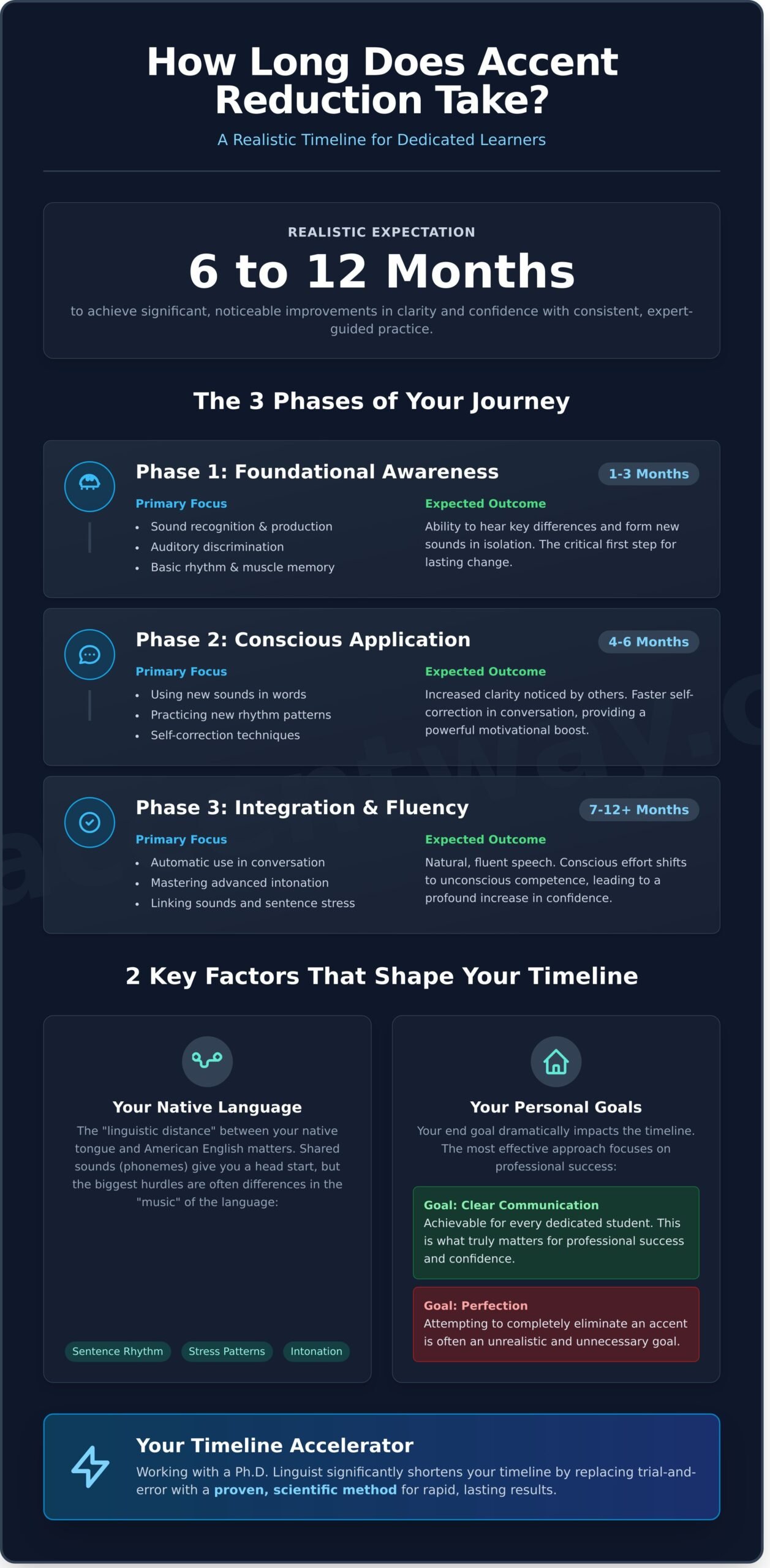
So, how long does accent reduction take? For a dedicated student working consistently with an expert coach, you can expect to achieve significant, noticeable improvements in clarity and confidence within 6 to 12 months. This journey is a highly personal one, grounded in the science of phonetics and cognitive learning. The process, often called accent modification, involves mastering the specific phonemes and intonation patterns of American English. For a detailed primer, Wikipedia’s article on what is accent reduction? offers an excellent overview of the field.
Remember, this timeline is a guide, not a guarantee. Your progress depends on factors like your native language, practice consistency, and the quality of your instruction. Below is a breakdown of what you can realistically expect as you move through the key phases of mastering the American accent.
| Phase | Typical Timeline | Primary Focus | Expected Outcome |
|---|---|---|---|
| Phase 1: Foundational Awareness | 1-3 Months | Sound recognition and production; basic rhythm. | Ability to hear and form new sounds in isolation. |
| Phase 2: Conscious Application | 4-6 Months | Using new sounds in words and sentences. | Increased clarity noticed by others; faster self-correction. |
| Phase 3: Integration & Fluency | 7-12+ Months | Automatic use in conversation; advanced intonation. | Natural, fluent speech with significantly increased confidence. |
Want a realistic timeline for your own accent?
Most learners do not need another generic timeline. They need to know which sounds, rhythm habits, intonation patterns, and listening habits are keeping the old accent pattern in place. A 1-on-1 session helps you stop guessing and understand what your personal accent reduction timeline should look like.
Phase 1: Foundational Awareness (1-3 Months)
This initial stage is all about building your cognitive and analytical awareness. You’ll learn to identify and physically produce the core American English sounds-especially vowels-that may not exist in your native language. The focus is on auditory discrimination and developing new muscle memory. You’ll start noticing the key differences between your speech and that of native speakers. While progress can feel slow, this foundational work is the most critical step for lasting success.
Phase 2: Conscious Application (4-6 Months)
Here, you begin to bridge the gap between knowledge and practice. You’ll consciously apply new sounds and rhythm patterns in structured exercises and practiced sentences. Mistakes are an expected and valuable part of this phase, as your ability to hear and self-correct becomes much faster. This is often when listeners notice a definite improvement in your clarity, providing a powerful motivational boost to continue your dedicated practice.
Phase 3: Integration & Fluency (7-12+ Months)
This is the transformational phase where conscious effort shifts to unconscious competence. New speech patterns become more automatic, freeing you to focus on what you’re saying, not how you’re saying it. Your training will advance to mastering nuances like linking sounds between words, proper sentence stress, and natural intonation. The result is not just clearer speech, but a profound increase in fluency and the confidence to succeed in any conversation.
5 Key Factors That Determine Your Accent Reduction Timeline
So, how long does accent reduction take? While every student wants a simple number, the truth is more personal and-most importantly-more empowering. Your timeline isn’t set in stone; it’s shaped by several key factors that you can directly influence. As a Ph.D. Linguist, I can tell you that understanding these elements is the secret to accelerating your journey toward speaking clear, confident American English.
Factor 1: Your Native Language vs. American English
Think of languages as being on a map. The “linguistic distance” between your native tongue and American English plays a significant role. If your language shares many phonemes (individual sounds) and grammatical structures with English, you have a natural head start. However, the biggest hurdles are often the invisible ones: sentence rhythm, stress patterns, and intonation-the unique “music” of American English, which can be vastly different from your own.
Factor 2: Your Personal Goals (Clarity vs. Perfection)
Your end goal dramatically impacts your timeline. Are you aiming for clear, effective communication, or are you striving to sound indistinguishable from a native speaker? The first goal-confident clarity-is achievable for every dedicated student and is what truly matters for professional success. The second, attempting to completely eliminate an accent, is a much longer-term ambition. When you focus on being understood clearly, you will achieve meaningful results much faster.
Factor 3: The Quality and Consistency of Your Practice
Mastering an accent is like training for a sport. Twenty minutes of focused, daily practice is far more effective than a three-hour cram session on a Sunday. Quality practice isn’t just repetition; it involves targeted exercises to build new muscle memory in your tongue and lips, recording your voice to analyze your progress, and receiving expert feedback. Without the right guidance from a professional coach, it’s easy to practice the wrong things and reinforce old habits.
Factor 4: Your Immersion and Daily Exposure
You can’t learn to swim without getting in the water. The more you surround yourself with the sounds of American English, the faster your brain will adapt. You can create an immersive environment anywhere by:
- Listening to American podcasts and audiobooks during your commute.
- Watching American TV shows and movies to absorb natural speech patterns.
- Joining online conversation groups to practice speaking in a low-pressure setting.
Even passive listening helps train your ear to the natural intonation, making your own speech sound more authentic over time.
The Role of a Professional Coach: Your Timeline Accelerator
While self-study resources offer a starting point, the single most significant factor in accelerating your progress is working with a professional accent coach. If you’re serious about seeing tangible results and want the most efficient answer to “how long does accent reduction take,” a guided approach is unparalleled. It replaces the slow, frustrating cycle of trial-and-error with a direct, research-based path to clarity.
Expert Diagnosis and a Personalized Roadmap
A trained linguist acts as a diagnostic expert for your speech. Within the first session, they can pinpoint the exact phonemes, cadence patterns, and mouth movements that are holding you back-challenges you may not even be aware of. This initial analysis is crucial. Instead of wasting months practicing sounds you’ve already mastered, you receive a personalized roadmap targeting your unique habits. This tailored plan is built on research-based, effective accent reduction techniques, ensuring every moment of your practice is spent on what truly matters.
The Power of an Immediate Feedback Loop
One of the greatest dangers of self-study is unknowingly reinforcing your own mistakes. You might practice a sound hundreds of times, only to discover you were cementing an incorrect habit. A coach provides an immediate feedback loop, correcting errors in real-time before they become fossilized. This constant, expert guidance ensures you are building muscle memory correctly from day one. This process not only builds accuracy but also provides the encouragement and confidence needed to use your new skills in real-world conversations.
Mastering the ‘Invisible’ Elements of Speech
Pronouncing individual sounds correctly is only one piece of the puzzle. The true music of the American accent lies in its intonation, stress, and rhythm-the “invisible” elements that apps and books often fail to teach effectively. These subtle nuances are what separate clear speech from natural-sounding, fluent speech. A coach provides structured, targeted exercises to master these musical aspects, helping you sound more connected and engaging. A comprehensive American Accent Program is designed to integrate this expert guidance, transforming not just what you say, but how you say it.
A Step-by-Step Guide to Your First 90 Days
The question of how long does accent reduction take can feel overwhelming. But the journey to confident, clear speech doesn’t happen overnight; it happens day by day. By breaking the process into a structured 90-day plan, you can transform this monumental goal into a series of achievable victories. This roadmap shows you exactly what quality, focused practice looks like, making your goal feel more attainable than ever.
Month 1: Building Your Foundation
The first 30 days are dedicated to developing awareness. As any linguist will tell you, you cannot change what you cannot hear. We begin with the foundational phonemes of the American accent.
- Weeks 1-2: Ear Training. Focus on actively listening to native speakers. Your goal is to identify 1-2 target sounds that are challenging for you, such as the American ‘R’ or the ‘TH’ sound.
- Weeks 3-4: Mouth Mechanics. Now, connect sound to physical action. Using a mirror, observe and practice the precise tongue, lip, and jaw placement-your articulators-required for your target sounds.
Actionable Tip: Record yourself saying a list of 10 words with your target sounds each day. Don’t judge-just listen and build your awareness.
Month 2: From Sounds to Words
With a solid foundation, you can now build complexity and precision. This month, we move from isolated sounds to the building blocks of speech: words. This is where your clarity begins to improve dramatically.
- Weeks 5-6: Minimal Pairs. Practice distinguishing between words that differ by only one sound, like ship/sheep or bit/beat. This sharpens both your listening and production skills.
- Weeks 7-8: Word Stress. Master the emphasis on the correct syllable in multi-syllable words (e.g., PRO-gress vs. pro-GRESS). This is critical for intelligibility.
Actionable Tip: Read a short paragraph from a book aloud daily, focusing on crisp sounds and correct word stress for a natural flow.
Month 3: Simple Sentences and Rhythm
In the final month of this initial phase, you will learn to connect words into natural, flowing speech. This is where your confidence truly begins to soar as you start mastering the music of English.
- Weeks 9-10: Linking Sounds. Practice connecting words smoothly, just as native speakers do (e.g., “an apple” sounds like “a-napple”). This creates a more fluid rhythm.
- Weeks 11-12: Basic Intonation. Focus on pitch. Practice the rising pitch for yes/no questions and the falling pitch for statements to convey the correct meaning and emotion.
Actionable Tip: Rehearse simple, real-world interactions aloud, like ordering a coffee or asking for directions, focusing on your intonation.
Following this 90-day plan shows that the answer to “how long does accent reduction take?” depends heavily on consistent, structured practice. While self-study is powerful, a guided approach with an expert can significantly accelerate your progress. To see how a personalized program can refine your American accent, explore the research-based methods at myaccentway.com.
Why some learners improve faster
Accent reduction becomes faster when the student is not only repeating corrections. In MyAccentWay Interactive Accent Training, Prof. Alex creates a learning situation where the student listens, compares, adjusts, and becomes an active participant in the speech-change process.
Traditional practice
A coach tells you what to fix. You repeat the sound, leave the session, and often stay dependent on correction.
MyAccentWay training
You learn how to hear the difference, understand why the correction works, and apply the new pattern inside words, sentences, rhythm, and real communication.
Common Myths That Can Slow Your Progress
Your journey to clear, confident speech is as much about mindset as it is about muscle memory. The beliefs you hold can either accelerate your progress or create significant roadblocks. Your final answer to “how long does accent reduction take” is deeply influenced by overcoming these mental hurdles. Let’s debunk the most common myths with linguistic facts to ensure you stay on an effective path to success.
Myth: ‘I have to lose my original accent completely.’
This is perhaps the most damaging misconception. The goal of accent modification is not to erase your identity but to add a new skill to your linguistic toolkit. Your original accent is a beautiful part of your cultural heritage. The true objective is to master the phonemes and intonation of the American accent so you can communicate with clarity and confidence, ensuring you are always understood.
Myth: ‘I’m too old to change my accent.’
This is scientifically untrue. Thanks to neuroplasticity, our brains retain the incredible ability to learn, adapt, and form new neural pathways at any age. While children may absorb sounds unconsciously, adults possess powerful advantages: higher motivation, well-developed analytical skills, and a greater capacity for focused, deliberate practice. Thousands of adults successfully modify their accents every year by leveraging these cognitive strengths.
Myth: ‘If I practice more, I’ll get better faster.’
Quantity of practice does not guarantee quality of results. The old saying should be: “Perfect practice makes perfect.” Practicing sounds or speech patterns incorrectly only reinforces bad habits, ingraining the wrong muscle memory and making it harder to correct later. This is why expert feedback is non-negotiable for effective progress. Guidance from a trained linguist ensures that every minute you spend practicing is a minute spent building the right skills, which directly impacts how long does accent reduction take.
By replacing these myths with an informed, positive mindset, you empower yourself to learn efficiently and effectively. Ready to build a practice routine that supports steady progress? Learn about our research-based, expert-led method.
Your Path to Clear Speech: Mastering Your Accent Reduction Timeline
As we’ve explored, the answer to how long does accent reduction take is not a single number, but a personal journey. Your progress is shaped by your dedication, your linguistic background, and the methods you use. The most crucial takeaway is that while the timeline is unique to you, it is not out of your control. With a structured approach and expert guidance, you can make significant, noticeable improvements far more quickly than you might imagine.
Why navigate this path alone when a research-based method can accelerate your results? At MyAccentWay, we eliminate the guesswork. Our program combines personalized 1-on-1 coaching with a Ph.D. Linguist and our proprietary 2D Sound Motion Technology to provide a clear, scientific path to mastering the American Accent. We encourage all dedicated students to practice consistently and track their progress.
Ready to accelerate your journey to clear, confident speech? Discover our American Accent program.
Your goal of speaking with clarity and confidence is within reach. Take the first step today and begin your transformation.
MyAccentWay · 2D Sound Motion Technology
American English Pronunciation: Consonant and Vowel Sounds with 2D Sound Motion Technology
Learning American English pronunciation and the American accent is more effective when you train your speech organs, not only listen and repeat. 2D Sound Motion Technology and Interactive Visual 2D Sound Simulators, developed in 2020 by Prof. Alex, Ph.D. Accent Coach, Doctor of Education, and professional linguist, as part of his interactive teaching model based on his Ph.D. research in interactive teaching methods, train your tongue, lips, jaw, teeth, airflow, and voice step by step. They train each American sound and more than 30 sound combinations through Interactive 2D video simulation.
What 2D Sound Motion Technology is
2D Sound Motion Technology is an advanced accent reduction and articulation training tool by Prof. Alex. It corrects, develops, and trains each American sound and more than 30 sound combinations through Interactive 2D video simulation.
What Interactive Visual 2D Sound Simulators do
Interactive Visual 2D Sound Simulators are part of 2D Sound Motion Technology, the articulation-training method Prof. Alex created by applying his Ph.D. research in interactive teaching to American pronunciation. Instead of listening and repeating, students actively train their speech organs. Each simulator uses Interactive 2D mouth movement to train the speech organs (tongue, lips, jaw, teeth, airflow, and voice) to produce each American sound correctly. Every consonant has its own simulator: explore American consonants trained with 2D Sound Motion Technology.
Sample training: the American t sound (aspirated [t])
Practice
Record yourself speaking these words:
Tab · Tacos · Time · Tub · Hotel · Motel · Sit · Pit · Net
Instructions
Play the Interactive Visual 2D Sound Simulator for the American t sound below several times and follow it step by step. Move your tongue, jaw, and airflow together with the simulator and train your articulation.
Interactive Visual 2D Sound Simulator: American unvoiced sound [t]
Practice
Record yourself again speaking these words, but this time focus on the movement of your tongue. Go slow, and you will hear the difference. You’ve got this!
Tab · Tacos · Time · Tub · Hotel · Motel · Sit · Pit · Net
How Interactive Visual 2D Sound Simulators solve pronunciation and speaking problems
- Wrong articulationMost pronunciation problems start with the tongue, lips, jaw, or teeth in the wrong position. Each Interactive Visual 2D Sound Simulator trains the correct articulation of one American sound, so the student corrects the cause of the problem, not only the result.
- Airflow and voicingMany accent problems come from wrong airflow or voicing: sounds that are too weak, too strong, or voiced when they should be unvoiced. The simulators train airflow and voice together with articulation, step by step, for each American sound and more than 30 sound combinations.
- Clear speech and confidenceWhen each sound is trained correctly, words connect into clear American English speech. Listeners can understand you more easily, and speaking at work, in meetings, and on calls becomes more confident.

If you start hearing the aspiration, the short airstream after [t], with one simulator, you can only imagine how successful you can be in 1-on-1 Interactive American Accent Training with Prof. Alex, Ph.D. Accent Coach, where your whole American sound system is trained sound by sound.
In MyAccentWay, the Interactive Visual 2D Sound Simulators are only available in 1-on-1 accent coaching sessions with Prof. Alex.
Interactive American Accent Training for Foreign-Born Professionals in the United States
Foreign-born professionals in the United States often know their field and speak advanced English. Yet American listeners may still struggle with their sounds, stress, and rhythm. MyAccentWay offers private online American accent training through Interactive American Accent Training.
Interactive American Accent Training is led by Prof. Alex, Ph.D. Accent Coach, Doctor of Education, and professional linguist. He first diagnoses each speaker’s native-language patterns. Then he trains American sound articulation, stress, rhythm, and intonation for real real conversations.
Who this training is for
- Engineers, IT specialists, and data professionals presenting to U.S. teams and clients
- Doctors, nurses, and healthcare professionals explaining care to American patients
- Managers, executives, and founders leading meetings, pitches, and briefings
- Consultants, researchers, and academics speaking at conferences and webinars
- Professionals preparing for interviews, promotions, or client-facing roles
Online training across the U.S.
MyAccentWay is based in Austin, Texas, and all training is online. The program is especially relevant for professionals in Austin, Dallas, Houston, New York City, the San Francisco Bay Area, Los Angeles, Seattle, Boston, Chicago, Miami, Washington DC, Atlanta, and Raleigh.
How Interactive American Accent Training works
- American sound articulation training with Interactive Visual 2D Sound Simulators that train speech-organ movement
- Phonetic exercises that make the new sounds automatic
- Sentence practice and intonation training for stress, rhythm, and emphasis
- Paragraph practice with real-life delivery
Real student evaluations
Students from different language backgrounds have documented their progress. Abishek, a Tamil and Indian English speaker, moved from 62 to 84 in 9 months. Tian, a Mandarin speaker, moved from 58 to 85 in 8 months. Vlad, a Russian speaker, moved from 60 to 83 in 5 months.
The first step is a 1 Hour Evaluation Session with Prof. Alex.
Frequently Asked Questions About Accent Reduction
What is the difference between accent reduction and learning English (ESL)?
English as a Second Language (ESL) focuses on building a foundation of grammar, vocabulary, and basic communication. Accent reduction, however, is an advanced discipline for fluent speakers. It concentrates on mastering the phonetics of the American accent-the specific sounds (phonemes), rhythm, and intonation patterns. The goal is to refine your speech for enhanced clarity and confidence, moving beyond fluency to mastery.
Can I really reduce my accent just by watching movies and TV shows?
While movies provide excellent exposure to natural American English, this is a passive learning method. True accent modification requires active, structured practice. To effectively retrain your speech habits, you need targeted exercises to develop muscle memory and expert feedback to identify and correct specific errors. Watching media is a valuable supplement for listening skills, but it is not a substitute for a dedicated training program.
Will accent reduction make me lose my identity or sound fake?
Absolutely not. At MyAccentWay, our philosophy is “Your CULTURE MATTERS.” The goal is not to erase your identity but to add a powerful communication tool to your skillset, allowing you to speak with greater clarity and impact. Mastering the American accent gives you the versatility and confidence to adapt your speech for any professional or social situation, empowering your unique voice, not replacing it.
How can I track my own progress in accent reduction?
An effective method is to record yourself reading the same short paragraph once a month. When you compare the recordings over time, you will hear tangible improvements in your pronunciation and flow. For more detailed analysis, working with a professional linguist or using specialized technology can provide data-driven feedback on your intonation patterns and individual phonemes, giving you a clear measure of your success.
Is it possible to completely eliminate an accent?
The goal is clear, confident communication, not total elimination, which is exceptionally rare for adult learners. Success is defined by being easily understood by any listener and speaking with a fluency that makes you feel empowered. For those asking how long does accent reduction take, the focus should be on achieving significant, noticeable improvement that boosts your confidence, rather than aiming for an unattainable ideal of perfection.
Why is intonation more important than just pronouncing words correctly?
Intonation is the “music” of a language-the rhythm, stress, and pitch that conveys meaning and emotion. You can pronounce every word perfectly, but with incorrect intonation, you might sound robotic or your message could be misunderstood. Mastering the patterns of American intonation is what makes your speech sound natural and engaging. It is the key to transforming your communication from simply correct to truly fluent and charismatic.
The problem is not always grammar or vocabulary.
If people understand your words but still miss your message, the deeper issue may be speech clarity, rhythm, intonation, and American pronunciation habits. MyAccentWay helps students retrain the sound system with professional 1-on-1 guidance, so English can feel clearer, freer, and more natural in real communication.
Two training methods that make speech change active.
MyAccentWay is not passive listen-and-repeat coaching. Prof. Alex, Ph.D. Accent Coach, Doctor of Education, and professional linguist, creates a learning situation where students become active learners and active participants in changing their own speech patterns.
Interactive training
Students do not just receive pronunciation instructions passively. They listen, think, compare, adjust, and understand their own speech patterns while Prof. Alex guides the correction process.
Cognitive accent training
Students learn to notice and correct the speech patterns that affect American pronunciation, then implement new American speech patterns into their code-switching process for more natural, long-lasting change.
Build speech habits people can hear in real conversations.
A stronger American accent is not built by memorizing topics or chasing quick pronunciation tips. It comes from structured training, professional feedback, active correction, and repeated application until clearer speech becomes easier to keep.
American accent training for professionals in Austin, Houston, Dallas, and nearby cities
MyAccentWay works with non-native professionals and advanced English speakers in Austin, Georgetown, Round Rock, Cedar Park, Leander, Pflugerville, Bee Cave, Lakeway, West Lake Hills, Dripping Springs, Buda, Kyle, San Marcos, Hutto, Taylor, New Braunfels, San Antonio, Houston, The Woodlands, Sugar Land, Katy, Pearland, Spring, Cypress, Missouri City, Dallas, Plano, Frisco, McKinney, Allen, Irving, Richardson, Grapevine, Southlake, Fort Worth, and other U.S. and Canadian business communities. The training focuses on clearer American pronunciation, sound articulation, rhythm, intonation, connected speech, professional speech clarity, and confident business communication.
Continue learning how MyAccentWay connects student results, reviews, proof, Prof. Alex’s method, and American accent training.
- Prof. Alex and the MyAccentWay MethodLearn how Prof. Alex created and leads the structured MyAccentWay American accent training system.
- Accent Reduction Curriculum and English Articulation TrainingSee accent reduction, accent modification, American pronunciation, English articulation, rhythm, and professional speech clarity.
- 2D Sound Motion Technology for American Accent TrainingUnderstand Interactive Visual 2D Sound Simulators for American sound articulation.
- Before-and-After American Accent Training ResultsListen to real before-and-after student proof and outcomes.
- Student Reviews and Accent Training ResultsRead student reviews and trust signals.
- Book a 1-on-1 American 1 Hour Evaluation SessionStart with a 1-hour interactive session with Prof. Alex.
Disclaimer – American Accent Program
The American Accent Program available through Visit Program Website
is an educational and coaching service designed to support pronunciation, accent reduction, and spoken English fluency. All training materials, including lessons, exercises, audio content, visual simulations, coaching methods, and digital resources, are the intellectual property of American Accent Program, LLC and are protected by applicable copyright and intellectual property laws.
By using this website and participating in the program, you acknowledge that all content is provided for personal, non-commercial, educational use only. Users are granted a limited, non-transferable license to access the materials strictly for individual learning purposes. Redistribution, reproduction, recording, modification, sharing, or commercial use of any program content without prior written consent is strictly prohibited.
The program may include live coaching sessions, digital tools, and instructional materials intended to improve pronunciation and communication skills. However, individual results may vary, and no specific level of fluency, accent reduction, or communication outcome is guaranteed.
The American Accent Program and its instructors do not provide medical, therapeutic, or clinical speech-language pathology services. All training is intended for educational purposes only.
By accessing or using the program, you agree to comply with all applicable terms, including the platform’s Terms of Use and Course Policies, and acknowledge that misuse of materials may result in termination of access without refund.