Guide to American English Accent Lessons for Professionals
(512) 265-9515Updated November 19, 2026 ◆ 12 min read
American English accent lessons work best when they combine structured phonetic instruction with live, personalized correction, something self-paced videos and apps cannot fully replicate. A qualified coach identifies the specific sounds, stress patterns, and intonation habits shaped by your native language, then gives immediate feedback as you practice. For non-native professionals preparing for meetings, presentations, or patient interactions, this interactive correction loop typically produces more targeted progress than passive listening or repetition alone.
Student testimonial

“I feel confident enough to speak American English!”
Interactive American Accent Training9monthsof hard work and dedication
Listen to the starting point0:00
Listen to the result0:00
Independent phonetic evaluation
Jane Timokhin, Ph.D. in Applied Linguistics
Independent evaluator Jane Timokhin, Ph.D. in Applied Linguistics, assessed Abishek’s before and after audio recordings and documented measurable improvements in American English pronunciation after nine months of training at MyAccentWay.
Interactive American Accent Training, informed by Prof. Alex’s doctoral research. Prof. Alex’s doctoral research identified four educational conditions for interactive foreign-language teaching, including placing students in an active position in the learning process and shifting the teacher’s role toward organizing and guiding student participation. At MyAccentWay, he applies these research-informed conditions through Interactive American Accent Training, integrating 2D Sound Motion Technology (active articulatory simulation), guided pronunciation practice, and personalized feedback. Students actively simulate, train, and refine American English speech sounds rather than relying exclusively on traditional listen-and-repeat instruction. Learn more about Prof. Alex’s doctoral research.
How American English Accent Lessons Differ From Self-Paced Courses and Apps
Live accent coaching corrects errors as they happen; self-paced videos and apps can only flag mistakes after the fact, without adjusting to how a specific speaker actually produces a sound. That gap in timing and precision is the main structural difference between effective american english accent lessons and open-ended self-study.
What Makes Live Correction and Personalized Feedback Different From AI-Only Feedback?
An app can tell a learner that a word was mispronounced. A coach can tell them why, and show them what to change next, in the same breath. During a live session, a learner tests a sound, hears specific correction on tongue position, lip rounding, or airflow, and retests immediately, often several times, until the adjustment holds. AI-only tools and pre-recorded video lessons can’t close that loop in real time; they flag an error pattern, but the learner has to guess at the physical fix on their own.
Personalized correction also depends on hearing where the error comes from. A coach trained to listen for native-language influence patterns catches issues that generic pronunciation drills miss entirely, a Spanish-influenced vowel shift, a Mandarin-influenced tone carried into English stress, or consonant cluster simplification common among Vietnamese or Korean speakers. Generic drills treat every learner’s “th” problem the same way; a coach treats each one as a distinct pattern tied to a specific first-language system, which is part of what Prof. Alex evaluates during Interactive American Accent Training sessions.
Why Do Some Professionals Need Structured Coaching Instead of Free Resources?
Open-ended resources work well for learners with no deadline and unlimited patience. Professionals preparing for a specific interview, a quarterly presentation, or a round of patient consultations rarely have either. They need a structured path with accountability, scheduled sessions, defined goals, and a coach tracking progress against a timeline, rather than a library of videos they have to sequence themselves.
Communication skill, including pronunciation clarity, plays a measurable role in how professionals are perceived and how their careers advance [1]. For healthcare professionals, business leaders, and engineers who already have strong English vocabulary and grammar, the remaining gap is often pronunciation, rhythm, and intonation, not content [1]. Structured, interactive coaching addresses that gap directly, which is why demand for accent coaching has grown across healthcare, business, and technology fields as more professionals look for applied, outcome-focused training rather than general English practice [2].
Common Pronunciation Challenges Non-Native Professionals Face
Most professionals struggle with four recurring areas, and these show up differently depending on each speaker’s language background, but the underlying patterns are predictable enough to train directly:
- Vowel length and tension: words like “ship” and “sheep” or “full” and “fool” depend on vowel length, not just the written vowel.
- Consonant clusters: strings of sounds in words like “asked” /æskt/ or “months” /mʌnθs/ often get simplified or broken apart with extra vowel sounds.
- Stress placement: word and sentence stress patterns that shift meaning and clarity when misapplied.
- Connected speech: the quick linking of sounds across words in casual professional speech, which can make even advanced speakers harder to follow.
Add these together, and a highly competent speaker can still sound harder to follow than their ideas deserve.
How Do Native Language Backgrounds Influence American Pronunciation Patterns?
Native-language sound systems shape pronunciation in consistent but individual ways, tendencies, not fixed rules for every speaker. Some Spanish-influenced speech may narrow certain vowel contrasts that English keeps distinct. Some Mandarin-influenced speech may apply syllable-timed rhythm to a language that relies on stress-timed rhythm, where stressed syllables, not even spacing, carry the beat. Some French-influenced speech may carry a habit of stressing the final syllable of a word, where American English often stresses an earlier syllable instead.
These patterns are not errors in logic or effort. They are transfer effects from a first language’s sound system, and they respond well to targeted practice once a speaker can hear and feel the specific contrast involved.
What Speech Patterns Does a Professional Accent Coach Listen For?
During a structured evaluation, a coach listens for consonant and vowel accuracy, overall word clarity, stress placement at the word and sentence level, rhythm, intonation, and how smoothly sounds connect across word boundaries. This is the same set of criteria Prof. Alex reviews in a baseline evaluation, mapped to the individual’s native-language influences rather than a generic checklist.
These challenges surface in concrete workplace moments: being asked to repeat a point in a meeting, a patient misunderstanding a medication instruction, or an audience losing focus midway through a presentation because the rhythm made tracking the message harder than it should be. Structured american english accent lessons address these patterns directly, rather than leaving speakers to guess which sound or stress habit is costing them clarity [2]. Clear, confident professional speech is also the throughline in strategic communication guidance for ESL professionals, where pronunciation clarity is treated as a factor in how messages land and how careers advance [1].
How Interactive Coaching Builds a Clearer American Accent
A clearer accent comes from actively testing and adjusting tongue, lip, and jaw position with live feedback, not from copying a sound you hear.
Many self-directed learners default to mimicry: they listen to a word, repeat it, and hope it lands close enough. The problem is that mimicry skips the step where a learner understands why a sound is produced a certain way. Without that understanding, errors get practiced into habits instead of corrected. This is one reason generic american english accent lessons that rely on repeat-after-me audio often plateau, the student is copying an output without adjusting the input (tongue placement, lip rounding, airflow).
What Is the Difference Between Mimicry, Phonetic Instruction, and Interactive Articulation Training?
Mimicry copies a sound without addressing mouth position. Phonetic instruction goes further by teaching the rules, where the tongue should sit, how the jaw should move, which sounds are voiced, but it’s still largely one-directional, with the student absorbing information rather than testing it. Interactive articulation training adds the missing piece: the student practices a sound, compares their production against a target, adjusts, and tries again, with a coach correcting in real time.
This is the mechanism behind Prof. Alex’s Interactive American Accent Training. Instead of watching a demonstration, students use Interactive Visual 2D Sound Simulators to actively train and adjust tongue, lip, jaw, and airflow positioning for a specific American English sound, then apply that adjustment immediately in guided practice with Prof. Alex. The simulators give the student a concrete, repeatable way to test a sound and correct it on the spot, rather than trying to reverse-engineer mouth position from audio alone.
How Long Does It Realistically Take to Improve Your American Accent?
Timelines vary by starting proficiency, native-language influence, and how often a student practices between sessions. A Mandarin speaker working on final consonants and a Spanish speaker working on vowel length are solving different problems, and neither follows a fixed calendar. Practice frequency matters as much as the coaching itself, a student training twice weekly with structured phonetic exercises generally sees change faster than one training once a month, though individual results still depend on the specific sounds and patterns involved.
The interactive approach itself has research behind its logic, if not a guaranteed timeline. Prof. Alex’s doctoral research (2017) found that interactive foreign-language instruction outperformed traditional teacher-centered instruction in the experiment conducted for that study. That research examined foreign-language learning among engineering students, not accent training specifically, but Prof. Alex later applied its core principles, active practice, comparison, and adjustment, to American accent coaching.
MyAccentWay · 2D Sound Motion Technology
American English Pronunciation: Consonant and Vowel Sounds with 2D Sound Motion Technology
Learning American English pronunciation involves more than listening and repeating. Active articulatory training helps students practice the coordinated movements of the tongue, lips, jaw, airflow, and voicing needed to produce American English sounds. 2D Sound Motion Technology and Interactive Visual 2D Sound Simulators, developed in 2020 by Prof. Alex, Ph.D. Accent Coach, Doctor of Education, and professional linguist, as part of his interactive teaching model that applies principles from his doctoral research in interactive teaching methods, train your tongue, lips, jaw, teeth, airflow, and voice step by step. They train each American sound.
What 2D Sound Motion Technology is
2D Sound Motion Technology is an advanced accent reduction and articulation training tool by Prof. Alex. It trains each American sound through Interactive Visual 2D Sound Simulators.
What Interactive Visual 2D Sound Simulators do
Interactive Visual 2D Sound Simulators are part of 2D Sound Motion Technology, the articulation-training method Prof. Alex created in 2020. It applies one of the four conditions of interactive teaching identified in his doctoral research: placing students in an active position in the learning process. Instead of listening and repeating, students actively train their speech organs. With each simulator, students control articulation movement sequences and physically train the speech organs (tongue, lips, jaw, airflow, and voicing) with synchronized voice-over instructions to produce each American sound correctly. Every consonant has its own simulator: explore American consonants trained with 2D Sound Motion Technology.
Sample training: the American t sound (aspirated [t])
Practice
Record yourself speaking these words:
Tab · Tacos · Time · Tub · Hotel · Motel · Sit · Pit · Net
Instructions
Play the Interactive Visual 2D Sound Simulator for the American t sound below several times and follow it step by step. Control the simulator’s articulation movement sequence and practice the corresponding tongue and jaw movements, coordinating airflow and voicing as you pronounce [t].
Interactive Visual 2D Sound Simulator: American unvoiced sound [t]
Practice
Record yourself again speaking these words, but this time focus on the movement of your tongue. Go slow, and you will hear the difference. You’ve got this!
Tab · Tacos · Time · Tub · Hotel · Motel · Sit · Pit · Net
How Interactive Visual 2D Sound Simulators solve pronunciation and speaking problems
- Wrong articulationMost pronunciation problems start with the tongue, lips, jaw, or teeth in the wrong position. Each Interactive Visual 2D Sound Simulator trains the correct articulation of one American sound, so the student corrects the cause of the problem, not only the result.
- Airflow and voicingMany accent problems come from wrong airflow or voicing: sounds that are too weak, too strong, or voiced when they should be unvoiced. The simulators train airflow and voice together with articulation, step by step, for each American sound.
- Clear speech and confidenceWhen each sound is trained correctly, words connect into clear American English speech. Listeners can understand you more easily, and speaking at work, in meetings, and on calls becomes more confident.

If you start hearing the aspiration, the short airstream after [t], with one simulator, you can only imagine how successful you can be in 1-on-1 Interactive American Accent Training with Prof. Alex, Ph.D. Accent Coach, where your whole American sound system is trained sound by sound.
The simulators are integrated into Prof. Alex’s 1-on-1 Interactive American Accent Training and are also available through the InPronunci learning platform.
What to Expect From a Professional American English Accent Training Program
A well-structured program moves through four stages in order:
- Baseline evaluation: identifying current sound accuracy, stress patterns, and connected speech habits.
- Individual sound articulation: consciously comparing target sounds to habitual pronunciation and adjusting mouth position.
- Sentence-level rhythm and intonation: embedding corrected sounds into natural stress and intonation patterns.
- Paragraph-level presentation practice: applying all three skills to real presentation-style delivery.
Professionals researching american english accent lessons often expect a single class to fix pronunciation. In practice, clear improvement comes from this sequence, not a one-time session. Each stage builds on the last, and skipping ahead to sentences or presentations before the underlying sounds are solid tends to produce shaky results.
What Does a Baseline Evaluation Reveal About Your Pronunciation and Goals?
A baseline evaluation identifies exactly which consonants and vowels are inconsistent, how stress and rhythm patterns differ from General American English, and which connected speech habits affect clarity in real conversation. It also surfaces how a speaker’s first-language sound system shapes specific pronunciation patterns, without treating those patterns as flaws to eliminate entirely.
A thorough evaluation goes beyond listing errors. It connects pronunciation findings to the speaker’s actual communication goals: a healthcare professional handling patient conversations has different priorities than an engineer presenting technical findings to a client. Accent coaching research describes this kind of targeted, goals-based approach as central to effective intervention, particularly in professional fields such as healthcare, business, and technology [2].
In MyAccentWay’s $100 1 Hour Evaluation Session, Prof. Alex, Ph.D. Accent Coach, Doctor of Education, and professional linguist, analyzes a recorded reading passage for sound accuracy, word and sentence stress, rhythm, intonation, and connected speech, then delivers a personalized written Baseline Evaluation Report ahead of the live session.
How Does Accent Training Progress From Individual Sounds to Full Presentations?
Training starts with isolated American sound articulation, where a learner consciously compares a target sound to their habitual pronunciation and adjusts tongue, lip, and jaw position with guidance. From there, phonetic exercises embed that sound in words, sentence practice builds stress and intonation patterns across full thoughts, and paragraph practice applies all three to presentation-style delivery.
This progression reflects how professional communication actually works: a single sound rarely causes a misunderstanding on its own, but rhythm and intonation errors compound across a sentence and then a presentation. A strategic guide for ESL professionals makes a similar point about pronunciation clarity affecting meetings, interviews, and client trust well beyond any one sound [1].
A sample class during an evaluation session illustrates this process on one selected sound with immediate correction. It gives a realistic preview of Interactive American Accent Training, but it does not complete the full four-stage path.
Start with MyAccentWay’s $100 1 Hour Evaluation Session, which includes a written baseline report, a private live evaluation, and sample training with direct correction from Prof. Alex, plus a customized plan for ongoing Interactive American Accent Training.
Choosing Between One-on-One Coaching and App-Based Training
The choice comes down to how often you want live correction and how much structured practice you can fit between sessions. Weekly live coaching builds faster feedback loops; app-based training with monthly live sessions builds flexibility around a demanding job.
What Are the Differences Between Monthly Coaching Sessions and Weekly Interactive Training?
MyAccentWay’s ongoing coaching option runs on a cadence of four classes per month (typically once weekly) or eight classes per month (typically twice weekly), with Prof. Alex correcting articulation live in every session. That frequency suits professionals who want a coach actively guiding each phonetic exercise and sentence drill as they go, adjusting tongue and lip placement in real time rather than reviewing it days later.
The InPronunci Premium plan takes a different shape. It includes one private one-hour live Interactive American Accent Training session with Prof. Alex per month, paired with Interactive Visual 2D Sound Simulators, Pronunci Instructions from Prof. Alex, and InPronunci AI Accent Coach feedback on practice sentences and paragraphs between sessions. Students submit recordings and AI evaluation screenshots through WhatsApp for personalized feedback on their progress, so correction doesn’t stop just because the next live session is weeks away.
Which Training Format Fits Your Schedule and Budget as a Working Professional?
Clinicians on rotating shifts, engineers managing sprint deadlines, and consultants traveling for client work often can’t commit to a fixed weekly slot. For this group, asynchronous feedback between fewer live sessions tends to fit better than a rigid weekly calendar commitment, practice happens whenever the schedule allows, and the monthly session anchors progress with direct correction from Prof. Alex.
Budget plays a role too, though the comparison is about structure, not just cost. A higher-touch weekly or twice-weekly coaching cadence gives more live correction time but asks for more schedule commitment. A hybrid approach, app-based practice with Interactive Visual 2D Sound Simulators plus one monthly live correction session, gives a more budget-friendly entry point for professionals who want structured american english accent lessons without a packed calendar.
One practical distinction matters for enrollment: InPronunci Premium plan students enroll directly at learn.inpronunci.com without needing a prior evaluation session, while MyAccentWay’s live coaching track typically begins with the $100 1 Hour Evaluation Session, where Prof. Alex reviews your baseline recording and recommends a training frequency based on your goals [1]. Neither path promises a fixed timeline, progress depends on your starting pronunciation patterns, how consistently you practice, and how often you get live correction, a factor accent researchers consistently point to when explaining why coaching frequency and clinician involvement affect outcomes in accent intervention [2].
Interactive American Accent Training for Foreign-Born Professionals in the United States
Foreign-born professionals in the United States often know their field and speak advanced English. Yet American listeners may still struggle with their sounds, stress, and rhythm. MyAccentWay offers private online American accent training through Interactive American Accent Training with Prof. Alex.
Training is online and 1-on-1 for learners anywhere in the U.S. It starts with a 1 Hour Evaluation Session.
Frequently Asked Questions
Can accent training help you keep your native identity while sounding clearer?
Yes, accent training can improve clarity without erasing your voice or forcing a different identity. The goal of Interactive American Accent Training is to adjust specific sounds, rhythm, and intonation patterns that affect intelligibility, not to eliminate every trace of your native language. Prof. Alex works with your existing speech patterns and builds clearer American articulation on top of them, respecting the accent you bring to the table.
Is American English accent training only for beginners?
No, most accent training is actually designed for intermediate and advanced speakers. MyAccentWay works specifically with non-native professionals who already communicate well in English but want sharper pronunciation, smoother rhythm, and more confident delivery in meetings, interviews, and presentations.
Do accent lessons target a neutral accent or a specific regional American accent?
Most accent training, including MyAccentWay’s program, uses General American pronunciation as the reference point rather than a specific regional accent. General American reflects the pronunciation patterns most widely understood across U.S. workplaces, media, and professional settings. Training focuses on sound articulation, stress, and intonation patterns common to this reference model, not on regional markers like a Southern or New England accent.
How is progress measured during accent training?
Progress is tracked through recorded baseline evaluations compared against later recordings of the same sounds, sentences, or passages. Prof. Alex reviews specific markers: consonant and vowel accuracy, word stress, sentence rhythm, intonation, and connected speech. Individual recordings document personal progress over time; they don’t represent a standardized test score or guaranteed outcome.
Can accent lessons be combined with other English skill-building efforts?
Yes, accent training works well alongside vocabulary building, business writing practice, or general fluency coaching, since pronunciation is only one layer of professional communication. Many professionals pursue accent lessons specifically because their grammar and vocabulary are already strong, and pronunciation, rhythm, and intonation are the remaining gaps affecting how clearly their ideas come across in meetings and presentations.
Conclusion
Clearer American pronunciation comes from targeted, active practice, not passive listening or generic drills. Progress depends on identifying your specific sound patterns, training articulation with real-time feedback, and building that accuracy into sentences and presentations you’ll actually deliver at work. Whether you’re preparing for client calls, patient conversations, or a conference talk, the starting point is the same: an accurate picture of where your pronunciation stands today.
Book a $100 1 Hour Evaluation Session with Prof. Alex to get a written baseline report and a sample of Interactive American Accent Training built around your speech.
Sources & References
Recommended Articles
A Guide to How to Sound More Natural in American English
Learn how to sound more natural in American English with proven tips on rhythm, stress, linking, and intonation that native listeners instantly recognize.

How to Sound More American With Pronunciation Tips for Pros
Learn how to sound more American with proven tips on vowel sounds, stress patterns, rhythm, and intonation that help professionals speak with greater clarity.
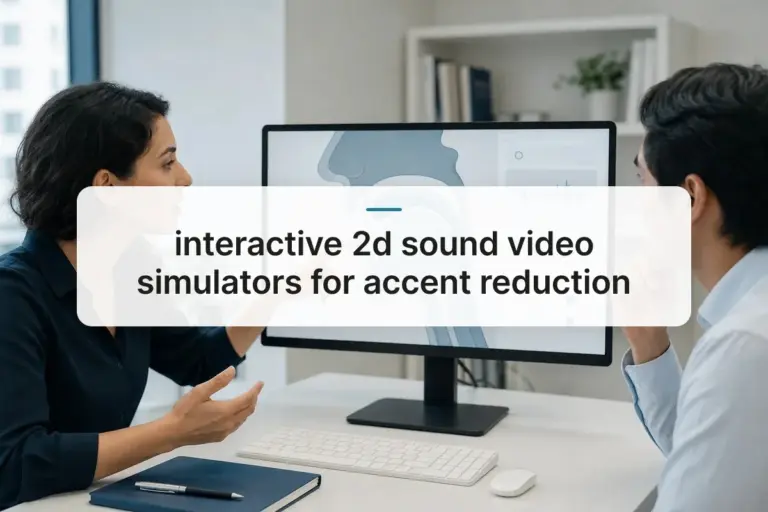
interactive 2d sound video simulators for accent reduction
Interactive Visual 2D Sound Simulators let you actively control and adjust tongue, lip, jaw, airflow, and voicing movements on screen while practicing.....



