American Accent Training for Non-Native and Foreign-Born Actors
(512) 265-9515Updated October 22, 2026 ◆ 12 min read
American accent training for non-native and foreign-born actors builds a General American accent you can hold through auditions, long takes, and live performance. At MyAccentWay, Prof. Alex trains foreign-born actors in live online 1-on-1 sessions. He works on the sounds, stress, rhythm, and intonation that your native language changes, so the accent stays consistent when the camera is rolling.
Real student result

“I feel confident enough to speak American English!”
Interactive American Accent Training9monthsof hard work and dedication
Listen to the starting point0:00
Listen to the result0:00
“Many of my students once believed they could never sound like this. School taught them grammar and vocabulary, but not how to train their English speech. That is what we do together, step by step, until you speak English independently and with confidence.”
Abishek’s result was achieved through Prof. Alex’s research-based Interactive 1-on-1 American Accent Training. His doctoral research found this interactive method more effective than traditional, teacher-centered methods. See the research basis →
Many foreign-born actors know how a line should sound but lose the American sounds under the pressure of a long take or a high-stakes audition. Vowels drift, the American [r] slips, and native rhythm returns. This guide explains how actor-specific American accent training works, how to prepare a script, and how to start with a 1-hour evaluation.
Book American Accent Training for Foreign-Born Actors
- Who it is for: non-native and foreign-born actors preparing for roles, auditions, self-tapes, and stage work in American English.
- How you start: a 1-hour evaluation for $100. Prof. Alex checks your American sounds one by one, along with your stress and intonation. He shows you which sounds from your native language carry into your English.
- What you leave with: a sound-by-sound plan for your accent and your next role.
- How training works: Interactive Visual 2D Sound Simulators train your speech organs for each American sound. Then you practice the sounds in your script lines with live feedback from Prof. Alex.
General American Speech for Foreign-Born Actors
American accent training for actors is the intentional modification of speech patterns so the accent stays consistent across every take and every scene. It is a technical skill, like stage combat or period dance, that keeps your voice from becoming a distraction. You are not losing your identity; you are expanding your phonetic range, so the audience connects with your character instead of wondering where you are from.
A trained accent is different from an impression. An impression is fragile and often breaks under the pressure of a film set. Prof. Alex teaches how each sound is physically produced, so you can repeat the same performance at 4:00 AM as you did at noon. That consistency matters when foreign-born actors audition for U.S. productions.
Why Foreign-Born Actors Need More Than Copying a Sound
When an actor copies a sound by ear, the brain is busy listening to its own voice instead of staying present in the scene. In a high-stakes emotional moment, the brain puts feeling before pronunciation, and native speech patterns return. Training the speech organs moves the accent from conscious thought into physical habit, so your articulators find the correct position without you thinking about it.
The Role of General American (GenAm) in Modern Media
General American English is the accent most film and television auditions in the United States expect. It is a non-regional accent that fits almost any setting. A reliable switch into General American gives a foreign-born actor more roles to audition for.
The same core principles are used in American Accent Training for U.S. Professionals. On stage or in a boardroom, the goal is clear communication. Your culture matters and adds depth to your acting; American accent training is the tool that lets every audience hear you clearly.
Phonemes and Intonation for the Stage
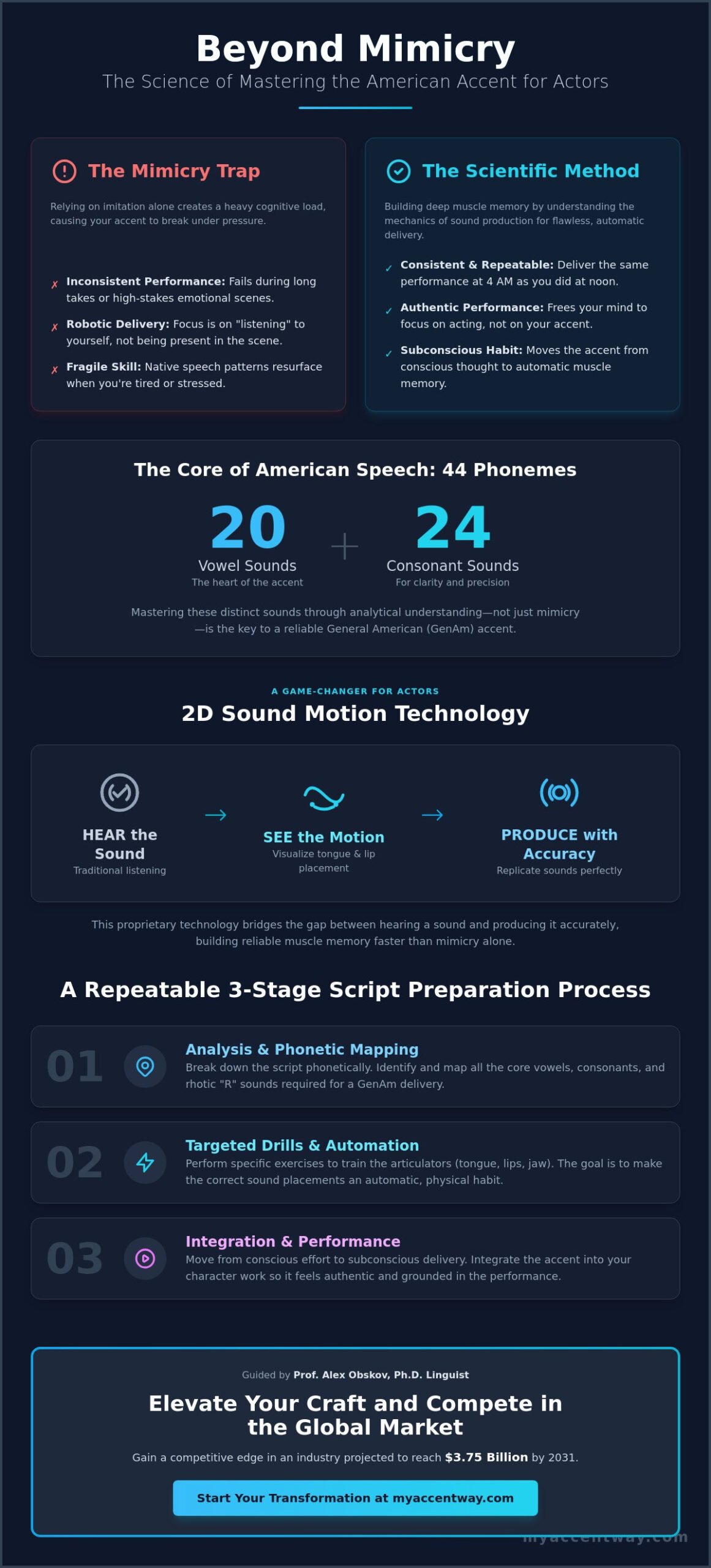
Prof. Alex approaches American accent training for actors through interactive teaching, the method he studied in his doctoral research. Students analyze how each sound is produced instead of copying it. The American sound system has 44 core phonemes: 24 consonants and 20 vowels. Learning them means understanding how each sound is produced, so you can produce it under any performance condition.
One of the most important sounds for foreign-born actors is the American [r]. Many languages produce the [r] at the front of the mouth or with a trill, while the American [r] is produced further back. This single sound often reveals a native accent in auditions. The American English Speech Course from Carnegie Mellon University covers these phonetic foundations in more detail.
Decoding American Vowels and Consonants
The 20 American vowels are the main source of accent variation. American English uses specific diphthongs and the schwa as its anchor. The schwa is the most common sound in American speech and appears in unstressed syllables. Without it, speech sounds over-pronounced. The American [t] also changes: it becomes a flap in words like “water” and a glottal stop in words like “button.” These details make an American accent sound natural to a U.S. audience.
Intonation and Rhythm: The Actor’s Secret Weapon
If phonemes are the notes, intonation and rhythm are the music. American speech often steps down in pitch across a sentence, and linked sounds join the end of one word to the beginning of the next. For an actor, intonation carries subtext and emotion. Shifting sentence stress to a different word changes a character’s intention. Try it: record one line several times and stress a different word each time. You will hear the meaning shift with the pitch.
How Interactive Visual 2D Sound Simulators Train Actors
Traditional coaching often relies on “watch my mouth.” The most important movements for sounds like the American [r] or [th] happen inside the mouth, where no one can follow them. Prof. Alex created 2D Sound Motion Technology as part of his interactive teaching model, based on his Ph.D. research in interactive teaching methods. With the Interactive Visual 2D Sound Simulators, students actively train the movement of the tongue, lips, jaw, teeth, and airflow while Prof. Alex corrects them live.
This approach connects hearing a sound with producing it. It is in line with research on sensory-based pronunciation instruction, which emphasizes multi-sensory feedback in speech learning.
Training the Speech Organs
The simulators train the difference between voiced and unvoiced consonants and the tongue position for each American vowel. This helps actors who find written phonetic descriptions confusing. Once tongue placement is trained, you can focus on the emotional truth of the scene.
Building Automatic Habits for the Set
The goal of American accent training for actors is an automatic speech pattern. Training each sound with the simulator and then using it in your script lines builds the habit step by step. When the director calls “action,” your American accent is grounded and consistent.
MyAccentWay · 2D Sound Motion Technology
American English Pronunciation: Consonant and Vowel Sounds with 2D Sound Motion Technology
Learning American English pronunciation and the American accent is more effective when you train your speech organs, not only listen and repeat. 2D Sound Motion Technology and Interactive Visual 2D Sound Simulators, developed in 2020 by Prof. Alex, Ph.D. Accent Coach, Doctor of Education, and professional linguist, as part of his interactive teaching model based on his Ph.D. research in interactive teaching methods, train your tongue, lips, jaw, teeth, airflow, and voice step by step. They train each American sound and more than 30 sound combinations through Interactive 2D video simulation.
What 2D Sound Motion Technology is
2D Sound Motion Technology is an advanced accent reduction and articulation training tool by Prof. Alex. It corrects, develops, and trains each American sound and more than 30 sound combinations through Interactive 2D video simulation.
What Interactive Visual 2D Sound Simulators do
Interactive Visual 2D Sound Simulators are part of 2D Sound Motion Technology, the articulation-training method Prof. Alex created by applying his Ph.D. research in interactive teaching to American pronunciation. Instead of listening and repeating, students actively train their speech organs. Each simulator uses Interactive 2D mouth movement to train the speech organs (tongue, lips, jaw, teeth, airflow, and voice) to produce each American sound correctly. Every consonant has its own simulator: explore American consonants trained with 2D Sound Motion Technology.
Sample training: the American t sound (aspirated [t])
Practice
Record yourself speaking these words:
Tab · Tacos · Time · Tub · Hotel · Motel · Sit · Pit · Net
Instructions
Play the Interactive Visual 2D Sound Simulator for the American t sound below several times and follow it step by step. Move your tongue, jaw, and airflow together with the simulator and train your articulation.
Interactive Visual 2D Sound Simulator: American unvoiced sound [t]
Practice
Record yourself again speaking these words, but this time focus on the movement of your tongue. Go slow, and you will hear the difference. You’ve got this!
Tab · Tacos · Time · Tub · Hotel · Motel · Sit · Pit · Net
How Interactive Visual 2D Sound Simulators solve pronunciation and speaking problems
- Wrong articulationMost pronunciation problems start with the tongue, lips, jaw, or teeth in the wrong position. Each Interactive Visual 2D Sound Simulator trains the correct articulation of one American sound, so the student corrects the cause of the problem, not only the result.
- Airflow and voicingMany accent problems come from wrong airflow or voicing: sounds that are too weak, too strong, or voiced when they should be unvoiced. The simulators train airflow and voice together with articulation, step by step, for each American sound and more than 30 sound combinations.
- Clear speech and confidenceWhen each sound is trained correctly, words connect into clear American English speech. Listeners can understand you more easily, and speaking at work, in meetings, and on calls becomes more confident.
If you start hearing the aspiration, the short airstream after [t], with one simulator, you can only imagine how successful you can be in 1-on-1 Interactive American Accent Training with Prof. Alex, Ph.D. Accent Coach, where your whole American sound system is trained sound by sound.
In MyAccentWay, the Interactive Visual 2D Sound Simulators are only available in 1-on-1 accent coaching sessions with Prof. Alex.
How to Prepare a Script Using American Accent Modification Techniques
Generic advice tells performers to “just listen” to native speakers. Actor-specific American accent training needs a structured framework. When you receive your sides for an audition, you need a repeatable system that moves from understanding to automatic production, so on camera your focus stays on the character.
Stage 1: Phonetic Script Analysis
Mark up your script with phonetic notation and highlight the sounds that trigger your native speech patterns. Pay attention to vowels and the American [r]. Mark the falling intonation points and the places where words link together. Consider the character’s background as well; even within General American, rhythm can change with the setting. Mapping these sounds early prevents your native accent from returning during high-stress takes.
Stage 2: Practice with Interactive Visual 2D Sound Simulators
After the analysis, use the Interactive Visual 2D Sound Simulators to train the specific sounds in your dialogue. Do not read the whole script at once. Isolate the hardest sentences and practice them at half your normal speed, checking every movement. Then increase the tempo until the American rhythm feels natural.
Stage 3: Performance and Feedback
Record your rehearsals and listen for inconsistencies, especially where your native intonation returns. Self-correction is a good start, and live feedback from Prof. Alex, Ph.D. Accent Coach catches the details a non-expert ear misses. Holding the accent across a 12-hour shoot day is tiring, so a well-practiced foundation is your best support.
Training with Prof. Alex, Ph.D. Accent Coach
Prof. Alex believes your cultural background is an asset, not an obstacle. His training adds a new skill to your range instead of asking you to change who you are. This philosophy, “Your Culture Matters,” keeps your artistic voice while you build the clarity U.S. roles require.
The MyAccentWay Training Approach
Training is individual. There is no one-size-fits-all curriculum; Prof. Alex adapts each session to your native language and pronunciation habits. Sessions are live online 1-on-1, so you can train from Austin, Los Angeles, New York, or anywhere you work.
Your Next Steps: From Audition to Booking
A reliable General American accent changes the casting conversation from “can they do the accent?” to “is this the right person for the character?” The first step is the 1-hour evaluation for $100, where Prof. Alex checks your American sounds and gives you a sound-by-sound plan.
Step Into Your Next Role with Confidence
Professional American accent training for non-native and foreign-born actors moves your accent from conscious effort to a performance habit. Led by Prof. Alex, Ph.D. Accent Coach, MyAccentWay uses Interactive Visual 2D Sound Simulators to train your speech organs, so you can focus on your craft while keeping your cultural identity.
Ready for your next audition? Book Your 1 Hour Evaluation Session with Prof. Alex, Ph.D. Accent Coach.
American Accent Training for Foreign-Born Actors and Voice Professionals in the United States
Foreign-born professionals in the United States often know their field and speak advanced English. Yet American listeners may still struggle with their sounds, stress, and rhythm. MyAccentWay offers private online American accent training through Interactive American Accent Training.
Interactive American Accent Training is led by Prof. Alex, Ph.D. Accent Coach, Doctor of Education, and professional linguist. He first diagnoses each speaker’s native-language patterns. Then he trains American sound articulation, rhythm, and intonation for real auditions and performances.
Who this training is for
- Engineers, IT specialists, and data professionals presenting to U.S. teams and clients
- Doctors, nurses, and healthcare professionals explaining care to American patients
- Managers, executives, and founders leading meetings, pitches, and briefings
- Consultants, researchers, and academics speaking at conferences and webinars
- Professionals preparing for interviews, promotions, or client-facing roles
Online training across the U.S.
MyAccentWay is based in Austin, Texas, and all training is online. The program is especially relevant for professionals in Austin, Dallas, Houston, New York City, the San Francisco Bay Area, Los Angeles, Seattle, Boston, Chicago, Miami, Washington DC, Atlanta, and Raleigh.
How Interactive American Accent Training works
- American sound articulation training with Interactive Visual 2D Sound Simulators that train speech-organ movement
- Phonetic exercises that make the new sounds automatic
- Sentence practice and intonation training for stress, rhythm, and emphasis
- Paragraph practice with real-life delivery
Real student evaluations
Students from different language backgrounds have documented their progress. Abishek, a Tamil and Indian English speaker, moved from 62 to 84 in 9 months. Tian, a Mandarin speaker, moved from 58 to 85 in 8 months. Vlad, a Russian speaker, moved from 60 to 83 in 5 months.
The first step is a 1 Hour Evaluation Session with Prof. Alex.
Frequently Asked Questions
Is there American accent training for non-native and foreign-born actors?
Yes. MyAccentWay trains non-native and foreign-born actors with Prof. Alex, Ph.D. Accent Coach in live online 1-on-1 sessions. Training covers American sounds, stress, rhythm, and intonation for roles, auditions, self-tapes, and stage work.
How much does American accent training for actors cost?
It starts with the 1-hour evaluation for $100. The plan after the evaluation depends on your goals and your next role.
Can I keep my native accent for other roles?
Yes. Training adds a General American accent to your range; it does not remove your own. You can use the American accent for a role and keep your native voice for personal life and other characters.
How long does it take for an actor to learn an American accent?
It depends on your native language, your starting point, and how much you practice between sessions. The 1-hour evaluation shows which sounds need the most work, and Prof. Alex builds your plan from there.
What is the difference between “accent reduction” and “accent modification” for actors?
“Accent reduction” usually means making speech clearer for a U.S. audience, while “accent modification” means an intentional shift toward a specific accent. For actors, modification is the more precise term because you adapt your speech to a script. Both aim for clarity without erasing your linguistic identity.
Is online American accent training a good fit for stage and screen actors?
Yes. Online 1-on-1 training is practical for working actors. With high-definition video and the Interactive Visual 2D Sound Simulators, Prof. Alex corrects your articulation live, the same way he would in person.
Can I learn a specific regional American accent with this method?
Yes. Once the foundations of General American are in place, you can work on regional accents such as New York or Southern. The same method is used to analyze their vowel shifts and rhythm.
Do I need to be an advanced English speaker to start actor-specific accent training?
An advanced level of English is recommended. Actor-specific work involves subtext, intonation, and emotional nuance. If you can work confidently with a script and understand your character’s objectives, you are ready to start.
The problem is not always grammar or vocabulary.
If people understand your words but still miss your message, the deeper issue may be speech clarity, rhythm, intonation, and American pronunciation habits. MyAccentWay helps students retrain the sound system with professional 1-on-1 guidance, so English can feel clearer, freer, and more natural in real communication.
Two training methods that make speech change active.
MyAccentWay is not passive listen-and-repeat coaching. Prof. Alex, Ph.D. Accent Coach, Doctor of Education, and professional linguist, creates a learning situation where students become active learners and active participants in changing their own speech patterns.
Interactive training
Students do not just receive pronunciation instructions passively. They listen, think, compare, adjust, and understand their own speech patterns while Prof. Alex guides the correction process.
Cognitive accent training
Students learn to notice and correct the speech patterns that affect American pronunciation, then implement new American speech patterns into their code-switching process for more natural, long-lasting change.
Build speech habits people can hear in real conversations.
A stronger American accent is not built by memorizing topics or chasing quick pronunciation tips. It comes from structured training, professional feedback, active correction, and repeated application until clearer speech becomes easier to keep.
Continue learning how MyAccentWay connects American sound articulation, Interactive Visual 2D Sound Simulators, accent reduction, student proof, and 1-on-1 training.
- Prof. Alex and the MyAccentWay MethodLearn how Prof. Alex created and leads the structured MyAccentWay American accent training system.
- Accent Reduction Curriculum and English Articulation TrainingSee accent reduction, accent modification, American pronunciation, English articulation, rhythm, and professional speech clarity.
- 2D Sound Motion Technology for American Accent TrainingUnderstand Interactive Visual 2D Sound Simulators for American sound articulation.
- Before-and-After American Accent Training ResultsListen to real before-and-after student proof and outcomes.
- Student Reviews and Accent Training ResultsRead student reviews and trust signals.
- Book a 1-on-1 American 1 Hour Evaluation SessionStart with a 1-hour interactive session with Prof. Alex.
Disclaimer – American Accent Program
The American Accent Program available through Visit Program Website
is an educational and coaching service designed to support pronunciation, accent reduction, and spoken English fluency. All training materials, including lessons, exercises, audio content, visual simulations, coaching methods, and digital resources, are the intellectual property of American Accent Program, LLC and are protected by applicable copyright and intellectual property laws.
By using this website and participating in the program, you acknowledge that all content is provided for personal, non-commercial, educational use only. Users are granted a limited, non-transferable license to access the materials strictly for individual learning purposes. Redistribution, reproduction, recording, modification, sharing, or commercial use of any program content without prior written consent is strictly prohibited.
The program may include live coaching sessions, digital tools, and instructional materials intended to improve pronunciation and communication skills. However, individual results may vary, and no specific level of fluency, accent reduction, or communication outcome is guaranteed.
The American Accent Program and its instructors do not provide medical, therapeutic, or clinical speech-language pathology services. All training is intended for educational purposes only.
By accessing or using the program, you agree to comply with all applicable terms, including the platform’s Terms of Use and Course Policies, and acknowledge that misuse of materials may result in termination of access without refund.