Adjust English Pronunciation for US Colleagues: A Professional Plan
(512) 265-9515Updated October 16, 2026 ◆ 15 min read
A professional guide for non-native English-speaking professionals who want clearer American pronunciation, stronger workplace fluency, and more confident communication with U.S. colleagues.
Real student result

“Prof. Alex is an excellent accent coach, and he puts a lot of practice into you. As a non-native English speaker, I wanted to reduce my foreign accent, and training my American accent with him has been a great experience.”
Interactive American Accent Training8monthsof hard work and dedication
Listen to the starting point0:00
Listen to the result0:00
“Many of my students once believed they could never sound like this. School taught them grammar and vocabulary, but not how to train their English speech. That is what we do together, step by step, until you speak English independently and with confidence.”
Tian’s result was achieved through Prof. Alex’s research-based Interactive 1-on-1 American Accent Training. His doctoral research found this interactive method more effective than traditional, teacher-centered methods. See the research basis →
Prof. Alex, Ph.D. Accent Coach
Interactive 1-on-1 accent training method, 2D Sound Motion Technology, and cognitive accent training for clearer American speech.
Sentence stress, connected speech rhythm, and three consonant contrasts are the highest-leverage targets to adjust when you want U.S. colleagues to understand you more easily. You do not need to eliminate your accent. You need to make your speech patterns predictable enough that listeners can follow you without effort. As of 2019, 28.4 million foreign-born individuals made up 17.4% of the U.S. labor force, according to the Bureau of Labor Statistics, which means this challenge is shared by millions of professionals in American workplaces every day.
Before your next meeting, do these three things:
- Stress the most important content word in each phrase (“We need to FINISH the report” not “we NEED to finish the report”).
- Chunk your sentences into short breath groups with a brief pause between them, rather than speaking in one long stream.
- Record yourself for 60 seconds on a work topic, then listen back for where your rhythm sounds choppy or flat.
- Identify one consonant contrast that causes confusion for your listeners (common ones: /v/ vs. /w/, /th/ vs. /d/, final consonant dropping).
- Write one sentence summarizing your main point before each meeting and practice saying it aloud twice.
Personalized American accent training with MyAccentWay, led by Prof. Alex, Ph.D., gives you a structured path from these first steps to measurable, lasting improvement.
Explore CurriculumBook Your 1 Hour Evaluation SessionRead ReviewsWhat should you fix first to improve pronunciation for colleagues?
Intelligibility research consistently points to the same priorities: sentence-level stress and chunking deliver faster comprehension gains than perfecting individual vowels. Here is where to focus your effort, ranked by impact:
- Sentence and phrase stress: Stress content words (nouns, main verbs, adjectives) and reduce function words. This is the single biggest signal U.S. listeners use to parse meaning.
- Chunking and connected speech: Group words into short phrases separated by micro-pauses. “I want to talk about / the budget / for next quarter” is far easier to follow than one unbroken stream.
- Rhythm and tempo: American English has a stress-timed rhythm. Unstressed syllables are shorter and reduced. Matching that pattern matters more than slowing down.
- Voice-onset contrasts: The /v/ vs. /w/ distinction (“very” vs. “wary”), the /th/ sounds, and final consonant clarity (not dropping the final /t/ or /d/) cause the most frequent misunderstandings.
- The American rhotic /r/: If your first language does not have a retroflex /r/, this sound affects perceived fluency in words like “work,” “first,” and “report.”
Before/after example: “Weneedtodiscusstheprojectdeadline” (no chunking, no stress) vs. “We need to DISCUSS / the project DEADLINE” (chunked, stressed). The second version takes the same time to say and is dramatically easier to process.
The goal is not accent-free speech. Pronunciation coaching targets intelligibility, not conformity. Harmless variation in vowel quality rarely causes breakdowns; missing stress and dropped final consonants do.
Pro Tip: Focus on contrasts that change meaning, not on every sound that differs from American English. If your /æ/ sounds slightly different from a native speaker’s, that is usually fine. If your listeners hear “wery” instead of “very,” that is worth fixing.
How do you build a structured training plan you can actually follow?
An effective method follows four stages: speech-organ awareness, targeted drills, sentence-level chunking practice, and conversation transfer. Form-focused pronunciation instruction produces measurable gains when it is tied to real workplace speech acts, not just isolated repetition.
Daily and weekly schedule (6–8 weeks):
- Days 1–5 (Week 1–2): 15 minutes of speech-organ awareness work. Learn where your tongue, lips, and jaw position for the target sounds. This is not “repeat after me” — it is understanding the physical mechanics first.
- Days 6–10 (Week 2–3): Add 10 minutes of focused articulation drills on your two or three priority contrasts. Record each session.
- Week 3–5: Introduce rhythm and intonation shadowing. Choose a 30-second audio clip from a U.S. business podcast and shadow it, matching stress and pausing patterns.
- Week 5–8: Workplace role-play. Practice presenting a project update, handling a Q&A, and making small talk. Record, compare with your Week 1 recording, and note specific changes.
- Coached sessions: Two one-hour sessions per week with a qualified coach accelerates transfer from drill to natural speech.
Progress evidence to collect:
- Pre- and post-recordings of the same 60-second work topic.
- A listener checklist: ask a trusted colleague to note how often they ask you to repeat yourself.
- A self-rated confidence scale (1–10) before and after each week of practice.
MyAccentWay’s Interactive Visual 2D Sound Simulators train this process. Instead of guessing where your tongue goes, you practice the exact mouth movement in real time. Practice with the simulators here: In MyAccentWay training, these simulators are used to train sound articulation, sound formation, and speech production during live 1-on-1 accent training sessions.
Tian, a Mandarin speaker, followed this structured path with Prof. Alex and achieved clear, measurable improvement in American consonants and rhythm.
Why does MyAccentWay work differently from traditional accent coaching?
MyAccentWay is not a traditional “repeat after me” program. Prof. Alex uses an active, interactive, and linguistics-based method that helps students understand, simulate, and retrain the speech patterns behind clearer American pronunciation.
Three pillars behind clearer American speech
Interactive 1-on-1 Accent Training Method
The interactive method is a unique way to educate accent training students. With 20 years of teaching and research experience, Prof. Alex developed active methods that help retrain the sound system. After working with students from multiple cultures around the world, Prof. Alex leads students to identify the speech patterns and habits that affect their accent and speech clarity. He helps students actively participate in the accent training process and work toward accurate American pronunciation through an active method, rather than a traditional passive-learning approach where the coach simply lectures or explains sounds. This interactive method helps students build stronger confidence speaking American English in meetings, interviews, presentations, client calls, and daily conversations.
Unique 2D Sound Motion Technology
When students face challenging articulation problems with sound development or pronunciation patterns, 2D Sound Motion Technology becomes a game changer. Students can develop and produce American sounds faster through Interactive Visual 2D Sound Simulators. Compared to traditional methods where the student only listens to the coach’s description of how to articulate a sound or speech pattern in American pronunciation, Interactive Visual 2D Sound Simulators make the process faster, easier, and more effective by training each American sound through simulation and guided voice-over instructions. The simulators train all speech organs involved in the articulation of a specific American sound and turn sound practice into easier, clearer speech patterns. This technology is unique to Prof. Alex’s American accent training method in the United States and cannot be found anywhere else.
Cognitive Accent Training
In adult accent training, it is important for students to understand the process behind speech change. That is why critical thinking in accent training is crucial. Through evaluation and guided practice, Prof. Alex leads students to use critical thinking so they can develop steady, long-lasting American pronunciation patterns. Instead of traditional methods that only theorize accent training or only build awareness of how to produce a sound or speech pattern, in cognitive accent training, Prof. Alex leads students to actively participate in retraining American sounds and speech patterns and applying them effectively and naturally while speaking American English.
This is why the article focuses on stress, rhythm, consonant clarity, and workplace transfer. The goal is not just to understand pronunciation theory. The goal is to build speech habits that become clearer, more natural, and easier to use in real professional communication.
MyAccentWay · 2D Sound Motion Technology
American English Pronunciation: Consonant and Vowel Sounds with 2D Sound Motion Technology
Learning American English pronunciation and the American accent is more effective when you train your speech organs, not only listen and repeat. 2D Sound Motion Technology and Interactive Visual 2D Sound Simulators, developed in 2020 by Prof. Alex, Ph.D. Accent Coach, Doctor of Education, and professional linguist, as part of his interactive teaching model based on his Ph.D. research in interactive teaching methods, train your tongue, lips, jaw, teeth, airflow, and voice step by step. They train each American sound and more than 30 sound combinations through Interactive 2D video simulation.
What 2D Sound Motion Technology is
2D Sound Motion Technology is an advanced accent reduction and articulation training tool by Prof. Alex. It corrects, develops, and trains each American sound and more than 30 sound combinations through Interactive 2D video simulation.
What Interactive Visual 2D Sound Simulators do
Interactive Visual 2D Sound Simulators are part of 2D Sound Motion Technology, the articulation-training method Prof. Alex created by applying his Ph.D. research in interactive teaching to American pronunciation. Instead of listening and repeating, students actively train their speech organs. Each simulator uses Interactive 2D mouth movement to train the speech organs (tongue, lips, jaw, teeth, airflow, and voice) to produce each American sound correctly. Every consonant has its own simulator: explore American consonants trained with 2D Sound Motion Technology.
Sample training: the American t sound (aspirated [t])
Practice
Record yourself speaking these words:
Tab · Tacos · Time · Tub · Hotel · Motel · Sit · Pit · Net
Instructions
Play the Interactive Visual 2D Sound Simulator for the American t sound below several times and follow it step by step. Move your tongue, jaw, and airflow together with the simulator and train your articulation.
Interactive Visual 2D Sound Simulator: American unvoiced sound [t]
Practice
Record yourself again speaking these words, but this time focus on the movement of your tongue. Go slow, and you will hear the difference. You’ve got this!
Tab · Tacos · Time · Tub · Hotel · Motel · Sit · Pit · Net
How Interactive Visual 2D Sound Simulators solve pronunciation and speaking problems
- Wrong articulationMost pronunciation problems start with the tongue, lips, jaw, or teeth in the wrong position. Each Interactive Visual 2D Sound Simulator trains the correct articulation of one American sound, so the student corrects the cause of the problem, not only the result.
- Airflow and voicingMany accent problems come from wrong airflow or voicing: sounds that are too weak, too strong, or voiced when they should be unvoiced. The simulators train airflow and voice together with articulation, step by step, for each American sound and more than 30 sound combinations.
- Clear speech and confidenceWhen each sound is trained correctly, words connect into clear American English speech. Listeners can understand you more easily, and speaking at work, in meetings, and on calls becomes more confident.
If you start hearing the aspiration, the short airstream after [t], with one simulator, you can only imagine how successful you can be in 1-on-1 Interactive American Accent Training with Prof. Alex, Ph.D. Accent Coach, where your whole American sound system is trained sound by sound.
In MyAccentWay, the Interactive Visual 2D Sound Simulators are only available in 1-on-1 accent coaching sessions with Prof. Alex.
What workplace tactics reduce misunderstandings in meetings and calls?
Pronunciation gains only pay off when you apply them in real conversations. U.S. workplace norms are low-context: directness, explicitness, and active participation are expected. Three tactics make an immediate difference:
- Pre-meeting position statement: Before any meeting, write one sentence summarizing your main point. Say it aloud twice. This primes your articulators and reduces in-meeting hesitation.
- Strategic clarification phrasing: Instead of saying “What?” use “Could you say that last part again?” or “I want to make sure I understood — you said X, right?” These phrases signal engagement, not confusion.
- Written follow-up: After a meeting, send a two-sentence email confirming the key decision or next step. This reinforces your spoken point and removes ambiguity.
Meeting habits to build:
- Signal your point before making it: “My concern is…” or “What I’d suggest is…”
- Chunk information: present one idea, pause, confirm, then continue.
- Confirm next steps aloud at the end of every meeting.
- Use paraphrase rather than repetition when asked to clarify.
- Keep small talk short and direct: “How was your weekend?” followed by a one-sentence answer, then a question back.
Pro Tip: Written follow-ups do double duty. They reduce cognitive load on your listeners and give you a record of what was agreed, which protects you professionally.
How long does it take to measure real improvement?
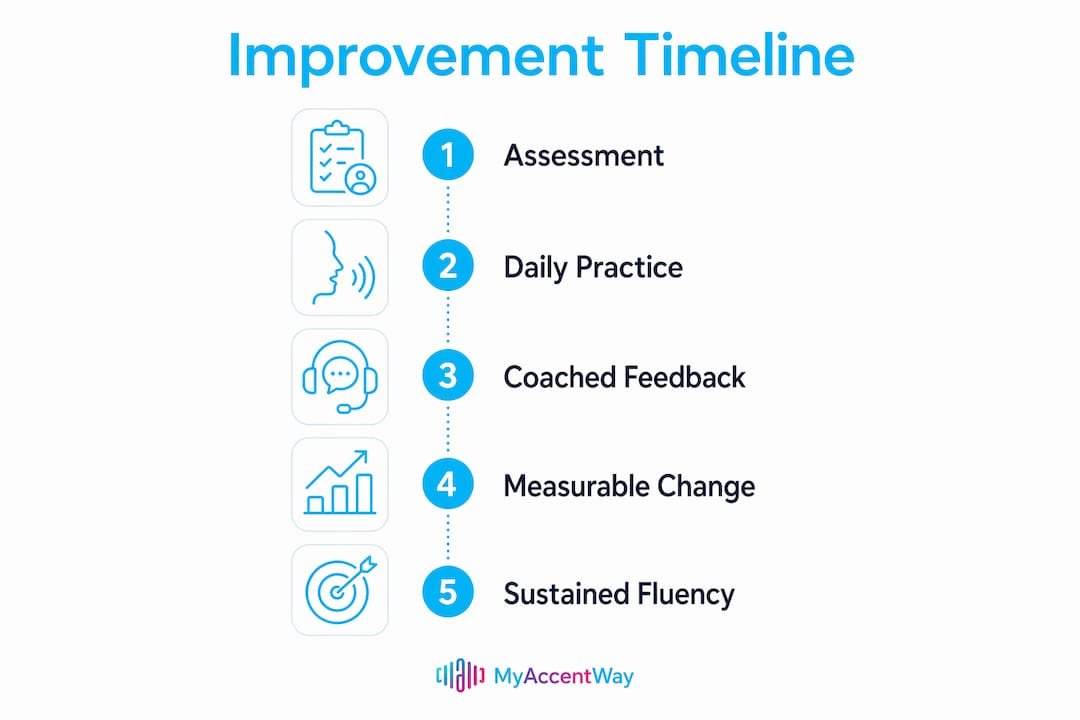
Noticeable improvement typically arrives within 6–8 weeks of focused daily practice combined with coached feedback. Workplace pronunciation training shows gains in clarity and participation after even short, targeted interventions when practice is tied to real job tasks.
| Milestone | What to expect |
|---|---|
| Week 0 | Baseline recording; identify 2–3 priority targets; listener asks for repetition frequently |
| Week 4 | Chunking and stress patterns more consistent; fewer repair requests in low-stakes conversations |
| Week 8 | Target sounds habitual in prepared speech; self-rated confidence noticeably higher; listener checklist shows measurable reduction in misunderstandings |
Collecting useful feedback:
- Ask a trusted colleague: “Do you notice any difference in how easy it is to follow me compared to a month ago?”
- Compare your Week 0 and Week 8 recordings on the same topic. Listen specifically for stress placement and chunking, not accent.
- Track how often you are asked to repeat yourself in a given week. That number is your clearest external metric.
The role of consistent repetition in pronunciation learning means daily practice of 15–30 minutes outperforms one long weekly session by a wide margin.
How do you choose an accent coach or program that actually works?
The most important credential is not a certificate in “accent coaching.” It is a linguistics background combined with a motor-based teaching method and documented student outcomes.
Evaluation checklist:
- Does the coach hold a graduate degree in linguistics, phonetics, or a related field?
- Does the method include speech-organ awareness, not just audio imitation?
- Are there verifiable student results with measurable outcomes?
- Does the program use technology (such as the Interactive Visual 2D Sound Simulators) as part of Prof. Alex’s interactive teaching model, based on his Ph.D. research in interactive teaching methods, to actively train the movement of the tongue, lips, jaw, teeth, and airflow while Prof. Alex corrects students live?
- Can you try a sample session before committing to a full program?
Pricing context: One-on-one accent coaching from a credentialed linguist typically ranges from moderate to premium investment depending on session frequency, coach experience, and technology tools included. A complete pricing guide helps you understand what drives cost and what to expect at each level. Group programs cost less but offer less personalized feedback on your specific sound system.
For professionals who want a low-commitment starting point, a 1 Hour Evaluation Session lets you experience the method before deciding on a full program.
Key Takeaways
Adjusting your English pronunciation for U.S. colleagues is effective when you prioritize sentence stress and chunking, practice daily with a structured method, and use speech-organ awareness rather than imitation alone.
| Point | Details |
|---|---|
| Prioritize stress and chunking | Sentence-level stress and breath-group chunking deliver faster intelligibility gains than perfecting individual vowels. |
| Practice 15–30 minutes daily | Short daily sessions outperform long weekly ones; 6–8 weeks of focused practice produces noticeable, measurable change. |
| Record and compare | Pre- and post-recordings of the same topic are your most objective measure of progress. |
| Use clarification scripts | Phrases like “I want to make sure I understood — you said X, right?” signal engagement and reduce misunderstandings. |
| Choose a linguistics-based coach | Look for a graduate linguistics background, motor-based techniques, visual tools, and verifiable student results. |
| MyAccentWay with Prof. Alex | Structured 1-on-1 coaching using Interactive 2D Sound Motion Technology delivers speech-organ awareness, targeted drills, and measurable outcomes. |
What most learners get wrong about pronunciation improvement
The professionals I work with most often arrive believing their accent is the problem. It rarely is. The actual barrier is almost always a mismatch between how they chunk and stress speech and what U.S. listeners expect. A strong accent with clear stress and good chunking is far easier to follow than a mild accent delivered in a flat, unstressed stream.
There is also a persistent myth that pronunciation improvement requires erasing your identity. That is not what structured training does. Your accent carries your history and your intelligence. What changes is the predictability of your rhythm and the clarity of your key consonant contrasts. Your voice stays yours.
The 2D Sound Motion Technology I use in every session addresses the real obstacle: most learners cannot produce a sound correctly because they do not yet understand the physical movement behind it. Once that movement is visible and teachable, progress accelerates in a way that audio imitation alone never achieves. Watch the demonstration at youtu.be/3EzjosgnzJE and you will see exactly what I mean.

Prof. Alex, Ph.D. Accent Coach
MyAccentWay: 1-on-1 coaching built for U.S. professionals
If you are ready to move from awareness to measurable change, MyAccentWay offers a structured, linguistics-based curriculum delivered one-on-one by Prof. Alex, Ph.D. The program combines the Interactive 1-on-1 Accent Training Method, 2D Sound Motion Technology, Interactive Visual 2D Sound Simulators, and cognitive accent training.
Active participation instead of passive sound explanation.
Visual simulation of tongue, lips, jaw, airflow, and vocal cords.
Critical thinking and active awareness for long-lasting speech change.
The most direct next step is to Book Your 1 Hour Evaluation Session and experience the method firsthand, or explore the full curriculum before you begin.
Useful sources
For learners and professionals:
- U.S. Bureau of Labor Statistics, Current Population Survey — workforce data on foreign-born participation; useful for understanding the scale of this challenge.
- PronSIG: Integrating Pronunciation into Business English — practitioner guidance on stress, chunking, and intelligibility priorities; best starting point for self-study technique selection.
- Business English Success: Improving Pronunciation for Clearer Communication — practical shadowing and recording techniques for professionals.
For technical and research context:
- PMC: Form-focused pronunciation instruction and workplace intelligibility — peer-reviewed case study on structured pronunciation intervention outcomes.
- TESL Ontario: The Three P’s of ESL in the Workplace — evidence for short, job-task-aligned training modules.
- ScienceDirect: Non-native accents and career outcomes — organizational research on accent bias and supervisory responses; relevant for managers and HR teams.
MyAccentWay program resources:
| Resource | Best for |
|---|---|
| 2D Sound Motion Technology | Understanding the visual articulation method |
| Accent Reduction Curriculum | Full program overview and course structure |
| 1 Hour Evaluation Session Page | Low-commitment first session |
| 1 Hour Evaluation Session and Program Details | Planning your investment |
Business English Pronunciation Coaching for Foreign-Born Professionals in the United States
Foreign-born professionals in the United States often know their field and speak advanced English. Yet American listeners may still struggle with their sounds, stress, and rhythm. MyAccentWay offers private online business pronunciation coaching through Interactive American Accent Training.
Interactive American Accent Training is led by Prof. Alex, Ph.D. Accent Coach, Doctor of Education, and professional linguist. He first diagnoses each speaker’s native-language patterns. Then he trains American sound articulation, stress, rhythm, and intonation for real meetings and client conversations.
Who this training is for
- Engineers, IT specialists, and data professionals presenting to U.S. teams and clients
- Doctors, nurses, and healthcare professionals explaining care to American patients
- Managers, executives, and founders leading meetings, pitches, and briefings
- Consultants, researchers, and academics speaking at conferences and webinars
- Professionals preparing for interviews, promotions, or client-facing roles
Online training across the U.S.
MyAccentWay is based in Austin, Texas, and all training is online. The program is especially relevant for professionals in Austin, Dallas, Houston, New York City, the San Francisco Bay Area, Los Angeles, Seattle, Boston, Chicago, Miami, Washington DC, Atlanta, and Raleigh.
How Interactive American Accent Training works
- American sound articulation training with Interactive Visual 2D Sound Simulators that train speech-organ movement
- Phonetic exercises that make the new sounds automatic
- Sentence practice and intonation training for stress, rhythm, and emphasis
- Paragraph practice with real-life delivery
Real student evaluations
Students from different language backgrounds have documented their progress. Abishek, a Tamil and Indian English speaker, moved from 62 to 84 in 9 months. Tian, a Mandarin speaker, moved from 58 to 85 in 8 months. Vlad, a Russian speaker, moved from 60 to 83 in 5 months.
The first step is a 1 Hour Evaluation Session with Prof. Alex.
FAQ
How long does it take to adjust English pronunciation for U.S. colleagues?
Most professionals notice measurable improvement within 6–8 weeks of daily practice (15–30 minutes) combined with coached feedback sessions targeting stress, chunking, and priority consonant contrasts.
What are the highest-impact pronunciation targets for workplace intelligibility?
Sentence stress on content words, breath-group chunking, and clarity of final consonants produce the fastest gains in being understood; these outperform perfecting individual vowel sounds.
Is one-on-one accent coaching worth it compared to self-study?
One-on-one coaching with a credentialed linguist accelerates transfer from drill to natural speech because a coach identifies your specific sound system gaps and adjusts the method in real time, something audio apps cannot do.
How does MyAccentWay’s method differ from standard pronunciation courses?
MyAccentWay uses Interactive 2D Sound Motion Technology as part of Prof. Alex’s interactive teaching model, based on his Ph.D. research in interactive teaching, to help students actively train the movement of the tongue, lips, jaw, teeth, and airflow with Interactive Visual 2D Sound Simulators while Prof. Alex corrects them live, so students understand the physical mechanics of each sound rather than guessing from audio alone.
Can improving pronunciation help my career, not just communication clarity?
Research shows employers rate accented workers as less capable in verbal and mathematical tasks even when performance signals are provided, so improving intelligibility directly reduces that perception gap and supports career advancement.
Train American pronunciation with Prof. Alex
In your 1 Hour Evaluation Session, Prof. Alex evaluates your speech patterns, identifies what affects clarity, and shows how the MyAccentWay method can help you speak clearer American English with more confidence.
Recommended
English Pronunciation for IT Professionals: A Comprehensive 2026 Guide
Last Tuesday, a senior DevOps engineer named Marco discovered that his technical expertise wasn't enough when he was asked to repeat his cloud...

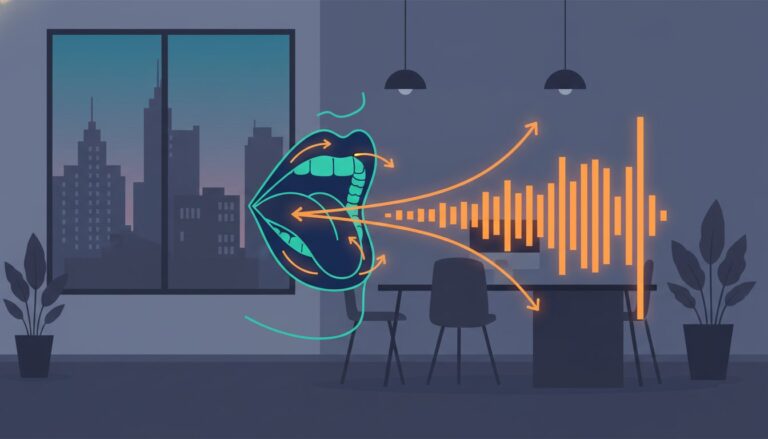
American English Pronunciation Practice: The 2026 Expert Guide
Last week, a senior project manager was asked to repeat his quarterly report findings for the third time. He knew his data was flawless, but the...

American English Pronunciation for Chinese Speakers
Prof. Alex explains American English pronunciation for Chinese speakers, Chinese accent reduction, Mandarin and Cantonese pronunciation challenges, and online American accent training for U.S. professionals.
The problem is not always grammar or vocabulary.
If people understand your words but still miss your message, the deeper issue may be speech clarity, rhythm, intonation, and American pronunciation habits. MyAccentWay helps students retrain the sound system with professional 1-on-1 guidance, so English can feel clearer, freer, and more natural in real communication.
Two training methods that make speech change active.
MyAccentWay is not passive listen-and-repeat coaching. Prof. Alex, Ph.D. Accent Coach, Doctor of Education, and professional linguist, creates a learning situation where students become active learners and active participants in changing their own speech patterns.
Interactive training
Students do not just receive pronunciation instructions passively. They listen, think, compare, adjust, and understand their own speech patterns while Prof. Alex guides the correction process.
Cognitive accent training
Students learn to notice and correct the speech patterns that affect American pronunciation, then implement new American speech patterns into their code-switching process for more natural, long-lasting change.
Build speech habits people can hear in real conversations.
A stronger American accent is not built by memorizing topics or chasing quick pronunciation tips. It comes from structured training, professional feedback, active correction, and repeated application until clearer speech becomes easier to keep.
Continue learning how MyAccentWay connects Prof. Alex’s method, accent reduction, English articulation, 2D Sound Motion Technology, student proof, and 1-on-1 American accent training.
- Prof. Alex and the MyAccentWay MethodLearn how Prof. Alex, Ph.D. Accent Coach, Doctor of Education, and professional linguist, created and leads the structured MyAccentWay American accent training system.
- Accent Reduction Curriculum and English Articulation TrainingSee how MyAccentWay trains accent reduction, accent modification, American pronunciation, English articulation, rhythm, and professional speech clarity.
- 2D Sound Motion Technology for American Accent TrainingUnderstand Prof. Alex’s Interactive Visual 2D Sound Simulators for American sound articulation.
- Before-and-After American Accent Training ResultsListen to real before-and-after student proof and accent training outcomes.
- Student Reviews and Accent Training ResultsRead student reviews, testimonials, and trust signals from MyAccentWay learners.
- Book a 1-Hour 1 Hour Evaluation SessionStart with a 1-hour accent evaluation session with Prof. Alex.




One Response