Accent Coaching for University Professors: Enhancing Academic Clarity & Impact
(512) 265-9515Updated October 14, 2026 ◆ 17 min read
Imagine standing before a high-stakes grant committee where your research is revolutionary, yet you notice the panel’s focus drifting as they struggle to parse the pronunciation of key technical terms. It’s a common hurdle for international faculty members. You’ve spent years mastering your field; however, receiving negative student evaluations regarding clarity can make you feel as if your expertise is being overlooked. I believe your professional identity is tied to your voice. You don’t need to sacrifice your cultural heritage to achieve the clarity your career demands.
Real student result

“I feel confident enough to speak American English!”
Interactive American Accent Training9monthsof hard work and dedication
Listen to the starting point0:00
Listen to the result0:00
“Many of my students once believed they could never sound like this. School taught them grammar and vocabulary, but not how to train their English speech. That is what we do together, step by step, until you speak English independently and with confidence.”
Abishek’s result was achieved through Prof. Alex’s research-based Interactive 1-on-1 American Accent Training. His doctoral research found this interactive method more effective than traditional, teacher-centered methods. See the research basis →
Specialized accent coaching for university professors provides a science-backed framework to bridge the gap between your knowledge and your delivery. As Prof. Alex, Ph.D. Accent Coach, I’ve helped many academics master the precise mechanics of American English to ensure their lectures are delivered with maximum confidence. In this guide, I’ll explain how tools like 2D Sound Motion Technology can refine your speech clarity and help you command any lecture hall. We’ll explore practical strategies for technical terminology and ways to increase your influence during academic networking events.
The Unique Speech Demands of Higher Education
University lecturing requires a level of vocal precision that general language courses rarely address. You might have a perfect score on a proficiency test, yet the lecture hall presents a unique set of challenges. It demands sustained clarity over 90 minute sessions where complex ideas must be communicated without fatigue. I’ve found that accent coaching for university professors is often the missing piece in an otherwise brilliant academic career. It bridges the gap between your deep subject matter expertise and the successful delivery of that knowledge to a diverse student body.
It’s vital to distinguish between accent reduction and the broader goal of speech clarity. In the context of peer-reviewed research and high-stakes presentations, clarity isn’t about sounding like a local; it’s about ensuring your data isn’t lost in translation. Studies show that student comprehension drops significantly when technical phonemes are inconsistent. This often results in lower course evaluations, regardless of the professor’s actual knowledge. By focusing on the mechanics of American English, you ensure that your research remains the primary focus of your audience.
Clarity Beyond Grammar and Vocabulary
Grammar and vocabulary are the foundation, but sound precision is the architecture of a lecture. If you mispronounce a single vowel in a technical term, the meaning can shift entirely. For example, confusing “causal” with “casual” during a lecture on statistics can lead to fundamental misunderstandings of the material. Mastering the nuances of American English pronunciation transforms a professor’s delivery into a powerful vehicle for academic influence and professional recognition. This level of precision is why many faculty members seek out specialized American accent training to refine their classroom presence.
Overcoming the ‘Identity vs. Clarity’ Dilemma
Many faculty members worry that modifying their speech means losing their cultural identity. As Prof. Alex, Ph.D. Accent Coach, I emphasize that your culture matters. Your original accent is a testament to your journey and global perspective. It shouldn’t be eliminated. Instead, think of accent modification as a professional tool for empowerment. It’s about giving you the choice to be understood exactly as you intend, especially during grant defenses or international conferences. We approach this as a professional partnership in communication, focusing on the science of sound to help you project authority while remaining true to your personal story.
The Science of Speech: 2D Sound Motion Technology
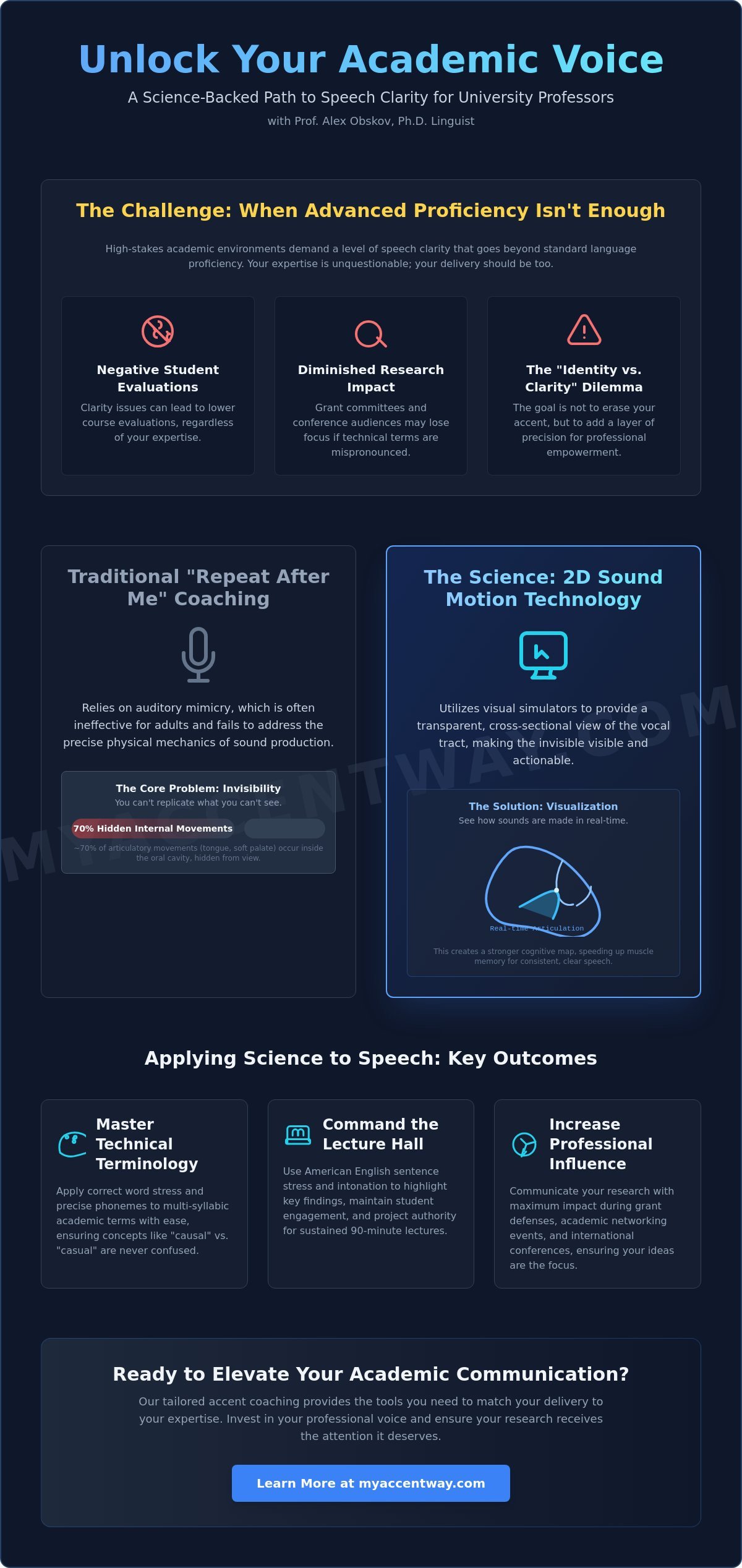
Traditional methods of speech training often rely on a “repeat after me” approach that fails to address the internal mechanics of sound production. For many scholars, simply looking at a coach’s mouth isn’t enough to understand how to produce the subtle nuances of American English. This is because many articulatory movements required for clear speech occur inside the oral cavity, hidden from view. To solve this, I utilize Interactive 2D Sound Simulators for American Sounds. These tools help you understand how the tongue, lips, and soft palate interact during sound production. This visual breakthrough is a cornerstone of effective accent coaching for university professors, as it appeals to the analytical and cognitive strengths of the academic mind.
Practicing sound production offers significant neurological benefits. When you practice with a 2D representation of a phoneme, your brain creates a stronger cognitive map of the physical movement required. This speeds up the process of building muscle memory, which is essential for maintaining clarity during a long lecture. The American Speech-Language-Hearing Association (ASHA) notes that Accent Modification is a specialized field focused on enhancing communication, and using technology to bridge the gap between theory and practice is a key part of that success. By practicing the sound, you move past guesswork and into precise, repeatable execution.
Visualizing American Sounds
Our 2D Sound Motion Technology is particularly effective for mastering sounds that don’t exist in other languages, such as the American [r] or the neutral schwa. Instead of struggling with static diagrams, you can observe the fluid motion of the tongue as it creates the necessary resonance for these sounds. We apply this technology directly to your high-frequency academic vocabulary. Whether you’re discussing “quantitative methodologies” or “theoretical frameworks,” seeing the internal motion of these complex words ensures your delivery is consistent and clear. This visual feedback loop is what makes our approach to accent coaching for university professors so efficient for busy researchers.
A Science-Backed Method for Scholars
I believe that speech clarity should be approached with the same rigor as any other scientific discipline. This sound-by-sound method ensures that every phoneme is produced with intentionality. We treat the American accent as a system of predictable rules and motions rather than a collection of random habits. This philosophy is detailed in our American Accent Training for U.S. Professionals, which serves as a foundational pillar for our curriculum. By mastering the individual building blocks of speech, you achieve a global level of clarity that resonates in the lecture hall and the boardroom alike. If you’re ready to see how these visual tools can transform your delivery, I invite you to learn more about our specialized accent reduction programs.
MyAccentWay · 2D Sound Motion Technology
American English Pronunciation: Consonant and Vowel Sounds with 2D Sound Motion Technology
Learning American English pronunciation and the American accent is more effective when you train your speech organs, not only listen and repeat. 2D Sound Motion Technology and Interactive Visual 2D Sound Simulators, developed in 2020 by Prof. Alex, Ph.D. Accent Coach, Doctor of Education, and professional linguist, as part of his interactive teaching model based on his Ph.D. research in interactive teaching methods, train your tongue, lips, jaw, teeth, airflow, and voice step by step. They train each American sound and more than 30 sound combinations through Interactive 2D video simulation.
What 2D Sound Motion Technology is
2D Sound Motion Technology is an advanced accent reduction and articulation training tool by Prof. Alex. It corrects, develops, and trains each American sound and more than 30 sound combinations through Interactive 2D video simulation.
What Interactive Visual 2D Sound Simulators do
Interactive Visual 2D Sound Simulators are part of 2D Sound Motion Technology, the articulation-training method Prof. Alex created by applying his Ph.D. research in interactive teaching to American pronunciation. Instead of listening and repeating, students actively train their speech organs. Each simulator uses Interactive 2D mouth movement to train the speech organs (tongue, lips, jaw, teeth, airflow, and voice) to produce each American sound correctly. Every consonant has its own simulator: explore American consonants trained with 2D Sound Motion Technology.
Sample training: the American t sound (aspirated [t])
Practice
Record yourself speaking these words:
Tab · Tacos · Time · Tub · Hotel · Motel · Sit · Pit · Net
Instructions
Play the Interactive Visual 2D Sound Simulator for the American t sound below several times and follow it step by step. Move your tongue, jaw, and airflow together with the simulator and train your articulation.
Interactive Visual 2D Sound Simulator: American unvoiced sound [t]
Practice
Record yourself again speaking these words, but this time focus on the movement of your tongue. Go slow, and you will hear the difference. You’ve got this!
Tab · Tacos · Time · Tub · Hotel · Motel · Sit · Pit · Net
How Interactive Visual 2D Sound Simulators solve pronunciation and speaking problems
- Wrong articulationMost pronunciation problems start with the tongue, lips, jaw, or teeth in the wrong position. Each Interactive Visual 2D Sound Simulator trains the correct articulation of one American sound, so the student corrects the cause of the problem, not only the result.
- Airflow and voicingMany accent problems come from wrong airflow or voicing: sounds that are too weak, too strong, or voiced when they should be unvoiced. The simulators train airflow and voice together with articulation, step by step, for each American sound and more than 30 sound combinations.
- Clear speech and confidenceWhen each sound is trained correctly, words connect into clear American English speech. Listeners can understand you more easily, and speaking at work, in meetings, and on calls becomes more confident.
If you start hearing the aspiration, the short airstream after [t], with one simulator, you can only imagine how successful you can be in 1-on-1 Interactive American Accent Training with Prof. Alex, Ph.D. Accent Coach, where your whole American sound system is trained sound by sound.
In MyAccentWay, the Interactive Visual 2D Sound Simulators are only available in 1-on-1 accent coaching sessions with Prof. Alex.
Mastering Academic Intonation and Word Stress
Academic lecturing is an endurance sport for the voice. It requires more than just correct grammar; it demands a mastery of the musicality inherent in American English. While many general programs focus on basic conversation, specialized accent coaching for university professors targets the complex prosody required for 90 minute lectures and intense peer reviews. Mastering this rhythm ensures your students stay engaged and your colleagues grasp the full weight of your research findings without the distraction of misaligned emphasis.
To achieve this level of clarity, we follow a systematic five step approach designed for the academic mind:
- Step 1: Identifying Primary Word Stress. We analyze multi-syllabic academic terminology, such as “methodology” or “theoretical,” to ensure the stress falls on the correct syllable.
- Step 2: Mastering Sentence Stress. You’ll learn to emphasize the “content words” that carry the core meaning of your research, ensuring your key findings stand out in any presentation.
- Step 3: Utilizing Intonation Patterns. We practice falling intonation for authoritative statements and rising intonation for questions. This prevents “uptalk,” which can inadvertently make an expert sound uncertain.
- Step 4: Practicing Linked Sounds. American English is a fluid language. We work on connecting final consonants to initial vowels to eliminate the staccato, “robotic” feel that often leads to listener fatigue.
- Step 5: Implementing the Shadowing Technique. By mimicking the delivery of highly effective academic speakers, you develop a natural feel for authentic American prosody.
The Rhythm of the Lecture Hall
American English is a stress-timed language, which differs significantly from syllable-timed languages like Spanish or French. In the lecture hall, this means that the time between stressed syllables should be roughly equal. If you give every syllable the same weight, your speech can become a monotonous drone that loses student interest. Using strategic pauses and vocal emphasis allows you to highlight critical data points. This is especially vital during rapid-fire Q&A sessions after a symposium, where you must project confidence and clarity under pressure.
Technical Terminology and Precision
Precision is the currency of academia. Common pronunciation mistakes in STEM or the Humanities often stem from misplacing word stress in specialized jargon. For instance, shifting the stress in “quantitative” can momentarily confuse an audience, forcing them to work harder to follow your logic. I recommend building a personalized academic dictionary that includes phonetic transcriptions for your most used terms. Mastering word stress prevents listener fatigue by providing the predictable rhythmic cues that academic audiences rely on to process dense information. If you’re ready to refine your delivery, consider exploring our targeted accent reduction options for faculty.
Evaluating Accent Coaching: Why Credentials Matter
Choosing a coach is a strategic career decision for any academic. While generic platforms often list thousands of tutors with varied backgrounds, university faculty require a specialized level of expertise that matches their own. A standard ESL tutor might help with basic grammar. However, they rarely understand the phonetic precision required to defend a thesis or present at an international symposium. Effective accent coaching for university professors must be rooted in linguistic science rather than anecdotal tips. You need a partner who understands that your professional credibility depends on the clarity of your delivery during high-stakes interactions.
The rigors of the “Publish or Perish” environment leave little room for trial and error. When evaluating a program, it’s essential to ask if the methodology is based on cognitive and analytical processes or simple repetition. Scholars thrive when the coaching process mirrors their own analytical mindset. This is why an individualized approach is superior to one-size-fits-all software. We focus on the specific phonemes and intonation patterns that are most relevant to your field of study, ensuring that every session provides immediate value to your lecturing and research defenses.
The Value of a Ph.D. Perspective
As Prof. Alex, Ph.D. Accent Coach, I bring a fellow scholar’s perspective to every session. This background allows for a unique form of “Intellectual Interaction” where we discuss the mechanics of speech with the same rigor you apply to your own research. We don’t just practice sounds; we analyze the linguistic systems behind them. For faculty members seeking American accent training near me, the convenience of online flexibility is vital. It allows you to integrate professional development into a busy schedule of lab work, grading, and departmental meetings without sacrificing the quality of expert, Ph.D. led instruction.
Progress and Results
In the professional world, measurable improvement in your speech clarity matters more than a marketing slogan. We track progress through ongoing assessments, evaluating how well you apply American sounds and word stress in real world academic scenarios. Our testimonials come from international faculty and researchers who have seen a direct impact on their student evaluations and networking confidence. By focusing on evidence-based results, we work to help your investment in accent reduction support a commanding presence in the lecture hall. If you’re ready to learn how a scientific approach can elevate your academic impact, I invite you to explore our tailored accent reduction programs today.
MyAccentWay: Tailored Training for University Faculty
At MyAccentWay, we recognize that your time is your most valuable asset. Our curriculum modules are specifically designed to address the high-pressure demands of academic lecturing and research presentations. We provide specialized accent coaching for university professors that integrates seamlessly into a researcher’s lifestyle. You’ll receive a structured, sound-by-sound curriculum that focuses on the specific linguistic challenges international faculty face. Beyond our live sessions, you gain full access to the MyAccentWay app and our Interactive Visual 2D Sound Simulators for American Sounds. These tools allow you to maintain consistent progress with just 15 minutes of daily practice, ensuring that the muscle memory for clear speech becomes permanent.
I believe that learning should happen in a supportive, friendly atmosphere. We prioritize your personal growth and confidence, moving away from the clinical feel of traditional speech therapy. This is a partnership where we celebrate your progress. Our goal is to help you speak English confidently and fluently while ensuring your research is delivered with maximum impact. By mastering the precise mechanics of the American accent, you’ll find that your expertise is no longer hidden behind pronunciation barriers.
Customized Coaching for Your Discipline
We don’t use generic scripts or irrelevant conversational fillers. I encourage you to bring your actual lecture notes, upcoming conference papers, or grant proposals to our coaching sessions. This ensures that the phonemes and intonation patterns we practice are the ones you use every day in your specific field. Whether you’re based in Austin, Texas, or teaching remotely from another university hub, our training is accessible nationwide. This individualized approach is what sets us apart from automated software. You can experience our 2D Sound Motion Technology firsthand by booking a 1 Hour Evaluation Session to learn how it trains your speech organs and accelerates your results.
Beyond the Classroom: Professional Networking
Mastering the American accent extends far beyond the lecture hall. It’s about building the commanding presence necessary for leadership roles in academia and professional networking. When you speak with clarity and a natural American rhythm, you project an air of authority that resonates at international conferences and departmental meetings. I want you to embrace your voice as a powerful tool for global impact. Your culture matters, and your unique perspective is vital to the academic community. By refining your accent reduction skills, you ensure that your voice is heard as clearly as your ideas. I invite you to explore our accent training for professionals and take the next step in your academic career today.
Elevate Your Academic Voice and Influence
Your research has the power to change your field, but only if your audience can fully grasp your message. We’ve examined how proprietary 2D Sound Motion Technology provides the visual clarity needed to master complex American sounds. By focusing on the precise mechanics of word stress and intonation, you move beyond simple communication to a place of true commanding presence. Specialized accent coaching for university professors ensures that your cultural identity remains intact while your speech clarity reaches the highest professional standard.
Success in academia shouldn’t be limited by pronunciation barriers. Led by Prof. Alex, Ph.D. Accent Coach, MyAccentWay offers a scientific approach focused on professional communication. It’s time to ensure your lectures and grant defenses reflect the full depth of your expertise. You can start this transformation by identifying your specific needs with a professional assessment. Book your sample accent assessment session with Prof. Alex, Ph.D. Accent Coach today and speak with the confidence your career deserves.
Accent Training for Foreign-Born Academics in the United States
Foreign-born professionals in the United States often know their field and speak advanced English. Yet American listeners may still struggle with their sounds, stress, and rhythm. MyAccentWay offers private online American accent training through Interactive American Accent Training.
Interactive American Accent Training is led by Prof. Alex, Ph.D. Accent Coach, Doctor of Education, and professional linguist. He first diagnoses each speaker’s native-language patterns. Then he trains American sound articulation, stress, rhythm, and intonation for real lectures and conferences.
Who this training is for
- Consultants, researchers, and academics speaking at conferences and webinars
- Engineers, IT specialists, and data professionals presenting to U.S. teams and clients
- Doctors, nurses, and healthcare professionals explaining care to American patients
- Managers, executives, and founders leading meetings, pitches, and briefings
- Professionals preparing for interviews, promotions, or client-facing roles
Online training across the U.S.
MyAccentWay is based in Austin, Texas, and all training is online. The program is especially relevant for professionals in Austin, Dallas, Houston, New York City, the San Francisco Bay Area, Los Angeles, Seattle, Boston, Chicago, Miami, Washington DC, Atlanta, and Raleigh.
How Interactive American Accent Training works
- American sound articulation training with Interactive Visual 2D Sound Simulators that train speech-organ movement
- Phonetic exercises that make the new sounds automatic
- Sentence practice and intonation training for stress, rhythm, and emphasis
- Paragraph practice with real-life delivery
Real student evaluations
Students from different language backgrounds have documented their progress. Abishek, a Tamil and Indian English speaker, moved from 62 to 84 in 9 months. Tian, a Mandarin speaker, moved from 58 to 85 in 8 months. Vlad, a Russian speaker, moved from 60 to 83 in 5 months.
The first step is a 1 Hour Evaluation Session with Prof. Alex.
Frequently Asked Questions
Will accent coaching help me get better student evaluations?
Improved speech clarity leads directly to higher student comprehension scores. When students don’t have to work as hard to parse your pronunciation, they can focus entirely on the course content. This reduction in cognitive load often results in increased positive feedback regarding instructor communication on end of semester evaluations. Clear delivery ensures your expertise is recognized rather than obscured by phonetic barriers.
Can I improve my pronunciation without losing my native identity?
You can absolutely enhance your clarity while maintaining your cultural heritage. As Prof. Alex, Ph.D. Accent Coach, I believe your culture matters and your original accent is part of your professional story. The goal of accent modification isn’t to change who you are but to provide you with the tools to be understood effortlessly. We focus on the mechanics of American sounds so you can choose when to apply them for maximum impact.
How long does it take for a professor to see noticeable results in clarity?
Most faculty members notice a measurable difference in their lecturing clarity after 4 to 6 weeks of consistent practice. While mastering every nuance takes longer, the initial sound by sound training provides immediate improvements in high frequency academic vocabulary. Using our Interactive Visual 2D Sound Simulators for 15 minutes daily accelerates this process. This structured approach ensures that you build the necessary muscle memory for lasting results in the lecture hall.
Is 2D Sound Motion Technology better than traditional mouth-posture coaching?
2D Sound Motion Technology is significantly more effective because it targets articulatory movements that happen inside the mouth. Traditional coaching relies on “look at my lips,” which misses the precise tongue placement required for sounds like the American [r]. Using a cross-sectional representation of the vocal tract engages analytical cognitive processes that traditional methods simply cannot reach, leading to faster and more accurate results.
Do you offer specialized training for technical or scientific vocabulary?
We specialize in accent coaching for university professors by integrating your specific technical jargon into the curriculum. Whether you teach organic chemistry or behavioral economics, we analyze the word stress and phonemes of your most used terms. This ensures that your research findings are delivered with authority. We help you build a personalized phonetic dictionary to ensure your most complex terminology is always understood by your peers.
Can I practice my actual lecture materials during the coaching sessions?
I highly recommend practicing with your actual lecture slides, grant proposals, or conference papers. This practical application ensures that the skills you learn in our sessions translate directly to your professional life. We work on the specific intonation and rhythm patterns required for your upcoming presentations. This real world focus makes the training immediately relevant and helps you project a commanding presence during high stakes academic defenses.
Are the sessions available online for faculty outside of Texas?
Our American accent training is available through flexible online sessions for faculty across the United States. While we are based in Austin, Texas, we support researchers in hubs like Boston, San Francisco, and Chicago. The online format allows you to integrate professional development into a busy academic schedule. You’ll receive the same high quality instruction and access to our proprietary Interactive Visual 2D Sound Simulators regardless of your physical location.
What is the difference between accent reduction and accent modification?
While the terms are often used interchangeably, accent modification more accurately describes our goal of enhancing speech clarity. Accent reduction sometimes implies a loss of identity, whereas modification focuses on adding a new set of communication tools to your repertoire. We focus on the science of American sounds to help you navigate professional environments effectively. Both approaches aim to ensure that your message is heard clearly without requiring you to change who you are.
The problem is not always grammar or vocabulary.
If people understand your words but still miss your message, the deeper issue may be speech clarity, rhythm, intonation, and American pronunciation habits. MyAccentWay helps students retrain the sound system with professional 1-on-1 guidance, so English can feel clearer, freer, and more natural in real communication.
Two training methods that make speech change active.
MyAccentWay is not passive listen-and-repeat coaching. Prof. Alex, Ph.D. Accent Coach, Doctor of Education, and professional linguist, creates a learning situation where students become active learners and active participants in changing their own speech patterns.
Interactive training
Students do not just receive pronunciation instructions passively. They listen, think, compare, adjust, and understand their own speech patterns while Prof. Alex guides the correction process.
Cognitive accent training
Students learn to notice and correct the speech patterns that affect American pronunciation, then implement new American speech patterns into their code-switching process for more natural, long-lasting change.
Build speech habits people can hear in real conversations.
A stronger American accent is not built by memorizing topics or chasing quick pronunciation tips. It comes from structured training, professional feedback, active correction, and repeated application until clearer speech becomes easier to keep.
Continue learning how MyAccentWay connects American sound articulation, Interactive Visual 2D Sound Simulators, accent reduction, student proof, and 1-on-1 training.
- Prof. Alex and the MyAccentWay MethodLearn how Prof. Alex, Ph.D. Accent Coach, Doctor of Education, and professional linguist, created and leads the structured MyAccentWay American accent training system.
- Accent Reduction Curriculum and English Articulation TrainingSee how MyAccentWay trains accent reduction, accent modification, American pronunciation, English articulation, rhythm, and professional speech clarity.
- 2D Sound Motion Technology for American Accent TrainingUnderstand Prof. Alex’s Interactive Visual 2D Sound Simulators for American sound articulation.
- Before-and-After American Accent Training ResultsListen to real before-and-after student proof and accent training outcomes.
- Student Reviews and Accent Training ResultsRead student reviews, testimonials, and trust signals from MyAccentWay learners.
- Book a 1-Hour 1 Hour Evaluation SessionStart with a 1-hour accent evaluation session with Prof. Alex.
Disclaimer – American Accent Program
The American Accent Program available through Visit Program Website
is an educational and coaching service designed to support pronunciation, accent reduction, and spoken English fluency. All training materials, including lessons, exercises, audio content, visual simulations, coaching methods, and digital resources, are the intellectual property of American Accent Program, LLC and are protected by applicable copyright and intellectual property laws.
By using this website and participating in the program, you acknowledge that all content is provided for personal, non-commercial, educational use only. Users are granted a limited, non-transferable license to access the materials strictly for individual learning purposes. Redistribution, reproduction, recording, modification, sharing, or commercial use of any program content without prior written consent is strictly prohibited.
The program may include live coaching sessions, digital tools, and instructional materials intended to improve pronunciation and communication skills. However, individual results may vary, and no specific level of fluency, accent reduction, or communication outcome is guaranteed.
The American Accent Program and its instructors do not provide medical, therapeutic, or clinical speech-language pathology services. All training is intended for educational purposes only.
By accessing or using the program, you agree to comply with all applicable terms, including the platform’s Terms of Use and Course Policies, and acknowledge that misuse of materials may result in termination of access without refund.